

Germany Compressor Market Research Report: Trends & Forecast (2026-2032)
By Compressor Type (Air Compressors, Gas Compressors), By Technology (Reciprocating Compressors, Rotary Screw Compressors, Rotary Scroll Compressors, Centrifugal Compressors), By P ... ortability (Stationary, Portable), By Lubrication (Oil-Lubricated, Oil-Free), By End User (Oil & Gas, Chemicals & Petrochemicals, Construction, Manufacturing, Power & Utilities, Mining, Food & Beverage, Pharmaceuticals, Textiles, Others), By Pressure Rating (Low (Upto 20 bar), Medium (21 to 100 bar), High (101 to 300 bar), Ultra-High (Above 300 bar)), and others Read more
- Buildings, Construction, Metals & Mining
- Aug 2026
- Pages 145
- Report Format: PDF, Excel, PPT
Germany Compressor Market
Projected 4.09% CAGR from 2026 to 2032
Study Period
2026-2032
Market Size (2026)
USD 2.50 Billion
Market Size (2032)
USD 3.18 Billion
Base Year
2025
Projected CAGR
4.09%
Leading Segments
By Compressor Type: Air Compressors
Germany Compressor Market Key Takeaways
- The Germany compressor market was valued at approximately USD 2.40 billion in 2025 and is estimated to reach USD 2.50 billion in 2026, expanding to USD 3.18 billion by 2032.
- The industry is projected to witness steady growth at a CAGR of approximately 4.09% during 2026–2032.
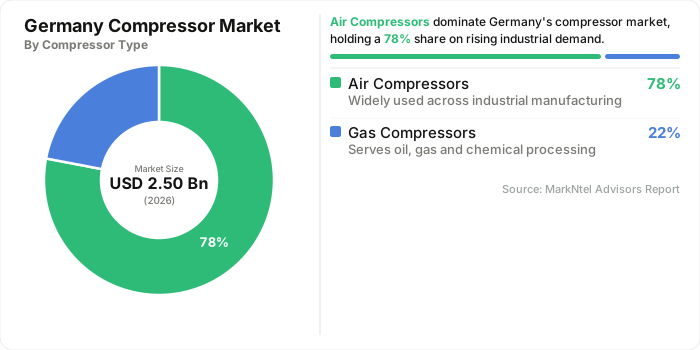
- By compressor type, air compressors dominate with a 78% share.
- By portability, portable compressors lead with a 58% share.
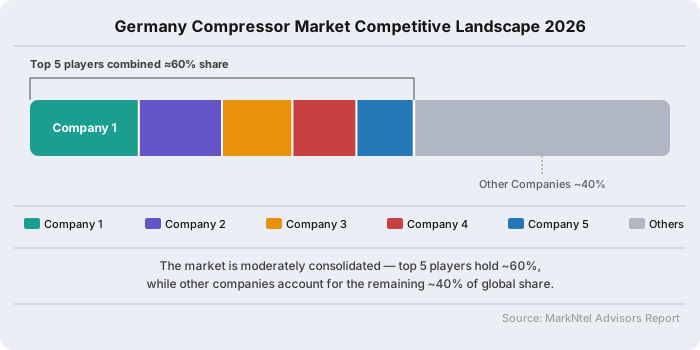
- The market is moderately consolidated, with the top five companies collectively accounting for approximately 60% of the market.
Germany Compressor Market Size and Outlook
The compressor market in Germany was valued at approximately USD 2.40 billion in 2025 and is expected to reach USD 2.50 billion in 2026. The market is projected to grow to approximately USD 3.18 billion by 2032, registering a CAGR of 4.09% during 2026–2032. Market expansion is supported by Germany’s strong manufacturing base, particularly automotive, machinery, chemicals, pharmaceuticals, and food processing, where compressors are essential for pneumatic systems and industrial processes.
Demand is also supported by investments in energy-efficient equipment, factory automation, and digital compressor monitoring. The transition toward low-carbon industrial operations is further encouraging replacement of older, less-efficient compressor systems with variable-speed, oil-free, and digitally connected technologies. Germany’s established industrial infrastructure and emphasis on energy efficiency are expected to sustain steady compressor demand through 2032.
Germany Compressor Market Key Indicators
- Germany’s automotive manufacturing base remains a major source of compressor demand. The German Association of the Automotive Industry reports that German plants produced 4.15 million passenger cars in 2025, up 2% year-on-year, sustaining compressor-intensive applications such as pneumatic tooling, paint spraying, and tire-fitting across OEM production lines.
- Germany’s machinery and metalworking activity is supporting demand for industrial compressors. Federal Statistical Office of Germany recorded an 11.5% month-on-month increase in machinery and equipment orders and a 30.2% rise in fabricated metal product orders in December 2025, indicating higher equipment utilization and procurement requirements for pneumatic systems.
- Germany’s hydrogen infrastructure is creating demand for specialized compression equipment. The International Energy Agency reported that a 100 MW electrolyser project in Germany reached final investment decision. Hydrogen production, storage, and pipeline injection require dedicated compression stages, increasing the relevance of hydrogen-compatible compressor systems.
- EU fluorinated-gas regulations are influencing compressor replacement requirements in refrigeration applications. Regulation (EU) 2024/573, applicable since March 11, 2024, mandates an HFC phase-down, encouraging cold-storage, food-processing, and commercial refrigeration operators to transition from legacy equipment toward compressors compatible with lower-GWP refrigerants.
Germany Compressor Market Scope
| Category | Segments |
|---|---|
| By Compressor Type | Air Compressors, Gas Compressors |
| By Technology | Reciprocating Compressors, Rotary Screw Compressors, Rotary Scroll Compressors, Centrifugal Compressors |
| By Portability | Stationary, Portable |
| By Lubrication | Oil-Lubricated, Oil-Free |
| By End User | Oil & Gas, Chemicals & Petrochemicals, Construction, Manufacturing, Power & Utilities, Mining, Food & Beverage, Pharmaceuticals, Textiles, Others |
| By Pressure Rating | Low (Upto 20 bar), Medium (21 to 100 bar), High (101 to 300 bar), Ultra-High (Above 300 bar |
Germany Compressor Market Growth Drivers
Battery Gigafactory Build-Out Creating Dry-Room Compressed Air Demand in Germany
Germany’s expansion from electric vehicle assembly toward domestic battery-cell production is creating new compressed-air requirements within battery manufacturing facilities, particularly because cell production involves controlled environments and continuous process-air applications that differ from conventional automotive plants. PowerCo commissioned its Salzgitter gigafactory on December 17, 2025, beginning production at 20 GWh annually, with planned expansion to 40 GWh, equivalent to cells for roughly 250,000 electric vehicles. Tesla is simultaneously expanding battery manufacturing at Gigafactory Berlin in Grünheide, with nearly $250 million in additional investment expected to increase cell capacity from 8 GWh to 18 GWh by 2027, taking cumulative cell-production investment toward USD 1.16 billion.
These capacity additions increase compressor demand because battery-cell production requires dry rooms maintained below a -40°C dew point, where compressed air is used for desiccant-wheel regeneration and pneumatic conveying of electrode powders. Such applications require continuous-duty, oil-free, moisture-controlled compressors, rather than the intermittent systems typically used for automotive pneumatic tools. Consequently, every expansion in German battery-cell production capacity adds requirements for dedicated low-dew-point compressed-air systems, creating an incremental and specialized demand pool within the Germany compressor market.
Recent Trends
Rising Adoption of AI-Enabled Edge Controllers and Digital Compressed-Air Connectivity
Germany’s compressor installations are increasingly moving toward networked and data-driven systems that can monitor operating conditions and optimize compressed-air performance in real time. Integrated sensors can track parameters such as pressure dew point, flow rate, and vibration, while AI-enabled algorithms within edge controllers can use these operating data to identify potential downstream leaks and determine appropriate maintenance timing. This shifts compressor functionality beyond air generation toward continuous equipment monitoring and automated system optimization.
The adoption of open communication interfaces such as OPC UA further supports this transition by allowing compressors to exchange operating data with plant-wide energy-management systems, enabling compressed-air output to respond more closely to changing production demand. Kaeser Kompressoren has incorporated connectivity and efficiency functions across its installed base, while Atlas Copco markets IoT-enabled compressor systems capable of automatically adjusting operation according to production-floor air requirements.
These capabilities can reduce energy losses associated with idle running and oversized operation while improving equipment oversight. As predictive-maintenance capabilities and open industrial connectivity become more integrated into compressor systems, German buyers are increasingly likely to evaluate edge-level diagnostics, automated optimization, and plant-level connectivity as core system requirements rather than supplementary digital features.
Opportunities and Challenges
High Industrial Electricity Costs Driving Federal Support for High-Efficiency Compressed-Air Retrofits
Germany’s elevated industrial electricity prices are simultaneously increasing the operating-cost burden of compressed-air systems and strengthening the economic case for efficiency upgrades. BDEW reported new-contract electricity rates of approximately 16.0–17.99 cents/kWh for small and mid-sized industrial buyers during 2025–2026, compared with the 5.92 cents/kWh average in 2020. Because compressor operation represents a continuous electricity expense for manufacturers, prolonged high-power prices increase the cost of operating older, inefficient equipment.
However, these conditions can also discourage smaller manufacturers from undertaking replacement projects because the upfront investment required for new compressor systems remains a barrier even when long-term energy savings are attractive. Germany’s BAFA Bundesförderung für Energie- und Ressourceneffizienz in der Wirtschaft (EEW) addresses this investment constraint by supporting replacement of inefficient compressors and compressed-air treatment systems with IE4/IE5-motor and variable-speed-drive alternatives.
Under Modul 4 premium funding, grants can cover up to 55% of eligible investment, with applications processed through the Förderzentrale Deutschland portal since September 15, 2025. This combination of persistent electricity-cost pressure and financial support creates an opportunity for compressor suppliers to accelerate replacement demand, particularly among small and mid-sized manufacturers that have previously deferred efficiency upgrades.
Segmentation Insights
Air Compressors Command a 78% Share Supported by Germany’s Broad Manufacturing Base
Supported by Germany’s large and decentralized industrial buyer base. The country had 22,213 manufacturing and mining establishments in 2025, and these facilities require compressed air for pneumatic tooling, packaging lines, and general process utilities. This broad application across numerous establishments creates recurring demand for air compressors and supports their dominant market position. Recent industrial investments further demonstrate the breadth of applications generating air-compressor demand. BASF’s Ludwigshafen announced a high double-digit million-euro investment in a semiconductor-grade sulfuric acid plant scheduled to begin operations by 2027, creating additional process-air requirements.
Similarly, Germany’s IED 2.0 requirements, with a June 1, 2026 transposition deadline covering roughly 13,000 industrial facilities, can drive equipment upgrades where compressed-air systems are affected by compliance requirements. The broad manufacturing base therefore provides multiple independent demand triggers for air compressors across chemical processing, manufacturing, packaging, and other industrial operations. Even though German manufacturing employment declined 1.2% in 2024, the scale of the existing establishment base continues to provide a substantial customer pool, supporting air compressors’ 78% share of the Germany compressor market. By compressor type the market is further segmented into the following sub-categories:
- Air Compressors
- Gas Compressors
Portable Compressors Capture 58% Share as Construction and Rental Activity Expand
Germany’s construction machinery trade and rental association bbi reported 3.5% nominal industry revenue growth in 2025 and forecasts approximately 4% rental-segment turnover growth in 2026, supported by expected infrastructure investment and an early recovery in building construction (Hochbau). These activities directly support demand for portable diesel- and electric-driven compressors used with pneumatic tools, drilling, and blasting equipment.
Demand is further supported by emissions-driven fleet renewal, as portable diesel compressors sold in Germany must comply with EU Stage V non-road mobile machinery emission limits. This requirement is encouraging rental operators to replace older Stage IIIB-compliant units with lower-emission models for use on public infrastructure and municipal construction projects.
As rental turnover continues expanding into 2026 alongside infrastructure investment, replacement activity for portable compressors is expected to strengthen, supporting their leading position over stationary compressors, which primarily serve continuous, fixed-site manufacturing applications. By portability the market is further segmented into the following sub-categories:
- Stationary
- Portable
Germany Compressor Competitive Landscape
The Germany compressor market is moderately consolidated, with leading global and domestic manufacturers competing across air and gas compressors. Atlas Copco, Ingersoll Rand, Kaeser Kompressoren, Siemens Energy, and BOGE Kompressoren collectively account for approximately 60% of market revenue, indicating significant concentration among leading players while allowing competition from specialized manufacturers.
Major Companies in the Germany Compressor Market
- Ingersoll Rand Plc
- Atlas Copco
- Kaeser Kompressoren SE
- BOGE Kompressoren
- Gardner Denver
- CompAir
- Siemens Energy
- ELGi Equipments
- Sullair
- Alup Kompressoren
- Hitachi Industrial Equipment Systems Co., Ltd.
- Kobelco Compressors Corporation
- Mitsubishi Heavy Industries, Ltd.
- MAN Energy Solutions SE
- Aerzener Maschinenfabrik GmbH
- Neuman & Esser Group
- Bauer Kompressoren GmbH
- Burckhardt Compression Holding AG
- Howden Group
- Sauer Compressors
Germany Compressor Market News and Recent Developments
May 2026: Aerzen Launches Generation G6 Turbo Blowers with Up to 15% Higher Energy Efficiency
Aerzener Maschinenfabrik introduced its Generation 6 turbo blower line, including the AT125-0.9S G6, AT125-1.3S G6, and AT250-0.9S G6, alongside the AT450-0.9S turbo stage. The AT125-0.9S G6 supports flows up to 83 m³/min, while the AT250-0.9S G6 reaches 157 m³/min. The redesigned turbo stage provides a control range of up to 1:5 and improves energy efficiency by up to 15% compared with conventional turbo technology. Standard remote monitoring tracks differential pressure, flow, temperature, and operating hours.
Market Impact: The launch strengthens Aerzen’s position in Germany’s energy-sensitive wastewater treatment, pneumatic conveying, and process-air applications while increasing the availability of digitally monitored, energy-efficient turbo equipment.
January 2026: BOGE Launches New Compressor and Remote-Monitoring Portfolio
BOGE Kompressoren announced a three-part 2026 product rollout comprising a new generation of its Boge connect remote-monitoring system, a new E-series for the mid-market, and a third-generation C-series compressor line. The Bielefeld-based manufacturer reported 2025 revenue broadly stable against 2024, while remaining below its €180 million 2023 record, and employed approximately 765 people globally. BOGE also targets CO₂-neutral operations by 2030, supported by expanded photovoltaic capacity and energy-efficiency measures at its Bielefeld headquarters.
Market Impact: The portfolio expansion strengthens BOGE’s offering across Germany’s SME-heavy industrial customer base, particularly as energy efficiency and remote diagnostics become increasingly relevant to compressor purchasing decisions.
August 2026: EU Commission Approves Bain Capital’s USD 8.56 billion Investment in Everllence
On August 14, 2026, the European Commission approved Volkswagen Group’s sale of a 51% stake in Everllence to Bain Capital for USD 8.56 billion. The Augsburg-headquartered company has approximately 16,000 employees and €4.9 billion in revenue, including 4,500 employees in Augsburg. The transaction includes employment and site guarantees through 2030.
Market Impact: The ownership change introduces independent investment capital into a major German turbo-compressor and turbomachinery producer, potentially strengthening its capacity to develop compression technologies for hydrogen, carbon capture, and industrial gas applications while preserving domestic production capacity through 2030.
April 2025: Aerzen Acquires ACI to Enter Germany’s Industrial Compressed-Air Market
Aerzener Maschinenfabrik completed its acquisition of Air Center International GmbH (ACI) on April 29, 2025, making ACI a wholly owned subsidiary and extending Aerzen into industrial compressed-air applications above 3.5 bar for the first time. ACI serves more than 1,000 customers across 78 countries and continues operating from Oberhausen. The combined portfolio covers compressed-air applications from 2.5 to 40 bar, with emphasis on the 4–13 bar range.
Market Impact: The acquisition expands Aerzen from blower and vacuum technologies into a broader compressed-air portfolio, increasing competitive pressure on established compressor suppliers in Germany. The planned recruitment of more than 50 compressed-air sales specialists globally further supports its expansion into compressed-air customer accounts.
Frequently Asked Questions
- Market Segmentation
- Introduction
- Product Definition
- Research Process
- Assumptions
- Executive Summary
- Germany Compressor Supply Chain Analysis
- Germany Compressor Import-Export Analysis 2022-25
- Germany Compressor Market Trends & Developments
- Germany Compressor Market Dynamics
- Growth Drivers
- Challenges
- Germany Compressor Market Hotspot & Opportunities
- Germany Compressor Market Porter’s Five Forces Analysis, 2026
- Germany Compressor Market Policies & Regulations
- Germany Compressor Market Outlook, 2022-32F
- Market Size & Analysis
- By Revenues (USD Million)
- By Unit Sold (Thousand)
- Market Segmentation & Analysis
-
- By Compressor Type- Market Size & Forecast 2022-2032, USD Million & Thousand Units
- Air Compressors
- Gas Compressors
- By Technology- Market Size & Forecast 2022-2032, USD Million & Thousand Units
- Reciprocating Compressors
- Rotary Screw Compressors
- Rotary Scroll Compressors
- Centrifugal Compressors
- By Portability- Market Size & Forecast 2022-2032, USD Million & Thousand Units
- Stationary
- Portable
- By Lubrication- Market Size & Forecast 2022-2032, USD Million & Thousand Units
- Oil-Lubricated
- Oil-Free
- By End User- Market Size & Forecast 2022-2032, USD Million & Thousand Units
- Oil & Gas
- Chemicals & Petrochemicals
- Construction
- Manufacturing
- Power & Utilities
- Mining
- Food & Beverage
- Pharmaceuticals
- Textiles
- Others
- By Pressure Rating- Market Size & Forecast 2022-2032, USD Million & Thousand Units
- Low (Upto 20 bar)
- Medium (21 to 100 bar)
- High (101 to 300 bar)
- Ultra-High (Above 300 bar)
- By Region
- North
- South
- East
- West
- By Competition
- Competition Characteristics
- Air Compressors
- Market Share of Top Companies
- Gas Compressors
- Market Share of Top Companies
- Air Compressors
- Competition Characteristics
-
- Market Size & Analysis
- Germany Air Compressor Market Outlook, 2022-32F
- Market Size & Analysis
- By Revenues (USD Million)
- By Unit Sold (Thousand)
- Market Segmentation & Analysis
- By Technology- Market Size & Forecast 2022-2032, USD Million & Thousand Units
- By Portability- Market Size & Forecast 2022-2032, USD Million & Thousand Units
- By Lubrication- Market Size & Forecast 2022-2032, USD Million & Thousand Units
- By End User- (Market Size & Forecast 2022-2032, USD Million & Thousand Units
- By Pressure Rating- Market Size & Forecast 2022-2032, USD Million & Thousand Units
- By Region- Market Size & Forecast 2022-2032, USD Million & Thousand Units
- Market Size & Analysis
- Germany Gas Compressor Market Outlook, 2022-32F
- Market Size & Analysis
- By Revenues (USD Million)
- By Unit Sold (Thousand)
- Market Segmentation & Analysis
- By Technology- Market Size & Forecast 2022-2032, USD Million & Thousand Units
- By Portability- Market Size & Forecast 2022-2032, USD Million & Thousand Units
- By Lubrication- Market Size & Forecast 2022-2032, USD Million & Thousand Units
- By End User- Market Size & Forecast 2022-2032, USD Million & Thousand Units
- By Pressure Rating- Market Size & Forecast 2022-2032, USD Million & Thousand Units
- By Region- Market Size & Forecast 2022-2032, USD Million & Thousand Units
- Market Size & Analysis
- India Compressor Market Key Strategic Imperatives for Success & Growth
- Competitive Outlook
- Company Profiles
- Ingersoll Rand Plc
- Business Description
- Product Portfolio
- Strategic Alliances or Partnerships
- Recent Developments
- Financial Details
- Others
- Atlas Copco
- Business Description
- Product Portfolio
- Strategic Alliances or Partnerships
- Recent Developments
- Financial Details
- Others
- Kaeser Kompressoren SE
- Business Description
- Product Portfolio
- Strategic Alliances or Partnerships
- Recent Developments
- Financial Details
- Others
- BOGE Kompressoren
- Business Description
- Product Portfolio
- Strategic Alliances or Partnerships
- Recent Developments
- Financial Details
- Others
- Gardner Denver
- Business Description
- Product Portfolio
- Strategic Alliances or Partnerships
- Recent Developments
- Financial Details
- Others
- CompAir
- Business Description
- Product Portfolio
- Strategic Alliances or Partnerships
- Recent Developments
- Financial Details
- Others
- Siemens Energy
- Business Description
- Product Portfolio
- Strategic Alliances or Partnerships
- Recent Developments
- Financial Details
- Others
- ELGi Equipments
- Business Description
- Product Portfolio
- Strategic Alliances or Partnerships
- Recent Developments
- Financial Details
- Others
- Sullair
- Business Description
- Product Portfolio
- Strategic Alliances or Partnerships
- Recent Developments
- Financial Details
- Others
- Alup Kompressoren
- Business Description
- Product Portfolio
- Strategic Alliances or Partnerships
- Recent Developments
- Financial Details
- Others
- Others
- Ingersoll Rand Plc
- Company Profiles
- Disclaimer
MarkNtel Advisors follows a robust and iterative research methodology designed to ensure maximum accuracy and minimize deviation in market estimates and forecasts. Our approach combines both bottom-up and top-down techniques to effectively segment and quantify various aspects of the market. A consistent feature across all our research reports is data triangulation, which examines the market from three distinct perspectives to validate findings. Key components of our research process include:
1. Scope & Research Design At the outset, MarkNtel Advisors define the research objectives and formulate pertinent questions. This phase involves determining the type of research—qualitative or quantitative—and designing a methodology that outlines data collection methods, target demographics, and analytical tools. They also establish timelines and budgets to ensure the research aligns with client goals.
2. Sample Selection and Data Collection In this stage, the firm identifies the target audience and determines the appropriate sample size to ensure representativeness. They employ various sampling methods, such as random or stratified sampling, based on the research objectives. Data collection is carried out using tools like surveys, interviews, and observations, ensuring the gathered data is reliable and relevant.
3. Data Analysis and Validation Once data is collected, MarkNtel Advisors undertake a rigorous analysis process. This includes cleaning the data to remove inconsistencies, employing statistical software for quantitative analysis, and thematic analysis for qualitative data. Validation steps are taken to ensure the accuracy and reliability of the findings, minimizing biases and errors.

4. Data Forecast and FinalizationThe final phase involves forecasting future market trends based on the analyzed data. MarkNtel Advisors utilize predictive modeling and time series analysis to anticipate market behaviors. The insights are then compiled into comprehensive reports, featuring visual aids like charts and graphs, and include strategic recommendations to inform client decision-making
We offer flexible licensing options to cater to varying organizational needs. Choose the pricing pack that best suits your requirements:
Buy Now Inquire Before Buying
 Request Customization
 Talk to our Consultant







