

India Real Estate Market Research Report: Trends & Forecast (2026-2032)
By Property Type (Residential Real Estate, Commercial Real Estate, Industrial Real Estate, Land), By Business Model (Sales / Ownership, Rental / Leasing, Real Estate Investment Tru ... sts (REITs), Residential, Commercial / Industrial), By Price Range (Affordable Housing, Mid-Segment Housing, Premium Housing, Luxury, Ultra-Luxury), By Construction Type (New Construction, Resale Properties), By Development Stage (Under Construction, Ready-to-Move, Redevelopment / Brownfield Projects, Greenfield Projects), By End User (Individuals, Corporate / Businesses, Government / Public Sector, Institutional Investors), and others Read more
- Buildings, Construction, Metals & Mining
- Apr 2026
- Pages 165
- Report Format: PDF, Excel, PPT
India Real Estate Market
Projected 13.04% CAGR from 2026 to 2032
Study Period
2026-2032
Market Size (2026)
USD 0.58 Trillion
Market Size (2032)
USD 1.21 Trillion
Base Year
2025
Projected CAGR
13.04%
Leading Segments
By Property Type: Residential Real Estate
India Real Estate Market Report Key Takeaways:
- The India Real Estate market size was valued at USD 0.53 trillion in 2025 and is projected to grow from USD 0.58 trillion in 2026 to USD 1.21 trillion by 2032, exhibiting a CAGR of 13.04% during 2026-32.
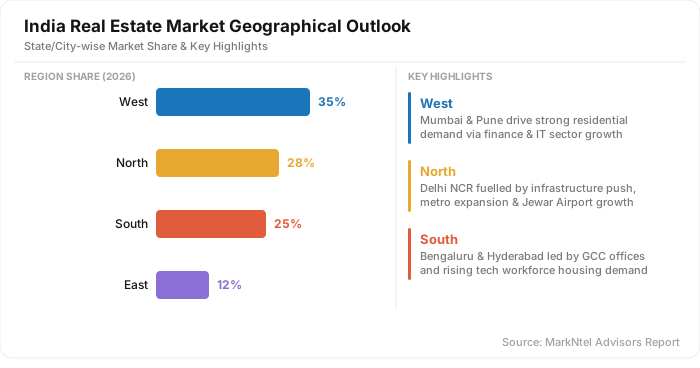
- West India holds the largest market share of about 35% in the India Real Estate Market in 2026.
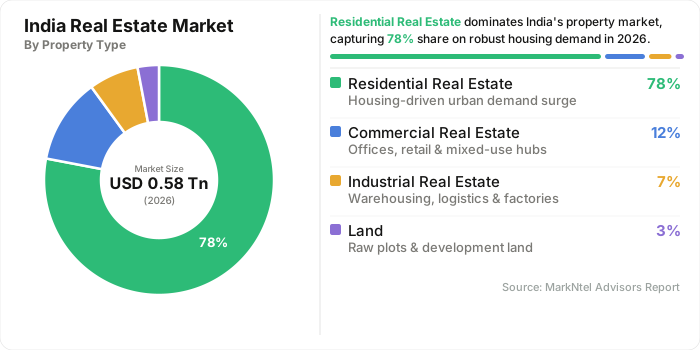
- By property type, the residential real estate segment represented a significant share of about 78% in the India Real Estate Market in 2026.
- By construction type, the new construction segment presented a significant share of about 70% in the India Real Estate Market in 2026.
Market Insights & Analysis: India Real Estate Market (2026-32):
The India Real Estate Market size was valued at around USD 0.53 trillion in 2025 and is projected to grow from USD 0.58 trillion in 2026 to USD 1.21 trillion by 2032. Along with this, the market is estimated to grow at a CAGR of around 13.04% during the forecast period, i.e., 2026-32.
The India Real Estate Market is projected to expand steadily, driven by rapid urbanization and migration trends, alongside the increasing adoption of co-working and flexible workspaces, which are collectively driving demand across residential and commercial segments.
According to the Government of India’s Economic Survey 2023–24, the urban population is expected to exceed 40% by 2030, rising from approximately 36–37% in 2024, reflecting a steady increase in city-based demand for housing and infrastructure. Supporting this trend, official data indicates that India’s urban population share reached 36.87% in 2024, highlighting continuous expansion in urban centers.
Migration patterns further reinforce this growth trajectory. Data from the Periodic Labour Force Survey (PLFS) shows that nearly 18.9% of total migration in India is rural-to-urban, largely driven by employment and education opportunities. This influx of population into cities is directly increasing demand for residential units, rental housing, and urban infrastructure.
Regional trends also underscore future potential. For instance, Kerala is projected to become over 80% urban by 2050, indicating dispersed yet consistent urban expansion , while Odisha’s urban population is expected to triple by 2036, boosting demand in emerging cities such as Bhubaneswar.
Government housing initiatives are playing a critical role in supporting this transition. Under Pradhan Mantri Awas Yojana – Urban (PMAY-U), more than 12.5 million houses have been sanctioned, with approximately 9.7 million completed, backed by central assistance exceeding USD 25 billion.
Furthermore, the launch of PMAY-U 2.0 (2024–2029), targeting the construction of 10 million additional urban homes, is expected to further accelerate housing supply and strengthen urban infrastructure.
In parallel, the commercial real estate segment is evolving with the rise of co-working and flexible workspaces. India’s flexible workspace supply is projected to grow from 80 million sq. ft. in 2024 to 125 million sq. ft. by 2027, supported by increasing enterprise demand, hybrid work adoption, and multi-city expansion strategies.
From an investment perspective, the scale of opportunity remains substantial. For example, India is estimated to require nearly USD 840 billion in urban infrastructure investment by 2036, translating to about USD 55 billion annually. Additionally, urban infrastructure spending is projected to exceed USD 90 billion between 2024 and 2028, reflecting strong public and private sector participation in city development.
India’s real estate market is entering a high-growth phase driven by urban expansion, migration, and infrastructure investments. Sustained policy support and evolving workspace trends will continue to strengthen demand, positioning the market for long-term, broad-based growth.
India Real Estate Market Recent Developments:
- 2025: Godrej Properties has acquired a 75-acre land parcel in Nagpur, targeting a revenue potential of approximately USD 90 million. The project will focus on plotted residential development spanning around 1.7 million sq. ft., marking its third acquisition in the city. The move highlights the company’s strategic expansion into emerging urban corridors driven by infrastructure growth and rising housing demand.
- 2025: Indian real estate developer DLF recorded approximately USD 1.3 billion in sales by fully selling its luxury project Privana North in Gurugram within a week. The strong response highlights rising demand for premium housing among affluent buyers, reflecting a broader shift toward luxury residential investments in India’s real estate market.
India Real Estate Market Scope:
| Category | Segments |
|---|---|
| By Property Type | (Residential Real Estate, Commercial Real Estate, Industrial Real Estate, Land), |
| By Business Model | (Sales / Ownership, Rental / Leasing, Real Estate Investment Trusts (REITs), Residential, Commercial / Industrial), |
| By Price Range | (Affordable Housing, Mid-Segment Housing, Premium Housing, Luxury, Ultra-Luxury), |
| By Construction Type | (New Construction, Resale Properties), |
| By Development Stage | (Under Construction, Ready-to-Move, Redevelopment / Brownfield Projects, Greenfield Projects), |
| By End User | (Individuals, Corporate / Businesses, Government / Public Sector, Institutional Investors), |
India Real Estate Market Driver:
Rapid Urbanization & Rising Migration
Rapid urbanization and rising migration are key drivers accelerating growth in the India real estate market. Urban centers are increasingly acting as economic hubs, with the Economic Survey 2025–26 highlighting that cities contribute nearly 70% of India’s GDP . This concentration of economic activity is intensifying demand for residential, commercial, and mixed-use developments, particularly in major metropolitan regions.
Migration trends further reinforce this demand. According to the Periodic Labour Force Survey (PLFS) on migration, 28.9% of India’s population is migrants, with a significantly higher migration rate of 34.9% in urban areas, compared to 26.5% in rural regions. This continuous movement of population toward cities is driven by employment opportunities, education, and better living standards, directly boosting demand for housing, rental properties, and urban infrastructure.
Global projections also indicate sustained long-term growth. UN-based estimates (2025) suggest that approximately 36% of India’s population currently resides in urban areas, with this share expected to approach 50% by 2050. This steady increase highlights the expanding need for planned urban development and real estate expansion across cities.
Urbanization and migration are fundamentally reshaping real estate demand in India. As cities continue to expand economically and demographically, this driver will significantly boost long-term market growth.
India Real Estate Market Trend:
Rise of Co-working and Flexible Workspaces
The India real estate market is undergoing a notable transformation with the rapid rise of co-working and flexible workspaces, driven by evolving work patterns and growing enterprise demand. Businesses are increasingly adopting hybrid work models, leading to a shift from traditional long-term leases to flexible, cost-efficient office solutions. This transition is positioning co-working spaces as a mainstream component of commercial real estate.
In 2024, flexible workspaces accounted for approximately 14–20% of total office leasing in India, reflecting a significant increase in adoption and signaling their transition from a niche offering to a core segment of the market.
This shift is further supported by strong leasing activity. For example, co-working operators leased a record 12.5 million sq. ft. of office space in 2024, representing a 44% year-on-year growth, particularly across major urban centers such as Bengaluru, Mumbai, and Hyderabad .
The increasing presence of startups, MSMEs, and global capability centers (GCCs) is also driving demand for flexible office spaces, as these organizations prioritize scalability and operational efficiency.
Co-working spaces are redefining commercial real estate dynamics in India. With strong leasing growth and rising enterprise adoption, this trend will continue to drive demand and reshape office space utilization in the coming years.
India Real Estate Market Opportunity:
Redevelopment and Urban Renewal Projects
Redevelopment and urban renewal are emerging as a powerful opportunity in the India real estate market, driven by large-scale government funding and policy-led transformation. A key catalyst is the Smart Cities Mission, under which more than 8,000 projects worth USD 19.7 billion have been executed across 100 cities as of 2025. These projects focus on retrofitting existing urban areas, modernizing transit corridors, and upgrading core infrastructure, thereby unlocking higher land utilization and boosting property values in dense urban centers .
In addition, recent policy measures are accelerating redevelopment momentum. The Government of India introduced a USD 12 billion Urban Challenge Fund in 2025, aimed at transforming underutilized land parcels, redeveloping aging public infrastructure, and revitalizing brownfield sites through public-private partnership (PPP) models . This initiative is expected to attract private capital, enhance urban density, and create new residential and commercial hubs within existing city limits.
Looking ahead, continued focus on transit-oriented development, mixed-use redevelopment, and infrastructure modernization will further expand investment opportunities beyond 2025. These initiatives are likely to improve urban livability while simultaneously increasing real estate demand across key metropolitan and emerging cities.
Urban renewal is unlocking hidden value in existing city landscapes. With sustained government funding and PPP-driven execution, redevelopment will significantly accelerate real estate expansion and long-term market growth.
India Real Estate Market Challenge:
Regulatory Inefficiencies and Project Delays
Regulatory inefficiencies continue to pose a major challenge to the India real estate market, particularly in the timely execution of projects. Complex approval procedures, fragmented governance across state and local authorities, and delays in clearances significantly extend development timelines. These inefficiencies are reflected in the growing backlog of delayed housing projects across the country.
As of 2025, nearly 480,000 housing units in India are delayed by more than three years, underscoring persistent execution bottlenecks despite the presence of regulatory frameworks. Such delays not only escalate construction and financing costs for developers but also impact homebuyer confidence and overall market liquidity. Extended project timelines further strain working capital cycles and discourage new project launches, especially in high-demand urban regions.
Moreover, delays in approvals and compliance processes reduce the efficiency of capital deployment, limiting the sector’s ability to respond to rising housing demand. This creates a mismatch between supply and demand, particularly in rapidly urbanizing cities.
Regulatory inefficiencies significantly slow down project completion and increase financial risks. If not addressed, these delays will continue to constrain supply growth and hinder the overall expansion of the real estate market.
India Real Estate Market (2026-32) Segmentation Analysis:
The India Real Estate Market study of MarkNtel Advisors evaluates & highlights the major trends and influencing factors in each segment. It includes predictions for the period 2026–32 at the country level. Based on the analysis, the market has been further classified as;
Based on Property Type:
- Residential Real Estate
- Apartments / Flats
- Villas / Independent Houses
- Condominiums
- Affordable Housing
- Luxury Housing
- Commercial Real Estate
- Office Spaces
- Retail Spaces (Malls, High Streets)
- Co-working Spaces
- Industrial Real Estate
- Warehouses
- Manufacturing Facilities
- Logistics Parks
- Land
- Agricultural Land
- Non-Agricultural Land
- Plots / Development Land
The residential real estate segment dominates the India Real Estate market, accounting for approximately 78% of the total market volume, primarily driven by strong end-user demand, rapid urbanization, and supportive government policies.
The continuous migration of population toward urban centers has significantly increased the need for housing across segments, including apartments, affordable housing, and mid-income developments. Rising disposable incomes, nuclear family structures, and improved access to home financing have further accelerated homeownership trends.
Government initiatives such as Pradhan Mantri Awas Yojana have played a crucial role in boosting the residential segment by addressing housing shortages, particularly in the affordable housing category. Large-scale housing construction, subsidies, and incentives have encouraged both developers and buyers, leading to increased project launches and sales volumes.
Additionally, residential real estate benefits from relatively stable demand compared to commercial and industrial segments, as housing is a basic necessity. The expansion of Tier II and Tier III cities, along with infrastructure development, has further widened the residential market base.
Demand for premium and luxury housing has also risen in metro cities, supported by high-net-worth individuals and evolving lifestyle preferences. Overall, consistent demand across income segments, policy support, and urban expansion collectively reinforce the leading position of residential real estate in India.
Based on Construction Type:
- New Construction
- Resale Properties
The new construction segment dominates the India Real Estate market, accounting for about 70% of the total market size, driven by rising demand for modern housing, improved infrastructure, and regulatory transparency.
Homebuyers increasingly prefer newly built properties due to better design, amenities, energy efficiency, and compliance with updated building standards. Features such as smart home integration, gated communities, and enhanced security systems further strengthen the appeal of new developments over older resale properties.
Regulatory reforms like the Real Estate (Regulation and Development) Act, 2016, have also boosted confidence in new construction projects by ensuring transparency, timely delivery, and accountability among developers. This has encouraged buyers to invest in under-construction and newly launched projects rather than resale properties, which may lack legal clarity or modern infrastructure.
Additionally, large-scale urban expansion and infrastructure projects have opened new land parcels for development, enabling developers to launch integrated townships and mixed-use projects. Government incentives for affordable housing and easier access to home loans have further stimulated demand for new units.
Overall, the combination of regulatory support, evolving consumer preferences, and continuous project launches positions new construction as the leading segment, driving sustained growth in the real estate market.
India Real Estate Market (2026-32): Regional Projection
West India dominates the India Real Estate market with an estimated 35% share, primarily driven by higher urbanization levels and strong economic concentration in key cities. The region has an urban population of approximately 46.7%, significantly higher than the national average of around 31%, reflecting a more developed urban ecosystem and stronger demand for residential and commercial real estate. This elevated urban share translates into sustained demand for housing, office spaces, and mixed-use developments across major cities.
Mumbai, the financial capital of India, plays a pivotal role in strengthening the region’s dominance. Real estate alone contributes nearly 10% to Mumbai’s GDP, highlighting the sector’s scale, investment intensity, and economic importance . The presence of financial institutions, multinational corporations, and a dense workforce continues to drive demand for both premium and affordable housing, as well as commercial assets.
Additionally, cities like Pune and Ahmedabad are emerging as key growth hubs, supported by infrastructure expansion, industrial development, and rising employment opportunities. These factors collectively enhance the region’s attractiveness for real estate investments.
West India’s higher urbanization and strong economic base position it as the leading real estate region. Sustained demand across residential and commercial segments will continue to reinforce its market dominance.
India Real Estate Market Competitive Analysis:
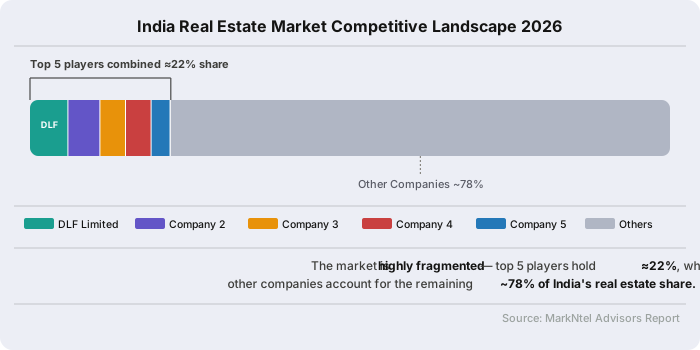
The Indian real estate industry is highly fragmented, with a large number of organized and unorganized developers operating across residential, commercial, and retail segments. The top five companies, DLF Limited, Godrej Properties Limited, Macrotech Developers Limited (Lodha Group), Prestige Estates Projects Limited, and Oberoi Realty Limited, collectively account for approximately 22% of the total market share.
Major Companies in Real Estate:
- Brigade Enterprises Limited
- DLF Limited
- Godrej Properties Limited
- Larsen & Toubro Limited
- Macrotech Developers Limited (Lodha Group)
- Oberoi Realty Limited
- Prestige Estates Projects Limited
- SOBHA Limited
- Sunteck Realty Limited
- Puravankara Limited
Gain a Competitive Edge with Our India Real Estate Market Report:
- India Real Estate Market Report by MarkNtel Advisors provides a detailed & thorough analysis of market size & share, growth rate, competitive landscape, and key players. This comprehensive analysis helps businesses gain a holistic understanding of the market dynamics & make informed decisions.
- This report also highlights current market trends & future projections, allowing businesses to identify emerging opportunities & potential challenges. By understanding market forecasts, companies can align their strategies & stay ahead of the competition.
- India Real Estate Market Report aids in assessing & mitigating risks associated with entering or operating in the market. By understanding market dynamics, regulatory frameworks, and potential challenges, businesses can develop strategies to minimize risks & optimize their operations.
*Reports Delivery Format - Market research studies from MarkNtel Advisors are offered in PDF, Excel and PowerPoint formats. Within 24 hours of the payment being successfully received, the report will be sent to your email address.
Frequently Asked Questions
- Market Segmentation
- Introduction
- Product Definition
- Research Process
- Assumptions
- Executive Summary
- India Real Estate Market Policies, Regulations, and Product Standards
- India Real Estate Market Trends & Developments
- India Real Estate Market Dynamics
- Growth Factors
- Challenges
- India Real Estate Market Hotspot & Opportunities
- Pricing, Rentals, and Yield Analysis (City-Specific Framework)
- Residential Pricing (₹/sq ft) – City-Wise
- Mumbai (incl. Thane, Navi Mumbai)
- Pune (Hinjewadi, Wakad, Baner)
- Bengaluru (Whitefield, Sarjapur, Electronic City)
- Hyderabad (Gachibowli, HITEC City, Kondapur)
- Chennai (OMR, Porur, Velachery)
- Gurugram (Golf Course Road, Sohna Road)
- Noida (Noida Extension, Sector 150)
- Chandigarh (Mohali, Zirakpur)
- Ahmedabad (SG Highway, Bopal)
- Indore (Vijay Nagar, Super Corridor)
- Lucknow (Gomti Nagar, Shaheed Path)
- Mysore
- Patna
- Commercial Office Rentals (₹/sq ft/month) – City-Wise
- Mumbai (BKC, Lower Parel)
- Bengaluru (Whitefield, Outer Ring Road)
- Gurugram (Cyber City, Golf Course Road)
- Noida (Sector 62, Expressway)
- Hyderabad (HITEC City, Gachibowli)
- Chennai (OMR, Guindy)
- Pune (Hinjewadi, Kharadi)
- Ahmedabad, Chandigarh (limited Grade A supply)
- Industrial & Warehousing Pricing (Per sq ft) – City Corridors
- Mumbai (Bhiwandi, Panvel)
- NCR (Dadri, Sonipat, Manesar)
- Bengaluru (Hoskote, Devanahalli)
- Hyderabad (Shamshabad)
- Chennai (Sriperumbudur, Oragadam)
- Pune (Chakan, Talegaon)
- Ahmedabad (Sanand, Changodar)
- Land Pricing (Per sq yd) – City & Peripheral Zones
- Core vs peripheral land across: Mumbai, Pune, Bengaluru, Hyderabad, NCR (Gurugram/Noida), Ahmedabad
- Emerging land markets: Indore, Lucknow, Patna, Mysore
- Price Trend Analysis (3–5 Year) – City Comparison
- Mumbai vs Bengaluru vs Hyderabad
- NCR (Gurugram vs Noida divergence)
- Pune vs Ahmedabad
- Emerging cities: Indore, Lucknow
- Yield and Return Metrics – City-Wise
- Rental yield comparison across: Mumbai, Bengaluru, Hyderabad, NCR, Pune, Chennai
- Low-yield vs high-growth cities
- Residential Pricing (₹/sq ft) – City-Wise
- Regulatory Framework (State + City Impact)
- National Regulations
- RERA Framework
- GST and Taxation
- State-Level Regulatory Analysis
- Maharashtra (Mumbai, Pune)
- Haryana & UP (Gurugram, Noida)
- Karnataka (Bengaluru, Mysore)
- Telangana (Hyderabad)
- Tamil Nadu (Chennai)
- Gujarat (Ahmedabad)
- Madhya Pradesh (Indore)
- Uttar Pradesh (Lucknow)
- Bihar (Patna)
- Impact on Pricing and Project Viability
- Approval timelines
- Cost escalation
- Compliance burden
- National Regulations
- Project Pipeline and Future Supply (City-Wise)
- City-Wise Pipeline
- Mumbai (redevelopment + luxury supply)
- Pune (residential expansion)
- Bengaluru (IT corridor housing)
- Hyderabad (large-scale housing + office)
- NCR (Gurugram + Noida expressway projects)
- Chennai (industrial + residential mix)
- Ahmedabad (plotted + industrial growth)
- Indore, Lucknow, Patna (emerging pipeline)
- Project Execution Timeline
- Near-Term (0–3 years)
- Mid-Term (3–5 years)
- Long-Term Development
- Supply vs Demand Outlook (City-Level)
- Oversupply risk: NCR Micro-markets
- Tight supply: Mumbai, Bengaluru core
- Growth markets: Hyderabad, Pune
- City-Wise Pipeline
- India Real Estate Market Outlook, 2022-2032F
- Market Size & Outlook
- By Revenues (USD Million)
- Market Share & Outlook
- By Property Type- Market Size & Forecast 2022-2032, USD Million
- Residential Real Estate
- Apartments / Flats
- Villas / Independent Houses
- Condominiums
- Affordable Housing
- Luxury Housing
- Commercial Real Estate
- Office Spaces
- Retail Spaces (Malls, High Streets)
- Co-working Spaces
- Industrial Real Estate
- Warehouses
- Manufacturing Facilities
- Logistics Parks
- Land
- Agricultural Land
- Non-Agricultural Land
- Plots / Development Land
- Residential Real Estate
- By Business Model- Market Size & Forecast 2022-2032, USD Million
- Sales / Ownership
- Rental / Leasing
- Real Estate Investment Trusts (REITs)
- By Size (sq. ft.)- Market Size & Forecast 2022-2032, USD Million
- Residential
- 1 BHK
- 2 BHK
- 3 BHK & above
- Commercial / Industrial
- Up to 1,000 sq. ft.
- 1,001 sq. ft. - 5,000 sq. ft.
- 5,001 sq. ft. - 10,000 sq. ft.
- 10,001 sq. ft. - 50,000 sq. ft.
- Above 50,000 sq. ft.
- Residential
- By Price Range- Market Size & Forecast 2022-2032, USD Million
- Affordable Housing
- Mid-Segment Housing
- Premium Housing
- Luxury
- Ultra-Luxury
- By Construction Type- Market Size & Forecast 2022-2032, USD Million
- New Construction
- Resale Properties
- By Development Stage- Market Size & Forecast 2022-2032, USD Million
- Under Construction
- Ready-to-Move
- Redevelopment / Brownfield Projects
- Greenfield Projects
- By End User- Market Size & Forecast 2022-2032, USD Million
- Individuals
- Corporate / Businesses
- Government / Public Sector
- Institutional Investors
- By Region- Market Size & Forecast 2022-2032, USD Million
- North
- Uttar Pradesh
- Punjab
- Haryana
- Delhi NCR
- East
- West Bengal
- Bihar
- Jharkhand
- North Eastern States
- Chhattisgarh
- West
- Rajasthan
- Gujarat
- Maharashtra
- Madhya Pradesh
- South
- Tamil Nadu
- Karnataka
- Kerala
- Andhra
- Telangana
- North
- By Company
- Competition Characteristics
- Market Share & Analysis
- By Property Type- Market Size & Forecast 2022-2032, USD Million
- Market Size & Outlook
- India Residential Real Estate Market Outlook, 2022-2032
- Market Size & Outlook
- By Revenues (USD Million)
- Market Share & Outlook
- By Business Model- Market Size & Forecast 2022-2032, USD Million
- By Size (sq. ft.)- Market Size & Forecast 2022-2032, USD Million
- By Price Range- Market Size & Forecast 2022-2032, USD Million
- By Construction Type- Market Size & Forecast 2022-2032, USD Million
- By Development Stage- Market Size & Forecast 2022-2032, USD Million
- By End User- Market Size & Forecast 2022-2032, USD Million
- By Region- Market Size & Forecast 2022-2032, USD Million
- Market Size & Outlook
- India Commercial Real Estate Market Outlook, 2022-2032
- Market Size & Outlook
- By Revenues (USD Million)
- Market Share & Outlook
- By Business Model- Market Size & Forecast 2022-2032, USD Million
- By Size (sq. ft.)- Market Size & Forecast 2022-2032, USD Million
- By Price Range- Market Size & Forecast 2022-2032, USD Million
- By Construction Type- Market Size & Forecast 2022-2032, USD Million
- By Development Stage- Market Size & Forecast 2022-2032, USD Million
- By End User- Market Size & Forecast 2022-2032, USD Million
- By Region- Market Size & Forecast 2022-2032, USD Million
- Market Size & Outlook
- India Industrial Real Estate Market Outlook, 2022-2032
- Market Size & Outlook
- By Revenues (USD Million)
- Market Share & Outlook
- By Business Model- Market Size & Forecast 2022-2032, USD Million
- By Size (sq. ft.)- Market Size & Forecast 2022-2032, USD Million
- By Price Range- Market Size & Forecast 2022-2032, USD Million
- By Construction Type- Market Size & Forecast 2022-2032, USD Million
- By Development Stage- Market Size & Forecast 2022-2032, USD Million
- By End User- Market Size & Forecast 2022-2032, USD Million
- By Region- Market Size & Forecast 2022-2032, USD Million
- Market Size & Outlook
- India Land Market Outlook, 2022-2032
- Market Size & Outlook
- By Revenues (USD Million)
- Market Share & Outlook
- By Business Model- Market Size & Forecast 2022-2032, USD Million
- By Size (sq. ft.)- Market Size & Forecast 2022-2032, USD Million
- By Price Range- Market Size & Forecast 2022-2032, USD Million
- By Construction Type- Market Size & Forecast 2022-2032, USD Million
- By Development Stage- Market Size & Forecast 2022-2032, USD Million
- By End User- Market Size & Forecast 2022-2032, USD Million
- By Region- Market Size & Forecast 2022-2032, USD Million
- Market Size & Outlook
- India Real Estate Market Key Strategic Imperatives for Success & Growth
- Competitive Outlook
- Company Profiles
- Brigade Enterprises Limited
- Business Description
- Product Portfolio
- Collaborations & Alliances
- Recent Developments
- Financial Details
- Others
- DLF Limited
- Business Description
- Product Portfolio
- Collaborations & Alliances
- Recent Developments
- Financial Details
- Others
- Godrej Properties Limited
- Business Description
- Product Portfolio
- Collaborations & Alliances
- Recent Developments
- Financial Details
- Others
- Larsen & Toubro Limited
- Business Description
- Product Portfolio
- Collaborations & Alliances
- Recent Developments
- Financial Details
- Others
- Macrotech Developers Limited (Lodha Group)
- Business Description
- Product Portfolio
- Collaborations & Alliances
- Recent Developments
- Financial Details
- Others
- Oberoi Realty Limited
- Business Description
- Product Portfolio
- Collaborations & Alliances
- Recent Developments
- Financial Details
- Others
- Prestige Estates Projects Limited
- Business Description
- Product Portfolio
- Collaborations & Alliances
- Recent Developments
- Financial Details
- Others
- SOBHA Limited
- Business Description
- Product Portfolio
- Collaborations & Alliances
- Recent Developments
- Financial Details
- Others
- Sunteck Realty Limited
- Business Description
- Product Portfolio
- Collaborations & Alliances
- Recent Developments
- Financial Details
- Others
- Puravankara Limted
- Business Description
- Product Portfolio
- Collaborations & Alliances
- Recent Developments
- Financial Details
- Others
- Brigade Enterprises Limited
- Company Profiles
- Disclaimer
MarkNtel Advisors follows a robust and iterative research methodology designed to ensure maximum accuracy and minimize deviation in market estimates and forecasts. Our approach combines both bottom-up and top-down techniques to effectively segment and quantify various aspects of the market. A consistent feature across all our research reports is data triangulation, which examines the market from three distinct perspectives to validate findings. Key components of our research process include:
1. Scope & Research Design At the outset, MarkNtel Advisors define the research objectives and formulate pertinent questions. This phase involves determining the type of research—qualitative or quantitative—and designing a methodology that outlines data collection methods, target demographics, and analytical tools. They also establish timelines and budgets to ensure the research aligns with client goals.
2. Sample Selection and Data Collection In this stage, the firm identifies the target audience and determines the appropriate sample size to ensure representativeness. They employ various sampling methods, such as random or stratified sampling, based on the research objectives. Data collection is carried out using tools like surveys, interviews, and observations, ensuring the gathered data is reliable and relevant.
3. Data Analysis and Validation Once data is collected, MarkNtel Advisors undertake a rigorous analysis process. This includes cleaning the data to remove inconsistencies, employing statistical software for quantitative analysis, and thematic analysis for qualitative data. Validation steps are taken to ensure the accuracy and reliability of the findings, minimizing biases and errors.

4. Data Forecast and FinalizationThe final phase involves forecasting future market trends based on the analyzed data. MarkNtel Advisors utilize predictive modeling and time series analysis to anticipate market behaviors. The insights are then compiled into comprehensive reports, featuring visual aids like charts and graphs, and include strategic recommendations to inform client decision-making
We offer flexible licensing options to cater to varying organizational needs. Choose the pricing pack that best suits your requirements:
Buy Now Inquire Before Buying
 Request Customization
 Talk to our Consultant







