

By Tire Type (Radial, Bias), By Vehicle Type (Two-Wheeler, Three-Wheeler, Passenger Car, Light Commercial Vehicle (LCV), Medium & Heavy Commercial Vehicle (MHCV), Off-the-Road Vehicle (OTR)), By Deman... ... cle (OTR)), By Demand Type (OEM, Replacement), By Season (Summer Tires, Winter Tires, All-Season Tires), By Sales Channel (Direct Sales, Dealer/Distributor, Online Platform), By Tire Size (Tire Size 1, Tire Size 2, Tire Size 3, Tire Size 4, Tire Size 5), By Price Category (Economy, Mid-Range, Premium), and others Read more
- Tire
- Aug 2026
- 145
- PDF, Excel, PPT
Japan Tire Market Key Takeaways
- The Japan tire market size was valued at around USD 11.92 billion in 2025 and is projected to grow from USD 12.78 billion in 2026 to USD 18.99 billion by 2032.
- The industry is projected to witness steady growth at a CAGR of around 6.82% during 2026-2032.
- By demand type, the replacement segment is expected to dominate the Japan Tire Market, accounting for approximately 76% market share in 2026.
- By vehicle type, passenger cars are anticipated to hold nearly 75% of the Japan Tire Market share in 2026.
- The industry is moderately consolidated, with the top five players collectively account for approximately 65% market share.
Japan Tire Market Size and Outlook
The tire market size in Japan was valued at USD 11.92 billion in 2025 and is projected to grow from USD 12.78 billion in 2026 to USD 18.99 billion by 2032. Along with this, the market is estimated to grow at a CAGR of around 6.82% during the forecast period, i.e., 2026-32.
This growth trajectory is underpinned by three converging structural forces reshaping tire demand across the Japan tire industry. Domestic vehicle sales rebounded to a multi-year high in 2025, with registration data compiled by the Japan Automobile Manufacturers Association (JAMA) showing Japan's new vehicle market expanded 3.3% year-on-year to 4,565,777 units, as kei-class minicar sales rose 7.0% to 1,667,360 units and standard passenger vehicle sales climbed 1.2% to 2,898,417 units. This broad-based recovery in domestic registrations directly strengthens OEM tire fitment volumes while feeding the replacement tire pipeline as the newly registered fleet enters its inspection and maintenance cycle.
Alongside this, government-backed electrification of commercial fleets is adding new tire demand intensity beyond the passenger segment. Japan's Cabinet-approved Plan for Global Warming Countermeasures, reaffirmed in February 2025, sets a target for electrified vehicles to account for 20-30% of new light commercial vehicle sales by 2030, alongside an early-adoption goal of 5,000 electrified heavy vehicles during the 2020s. This policy-driven shift toward electrified trucks and delivery vans is accelerating demand for tires engineered to handle higher torque loads and battery weight, creating a distinct high-value product category within Japan's commercial tire segment.
Reinforcing both trends, accelerating e-commerce activity is expanding urban delivery fleets and their associated tire replacement cycles. METI's FY2024 E-Commerce Market Survey, released in August 2025, confirms that Japan's domestic B2C e-commerce market grew 5.1% to reach 26.1 trillion yen, while the B2B e-commerce market expanded 10.6% to USD 3.43 trillion. This sustained digital commerce growth is intensifying last-mile and logistics vehicle utilization nationwide, reinforcing continuous replacement tire consumption across light commercial and delivery vehicle fleets through 2032.
Japan Tire Market Key Indicators
- Japan produced approximately 23 million motor vehicles in 2025, according to the Japan Automobile Manufacturers Association (JAMA). Higher vehicle production directly increases OEM tire demand while expanding the future replacement tire market through a larger vehicle parc.
- Japan exported approximately 82 million motor vehicles in 2025, as reported by the Japan Automobile Manufacturers Association (JAMA). strong vehicle exports support domestic tire manufacturing and strengthen demand for OEM tires supplied to export-oriented vehicle production.
- Japan recorded 442,901 battery electric vehicle (BEV), plug-in hybrid electric vehicle (PHEV), and hybrid electric vehicle (HEV) sales during 2025, according to the Japan Automobile Dealers Association (JADA). Rising electrified vehicle adoption is increasing demand for specialized tires offering lower rolling resistance, higher load capacity, and reduced road noise.
- Japan's Ministry of Land, Infrastructure, Transport and Tourism (MLIT) continues enforcing the mandatory Shaken vehicle inspection system, requiring periodic inspections throughout a vehicle's operating life. Mandatory inspections encourage regular tire replacement, supporting stable aftermarket demand across the Japan tire market.
- Japan's Ministry of Economy, Trade and Industry (METI) continues promoting carbon neutrality under the GX (Green Transformation) Strategy, encouraging industries to adopt resource-efficient manufacturing and decarbonization technologies. Sustainability initiatives are accelerating investment in low-carbon tire manufacturing, recycled materials, and next-generation tire technologies across the Japanese tire industry.
Japan’s Tire Industry Retained Export Dominance Despite a 9% Decline in Export Volume Since 2022
Strong export orientation: In 2025, Japan exported approximately USD 5.3 billion (1.0 million tons) of tires, compared with imports of around USD 1.5 billion (325 thousand tons). Exports were therefore about 3.2× imports by volume and 3.5× by value, confirming that Japan's tire industry remains structurally export-oriented rather than import-dependent.
Moderating exports: Export volume declined from approximately 1.1 million tons in 2022 to 1.0 million tons in 2025, primarily reflecting softer demand across some overseas markets and intensifying competition from lower-cost Asian manufacturers. However, the relatively limited decline in export value indicates resilience in Japan's higher-value tire portfolio.
Rising imports: Imports increased from approximately 290 thousand tons in 2022 to 325 thousand tons in 2025, as Japanese distributors and manufacturers increasingly sourced competitively priced products from Asian production hubs. However, imports remained substantially below exports, indicating supply supplementation rather than structural import dependence.
Domestic manufacturing resilience: Japan's tire production increased 0.8% in 2025 to 123.3 million units, marking the first annual production increase in four years. Truck-and-bus tire production rose 9.6%, supporting manufacturers' shift toward commercially oriented segments. JATMA production and sales data
Export competitiveness: Japan is sustaining its position through premium product positioning, technological differentiation, commercial-tire specialization, and geographic diversification. North American export value increased 9.3% in 2025, helping offset weaker demand in several other regions. JATMA import and export data
Overall assessment: Japan generated an estimated USD 3.8 billion tire trade surplus in 2025, demonstrating that the market remains strongly export-led, while growing imports primarily improve product availability and cost competitiveness rather than creating dependence on foreign supply.
Japan Tire Market Production Analysis
Japan remains one of the world's largest producers of high-performance automotive tires, supported by advanced manufacturing technologies, strong research and development capabilities, and the global production networks of leading domestic manufacturers. According to the Japan Automobile Tyre Manufacturers Association (JATMA), automotive tire production reached 123.28 million units in 2025, representing a 0.8% year-on-year increase and marking the first annual production growth in four years. The recovery reflects improving vehicle production, stronger replacement tire demand, and resilient export-oriented manufacturing.
Passenger car tires remained the largest production segment, accounting for 88.57 million units, although output declined 1.0% compared with 2024 due to softer domestic passenger vehicle production. In contrast, light truck tire production increased 3.6% to 20.30 million units, while truck and bus tire production recorded the strongest growth, rising 9.6% to 9.84 million units, supported by recovering commercial vehicle demand and increased overseas shipments. Production of other tire categories, including agricultural, industrial, construction, and motorcycle tires, also expanded 4.5% to 4.58 million units, demonstrating broad-based recovery across specialty tire segments.
Japan's production landscape continues to emphasize premium-quality and technologically advanced tires rather than high-volume, low-cost manufacturing. Leading manufacturers such as Bridgestone, Sumitomo Rubber Industries, Yokohama Rubber, and Toyo Tire increasingly focus on high-performance passenger, commercial, and specialty tires with higher value addition. This strategy has enabled Japan to maintain strong export competitiveness despite increasing production capacity across other Asian manufacturing countries. The continued recovery in domestic production, combined with rising commercial vehicle tire output and stable global demand, is expected to support sustained growth in Japan's tire manufacturing industry over the coming years.
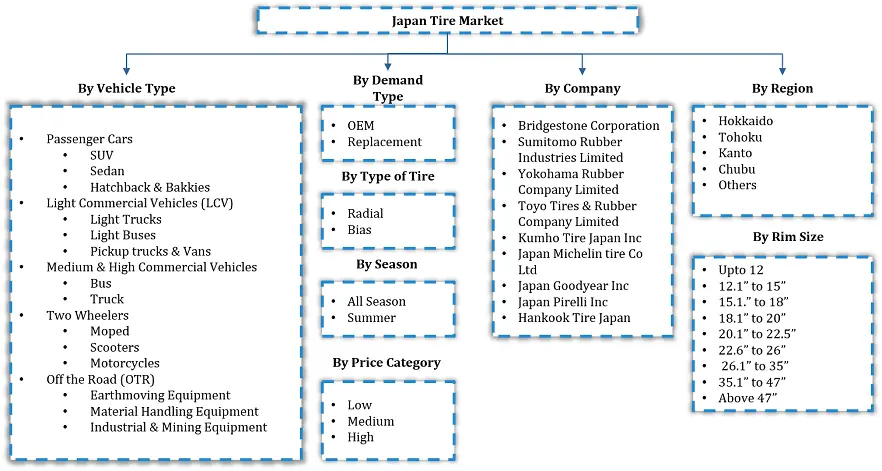
Japan Tire Market Scope
| Category | Segments |
|---|---|
| By Tire Type | Radial, Bias |
| By Vehicle Type | Two-Wheeler, Three-Wheeler, Passenger Car, Light Commercial Vehicle (LCV), Medium & Heavy Commercial Vehicle (MHCV), Off-the-Road Vehicle (OTR |
| By Demand Type | OEM, Replacement |
| By Season | Summer Tires, Winter Tires, All-Season Tires |
| By Sales Channel | Direct Sales, Dealer/Distributor, Online Platform |
| By Tire Size | Tire Size 1, Tire Size 2, Tire Size 3, Tire Size 4, Tire Size 5 |
| By Price Category | Economy, Mid-Range, Premium |
Japan Tire Market Growth Drivers
Growing Automotive Production and OEM Collaborations Driving Demand in the Japan Tire Market
The Japan tire market is benefiting from the country's strong automotive manufacturing ecosystem, where sustained vehicle production and long-standing collaborations between tire manufacturers and automakers continue to support original equipment (OEM) tire demand. Japan remains one of the world's leading automobile manufacturing hubs, with domestic manufacturers emphasizing vehicle quality, safety, and technological innovation. According to the Japan Automobile Manufacturers Association (JAMA), Japan produced approximately 8.23 million motor vehicles in 2025, reaffirming the country's position as a major global automotive production center. Every newly manufactured vehicle requires OEM tire fitment, creating a stable demand base for domestic tire manufacturers while fostering continuous investment in product engineering and production capabilities. This well-established automotive value chain continues to strengthen long-term growth prospects for the Japan tire industry.
The growth outlook is further reinforced by expanding original equipment partnerships between tire manufacturers and leading automakers. In May 2025, Toyo Tire Corporation announced that its OPEN COUNTRY A/T III tire had been selected as original equipment for the all-new Subaru Outback in Japan, reflecting increasing demand for vehicle-specific tire solutions that enhance handling, durability, and driving comfort. Such collaborations enable tire manufacturers to commercialize advanced technologies at the vehicle production stage while creating long-term replacement opportunities throughout the vehicle lifecycle. As Japanese automakers continue introducing next-generation passenger vehicles and SUVs, OEM partnerships are expected to remain a key driver supporting innovation and sustained expansion of the Japan tire market.
- Market Segmentation
- Introduction
- Product Definition
- Research Process
- Assumptions
- Executive Summary
- Japan Tire Market Production (Thousand Units) Trend 2022-2032
- Company Wise Production Plants and Statistics
- List of all the Manufacturing Plants
- Installed Capacity in (Units or Tons)
- Actual Production Capacity
- Type of Tires Produced
- New Plants & Plant Closure Details
- Others
- Planned Production Target
- List of all the Manufacturing Plants
- Company Wise Production Plants and Statistics
- Japan Tire Market Pricing Analysis 2022-2032
- Europe Tire Market Pricing Trend (USD/Units) 2022-2032
- By Type of Tires (USD/Unit)
- Three-Wheeler
- Two Wheelers
- Passenger Car
- Light Commercial Vehicle (LCV)
- Medium & Heavy Commercial Vehicle (MHCV)
- Off-the-Road Vehicle (OTR)
- Competitor Wise Price Benchmarking
- Historical Price YoY Increase by Brands
- By Type of Tires (USD/Unit)
- Europe Tire Market Pricing Trend (USD/Units) 2022-2032
- Japan Tire Market Supply Chain Analysis 2022-2032
- Japan Tire Market Import & Export Analysis 2022-2032
- Japan Tire Market Policies, Regulations, and Product Standards
- Japan Tire Market Trends & Developments
- Japan Tire Market Dynamics
- Growth Factors
- Challenges
- Japan Tire Market Hotspot & Opportunities
- Japan Tire Market Outlook, 2022-2032
- Market Size & Outlook
- By Revenues (USD Million)
- By Unit Sold (Thousand Units)
- Market Segmentation & Outlook
- By Tire Type- Market Size & Forecast 2022-2032, USD Million & Thousand Units
- Radial
- Bias
- By Vehicle Type- Market Size & Forecast 2022-2032, USD Million & Thousand Units
- Two-Wheeler
- Three-Wheeler
- Passenger Car
- Light Commercial Vehicle (LCV)
- Medium & Heavy Commercial Vehicle (MHCV)
- Off-the-Road Vehicle (OTR)
- By Demand Type- Market Size & Forecast 2022-2032, USD Million & Thousand Units
- OEM
- Replacement
- By Season- Market Size & Forecast 2022-2032, USD Million & Thousand Units
- Summer Tires
- Winter Tires
- All-Season Tires
- By Sales Channel- Market Size & Forecast 2022-2032, USD Million & Thousand Units
- Direct Sales
- Dealer/Distributor
- Online Platform
- By Tire Size- Market Size & Forecast 2022-2032, USD Million & Thousand Units
- Tire Size 1
- Tire Size 2
- Tire Size 3
- Tire Size 4
- Tire Size 5
- By Price Category- Market Size & Forecast 2022-2032, USD Million & Thousand Units
- Economy
- Mid-Range
- Premium
- By Region- Market Size & Forecast 2022-2032, USD Million & Thousand Units
- Hokkaido
- Tohoku
- Kanto
- Chubu
- Other
- By Company
- Competition Characteristics
- Market Share & Analysis
- By Tire Type- Market Size & Forecast 2022-2032, USD Million & Thousand Units
- Market Size & Outlook
- Japan Radial Tire Market Outlook, 2022-2032
- Market Size & Outlook
- By Revenues (USD Million)
- By Unit Sold (Thousand Units)
- Market Segmentation & Outlook
- By Vehicle Type- Market Size & Forecast 2022-2032, USD Million & Thousand Units
- By Demand Type- Market Size & Forecast 2022-2032, USD Million & Thousand Units
- By Season- Market Size & Forecast 2022-2032, USD Million & Thousand Units
- By Sales Channel- Market Size & Forecast 2022-2032, USD Million & Thousand Units
- By Tire Size- Market Size & Forecast 2022-2032, USD Million & Thousand Units
- By Price Category- Market Size & Forecast 2022-2032, USD Million & Thousand Units
- By Region- Market Size & Forecast 2022-2032, USD Million & Thousand Units
- Market Size & Outlook
- Japan Bias Tire Market Outlook, 2022-2032
- Market Size & Outlook
- By Revenues (USD Million)
- By Unit Sold (Thousand Units)
- Market Segmentation & Outlook
- By Vehicle Type- Market Size & Forecast 2022-2032, USD Million & Thousand Units
- By Demand Type- Market Size & Forecast 2022-2032, USD Million & Thousand Units
- By Season- Market Size & Forecast 2022-2032, USD Million & Thousand Units
- By Sales Channel- Market Size & Forecast 2022-2032, USD Million & Thousand Units
- By Tire Size- Market Size & Forecast 2022-2032, USD Million & Thousand Units
- By Price Category- Market Size & Forecast 2022-2032, USD Million & Thousand Units
- By Region- Market Size & Forecast 2022-2032, USD Million & Thousand Units
- Market Size & Outlook
- Japan Tire Market Key Strategic Imperatives for Success & Growth
- Competitive Outlook
- Company Profiles
- Bridgestone Corporation
- Business Description
- Product Portfolio
- Collaborations & Alliances
- Recent Developments
- Financial Details
- Others
- Sumitomo Rubber Industries, Ltd.
- Business Description
- Product Portfolio
- Collaborations & Alliances
- Recent Developments
- Financial Details
- Others
- The Yokohama Rubber Co., Ltd.
- Business Description
- Product Portfolio
- Collaborations & Alliances
- Recent Developments
- Financial Details
- Others
- Toyo Tire Corporation
- Business Description
- Product Portfolio
- Collaborations & Alliances
- Recent Developments
- Financial Details
- Others
- Michelin Japan Co., Ltd.
- Business Description
- Product Portfolio
- Collaborations & Alliances
- Recent Developments
- Financial Details
- Others
- Goodyear Japan Ltd.
- Business Description
- Product Portfolio
- Collaborations & Alliances
- Recent Developments
- Financial Details
- Others
- Continental Tire Japan Co., Ltd.
- Business Description
- Product Portfolio
- Collaborations & Alliances
- Recent Developments
- Financial Details
- Others
- Pirelli Japan K.K.
- Business Description
- Product Portfolio
- Collaborations & Alliances
- Recent Developments
- Financial Details
- Others
- Hankook Tire Japan Co., Ltd.
- Business Description
- Product Portfolio
- Collaborations & Alliances
- Recent Developments
- Financial Details
- Others
- Kumho Tire Japan Inc.
- Business Description
- Product Portfolio
- Collaborations & Alliances
- Recent Developments
- Financial Details
- Others
- Others
- Bridgestone Corporation
- Company Profiles
- Disclaimer
MarkNtel Advisors follows a robust and iterative research methodology designed to ensure maximum accuracy and minimize deviation in market estimates and forecasts. Our approach combines both bottom-up and top-down techniques to effectively segment and quantify various aspects of the market. A consistent feature across all our research reports is data triangulation, which examines the market from three distinct perspectives to validate findings. Key components of our research process include:
1. Scope & Research Design At the outset, MarkNtel Advisors define the research objectives and formulate pertinent questions. This phase involves determining the type of research—qualitative or quantitative—and designing a methodology that outlines data collection methods, target demographics, and analytical tools. They also establish timelines and budgets to ensure the research aligns with client goals.
2. Sample Selection and Data Collection In this stage, the firm identifies the target audience and determines the appropriate sample size to ensure representativeness. They employ various sampling methods, such as random or stratified sampling, based on the research objectives. Data collection is carried out using tools like surveys, interviews, and observations, ensuring the gathered data is reliable and relevant.
3. Data Analysis and Validation Once data is collected, MarkNtel Advisors undertake a rigorous analysis process. This includes cleaning the data to remove inconsistencies, employing statistical software for quantitative analysis, and thematic analysis for qualitative data. Validation steps are taken to ensure the accuracy and reliability of the findings, minimizing biases and errors.

4. Data Forecast and FinalizationThe final phase involves forecasting future market trends based on the analyzed data. MarkNtel Advisors utilize predictive modeling and time series analysis to anticipate market behaviors. The insights are then compiled into comprehensive reports, featuring visual aids like charts and graphs, and include strategic recommendations to inform client decision-making
We’d love to understand what matters most to you.