

Japan Electric Vehicle Market Research Report: Forecast (2025-2030)
Japan Electric Vehicle Market - By Vehicle Type (Electric Car, Two Wheelers, Electric Trucks, Electric Buses), By Power Source (Battery Electric Vehicle (BEV), Plug-In Hybrid Elec ... tric Vehicle (PHEV), Hybrid Electric Vehicle (HEV)), By Battery Type (Lithium-Ion Battery, Lithium Titanate Oxide (LTO), Others (Lead Acid Battery, Nickel-Metal Hydride, etc.)), and others Read more
- Automotive
- May 2025
- Pages 160
- Report Format: PDF, Excel, PPT
Market Insights & Analysis: Japan Electric Vehicle Market (2025-30):
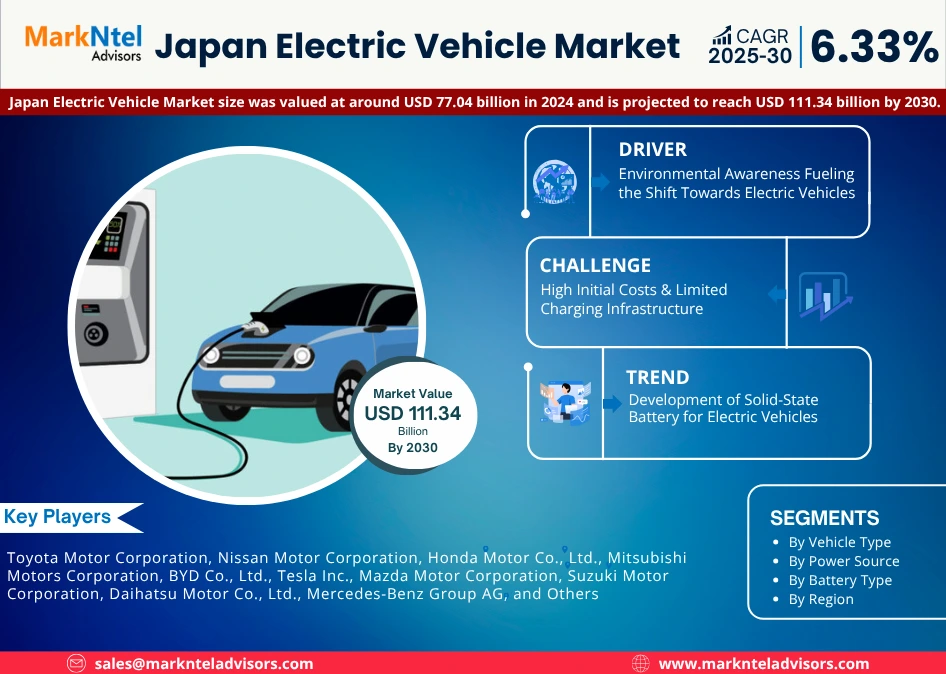
The Japan Electric Vehicle Market size was valued at around USD 77.04 billion in 2024 and is projected to reach USD 111.34 billion by 2030. Along with this, the market is estimated to grow at a CAGR of around 6.33% during the forecast period, i.e., 2025-30. The market is rapidly growing due to several components, including the high burden of air pollution as the road traffic is increasing, growing awareness regarding environmental issues, government incentives encouraging clean and electrified transportation, including electric vehicles, integration of the latest technologies for enhancing the features in electric vehicles, etc. Out of these, the leading growth factor is the rapid shift toward renewable alternatives for sustainable development in Japan, which is leading to a huge demand for Electric Vehicles (EVs) in the country.
| Report Coverage | Details |
|---|---|
| Historical Years | 2020–23 |
| Forecast Years | 2025–30 |
| Market Value in 2024 | USD 77.04 Billion |
| Market Value by 2030 | USD 111.34 Billion |
| CAGR (2025–30) | 6.33% |
| Top Key Players | Toyota Motor Corporation, Nissan Motor Corporation, Honda Motor Co., Ltd., Mitsubishi Motors Corporation, BYD Co., Ltd., Tesla Inc., Mazda Motor Corporation, Suzuki Motor Corporation, Daihatsu Motor Co., Ltd., Mercedes-Benz Group AG, and Others |
| Segmentation | By Vehicle Type (Electric Car, Two Wheelers, Electric Trucks, Electric Buses), By Power Source (Battery Electric Vehicle (BEV), Plug-In Hybrid Electric Vehicle (PHEV), Hybrid Electric Vehicle (HEV)), By Battery Type (Lithium-Ion Battery, Lithium Titanate Oxide (LTO), Others (Lead Acid Battery, Nickel-Metal Hydride, etc.)), and others |
| Key Report Highlights |
|
*Boost strategic growth with in-depth market analysis - Get a free sample preview today!
Additionally, the constant push by the Japanese government to promote the adoption of electric vehicles in the country through significant investments under important policies and incentives is leading to the opportunistic growth of the market. Also, the government is making efforts to provide solutions for the fragmented charging facilities in the country by launching about 30,000 public EV charging platforms in Japan by 2030, which ultimately contribute to the potential market’s growth. Moreover, the government of Japan has allocated about USD2.4 billion to expand battery production for Electric Vehicles in Japan, thus increasing the market growth. Also, the passenger EVs are dominating the market due to strong customer demand.
Furthermore, the regulatory agency of Japan, the Ministry of Economy, Trade, and Industry, has approved the manufacturing of the latest batteries called solid-state batteries to increase efficiency, which are more suitable for Electric Vehicles. Toyota Motors Corporation got the first approval from the authority. However, instead of investing in the expansion of charging points for EVs in country, Japan is still facing charging infrastructure congestion for Electric Vehicles, thus hindering the market’s growth.
Japan Electric Vehicle Market Driver:
Environmental Awareness Fueling the Shift Towards Electric Vehicles – The growing concerns regarding environmental and human health due to rising air pollution are fueling market demand. It is emerging due to the harmful emissions from the large-scale factories and fuel-based road traffic in Japan. More than 20% of the nitrogenous waste and 20% of the carbon emissions are coming from road traffic in Japan. It is leading to sustainable practices in the country, which is further driving the adoption of Electric Vehicles in Japan.
Japan has witnessed air pollution as the 8th highest risk factor for rising morbidity in the country. For instance, the air index in Japan in 2022 reached about PM2.5, which is far more than the recommended levels by the World Health Organization. It led to more than 50,000 deaths in Japan in that year, which raised the awareness among the citizens to shift towards more sustainable alternatives including electric vehicles in the country.
Japan Electric Vehicle Market Opportunity:
Strong Promotion for EVs through Government Initiatives – The Japanese government has launched various policies such as the Clean Energy Vehicle Subsidy Program, Green Growth Strategy, Eco Car Tax Incentive Program, etc., to promote the adoption of electric vehicles in the country. As per the Ministry of Foreign Affairs of Japan (2021), the government has launched an incentive called the "Green Growth Strategy towards 2050 Net-Zero Carbon Footprints" aimed to achieve 100% electrified vehicle sales by 2035 including battery EVs, Hybrid EVs, etc., and more than 45% reduction in carbon emissions by 2040.
Additionally, the government is providing about USD6,000 per EV subsidy to increase the sales of Electric Vehicles in the country. Also, there is a tax exemption on vehicles which are having low CO2 emissions and high fuel efficiency, including electric vehicles. All these efforts by the government are leading to the potential growth of the Japan EV market.
Japan Electric Vehicle Market Challenge:
High Initial Costs & Limited Charging Infrastructure – The market is facing a high initial investment challenge due to highly expensive batteries, which are made up of metals like lithium, nickel, cobalt, etc. Additionally, the integration of advanced features like smart driving assistance systems is imposing additional costs on vehicles, which are further increasing the cumulative expenses of EVs in Japan. For instance, the Toyota Yaris Cross X 2WD (Gasoline SUV) is valued at around USD12,000 while the price of the Toyota BZ4X (Electric SUV) is about USD42,000.
Additionally, Japan is rapidly increasing the manufacturing of electric vehicles, however, it currently lacks an established charging infrastructure for electric vehicles, which is hindering the market’s growth. For instance, the country has approximately 30,000 public charging stations only for EVs. Additionally, over 55% of these stations are outmoded already without having fast charging options, which is creating a huge demand for the development of charging infrastructure in the country, thus restraining the market’s growth.
Japan Electric Vehicle Market Trend:
Development of Solid-State Battery for Electric Vehicles – To achieve high energy density output, safer driving, etc. in EVs, the Ministry of Economy, Trade and Industry (METI) of Japan has approved the manufacturing of solid-state batteries for EVs in Japan. These new batteries are aimed at increasing the efficiency of Electric vehicles, eliminating the risks of chemical leakages, and decreasing charging time.
Companies like Toyota Motor Corporation got the approval for the manufacturing of solid-state batteries for EVs from METI in 2024, which allows the transformation of this market. Additionally, a collaboration has been done between Toyota Motors and Idemitsu Kosan to produce sulphide-based solid electrolyte batteries for increasing EV safety. Also, Idemitsu is expanding its production facility and planning to build a commercial-scale sulfide-based battery plant for EVs in Tokyo with an estimated annual production capacity of 60,000 solid-state battery EVs in Japan.
Japan Electric Vehicle Market (2025-30): Segmentation Analysis
The Japan Electric Vehicle Market study of MarkNtel Advisors evaluates & highlights the major trends and influencing factors in each segment. It includes predictions for the period 2025–2030 at the national level. Based on the analysis, the market has been further classified as:
Based on Power Source:
- Battery Electric Vehicle (BEV)
- Plug-In Hybrid Electric Vehicle (PHEV)
- Hybrid Electric Vehicle (HEV)
Out of these, the Hybrid Electric Vehicle (HEV) holds the largest market share of more than 80%. The HEVs are dominating the market due to the strong consumer preference for fuel-efficient vehicles, which will be fully served by the hybrid approach. Many key players, like Mitsubishi, etc. are actively manufacturing substantial units of Hybrid EVs in Japan. For instance, Toyota produces over 1 million hybrid EV units per year in Japan, with a further aim to increase the production rate to more than 3.5 million by 2030. Also, in 2025, Toyota Motors Corporation launched new hybrid EVs called Allfard and Vellfire, which are available in Hybrid as well as in plug-in hybrid models. This significant production is leading to the supremacy of HEVs in Japan’s Electric Vehicle Market.
Based on Battery Type:
- Lithium-Ion Battery
- Lithium Titanate Oxide (LTO)
- Others
Among these, the Lithium-Ion Battery is the leading segment of this market and accounts for more than 60% of the market share. Japan is one of the largest producers of lithium-ion batteries globally as of 2024. As per the International Energy Agency (2024), Japan's Lithium-ion production capacity is estimated at 60 GWh annually, which is further projected to increase and reach more than 120 GWh by the end of 2025, marking a significant production capability to raise the market standards in Japan. Several companies like Panasonic, Nissan, Toshiba, etc. are the major players in this market.
Additionally, many companies are expanding their production capacity by establishing new manufacturing plants targeting lithium-ion battery production in different regions across Japan. For instance, Mazda is constructing a lithium-ion battery plant in Iwakuni City with an annual production capacity of about 10 GWh. Also, Nissan is planning to produce its lithium-ion phosphate-based batteries with 5 GWh per year by 2029. These are contributing to the dominance of Lithium-ion batteries in Japan’s EV market.
Japan Electric Vehicle Industry Recent Development:
- 2024: Nissan Motor Corporation introduced the Ariya NISMO, a high-performance electric SUV, in Japan. This model builds upon the standard Ariya e-4ORCE, offering enhanced speed, comfort, and handling.
- 2024: Mitsubishi Motors Corporation has updated the plug-in hybrid electric vehicle (PHEV) model of the Outlander crossover SUV in Japan. It combines advanced electrification with the brand's renowned all-wheel-drive technology.
Gain a Competitive Edge with Our Japan Electric Vehicle Market Report
- Japan Electric Vehicle Market Report by MarkNtel Advisors provides a detailed & thorough analysis of market size & share, growth rate, competitive landscape, and key players. This comprehensive analysis helps businesses gain a holistic understanding of the market dynamics & make informed decisions.
- This report also highlights current market trends & future projections, allowing businesses to identify emerging opportunities & potential challenges. By understanding market forecasts, companies can align their strategies & stay ahead of the competition.
- Japan Electric Vehicle Market Report aids in assessing & mitigating risks associated with entering or operating in the market. By understanding market dynamics, regulatory frameworks, and potential challenges, businesses can develop strategies to minimize risks & optimize their operations.
*Reports Delivery Format - Market research studies from MarkNtel Advisors are offered in PDF, Excel and PowerPoint formats. Within 24 hours of the payment being successfully received, the report will be sent to your email address.
Frequently Asked Questions
- Market Segmentation
- Introduction
- Research Process
- Product Definition
- Assumption
- Executive Summary
- Japan Electric Vehicle Market Trends & Developments
- Japan Electric Vehicle Market Dynamics
- Growth Drivers
- Challenges
- Japan Electric Vehicle Market Regulations, Norms, & Product Standards
- Japan Electric Vehicle Market Imports & Exports Analysis
- Japan Electric Vehicle Market Hotspots & Opportunities
- Japan Electric Vehicle Market Value Chain Analysis
- Japan Electric Vehicle Market Outlook, 2020- 2030F
- Market Size & Analysis
- By Revenues (USD Million)
- By Units Sold (Thousand Units)
- Market Share & Analysis
- By Vehicle Type
- Electric Car- Market Size & Forecast 2020- 2030, Thousand Units
- Two Wheelers- Market Size & Forecast 2020- 2030, Thousand Units
- Electric Trucks- Market Size & Forecast 2020- 2030, Thousand Units
- Electric Buses- Market Size & Forecast 2020- 2030, Thousand Units
- By Power Source
- Battery Electric Vehicle (BEV) - Market Size & Forecast 2020- 2030, Thousand Units
- Plug-In Hybrid Electric Vehicle (PHEV) - Market Size & Forecast 2020- 2030, Thousand Units
- Hybrid Electric Vehicle (HEV) - Market Size & Forecast 2020- 2030, Thousand Units
- By Battery Type
- Lithium-Ion Battery- Market Size & Forecast 2020- 2030, Thousand Units
- Lithium Titanate Oxide (LTO) - Market Size & Forecast 2020- 2030, Thousand Units
- Others (Lead Acid Battery, Nickel-Metal Hydride, etc.) - Market Size & Forecast 2020- 2030, Thousand Units
- By Region
- North
- South
- East
- West
- By Company
- Competition Characteristics
- Market Share & Analysis
- By Vehicle Type
- Market Size & Analysis
- Japan Electric Car Market Outlook, 2020- 2030F
- Market Size & Analysis
- By Revenues (USD Million)
- By Units Sold (Thousand Units)
- Market Share & Analysis
- By Power Source- Market Size & Forecast 2020- 2030, Thousand Units
- By Battery Type- Market Size & Forecast 2020- 2030, Thousand Units
- Market Size & Analysis
- Japan Electric Two-wheeler Market Outlook, 2020- 2030F
- Market Size & Analysis
- By Revenues (USD Million)
- By Units Sold (Thousand Units)
- Market Share & Analysis
- By Power Source- Market Size & Forecast 2020- 2030, Thousand Units
- By Battery Type- Market Size & Forecast 2020- 2030, Thousand Units
- Market Size & Analysis
- Japan Electric Trucks Market Outlook, 2020- 2030F
- Market Size & Analysis
- By Revenues (USD Million)
- By Units Sold (Thousand Units)
- Market Share & Analysis
- By Power Source- Market Size & Forecast 2020- 2030, Thousand Units
- By Battery Type- Market Size & Forecast 2020- 2030, Thousand Units
- Market Size & Analysis
- Japan Electric Buses Market Outlook, 2020- 2030F
- Market Size & Analysis
- By Revenues (USD Million)
- By Units Sold (Thousand Units)
- Market Share & Analysis
- By Power Source- Market Size & Forecast 2020- 2030, Thousand Units
- By Battery Type- Market Size & Forecast 2020- 2030, Thousand Units
- Market Size & Analysis
- Japan Electric Vehicle Market Key Strategic Imperatives for Success & Growth
- Competition Outlook
- Company Profiles
- Toyota Motor Corporation
- Business Description
- Product Portfolio
- Strategic Alliances or Partnerships
- Recent Developments
- Financial Details
- Others
- Nissan Motor Corporation
- Business Description
- Product Portfolio
- Strategic Alliances or Partnerships
- Recent Developments
- Financial Details
- Others
- Honda Motor Co., Ltd.
- Business Description
- Product Portfolio
- Strategic Alliances or Partnerships
- Recent Developments
- Financial Details
- Others
- Mitsubishi Motors Corporation
- Business Description
- Product Portfolio
- Strategic Alliances or Partnerships
- Recent Developments
- Financial Details
- Others
- BYD Co. Ltd.
- Business Description
- Product Portfolio
- Strategic Alliances or Partnerships
- Recent Developments
- Financial Details
- Others
- Tesla Inc.
- Business Description
- Product Portfolio
- Strategic Alliances or Partnerships
- Recent Developments
- Financial Details
- Others
- Mazda Motor Corporation
- Business Description
- Product Portfolio
- Strategic Alliances or Partnerships
- Recent Developments
- Financial Details
- Others
- Suzuki Motor Corporation
- Business Description
- Product Portfolio
- Strategic Alliances or Partnerships
- Recent Developments
- Financial Details
- Others
- Mercedes-Benz Group AG
- Business Description
- Product Portfolio
- Strategic Alliances or Partnerships
- Recent Developments
- Financial Details
- Others
- Daihatsu Motor Co., Ltd.
- Business Description
- Product Portfolio
- Strategic Alliances or Partnerships
- Recent Developments
- Financial Details
- Others
- Others
- Toyota Motor Corporation
- Company Profiles
- Disclaimer
MarkNtel Advisors follows a robust and iterative research methodology designed to ensure maximum accuracy and minimize deviation in market estimates and forecasts. Our approach combines both bottom-up and top-down techniques to effectively segment and quantify various aspects of the market. A consistent feature across all our research reports is data triangulation, which examines the market from three distinct perspectives to validate findings. Key components of our research process include:
1. Scope & Research Design At the outset, MarkNtel Advisors define the research objectives and formulate pertinent questions. This phase involves determining the type of research—qualitative or quantitative—and designing a methodology that outlines data collection methods, target demographics, and analytical tools. They also establish timelines and budgets to ensure the research aligns with client goals.
2. Sample Selection and Data Collection In this stage, the firm identifies the target audience and determines the appropriate sample size to ensure representativeness. They employ various sampling methods, such as random or stratified sampling, based on the research objectives. Data collection is carried out using tools like surveys, interviews, and observations, ensuring the gathered data is reliable and relevant.
3. Data Analysis and Validation Once data is collected, MarkNtel Advisors undertake a rigorous analysis process. This includes cleaning the data to remove inconsistencies, employing statistical software for quantitative analysis, and thematic analysis for qualitative data. Validation steps are taken to ensure the accuracy and reliability of the findings, minimizing biases and errors.

4. Data Forecast and FinalizationThe final phase involves forecasting future market trends based on the analyzed data. MarkNtel Advisors utilize predictive modeling and time series analysis to anticipate market behaviors. The insights are then compiled into comprehensive reports, featuring visual aids like charts and graphs, and include strategic recommendations to inform client decision-making
We offer flexible licensing options to cater to varying organizational needs. Choose the pricing pack that best suits your requirements:
Buy Now Inquire Before Buying
 Request Customization
 Talk to our Consultant







