Japan E-Commerce Market Research Report: Size, Share, Trends & Forecast (2026-2032)
By Business Model (Business-to-Consumer (B2C), Business-to-Business (B2B), Consumer-to-Consumer (C2C)), By Product Category (Electronics & Appliances, Fashion & Apparel, Food & Gro ... cery, Beauty & Personal Care, Home & Furniture, Books, Toys & Hobby, Automotive & Accessories, Healthcare & Pharmaceuticals, Others), By Platform Type (Web-based, Mobile-based), By Payment Mode – (Digital Wallets, Bank Transfers, Credit/Debit Cards, Cash on Delivery (COD)), By End User (Individual Consumers, Enterprises / Businesses), and others Read more
- ICT & Electronics
- Apr 2026
- Pages 165
- Report Format: PDF, Excel, PPT
Japan E-Commerce Market
Projected 9.51% CAGR from 2026 to 2032
Study Period
2026-2032
Market Size (2026)
USD 319.42 Billion
Market Size (2032)
USD 550.93 Billion
Base Year
2025
Projected CAGR
9.51%
Leading Segments
By Business Model: Business-to-Consumer (B2C)
Japan E-Commerce Market Report Key Takeaways:
- The Japan E-Commerce market size was valued at USD 291.69 billion in 2025 and is projected to grow from USD 319.42 billion in 2026 to USD 550.93 billion by 2032, exhibiting a CAGR of 9.51% during the forecast period.
- Kanto holds the largest market share of about 38% in the Japan E-Commerce Market in 2026.
- By business model, the business-to-business (B2B) segment represented a significant share of about 88% in the Japan E-Commerce Market in 2026.
- By payment mode, the credit/debit cards segment presented a significant share of about 55% in the Japan E-Commerce Market in 2026.
Market Insights & Analysis: Japan E-Commerce Market (2026-32):
The Japan E-Commerce Market size was valued at approximately USD 291.69 billion in 2025 and is projected to grow from USD 319.42 billion in 2026 to USD 550.93 billion by 2032. Along with this, the market is estimated to grow at a CAGR of around 9.51% during the forecast period, i.e., 2026-32.
The Japan E-Commerce Market is projected to expand steadily, driven by widespread internet and smartphone penetration, alongside increasing adoption of AI-driven personalization, which is enhancing customer engagement, optimizing retail operations, and driving higher conversion rates across digital commerce platforms.
According to the Ministry of Internal Affairs and Communications, 90.6% of Japanese households owned smartphones in 2023, while 90.4% used these devices to access the internet, highlighting a highly connected consumer base with seamless access to digital commerce platforms. This widespread connectivity has directly translated into transaction behavior, as the Ministry of Economy, Trade and Industry reported that 58.7% of online goods sales were completed via smartphones in 2023, reinforcing mobile commerce as a dominant channel.
Consumer participation in digital retail is also expanding steadily. Government household data indicates that the share of households engaging in online shopping increased from 52.7% to approximately 55.8% by early 2025, reflecting rising trust and reliance on e-commerce platforms.
Additionally, Japan’s strong digital ecosystem supports international transactions, with consumers conducting USD 2.7–3.0 billion in cross-border e-commerce purchases in 2023, further broadening market scope beyond domestic boundaries.
From a category perspective, the market demonstrates robust and diversified growth. For example, METI data highlights that electronics and appliances recorded USD 175–180 billion in 2024 with 43.03% online penetration, while fashion & apparel reached JPY USD 175–180 billion with 23.38% penetration, indicating strong digital demand.
The food & grocery segment, valued at USD 200+ billion, remains underpenetrated at 4.52%, presenting significant headroom for future online expansion. Meanwhile, home & furniture USD 160+ billion achieved 32.58% penetration, and books, toys & hobby led with 56.45% penetration and USD 120+ billion, reflecting mature digital adoption in select categories .
Looking ahead, the integration of AI and personalization is expected to further accelerate market growth. The Japanese government, through initiatives like the SUPER-DX program, is actively promoting AI-enabled retail solutions, including automation platforms and unmanned stores. These technologies are enhancing customer targeting, optimizing inventory, and improving overall shopping experiences .
Japan’s e-commerce market is set to benefit from strong government-backed investments in AI and digital infrastructure. The Ministry of Economy, Trade, and Industry has committed USD 27–28 billion through 2030 to enhance digital commerce, personalization, and operational efficiency.
Additionally, subsidies of up to USD 500+ million have been approved for cloud and AI computing projects, enabling scalable and advanced e-commerce capabilities . These initiatives are expected to strengthen innovation, improve customer experience, and support sustained market growth beyond 2025.
Japan’s e-commerce market is strongly positioned for long-term growth, supported by high digital connectivity and evolving consumer behavior. The continued adoption of AI and expansion of underpenetrated segments will further strengthen market momentum in the coming years.
Japan E-Commerce Market Recent Developments:
- 2025: Mercari announced the launch of its “Mercari Global App” in 2025 as part of its cross-border strategy, enabling international users to access Japan’s marketplace more seamlessly. The app simplifies transactions by addressing language, payment, and purchasing barriers, supporting global expansion into multiple regions.
Japan E-Commerce Market Scope:
| Category | Segments |
|---|---|
| By Business Model | (Business-to-Consumer (B2C), Business-to-Business (B2B), Consumer-to-Consumer (C2C)), |
| By Product Category | (Electronics & Appliances, Fashion & Apparel, Food & Grocery, Beauty & Personal Care, Home & Furniture, Books, Toys & Hobby, Automotive & Accessories, Healthcare & Pharmaceuticals, Others), |
| By Platform Type | (Web-based, Mobile-based), |
| By Payment Mode | (Digital Wallets, Bank Transfers, Credit/Debit Cards, Cash on Delivery (COD)), |
| By End User | (Individual Consumers, Enterprises / Businesses), |
Japan E-Commerce Market Driver:
High Internet and Smartphone Penetration
Japan’s e-commerce market is strongly driven by widespread internet access and high mobile penetration, which have created a highly connected and digitally active consumer base. According to Freedom House, Japan recorded 188.9 million mobile connections in 2024, exceeding the total population and reflecting extensive multi-device usage . This level of connectivity enables consumers to engage with digital platforms seamlessly across smartphones, tablets, and other connected devices, significantly enhancing online shopping accessibility and frequency.
This strong digital foundation has directly translated into market expansion. Data from the Ministry of Economy, Trade, and Industry shows that Japan’s B2C e-commerce market reached USD 167–175 billion in 2024, registering a 5.1% year-on-year growth . The consistent rise in market value is closely linked to the ease of internet access and mobile-driven transactions, which allow consumers to shop anytime and anywhere.
Furthermore, the same METI survey highlights that the e-commerce penetration ratio increased to 9.8% in 2024, indicating a steady shift from offline to online consumption. This demonstrates how strong digital infrastructure is actively converting traditional retail demand into e-commerce channels.
High internet and mobile penetration are fundamental enablers of Japan’s e-commerce ecosystem. As connectivity continues to deepen, it will further accelerate digital adoption and sustain long-term market growth.
Japan E-Commerce Market Trend:
Integration of AI and Personalization
The integration of artificial intelligence (AI) and personalization is emerging as a defining trend in Japan’s e-commerce market, supported by strong institutional backing and increasing enterprise adoption.
According to the U.S. government’s International Trade Administration, Japan’s AI market reached USD 8.9 billion in 2024 and is projected to expand to USD 27.9 billion by 2029, reflecting rapid cross-sector adoption, including retail and digital commerce. This growth is enabling retailers to deploy advanced analytics for personalized product recommendations, demand forecasting, and automated customer engagement.
Adoption at the enterprise level is also accelerating. A 2024 survey reported by Reuters indicates that 24% of Japanese companies have already implemented AI, while an additional 35% are planning adoption, primarily to enhance productivity and customer experience . This trend is significantly improving conversion rates and operational efficiency across e-commerce platforms.
In practical application, leading Japanese retailers are introducing AI-powered cashier-less stores, where computer vision and intelligent algorithms allow customers to complete purchases without traditional checkout processes. These systems not only streamline operations but also enable real-time personalization of the shopping journey.
AI and personalization are transforming Japan’s e-commerce ecosystem by enhancing efficiency and customer engagement. As adoption expands, this trend will play a pivotal role in driving innovation and accelerating market growth.
Japan E-Commerce Market Opportunity:
Expansion of Omni-Channel Retailing
The expansion of omnichannel retailing is emerging as a critical opportunity in Japan’s e-commerce market, driven by the convergence of physical retail infrastructure with advanced digital capabilities.
According to the Ministry of Economy, Trade and Industry, Japan continues to maintain a strong brick-and-mortar retail base, while e-commerce penetration is steadily increasing. This dual-channel structure provides a favorable foundation for the adoption of integrated retail models that enable seamless transitions between online and offline touchpoints.
Retailers are increasingly deploying omnichannel strategies such as click-and-collect, ship-from-store, and real-time inventory synchronization to enhance operational efficiency and customer convenience. Physical outlets are being repurposed as micro-fulfillment centers, allowing companies to optimize last-mile delivery and reduce turnaround times. Simultaneously, widespread digital adoption, supported by high internet penetration and mobile usage, is reinforcing cross-channel consumer engagement and purchase behavior.
Looking ahead, continued investments in digital transformation initiatives, AI-enabled analytics, and logistics optimization are expected to accelerate omnichannel integration beyond 2025. Retailers are also prioritizing unified commerce platforms and data-driven personalization to deliver consistent and tailored customer experiences across all channels.
Omnichannel retailing strengthens both supply chain agility and customer engagement. Its expansion is expected to significantly enhance retail efficiency and act as a key catalyst for sustained growth in Japan’s e-commerce market.
Japan E-Commerce Market Challenge:
Logistics Capacity Constraints and Rising Delivery Costs
Japan’s e-commerce market is increasingly constrained by logistics capacity limitations, which are intensifying overall operational costs. With the continued expansion of online retail, parcel volumes have risen significantly, placing additional pressure on already stretched delivery networks. However, this surge in demand is not being matched by equivalent growth in logistics capacity.
A key structural concern is the projected decline in freight-handling capacity. Government-backed policy discussions indicate that Japan’s logistics capacity could fall by approximately 34% by 2030, primarily due to a persistent shortage of delivery drivers. This issue has been further exacerbated by regulatory reforms introduced in 2024, which impose stricter limits on overtime working hours for truck drivers, thereby reducing overall delivery capacity.
The imbalance between rising e-commerce demand and shrinking logistics resources is significantly increasing last-mile delivery costs and creating inefficiencies in order fulfillment. As a result, retailers are facing higher operational expenses and potential service delays.
Logistics capacity constraints are directly impacting cost structures and service efficiency. If unaddressed, these challenges will limit scalability and hinder the sustained growth of Japan’s e-commerce market.
Japan E-Commerce Market (2026-32) Segmentation Analysis:
The Japan E-Commerce Market study of MarkNtel Advisors evaluates & highlights the major trends and influencing factors in each segment. It includes predictions for the period 2026–32 at the country level. Based on the analysis, the market has been further classified as;
Based on Business Model:
- Business-to-Consumer (B2C)
- Business-to-Business (B2B)
- Consumer-to-Consumer (C2C)
The business-to-business (B2B) segment dominates the Japan E-Commerce market, accounting for approximately 88% of the market size, supported by the country’s highly developed industrial ecosystem and advanced digital infrastructure.
Japan’s strong presence in manufacturing, automotive, and electronics sectors has created substantial demand for efficient, large-scale procurement systems, driving the transition toward digital B2B platforms. These platforms enable enterprises to streamline sourcing, manage supplier networks, and execute bulk transactions with greater transparency and cost efficiency.
The widespread adoption of enterprise technologies, including cloud-based procurement systems and integrated supply chain solutions, has further accelerated B2B e-commerce growth. Organizations are increasingly leveraging digital tools to optimize inventory management, enhance operational visibility, and reduce transaction costs. This shift is particularly evident among large corporations and small-to-medium enterprises aiming to improve productivity and remain competitive in a rapidly evolving business environment.
Additionally, Japan’s export-oriented economy supports the expansion of cross-border B2B transactions, enabling domestic firms to engage with global partners more efficiently. Government-led digital transformation initiatives are also reinforcing the adoption of online business platforms across industries.
The sustained dominance of the B2B segment is driven by industrial demand, technological integration, and efficiency optimization. It will continue to play a central role in shaping the growth trajectory of Japan’s e-commerce market.
Based on Payment Mode:
- Digital Wallets
- Bank Transfers
- Credit/Debit Cards
- Cash on Delivery (COD)
The credit/debit cards segment dominates the Japan E-Commerce market, accounting for about 55% of total market value, supported by strong consumer confidence, robust financial infrastructure, and extensive merchant acceptance.
Card-based payments are widely regarded as secure and reliable, offering advanced authentication protocols and fraud protection mechanisms that align with Japan’s risk-averse consumer behavior. This has reinforced their preference for online transactions, particularly in high-value purchases.
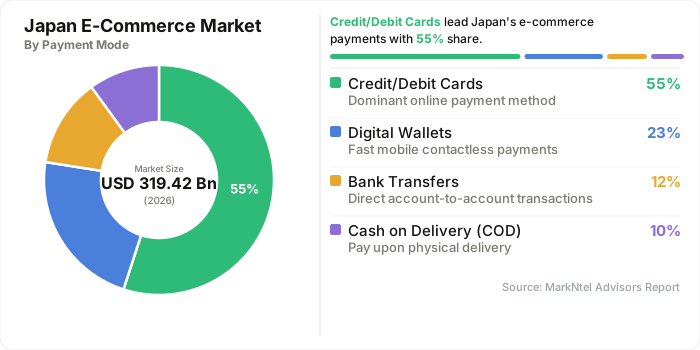
The dominance of cards is further driven by their seamless integration across e-commerce platforms, enabling fast and efficient payment processing. Most online retailers in Japan are equipped with optimized card payment gateways, ensuring minimal transaction friction.
Additionally, the growing linkage of credit and debit cards with mobile wallets and digital platforms has enhanced convenience, facilitating one-click payments and subscription-based billing models.
Moreover, incentive structures such as reward points, cashback programs, and installment payment options continue to encourage higher usage of credit cards, supporting increased transaction volumes. Regulatory support for cashless payments and ongoing improvements in payment security standards further strengthen adoption.
The combination of security, convenience, and financial incentives sustains the leadership of card-based payments. This dominance is expected to continue, enabling smoother transactions and supporting the expansion of Japan’s e-commerce ecosystem.
Japan E-Commerce Market (2026-32): Regional Projection
Kanto dominates the Japan E-Commerce market with an estimated 38% share, supported by its exceptional urban concentration, economic significance, and advanced infrastructure. At the core of this dominance is Tokyo, which alone has a population exceeding 14 million, representing the highest urban concentration in the country. This dense population structure fosters frequent online purchasing behavior and supports higher-value transactions, as consumers benefit from easy access to digital platforms and efficient delivery networks.
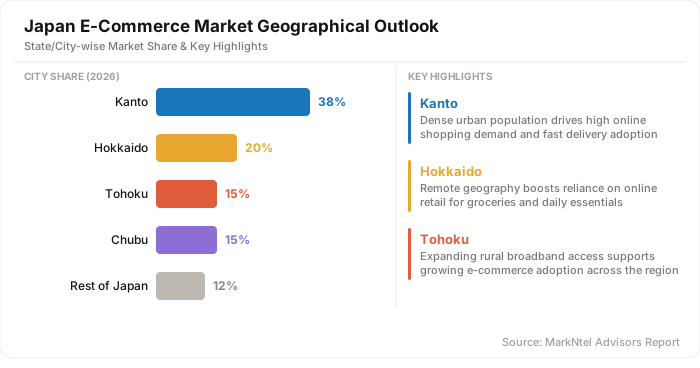
Beyond population advantages, Kanto serves as Japan’s primary economic and commercial hub, hosting a significant share of corporate headquarters, retail establishments, and technology providers. This concentration of businesses accelerates the adoption of e-commerce solutions, including omnichannel retailing and AI-driven personalization.
The region’s well-developed logistics infrastructure further strengthens its leadership. Extensive transportation networks, modern warehousing facilities, and proximity to major ports and airports enable faster fulfillment and optimized last-mile delivery. These capabilities allow e-commerce players to meet rising consumer expectations for speed and reliability.
Kanto’s dominance is reinforced by its population density, economic centrality, and logistics efficiency. These factors collectively position the region as the primary growth engine of Japan’s e-commerce market.
Japan E-commerce Market Competitive Landscape
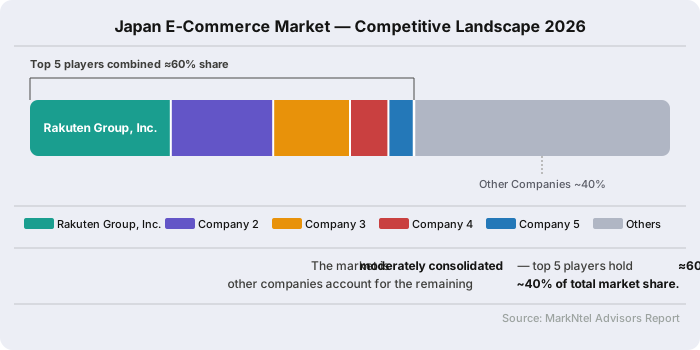
The market is moderately consolidated, with the top five players accounting for approximately 60% of the total market share. Leading companies include Rakuten Group, Inc., Amazon Japan G.K., LY Corporation, Mercari, Inc., and DMM.com LLC.
Key E-Commerce Companies in Japan
- Rakuten Group, Inc.
- Amazon Japan G.K.
- LY Corporation (Yahoo! Shopping Japan)
- Mercari, Inc.
- DMM.com LLC
- Qoo10 Japan
- KDDI Corporation
- ZOZO, Inc.
- Locondo
- MonotaRO Co.Ltd.
- ASKUL Corporation
- Others
Gain a Competitive Edge with Our Japan E-Commerce Market Report:
- Japan E-Commerce Market Report by MarkNtel Advisors provides a detailed & thorough analysis of market size & share, growth rate, competitive landscape, and key players. This comprehensive analysis helps businesses gain a holistic understanding of the market dynamics & make informed decisions.
- This report also highlights current market trends & future projections, allowing businesses to identify emerging opportunities & potential challenges. By understanding market forecasts, companies can align their strategies & stay ahead of the competition.
- Japan E-Commerce Market Report aids in assessing & mitigating risks associated with entering or operating in the market. By understanding market dynamics, regulatory frameworks, and potential challenges, businesses can develop strategies to minimize risks & optimize their operations.
*Reports Delivery Format - Market research studies from MarkNtel Advisors are offered in PDF, Excel and PowerPoint formats. Within 24 hours of the payment being successfully received, the report will be sent to your email address.
Frequently Asked Questions
- Market Segmentation
- Introduction
- Product Definition
- Research Process
- Assumptions
- Executive Summary
- Japan E-Commerce Market Policies, Regulations, and Product Standards
- Japan E-Commerce Market Trends & Developments
- Japan E-Commerce Market Dynamics
- Growth Drivers
- Challenges
- Japan E-Commerce Market Hotspot & Opportunities
- Japan E-Commerce Market Outlook, 2022-2032
- Market Size & Outlook
- By Revenues (USD Million)
- Market Share & Outlook
- By Business Model – Market Size & Forecast 2022-2032, USD Million
- Business-to-Consumer (B2C)
- Business-to-Business (B2B)
- Consumer-to-Consumer (C2C)
- By Product Category – Market Size & Forecast 2022-2032, USD Million
- Electronics & Appliances
- Smartphones
- Cooking Appliances
- Washing Machines
- Refrigerators
- Ovens
- Vacuum Cleaners
- Television
- Others
- Fashion & Apparel
- Kids wear
- Mens Wear
- Women Wear
- Food & Grocery
- Fresh Fruits
- Snacks & Processed Food
- Cereals
- Others
- Beauty & Personal Care
- Skincare
- Color Cosmetics
- Haircare
- Suncare
- Others
- Home & Furniture
- Kitchen Furniture
- Living Room Furniture
- Bedroom Furniture
- Home Cleaners
- Others
- Books, Toys & Hobby
- Books
- Traditional Toys
- Electronic Toys & Games
- Others
- Automotive & Accessories
- Car Interiors
- Tires
- Infotainment Systems
- Others
- Healthcare & Pharmaceuticals
- OTC Medicines
- Medical Consumables
- Others
- Others
- Electronics & Appliances
- By Platform Type – Market Size & Forecast 2022-2032, USD Million
- Web-based
- Mobile-based
- By Payment Mode – Market Size & Forecast 2022-2032, USD Million
- Digital Wallets
- Bank Transfers
- Credit/Debit Cards
- Cash on Delivery (COD)
- By End User – Market Size & Forecast 2022-2032, USD Million
- Individual Consumers
- Enterprises / Businesses
- By Region
- Hokkaido
- Tohoku
- Kanto
- Chubu
- Rest of Japan
- By Company
- Company Revenue Shares
- Competitor Characteristics
- By Business Model – Market Size & Forecast 2022-2032, USD Million
- Market Size & Outlook
- Japan Electronics & Appliances Market Outlook, 2022-2032
- Market Size & Outlook
- By Revenues (USD Million)
- Market Share & Outlook
- By Business Model – Market Size & Forecast 2022-2032, USD Million
- By Platform Type – Market Size & Forecast 2022-2032, USD Million
- By Payment Mode – Market Size & Forecast 2022-2032, USD Million
- By End User – Market Size & Forecast 2022-2032, USD Million
- By Region
- Market Size & Outlook
- Japan Fashion & Apparel Market Outlook, 2022-2032
- Market Size & Outlook
- By Revenues (USD Million)
- Market Share & Outlook
- By Business Model – Market Size & Forecast 2022-2032, USD Million
- By Platform Type – Market Size & Forecast 2022-2032, USD Million
- By Payment Mode – Market Size & Forecast 2022-2032, USD Million
- By End User – Market Size & Forecast 2022-2032, USD Million
- By Region
- Market Size & Outlook
- Japan Food & Grocery Market Outlook, 2022-2032
- Market Size & Outlook
- By Revenues (USD Million)
- Market Share & Outlook
- By Business Model – Market Size & Forecast 2022-2032, USD Million
- By Platform Type – Market Size & Forecast 2022-2032, USD Million
- By Payment Mode – Market Size & Forecast 2022-2032, USD Million
- By End User – Market Size & Forecast 2022-2032, USD Million
- By Region
- Market Size & Outlook
- Japan Beauty & Personal Care Market Outlook, 2022-2032
- Market Size & Outlook
- By Revenues (USD Million)
- Market Share & Outlook
- By Business Model – Market Size & Forecast 2022-2032, USD Million
- By Platform Type – Market Size & Forecast 2022-2032, USD Million
- By Payment Mode – Market Size & Forecast 2022-2032, USD Million
- By End User – Market Size & Forecast 2022-2032, USD Million
- By Region
- Market Size & Outlook
- Japan Home & Furniture Market Outlook, 2022-2032
- Market Size & Outlook
- By Revenues (USD Million)
- Market Share & Outlook
- By Business Model – Market Size & Forecast 2022-2032, USD Million
- By Platform Type – Market Size & Forecast 2022-2032, USD Million
- By Payment Mode – Market Size & Forecast 2022-2032, USD Million
- By End User – Market Size & Forecast 2022-2032, USD Million
- By Region
- Market Size & Outlook
- Japan Books, Toys & Hobby Market Outlook, 2022-2032
- Market Size & Outlook
- By Revenues (USD Million)
- Market Share & Outlook
- By Business Model – Market Size & Forecast 2022-2032, USD Million
- By Platform Type – Market Size & Forecast 2022-2032, USD Million
- By Payment Mode – Market Size & Forecast 2022-2032, USD Million
- By End User – Market Size & Forecast 2022-2032, USD Million
- By Region
- Market Size & Outlook
- Japan Automotive & Accessories Market Outlook, 2022-2032
- Market Size & Outlook
- By Revenues (USD Million)
- Market Share & Outlook
- By Business Model – Market Size & Forecast 2022-2032, USD Million
- By Platform Type – Market Size & Forecast 2022-2032, USD Million
- By Payment Mode – Market Size & Forecast 2022-2032, USD Million
- By End User – Market Size & Forecast 2022-2032, USD Million
- By Region
- Market Size & Outlook
- Japan Healthcare & Pharmaceuticals Market Outlook, 2022-2032
- Market Size & Outlook
- By Revenues (USD Million)
- Market Share & Outlook
- By Business Model – Market Size & Forecast 2022-2032, USD Million
- By Platform Type – Market Size & Forecast 2022-2032, USD Million
- By Payment Mode – Market Size & Forecast 2022-2032, USD Million
- By End User – Market Size & Forecast 2022-2032, USD Million
- By Region
- Market Size & Outlook
- Japan E-Commerce Market Key Strategic Imperatives for Success & Growth
- Competition Outlook
- Company Profiles
- Rakuten Group, Inc.
- Business Description
- Product Portfolio
- Strategic Alliances or Partnerships
- Recent Developments
- Financial Details
- Others
- Amazon Japan G.K.
- Business Description
- Product Portfolio
- Strategic Alliances or Partnerships
- Recent Developments
- Financial Details
- Others
- LY Corporation (Yahoo! Shopping Japan)
- Business Description
- Product Portfolio
- Strategic Alliances or Partnerships
- Recent Developments
- Financial Details
- Others
- Mercari, Inc.
- Business Description
- Product Portfolio
- Strategic Alliances or Partnerships
- Recent Developments
- Financial Details
- Others
- DMM.com LLC
- Business Description
- Product Portfolio
- Strategic Alliances or Partnerships
- Recent Developments
- Financial Details
- Others
- Qoo10 Japan
- Business Description
- Product Portfolio
- Strategic Alliances or Partnerships
- Recent Developments
- Financial Details
- Others
- KDDI Corporation
- Business Description
- Product Portfolio
- Strategic Alliances or Partnerships
- Recent Developments
- Financial Details
- Others
- ZOZO, Inc.
- Business Description
- Product Portfolio
- Strategic Alliances or Partnerships
- Recent Developments
- Financial Details
- Others
- Locondo
- Business Description
- Product Portfolio
- Strategic Alliances or Partnerships
- Recent Developments
- Financial Details
- Others
- MonotaRO Co., Ltd.
- Business Description
- Product Portfolio
- Strategic Alliances or Partnerships
- Recent Developments
- Financial Details
- Others
- ASKUL Corporation
- Business Description
- Product Portfolio
- Strategic Alliances or Partnerships
- Recent Developments
- Financial Details
- Others
- Others
- Rakuten Group, Inc.
- Company Profiles
- Disclaimer
MarkNtel Advisors follows a robust and iterative research methodology designed to ensure maximum accuracy and minimize deviation in market estimates and forecasts. Our approach combines both bottom-up and top-down techniques to effectively segment and quantify various aspects of the market. A consistent feature across all our research reports is data triangulation, which examines the market from three distinct perspectives to validate findings. Key components of our research process include:
1. Scope & Research Design At the outset, MarkNtel Advisors define the research objectives and formulate pertinent questions. This phase involves determining the type of research—qualitative or quantitative—and designing a methodology that outlines data collection methods, target demographics, and analytical tools. They also establish timelines and budgets to ensure the research aligns with client goals.
2. Sample Selection and Data Collection In this stage, the firm identifies the target audience and determines the appropriate sample size to ensure representativeness. They employ various sampling methods, such as random or stratified sampling, based on the research objectives. Data collection is carried out using tools like surveys, interviews, and observations, ensuring the gathered data is reliable and relevant.
3. Data Analysis and Validation Once data is collected, MarkNtel Advisors undertake a rigorous analysis process. This includes cleaning the data to remove inconsistencies, employing statistical software for quantitative analysis, and thematic analysis for qualitative data. Validation steps are taken to ensure the accuracy and reliability of the findings, minimizing biases and errors.

4. Data Forecast and FinalizationThe final phase involves forecasting future market trends based on the analyzed data. MarkNtel Advisors utilize predictive modeling and time series analysis to anticipate market behaviors. The insights are then compiled into comprehensive reports, featuring visual aids like charts and graphs, and include strategic recommendations to inform client decision-making
We offer flexible licensing options to cater to varying organizational needs. Choose the pricing pack that best suits your requirements:
Buy Now Inquire Before Buying
 Request Customization
 Talk to our Consultant