

By Type (Phosphonates, Carboxylate-based Polymers, Sulfonates, Others (including bio-based/green antiscalants)), By Application (Reverse Osmosis (RO) Systems, Cooling Water Systems, Boilers & Steam Sy... ... , Boilers & Steam Systems, Desalination, Others (process water, wastewater reuse)), By End-Use Industry (Power Generation, Oil & Gas, Chemicals & Petrochemicals, Food & Beverage, Municipal Water & Wastewater, Others (pulp & paper, mining, pharmaceuticals)), By Technology (Reverse Osmosis (RO), Nanofiltration (NF), Ultrafiltration (UF), Thermal Desalination (MSF/MED), Conventional Water Treatment Systems), By Feed Water (Seawater, Brackish Water, Surface Water, Groundwater, Wastewater / Recycled Water), and others Read more
- Chemicals
- May 2026
- 280
- PDF, Excel, PPT
Europe Antiscalant Market Key Takeaways
- The Europe antiscalant market was valued at approximately USD 556 million in 2025 and is projected to grow from USD 572.95 million in 2026 to USD 847.43 million by 2032, registering a CAGR of 6.74% during the forecast period (2026–2032).
- Germany leads the regional market, accounting for approximately 21.63% share in 2026, supported by strong demand from both industrial and municipal sectors.
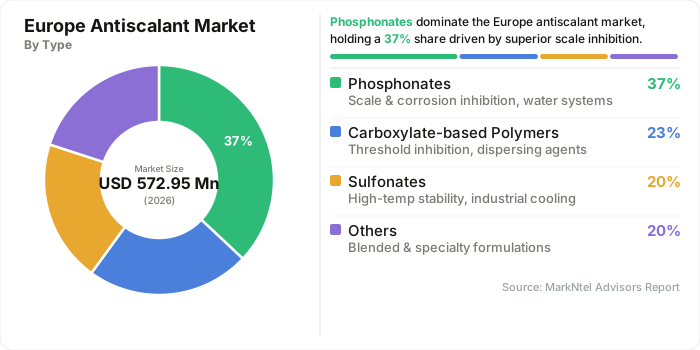
- By type, phosphonates dominate the market, contributing nearly 37% share, driven by their high efficiency in scale prevention across diverse applications.
- By end use, the municipal water and wastewater segment holds the largest share, accounting for approximately 27% in 2026, supported by extensive treatment infrastructure and continuous operational requirements.
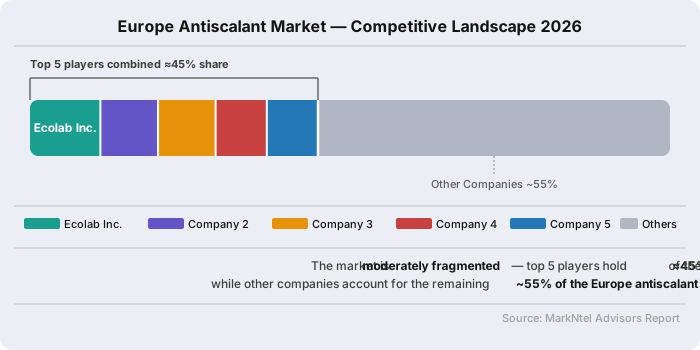
- The market exhibits a moderately fragmented structure, with the top five players collectively accounting for around 45% of the total market share, reflecting a balanced mix of leading global companies and competitive regional participants.
Europe Antiscalant Market Size and Outlook
The Europe antiscalant market is projected to grow at a CAGR of approximately 6.74% during the forecast period (2026–2032), reflecting steady expansion driven by multiple structural factors. This growth is primarily supported by sustained investments in water treatment infrastructure across municipal and industrial sectors, aimed at improving water quality and operational efficiency.
Reflecting the scale of this infrastructure, Europe treats approximately 40 billion cubic meters of wastewater annually, highlighting the continuous demand for treatment chemicals across the regio n. This extensive treatment activity, combined with ongoing operations in industries such as chemicals, power, and food processing, ensures consistent consumption of scale inhibitor chemicals. Consequently, the market remains driven by stable operational needs and recurring maintenance cycles.
Building on this established foundation, evolving regulatory frameworks are further shaping demand by accelerating the adoption of advanced treatment solutions. The revised European Commission Urban Wastewater Treatment Directive, effective from 2025, introduces stricter nutrient removal and micropollutant treatment requirements. These measures are encouraging municipalities and industries to adopt membrane-based systems that rely on antiscalants for efficient RO membrane performance. In parallel, the EU Water Framework Directive continues to enforce stringent water quality standards, prompting ongoing upgrades across treatment facilities. This regulatory push ensures sustained demand, particularly from municipal water and wastewater treatment systems.
Moreover, infrastructure investments and water reuse initiatives are translating policy intent into measurable market expansion. The European Investment Bank has committed approximately USD 17 billion toward water-related projects between 2025 and 2027, aimed at enhancing water resilience across the region. These investments are supporting desalination and reuse capacity expansion in countries such as Spain and Italy, where water stress is increasing. At the same time, industrial users are adopting closed-loop systems to reduce freshwater consumption, as demonstrated by EU-backed initiatives such as the LIFE ANHIDRA project, which achieved substantial reductions in water use and wastewater discharge. Together, these developments reinforce the structural demand for antiscalants .
As regulatory pressures intensify and infrastructure development advances, improving industrial efficiency will play a key role in accelerating market growth revenues from USD 572.95 million in 2026 to USD 847.43 million by 2032. Sustainability-driven policies are encouraging the adoption of environmentally compliant formulations, including biodegradable and low-phosphorus antiscalants. In addition, broader initiatives under the EU Green Deal and circular economy framework are accelerating water reuse and resource optimization across sectors. With strong alignment between regulatory direction, infrastructure expansion, and industrial practices, the antiscalant market across Europe is positioned for stable and sustained growth in the coming years.
Europe Antiscalant Market Key Indicators
- The European Environment Agency reports that around 81% of the EU population was connected to at least secondary wastewater treatment systems, indicating widespread infrastructure coverage. This extensive network of treatment facilities requires ongoing chemical dosing to maintain operational efficiency, thereby increasing demand for antiscalants across municipal systems.
- With at least 30% of the EU population experiencing water stress annually, as reported by the European Environment Agency, pressure on water resources is intensifying. This is driving the adoption of water-efficient technologies across industries and municipalities, including advanced treatment systems that rely on antiscalants for reliable operation.
- As per the European Commission, over 90% of urban wastewater in the EU is collected and treated, highlighting the widespread deployment of municipal water infrastructure. Continuous operation and upgrading of these treatment facilities require consistent chemical dosing to maintain system efficiency and prevent scaling, thereby supporting demand for antiscalants .
- European Union data indicates that total freshwater abstraction has decreased by approximately 14%, mainly due to reduced water use in electricity cooling systems. Despite this decline, thermal power and industrial operations still require significant water for cooling and processing, thereby sustaining demand for antiscalants to prevent scaling and maintain system efficiency.
Europe Antiscalant Market Scope
| Category | Segments |
|---|---|
| By Type | Phosphonates, Carboxylate-based Polymers, Sulfonates, Others (including bio-based/green antiscalants |
| By Application | Reverse Osmosis (RO) Systems, Cooling Water Systems, Boilers & Steam Systems, Desalination, Others (process water, wastewater reuse |
| By End-Use Industry | Power Generation, Oil & Gas, Chemicals & Petrochemicals, Food & Beverage, Municipal Water & Wastewater, Others (pulp & paper, mining, pharmaceuticals |
| By Technology | Reverse Osmosis (RO), Nanofiltration (NF), Ultrafiltration (UF), Thermal Desalination (MSF/MED), Conventional Water Treatment Systems |
| By Feed Water | Seawater, Brackish Water, Surface Water, Groundwater, Wastewater / Recycled Water |
Europe Antiscalant Market Growth Drivers
Rising Water Scarcity & Desalination Demand
Water scarcity across Europe has intensified due to climate change, prolonged droughts, and increasing pressure on available water resources. The European Commission highlights that water scarcity and droughts are becoming more frequent, with demand exceeding sustainable supply in several regions. Complementing this, the European Environment Agency reports that around 30% of the EU population and nearly 20% of land area are affected annually . This growing imbalance is steadily pushing governments toward investments in desalination and water reuse infrastructure.
As this structural pressure translates into action, demand for advanced treatment systems is increasing across Southern Europe. Countries such as Spain and Italy are expanding desalination and water infrastructure, including a USD 502 million desalination program in Catalonia and over USD 970 million allocated by Italy for system upgrades . These facilities rely on reverse osmosis processes, where RO membrane antiscalants are essential to maintain efficiency and prevent scaling. Consequently, the expansion of such systems is directly increasing chemical consumption across municipal and industrial applications.
As water scarcity represents a persistent structural challenge rather than a short-term issue, its impact on demand continues to build steadily over time. Desalination and reuse systems require continuous antiscalant dosing throughout their operational life, ensuring recurring consumption rather than one-time use. Policy initiatives under the European Commission are further reinforcing water resilience and reuse adoption across sectors. As infrastructure continues to expand and efficiency becomes critical, this driver is expected to support stable and long-term market growth.
Recent Trends
Increasing Adoption of Membrane-Based Technologies
The adoption of membrane-based technologies such as reverse osmosis and nanofiltration has accelerated across Europe, driven by stricter treatment requirements and rising water quality standards. The revised European Commission Urban Wastewater Treatment Directive, effective from 2025, mandates advanced removal of micropollutants, favoring high-efficiency filtration systems. In parallel, tightening limits on contaminants such as PFAS from 2026 are further encouraging utilities to deploy advanced treatment technologies, including reverse osmosis . Together, these regulatory developments are steadily shifting preference toward membrane-based systems across municipal and industrial applications.
As this transition gains momentum, it is reshaping operational practices and chemical demand patterns across the value chain. Membrane systems require continuous scale and fouling control, directly increasing dependence on RO membrane antiscalants to maintain performance and efficiency. At the same time, industries are integrating reverse osmosis into water reuse and high-purity applications, further strengthening adoption across end-use sectors. In line with this shift, hybrid batch reverse osmosis systems introduced by Salinity Solutions and SUEZ have demonstrated recovery rates of up to 90–95%. These advancements are improving system efficiency while expanding applicability across diverse treatment environments.
As adoption continues to expand, ongoing improvements in membrane performance and system efficiency are reinforcing the long-term viability of these technologies. Enhancements in durability, recovery rates, and process optimization are reducing operational costs and supporting wider deployment across both new installations and retrofits. In parallel, the integration of automated monitoring systems is enabling better performance control and optimized chemical usage. This combination of efficiency gains and expanding applications is steadily strengthening the role of membrane technologies in shaping long-term antiscalant market demand.
Europe Antiscalant Market Opportunities and Challenges
Regulatory Pressure on Chemical Usage Driving Development of Eco-Friendly and Low-Phosphorus Antiscalants
Escalating environmental scrutiny and stricter chemical regulations are limiting the use of traditional antiscalant formulations, especially those based on phosphorus and non-biodegradable compounds. Regulatory authorities across Europe, led by the European Commission, are strengthening restrictions under frameworks such as REACH and water quality directives to limit chemical discharge into aquatic environments . In parallel, evolving wastewater treatment requirements are placing greater emphasis on reducing nutrient discharge and persistent chemical residues. These measures are increasing compliance pressure and restricting the long-term use of conventional chemistries.
This regulatory tightening is simultaneously creating opportunities for innovation in sustainable water treatment solutions. Manufacturers are increasingly developing biodegradable and low-phosphorus antiscalants that comply with environmental standards while maintaining performance efficiency. Advances in polymer chemistry and green formulations are enabling reduced dosage levels and improved compatibility with membrane-based systems. At the same time, end-users are prioritizing environmentally compliant chemicals as part of sustainability-driven procurement strategies. As a result, companies are leveraging eco-friendly product development to achieve competitive differentiation and unlock new growth opportunities in the Europe antiscalant market.
Segmentation Insights
High Performance and Reliability Keep Phosphonates at the Core of Europe’s Antiscalant Demand
Holding approximately 37% of total demand, phosphonates remain the leading segment in the antiscalant industry across Europe, supported by their consistent performance in managing scale formation across diverse operating conditions. Their strong threshold inhibition and crystal modification capabilities enable effective control of deposits even in high-temperature and high-pressure environments such as reverse osmosis systems, cooling circuits, and boiler operations. This reliability ensures stable system performance and reduced maintenance requirements, making them widely preferred across both industrial and municipal applications. As a result, their broad applicability continues to sustain their dominant market position.
This position is strengthened by their economic efficiency and strong adoption across industrial applications in Europe. Phosphonates perform effectively at low dosages, allowing industries such as power generation, chemicals, and manufacturing to optimize operational costs while maintaining treatment efficiency. In addition, Europe’s well-established specialty chemicals manufacturing base supports consistent production and supply across key markets. Their long-standing usage and proven performance reduce formulation risks in large-scale systems requiring uninterrupted operation. Collectively, these factors enable phosphonates to maintain a strong balance of performance, scalability, and cost efficiency, reinforcing their leadership despite the gradual emergence of alternative solutions. Based on type, the market is segmented into:
- Phosphonates
- Carboxylate-based Polymers
- Sulfonates
- Others
Robust Municipal Water and Wastewater Infrastructure Continues to Shape Antiscalant Demand Across Europe
Municipal water and wastewater accounts for about 27% of total demand in the Europe antiscalant industry, with its leading position supported by the extensive reach and continuous functioning of public treatment infrastructure. A significant share of the European population is connected to centralized wastewater treatment systems, reflecting the widespread deployment of municipal facilities across the region. These systems require consistent chemical dosing, increasing reliance on water treatment additives to prevent scaling in pipelines, filtration units, and membrane-based processes. Given the essential nature of water services, municipal operations run continuously, ensuring stable and recurring consumption of antiscalants.
Continued investment in water infrastructure across both national and local levels is further solidifying this segment’s leading position. For instance, Spain is allocating over USD 1.6 billion toward water management and climate resilience projects, including desalination and system upgrades , while smaller municipalities such as those in Mallorca are planning dedicated desalination plants to address water shortages . These developments highlight the growing reliance on advanced treatment technologies, particularly reverse osmosis systems that require effective scale control. The ongoing expansion and modernization of municipal systems continue to drive consistent demand for chemical treatment, further strengthening the segment’s leadership in the antiscalant industry across Europe. Based on end user industry, the market is segmented into:
- Power Generation
- Oil & Gas
- Chemicals & Petrochemicals
- Food & Beverage
- Municipal Water & Wastewater
- Others
Europe Antiscalant Market Geographical Outlook
Germany accounts for approximately 21.63% share of the antiscalant market across Europe, supported by its strong industrial base and extensive water treatment infrastructure. As Europe’s largest economy, Germany hosts a high concentration of water-intensive industries such as chemicals, power generation, and manufacturing, all of which require continuous water treatment to maintain operational efficiency. The presence of large-scale industrial facilities drives consistent demand for industrial water chemistry products, including antiscalants, across cooling systems, boilers, and process water applications. This sustained industrial activity makes Germany a key hub for water treatment chemical consumption within the region.
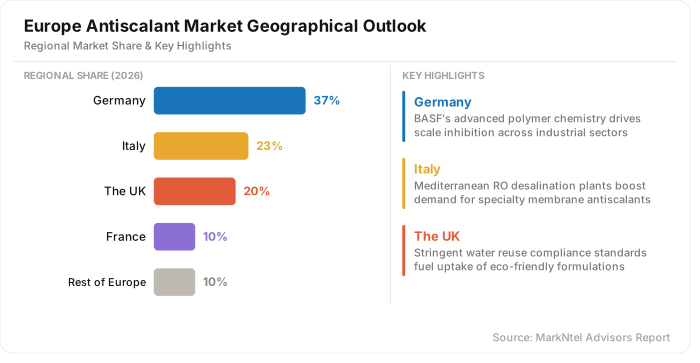
This strong demand is further supported by Germany’s well-developed wastewater infrastructure, which continues to reinforce its leading position. Germany operates over 9,000 municipal wastewater treatment plants, with a total capacity exceeding 150 million populations equivalent, reflecting the scale of continuous treatment activity across the country . In parallel, strict environmental regulations under the European Commission framework are encouraging industries and utilities to optimize water usage and adopt efficient treatment practices. Additionally, Germany’s well-established specialty chemicals sector supports the local production and supply of antiscalants, ensuring availability and innovation across applications. This combination of industrial intensity and infrastructure depth positions Germany as a consistent high-volume consumer within the regional market.
Europe Antiscalant Market Competitive Analysis
The competitive landscape of the Europe antiscalant industry is shaped by a mix of dominant global players and a broad network of regional suppliers, resulting in a moderately fragmented structure. Major companies such as Ecolab Inc., SUEZ Water Technologies & Solutions, Kemira Oyj, Solenis, and Kurita Water Industries Ltd. collectively represent around 45% of demand. Their continued strength is driven by the ability to provide end-to-end water treatment solutions that integrate chemical performance with system reliability and long-term operational support.
Leading Antiscalant Manufacturers in Europe
- Ecolab Inc.
- Veolia Water Technologies
- SUEZ Water Technologies & Solutions
- Kemira Oyj
- Solenis
- BASF SE
- Arkema Group
- Clariant AG
- Kurita Water Industries Ltd.
- Italmatch Chemicals S.p.A.
- Others
Europe Antiscalant Industry News and Recent Developments
June 2025: Kemira Oyj Advances Activated Carbon Reactivation Plant in Sweden
Kemira Oyj is advancing sustainable water treatment capacity in Europe through the development of an activated carbon reactivation plant in Sweden. The facility is designed to support removal of micropollutants such as PFAS and enable reuse of filtration media, aligning with increasing demand for advanced and environmentally efficient treatment solutions.
Impact Analysis: This development highlights the growing shift toward advanced and sustainable water treatment infrastructure across Europe. The increasing focus on micropollutant removal is accelerating the adoption of high-efficiency treatment systems, which require optimized chemical dosing, including antiscalants. As similar projects expand, demand for performance-driven water treatment chemicals is expected to strengthen across municipal and industrial application.
- Market Segmentation
- Introduction
- Product Definition
- Research Process
- Assumptions
- Executive Summary
- Europe Antiscalant Market Policies, Regulations, and Product Standards
- Europe Antiscalant Market Trends & Developments
- Europe Antiscalant Market Dynamics
- Growth Factors
- Challenges
- Europe Antiscalant Market Hotspot & Opportunities
- Europe Antiscalant Market Outlook, 2022-2032F
- Market Size & Outlook
- By Revenues (USD Million)
- By Quantity sold (Tons)
- Market Share & Analysis
- By Type- Market Size & Forecast 2022-2032, USD Million
- Phosphonates
- Carboxylate-based Polymers
- Sulfonates
- Others (including bio-based/green antiscalants)
- By Application- Market Size & Forecast 2022-2032, USD Million
- Reverse Osmosis (RO) Systems
- Cooling Water Systems
- Boilers & Steam Systems
- Desalination
- Others (process water, wastewater reuse)
- By End-Use Industry- Market Size & Forecast 2022-2032, USD Million
- Power Generation
- Oil & Gas
- Chemicals & Petrochemicals
- Food & Beverage
- Municipal Water & Wastewater
- Others (pulp & paper, mining, pharmaceuticals)
- By Technology- Market Size & Forecast 2022-2032, USD Million
- Reverse Osmosis (RO)
- Nanofiltration (NF)
- Ultrafiltration (UF)
- Thermal Desalination (MSF/MED)
- Conventional Water Treatment Systems
- By Feed Water- Market Size & Forecast 2022-2032, USD Million
- Seawater
- Brackish Water
- Surface Water
- Groundwater
- Wastewater / Recycled Water
- By Country
- Germany
- The UK
- Italy
- France
- Spain
- Benelux
- Sweden
- Rest of Europe
- By Company
- Competition Characteristics
- Market Share & Analysis
- By Type- Market Size & Forecast 2022-2032, USD Million
- Market Size & Outlook
- Germany Antiscalant Market Outlook, 2022-2032F
- Market Size & Outlook
- By Revenues (USD Million)
- By Quantity sold (Tons)
- Market Share & Analysis
- By Type- Market Size & Forecast 2022-2032, USD Million
- By Application- Market Size & Forecast 2022-2032, USD Million
- By End-Use Industry- Market Size & Forecast 2022-2032, USD Million
- By Technology- Market Size & Forecast 2022-2032, USD Million
- By Feed Water- Market Size & Forecast 2022-2032, USD Million
- Market Size & Outlook
- The UK Antiscalant Market Outlook, 2022-2032F
- Market Size & Outlook
- By Revenues (USD Million)
- By Quantity sold (Tons)
- Market Share & Analysis
- By Type- Market Size & Forecast 2022-2032, USD Million
- By Application- Market Size & Forecast 2022-2032, USD Million
- By End-Use Industry- Market Size & Forecast 2022-2032, USD Million
- By Technology- Market Size & Forecast 2022-2032, USD Million
- By Feed Water- Market Size & Forecast 2022-2032, USD Million
- Market Size & Outlook
- Italy Antiscalant Market Outlook, 2022-2032F
- Market Size & Outlook
- By Revenues (USD Million)
- By Quantity sold (Tons)
- Market Share & Analysis
- By Type- Market Size & Forecast 2022-2032, USD Million
- By Application- Market Size & Forecast 2022-2032, USD Million
- By End-Use Industry- Market Size & Forecast 2022-2032, USD Million
- By Technology- Market Size & Forecast 2022-2032, USD Million
- By Feed Water- Market Size & Forecast 2022-2032, USD Million
- Market Size & Outlook
- France Antiscalant Market Outlook, 2022-2032F
- Market Size & Outlook
- By Revenues (USD Million)
- By Quantity sold (Tons)
- Market Share & Analysis
- By Type- Market Size & Forecast 2022-2032, USD Million
- By Application- Market Size & Forecast 2022-2032, USD Million
- By End-Use Industry- Market Size & Forecast 2022-2032, USD Million
- By Technology- Market Size & Forecast 2022-2032, USD Million
- By Feed Water- Market Size & Forecast 2022-2032, USD Million
- Market Size & Outlook
- Spain Antiscalant Market Outlook, 2022-2032F
- Market Size & Outlook
- By Revenues (USD Million)
- By Quantity sold (Tons)
- Market Share & Analysis
- By Type- Market Size & Forecast 2022-2032, USD Million
- By Application- Market Size & Forecast 2022-2032, USD Million
- By End-Use Industry- Market Size & Forecast 2022-2032, USD Million
- By Technology- Market Size & Forecast 2022-2032, USD Million
- By Feed Water- Market Size & Forecast 2022-2032, USD Million
- Market Size & Outlook
- Benelux Antiscalant Market Outlook, 2022-2032F
- Market Size & Outlook
- By Revenues (USD Million)
- By Quantity sold (Tons)
- Market Share & Analysis
- By Type- Market Size & Forecast 2022-2032, USD Million
- By Application- Market Size & Forecast 2022-2032, USD Million
- By End-Use Industry- Market Size & Forecast 2022-2032, USD Million
- By Technology- Market Size & Forecast 2022-2032, USD Million
- By Feed Water- Market Size & Forecast 2022-2032, USD Million
- Market Size & Outlook
- Sweden Antiscalant Market Outlook, 2022-2032F
- Market Size & Outlook
- By Revenues (USD Million)
- By Quantity sold (Tons)
- Market Share & Analysis
- By Type- Market Size & Forecast 2022-2032, USD Million
- By Application- Market Size & Forecast 2022-2032, USD Million
- By End-Use Industry- Market Size & Forecast 2022-2032, USD Million
- By Technology- Market Size & Forecast 2022-2032, USD Million
- By Feed Water- Market Size & Forecast 2022-2032, USD Million
- Market Size & Outlook
- Europe Antiscalant Market Key Strategic Imperatives for Success & Growth
- Competitive Outlook
- Company Profiles
- Ecolab Inc.
- Business Description
- Product Portfolio
- Collaborations & Alliances
- Recent Developments
- Financial Details
- Others
- Veolia Water Technologies
- Business Description
- Product Portfolio
- Collaborations & Alliances
- Recent Developments
- Financial Details
- Others
- SUEZ Water Technologies & Solutions
- Business Description
- Product Portfolio
- Collaborations & Alliances
- Recent Developments
- Financial Details
- Others
- Kemira Oyj
- Business Description
- Product Portfolio
- Collaborations & Alliances
- Recent Developments
- Financial Details
- Others
- BASF SE
- Business Description
- Product Portfolio
- Collaborations & Alliances
- Recent Developments
- Financial Details
- Others
- Arkema Group
- Business Description
- Product Portfolio
- Collaborations & Alliances
- Recent Developments
- Financial Details
- Others
- Clariant AG
- Business Description
- Product Portfolio
- Collaborations & Alliances
- Recent Developments
- Financial Details
- Others
- Kurita Water Industries Ltd.
- Business Description
- Product Portfolio
- Collaborations & Alliances
- Recent Developments
- Financial Details
- Others
- Italmatch Chemicals S.p.A.
- Business Description
- Product Portfolio
- Collaborations & Alliances
- Recent Developments
- Financial Details
- Others
- Solenis
- Business Description
- Product Portfolio
- Collaborations & Alliances
- Recent Developments
- Financial Details
- Others
- Ecolab Inc.
- Company Profiles
- Disclaimer

MarkNtel Advisors follows a robust and iterative research methodology designed to ensure maximum accuracy and minimize deviation in market estimates and forecasts. Our approach combines both bottom-up and top-down techniques to effectively segment and quantify various aspects of the market. A consistent feature across all our research reports is data triangulation, which examines the market from three distinct perspectives to validate findings. Key components of our research process include:
1. Scope & Research Design At the outset, MarkNtel Advisors define the research objectives and formulate pertinent questions. This phase involves determining the type of research—qualitative or quantitative—and designing a methodology that outlines data collection methods, target demographics, and analytical tools. They also establish timelines and budgets to ensure the research aligns with client goals.
2. Sample Selection and Data Collection In this stage, the firm identifies the target audience and determines the appropriate sample size to ensure representativeness. They employ various sampling methods, such as random or stratified sampling, based on the research objectives. Data collection is carried out using tools like surveys, interviews, and observations, ensuring the gathered data is reliable and relevant.
3. Data Analysis and Validation Once data is collected, MarkNtel Advisors undertake a rigorous analysis process. This includes cleaning the data to remove inconsistencies, employing statistical software for quantitative analysis, and thematic analysis for qualitative data. Validation steps are taken to ensure the accuracy and reliability of the findings, minimizing biases and errors.

4. Data Forecast and FinalizationThe final phase involves forecasting future market trends based on the analyzed data. MarkNtel Advisors utilize predictive modeling and time series analysis to anticipate market behaviors. The insights are then compiled into comprehensive reports, featuring visual aids like charts and graphs, and include strategic recommendations to inform client decision-making
We’d love to understand what matters most to you.