

Indonesia Water & Wastewater Treatment Chemicals Market Research Report: Size, Share, Trends & Forecast (2026-2032)
By Type (Coagulants & Flocculants, Biocides & Disinfectants, Corrosion Inhibitors, Scale Inhibitors, pH Adjusters & Stabilizers, Defoamers, Chelating Agents, Others), By Applicatio ... n (Raw Water Treatment, Municipal Wastewater Treatment, Industrial Wastewater Treatment, Cooling Water Treatment, Boiler Water Treatment, Desalination), By End User (Municipal, Power Generation, Oil & Gas, Chemical Manufacturing, Mining, Food & Beverage, Pulp & Paper, Pharmaceuticals, Others), and others Read more
- Chemicals
- May 2026
- Pages 160
- Report Format: PDF, Excel, PPT
Indonesia Water & Wastewater Treatment Chemicals Market
Projected 3.64% CAGR from 2026 to 2032
Study Period
2026-2032
Market Size (2026)
USD 577.22 Billion
Market Size (2032)
USD 715.45 Billion
Base Year
2025
Projected CAGR
3.64%
Leading Segments
By End User: Municipal
Indonesia Water & Wastewater Treatment Chemicals Market Key Takeaways
- The Indonesia Water & Wastewater Treatment Chemicals Market was valued at USD 542.77 billion in 2025 and is projected to reach USD 577.22 billion in 2026, further expanding to USD 715.45 billion by 2032, driven by increasing industrialization, rising urban water demand, and strengthening wastewater treatment regulations.
- The industry is expected to grow at a CAGR of 3.64% during 2026–2032, supported by ongoing investments in water infrastructure, expanding municipal treatment capacity, and growing emphasis on sustainable water management practices.
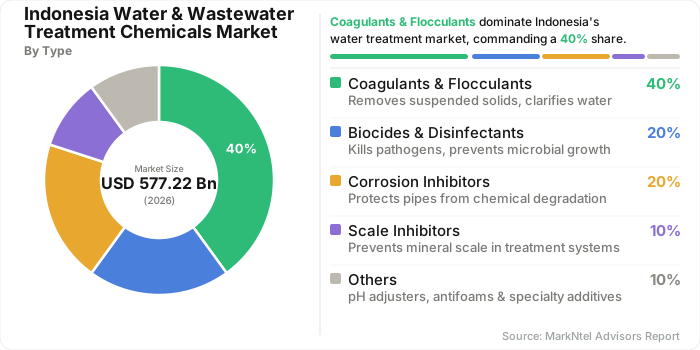
- By type, coagulants and flocculants dominate the market, accounting for approximately 40% of the total share.
- By end user, the municipal segment led the market, capturing around 38% share in 2026.
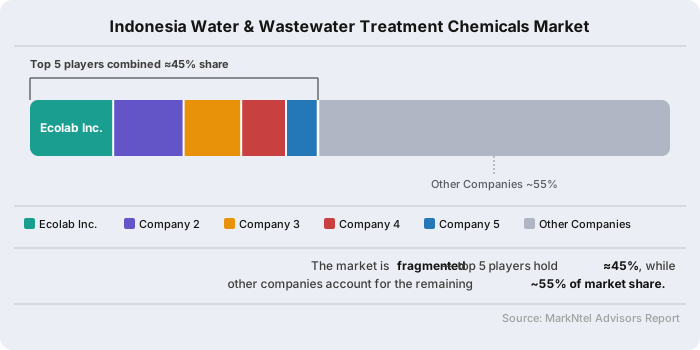
- The industry remains fragmented, with the top five players collectively accounting for nearly 45% of the total market share.
Indonesia Water & Wastewater Treatment Chemicals Market Size and Outlook
The Indonesia Water & Wastewater Treatment Chemicals Market size is projected to reach USD 577.22 billion in 2026 and further expand to USD 715.45 billion by 2032, growing at a CAGR of around 3.64% during 2026–2032. The market was previously valued at USD 542.77 billion in 2025.
Consistent expansion is expected to be observed in the Indonesia water & wastewater treatment Chemicals industry, driven by increasing government investment in water infrastructure and the rising demand for customized chemical solutions across industrial and municipal treatment applications.
Access to basic drinking water increased from 91.72% in 2023 to 92.42% in 2024, while safely managed drinking water reached 14.1%, reflecting gradual progress but also highlighting persistent gaps in treatment quality . At the same time, safely managed sanitation coverage remains limited at 10.25% in 2024 , indicating the continued need for wastewater treatment improvements across the country.
Regulatory developments are further reinforcing demand for treatment chemicals. The implementation of PERMENLHK 14/2024 has introduced more stringent environmental standards, requiring industries to meet tighter discharge norms. This has increased the adoption of advanced chemical treatment solutions to ensure compliance. Despite these measures, only 7.4% of municipal wastewater is safely treated, leaving a significant volume untreated and creating strong demand for expanded treatment capacity and chemical consumption.
Infrastructure investments are significantly accelerating the adoption of water and wastewater treatment chemicals. Programs supported by the World Bank, including the National Urban Water Supply Project (NUWSP), improved water access for 8.4 million people by 2024, backed by USD 160 million in blended financing. The integration of advanced technologies such as Hollow Fibre Nano Filtration (HFNF) is increasing reliance on specialty chemicals, while improved utility performance and reduced tariffs are driving higher water consumption and treatment volumes .
Furthermore, achieving the universal safe water access could increase Indonesia’s GDP by approximately 1.2 percentage points by 2045, reinforcing long-term sector investments by the Government of Indonesia.
A notable shift is the growing adoption of customized chemical formulations, tailored to diverse wastewater characteristics across industries. This trend supports precision dosing systems, enhances operational efficiency, and ensures compliance with evolving standards. Additionally, limitations of conventional treatment methods are accelerating the transition toward sustainable water treatment practices, driving demand for green chemicals and advanced coagulants.
Within this evolving landscape, coagulants and flocculants continue to dominate due to their essential role in removing suspended solids, turbidity, and organic contaminants, particularly as pollution levels rise and regulatory standards tighten. At the same time, the municipal sector remains the leading application area, driven by rapid urbanization and increasing government investments in public water supply and sanitation infrastructure, which are significantly boosting the consumption of treatment chemicals across potable water and wastewater systems.
Collectively, the water & wastewater treatment sector in Indonesia is shaped by regulatory enforcement, infrastructure expansion, and technological advancement. As it continues to address water quality gaps and scale treatment capacity, demand for efficient, customized, and sustainable chemical solutions is expected to grow steadily.
Indonesia Water & Wastewater Treatment Chemicals Market Key Indicators
- According to the UNICEF, Indonesia achieved 91.72% coverage of improved drinking water in 2024, yet only 11.8% of the population has access to safely managed water. This gap highlights the need for stronger treatment processes, increasing reliance on advanced purification chemicals to ensure potable water quality across expanding supply systems.
- Indonesia’s national plan (2020–2024) targeted 100% safe drinking water access, requiring investments of approximately USD 16.2 billion . Such large-scale funding reflects the urgency of infrastructure expansion and supports the growing deployment of water treatment solutions across municipal and regional systems.
- The government’s plan to inaugurate six new dams across five provinces by 2025 will significantly enhance raw water availability for domestic and industrial use . However, variable water quality from these sources will require extensive use of water conditioning chemicals to meet treatment and safety standards that will drive the demand of water & wastewater treatment chemicals.
- Data from the Asian Development Bank shows that 68% of Indonesia’s rivers are heavily polluted, with 70% of pollution originating from domestic waste . This creates sustained demand for coagulation and flocculation agents to treat contaminated water at both municipal and industrial levels.
Indonesia Water & Wastewater Treatment Chemicals Market Scope
| Category | Segments |
|---|---|
| By Type | Coagulants & Flocculants, Biocides & Disinfectants, Corrosion Inhibitors, Scale Inhibitors, pH Adjusters & Stabilizers, Defoamers, Chelating Agents, Others |
| By Application | Raw Water Treatment, Municipal Wastewater Treatment, Industrial Wastewater Treatment, Cooling Water Treatment, Boiler Water Treatment, Desalination |
| By End User | Municipal, Power Generation, Oil & Gas, Chemical Manufacturing, Mining, Food & Beverage, Pulp & Paper, Pharmaceuticals, Others |
Indonesia Water & Wastewater Treatment Chemicals Market Growth Drivers
Increasing Government Investment in Water Infrastructure
Indonesia’s water & wastewater treatment chemicals industry is strongly driven by increasing government investment in water and sanitation infrastructure, positioning the sector as a national development priority.
Under the National Medium-Term Development Plan (RPJMN), water and sanitation are identified as critical focus areas within Indonesia’s broader infrastructure pipeline, which exceeds USD 470 billion . This large-scale allocation reflects the government’s commitment to improving water access, wastewater treatment capacity, and overall environmental sustainability.
Public expenditure continues to rise with targeted funding for water-related projects. For 2025, Indonesia’s Ministry of Public Works proposed an additional USD 3.8 billion to support the expansion of drinking water systems and sanitation infrastructure. These investments are directed toward key regions, including Papua and the new capital city, Nusantara (IKN), where modern and efficient water treatment systems are being developed. Such initiatives are accelerating the installation of new treatment plants and upgrading existing facilities, directly increasing the demand for treatment chemicals across municipal and industrial applications.
The ongoing focus on water infrastructure development in Indonesia, urban sanitation expansion, and public water systems is expected to sustain long-term growth. As infrastructure scales nationwide, the need for efficient chemical treatment solutions will continue to rise.
Rising government-backed investments are creating a robust pipeline of water projects, which will significantly boost the adoption of water & wastewater treatment chemicals and drive consistent market expansion in the coming years.
Recent Trends
Growing Demand for Customized Chemical Solutions
A key trend in the Indonesia water & wastewater treatment chemicals industry is the increasing shift toward customized, application-specific chemical solutions tailored to diverse industrial and municipal requirements.
Indonesia’s wastewater profile varies significantly across sectors such as mining, palm oil, textiles, and food processing, creating the need for precision-based formulations rather than conventional, standardized chemicals. This has led to rising demand for chemicals that are specifically engineered to address variations in pH levels, organic load, heavy metals, and suspended solids.
In 2024, Gradiant launched its CURE Chemicals portfolio, comprising over 300 customized formulations globally. When combined with its active project presence in Indonesia, this reflects the growing shift toward application-specific chemical solutions in the country . Such offerings emphasize not only tailored formulations but also integrated services, including water analysis, on-site optimization, and performance monitoring, enabling end-users to achieve higher treatment efficiency and regulatory compliance.
This trend is further supported by the industry’s transition toward process optimization, industrial water management, and precision dosing technologies, which enhance treatment outcomes while reducing chemical wastage.
As industries increasingly prioritize efficiency and compliance, the demand for customized chemical solutions is expected to strengthen, reshaping the water & wastewater treatment chemicals market from bulk supply toward value-driven, performance-oriented offerings.
Indonesia Water & Wastewater Treatment Chemicals Market Opportunities and Challenges
Regulatory Compliance Challenges Driving Adoption of Green & Specialty Chemicals
A key challenge in the Indonesia water & wastewater treatment chemicals industry is the limited efficiency of conventional treatment chemicals in meeting increasingly stringent discharge standards.
Traditional solutions often lead to high sludge generation, residual toxicity, and inconsistent removal of complex pollutants, particularly in industrial wastewater with high COD and hazardous content. This increases operational costs related to sludge handling and reduces overall treatment efficiency. Additionally, many facilities face constraints in optimized chemical dosing and process control, especially in decentralized and mid-scale operations, making regulatory compliance more difficult as enforcement tightens.
This challenge is creating a strong opportunity through the rising demand for green chemicals and specialty treatment solutions. Recent 2024 research from IPB University highlights that chitosan-based bio-coagulants, at 0.75% dosage, effectively reduce pH, TSS, COD, and BOD, demonstrating their potential as biodegradable alternatives. This is further supported by government action, where Indonesia’s Ministry of Environment deployed 10,000 liters of eco-enzyme in the Cisadane River in 2026 to improve water quality .
Overall, the limitations of conventional treatment methods are accelerating the transition toward sustainable water treatment solutions in Indonesia. The growing adoption of green chemicals and advanced coagulants is expected to enhance treatment efficiency, ensure regulatory compliance, and drive long-term growth in the Indonesia Water & Wastewater Treatment Chemicals Market.
Segmentation Insights
Coagulants & Flocculants Dominate Indonesia Water & Wastewater Treatment Chemicals
Coagulants & flocculants account for approximately 40% of the overall revenue in the Indonesia Water & Wastewater Treatment Chemical industry, making them the dominant segment within the broader product landscape, which also includes biocides & disinfectants, corrosion inhibitors, scale inhibitors, pH adjusters & stabilizers, defoamers, chelating agents, and others.
Their leadership is primarily driven by their critical role in primary water treatment processes, where they enable the effective removal of suspended solids, turbidity, and organic matter from both raw and wastewater sources.
Indonesia’s high levels of surface water pollution and untreated wastewater significantly increase the need for coagulation and flocculation processes, especially in municipal treatment plants and industrial facilities. These chemicals are typically the first line of treatment, ensuring improved clarity and preparing water for downstream processes such as disinfection and filtration. As a result, they are consumed in larger volumes compared to other specialty chemicals.
Additionally, the expansion of municipal water treatment systems and growing demand for industrial wastewater treatment across sectors like mining, textiles, and palm oil processing are further driving segment growth. Their relatively lower cost, high efficiency, and compatibility with various treatment systems also support widespread adoption.
Overall, the dominance of this segment is reinforced by its essential function in water clarification processes and its direct impact on overall treatment efficiency. Based on type, the scope has been classified into:
- Coagulants & Flocculants
- Biocides & Disinfectants
- Corrosion Inhibitors
- Scale Inhibitors
- pH Adjusters & Stabilizers
- Defoamers
- Chelating Agents
- Others
Municipal Sector Dominates End-User Segment
The municipal segment accounts for nearly 38% of total revenue, making it the leading end-use sector within the Indonesia water & wastewater treatment chemicals industry, ahead of industries such as power generation, oil & gas, chemical manufacturing, mining, food & beverage, pulp & paper, and pharmaceuticals. This dominance is primarily driven by the country’s growing urban population and the increasing demand for reliable municipal water treatment and sanitation services.
Indonesia continues to face significant challenges in wastewater management, with a large portion of domestic wastewater remaining untreated. This has led to substantial investments in public water infrastructure, including the development and upgrading of water treatment plants, sewage systems, and distribution networks. As a result, the municipal sector requires consistent and high-volume consumption of treatment chemicals for applications such as coagulation, disinfection, and pH balancing.
Additionally, government initiatives aimed at expanding access to safe drinking water and improving sanitation coverage are accelerating the demand for urban wastewater management solutions. Municipal utilities also operate on a continuous basis, ensuring recurring chemical usage compared to more cyclical industrial demand.
The dominance of the municipal segment is supported by its critical role in public health protection, large-scale operations, and ongoing infrastructure expansion across Indonesia. The study analyzes the following key end-user segments:
- Municipal
- Power Generation
- Oil & Gas
- Chemical Manufacturing
- Mining
- Food & Beverage
- Pulp & Paper
- Pharmaceuticals
- Others
Indonesia Water & Wastewater Treatment Chemicals Market Competitive Analysis
The Indonesia Water & Wastewater Treatment Chemicals Market is fragmented in nature, with a wide presence of regional and international players operating across multiple chemical categories, including coagulants & flocculants, biocides & disinfectants, corrosion inhibitors, and scale inhibitors. The top five companies, including Ecolab Inc., Solenis LLC, Kemira Oyj, Kurita Water Industries Ltd., and Veolia Water Technologies, collectively account for approximately 45% of the total market share.
Key Water & Wastewater Treatment Chemical Companies in Indonesia
- PT Strivechem Indonesia
- PT Chempower Indonesia
- PT Kurita Indonesia
- Ecolab Inc.
- Kemira Oyj
- Kurita Water Industries Ltd.
- Veolia Water Technologies
- Solenis LLC
- BASF SE
- Toray Industries, Inc.
- Others
Indonesia Water & Wastewater Treatment Chemicals Industry News and Recent Developments:
August 2025: Ochemate Showcases Advanced Chemical & Membrane Solutions at INDO WATER 2025
Ochemate announced its participation in INDO WATER 2025 in Jakarta, presenting a multi-drive solution integrating chemicals, membrane products, and process optimization. The company highlighted high-performance formulations such as antiscalants, biocides, and customized cleaning chemicals, specifically optimized for Southeast Asia’s challenging water conditions, including high hardness and organic content.
Impact Analysis: This development reflects a clear industry shift toward integrated and customized chemical solutions rather than standalone products. By aligning chemical formulations with regional water characteristics, Ochemate’s approach enhances treatment efficiency, reduces operational costs, and improves compliance with stringent discharge standards. It also indicates rising demand for specialty chemicals and system-based solutions in Indonesia, particularly in industrial wastewater and desalination applications, strengthening the market’s transition toward performance-driven and application-specific chemical usage.
Frequently Asked Questions
- Market Segmentation
- Introduction
- Product Definition
- Research Process
- Assumptions
- Executive Summary
- Indonesia Water & Wastewater Treatment Chemicals Market Policies, Regulations, and Product Standards
- Indonesia Water & Wastewater Treatment Chemicals Production (Thousand Tons) Trend 2022-2032
- Indonesia Water and Wastewater Treatment Chemicals Production (Thousand Tons) Trend by Type
- Coagulants & Flocculants
- Biocides & Disinfectants
- Corrosion Inhibitors
- Scale Inhibitors
- pH Adjusters & Stabilizers
- Defoamers
- Chelating Agents
- Others
- Company Wise Production Plants and Statistics
- Installed Production Capacity
- Actual Production
- Planned Production Target
- Indonesia Water and Wastewater Treatment Chemicals Production (Thousand Tons) Trend by Type
- Indonesia Water and Wastewater Treatment Chemicals Pricing Analysis 2022-2032
- Indonesia Water and Wastewater Treatment Chemicals Pricing Trend (USD/Tons) 2022-2032
- Indonesia Water and Wastewater Treatment Chemicals Pricing Trend (USD/Tons) By Type 2022-2032
- Coagulants & Flocculants
- Biocides & Disinfectants
- Corrosion Inhibitors
- Scale Inhibitors
- pH Adjusters & Stabilizers
- Defoamers
- Chelating Agents
- Others
- Indonesia Water & Wastewater Treatment Chemicals Market Dynamics
- Growth Factors
- Challenges
- Indonesia Water & Wastewater Treatment Chemicals Market Hotspot & Opportunities
- Indonesia Water & Wastewater Treatment Chemicals Market Outlook, 2022-2032F
- Market Size & Outlook
- By Revenues (USD Million)
- By Volume (Tons)
- Market Share & Outlook
- By Type- Market Size & Forecast 2022-2032, USD Million
- Coagulants & Flocculants
- Biocides & Disinfectants
- Corrosion Inhibitors
- Scale Inhibitors
- pH Adjusters & Stabilizers
- Defoamers
- Chelating Agents
- Others
- By Application - Market Size & Forecast 2022-2032, USD Million
- Raw Water Treatment
- Municipal Wastewater Treatment
- Industrial Wastewater Treatment
- Cooling Water Treatment
- Boiler Water Treatment
- Desalination
- By End User - Market Size & Forecast 2022-2032, USD Million
- Municipal
- Power Generation
- Oil & Gas
- Chemical Manufacturing
- Mining
- Food & Beverage
- Pulp & Paper
- Pharmaceuticals
- Others
- By Region- Market Size & Forecast 2022-2032, USD Million
- Java
- Sumatra
- Kalimantan
- Sulawesi
- Others
- By Company
- Competition Characteristics
- Market Share & Analysis
- By Type- Market Size & Forecast 2022-2032, USD Million
- Market Size & Outlook
- Indonesia Coagulants Water & Wastewater Treatment Chemicals Market Outlook, 2022-2032
- Market Size & Outlook
- By Revenues (USD Million)
- By Volume (Tons)
- Market Share & Outlook
- By Application - Market Size & Forecast 2022-2032, USD Million
- By End User - Market Size & Forecast 2022-2032, USD Million
- Market Size & Outlook
- Indonesia Flocculants Water & Wastewater Treatment Chemicals Market Outlook, 2022-2032
- Market Size & Outlook
- By Revenues (USD Million)
- By Volume (Tons)
- Market Share & Outlook
- By Application - Market Size & Forecast 2022-2032, USD Million
- By End User - Market Size & Forecast 2022-2032, USD Million
- Market Size & Outlook
- Indonesia Biocides & Disinfectants Water & Wastewater Treatment Chemicals Market Outlook, 2022-2032
- Market Size & Outlook
- By Revenues (USD Million)
- By Volume (Tons)
- Market Share & Outlook
- By Application - Market Size & Forecast 2022-2032, USD Million
- By End User - Market Size & Forecast 2022-2032, USD Million
- Market Size & Outlook
- Indonesia Corrosion Inhibitors Water & Wastewater Treatment Chemicals Market Outlook, 2022-2032
- Market Size & Outlook
- By Revenues (USD Million)
- By Volume (Tons)
- Market Share & Outlook
- By Application - Market Size & Forecast 2022-2032, USD Million
- By End User - Market Size & Forecast 2022-2032, USD Million
- Market Size & Outlook
- Indonesia Scale Inhibitors Water & Wastewater Treatment Chemicals Market Outlook, 2022-2032
- Market Size & Outlook
- By Revenues (USD Million)
- By Volume (Tons)
- Market Share & Outlook
- By Application - Market Size & Forecast 2022-2032, USD Million
- By End User - Market Size & Forecast 2022-2032, USD Million
- Market Size & Outlook
- Indonesia pH Adjusters & Stabilizers Water & Wastewater Treatment Chemicals Market Outlook, 2022-2032
- Market Size & Outlook
- By Revenues (USD Million)
- By Volume (Tons)
- Market Share & Outlook
- By Application - Market Size & Forecast 2022-2032, USD Million
- By End User - Market Size & Forecast 2022-2032, USD Million
- Market Size & Outlook
- Indonesia Defoamers Water & Wastewater Treatment Chemicals Market Outlook, 2022-2032
- Market Size & Outlook
- By Revenues (USD Million)
- By Volume (Tons)
- Market Share & Outlook
- By Application - Market Size & Forecast 2022-2032, USD Million
- By End User - Market Size & Forecast 2022-2032, USD Million
- Market Size & Outlook
- Indonesia Chelating Agents Water & Wastewater Treatment Chemicals Market Outlook, 2022-2032
- Market Size & Outlook
- By Revenues (USD Million)
- By Volume (Tons)
- Market Share & Outlook
- By Application - Market Size & Forecast 2022-2032, USD Million
- By End User - Market Size & Forecast 2022-2032, USD Million
- Market Size & Outlook
- Indonesia Water & Wastewater Treatment Chemicals Market Key Strategic Imperatives for Success & Growth
- Competitive Outlook
- Company Profiles
- PT Strivechem Indonesia
- Business Description
- Product Portfolio
- Collaborations & Alliances
- Recent Developments
- Financial Details
- Others
- PT Chempower Indonesia
- Business Description
- Product Portfolio
- Collaborations & Alliances
- Recent Developments
- Financial Details
- Others
- PT Kurita Indonesia
- Business Description
- Product Portfolio
- Collaborations & Alliances
- Recent Developments
- Financial Details
- Others
- Ecolab Inc.
- Business Description
- Product Portfolio
- Collaborations & Alliances
- Recent Developments
- Financial Details
- Others
- Kemira Oyj
- Business Description
- Product Portfolio
- Collaborations & Alliances
- Recent Developments
- Financial Details
- Others
- Kurita Water Industries Ltd.
- Business Description
- Product Portfolio
- Collaborations & Alliances
- Recent Developments
- Financial Details
- Others
- Veolia Water Technologies
- Business Description
- Product Portfolio
- Collaborations & Alliances
- Recent Developments
- Financial Details
- Others
- Solenis LLC
- Business Description
- Product Portfolio
- Collaborations & Alliances
- Recent Developments
- Financial Details
- Others
- BASF SE
- Business Description
- Product Portfolio
- Collaborations & Alliances
- Recent Developments
- Financial Details
- Others
- Toray Industries, Inc.
- Business Description
- Product Portfolio
- Collaborations & Alliances
- Recent Developments
- Financial Details
- Others
- Others
- PT Strivechem Indonesia
- Company Profiles
- Disclaimer
MarkNtel Advisors follows a robust and iterative research methodology designed to ensure maximum accuracy and minimize deviation in market estimates and forecasts. Our approach combines both bottom-up and top-down techniques to effectively segment and quantify various aspects of the market. A consistent feature across all our research reports is data triangulation, which examines the market from three distinct perspectives to validate findings. Key components of our research process include:
1. Scope & Research Design At the outset, MarkNtel Advisors define the research objectives and formulate pertinent questions. This phase involves determining the type of research—qualitative or quantitative—and designing a methodology that outlines data collection methods, target demographics, and analytical tools. They also establish timelines and budgets to ensure the research aligns with client goals.
2. Sample Selection and Data Collection In this stage, the firm identifies the target audience and determines the appropriate sample size to ensure representativeness. They employ various sampling methods, such as random or stratified sampling, based on the research objectives. Data collection is carried out using tools like surveys, interviews, and observations, ensuring the gathered data is reliable and relevant.
3. Data Analysis and Validation Once data is collected, MarkNtel Advisors undertake a rigorous analysis process. This includes cleaning the data to remove inconsistencies, employing statistical software for quantitative analysis, and thematic analysis for qualitative data. Validation steps are taken to ensure the accuracy and reliability of the findings, minimizing biases and errors.

4. Data Forecast and FinalizationThe final phase involves forecasting future market trends based on the analyzed data. MarkNtel Advisors utilize predictive modeling and time series analysis to anticipate market behaviors. The insights are then compiled into comprehensive reports, featuring visual aids like charts and graphs, and include strategic recommendations to inform client decision-making
We offer flexible licensing options to cater to varying organizational needs. Choose the pricing pack that best suits your requirements:
Buy Now Inquire Before Buying
 Request Customization
 Talk to our Consultant







