

By Battery Chemistry (Prussian Blue/White, Layered Oxide, Polyanionic, Organic, Others), By Form Factor (Cylindrical, Prismatic, Pouch), By Application (Stationary Energy Storage, Transportation, Cons... ... Transportation, Consumer Electronics, Industrial Backup Power, Marine & Other Applications), By End-User Industry (Utility, Residential, Commercial & Industrial, Automotive), and others Read more
- Automotive
- Sep 2026
- 180
- PDF, Excel, PPT
China Sodium-Ion Battery Market Key Takeaways
- The China sodium-ion battery market size was valued at USD 0.22 billion in 2025 and is projected to grow from USD 0.27 billion in 2026 to USD 1.45 billion by 2032.
- The industry is projected to sustain growth at a steady CAGR of 32.33% during 2026-2032.
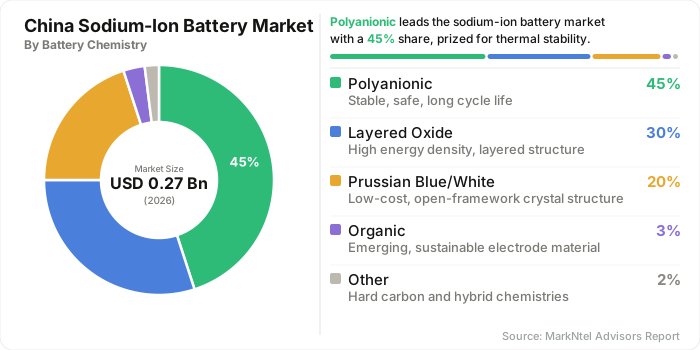
- By battery chemistry, polyanionic chemistry batteries holds a significant share of about 45% in 2026.
- By application, stationary energy storage seized a significant share of about 73% in 2026.
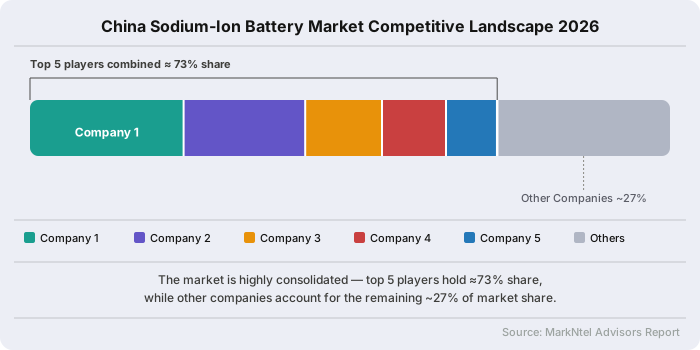
- The industry is moderately consolidated. However, the top five players collectively account for nearly 73% share.
China Sodium-Ion Battery Market Size and Outlook
The China sodium-ion battery market size was valued at USD 0.22 billion in 2025 and is projected to grow from USD 0.27 billion in 2026 to USD 1.45 billion by 2032. Along with this, the market is estimated to grow at a CAGR of around 32.33% during the forecast period, i.e., 2026-32.
The demand for sodium-ion batteries in China is being propelled by rapid electric vehicle adoption, expanding grid-scale energy storage, and government support for next-generation battery technologies. The launch of the first mass-produced sodium-ion passenger EV by CATL and Changan in February 2026 demonstrates accelerating commercialization. Policy support is also strengthening, with sodium-ion batteries receiving a temporary consumption-tax exemption from September 2026 through December 2028. Future opportunities include energy storage, commercial vehicles, two-wheelers, and low-cost EVs. With improving energy density, manufacturing scale, and supply-chain localization, the market has strong long-term growth potential.
China Sodium-Ion Battery Market Key Indicators
- China's NEV market provides a major demand pool for sodium-ion batteries. In the first seven months of 2026, NEV sales reached 9.0 million units, up nearly 10% year on year, while NEVs represented more than 50% of cumulative new-car sales. In July alone, NEV sales exceeded 1.56 million units, up 23.7% year on year. The expanding EV base creates substantial opportunities for sodium-ion batteries in cost-sensitive and short-to-medium-range vehicles.
- In February 2026, CATL and Changan unveiled the world's first mass-production passenger vehicle using sodium-ion batteries, with market launch scheduled for mid-2026. CATL's Naxtra battery provides energy density of up to 175 Wh/kg and enables more than 400 km of range, demonstrating that sodium-ion technology is moving into mainstream automotive applications.
- Large-scale R&D investment is strengthening China's sodium-ion technology pipeline. CATL reported that it had invested nearly USD 1.39 billion over the previous decade in sodium-ion R&D and accumulated more than 1,600 patent families and over 200 globally granted patents by June 2026. The company also developed capabilities to produce tens of thousands of tonnes of sodium-ion anode and cathode materials. Such investment improves technological maturity and supports domestic supply-chain development.
- China shipped an estimated 8.1 GWh of sodium-ion batteries in 2025, per EVTank data, up sharply from 3.7 GWh in 2024 (428% YoY growth) and 0.7 GWh in 2023. Energy storage applications absorbed over 60% of volume. EVTank projects shipments reaching 435 GWh by 2030, implying roughly 50x growth over five years, driven by AI data-center storage demand and lithium-sodium hybrid deployment models across grid and industrial applications.
- China's sodium-ion manufacturing footprint expanded rapidly: 254.7 GWh of cell capacity was planned across 48 projects, representing approximately USD 18.70 billion in combined investment, in 2024 alone, while a further 179.5 GWh was newly announced across 37 projects during January–September 2025. Individual plants such as Guangde Qingna's 20 GWh Sichuan facility, backed by approximately USD 0.88 billion, illustrate how capacity commitments increasingly exceed 20 GWh per project.
China Sodium-Ion Battery Market Scope
| Category | Segments |
|---|---|
| By Battery Chemistry | Prussian Blue/White, Layered Oxide, Polyanionic, Organic, Others |
| By Form Factor | Cylindrical, Prismatic, Pouch |
| By Application | Stationary Energy Storage, Transportation, Consumer Electronics, Industrial Backup Power, Marine & Other Applications |
| By End-User Industry | Utility, Residential, Commercial & Industrial, Automotive |
China Sodium-Ion Battery Market Growth Drivers
Rapid Expansion of Grid-Scale Energy Storage Accelerating Sodium-Ion Battery Adoption
China’s rapidly expanding energy-storage infrastructure is creating strong demand for alternative battery chemistries, making grid-scale storage a key growth driver for sodium-ion batteries. By the end of 2025, China’s new-type energy-storage capacity reached 136 GW/351 GWh, providing a substantial addressable market for cost-efficient and resource-diversified storage technologies. The expansion is closely linked to China’s rapid renewable energy deployment, which increases the requirement for flexible storage to manage intermittency and improve grid stability.
The growing opportunity is already translating into GWh-scale commercial commitments within China. In April 2026, CATL and HyperStrong signed a three-year, 60 GWh sodium-ion energy-storage agreement, representing the world's largest sodium-ion commercial order at the time. CATL also confirmed that it will begin delivering its first sodium-ion energy-storage systems to Chinese customers in September 2026, with cumulative shipments expected to reach 1 GWh by the end of 2026.
Manufacturing capacity is simultaneously scaling to support this demand. CATL has added 40 GWh of annual sodium-ion capacity at its Fuding base, while its Jining facility in Shandong has 160 GWh of planned capacity. Consequently, China's expanding energy-storage requirement is helping move sodium-ion batteries from pilot-stage applications toward large-scale commercial deployment, strengthening the market's growth prospects.
Recent Trends
Rapid Shift Toward NFPP Cathodes as Commercial Production Scales
A key trend in China’s sodium-ion battery industry is the rapid shift toward polyanion-based sodium iron phosphate (NFPP) cathodes, particularly as manufacturers scale commercial production. Shanghai Metals Market (SMM) reported that NFPP's share of China's sodium-ion cathode materials reached 69% in July 2025, while overall sodium-ion battery production continued to expand. SMM also noted that the rising NFPP share occurred alongside the accelerated release of hard-carbon anode capacity, demonstrating that the shift was occurring across the industrial chain rather than only at the R&D stage.
The trend subsequently strengthened. Reporting based on SMM data indicated that NFPP accounted for more than 70% of China's sodium-ion cathode output during multiple periods in late 2025 and early 2026, while layered-oxide materials lost share as producers adjusted their product mix. This change reflects manufacturers' increasing preference for NFPP's structural stability, cost suitability and durability, which are particularly valuable in stationary storage applications.
Importantly, the shift is occurring while China expands sodium-ion manufacturing capacity and applications. SMM's July 2025 data showed hard-carbon anode production more than doubled year-on-year, indicating broader supply-chain scaling alongside NFPP adoption. Consequently, NFPP is emerging as the leading commercially oriented cathode chemistry, positioning it as an important trend shaping China's sodium-ion battery technology mix.
China Sodium-Ion Battery Market Opportunities and Challenges
Lower Energy Density Limits EV Adoption, Boosting Stationary Storage Opportunities
Lower energy density remains a key challenge for China's sodium-ion battery market, particularly in long-range passenger EVs where driving range and battery-pack size are important purchasing factors. According to the IEA, the latest sodium-ion cells achieve up to 175 Wh/kg, compared with up to 205 Wh/kg for LFP. This translates into a potential driving range of around 350 km for an average sodium-ion SUV, compared with 400–600 km for comparable lithium-ion vehicles. The performance gap therefore limits sodium-ion's ability to compete directly with China's highly established LFP technology.
This limitation creates an opportunity for sodium-ion batteries to expand in stationary and long-duration energy storage, where lower energy density is less restrictive because systems are not constrained by vehicle weight or driving range. A strong Chinese industry example is CATL's April 2026 agreement with HyperStrong for 60 GWh of sodium-ion battery supply over three years, described by CATL as the world's largest sodium-ion energy-storage cooperation agreement. CATL stated that sodium-ion systems can simplify integration in long-duration storage, reduce auxiliary energy losses, and improve overall plant efficiency.
The opportunity is gaining further validation through commercialization: in June 2026, CATL unveiled its TENER Sodium Energy Storage System and announced plans for 1 GWh of cumulative shipments in 2026, while its Fuding facility is adding 40 GWh of annual sodium-ion capacity and its Jining base has planned 160 GWh.
Segmentation Insights
Polyanionic Chemistry Accounts for Approximately 45% of China’s Sodium-Ion Battery Demand
Polyanionic chemistry remains the leading battery type in China’s sodium-ion battery industry, accounting for approximately 45% of the chemistry mix. The dominance is primarily driven by the rapid adoption of sodium iron phosphate (NFPP), which offers strong structural stability, safety, long cycle life, and cost advantages. Industry data indicate that NFPP's share of China's sodium-ion cathode output consistently exceeded 70% from late 2025 into early 2026, demonstrating its increasing commercial preference.
The chemistry is particularly suited to stationary energy storage, where durability and cost are more important than maximum energy density. In addition, recent research highlights NFPP's low-cost composition and long-cycle performance, supporting its commercialization potential. Consequently, manufacturers are increasingly shifting production toward polyanionic cathodes as China's sodium-ion industry scales from pilot projects to commercial applications. Based on battery chemistry, the scope has been segmented into
- Prussian Blue/White
- Layered Oxide
- Polyanionic
- Organic
- Others
Stationary Energy Storage Accounts for Approximately 73% of Revenue
Stationary energy storage represents the largest application segment in China’s sodium-ion battery market, accounting for approximately 73% of total revenue. Its leadership is supported by sodium-ion batteries’ suitability for large-scale storage, where lower energy density is less restrictive than in transportation. In March 2025, a 200 MW/400 MWh hybrid energy-storage station in Yunnan achieved full-capacity grid connection, incorporating 40 MWh of sodium-ion batteries supplied by HiNa Battery. The project became China’s largest lithium-sodium hybrid storage station and the country’s first 1-hour-rate sodium-ion storage project, demonstrating sodium-ion batteries’ suitability for high-rate grid applications and renewable energy integration.
This deployment demonstrates that sodium-ion technology is progressing beyond pilot testing toward commercial-scale stationary applications, supporting energy storage as the principal revenue-generating application. In addition, CATL and HyperStrong announced the world’s largest sodium-ion energy-storage agreement in May 2026, further strengthening the technology’s stationary-storage pipeline. Growing renewable-energy integration, grid-balancing requirements, and sodium-ion’s strong safety and low-temperature characteristics are therefore positioning stationary storage as the primary revenue-generating application. By application, the scope has been classified into
- Stationary Energy Storage
- Transportation
- Consumer Electronics
- Industrial Backup Power
- Marine & Other Applications
China Sodium-Ion Battery Market Competitive Analysis
Top 5 Companies Account for Approximately 73% Market Share
The China sodium-ion battery industry is moderately consolidated, with leading companies such as Ningbo Veken Technology Co., Ltd., Contemporary Amperex Technology Co., Limited, BYD Company Limited, Jiangsu Highstar Power Co., Ltd., and Tianneng Battery Group Co., Ltd. collectively accounting for an estimated 73% of reported sodium-ion battery shipments.
Key Players in China Sodium-Ion Battery Market
- Ningbo Veken Technology Co., Ltd.
- Contemporary Amperex Technology Co., Limited
- BYD Company Limited
- Jiangsu Highstar Power Co., Ltd.
- Tianneng Battery Group Co., Ltd.
- EVE Energy Co., Ltd.
- Guangzhou Great Power Energy & Technology Co., Ltd.
- Sunwoda Electronic Co., Ltd.
- SVOLT Energy Technology Co., Ltd.
- HiNa Battery Technology Co., Ltd.
- Others
China Sodium-Ion Battery Industry News and Recent Developments
February 2026: CATL and Changan Launch First Mass-Produced Sodium-Ion EV
On February 5, 2026, CATL and Changan launched what they described as the world's first mass-produced passenger vehicle equipped with sodium-ion batteries. CATL's Naxtra battery provides energy density of up to 175 Wh/kg, while the vehicle can achieve more than 400 km of electric range. The launch represents a major commercialization milestone by bringing sodium-ion technology into mainstream passenger EV production.
Impact Analysis: The launch accelerates sodium-ion battery commercialization in China by demonstrating their viability in mass-produced passenger EVs. The more than 400 km range helps address concerns over sodium-ion's traditionally lower energy density, while CATL's large-scale production capabilities can support cost reductions. The development is likely to encourage other Chinese automakers and battery manufacturers to integrate sodium-ion technology into mainstream, cost-sensitive electric vehicles.
April 2025: CATL Unveils Naxtra as First Mass-Produced Sodium-Ion Battery
On April 21, 2025, CATL unveiled Naxtra, which it described as the world's first mass-producible sodium-ion battery. The battery achieved an energy density of up to 175 Wh/kg, while CATL highlighted improved low-temperature performance and safety. The launch marked an important transition of sodium-ion technology from development toward mass production for electric vehicles and other applications
Impact Analysis: The Naxtra unveiling established a concrete pathway for commercial-scale sodium-ion battery production in China. Its 175 Wh/kg energy density narrows the performance gap with lithium-ion technologies, while improved low-temperature operation strengthens its suitability for diverse driving conditions. The launch also provides a technological foundation for subsequent vehicle applications, helping accelerate investment, manufacturing scale-up, and broader adoption of sodium-ion batteries across China's electric-mobility ecosystem.
- Market Segmentation
- Introduction
- Product Definition
- Research Process
- Assumptions
- Executive Summary
- China Sodium-Ion Battery Supply Chain Analysis
- China Sodium-Ion Battery Import/Export Data Analysis
- China Sodium-Ion Battery Market Policies, Regulations, and Product Standards
- China Sodium-Ion Battery Market Production Trend (Units) 2022-2032
- China Sodium-Ion Battery Market Production Trend (Units) By Battery Chemistry
- Prussian Blue/White
- Layered Oxide
- Polyanionic
- Organic
- Others
- Company Wise Production Plants and Statistics
- Installed Production Capacity
- Actual Production
- Planned Production Target
- China Sodium-Ion Battery Market Production Trend (Units) By Battery Chemistry
- China Sodium-Ion Battery Market Pricing Analysis 2022-2032
- China Sodium-Ion Battery Market Pricing Trend (USD/Units) 2022-2032
- China Sodium-Ion Battery Market Pricing Trend (USD/Units) By Regions 2022-2032
- East China
- North China
- South China
- Central China
- Southwest China
- Northwest China
- Northeast China
- China Sodium-Ion Battery Market Pricing Trend (USD/Units) By Battery Chemistry 2022-2032
- Prussian Blue/White
- Layered Oxide
- Polyanionic
- Organic
- Others
- China Sodium-Ion Battery Market Trends & Developments
- China Sodium-Ion Battery Market Dynamics
- Growth Factors
- Challenges
- China Sodium-Ion Battery Market Hotspot & Opportunities
- China Sodium-Ion Battery Market Outlook, 2022-2032
- Market Size & Outlook
- By Revenues (USD Million)
- By Quantity Sold (Thousand Units)
- Market Segmentation & Outlook
- By Battery Chemistry- Market Size & Forecast 2022-2032, USD Million & Thousand Units
- Prussian Blue/White
- Layered Oxide
- Polyanionic
- Organic
- Others
- By Form Factor- Market Size & Forecast 2022-2032, USD Million & Thousand Units
- Cylindrical
- Prismatic
- Pouch
- By Application- Market Size & Forecast 2022-2032, USD Million & Thousand Units
- Stationary Energy Storage
- Transportation
- Consumer Electronics
- Industrial Backup Power
- Marine & Other Applications
- By End-User Industry- Market Size & Forecast 2022-2032, USD Million & Thousand Units
- Utility
- Residential
- Commercial & Industrial
- Automotive
- By Region- Market Size & Forecast 2022-2032, USD Million & Thousand Units
- East China
- North China
- South China
- Central China
- Southwest China
- Northwest China
- Northeast China
- By Company
- Competition Characteristics
- Market Share & Analysis
- By Battery Chemistry- Market Size & Forecast 2022-2032, USD Million & Thousand Units
- Market Size & Outlook
- China Prussian Blue/White Sodium-Ion Battery Market Outlook, 2022-2032
- Market Size & Outlook
- By Revenues (USD Million)
- By Quantity Sold (Thousand Units)
- Market Segmentation & Outlook
- By Form Factor- Market Size & Forecast 2022-2032, USD Million & Thousand Units
- By Application- Market Size & Forecast 2022-2032, USD Million & Thousand Units
- By End-User Industry- Market Size & Forecast 2022-2032, USD Million & Thousand Units
- By Region- Market Size & Forecast 2022-2032, USD Million & Thousand Units
- Market Size & Outlook
- China Layered Oxide Sodium-Ion Battery Market Outlook, 2022-2032
- Market Size & Outlook
- By Revenues (USD Million)
- By Quantity Sold (Thousand Units)
- Market Segmentation & Outlook
- By Form Factor- Market Size & Forecast 2022-2032, USD Million & Thousand Units
- By Application- Market Size & Forecast 2022-2032, USD Million & Thousand Units
- By End-User Industry- Market Size & Forecast 2022-2032, USD Million & Thousand Units
- By Region- Market Size & Forecast 2022-2032, USD Million & Thousand Units
- Market Size & Outlook
- China Polyanionic Sodium-Ion Battery Market Outlook, 2022-2032
- Market Size & Outlook
- By Revenues (USD Million)
- By Quantity Sold (Thousand Units)
- Market Segmentation & Outlook
- By Form Factor- Market Size & Forecast 2022-2032, USD Million & Thousand Units
- By Application- Market Size & Forecast 2022-2032, USD Million & Thousand Units
- By End-User Industry- Market Size & Forecast 2022-2032, USD Million & Thousand Units
- By Region- Market Size & Forecast 2022-2032, USD Million & Thousand Units
- Market Size & Outlook
- China Organic Sodium-Ion Battery Market Outlook, 2022-2032
- Market Size & Outlook
- By Revenues (USD Million)
- By Quantity Sold (Thousand Units)
- Market Segmentation & Outlook
- By Form Factor- Market Size & Forecast 2022-2032, USD Million & Thousand Units
- By Application- Market Size & Forecast 2022-2032, USD Million & Thousand Units
- By End-User Industry- Market Size & Forecast 2022-2032, USD Million & Thousand Units
- By Region- Market Size & Forecast 2022-2032, USD Million & Thousand Units
- Market Size & Outlook
- China Sodium-Ion Battery Market Key Strategic Imperatives for Success & Growth
- Competitive Outlook
- Company Profiles
- Ningbo Veken Technology Co., Ltd.
- Business Description
- Product Portfolio
- Collaborations & Alliances
- Recent Developments
- Financial Details
- Others
- Contemporary Amperex Technology Co., Limited
- Business Description
- Product Portfolio
- Collaborations & Alliances
- Recent Developments
- Financial Details
- Others
- BYD Company Limited
- Business Description
- Product Portfolio
- Collaborations & Alliances
- Recent Developments
- Financial Details
- Others
- Jiangsu Highstar Power Co., Ltd.
- Business Description
- Product Portfolio
- Collaborations & Alliances
- Recent Developments
- Financial Details
- Others
- Tianneng Battery Group Co., Ltd.
- Business Description
- Product Portfolio
- Collaborations & Alliances
- Recent Developments
- Financial Details
- Others
- EVE Energy Co., Ltd.
- Business Description
- Product Portfolio
- Collaborations & Alliances
- Recent Developments
- Financial Details
- Others
- Guangzhou Great Power Energy & Technology Co., Ltd.
- Business Description
- Product Portfolio
- Collaborations & Alliances
- Recent Developments
- Financial Details
- Others
- Sunwoda Electronic Co., Ltd.
- Business Description
- Product Portfolio
- Collaborations & Alliances
- Recent Developments
- Financial Details
- Others
- SVOLT Energy Technology Co., Ltd.
- Business Description
- Product Portfolio
- Collaborations & Alliances
- Recent Developments
- Financial Details
- Others
- HiNa Battery Technology Co., Ltd.
- Business Description
- Product Portfolio
- Collaborations & Alliances
- Recent Developments
- Financial Details
- Others
- Ningbo Veken Technology Co., Ltd.
- Company Profiles
- Disclaimer

MarkNtel Advisors follows a robust and iterative research methodology designed to ensure maximum accuracy and minimize deviation in market estimates and forecasts. Our approach combines both bottom-up and top-down techniques to effectively segment and quantify various aspects of the market. A consistent feature across all our research reports is data triangulation, which examines the market from three distinct perspectives to validate findings. Key components of our research process include:
1. Scope & Research Design At the outset, MarkNtel Advisors define the research objectives and formulate pertinent questions. This phase involves determining the type of research—qualitative or quantitative—and designing a methodology that outlines data collection methods, target demographics, and analytical tools. They also establish timelines and budgets to ensure the research aligns with client goals.
2. Sample Selection and Data Collection In this stage, the firm identifies the target audience and determines the appropriate sample size to ensure representativeness. They employ various sampling methods, such as random or stratified sampling, based on the research objectives. Data collection is carried out using tools like surveys, interviews, and observations, ensuring the gathered data is reliable and relevant.
3. Data Analysis and Validation Once data is collected, MarkNtel Advisors undertake a rigorous analysis process. This includes cleaning the data to remove inconsistencies, employing statistical software for quantitative analysis, and thematic analysis for qualitative data. Validation steps are taken to ensure the accuracy and reliability of the findings, minimizing biases and errors.

4. Data Forecast and FinalizationThe final phase involves forecasting future market trends based on the analyzed data. MarkNtel Advisors utilize predictive modeling and time series analysis to anticipate market behaviors. The insights are then compiled into comprehensive reports, featuring visual aids like charts and graphs, and include strategic recommendations to inform client decision-making
We’d love to understand what matters most to you.