India Tire Tube Market Research Report: Growth Drivers & Forecast (2026-2032)
By Tube Type (Standard Inner Tubes, Heavy-Duty Inner Tubes, Reinforced Inner Tubes, Puncture-Resistant Tubes), By Vehicle Type (Passenger Car (Hatchback, Sedan, SUV), Light Commerc ... ial Vehicle (Light Trucks, Light Buses, Pick-up Trucks and Vans), Medium and Heavy Commercial Vehicles (Buses, Trucks), Off-the-Road (OTR) (Earthmoving Equipment, Agricultural Vehicles, Material Handling Vehicles), Two-Wheeler (Motorcycle, Scooter, Moped), Three-Wheeler (Passenger Carrier, Cargo Carrier)), By Material (Butyl Rubber Tubes, Natural Rubber Tubes), By Valve Type (Straight Valve, Bent Valve, Others), By Demand Type (OEM, Replacement), By Tire Size (Up to 12 Inches, 13–16 Inches, 17–20 Inches, Above 20 Inches), By Distribution Channel (Direct Sales, Authorized Dealers & Distributors, Multi-brand Tire Retailers, Exclusive Brand Outlets, Online Sales), and others Read more
- Automotive
- Aug 2026
- Pages 145
- Report Format: PDF, Excel, PPT
India Tire Tube Market
Projected 9.02% CAGR from 2026 to 2032
Study Period
2026-2032
Market Size (2026)
USD 237 Million
Market Size (2032)
USD 398 Million
Base Year
2025
Projected CAGR
9.02%
Leading Segments
By Tube Type: Standard Inner Tubes
India Tire Tube Market Key Takeaways
- India tire tube market size was valued at USD 210 million in 2025 and is projected to grow from USD 237 million in 2026 to USD 398 million by 2032.
- The market is projected to register a CAGR of 9.02% during 2026–2032.
- By tube type, standard inner tubes led the market with a 72% share in 2026.
- By vehicle type, two-wheelers constituted a 54% share in the market in 2026.
- The industry is moderately consolidated, with the top five players collectively accounting for approximately 58% of the market share in 2026.
India Tire Tube Market Size and Outlook
The tire tube market in India was valued at USD 210 million in 2025 and is currently standing at USD 237 million in 2026. The industry is projected to grow to USD 398 million by 2032, showcasing a CAGR of around 9.02% during the forecast period, i.e., 2026–32.
The market is benefiting from the country's expanding automotive ecosystem, higher vehicle utilization, and a large replacement base that continues to generate consistent demand across passenger vehicles, commercial vehicles, two-wheelers, tractors, and off-road equipment. While tubeless tyres are gaining adoption in several vehicle categories, tube type products continue to hold relevance in agricultural and heavy-duty applications, ensuring stable demand. The industry is also strengthening its manufacturing base through significant capacity additions made during the past few years, improving domestic supply capabilities and supporting future consumption.
The market is also benefiting from improving export competitiveness and long-term industry expansion plans. India's tyre exports reached a record high during FY2026, growing 9% year on year, reflecting stronger international acceptance of domestically manufactured products despite a challenging global trade environment. Looking ahead, the industry's Viksit Bharat 2047 roadmap projects production volumes to increase nearly fourfold, supported by replacement demand, electrification, premium product adoption, export expansion, and stronger Indian brands in global markets. This positive outlook is further reinforced by the growing international recognition of Indian tyre manufacturers, with multiple domestic brands ranked among the world's strongest tyre brands in 2026.
Government initiatives and regulatory measures continue to strengthen the market's long term foundation through quality, safety, and domestic manufacturing support. BIS Quality Control Orders mandate compliance for automotive tubes and for cycle and rickshaw tyres and tubes, ensuring standardized quality across key product categories. During 2026, industry and government also advanced discussions on the implementation of AIS 142, while regulatory efforts increasingly focused on testing infrastructure, product safety, and sustainability. Additionally, the Government imposed anti-dumping duties on selected rubber chemicals in June 2026, supporting domestic manufacturing competitiveness and encouraging greater resilience across the tire tube value chain.
India Tire Tube Market Key Indicators
- India’s automotive sector recorded strong growth in FY 2025-26, with total domestic sales of 46.43 lakh passenger vehicles, 10.80 lakh commercial vehicles, 8.36 lakh three-wheelers, and 2.17 crore two-wheelers. Two-wheeler sales increased by 10.7% year-on-year, reaching their highest-ever level in a financial year. Since motorcycles and scooters represent one of the largest applications for tire tubes, higher two-wheeler sales increase the installed base of tires and subsequently support demand for replacement tubes, particularly in tube-type motorcycle and scooter applications.
- India's two-wheeler market crossed 20.50 million units in calendar 2025, registering 4.9% growth compared with 2024. The sustained expansion of the two-wheeler fleet increases the number of tires requiring periodic replacement due to punctures, wear, and damage, thereby creating recurring demand for tire tubes in applicable tube-type tires. The large installed base also supports the aftermarket channel for replacement tubes.
- India's tractor industry recorded 11.60 lakh domestic tractor sales in FY 2025-26, up from approximately 9.40 lakh units in FY 2024-25, representing growth of about 23.5%. Agricultural tractors extensively operate in rural and off-road environments where tire damage, punctures, and maintenance requirements can be relatively high. Rising tractor sales therefore expand the installed base of agricultural tires and support demand for replacement tire tubes used in compatible tractor tires.
- India's national highway network reached approximately 146,560 km in 2025, compared with 91,287 km in 2014, while four-lane-and-above national highways increased to 43,512 km. Expansion of road infrastructure increases vehicle utilization, freight movement, intercity transportation, and rural connectivity. Higher vehicle-kilometers traveled increases tire wear and the frequency of tire maintenance and replacement, indirectly supporting demand for tire tubes in tube-type applications across two-wheelers, agricultural vehicles, and other commercial vehicles.
- India's natural rubber consumption reached approximately 1.40 million metric tons in FY 2024-25, of which 946,230 metric tons, or nearly 68%, was consumed by the auto-tire and tube sector. The concentration of rubber consumption in tire and tube manufacturing demonstrates the strong linkage between India's rubber-processing industry and the tire tube market. Continued growth in tire and tube production can therefore increase demand for natural rubber, while fluctuations in rubber availability and prices can influence tube manufacturing costs and market pricing.
- High-speed electric two-wheeler penetration in India increased from 0.2% of two-wheeler sales in FY 2020 to 5.8% in FY 2025, with high-speed electric two-wheeler retail volumes increasing from approximately 27,000 units to 1.15 million units during the period. The rapid electrification of the two-wheeler fleet represents a structural shift for the tire industry because EV manufacturers increasingly use tubeless tire configurations. Consequently, rising EV penetration can act as a disruptive indicator for the tire tube market by reducing the addressable market for tubes in newly sold vehicles, even as the overall replacement tire market continues to expand.
India Tire Tube Market Scope
| Category | Segments |
|---|---|
| By Tube Type | Standard Inner Tubes, Heavy-Duty Inner Tubes, Reinforced Inner Tubes, Puncture-Resistant Tubes |
| By Vehicle Type | Passenger Car (Hatchback, Sedan, SUV), Light Commercial Vehicle (Light Trucks, Light Buses, Pick-up Trucks and Vans), Medium and Heavy Commercial Vehicles (Buses, Trucks), Off-the-Road (OTR) (Earthmoving Equipment, Agricultural Vehicles, Material Handling Vehicles Two-Wheeler (Motorcycle, Scooter, Moped), Three-Wheeler (Passenger Carrier, Cargo Carrier |
| By Material | Butyl Rubber Tubes, Natural Rubber Tubes |
| By Valve Type | Straight Valve, Bent Valve, Others |
| By Demand Type | OEM, Replacement |
| By Tire Size | Up to 12 Inches, 13–16 Inches, 17–20 Inches, Above 20 Inches |
| By Distribution Channel | Direct Sales, Authorized Dealers & Distributors, Multi-brand Tire Retailers, Exclusive Brand Outlets, Online Sales |
India Tire Tube Market Growth Drivers
Growing Two Wheeler and Three Wheeler Sales Driving Replacement Tube Demand
The strong recovery in India's two-wheeler and three-wheeler sector is creating sustained demand for tire tubes, particularly through the replacement market where tube-type tyres continue to dominate a significant share of entry-level motorcycles, scooters, and three-wheelers. In September 2025, the GST Council reduced GST on two-wheelers and three-wheelers up to 350cc from 28% to 18%, making vehicles more affordable and encouraging higher purchases. The tax revision was followed by price reductions announced by leading manufacturers, contributing to stronger retail demand during the subsequent months.
The impact of these measures continued throughout FY2026 as vehicle sales remained robust across both wholesale and retail channels. Two-wheeler wholesales increased by 10.7% to 21.7 million units, while three-wheeler wholesales grew by 12.8% to 836,000 units during FY2026. Retail momentum was equally strong, with two wheeler registrations surpassing 21.4 million units, reflecting broad based demand led largely by rural markets and replacement purchases. Expanding sales are also encouraging aftermarket investments, as manufacturers continue strengthening their retail presence through dedicated tyre and tube outlets, supporting wider product availability and reinforcing long term demand for tire tubes across India's mobility ecosystem.
Recent Trends
EV Specific Tire and Tube Development Supported by Domestic Manufacturing Initiatives
The growing electrification of India's mobility sector is encouraging tire and tube manufacturers to develop products tailored for electric two wheelers and three wheelers, which require improved durability, lower rolling resistance, and higher load carrying capability. This transition is being supported by the production linked incentive scheme for the automobile and auto component industry, which was extended through FY2027 to FY2028 in 2025. The scheme mandates a minimum 50% domestic value addition for incentivized advanced automotive components, including EV tyres and tubes, promoting localized manufacturing and product development.
The shift towards EV-focused products is gaining momentum as electric vehicle adoption continues to rise across the country. By January 2026, more than 1.36 million electric vehicles had been incentivized under the PLI Auto Scheme, including over one million electric two wheelers and around 200,000 electric three wheelers. Retail adoption is also accelerating, with electric two wheelers accounting for a record 10.6% of total two wheeler retail sales in June 2026. As manufacturers expand EV specific product portfolios and increase investments in localized production, the market is expected to witness greater innovation in tire tube materials and designs that align with the performance and efficiency requirements of next-generation electric mobility.
India Tire Tube Market Challenges and Opportunities
Rising Compliance Requirements Creating Circular Economy Growth Opportunities
The implementation of stricter environmental regulations is increasing compliance responsibilities for tire tube manufacturers across India. Under the extended producer responsibility framework, producers and importers are now required to recycle waste tyres equivalent to 100% of their manufacturing or import volume from two years earlier, significantly raising collection, traceability, and recycling obligations. With the FY2025 to FY2026 annual return filing deadline set for April 30, 2026, manufacturers are increasingly required to strengthen reverse logistics networks and ensure timely regulatory compliance, adding operational complexity and compliance costs across the value chain.
However, these regulatory requirements are also laying the foundation for a stronger circular economy within the tire tube industry. The EPR framework is improving the domestic availability of reclaimed rubber, crumb rubber, and recovered carbon black, enabling manufacturers to diversify raw material sourcing while reducing dependence on virgin materials. Industry participation is also expanding, with recycling companies collaborating with technical bodies to strengthen the country's tyre recycling ecosystem and improve resource recovery.
This transition is further supported by fresh investments in recycling infrastructure and waste collection. A new recycling complex commissioned in Maharashtra commenced commercial operations in June 2026, producing reclaimed carbon black and tyre pyrolysis oil for industrial applications. Investor interest is also increasing, with a tyre waste management startup raising USD 2.4 million in February 2026 to expand its collection network across multiple cities. As recycling capacity continues to scale, manufacturers are expected to benefit from a more reliable supply of secondary raw materials while improving sustainability and long-term cost efficiency.
Segmentation Insightsh3>Standard Inner Tubes Dominating the Market Through Broad Vehicle Compatibility and Replacement Demand
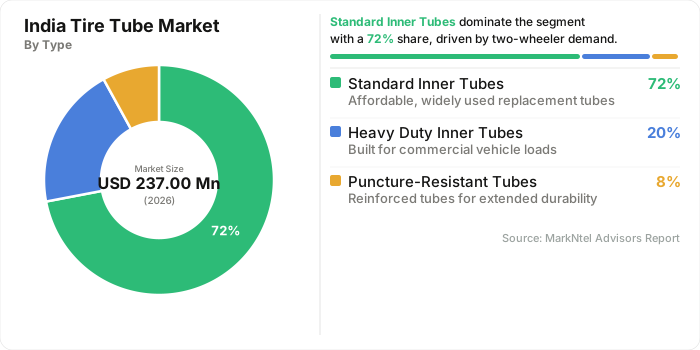
Standard Inner Tubes held around 72% share of the India tire tube market in 2026, primarily due to their extensive use across two-wheelers, three-wheelers, passenger vehicles, agricultural equipment, and several commercial vehicle applications. Their affordability, widespread availability, and compatibility with conventional tube-type tyres have made them the preferred choice for both OEMs and the replacement market. Strong demand from India's large installed vehicle base further reinforces the segment's leadership, particularly in rural and semi-urban regions where tube-type tyres remain widely used.
The dominance of standard inner tubes is also supported by their ease of replacement, lower maintenance costs, and extensive distribution through authorized dealers, multi-brand retailers, and local workshops. Compared with heavy-duty and puncture-resistant variants, standard tubes address a much broader customer base and cater to everyday commuting as well as commercial transportation needs. Based on tube type, the market is further bifurcated into:
- Standard Inner Tubes
- Heavy Duty Inner Tubes
- Puncture Resistant / Reinforced Tubes
Two-Wheelers Leading the Market Owing to India's Expanding Vehicle Base and High Replacement Cycle
The two-wheeler segment accounted for nearly 54% of the India tire tube industry in 2026, driven by the country's large motorcycle and scooter population and continued reliance on tube type tyres across entry level and commuter models. Rising vehicle ownership, expanding rural mobility, and consistent replacement requirements have collectively strengthened demand for tire tubes in this segment. Strong wholesale and retail vehicle sales during FY2026 further supported tube consumption, particularly in commuter motorcycles that account for the largest share of India's two wheeler fleet.
The segment also benefits from shorter tyre and tube replacement intervals resulting from high daily usage, varying road conditions, and frequent commuting. Extensive aftermarket availability through authorized dealers and independent retailers ensures easy product accessibility across urban and rural markets. Based on vehicle type, the market is further bifurcated into:
- Passenger Car
- Light Commercial Vehicle
- Medium and Heavy Commercial Vehicles
- Off the Road (OTR)
- Two Wheeler
- Three Wheeler
India Tire Tube Market Competitive Analysis
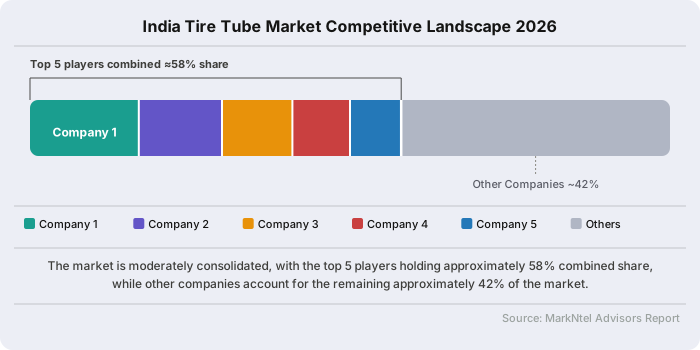
The market is moderately consolidated, with competition led by established tyre manufacturers, specialized inner tube producers, and diversified rubber product companies serving OEM and replacement demand across passenger vehicles, commercial vehicles, two wheelers, three wheelers, agricultural equipment, and off the road applications.Major participants include MRF Ltd., Apollo Tyres Ltd., CEAT Ltd., JK Tyre & Industries Ltd., and TVS Srichakra Ltd. The top five players collectively account for approximately 58% of the India tire tube market.
Key Companies in the India Tire Tube Market
- MRF Ltd.
- Apollo Tyres Ltd.
- CEAT Ltd.
- JK Tyre & Industries Ltd.
- TVS Srichakra Ltd.
- Ralson Tyres Ltd.
- Metro Tyres Ltd.
- Govind Rubber Ltd.
- Hindustan Rubber Industries
- Hartex Rubber Pvt. Ltd.
India Tire Tube Industry News and Recent Developments
2026: Apollo Tyres Expands Premium Vredestein Portfolio in India
Apollo Tyres launched the Vredestein Pinza HT premium SUV tyre in India in July 2026, expanding its premium product portfolio to address the growing demand for high performance sport utility vehicles. The launch strengthens the company's premium brand presence while reflecting continued investments in technologically advanced tyre solutions for evolving consumer requirements.
Impact Analysis: The product launch highlights the increasing focus of domestic manufacturers on premiumisation, technology driven innovation, and portfolio diversification. Such developments are expected to enhance the competitiveness of Indian tyre manufacturers, strengthen domestic manufacturing capabilities, and encourage further investments in advanced tyre and tube technologies.
2026: CEAT Expands Commercial Vehicle Service Network
CEAT inaugurated a new Truck Service Hub in Maharashtra during April 2026 to strengthen its commercial vehicle aftermarket presence. The facility provides tyre inspection, maintenance support, fleet management services, and customer assistance, expanding the company's service network for commercial vehicle operators.
Impact Analysis: The expansion of organized service infrastructure is expected to strengthen the replacement ecosystem by improving customer accessibility and aftersales support. A wider service network enhances customer retention, supports recurring replacement demand, and enables manufacturers to strengthen their presence across India's growing commercial vehicle segment.
2026: TVS Srichakra Strengthens Retail Presence Through Eurogrip Expansion
TVS Srichakra inaugurated its 13th Eurogrip exclusive retail outlet in Ahmedabad in March 2026. The outlet offers tyres and tubes for scooters, commuter motorcycles, performance motorcycles, and three wheelers, supporting the company's strategy to strengthen its retail footprint in key automotive markets.
Impact Analysis: The continued expansion of exclusive retail outlets improves product accessibility and brand visibility across the replacement market. A stronger distribution network supports higher aftermarket penetration, enhances customer engagement, and reinforces long term demand for tyre and tube products, particularly within India's high volume two wheeler segment.
Frequently Asked Questions
- Market Segmentation
- Introduction
- Product Definition
- Research Process
- Assumptions
- Executive Summary
- India Tire Tube Market Production Analysis, 2022-2032
- India Tire Tube Overall Production Analysis, By Tube Type
- Standard Inner Tubes
- Heavy-Duty Inner Tubes
- Reinforced Inner Tubes
- Puncture-Resistant Tubes
- Company Wise Production Analysis, By Tube Type
- Standard Inner Tubes
- Heavy-Duty Inner Tubes
- Reinforced Inner Tubes
- Puncture-Resistant Tubes
- India Tire Tube Overall Production Analysis, By Tube Type
- India Tire Tube Market Trends & Developments
- India Tire Tube Market Dynamics
- Growth Drivers
- Challenges
- India Tire Tube Market Import & Export Statistics
- India Tire Tube Market Regulations, Policies and Standards
- India Tire Tube Market Hotspot & Opportunities
- India Tire Tube Market Outlook, 2022-2032F
- Market Size & Analysis
- By Revenue (USD Million)
- By Units Sold (Thousand Units)
- Market Share & Analysis
- By Tube Type- (Thousand Units)
- Standard Inner Tubes
- Heavy-Duty Inner Tubes
- Reinforced Inner Tubes
- Puncture-Resistant Tubes
- By Vehicle Type- (Thousand Units)
- Passenger Car
- Hatchback
- Sedan
- SUV
- Light Commercial Vehicle
- Light Trucks
- Light Buses
- Pick-up Trucks and Vans
- Medium and Heavy Commercial Vehicles
- Buses
- Trucks
- Off-the-Road (OTR)
- Earthmoving Equipment
- Agricultural Vehicles
- Material Handling Vehicles
- Two-Wheeler
- Motorcycle
- Scooter
- Moped
- Three-Wheeler
- Passenger Carrier
- Cargo Carrier
- Passenger Car
- By Material- (Thousand Units)
- Butyl Rubber Tubes
- Natural Rubber Tubes
- By Valve Type- (Thousand Units)
- Straight Valve
- Bent Valve
- Others
- By Demand Type- (Thousand Units)
- OEM
- Replacement
- By Tire Size- (Thousand Units)
- Up to 12 Inches
- 13–16 Inches
- 17–20 Inches
- Above 20 Inches
- By Distribution Channel- (Thousand Units)
- Direct Sales
- Authorized Dealers & Distributors
- Multi-brand Tire Retailers
- Exclusive Brand Outlets
- Online Sales
- By Region
- North
- Uttar Pradesh
- Punjab
- Haryana
- Delhi NCR
- Others
- West
- Rajasthan
- Gujarat
- Maharashtra
- Madhya Pradesh
- Others
- South
- Tamil Nadu
- Karnataka
- Andhra Pradesh
- Telangana
- Others
- East
- West Bengal
- Bihar
- Jharkhand
- North Eastern States
- Others
- North
- By Competitors
- Competition Characteristics
- Market Share Analysis
- By Tube Type- (Thousand Units)
- Market Size & Analysis
- India Tire Standard Inner Tube Market Outlook, 2022-2032F
- Market Size & Analysis
- By Revenue (USD Million)
- By Units Sold (Thousand Units)
- Market Share & Analysis
- By Vehicle Type- (Thousand Units)
- By Material- (Thousand Units)
- By Valve Type- (Thousand Units)
- By Demand Type- (Thousand Units)
- By Tire Size- (Thousand Units)
- By Distribution Channel- (Thousand Units)
- By Region
- Market Size & Analysis
- India Tire Heavy-Duty Inner Tube Market Outlook, 2022-2032F
- Market Size & Analysis
- By Revenue (USD Million)
- By Units Sold (Thousand Units)
- Market Share & Analysis
- By Vehicle Type- (Thousand Units)
- By Material- (Thousand Units)
- By Valve Type- (Thousand Units)
- By Demand Type- (Thousand Units)
- By Tire Size- (Thousand Units)
- By Distribution Channel- (Thousand Units)
- By Region
- Market Size & Analysis
- India Tire Reinforced Inner Tube Market Outlook, 2022-2032F
- Market Size & Analysis
- By Revenue (USD Million)
- By Units Sold (Thousand Units)
- Market Share & Analysis
- By Vehicle Type- (Thousand Units)
- By Material- (Thousand Units)
- By Valve Type- (Thousand Units)
- By Demand Type- (Thousand Units)
- By Tire Size- (Thousand Units)
- By Distribution Channel- (Thousand Units)
- By Region
- Market Size & Analysis
- India Tire Puncture-Resistant Tube Market Outlook, 2022-2032F
- Market Size & Analysis
- By Revenue (USD Million)
- By Units Sold (Thousand Units)
- Market Share & Analysis
- By Vehicle Type- (Thousand Units)
- By Material- (Thousand Units)
- By Valve Type- (Thousand Units)
- By Demand Type- (Thousand Units)
- By Tire Size- (Thousand Units)
- By Distribution Channel- (Thousand Units)
- By Region
- Market Size & Analysis
- Competition Outlook
- Company Profiles
- MRF Ltd.
- Business Description
- Type Portfolio
- Strategic Alliances or Partnerships
- Recent Developments
- Financial Details
- Others
- Apollo Tyres Ltd.
- Business Description
- Type Portfolio
- Strategic Alliances or Partnerships
- Recent Developments
- Financial Details
- Others
- CEAT Ltd.
- Business Description
- Type Portfolio
- Strategic Alliances or Partnerships
- Recent Developments
- Financial Details
- Others
- JK Tyre & Industries Ltd.
- Business Description
- Type Portfolio
- Strategic Alliances or Partnerships
- Recent Developments
- Financial Details
- Others
- TVS Srichakra Ltd.
- Business Description
- Type Portfolio
- Strategic Alliances or Partnerships
- Recent Developments
- Financial Details
- Others
- Ralson Tyres Ltd.
- Business Description
- Type Portfolio
- Strategic Alliances or Partnerships
- Recent Developments
- Financial Details
- Others
- Metro Tyres Ltd.
- Business Description
- Type Portfolio
- Strategic Alliances or Partnerships
- Recent Developments
- Financial Details
- Others
- Govind Rubber Ltd.
- Business Description
- Type Portfolio
- Strategic Alliances or Partnerships
- Recent Developments
- Financial Details
- Others
- Hindustan Rubber Industries
- Business Description
- Type Portfolio
- Strategic Alliances or Partnerships
- Recent Developments
- Financial Details
- Others
- Hartex Rubber Pvt. Ltd.
- Business Description
- Type Portfolio
- Strategic Alliances or Partnerships
- Recent Developments
- Financial Details
- Others
- B.K. Rubber Industries Pvt. Ltd.
- Business Description
- Type Portfolio
- Strategic Alliances or Partnerships
- Recent Developments
- Financial Details
- Others
- G.N. Polymers Pvt. Ltd.
- Business Description
- Type Portfolio
- Strategic Alliances or Partnerships
- Recent Developments
- Financial Details
- Others
- Dolfin Rubbers Ltd.
- Business Description
- Type Portfolio
- Strategic Alliances or Partnerships
- Recent Developments
- Financial Details
- Others
- Others
- MRF Ltd.
- Company Profiles
- Disclaimer
MarkNtel Advisors follows a robust and iterative research methodology designed to ensure maximum accuracy and minimize deviation in market estimates and forecasts. Our approach combines both bottom-up and top-down techniques to effectively segment and quantify various aspects of the market. A consistent feature across all our research reports is data triangulation, which examines the market from three distinct perspectives to validate findings. Key components of our research process include:
1. Scope & Research Design At the outset, MarkNtel Advisors define the research objectives and formulate pertinent questions. This phase involves determining the type of research—qualitative or quantitative—and designing a methodology that outlines data collection methods, target demographics, and analytical tools. They also establish timelines and budgets to ensure the research aligns with client goals.
2. Sample Selection and Data Collection In this stage, the firm identifies the target audience and determines the appropriate sample size to ensure representativeness. They employ various sampling methods, such as random or stratified sampling, based on the research objectives. Data collection is carried out using tools like surveys, interviews, and observations, ensuring the gathered data is reliable and relevant.
3. Data Analysis and Validation Once data is collected, MarkNtel Advisors undertake a rigorous analysis process. This includes cleaning the data to remove inconsistencies, employing statistical software for quantitative analysis, and thematic analysis for qualitative data. Validation steps are taken to ensure the accuracy and reliability of the findings, minimizing biases and errors.

4. Data Forecast and FinalizationThe final phase involves forecasting future market trends based on the analyzed data. MarkNtel Advisors utilize predictive modeling and time series analysis to anticipate market behaviors. The insights are then compiled into comprehensive reports, featuring visual aids like charts and graphs, and include strategic recommendations to inform client decision-making
We offer flexible licensing options to cater to varying organizational needs. Choose the pricing pack that best suits your requirements:
Buy Now Inquire Before Buying
 Request Customization
 Talk to our Consultant