

By Product Type (Central Inverter, Micro-Inverter, String Inverter, Hybrid inverters), By phase (Single Phase, Three -Phase), By Connection type (On -Grid, Off -grid), By Power Out......put (≤ 3 kW, 3 kW – 10 kW, 10 kW – 100 kW, 100 kW – 500 kW, Above 500 kW), By End User -Market Size & Forecast 2022-2032, USD Million (Residential, Commercial, Industrial, Utility), and others Read more
- Energy
- Jul 2026
- 230
- PDF, Excel, PPT
Southeast Asia Solar Inverter Market Key Takeaways
- The Southeast Asia solar inverter market was valued at USD 222.2 million in 2025 and is projected to grow from USD 239.4 million in 2026 to USD 368.4 million by 2032.
- The industry is projected to witness steady growth at a CAGR of 7.45% during the forecast period.
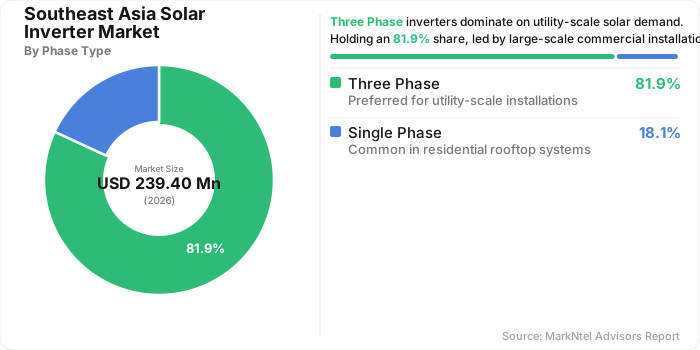
- Three-phase inverters dominate the market by phase, accounting for approximately 81.9% of the total market share in 2026.
- On-grid inverters lead the connection type segment with approximately 92.6% share in 2026.
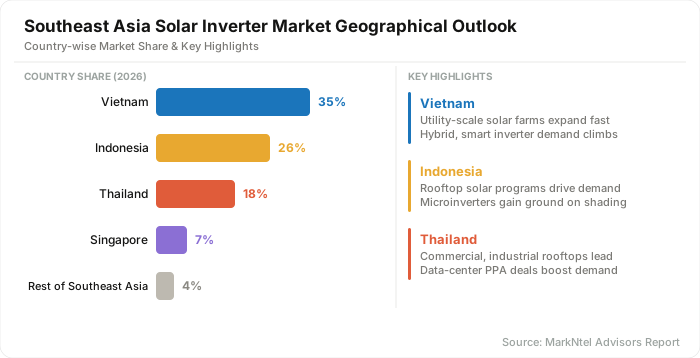
- Vietnam is the largest country-level market, contributing approximately 35% of the regional market.
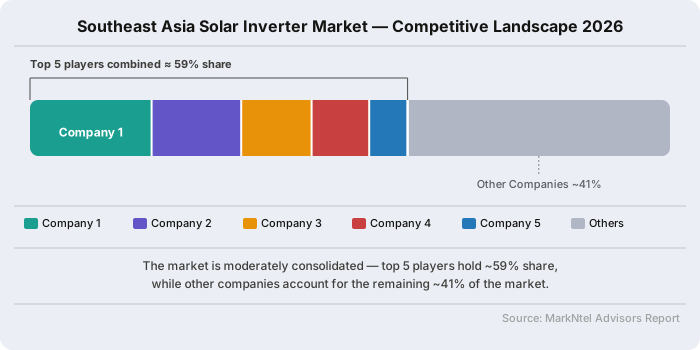
- The market is moderately consolidated, with the top five companies accounting for approximately 59% of the market in 2026.
Southeast Asia Solar Inverter Market Size and Outlook
The Southeast Asia solar inverter market is valued at USD 222.2 million in 2025 and is projected to reach USD 239.4 million in 2026, advancing to USD 368.4 million by 2032 at a CAGR of 7.45% during 2026-32.
This growth is driven by the region's accelerating deployment of utility-scale and distributed solar projects, supported by national auction programs, expanding renewable energy investments, and rising electricity demand. Long-term solar capacity additions are creating sustained demand for advanced inverter technologies across residential, commercial, and utility-scale applications.
National policy initiatives continue to strengthen market momentum. The Philippines' Department of Energy concluded the fourth round of its Green Energy Auction program in 2025, allocating over 10 GW of combined solar, storage, and wind capacity, representing the largest single allocation under the program to date and providing a direct boost to utility-scale inverter procurement.
Government policy is also reshaping end-user demand across multiple segments. Indonesia's state utility PLN, through its 2025–2034 Electricity Supply Business Plan (RUPTL), established a rooftop solar quota increase of 3,037 MW through 2034, significantly expanding the addressable market for distributed inverter installations across commercial and residential rooftops nationwide.
Manufacturers are simultaneously strengthening regional supply capabilities through localized production. GoodWe commenced operations at its Haiphong, Vietnam manufacturing facility, spanning approximately 14,800 square meters and dedicated to the production of grid-tied and hybrid inverters. Once the first phase reaches full operation, the facility is expected to achieve an annual production capacity of 5 GW, reinforcing regional supply resilience. Complementing this expansion, Enphase Energy entered the Vietnamese and Malaysian markets in January 2025, introducing its IQ8P microinverters rated at 480 W peak AC output for residential and commercial rooftop solar systems compatible with higher-powered modules.
Sustained auction-driven capacity additions, expanding rooftop solar quotas, and continued manufacturing localization are expected to support market expansion through 2032, while increasing grid-connection activity and broader adoption across residential, commercial, and utility-scale applications further strengthen long-term demand for solar inverters throughout Southeast Asia.
Southeast Asia Solar Inverter Market Key Indicators
- The Philippines' Department of Energy reported 3,765 MW of grid-connected solar capacity as of March 2026, with 99% comprising ground-mounted installations and only 52 MW behind-the-meter. This utility-scale dominance continues to drive demand for high-capacity central and string inverters, while residential-grade inverter adoption remains comparatively limited across the market.
- Under Resolution 70-NQ/TW, issued on August 20, 2025, Vietnam's Politburo confirmed 18.8 GW of operational ground-mounted and rooftop solar capacity by end-2024, representing nearly 26% of the national power system. This extensive installed base is creating a growing replacement and retrofit inverter market as early-generation systems approach end-of-warranty cycles.
- Indonesia's Ministry of Energy and Mineral Resources confirmed cumulative solar capacity reached 1.49 GW in 2025, with 546 MW added during the year, primarily through commercial and industrial rooftop installations. This transition toward distributed C&I solar is driving stronger demand for mid-capacity three-phase string inverters over utility-scale central inverter systems.
- Thailand's rapid rooftop and commercial solar expansion from 2 MW in 2019 to 3.3 GW by end-2024 significantly increases inverter demand. Every new solar installation requires inverters, while the growing installed base also creates future demand for inverter replacement, upgrades, maintenance, and smart-grid compatible systems as projects mature and grid requirements evolve.
Southeast Asia Solar Inverter Market Scope
| Category | Segments |
|---|---|
| By Product Type | Central Inverter, Micro-Inverter, String Inverter, Hybrid inverters |
| By phase | Single Phase, Three -Phase |
| By Connection type | On -Grid, Off -grid |
| By Power Output | ≤ 3 kW, 3 kW – 10 kW, 10 kW – 100 kW, 100 kW – 500 kW, Above 500 kW |
| By End User | Residential, Commercial, Industrial, Utility |
Southeast Asia Solar Inverter Market Growth Drivers
Rising Data Center and Industrial Electricity Demand Driving Corporate Solar Procurement in Southeast Asia
Rising electricity consumption from data centers and industrial facilities across Southeast Asia is outpacing grid capacity additions, encouraging large power consumers to adopt direct corporate solar procurement. This shift is creating sustained demand for grid-tied and hybrid solar inverters, as every new commercial and industrial solar installation requires efficient power conversion and grid integration technologies.
A major example is Malaysia's Corporate Renewable Energy Supply Scheme (CRESS), launched by the Energy Commission in September 2024. According to Tenaga Nasional Berhad, the program reached 1.3 GW of corporate renewable energy uptake by mid-2025, including a 50 MW, 21-year renewable electricity supply agreement with data center operator DayOne. This initiative is accelerating corporate investment in renewable energy and expanding demand for advanced inverter systems.
Industrial solar procurement is also supporting utility-scale deployment. Under Malaysia's sixth Large Scale Solar (LSS6) tender, the Energy Commission allocated 2,000 MW of utility-scale solar capacity while mandating battery energy storage integration across all awarded projects to enhance grid stability. Consequently, inverter suppliers offering hybrid, battery-compatible platforms are gaining a competitive advantage, as integrated storage and inverter solutions are increasingly preferred for large corporate and industrial renewable energy projects.
Recent Trends
Inverter Software Advancing to Provide Synthetic Inertia and Grid Voltage Stabilization in Weak-Grid Environments
Grid-forming and AI-driven inverter software are rapidly moving from pilot projects to mainstream deployment across Southeast Asia, enabling solar inverters to perform advanced grid-support functions traditionally provided by conventional power plants. These next-generation inverters deliver synthetic inertia, active voltage regulation, black-start capability, and fault ride-through performance, making them essential for grids with high renewable energy penetration and weak transmission infrastructure.
The adoption of grid-forming inverters across the Asia-Pacific region increased by more than 30% year-on-year during 2025–2026, with their share of the utility-scale inverter market expected to rise from 10–15% in 2026 to 40–55% by 2035. This reflects a structural transition from synchronous generators to inverter-based renewable energy systems capable of autonomously maintaining grid stability.
Supporting this trend, Huawei launched its fusion Solar 9.0 Smart PV Solution across the Southeast Asia region in April 2026, integrating grid-forming inverter technology with AI-driven operations and maintenance through its fusion Solar Agent edge-to-cloud platform. These technological advancements enable developers to deploy solar-plus-storage projects in previously constrained or weak-grid locations, expanding the addressable market for advanced inverter solutions while improving grid reliability across Southeast Asia.
Southeast Asia Solar Inverter Market Opportunities and Challenges
Transmission Infrastructure Constraints Driving Hybrid Inverter Adoption for Battery-Coupled Solar Projects
The rapid expansion of utility-scale solar capacity across Southeast Asia is placing increasing pressure on existing transmission infrastructure, resulting in grid congestion and limiting the connection of new renewable energy projects. According to the International Energy Agency (IEA), Southeast Asia has a significant gap between 28 GW of operating and 220 GW of prospective utility-scale wind and solar capacity, highlighting rising transmission constraints and curtailment risks.
In the Philippines, the Department of Energy has mandated energy storage system (ESS) integration for all new renewable energy projects under the Energy Storage Systems (ESS) Act, making battery storage a prerequisite for project bankability rather than an optional addition. This transition is directly increasing demand for hybrid and grid-forming inverters capable of bidirectional power flow, frequency regulation, and enhanced grid support.
Supportive regulatory frameworks and strategic industry investments are further accelerating hybrid inverter adoption. Vietnam implemented Circular No. 62/2025/TT-BCT on January 26, 2026, introducing a two-part tariff structure for battery energy storage that separately compensates power capacity and energy delivery, improving the commercial viability of solar-plus-battery projects in transmission-constrained regions.
Complementing this trend, ABB Group acquired Gamesa Electric's power electronics business in January 2025 to strengthen its portfolio of grid-forming central inverters for hybrid renewable energy applications, reflecting manufacturers' growing focus on storage-coupled inverter technologies across Southeast Asia.
Segmentation Insights
Three-Phase Inverters Command 81.9% Share as Large-Scale Solar Installations Accelerate
Three-phase inverters have established themselves as the preferred choice across Southeast Asia solar inverter market due to their ability to efficiently manage higher power loads while maintaining balanced current distribution for commercial, industrial, and utility-scale solar installations. As large-scale renewable energy projects continue to dominate new capacity additions, the adoption of three-phase systems remains significantly stronger than single-phase alternatives, which are primarily deployed in residential applications.
Government regulations are further reinforcing this trend. In Malaysia, the Energy Commission (Suruhanjaya Tenaga) mandates that any solar PV installation exceeding 72 kW must obtain a private generating license, a threshold that effectively steers larger commercial and industrial projects toward three-phase configurations rather than single-phase systems.
Manufacturers are also strengthening their offerings to meet rising demand in this segment. At Asia Sustainable Energy Week 2026 in Bangkok, Sun grow showcased its SH125CX three-phase hybrid inverter for commercial and industrial applications alongside the SG510HX high-power string inverter for utility-scale projects, positioning both as CAPEX-reducing solutions for the region's expanding large-scale solar pipeline.
With commercial rooftop and utility-scale solar installations continuing to outpace standalone residential deployment, three-phase inverter adoption is expected to remain the industry standard for higher-capacity solar projects across Southeast Asia. By phase the market is further segmented into the following sub-categories:
- Single Phase
- Three -Phase
On-Grid Inverters Capture 92.6% Share as Expanding Grid Infrastructure Accelerates Solar Integration
Driven by Southeast Asia's continuous expansion of national electricity grids and the increasing preference for grid-connected solar installations. Growing investments in transmission infrastructure and renewable energy integration have made on-grid systems the standard configuration for utility-scale, commercial, and an increasing number of residential solar projects.
The International Energy Agency's (IEA) Southeast Asia Energy Outlook 2026 reported that total energy investment in the region exceeded USD 100 billion in 2025. The report further highlighted that grid and storage investments must increase from USD 13 billion today to USD 50 billion by 2050 to support the region's accelerating renewable energy deployment and ensure reliable grid integration.
The dominance of on-grid systems is also reflected in large-scale solar developments connected directly to national transmission networks. Indonesia's state utility PLN, in partnership with Abu Dhabi-based Masdar, operates the 192 MW Cirata Floating PV Installation across 225 hectares of the Cirata Reservoir in West Java. As Southeast Asia's largest floating solar power plant, the project is fully connected to the Java-Bali transmission system, demonstrating the region's strong reliance on grid-tied solar infrastructure. With governments continuing to expand transmission networks and renewable energy capacity, on-grid inverters are expected to remain the preferred connection type across utility, commercial, and residential solar installations. By connection type the market is further segmented into the following sub-categories:
- On-Grid
- Off-Grid
Southeast Asia Solar Inverter Market Geographical Analysis
Vietnam accounts for approximately 35% share of the Southeast Asia solar inverter market, making it the region's largest market. Its leadership is supported by favorable solar irradiation, strong policy support, and an aggressive renewable energy expansion strategy that continues to drive inverter demand across utility-scale, commercial, and residential solar installations.
A key growth driver is Decision No. 768/QD-TTg, approved in April 2025, under which the government revised Power Development Plan VIII (PDP8) and increased the national solar capacity target to 46–73 GW by 2030. Achieving this ambitious target will require sustained annual capacity additions, creating significant long-term demand for advanced solar inverter technologies.
Government commitment is also evident through large provincial investments. In July 2026, Lam Dong Province approved over USD 219 million for new solar projects, including the 240 MW Dong Nai 2 Hydropower Reservoir Floating Solar Power Plant developed by Trung Nam Hydroelectric Corp with an investment of USD 189 million. The project is expected to generate approximately 464.19 million kWh annually, strengthening renewable electricity supply. With PDP8 requiring capacity additions far beyond the current installed base, continued provincial approvals and renewable investments are expected to reinforce Vietnam's regional leadership and sustain strong demand for solar inverters through 2032.
Southeast Asia Solar Inverter Industry Competitive Landscape
The Southeast Asia solar inverter market is moderately consolidated, with the top five companies, Huawei Technologies Co., Ltd., Sungrow Power Supply Co., Ltd., Growatt New Energy Technology Co., Ltd., GoodWe Technologies Co., Ltd., and Ginlong Technologies Co., Ltd. (Solis) collectively accounting for approximately 59% of the market in 2026.
Major Companies in Southeast Asia Solar Inverter Market
- Huawei Technologies Co., Ltd.
- Sun Grow Power Supply Co., Ltd.
- Growatt New Energy Technology Co., Ltd.
- GoodWe Technologies Co., Ltd.
- Ginlong Technologies Co., Ltd. (Solis)
- SMA Solar Technology AG
- SolarEdge Technologies Inc.
- Enphase Energy, Inc.
- FIMER S.p.A.
- Fronius International GmbH
- Delta Electronics, Inc.
Southeast Asia Solar Inverter Market News and Recent Developments
2026: Berde Renewables, Sungrow, and Solar Hive Sign 200 MW Solar Inverter Supply Agreement for Southeast Asia
Berde Renewables signed a Master Framework Agreement with Sungrow Power and Solar Hive to procure 200 MW of solar inverters and 500 MWh of battery energy storage systems for projects across the Philippines and Thailand over three years. The agreement supports commercial and industrial hybrid solar deployments, while Solar Hive will provide regional logistics and technical support.
Impact Analysis: The partnership strengthens supply-chain reliability, accelerates hybrid solar-plus-storage adoption, ensures long-term inverter demand, and enhances Sungrow's competitive position in Southeast Asia's expanding renewable energy market.
2026: SchneiTec Commissions Cambodia's First Utility-Scale Grid-Forming Battery Energy Storage Project
SchneiTec commissioned Cambodia's first and largest battery energy storage system (500 MW / 1,000 MWh) in Krakor district, Pursat province. The project integrates grid-forming inverter technology to provide synthetic inertia, frequency regulation, and voltage support, following a 12 MWh demonstration pilot with Huawei Digital Power in 2025.
Impact Analysis: The project demonstrates the commercial viability of utility-scale grid-forming inverters, encouraging wider deployment of hybrid solar-plus-storage systems, strengthening grid stability, and accelerating investment in advanced inverter technologies across Southeast Asia.
- Market Segmentation
- Introduction
- Product Definition
- Research Process
- Assumptions
- Executive Summary
- Southeast Asia Solar Inverter Market Policies, Regulations, and Product Standards
- Southeast Asia Solar Inverter Market Trends & Developments
- Southeast Asia Solar Inverter Market Dynamics
- Growth Factors
- Challenges
- Southeast Asia Solar Inverter Market Hotspot & Opportunities
- Southeast Asia Solar Inverter Market Outlook, 2022-2032
- Market Size & Outlook
- By Revenues (USD Million)
- Market Segmentation & Outlook
- By Product Type- Market Size & Forecast 2022-2032, USD Million
- Central Inverter
- Micro-Inverter
- String Inverter
- Hybrid inverters
- By phase- Market Size & Forecast 2022-2032, USD Million
- Single Phase
- Three -Phase
- By Connection type- Market Size & Forecast 2022-2032, USD Million
- On -Grid
- Off -grid
- By Power Output- Market Size & Forecast 2022-2032, USD Million
- ≤ 3 kW
- 3 kW – 10 kW
- 10 kW – 100 kW
- 100 kW – 500 kW
- Above 500 kW
- By End User -Market Size & Forecast 2022-2032, USD Million
-
- Residential
- Commercial
- Industrial
- Utility
-
- By Region
- Vietnam
- Thailand
- Indonesia
- Singapore
- Malaysia
- Cambodia
- Philippines
- Rest Of Southeast Asia
- By Company
- Competition Characteristics
- Market Share & Analysis
- By Product Type- Market Size & Forecast 2022-2032, USD Million
- Market Size & Outlook
- Vietnam Solar Inverter Market Outlook, 2022-2032
- Market Size & Outlook
- By Revenues (USD Million)
- Market Segmentation and Outlook
- By Product type- Market Size & Forecast 2022-2032, USD Million
- By Phase type- Market Size & Forecast 2022-2032, USD Million
- By Connection- Market Size & Forecast 2022-2032, USD Million
- By Power Output- Market Size & Forecast 2022-2032, USD Million
- By End User- Market Size & Forecast 2022-2032, USD Million
- Market Size & Outlook
- Thailand Solar Inverter s Market Outlook, 2022-2032
- Market Size & Outlook
- By Revenues (USD Million)
- Market Segmentation and Outlook
- By Product type- Market Size & Forecast 2022-2032, USD Million
- By Phase type- Market Size & Forecast 2022-2032, USD Million
- By Connection- Market Size & Forecast 2022-2032, USD Million
- By Power Output- Market Size & Forecast 2022-2032, USD Million
- By End User- Market Size & Forecast 2022-2032, USD Million
- Market Size & Outlook
- Indonesia Solar Inverter s Market Outlook, 2022-2032
- Market Size & Outlook
- By Revenues (USD Million)
- Market Segmentation and Outlook
- By Product type- Market Size & Forecast 2022-2032, USD Million
- By Phase type- Market Size & Forecast 2022-2032, USD Million
- By Connection- Market Size & Forecast 2022-2032, USD Million
- By Power Output- Market Size & Forecast 2022-2032, USD Million
- By End User- Market Size & Forecast 2022-2032, USD Million
- Market Size & Outlook
- Singapore Solar Inverter s Market Outlook, 2022-2032
- Market Size & Outlook
- By Revenues (USD Million)
- Market Segmentation and Outlook
- By Product type- Market Size & Forecast 2022-2032, USD Million
- By Phase type- Market Size & Forecast 2022-2032, USD Million
- By Connection- Market Size & Forecast 2022-2032, USD Million
- By Power Output- Market Size & Forecast 2022-2032, USD Million
- By End User- Market Size & Forecast 2022-2032, USD Million
- Market Size & Outlook
- Malaysia Solar Inverter s Market Outlook, 2022-2032
- Market Size & Outlook
- By Revenues (USD Million)
- Market Segmentation and Outlook
- By Product type- Market Size & Forecast 2022-2032, USD Million
- By Phase type- Market Size & Forecast 2022-2032, USD Million
- By Connection- Market Size & Forecast 2022-2032, USD Million
- By Power Output- Market Size & Forecast 2022-2032, USD Million
- By End User- Market Size & Forecast 2022-2032, USD Million
- Market Size & Outlook
- Cambodia Solar Inverter s Market Outlook, 2022-2032
- Market Size & Outlook
- By Revenues (USD Million)
- Market Segmentation and Outlook
- By Product type- Market Size & Forecast 2022-2032, USD Million
- By Phase type- Market Size & Forecast 2022-2032, USD Million
- By Connection- Market Size & Forecast 2022-2032, USD Million
- By Power Output- Market Size & Forecast 2022-2032, USD Million
- By End User- Market Size & Forecast 2022-2032, USD Million
- Market Size & Outlook
- Philippines Solar Inverter Market Outlook, 2022-2032
- Market Size & Outlook
- By Revenues (USD Million)
- Market Segmentation and Outlook
- By Product type- Market Size & Forecast 2022-2032, USD Million
- By Phase type- Market Size & Forecast 2022-2032, USD Million
- By Connection- Market Size & Forecast 2022-2032, USD Million
- By Power Output- Market Size & Forecast 2022-2032, USD Million
- By End User- Market Size & Forecast 2022-2032, USD Million
- Market Size & Outlook
- Southeast Asia Solar Inverter Market Key Strategic Imperatives for Success & Growth
- Competitive Outlook
- Company Profiles
- Huawei Technologies Co., Ltd.
- Business Description
- Product Portfolio
- Collaborations & Alliances
- Recent Developments
- Financial Details
- Others
- Sun Grow Power Supply Co., Ltd.
- Business Description
- Product Portfolio
- Collaborations & Alliances
- Recent Developments
- Financial Details
- Others
- Growatt New Energy Technology Co., Ltd.
- Business Description
- Product Portfolio
- Collaborations & Alliances
- Recent Developments
- Financial Details
- Others
- GoodWe Technologies Co., Ltd.
- Business Description
- Product Portfolio
- Collaborations & Alliances
- Recent Developments
- Financial Details
- Others
- Ginlong Technologies Co., Ltd. (Solis)
- Business Description
- Product Portfolio
- Collaborations & Alliances
- Recent Developments
- Financial Details
- Others
- SMA Solar Technology AG
- Business Description
- Product Portfolio
- Collaborations & Alliances
- Recent Developments
- Financial Details
- Others
- SolarEdge Technologies Inc.
- Business Description
- Product Portfolio
- Collaborations & Alliances
- Recent Developments
- Financial Details
- Others
- Enphase Energy, Inc.
- Business Description
- Product Portfolio
- Collaborations & Alliances
- Recent Developments
- Financial Details
- Others
- FIMER S.p.A.
- Business Description
- Product Portfolio
- Collaborations & Alliances
- Recent Developments
- Financial Details
- Others
- Fronius International GmbH
- Business Description
- Product Portfolio
- Collaborations & Alliances
- Recent Developments
- Financial Details
- Others
- Delta Electronics, Inc.
- Business Description
- Product Portfolio
- Collaborations & Alliances
- Recent Developments
- Financial Details
- Others
- Schneider Electric SE
- Business Description
- Product Portfolio
- Collaborations & Alliances
- Recent Developments
- Financial Details
- Others
- Huawei Technologies Co., Ltd.
- Company Profiles
- Disclaimer

MarkNtel Advisors follows a robust and iterative research methodology designed to ensure maximum accuracy and minimize deviation in market estimates and forecasts. Our approach combines both bottom-up and top-down techniques to effectively segment and quantify various aspects of the market. A consistent feature across all our research reports is data triangulation, which examines the market from three distinct perspectives to validate findings. Key components of our research process include:
1. Scope & Research Design At the outset, MarkNtel Advisors define the research objectives and formulate pertinent questions. This phase involves determining the type of research—qualitative or quantitative—and designing a methodology that outlines data collection methods, target demographics, and analytical tools. They also establish timelines and budgets to ensure the research aligns with client goals.
2. Sample Selection and Data Collection In this stage, the firm identifies the target audience and determines the appropriate sample size to ensure representativeness. They employ various sampling methods, such as random or stratified sampling, based on the research objectives. Data collection is carried out using tools like surveys, interviews, and observations, ensuring the gathered data is reliable and relevant.
3. Data Analysis and Validation Once data is collected, MarkNtel Advisors undertake a rigorous analysis process. This includes cleaning the data to remove inconsistencies, employing statistical software for quantitative analysis, and thematic analysis for qualitative data. Validation steps are taken to ensure the accuracy and reliability of the findings, minimizing biases and errors.

4. Data Forecast and FinalizationThe final phase involves forecasting future market trends based on the analyzed data. MarkNtel Advisors utilize predictive modeling and time series analysis to anticipate market behaviors. The insights are then compiled into comprehensive reports, featuring visual aids like charts and graphs, and include strategic recommendations to inform client decision-making
FILL THE FORM TO INQUIRE BEFORE BUYING THIS REPORT
We offer flexible licensing options to cater to varying organizational needs. Choose the pricing pack that best suits your requirements:
Buy Now Talk to our Consultant
 Request Customization