

Europe Solar Inverter Market Research Report: Trends & Forecast (2026-2032)
By Type (String Inverters, Central Inverters, Micro inverters, Hybrid Inverters), By System Type (On-Grid, Off-Grid, Hybrid), By Application (Residential, Commercial & Industrial ( ... C&I), Utility-Scale), By Phase (Single Phase, Three Phase), By Power Rating (Up to 10 kW, 10 kW – 100 kW, Above 100 kW), and others Read more
- Energy
- Apr 2026
- Pages 265
- Report Format: PDF, Excel, PPT
Europe Solar Inverter Market
Projected 6.8% CAGR from 2026 to 2032
Study Period
2026-2032
Market Size (2026)
USD 3.31 Billion
Market Size (2032)
USD 4.91 Billion
Base Year
2025
Projected CAGR
6.8%
Leading Segments
By Application: Utility-Scale
Europe Solar Inverter Market Report Key Takeaways:
- The Europe Solar Inverter Market size was valued at around USD 3.1 billion in 2025 and is projected grow from USD 3.31 billion in 2026 to USD 4.91 billion by 2032, exhibiting a CAGR of 6.8% during the forecast period.
- Germany holds the largest market share of about 26.7% in the Europe Solar Inverter Market in 2026.
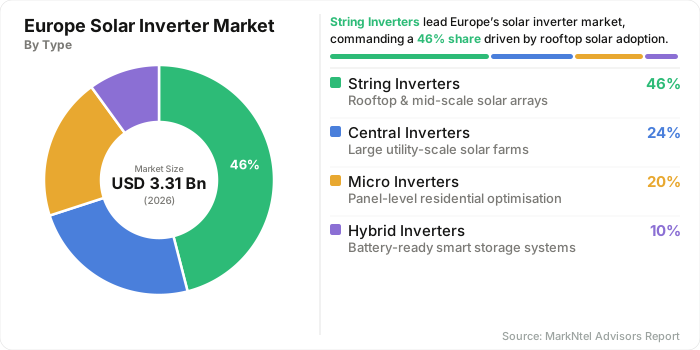
- By Type, the String Inverters segment represented a significant share of about 46% in the Europe Solar Inverter Market in 2026.
- By Application, the Utility-Scale segment presented a significant share of about 59% in the Europe Solar Inverter Market in 2026.
- Leading companies in the market are SMA Solar Technology AG, FIMER SpA, SolarEdge Technologies, Huawei Technologies, Sungrow Power Supply, Fronius International, Ingeteam, KACO New Energy, Schneider Electric, Power Electronics, and Others.
Market Insights & Analysis: Europe Solar Inverter Market (2026-32):
The Europe Solar Inverter Market size was valued at around USD 3.1 billion in 2025 and is projected grow from USD 3.31 billion in 2026 to USD 4.91 billion by 2032, exhibiting a CAGR of 6.8% during the forecast period, i.e., 2026-32.
The Europe solar inverter market has demonstrated strong historical expansion, supported by rapid solar PV deployment and declining technology costs. The International Energy Agency reported that solar PV remains the fastest-growing renewable technology, with Europe adding over 65 GW of capacity in 2025, reaching approximately 406 GW cumulatively . This sustained installation base has consistently driven inverter demand, as every solar system requires efficient DC-to-AC conversion. Over time, increasing grid integration requirements and system efficiency standards have further reinforced inverter adoption across the region.
Current market conditions reflect robust participation across residential, commercial, and utility-scale end users, each contributing distinctly to demand. Residential adoption continues to expand in countries such as Germany and the Netherlands, supported by net-metering and high retail electricity prices. However, utility-scale projects dominate new capacity additions, with solar contributing over 13% of EU electricity generation in 2025 and reaching nearly 68 TWh in the first quarter alone. Commercial and industrial users are also increasing solar adoption to stabilize operating costs and meet sustainability commitments.
Regulatory frameworks and infrastructure investments remain central to sustaining market growth across Europe. The European Commission, through REPowerEU, has accelerated renewable energy deployment and grid modernization initiatives aimed at reducing fossil fuel dependence. Solar capacity in Europe has more than doubled since 2020, surpassing 300 GW, reflecting the impact of policy-driven expansion . Additionally, ongoing investments in smart grids and digital energy systems are increasing demand for advanced inverters capable of real-time monitoring, grid balancing, and enhanced operational efficiency.
Looking ahead, the market outlook remains positive, supported by long-term renewable expansion and evolving energy consumption patterns. Europe is expected to add nearly 450 GW of renewable capacity between 2025 and 2030, ensuring sustained demand for solar inverters across all segments. Industry players such as SMA Solar Technology AG and Huawei Technologies are advancing hybrid and smart inverter technologies aligned with storage integration trends. Despite a slight 0.7% slowdown in installations in 2025, the market continues to exhibit stable, policy-driven growth.
Europe Solar Inverter Market Recent Developments:
- 2025 : Solis introduced a 125 kW three-phase hybrid inverter in Munich, targeting commercial solar-plus-storage systems. The solution integrates PV, battery, and grid control, supporting up to 750 kW scalability. This launch highlights the shift toward high-capacity hybrid systems in Europe, improving energy independence and system efficiency for commercial users.
- 2025 : GoodWe introduced new all-in-one energy storage inverter systems for residential and C&I sectors at Intersolar Europe 2025. The solutions feature enhanced safety, AI-driven management, and improved ROI, supporting Europe’s transition toward integrated solar-storage ecosystems and smarter energy consumption.
Europe Solar Inverter Market Scope:
| Category | Segments |
|---|---|
| By Type | (String Inverters, Central Inverters, Micro inverters, Hybrid Inverters), |
| By System Type | (On-Grid, Off-Grid, Hybrid), |
| By Application | (Residential, Commercial & Industrial (C&I), Utility-Scale), |
| By Phase | (Single Phase, Three Phase), |
| By Power Rating | (Up to 10 kW, 10 kW – 100 kW, Above 100 kW), |
Europe Solar Inverter Market Driver:
Rapid Expansion of Solar PV Installations
The rapid expansion of solar PV installations has become the most influential structural driver of the Europe solar inverter market, directly increasing system volumes and equipment demand. The European Commission and industry reporting indicate that the EU is expected to install approximately 64.2 GW of new solar capacity in 2025 , reflecting sustained deployment momentum. This growth builds on consistently high annual additions in recent years, driven by energy security priorities and decarbonization mandates. As every solar installation requires inverter integration, rising capacity additions translate directly into proportional inverter demand expansion.
This driver is measurably impacting demand across multiple end-user segments, ensuring broad-based market growth. Utility-scale installations continue to dominate capacity additions through competitive auctions and long-term power purchase agreements, creating large-volume inverter requirements. At the same time, commercial and industrial users are accelerating solar adoption to manage electricity costs and meet corporate sustainability goals. Residential rooftop solar remains a key contributor, supported by favorable policies and high energy prices. This multi-segment expansion ensures that inverter demand is diversified across applications and geographies rather than concentrated in a single segment.
Importantly, this driver is materially expanding market volume rather than influencing short-term pricing or cyclical adoption patterns. According to the International Renewable Energy Agency, over 90% of global power capacity additions in 2024 were renewable , highlighting a structural energy transition that Europe is actively advancing. Each gigawatt of solar capacity requires corresponding inverter deployment, creating a direct volume-linked demand mechanism. With annual installations exceeding 60 GW and a growing base of installed systems requiring replacement, the market benefits from both new demand and lifecycle-driven upgrades, reinforcing sustained long-term expansion.
Europe Solar Inverter Market Trend:
Shift Toward Smart & Hybrid Inverters
The shift toward smart and hybrid inverters has emerged as a defining technological trend in the Europe solar inverter market, driven by increasing grid complexity and energy storage adoption. The European Commission has accelerated battery integration and digital grid initiatives under REPowerEU, encouraging systems capable of managing both solar generation and storage . Rising electricity price volatility has further strengthened demand for self-consumption solutions. As a result, the market is transitioning from conventional inverters to intelligent, multi-functional systems.
This trend is reshaping industry dynamics by integrating power conversion, storage management, and grid interaction into a unified platform. Hybrid inverters enable bidirectional energy flow, allowing users to store excess energy and optimize consumption. Smart inverters with real-time monitoring and remote control are increasingly required to comply with evolving European grid codes. In 2025, Huawei Technologies introduced AI-driven smart PV and hybrid inverter solutions at Intersolar Europe , while Sungrow Power Supply launched modular, storage-integrated inverter systems with advanced grid-forming capabilities .
The trend is expected to persist due to structural electrification and digitalization of Europe’s energy systems. The International Energy Agency highlights distributed energy resources and storage as central to future power infrastructure. As renewable penetration increases, grid operators require intelligent inverters capable of stabilization and real-time response. Continuous innovation by leading manufacturers and regulatory alignment toward smart grid integration ensure that hybrid and intelligent inverter solutions will remain central to long-term market evolution.
Europe Solar Inverter Market Opportunity:
Repowering & Replacement of Aging Solar Installations
The opportunity for repowering and replacement of aging solar installations has emerged due to the early wave of photovoltaic deployment across Europe between 2010 and 2015. Systems installed during this period are now reaching inverter end-of-life cycles, typically 8–12 years, creating a structural replacement demand. The European Commission reported that EU solar capacity reached approximately 406 GW in 2025, forming a vast installed base now entering aging phases. This lifecycle dynamic ensures a predictable pipeline of inverter replacement across residential, commercial, and utility segments.
This opportunity translates into tangible demand as replacement cycles are driven by both technical necessity and regulatory evolution. Solar panels typically operate for over 20 years, while inverters require earlier replacement to maintain efficiency and compliance . Europe’s solar generation exceeded 340 TWh in 2025, increasing reliance on stable and high-performance systems. Modern inverters offer advanced features such as smart monitoring and storage integration, making upgrades economically viable. This creates a clear cause-and-effect linkage where aging infrastructure and evolving grid requirements drive consistent aftermarket demand.
The opportunity is particularly advantageous for new entrants due to the fragmented and service-driven nature of the replacement market. Unlike utility-scale projects dominated by large incumbents, repowering demand is distributed across millions of installations. Continuous annual additions, including over 65 GW installed in 2025, are also expanding the future replacement pipeline. This decentralized structure enables smaller players to compete through localized service networks and partnerships, providing scalable entry opportunities within the European solar inverter market.
Europe Solar Inverter Market Challenge:
Grid Integration and Curtailment Issues
Grid integration and curtailment issues have emerged as a critical structural challenge in the Europe solar inverter market, as renewable capacity expansion continues to outpace grid infrastructure upgrades. The International Energy Agency highlights that electricity networks across advanced economies are struggling to accommodate variable renewable generation. In Europe, outdated transmission systems and limited interconnection capacity are creating congestion in high-solar regions. This mismatch between generation growth and grid readiness is increasingly constraining efficient power evacuation and system stability.
The impact of this challenge is measurable through rising curtailment levels and project delays across key markets. Reports indicate that renewable energy curtailment in Europe reached approximately 11% in 2025 due to grid congestion, reflecting significant energy losses. Additionally, estimates suggest that up to 310 TWh of renewable electricity could be curtailed by 2040 if grid constraints persist. Countries such as Spain and Germany are already facing grid connection bottlenecks and extended approval timelines. These factors reduce plant utilization rates and delay inverter deployment across projects.
This challenge materially restricts market expansion by increasing investment uncertainty and limiting scalability. Developers face higher costs and delayed returns due to grid access constraints, discouraging new project development in saturated regions. While the European Commission is accelerating grid modernization and fast-tracking infrastructure projects, implementation timelines remain slower than installation growth. Consequently, inverter demand is indirectly constrained by grid limitations, making integration and curtailment issues a key barrier to sustained market expansion.
Europe Solar Inverter Market (2026-32) Segmentation Analysis:
The Europe Solar Inverter Market study of MarkNtel Advisors evaluates & highlights the major trends and influencing factors in each segment. It includes predictions for the period 2026–32 at the regional level. Based on the analysis, the market has been further classified as;
Based on Type:
- String Inverters
- Central Inverters
- Micro inverters
- Hybrid Inverters
The string inverter segment dominates the Europe Solar Inverter Market, accounting for approximately 46% of total demand, primarily due to its strong alignment with the region’s distributed solar deployment model. Europe’s solar expansion is heavily driven by rooftop and decentralized systems, where string inverters offer cost efficiency, flexibility, and ease of installation. According to the European Commission, distributed solar adoption has accelerated across countries such as Germany and Italy, where residential and commercial installations form a significant share of new capacity additions.
The dominance of string inverters is further reinforced by their adaptability across small- to mid-scale applications, which represent a substantial portion of Europe’s solar base. Unlike central inverters, string systems enable modular deployment and easier maintenance, particularly for commercial and industrial users. Their superior performance under partial shading conditions makes them highly suitable for Europe’s dense urban infrastructure, where rooftop installations often face design and orientation constraints.
Technological advancements and continuous product innovation further strengthen this dominance. For instance, Huawei Technologies launched AI-powered FusionSolar smart string inverters with advanced monitoring and safety features in 2025 , while Sungrow Power Supply introduced the SG350HX-20 high-power string inverter designed for higher efficiency and large-scale applications. These developments highlight ongoing innovation in string inverter technology, reinforcing their competitive advantage and sustained leadership in the European market.
Based on Application:
- Residential
- Commercial & Industrial (C&I)
- Utility-Scale
The utility-scale segment dominates the Europe Solar Inverter Market, accounting for approximately 59% of total demand, primarily because large-scale solar projects contribute the highest share of new capacity additions across the region. Utility-scale installations accounted for over 50% of total EU solar additions in 2025, supported by a decline in residential deployment to around 15% of new capacity, r eflecting a clear shift toward centralized generation models. This transition is further reinforced by policy frameworks from the European Commission, which prioritize rapid, high-volume renewable deployment through auctions and large project approvals.
This dominance is further supported by the inherent cost and scalability advantages of utility-scale solar projects. Large solar farms benefit from economies of scale, enabling a lower levelized cost of electricity compared to rooftop systems, making them the preferred choice for governments and utilities. These projects require high-capacity inverter systems, resulting in concentrated demand and higher market value contribution compared to fragmented residential and commercial installations.
Infrastructure and investment trends further reinforce the leadership of utility-scale applications. Utility-scale projects also accounted for over 50% of new battery storage capacity additions in Europe in 2025, indicating their central role in integrated energy systems. The expansion of large solar parks across countries such as Spain and France continues to drive gigawatt-scale deployments. This combination of policy support, cost efficiency, and large project pipelines ensures sustained dominance of the utility-scale segment in the European solar inverter market.
Europe Solar Inverter Market (2026-32): Regional Projection
Germany dominates the Europe Solar Inverter Market, accounting for approximately 26.7% of total regional demand, primarily because it represents the largest and most mature solar market in Europe with a strong base of both installed capacity and continuous additions. According to the European Commission, Germany has consistently led solar deployment under its long-standing Energiewende strategy, driving large-scale adoption across residential, commercial, and utility segments. This sustained installation activity creates continuous demand for inverters across both new projects and replacement cycles.
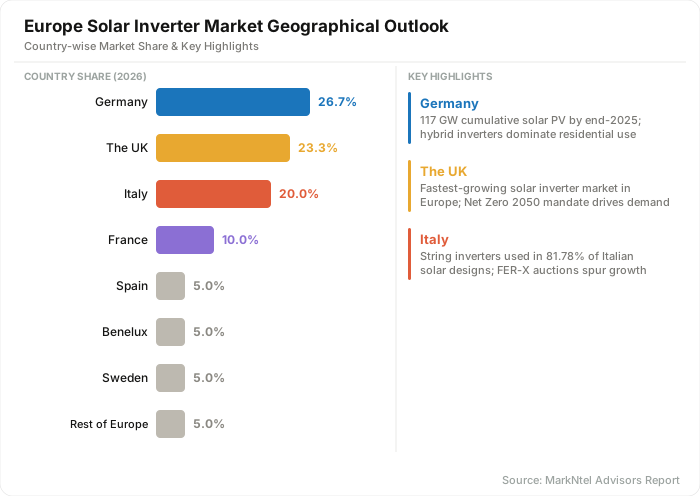
This dominance is further reinforced by Germany’s extensive distributed solar infrastructure, particularly in the residential and commercial sectors. The country has one of the highest rooftop solar penetration rates in Europe, supported by net-metering mechanisms and favorable regulatory policies. According to the Fraunhofer Institute for Solar Energy Systems, Germany remains among the leading countries in annual solar installations, reflecting strong demand across decentralized energy systems. These installations require string and hybrid inverters at scale, strengthening Germany’s overall contribution to regional inverter demand.
Germany’s leadership is also supported by its strong domestic manufacturing ecosystem and technological expertise in solar energy systems. Companies such as SMA Solar Technology AG play a key role in advancing inverter technologies and supporting local supply chains. Additionally, the country’s focus on grid modernization and energy storage integration continues to drive demand for advanced inverter solutions. The combination of a large installed base, continuous policy support, and industrial capability positions Germany as the leading market for solar inverters in Europe.
Europe Solar Inverter Market Competitive Landscape
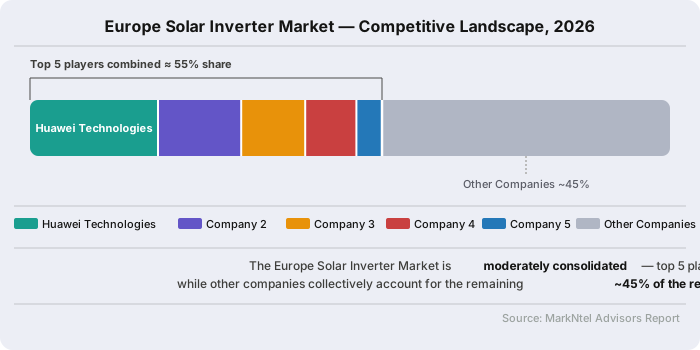
The market is moderately consolidated, with the top five players accounting for approximately 550% of the total market share. Leading companies include Huawei Technologies, Sungrow Power Supply, SolarEdge Technologies, SMA Solar Technology AG, and FIMER SpA.
Key Solar Inverter Companies in Europe
- SMA Solar Technology AG
- FIMER SpA
- SolarEdge Technologies
- Huawei Technologies
- Sungrow Power Supply
- Fronius International
- Ingeteam
- KACO New Energy
- Schneider Electric
- Power Electronics
- Others
Gain a Competitive Edge with Our Europe Solar Inverter Market Report:
- Europe Solar Inverter Market Report by MarkNtel Advisors provides a detailed & thorough analysis of market size & share, growth rate, competitive landscape, and key players. This comprehensive analysis helps businesses gain a holistic understanding of the market dynamics & make informed decisions.
- This report also highlights current market trends & future projections, allowing businesses to identify emerging opportunities & potential challenges. By understanding market forecasts, companies can align their strategies & stay ahead of the competition.
- Europe Solar Inverter Market Report aids in assessing & mitigating risks associated with entering or operating in the market. By understanding market dynamics, regulatory frameworks, and potential challenges, businesses can develop strategies to minimize risks & optimize their operations.
*Reports Delivery Format - Market research studies from MarkNtel Advisors are offered in PDF, Excel and PowerPoint formats. Within 24 hours of the payment being successfully received, the report will be sent to your email address.
Frequently Asked Questions
- Market Segmentation
- Introduction
- Product Definition
- Research Process
- Assumptions
- Executive Summary
- Europe Solar Inverter Market Policies, Regulations, and Product Standards
- Europe Solar Inverter Market Trends & Developments
- Europe Solar Inverter Market Dynamics
- Growth Factors
- Challenges
- Europe Solar Inverter Market Hotspot & Opportunities
- Europe Solar Inverter Market Outlook, 2022-2032F
- Market Size & Outlook
- By Revenues (USD Million)
- Market Share & Analysis
- By Type- Market Size & Forecast 2022-2032, USD Million
- String Inverters
- Central Inverters
- Micro inverters
- Hybrid Inverters
- By System Type- Market Size & Forecast 2022-2032, USD Million
- On-Grid
- Off-Grid
- Hybrid
- By Application- Market Size & Forecast 2022-2032, USD Million
- Residential
- Commercial & Industrial (C&I)
- Utility-Scale
- By Phase- Market Size & Forecast 2022-2032, USD Million
- Single Phase
- Three Phase
- By Power Rating- Market Size & Forecast 2022-2032, USD Million
- Up to 10 kW
- 10 kW – 100 kW
- Above 100 kW
- By Country
- Germany
- The UK
- Italy
- France
- Spain
- Benelux
- Sweden
- Rest of Europe
- By Company
- Competition Characteristics
- Market Share & Analysis
- By Type- Market Size & Forecast 2022-2032, USD Million
- Market Size & Outlook
- Germany Solar Inverter Market Outlook, 2022-2032F
- Market Size & Outlook
- By Revenues (USD Million)
- Market Share & Analysis
- By Type- Market Size & Forecast 2022-2032, USD Million
- By System Type- Market Size & Forecast 2022-2032, USD Million
- By Application- Market Size & Forecast 2022-2032, USD Million
- By Phase- Market Size & Forecast 2022-2032, USD Million
- By Power Rating- Market Size & Forecast 2022-2032, USD Million
- Market Size & Outlook
- The UK Solar Inverter Market Outlook, 2022-2032F
- Market Size & Outlook
- By Revenues (USD Million)
- Market Share & Analysis
- By Type- Market Size & Forecast 2022-2032, USD Million
- By System Type- Market Size & Forecast 2022-2032, USD Million
- By Application- Market Size & Forecast 2022-2032, USD Million
- By Phase- Market Size & Forecast 2022-2032, USD Million
- By Power Rating- Market Size & Forecast 2022-2032, USD Million
- Market Size & Outlook
- Italy Solar Inverter Market Outlook, 2022-2032F
- Market Size & Outlook
- By Revenues (USD Million)
- Market Share & Analysis
- By Type- Market Size & Forecast 2022-2032, USD Million
- By System Type- Market Size & Forecast 2022-2032, USD Million
- By Application- Market Size & Forecast 2022-2032, USD Million
- By Phase- Market Size & Forecast 2022-2032, USD Million
- By Power Rating- Market Size & Forecast 2022-2032, USD Million
- Market Size & Outlook
- France Solar Inverter Market Outlook, 2022-2032F
- Market Size & Outlook
- By Revenues (USD Million)
- Market Share & Analysis
- By Type- Market Size & Forecast 2022-2032, USD Million
- By System Type- Market Size & Forecast 2022-2032, USD Million
- By Application- Market Size & Forecast 2022-2032, USD Million
- By Phase- Market Size & Forecast 2022-2032, USD Million
- By Power Rating- Market Size & Forecast 2022-2032, USD Million
- Market Size & Outlook
- Spain Solar Inverter Market Outlook, 2022-2032F
- Market Size & Outlook
- By Revenues (USD Million)
- Market Share & Analysis
- By Type- Market Size & Forecast 2022-2032, USD Million
- By System Type- Market Size & Forecast 2022-2032, USD Million
- By Application- Market Size & Forecast 2022-2032, USD Million
- By Phase- Market Size & Forecast 2022-2032, USD Million
- By Power Rating- Market Size & Forecast 2022-2032, USD Million
- Market Size & Outlook
- Benelux Solar Inverter Market Outlook, 2022-2032F
- Market Size & Outlook
- By Revenues (USD Million)
- Market Share & Analysis
- By Type- Market Size & Forecast 2022-2032, USD Million
- By System Type- Market Size & Forecast 2022-2032, USD Million
- By Application- Market Size & Forecast 2022-2032, USD Million
- By Phase- Market Size & Forecast 2022-2032, USD Million
- By Power Rating- Market Size & Forecast 2022-2032, USD Million
- Market Size & Outlook
- Sweden Solar Inverter Market Outlook, 2022-2032F
- Market Size & Outlook
- By Revenues (USD Million)
- Market Share & Analysis
- By Type- Market Size & Forecast 2022-2032, USD Million
- By System Type- Market Size & Forecast 2022-2032, USD Million
- By Application- Market Size & Forecast 2022-2032, USD Million
- By Phase- Market Size & Forecast 2022-2032, USD Million
- By Power Rating- Market Size & Forecast 2022-2032, USD Million
- Market Size & Outlook
- Europe Solar Inverter Market Key Strategic Imperatives for Success & Growth
- Competitive Outlook
- Company Profiles
- SMA Solar Technology AG
- Business Description
- Product Portfolio
- Collaborations & Alliances
- Recent Developments
- Financial Details
- Others
- FIMER SpA
- Business Description
- Product Portfolio
- Collaborations & Alliances
- Recent Developments
- Financial Details
- Others
- SolarEdge Technologies
- Business Description
- Product Portfolio
- Collaborations & Alliances
- Recent Developments
- Financial Details
- Others
- Huawei Technologies
- Business Description
- Product Portfolio
- Collaborations & Alliances
- Recent Developments
- Financial Details
- Others
- Sungrow Power Supply
- Business Description
- Product Portfolio
- Collaborations & Alliances
- Recent Developments
- Financial Details
- Others
- Fronius International
- Business Description
- Product Portfolio
- Collaborations & Alliances
- Recent Developments
- Financial Details
- Others
- Ingeteam
- Business Description
- Product Portfolio
- Collaborations & Alliances
- Recent Developments
- Financial Details
- Others
- KACO New Energy
- Business Description
- Product Portfolio
- Collaborations & Alliances
- Recent Developments
- Financial Details
- Others
- Schneider Electric
- Business Description
- Product Portfolio
- Collaborations & Alliances
- Recent Developments
- Financial Details
- Others
- Power Electronics
- Business Description
- Product Portfolio
- Collaborations & Alliances
- Recent Developments
- Financial Details
- Others
- Others
- Business Description
- Product Portfolio
- Collaborations & Alliances
- Recent Developments
- Financial Details
- Others
- SMA Solar Technology AG
- Company Profiles
- Disclaimer
MarkNtel Advisors follows a robust and iterative research methodology designed to ensure maximum accuracy and minimize deviation in market estimates and forecasts. Our approach combines both bottom-up and top-down techniques to effectively segment and quantify various aspects of the market. A consistent feature across all our research reports is data triangulation, which examines the market from three distinct perspectives to validate findings. Key components of our research process include:
1. Scope & Research Design At the outset, MarkNtel Advisors define the research objectives and formulate pertinent questions. This phase involves determining the type of research—qualitative or quantitative—and designing a methodology that outlines data collection methods, target demographics, and analytical tools. They also establish timelines and budgets to ensure the research aligns with client goals.
2. Sample Selection and Data Collection In this stage, the firm identifies the target audience and determines the appropriate sample size to ensure representativeness. They employ various sampling methods, such as random or stratified sampling, based on the research objectives. Data collection is carried out using tools like surveys, interviews, and observations, ensuring the gathered data is reliable and relevant.
3. Data Analysis and Validation Once data is collected, MarkNtel Advisors undertake a rigorous analysis process. This includes cleaning the data to remove inconsistencies, employing statistical software for quantitative analysis, and thematic analysis for qualitative data. Validation steps are taken to ensure the accuracy and reliability of the findings, minimizing biases and errors.

4. Data Forecast and FinalizationThe final phase involves forecasting future market trends based on the analyzed data. MarkNtel Advisors utilize predictive modeling and time series analysis to anticipate market behaviors. The insights are then compiled into comprehensive reports, featuring visual aids like charts and graphs, and include strategic recommendations to inform client decision-making
We offer flexible licensing options to cater to varying organizational needs. Choose the pricing pack that best suits your requirements:
Buy Now Inquire Before Buying
 Request Customization
 Talk to our Consultant







