

India Power and Distribution Transformer Market Research Report: Trends & Forecast (2026-2032)
By Insulation & Cooling Method (Oil-Filled Transformer, Dry-Type Transformer), By Phase (Single-Phase Transformer, Three-Phase Transformer), By Voltage Rating (Power Transformer (1 ... –50 MVA, 50.1–160 MVA, 160.1–350 MVA, Above 350 MVA), Distribution Transformer (Up to 100 KVA, 100.1–315 KVA, 315.1 KVA–5 MVA)), and others Read more
- Energy
- Sep 2026
- Pages 170
- Report Format: PDF, Excel, PPT
India Power and Distribution Transformer Market
Projected 4.97% CAGR from 2026 to 2032
Study Period
2026-2032
Market Size (2026)
USD 4.03 Billion
Market Size (2032)
USD 5.39 Billion
Base Year
2025
Projected CAGR
4.97%
Leading Segments
By Insulation Cooling Method: Oil-Filled Transformer
India Power and Distribution Transformer Market Key Takeaways
- The India power and distribution transformer market was valued at USD 3.88 billion in 2025 and is projected to grow from USD 4.03 billion in 2026 to USD 5.39 billion by 2032.
- The industry is projected to witness steady growth at a CAGR of 4.97% during 2026–2032.
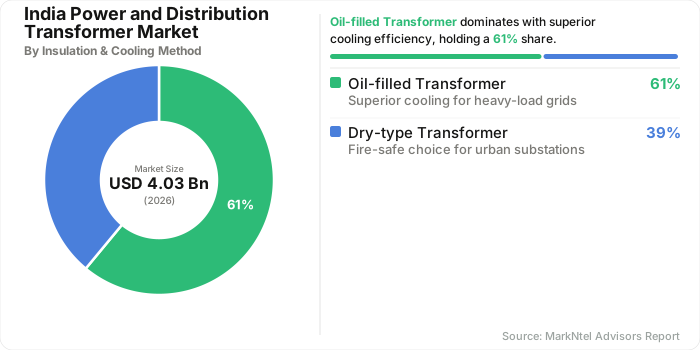
- By insulation and cooling method, oil-filled transformers dominate the market with an estimated 61% share.
- By phase, Three-phase transformers account for approximately 73% of the market.
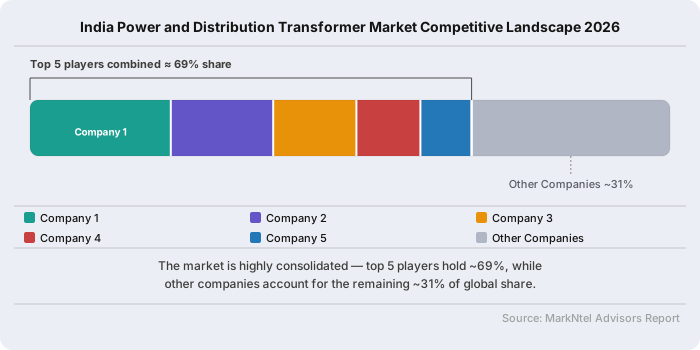
- The market is moderately consolidated, with the top five companies accounting for approximately 69% of total market revenue.
India Power and Distribution Transformer Market Size and Outlook
The India power and distribution transformer market was valued at USD 3.88 billion in 2025, and USD 4.03 billion in 2026; it is projected to reach USD 5.39 billion by 2032, expanding at a CAGR of 4.97% during 2026–2032.
The market is fundamentally linked to India’s electricity infrastructure. Electricity transmitted over long distances experiences approximately 3–4% transmission losses; therefore, power is transmitted at high voltage and stepped down closer to consumption, requiring transformers across multiple stages of the grid. As electricity generation and consumption increase, corresponding transformation capacity is required between generation centres and end users.
The scale of this requirement is expected to increase over the forecast period. Peak electricity demand is projected to increase from around 249 GW to 366.4 GW by FY2031–32, while the CEA envisages approximately 1,274 GVA of additional transformation capacity at 220 kV and above through the forecast period.
Procurement is primarily undertaken by transmission utilities, DISCOMs, renewable energy developers, industrial facilities and large power users, while end-use demand comes from households, agriculture, commercial establishments, manufacturing units, data centers and other infrastructure. This diversified consumption base spreads transformer requirements across different voltage and capacity categories.
The supply side is also preparing for this anticipated infrastructure requirement; domestic manufacturers such as CG Power and Transformers & Rectifiers (India) are expanding power-transformer manufacturing capacity toward 2027, indicating that suppliers are positioning capacity ahead of the full realization of the planned transmission build-out.
Meanwhile, on the consumption side, agricultural feeder solarisation under government programmes is creating additional requirements for rural distribution infrastructure, as solar-powered irrigation feeders require associated transformer capacity. Together, planned transformation capacity, diversified end-use requirements and supplier expansion underpin the market’s progression toward USD 6.37 billion by 2032.
India Power and Distribution Transformer Market Key Indicators
- India produced 1,047.52 million tonnes of raw coal in 2024–25, against a target of 1,080.20 million tonnes. Sustained coal production supports continued operation of coal-fired power plants, which require step-up and auxiliary transformers for generation, transmission and internal power distribution, maintaining transformer demand across coal-linked power infrastructure.
- India’s inter-regional transmission capacity is projected to increase from 119 GW to 168 GW by 2032, supported by 33 GW of new HVDC links. These long-distance transmission projects require high-capacity power transformers, including converter transformers, while expanded interstate networks subsequently require additional distribution transformation capacity to deliver electricity to end users.
- India added 55.3 GW of non-fossil power capacity in 2025-26, including 44.61 GW of solar capacity, as per the reports by Ministry of New and Renewable Energy. The rapid addition of solar and other non-fossil generation capacity requires step-up transformers at generating facilities and distribution transformers across associated power evacuation networks.
- The Ministry of Power’s Revamped Distribution Sector Scheme (RDSS) has sanctioned USD 15.99 billion for distribution infrastructure works, including the augmentation of distribution transformers and substations across states. This investment creates a direct procurement channel for transformer manufacturers by expanding and strengthening distribution networks.
- India produced 1,047.52 million tonnes of raw coal in 2024–25, against a target of 1,080.20 million tonnes. Sustained coal production supports continued operation of coal-fired power plants, which require step-up and auxiliary transformers for generation, transmission and internal power distribution, maintaining transformer demand across coal-linked power infrastructure.
India Power and Distribution Transformer Market Scope
| Category | Segments |
|---|---|
| By Insulation & Cooling Method | Oil-Filled Transformer, Dry-Type Transformer |
| By Phase | Single-Phase Transformer, Three-Phase Transformer |
| By Voltage Rating | Power Transformer (1–50 MVA, 50.1–160 MVA, 160.1–350 MVA, Above 350 MVA), Distribution Transformer (Up to 100 KVA, 100.1–315 KVA, 315.1 KVA–5 MVA |
India Power and Distribution Transformer Market Growth Drivers
Persistent Distribution Losses Creating a Funded Transformer Replacement Cycle Under RDSS
India’s persistent distribution losses are creating a government-backed pipeline for transformer replacement, augmentation, and new installations under the Revamped Distribution Sector Scheme (RDSS). National Aggregate Technical and Commercial (AT&C) losses declined from 21.91% in FY2021 to 16.16% in FY2025, but remain above the RDSS target of 12–15%, keeping DISCOMs under pressure to modernize inefficient distribution networks. The scale of this modernization is significant, with USD 29.56 billion of RDSS projects sanctioned nationally, including USD 15.98 billion for distribution infrastructure, creating a substantial procurement pipeline for equipment used in network strengthening. This spending directly supports transformer demand because distribution-network upgrades require utilities to replace aging transformers, augment overloaded transformer capacity, and install additional units to improve supply reliability and reduce technical losses.
The requirement is particularly strong in high-loss states. For instance, Kashmir Power Distribution Corporation Limited (KPDCL) reported AT&C losses of 33.54% in FY2025, more than twice the national average, highlighting the greater need for network intervention in such regions. As RDSS projects move from sanctions to execution, transformer manufacturers are therefore positioned to benefit from a multi-year, state-specific procurement cycle, particularly across DISCOMs with high losses and aging or overloaded distribution infrastructure.
Recent Trends
Rising Adoption of Ultra-High-Voltage 765 kV Transformers with Biodegradable Ester-Oil Insulation
India’s transmission network is increasingly moving toward 765 kV transformer infrastructure because renewable generation capacity is expanding in resource-rich regions such as Rajasthan, while major electricity demand centers are located farther away. Higher-voltage transmission enables larger volumes of renewable power to be evacuated over long distances through fewer, higher-capacity corridors, making 765 kV infrastructure increasingly relevant for renewable-grid integration. This shift is already visible in POWERGRID’s commissioning of the 765 kV Khetri–Narela and Bhadla-II–Sikar-II corridors during FY2025–26, which strengthen transmission capacity around Rajasthan’s renewable-energy zones.
The shift is also becoming visible in transformer procurement. In June 2025, Hitachi Energy India received a POWERGRID order for 30 units of 765 kV, 500 MVA single-phase transformers. Importantly, Hitachi Energy described the procurement as part of a move from project-based to programme-based planning, giving manufacturers greater visibility into future requirements and encouraging capacity alignment with multi-year grid expansion.
In parallel, insulation specifications are evolving. The CEA issued an advisory on ester oil as a technological option for transformers in May 2026, signalling growing institutional acceptance of alternative insulation fluids. This is being reinforced by industry implementation, with manufacturers developing and delivering ester-insulated equipment for Indian utilities.
Together, these developments indicate that future transmission tenders are likely to place greater emphasis on 765 kV capability, proven high-voltage designs and ester-insulation expertise, increasing the competitive advantage of suppliers that can meet these technical specifications.
Opportunities and Challenges
High CRGO Import Dependence, at 90%, Raises Cost Risk and Creates Opportunities for Supply-Chain Integration
CRGO (Cold Rolled Grain Oriented) electrical steel forms the magnetic core of power and distribution transformers, with its aligned grain structure reducing core losses and improving transformer efficiency. Therefore, CRGO availability and quality directly influence transformer performance and manufacturing costs. India consumes approximately 400,000–450,000 tonnes of CRGO annually, against domestic production of only 40,000–50,000 tonnes, leaving around 90% of requirements dependent on imports.
This exposes manufacturers to international prices, freight costs, currency movements and import-policy changes. The DGTR's June 2026 anti-dumping investigation into CRGO imports from China, Japan, South Korea and Russia adds further uncertainty around material costs. Copper creates additional commodity exposure, with LME copper exceeding USD 12,000 per tonne in December 2025 after rising more than 35% during the year. For manufacturers executing long-duration utility orders, such volatility can compress margins when input costs rise after contracts are awarded.
However, this dependency is creating an opportunity for domestic CRGO manufacturing and supply-chain integration. The Ministry of Steel's USD 662 million PLI Scheme for Specialty Steel includes CRGO to encourage domestic capacity. Meanwhile, at the company level, Transformers & Rectifiers (India)'s 51% acquisition of Posco-Poggenamp Electrical Steel provides greater control over CRGO processing and supply. As transformer demand expands, manufacturers securing long-term CRGO supplies or integrating processing capabilities can reduce procurement uncertainty, improve cost visibility and strengthen margin resilience.
Segmentation Insights
Oil-Filled Transformers Capture 61% Share as India’s Outdoor, High-Load Grid Favours Oil-Based Cooling
Supported by the country’s predominantly outdoor utility network, where transformers must operate continuously under high loads. Transformer oil provides both electrical insulation and heat dissipation, making oil-filled designs particularly suitable for large-capacity applications. India’s installed base of approximately 13 million distribution transformers, predominantly oil-immersed, further reinforces this established configuration. The CEA has also reported nearly 1.3 million distribution-transformer failures annually, creating a recurring replacement requirement alongside new installations.
This demand is visible in new grid infrastructure. POWERGRID approved a 400 kV substation at Vataman with 2×1,500 MVA, 765/400 kV oil-filled transformers, involving an estimated investment of USD 36.6 million, alongside additional transformer capacity supporting the Dholera semiconductor and industrial region. At the 1,500 MVA scale, oil-immersed technology remains the established solution for managing the insulation and cooling requirements of EHV transformers. As India develops large industrial and transmission projects such as Dholera, continued deployment of high-capacity oil-filled units reinforces this segment’s position as the primary volume category in utility transformer procurement. By insulation and cooling method, the market is further segmented into the following sub-categories:
- Oil-Filled Transformer
- Dry-Type Transformer
Three-Phase Transformers Capture 73% Share as India’s High-Load Grid Favors Three-Phase Supply
Because India’s power infrastructure is predominantly built to serve industrial, commercial, and utility-scale loads through three-phase networks. Three-phase systems provide continuous and balanced power and can transfer the same load with lower conductor requirements than single-phase systems, making them more efficient for high-load applications.
India’s distribution framework further reinforces this structure: 2025–26 tariff provisions require loads above 5 kW/5.55 kVA to use three-phase connections, while larger industrial HT consumers require dedicated three-phase transformation. Thus, three-phase transformer demand is largely a function of India’s grid architecture and load requirements rather than consumer preference.
This structure is reflected in procurement. In November 2025, Voltamp Transformers secured a USD 9.77 million order from Gujarat Energy Transmission Corporation (GETCO) for transformer supply supporting grid reinforcement. In renewable infrastructure, Indo-Tech Transformers secured a USD 9.01 million order from Avada Clean Project for nine 125 MVA transformers, supporting renewable-power evacuation.
As India expands industrial capacity, commercial infrastructure and renewable-generation projects, higher-load electricity connections will continue to require three-phase transformation. This sustains three-phase transformers as the dominant configuration across both power and distribution applications, while single-phase demand remains concentrated in smaller residential, rural, and low-load connections. By phase, the market is further segmented into the following sub-categories:
- Single-Phase Transformer
- Three-Phase Transformer
India Power & Distribution Transformer Market Competitive Landscape
The India power & distribution transformer market is moderately consolidated, with Crompton Greaves, TBEA Energy India, GE T&D India, Hitachi Energy India, and BHEL collectively accounting for approximately 69 % market share, while Siemens, ABB, Schneider Electric, CG Power, and Transformers & Rectifiers (India) also maintain significant competitive positions.
Major Players in the India Power and Distribution Transformer Market
- Siemens AG
- ABB Ltd
- General Electric Company (GE)
- Schneider Electric SE
- Toshiba Corporation
- Mitsubishi Electric Corporation
- Eaton Corporation plc
- Crompton Greaves Consumer Electricals Limited
- CG Power and Industrial Solutions Limited
- Transformers & Rectifiers (India) Limited
News and Recent Developments
2026: Siemens Energy India Approves USD 215.2 million Investment to Expand Power Transformer Capacity
Siemens Energy India approved USD 215.2 million to establish a new power transformer facility, adding 30,000 MVA and taking planned capacity to nearly 60,000 MVA.
News Market Impact Analysis: The investment expands domestic large power transformer supply and signals sustained transmission infrastructure demand. It is expected to strengthen local manufacturing capacity and support Siemens Energy’s participation in upcoming EHV transformer and substation projects.
2025: Toshiba Expands Hyderabad Manufacturing Base with USD 221 million Investment
Toshiba Energy Systems & Solutions announced an additional USD 221 million investment in its Hyderabad-based Toshiba Transmission & Distribution Systems (India) facility as part of a USD 347 million Japan–India capacity expansion program through FY2027. The expansion will increase production of transformers, switchgear, and surge arresters for India and export markets.
News Market Impact Analysis: The investment strengthens India’s manufacturing capacity for high-voltage transformer equipment and supports domestic supply while expanding export opportunities, increasing competitive pressure on Indian transformer manufacturers.
2025: TARIL Secures Transformer Supply Partnership with Hyosung T&D India
Transformers & Rectifiers (India) Ltd. secured a transformer supply contract from Hyosung T&D India in February 2025, enabling TARIL to supply transformers for Hyosung’s Indian transmission projects and strengthening domestic manufacturing integration.
News Market Impact Analysis: The partnership expands TARIL’s access to large transmission projects while strengthening localized transformer supply capacity. It also supports a broader shift toward OEM–local manufacturer partnerships, increasing opportunities for qualified Indian transformer suppliers.
Frequently Asked Questions
- Market Segmentation
- Introduction
- Product Definition
- Research Process
- Assumptions
- Executive Summary
- India Power and Distribution Transformer Market Policies, Regulations, and Product Standards
- India Power and Distribution Transformer Market Trends & Developments
- India Power and Distribution Transformer Market Dynamics
- Growth Factors
- Challenges
- India Power and Distribution Transformer Market Hotspot & Opportunities
- India Power and Distribution Transformer Market Outlook, 2022-2032
- Market Size & Outlook
- By Revenues (USD Million)
- Market Segmentation & Outlook
- By Insulation & Cooling Method- Market Size & Forecast 2022-2032, USD Million
- Oil-Filled Transformer
- Dry-Type Transformer
- By Phase- Market Size & Forecast 2022-2032, USD Million
- Single-Phase Transformer
- Three-Phase Transformer
- By Voltage Rating- Market Size & Forecast 2022-2032, USD Million
- Power Transformer
- 1–50 MVA
- 50.1–160 MVA
- 160.1–350 MVA
- Above 350 MVA
- Distribution Transformer
- Up to 100 KVA
- 100.1–315 KVA
- 315.1 KVA–5 MVA
- Power Transformer
- By Region- Market Size & Forecast 2022-2032, USD Million
- North
- South
- East
- West
- Central
- By Company
- Competition Characteristics
- Market Share & Analysis
- By Insulation & Cooling Method- Market Size & Forecast 2022-2032, USD Million
- Market Size & Outlook
- India Oil-Filled Power and Distribution Transformer Market Outlook, 2022-2032
- Market Size & Outlook
- By Revenues (USD Million)
- Market Segmentation & Outlook
- By Phase- Market Size & Forecast 2022-2032, USD Million
- By Voltage Rating- Market Size & Forecast 2022-2032, USD Million
- By Region- Market Size & Forecast 2022-2032, USD Million
- Market Size & Outlook
- India Dry-Type Power and Distribution Transformer Market Outlook, 2022-2032
- Market Size & Outlook
- By Revenues (USD Million)
- Market Segmentation & Outlook
- By Phase- Market Size & Forecast 2022-2032, USD Million
- By Voltage Rating- Market Size & Forecast 2022-2032, USD Million
- By Region- Market Size & Forecast 2022-2032, USD Million
- Market Size & Outlook
- India Power and Distribution Transformer Market Key Strategic Imperatives for Success & Growth
- Competitive Outlook
- Company Profiles
- Siemens AG
- Business Description
- Product Portfolio
- Collaborations & Alliances
- Recent Developments
- Financial Details
- Others
- ABB Ltd
- Business Description
- Product Portfolio
- Collaborations & Alliances
- Recent Developments
- Financial Details
- Others
- General Electric Company (GE)
- Business Description
- Product Portfolio
- Collaborations & Alliances
- Recent Developments
- Financial Details
- Others
- Schneider Electric SE
- Business Description
- Product Portfolio
- Collaborations & Alliances
- Recent Developments
- Financial Details
- Others
- Toshiba Corporation
- Business Description
- Product Portfolio
- Collaborations & Alliances
- Recent Developments
- Financial Details
- Others
- Mitsubishi Electric Corporation
- Business Description
- Product Portfolio
- Collaborations & Alliances
- Recent Developments
- Financial Details
- Others
- Eaton Corporation plc
- Business Description
- Product Portfolio
- Collaborations & Alliances
- Recent Developments
- Financial Details
- Others
- Crompton Greaves Consumer Electricals Limited
- Business Description
- Product Portfolio
- Collaborations & Alliances
- Recent Developments
- Financial Details
- Others
- CG Power and Industrial Solutions Limited
- Business Description
- Product Portfolio
- Collaborations & Alliances
- Recent Developments
- Financial Details
- Others
- Transformers & Rectifiers (India) Limited
- Business Description
- Product Portfolio
- Collaborations & Alliances
- Recent Developments
- Financial Details
- Others
- Siemens AG
- Company Profiles
- Disclaimer
MarkNtel Advisors follows a robust and iterative research methodology designed to ensure maximum accuracy and minimize deviation in market estimates and forecasts. Our approach combines both bottom-up and top-down techniques to effectively segment and quantify various aspects of the market. A consistent feature across all our research reports is data triangulation, which examines the market from three distinct perspectives to validate findings. Key components of our research process include:
1. Scope & Research Design At the outset, MarkNtel Advisors define the research objectives and formulate pertinent questions. This phase involves determining the type of research—qualitative or quantitative—and designing a methodology that outlines data collection methods, target demographics, and analytical tools. They also establish timelines and budgets to ensure the research aligns with client goals.
2. Sample Selection and Data Collection In this stage, the firm identifies the target audience and determines the appropriate sample size to ensure representativeness. They employ various sampling methods, such as random or stratified sampling, based on the research objectives. Data collection is carried out using tools like surveys, interviews, and observations, ensuring the gathered data is reliable and relevant.
3. Data Analysis and Validation Once data is collected, MarkNtel Advisors undertake a rigorous analysis process. This includes cleaning the data to remove inconsistencies, employing statistical software for quantitative analysis, and thematic analysis for qualitative data. Validation steps are taken to ensure the accuracy and reliability of the findings, minimizing biases and errors.

4. Data Forecast and FinalizationThe final phase involves forecasting future market trends based on the analyzed data. MarkNtel Advisors utilize predictive modeling and time series analysis to anticipate market behaviors. The insights are then compiled into comprehensive reports, featuring visual aids like charts and graphs, and include strategic recommendations to inform client decision-making
We offer flexible licensing options to cater to varying organizational needs. Choose the pricing pack that best suits your requirements:
Buy Now Inquire Before Buying
 Request Customization
 Talk to our Consultant







