

By Source (Household Appliances, Consumer Electronics, IT & Telecommunication, Mobile Computing Devices), By Material Recovered (Metal, Plastics, Glass, Others), By Technology (Mec......hanical Recycling, Hydrometallurgical processing, Pyrometallurgical processing, Manual disassembly, Advanced sorting technologies), By End User (Commercial Enterprises, Industrial & Manufacturing, Government & Public Institutions, Electronics Manufacturers / OEMs), and others Read more
- Environment
- Jul 2026
- 140
- PDF, Excel, PPT
Singapore Electronic Waste Recycling Market Key Takeaways
- The Singapore electronic waste recycling market was valued at USD 131 million in 2025 and is projected to grow from USD 142 million in 2026 to USD 233 million by 2032, registering a CAGR of 8.60% during the forecast period (2026–2032).
- Commercial end users account for the largest market share at 40% in 2026.
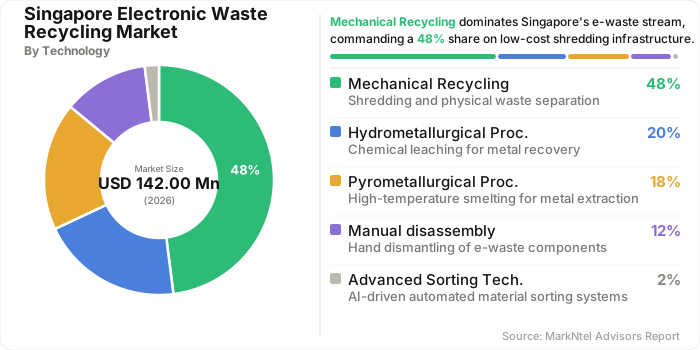
- In 2026, mechanical recycling dominates the market with a 48% share.
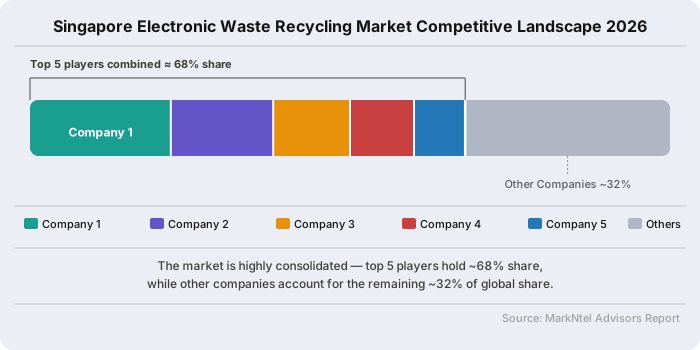
- The market is moderately consolidated, with the top five companies collectively accounting for 68% of the total market share.
Singapore Electronic Waste Recycling Market Size and Outlook
The Singapore electronic waste recycling market reached USD 131 million in 2025 and is projected to reach USD 233 million by 2032, expanding at a CAGR of 8.60%. Market growth is primarily supported by Singapore's mandatory, producer-financed collection framework, which has shifted electronic waste management from voluntary participation to a legally enforced recovery system.
Under the Resource Sustainability Act, the National Environment Agency (NEA) requires the Producer Responsibility Scheme (PRS) to recover 60% of the put-to-market weight for large household appliances and 20% for other regulated consumer products, according to the Ministry of Sustainability and the Environment. These mandatory recovery targets ensure that increasing electronics consumption is directly translated into predictable recycling volumes.
The Extended Producer Responsibility (EPR) scheme, introduced in July 2021 with ALBA E-Waste Smart Recycling serving as the scheme operator, further strengthens the market. The program covers ICT equipment, large household appliances, lamps, batteries, and solar photovoltaic panels while serving both residential consumers and commercial and industrial producers.
Businesses are also required to provide free take-back services for end-of-life regulated products, creating a broader and more consistent collection network. Public participation has also improved steadily, with NEA reporting that 78% of households recycled in 2025, compared with 72% in 2023, providing a larger and more reliable supply of recyclable electronic waste.
Private-sector investments are further enhancing Singapore's recycling capabilities. In 2025, SK Tes partnered with Au Botic Technology, supported by grants from the Singapore Economic Development Board, to introduce AI-powered automation and robotics that improve material recovery and battery detection during e-waste processing.
These technologies reduce reliance on manual dismantling while increasing recovery rates for valuable materials such as gold, copper, and lithium, and supporting sustained market growth through 2032.
Singapore Electronic Waste Recycling Market Key Indicators
- National Environment Agency (NEA) data shows Singapore's household recycling participation rose to 78% in 2025, up from 72% in 2023. Broader household engagement expands the pool of residents channeling small appliances, batteries, and electronics into formal e-waste collection points rather than general waste.
- NEA reports Singapore's daily domestic waste generation fell to 0.83 kg per capita in 2025, a 21% reduction from 2015. As households discard less material overall, recyclers face growing pressure to extract higher recovery value per unit of e-waste processed to sustain throughput economics.
- MSE confirms Semakau Landfill, Singapore's only landfill, is projected to reach capacity by around 2035 at current disposal rates. This fixed land constraint sustains long-term regulatory pressure to divert e-waste from incineration ash streams toward material recovery rather than disposal.
- Ministry of Sustainability and the Environment (MSE), under the Resource Sustainability Act, has set NEA-administered recovery targets of 60% of put-to-market weight for large household appliances and 20% for other covered consumer electronics. These binding category targets create baseline processing demand for regulated appliance and electronics recyclers independent of voluntary participation.
Singapore Electronic Waste Recycling Market Scope
| Category | Segments |
|---|---|
| By Source | Household Appliances, Consumer Electronics, IT & Telecommunication, Mobile Computing Devices |
| By Material Recovered | Metal, Plastics, Glass, Others |
| By Technology | Mechanical Recycling, Hydrometallurgical processing, Pyrometallurgical processing, Manual disassembly, Advanced sorting technologies |
| By End User | Commercial Enterprises, Industrial & Manufacturing, Government & Public Institutions, Electronics Manufacturers / OEMs |
Singapore Electronic Waste Recycling Market Growth Drivers
Mandatory Compliance Under Singapore's Extended Producer Responsibility (EPR) Scheme Driving Formal E-Waste Collection
Singapore's Resource Sustainability Act has established a mandatory Extended Producer Responsibility (EPR) framework that requires producers and importers of regulated electrical and electronic equipment to finance the collection and treatment of products at the end of their lifecycle. The National Environment Agency (NEA) has set statutory collection targets of 60% of the put-to-market weight for large household appliances and 20% for other regulated consumer products, shifting electronic waste recycling from a voluntary practice to a legally enforced compliance requirement. This regulatory framework ensures a consistent flow of electronic waste into licensed recycling facilities while strengthening formal collection networks.
The policy has already delivered measurable results. According to Singapore's Ministry of Sustainability and the Environment, more than 34,000 tonnes of e-waste have been collected and recycled under the EPR scheme since its launch in 2021. ALBA E-Waste Smart Recycling Pte. Ltd., appointed as the Producer Responsibility Scheme operator from July 2021 to June 2026, provides stable, regulator-backed collection volumes. This licensing structure creates high entry barriers, allowing NEA-approved recyclers to benefit from sustained, compliance-driven market growth.
Recent Trends
AI-Powered Automation and Robotic Material Sorting Transforming Singapore's E-Waste Recycling Operations
AI-driven automation and sensor-guided material sorting are emerging as a key trend in Singapore's electronic waste recycling industry, replacing labor-intensive dismantling with intelligent robotic systems capable of identifying and separating valuable materials with greater speed and precision. The need for automation is intensifying as e-waste volumes continue to grow. According to Singapore's Producer Responsibility Scheme, nearly 10,000 tonnes of e-waste were collected in 2025, representing a 60% increase over the previous year and placing greater pressure on recyclers to expand processing capacity efficiently.
Industry players are responding through strategic technology investments. In 2025, SK tes, operator of the SK tes B battery recycling facility in Tuas, partnered with Aubotic Technology Pte. Ltd. to develop AI-enabled robotics for sorting, inspection, and dismantling operations. The collaboration was further expanded in June, 2026, with grant support from the Singapore Economic Development Board (EDB) to accelerate automation pilot projects. The facility's hydrometallurgical recycling process already recovers more than 90% of precious metals at nearly 99% purity, providing a strong foundation for further efficiency gains through automation.
As AI-enabled processing technologies move from pilot projects to commercial deployment, automated sorting is expected to improve recovery yields, material purity, and operational consistency, strengthening Singapore's position as a leading regional hub for advanced urban mining and sustainable electronic waste recycling.
Singapore Electronic Waste Recycling Market Opportunities and Challenges
Fire and Safety Risks from End-of-Life Lithium-Ion Batteries Driving Investment in Domestic Battery-Metal Recovery
The increasing use of lithium-ion batteries in consumer electronics and electric vehicles is creating both safety challenges as well as recycling opportunities in Singapore. Improper disposal of batteries and power banks can cause fires when damaged during waste collection, transportation, or incineration, posing significant risks to workers and waste management infrastructure. In response, the National Environment Agency (NEA) intensified public education campaigns from July 2025, working with the Singapore Civil Defence Force (SCDF) and Town Councils to promote the safe handling and recycling of lithium-ion batteries and reduce fire-related incidents, according to the Ministry of Sustainability and the Environment.
At the same time, the growing volume of end-of-life batteries is encouraging investment in domestic recovery of critical battery materials. Electric vehicles accounted for approximately one-third of new car registrations between January and August 2024, supported by the EV Early Adoption Incentive (EEAI), expanding Singapore's future battery recycling feedstock. In January 2026, NEU Battery Materials completed the first close of a Pre-Series A funding round, co-led by SGInnovate and Shift4Good, to expand its Singapore operations into a 1,300-tonne semi-commercial plant capable of recovering battery-grade lithium from spent LFP batteries, strengthening the country's critical minerals supply chain.
Segmentation Insights
Mechanical Recycling Emerges as Singapore's Preferred E-Waste Treatment Technology
Mechanical recycling remains the leading processing route in Singapore's e-waste recycling industry with a market share of 48%, driven by its ability to handle large volumes of mixed electronic waste with high operational efficiency. The process employs shredding, crushing, magnetic separation, eddy-current separation, and optical sorting to recover ferrous metals, non-ferrous metals, plastics, and printed circuit boards before downstream refining. Compared with chemical and thermal recycling methods, mechanical processing offers lower operating costs, faster throughput, and fewer regulatory requirements, making it the preferred front-end technology for licensed recyclers. Industry investments continue to strengthen this segment.
In October 2025, Virogreen, a licensed e-waste recycler, inaugurated its E-Waste Visitor Centre with support from Singapore's SG Eco Fund, expanding awareness and capabilities in responsible e-waste collection and mechanical processing. Enviro-Hub's Singapore subsidiary Cimelia also operates two local recycling facilities with a combined processing capacity of approximately 3,600 tonnes annually, as reported in its FY2024 Annual Report. Continued investments in automated sorting and material recovery technologies are improving recovery yields, reinforcing mechanical recycling as the foundational processing route supporting Singapore's circular economy and domestic resource recovery objectives. By technology the market is further segmented into the following sub-categories:
- Mechanical Recycling
- Hydrometallurgical processing
- Pyrometallurgical processing
- Manual disassembly
- Advanced sorting technologies
Commercial Enterprises Lead the Market Through High-Value Electronic Asset Disposal and Regulatory Compliance
Commercial end users represent the largest share of Singapore e-waste recycling industry with a market share of 40%, driven by the continuous replacement of IT equipment, servers, networking hardware, office electronics, and enterprise devices. Unlike households, businesses are required to dispose of data-bearing equipment through licensed recyclers to ensure compliance with the Personal Data Protection Act (PDPA), secure data destruction, and responsible resource recovery. This structured disposal pattern results in significantly higher collection volumes through formal recycling channels. According to the National Environment Agency, Singapore's non-domestic recycling rate reached 67% in 2025, substantially exceeding the 11% domestic recycling rate, highlighting the stronger participation of commercial establishments in regulated recycling systems. Supporting this segment, KGS, an NEA-licensed recycler, continues to provide certified IT asset disposition and secure data destruction services for enterprises.
BR Metals further strengthened the commercial recycling value chain through a USD 4 million investment in 2025 to expand pre-treatment capacity for precious metal-bearing industrial scrap and spent batteries, increasing feedstock availability for its Singapore refining operations. Rising ESG reporting requirements and stricter data governance continue to reinforce commercial organizations as the primary contributors to Singapore formal e-waste recycling ecosystem. By end user the market is further segmented into the following sub-categories:
- Commercial Enterprises
- Industrial & Manufacturing
- Government & Public Institutions
- Electronics Manufacturers / OEMs
Singapore Electronic Waste Recycling Market Competitive Landscape
The Singapore Electronic Waste Recycling industry is moderately consolidated, with the leading companies in the market include ALBA E-Waste Smart Logistics Pte. Ltd., TES-AMM (Singapore) Pte. Ltd. (SK tes), Sims Lifecycle Services Pte. Ltd., BR Metals Pte. Ltd., and Cimelia Resource Recovery Pte. Ltd. Together, these five companies account for approximately 68% of the total market share.
Major Companies in the Singapore Electronic Waste Recycling Market
- ALBA E-Waste Smart Logistics Pte. Ltd.
- TES-AMM (Singapore) Pte. Ltd. (SK tes)
- Sims Lifecycle Services Pte. Ltd.
- Virogreen (S) Pte. Ltd.
- BR Metals Pte. Ltd.
- Enviro-Hub Holdings Ltd.
- Cimelia Resource Recovery Pte. Ltd.
- Metalo International Pte. Ltd.
- KGS Pte. Ltd.
- SembWaste Pte. Ltd.
Singapore Electronic Waste Recycling Market News and Recent Developments
2025: National Environment Agency Enforces Basel Convention Transboundary Movement Controls on Singapore E-Waste
Effective January 1, 2025, the National Environment Agency (NEA) implemented amendments to Singapore's Hazardous Waste (Control of Export, Import and Transit) Act, subjecting all e-waste and its components — including printed circuit boards and electronic parts — to transboundary movement control under the Basel Convention. Companies importing, exporting, or transiting e-waste through Singapore must now complete the Prior Informed Consent (PIC) procedure and secure a Basel permit before shipment, with separate permit applications required for hazardous waste under category A1181 and non-hazardous waste under category Y49. The amendment extends coverage to waste electronic parts and components, closing a prior regulatory gap.
Impact Analysis: The regulation raises entry barriers for cross-border e-waste traders and formalizes compliance costs for recyclers handling imported feedstock, favoring established, permit-ready operators over informal exporters. It also strengthens Singapore's positioning as a controlled, traceable processing hub for regional e-waste flows, supporting long-term feedstock security for domestic recyclers as informal channels face tighter restriction.
2025: Redux Launches Singapore's First Fully Automated Solar Panel E-Waste Recycling Facility
On November, 2025, Redux, a Singapore-based e-waste recycling specialist, launched Project SolaREV, an automated photovoltaic (PV) panel recycling facility developed in partnership with EtaVolt and Vector Green. The facility dismantles and processes 18 solar panels per hour, equivalent to 36,000 panels annually, representing approximately 27% of Singapore's current PV waste volume, and targets recovery of up to 96% of material content per panel. The launch was supported by Enterprise Singapore, IPI Singapore, and the Ministry of Trade and Industry, addressing a waste stream Redux projects will grow from 134,305 decommissioned panels in 2025 to 157,087 by 2030.
Impact Analysis: The facility establishes Singapore's first dedicated processing route for PV-specific e-waste, a category previously absorbed into general e-waste streams without specialized recovery infrastructure. This positions Redux to capture a distinct, fast-growing sub-segment ahead of competitors, while narrowing a supply-chain gap that had left decommissioned solar capacity exposed to landfill disposal risk.
- Market Segmentation
- Introduction
- Product Definition
- Research Process
- Assumptions
- Executive Summary
- Singapore Electronic Waste Recycling Market Policies, Regulations, and Product Standards
- Singapore Electronic Waste Recycling Market Trends & Developments
- Singapore Electronic Waste Recycling Market Dynamics
- Growth Factors
- Challenges
- Singapore Electronic Waste Recycling Market Hotspot & Opportunities
- Singapore Electronic Waste Recycling Market Outlook, 2022-2032
- Market Size & Outlook
- By Revenues (USD Million)
- Market Segmentation & Outlook
- By Source- Market Size & Forecast 2022-2032, USD Million
- Household Appliances
- Consumer Electronics
- IT & Telecommunication
- Mobile Computing Devices
- By Material Recovered- Market Size & Forecast 2022-2032, USD Million
- Metal
- Plastics
- Glass
- Others
- By Technology- Market Size & Forecast 2022-2032, USD Million
- Mechanical Recycling
- Hydrometallurgical processing
- Pyrometallurgical processing
- Manual disassembly
- Advanced sorting technologies
- By End User- Market Size & Forecast 2022-2032, USD Million
- Commercial Enterprises
- Industrial & Manufacturing
- Government & Public Institutions
- Electronics Manufacturers / OEMs
- By Region - Market Size & Forecast 2022-2032, USD Million
- North
- South
- East
- West
- Central
- By Company
- Competition Characteristics
- Market Share & Analysis
- By Source- Market Size & Forecast 2022-2032, USD Million
- Market Size & Outlook
- Singapore Household Appliances Recycling Market Outlook, 2022-2032
- Market Size & Outlook
- By Revenues (USD Million)
- Market Segmentation & Outlook
- By Material Recovered- Market Size & Forecast 2022-2032, USD Million
- By Recycling Process- Market Size & Forecast 2022-2032, USD Million
- By End User- Market Size & Forecast 2022-2032, USD Million
- By Region - Market Size & Forecast 2022-2032, USD Million
- Market Size & Outlook
- Singapore Consumer Electronics Recycling Market Outlook, 2022-2032
- Market Size & Outlook
- By Revenues (USD Million)
- Market Segmentation & Outlook
- By Material Recovered- Market Size & Forecast 2022-2032, USD Million
- By Recycling Process- Market Size & Forecast 2022-2032, USD Million
- By End User- Market Size & Forecast 2022-2032, USD Million
- By Region - Market Size & Forecast 2022-2032, USD Million
- Market Size & Outlook
- Singapore IT & Telecommunication Recycling Market Outlook, 2022-2032
- Market Size & Outlook
- By Revenues (USD Million)
- Market Segmentation & Outlook
- By Material Recovered- Market Size & Forecast 2022-2032, USD Million
- By Recycling Process- Market Size & Forecast 2022-2032, USD Million
- By End User- Market Size & Forecast 2022-2032, USD Million
- By Region - Market Size & Forecast 2022-2032, USD Million
- Market Size & Outlook
- Singapore Mobile Computing Devices Recycling Market Outlook, 2022-2032
- Market Size & Outlook
- By Revenues (USD Million)
- Market Segmentation & Outlook
- By Material Recovered- Market Size & Forecast 2022-2032, USD Million
- By Recycling Process- Market Size & Forecast 2022-2032, USD Million
- By End User- Market Size & Forecast 2022-2032, USD Million
- By Region - Market Size & Forecast 2022-2032, USD Million
- Market Size & Outlook
- Singapore Electronic Waste Recycling Market Key Strategic Imperatives for Success & Growth
- Competitive Outlook
- Company Profiles
- ALBA E-Waste Smart Logistics Pte. Ltd.
- Business Description
- Product Portfolio
- Collaborations & Alliances
- Recent Developments
- Financial Details
- Others
- TES-AMM (Singapore) Pte. Ltd. (SK tes)
- Business Description
- Product Portfolio
- Collaborations & Alliances
- Recent Developments
- Financial Details
- Others
- Sims Lifecycle Services Pte. Ltd.
- Business Description
- Product Portfolio
- Collaborations & Alliances
- Recent Developments
- Financial Details
- Others
- Virogreen (S) Pte. Ltd.
- Business Description
- Product Portfolio
- Collaborations & Alliances
- Recent Developments
- Financial Details
- Others
- BR Metals Pte. Ltd.
- Business Description
- Product Portfolio
- Collaborations & Alliances
- Recent Developments
- Financial Details
- Others
- Enviro-Hub Holdings Ltd.
- Business Description
- Product Portfolio
- Collaborations & Alliances
- Recent Developments
- Financial Details
- Others
- Cimelia Resource Recovery Pte. Ltd.
- Business Description
- Product Portfolio
- Collaborations & Alliances
- Recent Developments
- Financial Details
- Others
- Metalo International Pte. Ltd.
- Business Description
- Product Portfolio
- Collaborations & Alliances
- Recent Developments
- Financial Details
- Others
- KGS Pte. Ltd.
- Business Description
- Product Portfolio
- Collaborations & Alliances
- Recent Developments
- Financial Details
- Others
- SembWaste Pte. Ltd.
- Business Description
- Product Portfolio
- Collaborations & Alliances
- Recent Developments
- Financial Details
- Others
- ALBA E-Waste Smart Logistics Pte. Ltd.
- Company Profiles
- Disclaimer

MarkNtel Advisors follows a robust and iterative research methodology designed to ensure maximum accuracy and minimize deviation in market estimates and forecasts. Our approach combines both bottom-up and top-down techniques to effectively segment and quantify various aspects of the market. A consistent feature across all our research reports is data triangulation, which examines the market from three distinct perspectives to validate findings. Key components of our research process include:
1. Scope & Research Design At the outset, MarkNtel Advisors define the research objectives and formulate pertinent questions. This phase involves determining the type of research—qualitative or quantitative—and designing a methodology that outlines data collection methods, target demographics, and analytical tools. They also establish timelines and budgets to ensure the research aligns with client goals.
2. Sample Selection and Data Collection In this stage, the firm identifies the target audience and determines the appropriate sample size to ensure representativeness. They employ various sampling methods, such as random or stratified sampling, based on the research objectives. Data collection is carried out using tools like surveys, interviews, and observations, ensuring the gathered data is reliable and relevant.
3. Data Analysis and Validation Once data is collected, MarkNtel Advisors undertake a rigorous analysis process. This includes cleaning the data to remove inconsistencies, employing statistical software for quantitative analysis, and thematic analysis for qualitative data. Validation steps are taken to ensure the accuracy and reliability of the findings, minimizing biases and errors.

4. Data Forecast and FinalizationThe final phase involves forecasting future market trends based on the analyzed data. MarkNtel Advisors utilize predictive modeling and time series analysis to anticipate market behaviors. The insights are then compiled into comprehensive reports, featuring visual aids like charts and graphs, and include strategic recommendations to inform client decision-making
FILL THE FORM TO INQUIRE BEFORE BUYING THIS REPORT
We offer flexible licensing options to cater to varying organizational needs. Choose the pricing pack that best suits your requirements:
Buy Now Talk to our Consultant
 Request Customization