

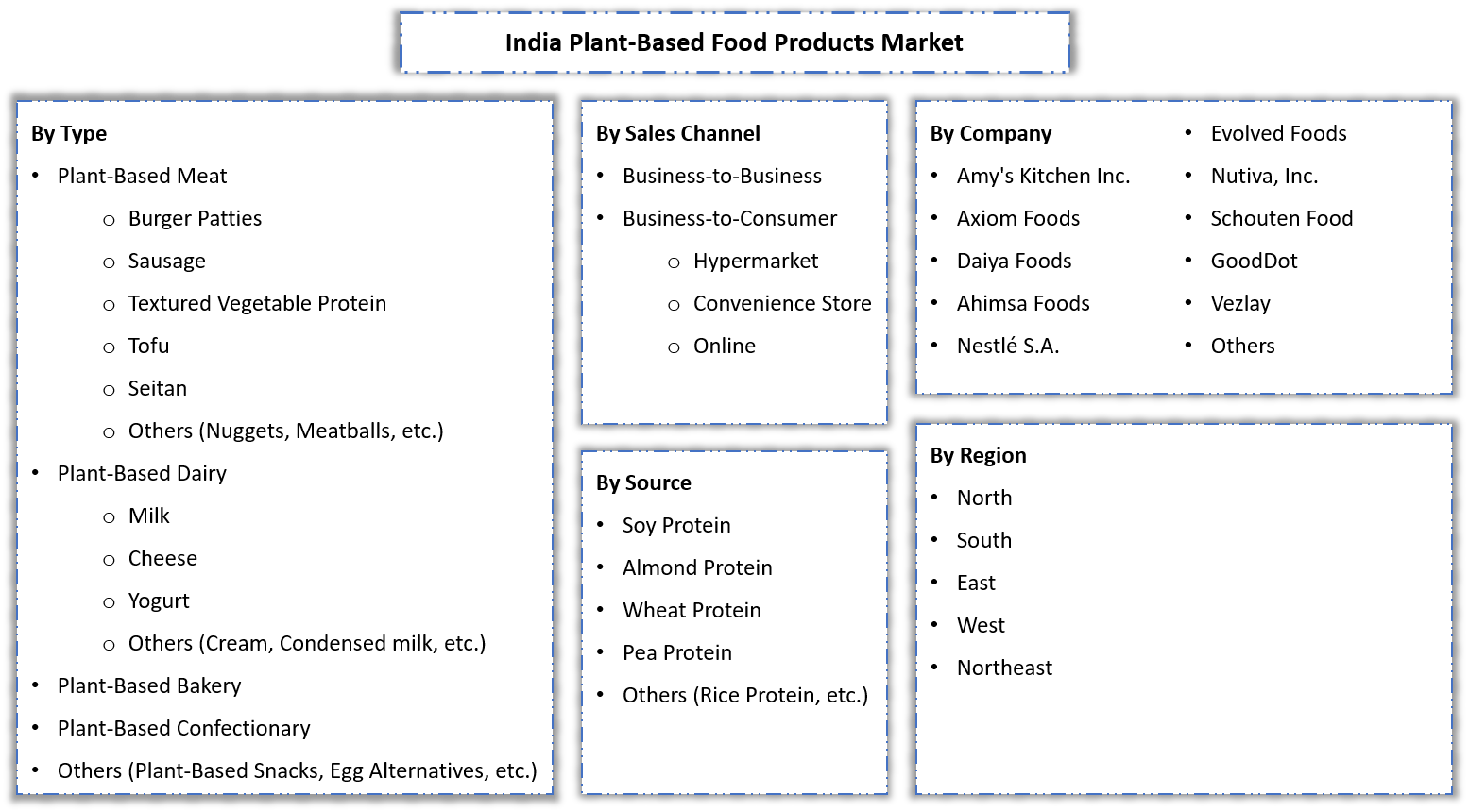
India Plant-Based Food Products Market Share & Growth - By Type (Plant-Based Meat (Burger Patties, Sausage, Textured Vegetable Protein, Tofu, Seitan, Others (Nuggets, Meatballs, et......c.)), (Plant-Based Dairy (Milk, Cheese, Yogurt, Others (Cream, Condensed milk, etc.)), Plant-Based Bakery, Plant-Based Confectionary, Others (Plant-Based Snacks, Egg Alternatives, etc.)), By Sales Channel (Business-to-Business, Business-to-Consumer (Hypermarket, Convenience Store, Online), By Source (Soy Protein, Almond Protein, Wheat Protein, Pea Protein, Others (Rice Protein, etc.)), and others. Read more
- Food & Beverages
- Sep 2025
- 130
- PDF, Excel, PPT
Market Definition
Plant-based food is a final product made from materials derived from plants, such as whole grains, nuts, seeds, legumes, fruits, and vegetables. The market for plant-based foods comprises food items devoid of elements of animal origin, either during processing or as part of the finished product. These products act as alternatives to animal-derived food items.
Market Insights & Analysis: India Plant-Based Food Products Market (2025-30):
The India Plant-Based Food Products Market size is valued at around USD 4.9 million in 2025 and is projected to reach USD 21.87 million by 2030. Along with this, the market is estimated to grow at a CAGR of around 34.87% during the forecast period, i.e., 2025-30. The market is predominantly propelled by a variety of consumer groups such as urban & middle-class consumers, millennials & other young populations, health-conscious and ethical buyers, protein-deficient consumers, and non-vegetarians & 'guilty' meat eaters, among others, posing the demand for plant-based food products.
Another factor backing the popularity of Plant-based food products is the Western influence, which doesn’t necessarily facilitate convenience to consumers in India. With the extensive availability of numerous sustainable and delicious vegetarian sources of protein, people are a bit hesitant to switch to a non-vegetarian diet, which in turn has led to the adoption of more plant-based food products in India.
Moreover, the growing lactose-intolerant population has again led to a substantial shift from animal-derived dairy products to plant-based ones, making the market traverse an upward trajectory in the coming years. Plant-based milk is gaining immense popularity among the youth, particularly almond and oat milk. Besides, the intensifying tendency to opt for cruelty-free products has also strengthened the market expansion in the historical period.
India Plant-Based Food Products Market Scope:
| Category | Segments |
|---|---|
| By Type | Plant-Based Meat (Burger Patties, Sausage, Textured Vegetable Protein, Tofu, Seitan, Others (Nuggets, Meatballs, etc.)), (Plant-Based Dairy (Milk, Cheese, Yogurt, Others (Cream, Condensed milk, etc.)), Plant-Based Bakery, Plant-Based Confectionary, Others (Plant-Based Snacks, Egg Alternatives, etc |
| By Sales Channel | Business-to-Business, Business-to-Consumer (Hypermarket, Convenience Store, Online |
| By Source | Soy Protein, Almond Protein, Wheat Protein, Pea Protein, Others (Rice Protein, etc. |
India Plant-Based Food Products Market Driver:
Increasing Vegan Population – With a significant portion of the country turning vegan, the demand for plant-based foods has escalated in the past few years. Due to their rich fiber and lesser cholesterol content, vegan food products are emerging as a better and healthier substitute for animal-based food products across the country. For instance, about 125 million Indians have adopted a strict vegan diet, contributing to the significant market growth & expansion. The popularity has been influenced by the trends in developed countries, such as the US, France, the United Kingdom, etc.
Additionally, the religious customs and ethical considerations have influenced vegetarianism in India for ages, which accounts for more than 40% of the Indian population as vegetarians, which further increased the demand for plant-based foods in the country.
- Introduction
- Product Definition
- Research Process
- Market Segmentation
- Assumptions
- Executive Summary
- Impact of COVID-19 on India Plant-Based Food Products
- India Plant-Based Food Products Trends & Insights
- India Plant-Based Food Products Market Dynamics
- Drivers
- Challenges
- India Plant-Based Food Products Market Regulations & Policies
- India Plant-Based Food Products Market Supply Chain Analysis
- India Plant-Based Food Products Market Hotspots & Opportunities
- India Plant-Based Food Products Market Outlook, 2020-2030F
- Market Size & Analysis
- By Revenues (USD Million)
- Market Share & Analysis
- By Type
- Plant-Based Meat
- Burger Patties
- Sausage
- Textured Vegetable Protein
- Tofu
- Seitan
- Others (Nuggets, Meatballs, etc.)
- Plant-Based Dairy
- Milk
- Cheese
- Yogurt
- Others (Cream, Condensed milk, etc.)
- Plant-Based Bakery
- Plant-Based Confectionary
- Others (Plant-Based Snacks, Egg Alternatives, etc.)
- Plant-Based Meat
- By Sales Channel
- Business-to-Business
- Business-to-Consumer
- Hypermarket
- Convenience Store
- Online
- By Source
- Soy Protein
- Almond Protein
- Wheat Protein
- Pea Protein
- Others (Rice Protein, etc.)
- By Region
- North
- South
- East
- West
- Northeast
- By Company
- Competition Characteristics
- Revenue Share, By Company
- By Type
- Market Size & Analysis
- India Plant-Based Food Products Market Key Strategic Imperatives for Growth & Success
- Competition Outlook
- Competition Matrix
- Brand Specialization
- Target Markets
- Target End Users
- Research & Development
- Strategic Alliances
- Strategic Initiatives
- Company Profiles
- Amy's Kitchen Inc.
- Axiom Foods
- Daiya Foods
- Ahimsa Foods
- Nestlé S.A.
- Evolved Foods
- Nutiva, Inc.
- Schouten Food
- GoodDot
- Vezlay
- Others
- Competition Matrix
- Disclaimer
MarkNtel Advisors follows a robust and iterative research methodology designed to ensure maximum accuracy and minimize deviation in market estimates and forecasts. Our approach combines both bottom-up and top-down techniques to effectively segment and quantify various aspects of the market. A consistent feature across all our research reports is data triangulation, which examines the market from three distinct perspectives to validate findings. Key components of our research process include:
1. Scope & Research Design At the outset, MarkNtel Advisors define the research objectives and formulate pertinent questions. This phase involves determining the type of research—qualitative or quantitative—and designing a methodology that outlines data collection methods, target demographics, and analytical tools. They also establish timelines and budgets to ensure the research aligns with client goals.
2. Sample Selection and Data Collection In this stage, the firm identifies the target audience and determines the appropriate sample size to ensure representativeness. They employ various sampling methods, such as random or stratified sampling, based on the research objectives. Data collection is carried out using tools like surveys, interviews, and observations, ensuring the gathered data is reliable and relevant.
3. Data Analysis and Validation Once data is collected, MarkNtel Advisors undertake a rigorous analysis process. This includes cleaning the data to remove inconsistencies, employing statistical software for quantitative analysis, and thematic analysis for qualitative data. Validation steps are taken to ensure the accuracy and reliability of the findings, minimizing biases and errors.

4. Data Forecast and FinalizationThe final phase involves forecasting future market trends based on the analyzed data. MarkNtel Advisors utilize predictive modeling and time series analysis to anticipate market behaviors. The insights are then compiled into comprehensive reports, featuring visual aids like charts and graphs, and include strategic recommendations to inform client decision-making
FILL THE FORM TO INQUIRE BEFORE BUYING THIS REPORT
We offer flexible licensing options to cater to varying organizational needs. Choose the pricing pack that best suits your requirements:
Buy Now Talk to our Consultant
 Request Customization