Japan Instant Noodles Market Research Report: Size, Share, Trends & Forecast (2026-2032)
By Type (Fried Noodles, Non-Fried Noodles), By Packaging Format (Cup/Container Noodles, Bag/Packet Noodles), By Noodle/Meal Style (Soup Noodles (Ramen and Ramyeon, Udon, Soba, Othe ... rs), Brothless Noodles (Yakisoba, Abura Soba/Oil Noodles, Dry and Spicy Noodles, Others)), By Distribution Channel (Supermarkets and Hypermarkets, Convenience Stores, Drugstores, Discount and General Merchandise Stores, Online Retail, Others), and others Read more
- Food & Beverages
- Aug 2026
- Pages 165
- Report Format: PDF, Excel, PPT
Japan Instant Noodles Market
Projected 3.02% CAGR from 2026 to 2032
Study Period
2026-2032
Market Size (2026)
USD 5.43 Billion
Market Size (2032)
USD 6.49 Billion
Base Year
2025
Projected CAGR
3.02%
Leading Segments
By Packaging Format: Cup/Container Noodles
Japan Instant Noodles Market Key Takeaways
- The market is estimated at USD 5.26 billion in 2025, rising to USD 5.43 billion in 2026 and USD 6.49 billion by 2032 at a 3.02% CAGR.
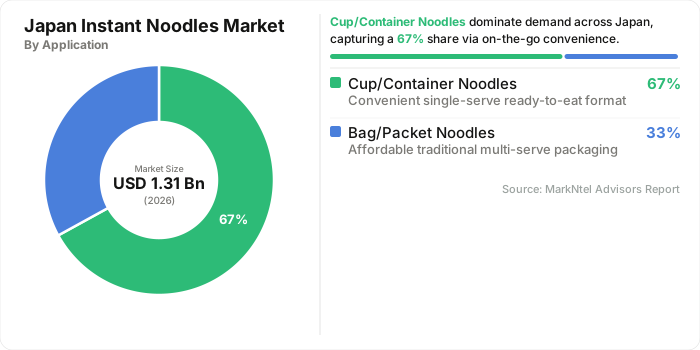
- Cup/container noodles represent the leading packaging format, with an estimated 67% market share in 2026.
- Supermarkets and hypermarkets dominate distribution channels, accounting for an estimated 51% market share in 2026.
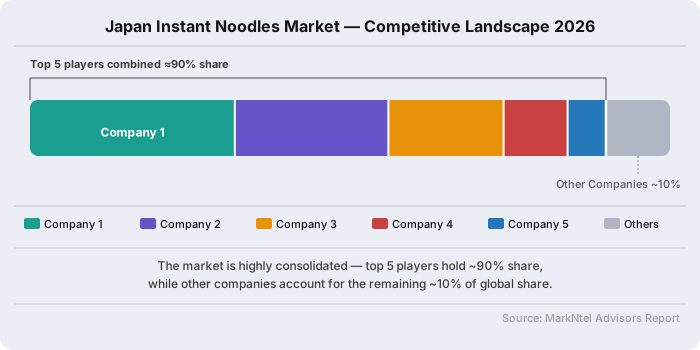
- The market is highly concentrated, with the top five companies collectively holding an estimated 90% market share in 2026.
Japan Instant Noodles Market Size and Outlook
The instant noodles market in Japan was valued at an estimated USD 5.26 billion in 2025 and is projected to reach approximately USD 5.43 billion in 2026. It is forecast to expand at a CAGR of around 3.02% during 2026–2032, reaching nearly USD 6.49 billion by 2032.
The market benefits from an established consumption base and the category’s ability to serve household meals, workplace lunches, snacks, travel and emergency stocking requirements. According to the World Instant Noodles Association, Japanese demand totaled 5.901 billion servings in 2024, compared with 5.974 billion in 2020. This stability shows that instant noodles are embedded in routine purchasing behavior, although high penetration limits rapid volume-led expansion. Broad availability across supermarkets, convenience stores, drugstores and online retail supports repeat purchases across planned and immediate-consumption occasions.
Over the forecast period, growth is expected to result primarily from moderate price realization and value migration rather than a marked increase in servings. Premium cups, non-fried noodles, internationally inspired flavors, richer toppings and lower-sodium formulations should support higher-value demand, while bag multipacks preserve affordability. However, population contraction, aging-related nutrition concerns, weak real-income growth and volatility in wheat, palm oil, packaging and exchange rates are likely to constrain volumes and margins. Consequently, measured expansion should reflect resilient consumption, selective pricing and gradual product-mix improvement.
Japan Instant Noodles Market Key Indicators
- Japan’s 2020 Population Census recorded 21.15 million one-person households, representing 38.1% of the total, while people aged 65 or older accounted for 29.3% of the population in 2024, according to the Statistical Handbook of Japan published in 2025. Smaller and older households support portion-controlled, low-preparation meals while increasing nutrition scrutiny.
- According to the Japan Franchise Association, nationwide convenience-store sales reached approximately USD 75.8 billion in 2025, increasing by 2.2%, across approximately 56,000 outlets. Dense store coverage supports immediate-consumption purchases, new-product visibility and premium single-serving sales, even when overall customer traffic remains broadly stable.
- An August 2025 report by the Ministry of Economy, Trade and Industry mentioned that online sales of food, beverages and alcohol reached approximately USD 20.57 billion, within an approximated USD 172.30 billion business-to-consumer e-commerce market. This scale supports bulk packs, imported brands, assortment extension and repeat purchasing beyond physical shelf constraints.
- The Japan Instant Food Industry Association estimated that instant-noodle manufacturing used approximately 310,000 tons of wheat in 2024. This substantial raw-material requirement increases exposure to flour and imported-grain costs, making procurement scale, manufacturing efficiency, pack architecture and selective pricing important to margin protection and supply continuity.
Japan Instant Noodles Market Pricing and Unit-Economics Analysis
Observed List Prices Across Major National Brands Extend from USD 0.70 per 70–80 g for Entry Packets to USD 1.90 per 100–120 g for Large Cups
Observed manufacturer list prices demonstrate a distinct progression across product formats. Entry-level packet noodles begin at approximately USD 0.70 before tax, while standard bag products are priced near USD 0.85. Mainstream cups generally occupy the USD 1.50–1.60 range, with large-format products extending from approximately USD 1.70 to USD 1.90. This progression reflects differences in portion size, included toppings, packaging requirements, portability and preparation convenience, all of which support higher expenditure per serving. Meanwhile, bag multipacks and private-label products maintain lower effective prices for households prioritizing value and repeated consumption.
Prices are also moving upward selectively within these tiers. In June 2025, Toyo Suisan announced an approximately 10% increase for specified open-price instant noodle products, effective October 1, 2025, reflecting changes in operating and cost conditions. Targeted adjustments help manufacturers offset ingredient, packaging, logistics, and currency pressures without uniformly repricing portfolios. Retailers can use promotions, multipacks, and private labels to retain price-sensitive households. Through 2032, this structure should enable market value to expand faster than servings, as premium cups, larger portions, regional recipes, and enhanced ingredients support higher realization. Clear differentiation between entry, mainstream, and premium tiers will remain essential to limit consumer trade-down and reduced purchasing frequency.
Japan's Instant Noodle Export Value Reached USD 118 Million in 2025, While Import Value Increased 32.9% Since 2022
Japan's instant noodles trade remains export-oriented, with exports consistently exceeding imports in both value and volume, reflecting the country's strong position in the premium instant noodles segment. Export volumes increased from 35 thousand tons in 2022 to 39 thousand tons in 2025 (+11.4%), while export value rose from USD 115 million to USD 118 million. The faster increase in value relative to volume indicates improving export realizations driven by premiumization rather than large-scale capacity expansion. Japanese manufacturers such as Nissin and Toyo Suisan continue benefiting from strong global demand for authentic ramen, premium cup noodles, healthier formulations, and regional Japanese flavors.
Expansion of Japanese cuisine worldwide, rising penetration through international supermarket chains and e-commerce platforms, and stronger brand equity in North America, Europe, and Southeast Asia have further supported exports. Although export volumes stabilized at 39 thousand tons during 2024-2025, export value continued to increase, highlighting higher average selling prices and a strategic focus on value-added products instead of competing in the low-cost segment.
On the import side, Japan imported 35 thousand tons of prepared noodle products in 2025, up from 27 thousand tons in 2022 (+29.6%), while import value increased from USD 79 million to USD 105 million (+32.9%). Rising imports primarily reflect increasing consumer demand for diversified Asian noodle varieties, including Korean, Chinese, Thai, and Vietnamese products, alongside the expansion of ethnic retail channels and convenience stores. The depreciation of the Japanese yen and higher freight and food manufacturing costs also lifted import values, while imports continue to complement, rather than replace, Japan's premium domestic production.
Japan Instant Noodles Market Scope
| Category | Segments |
|---|---|
| By Type | Fried Noodles, Non-Fried Noodles |
| By Packaging Format | Cup/Container Noodles, Bag/Packet Noodles |
| By Noodle/Meal Style | Soup Noodles (Ramen and Ramyeon, Udon, Soba, Others), Brothless Noodles (Yakisoba, Abura Soba/Oil Noodles, Dry and Spicy Noodles, Others |
| By Distribution Channel | Supermarkets and Hypermarkets, Convenience Stores, Drugstores, Discount and General Merchandise Stores, Online Retail, Others |
Japan Instant Noodles Market Growth Drivers
Relative Meal Affordability Amid Food Inflation Sustains Consumption
Instant noodles benefit from a low absolute meal cost, long shelf life and minimal preparation requirements, making them resilient when household food budgets tighten. Consumers can use packets and cups for pantry meals, workplace lunches or snacks without purchasing several ingredients or paying foodservice prices. During fiscal 2024, Japanese instant-noodle shipments increased 4.1% by volume and 6.7% by value, with industry reporting associating the performance with the category’s cost effectiveness during inflation. This combination supports both purchasing frequency and moderate price realization.
The rice-price surge reinforced this advantage. On May 26, 2025, the government announced that 300,000 tons of stockpiled rice would be sold through discretionary contracts, targeting a retail price of approximately USD 14 per five kilograms. On June 10, with the latest supermarket average still around USD 29 for the week through June 1, it announced another 200,000 tons from the 2020 and 2021 harvests for direct sale to retailers. These successive measures illustrate household cost pressure that can encourage temporary substitution toward shelf-stable noodles and tighter meal planning. Through 2032, relative affordability should support packet and mainstream-cup demand despite population decline.
Recent Trends
Korean Spicy, Creamy and Brothless Flavors Enter Mainstream Retail
Japan’s instant-noodle assortment is expanding beyond conventional shoyu, miso, salt and tonkotsu profiles toward Korean spicy, creamy and brothless recipes. These products create differentiated snack and meal occasions while encouraging consumers to modify preparation with cheese, eggs, milk, vegetables or other toppings. Nongshim Japan reports that Shin Ramyun’s domestic sales scale increased approximately fivefold during the ten years to 2025, demonstrating that Korean-style heat has moved beyond specialist imported-food demand into broader retail purchasing.
Commercial activity during 2025–2026 shows the trend extending into localized products and national distribution. Shin Ramyun Toomba, developed from a social-media recipe combining spicy noodles with a creamy pasta-style preparation, exceeded USD 6.70 million in Japanese sales during 2025; its proportion of young female purchasers was approximately three times that of standard Shin Ramyun before its nationwide rollout in February and March 2026. Samyang Japan also introduced Japan-exclusive Buldak Curry products through approximately 2,000 stores in April 2026. These launches demonstrate increasing segmentation by heat, creaminess, and brothless preparation. Through 2032, Korean-inspired flavors should accelerate assortment rotation and encourage domestic manufacturers to develop localized spicy products across packet and cup formats.
Japan Instant Noodles Market Opportunities and Challenges
High Sodium Content Constrains Health-Oriented Demand While Creating Reformulation Opportunities
High salt content can restrict instant noodles’ ability to participate in health-oriented meal occasions. Japan’s February 2026 voluntary front-of-pack nutrition guideline uses a daily reference value of 7.0 grams for salt equivalent, enabling consumers to compare a product’s contribution with recommended intake more directly. Mainstream products containing relatively high salt equivalent per prepared serving may thus discourage frequent consumption among older adults, families and wellness-oriented consumers, particularly as Japan’s aging population increases attention to sodium intake and balanced nutrition.
The constraint is creating opportunities for reformulation and clearer nutritional differentiation. On August 3, 2026, Acecook nationally renewed its three-product Dashi no Umami de Gen’en range covering udon, soba and Chinese-style noodles. The products retain a 40% salt reduction while strengthening dashi, spices and toppings with input from a Japanese chef to preserve flavor and satisfaction. This demonstrates that health-oriented value depends on rebuilding sensory intensity alongside reducing sodium. Manufacturers can extend the approach through improved seasoning systems, non-fried noodles, increased protein or fiber, and clearer front-of-pack communication. Companies maintaining familiar taste, satiety and affordability can support repeat purchases among older and wellness-oriented consumers while capturing incremental value without depending on substantial growth in overall consumption frequency.
Segmentation Insights
Cup/Container Noodles Lead Through One-Step Preparation and Broad Consumption-Occasion Coverage, Accounting for an Estimated 67% Market Share in 2026
Cup/container noodles lead because preparation, cooking vessel, portioning and serving are combined in a single package. The format is well suited to workplaces, convenience-led purchases, travel, emergency supplies and short daily meal breaks, where preparation time and cleanup influence product choice. Integrated seasonings and toppings, portable packaging and broad flavor availability support use across both meals and snacks. Containers also provide prominent branding space for collaborations, limited editions and differentiated ingredients, allowing manufacturers and retailers to refresh assortments without changing the familiar preparation process.
In fiscal 2025, Japan produced 3.943 billion cup servings compared with 1.961 billion bag servings, which supports the dominance of cup/container noodles. Bag/packet noodles remain important for multipacks and household meal preparation and may demonstrate stronger resilience when budgets tighten. Nevertheless, cups should retain leadership through immediate-consumption suitability, portion convenience and new-product rotation. Their outlook will depend on flavor innovation, health-oriented reformulation and packaging efficiency as population decline limits broad-based domestic consumption growth. Based on packaging format, the market is segmented into:
- Cup/Container Noodles
- Bag/Packet Noodles
Supermarkets and Hypermarkets Lead Through Multipack Economics and Assortment Breadth, Accounting for an Estimated 51% Market Share in 2026
Supermarkets and hypermarkets lead because they combine planned household shopping, multipack promotions, private labels and sufficient shelf space for mainstream bags, cups, regional recipes and imported lines. This assortment addresses value-oriented replenishment and higher-priced experimentation within one visit. High basket traffic supports repeat purchasing, while national retailer scale gives suppliers broad distribution for launches. The channel is also central to negotiations over shelf placement, promotional funding, pack architecture and responses to manufacturer price increases.
Comparable channel data for Japan’s wider noodle category placed supermarkets at 34.8% and hypermarkets at 18.9% in 2023, compared with 24.8% for convenience stores, and 6.1% for e-commerce. Convenience stores are thus expected to remain the strongest challenger through immediate consumption, premium cups and limited releases. Drugstores can gain through food-led traffic and sharp pricing, while e-commerce should grow from a smaller base through bulk packs and imported flavors. Even so, supermarkets and hypermarkets should retain leadership through 2032. Based on distribution channel, the market is segmented into:
- Supermarkets and Hypermarkets
- Convenience Stores
- Drugstores
- Discount and General Merchandise Stores
- Online Retail
- Others
Japan Instant Noodles Market Competitive Analysis
Japan instant noodles industry is highly concentrated, with the top five companies holding an estimated 90% share in 2026. The top five companies in the market are Nissin Foods Holdings, Toyo Suisan, Sanyo Foods, Acecook, and Maruka Foods.
Key Companies in the Japan Instant Noodles Market
- Nissin Foods Holdings Co., Ltd.
- Toyo Suisan Kaisha, Ltd.
- Sanyo Foods Co., Ltd.
- Acecook Co., Ltd.
- Maruka Foods Co., Ltd.
- Yamadai Co., Ltd.
- Sugakiya Foods Co., Ltd.
- House Foods Group Inc.
- Nongshim Co., Ltd.
- Marutai Co., Ltd.
- Samyang Foods Inc.
- Others
Japan Instant Noodles Industry News and Recent Developments
-
August 2026 | Nissin Plans USD 470 Million Cup Noodles Factory in Ibaraki
Nissin Foods Holdings announced a Cup Noodles factory in Tsukubamirai, Ibaraki, involving approximately USD 470 million in investment. Construction is scheduled to begin in May 2027, with operations targeted for fiscal 2029. The facility is designed for annual capacity of 500 million servings and carbon dioxide emissions per serving more than 10% below its Kanto plant.
Impact analysis: The project would materially expand domestic cup-noodle capacity, strengthen supply continuity and lower production-related environmental intensity. Its scale could also increase manufacturing-efficiency requirements for competitors seeking comparable national availability.
-
April 2026 | Sugakiya Launches World Flavor Noodle Tour Series
Sugakiya Foods launched Mala Tang noodles nationwide, excluding Okinawa, as the first product in its World Flavor Noodle Tour series. The cup combines wide, wavy non-fried noodles with a spicy mala profile and was released through supermarkets, convenience stores and drugstores.
Impact analysis: The launch extends Sugakiya beyond its regional Japanese flavor base while combining internationally inspired taste with non-fried positioning. Broad channel availability can increase trial, strengthen differentiation in cups and intensify flavor-led innovation among larger domestic competitors.
-
March 2026 | Acecook Introduces Vietnamese Hao Hao Packet Noodles in Japan
Acecook launched Hao Hao Tom Chua Cay nationwide in Japan, adapted from the company’s Vietnamese portfolio. The packet noodle combines shrimp, sour and spicy flavors and entered domestic retail at approximately USD 0.75 before tax.
Impact analysis: The launch gives consumers a low-cost route into Southeast Asian flavor profiles without relying on specialist imports. It can broaden bag-noodle usage across routine household meal and snack occasions, increase mainstream exposure to Vietnamese-style products and accelerate flavor and price competition among domestic and overseas-linked suppliers.
-
June 2025 | Marutai Revises USD 14 Million Saga Stick-Noodle Line Timeline
Marutai revised its Saga factory-line project, moving the operating target to September 2027 amid higher construction costs and labor constraints. The approximately USD 14 million line is designed to produce 132,000 servings per day, around 1.2 times the capacity of the Kitahata facility it is intended to replace.
Impact analysis: The delay defers near-term efficiency gains, but the completed line would modernize regional production and expand capacity for stick noodles. Higher output could support wider distribution and intensify specialist competition with larger national bag-noodle brands
Frequently Asked Questions
- Market Segmentation
- Introduction
- Product Definition
- Research Process
- Assumptions
- Executive Summary
- Japan Instant Noodles Market Pricing and Unit-Economics Analysis
- Japan Instant Noodles Market Policies, Regulations, and Product Standards
- Japan Instant Noodles Market Import & Export Trend Analysis (2022-25)
- Japan Instant Noodles Market Trends & Developments
- Japan Instant Noodles Market Dynamics
- Growth Factors
- Challenges
- Japan Instant Noodles Market Hotspot & Opportunities
- Japan Instant Noodles Market Outlook, 2022-2032
- Market Size & Outlook
- By Revenues (USD Million)
- By Quantity Sold (Thousand Tons)
- Market Segmentation & Outlook
- By Type- Market Size & Forecast 2022-2032, USD Million & Thousand Tons
- Fried Noodles
- Non-Fried Noodles
- By Packaging Format- Market Size & Forecast 2022-2032, USD Million & Thousand Tons
- Cup/Container Noodles
- Bag/Packet Noodles
- By Noodle/Meal Style- Market Size & Forecast 2022-2032, USD Million & Thousand Tons
- Soup Noodles
- Ramen and Ramyeon
- Udon
- Soba
- Others
- Brothless Noodles
- Yakisoba
- Abura Soba/Oil Noodles
- Dry and Spicy Noodles
- Others
- Soup Noodles
- By Distribution Channel- Market Size & Forecast 2022-2032, USD Million & Thousand Tons
- Supermarkets and Hypermarkets
- Convenience Stores
- Drugstores
- Discount and General Merchandise Stores
- Online Retail
- Others
- By Region- Market Size & Forecast 2022-2032, USD Million & Thousand Tons
- Hokkaido
- Tohoku
- Kanto
- Chubu
- Kansai/Kinki
- Chugoku
- Shikoku
- Kyushu and Okinawa
- By Company
- Competition Characteristics
- Market Share & Analysis
- By Type- Market Size & Forecast 2022-2032, USD Million & Thousand Tons
- Market Size & Outlook
- Japan Fried Noodles Market Outlook, 2022-2032
- Market Size & Outlook
- By Revenues (USD Million)
- By Quantity Sold (Thousand Tons)
- Market Segmentation & Outlook
- By Packaging Format- Market Size & Forecast 2022-2032, USD Million & Thousand Tons
- By Noodle/Meal Style- Market Size & Forecast 2022-2032, USD Million & Thousand Tons
- By Distribution Channel- Market Size & Forecast 2022-2032, USD Million & Thousand Tons
- By Region- Market Size & Forecast 2022-2032, USD Million & Thousand Tons
- Market Size & Outlook
- Japan Non-Fried Noodles Market Outlook, 2022-2032
- Market Size & Outlook
- By Revenues (USD Million)
- By Quantity Sold (Thousand Tons)
- Market Segmentation & Outlook
- By Packaging Format- Market Size & Forecast 2022-2032, USD Million & Thousand Tons
- By Noodle/Meal Style- Market Size & Forecast 2022-2032, USD Million & Thousand Tons
- By Distribution Channel- Market Size & Forecast 2022-2032, USD Million & Thousand Tons
- By Region- Market Size & Forecast 2022-2032, USD Million & Thousand Tons
- Market Size & Outlook
- Japan Instant Noodles Market Key Strategic Imperatives for Success & Growth
- Competitive Outlook
- Company Profiles
- Nissin Foods Holdings Co., Ltd.
- Business Description
- Product Portfolio
- Collaborations & Alliances
- Recent Developments
- Financial Details
- Others
- Toyo Suisan Kaisha, Ltd.
- Business Description
- Product Portfolio
- Collaborations & Alliances
- Recent Developments
- Financial Details
- Others
- Sanyo Foods Co., Ltd.
- Business Description
- Product Portfolio
- Collaborations & Alliances
- Recent Developments
- Financial Details
- Others
- Acecook Co., Ltd.
- Business Description
- Product Portfolio
- Collaborations & Alliances
- Recent Developments
- Financial Details
- Others
- Maruka Foods Co., Ltd.
- Business Description
- Product Portfolio
- Collaborations & Alliances
- Recent Developments
- Financial Details
- Others
- Yamadai Co., Ltd.
- Business Description
- Product Portfolio
- Collaborations & Alliances
- Recent Developments
- Financial Details
- Others
- Sugakiya Foods Co., Ltd.
- Business Description
- Product Portfolio
- Collaborations & Alliances
- Recent Developments
- Financial Details
- Others
- House Foods Group Inc.
- Business Description
- Product Portfolio
- Collaborations & Alliances
- Recent Developments
- Financial Details
- Others
- Nongshim Co., Ltd.
- Business Description
- Product Portfolio
- Collaborations & Alliances
- Recent Developments
- Financial Details
- Others
- Marutai Co., Ltd.
- Business Description
- Product Portfolio
- Collaborations & Alliances
- Recent Developments
- Financial Details
- Others
- Samyang Foods Inc.
- Business Description
- Product Portfolio
- Collaborations & Alliances
- Recent Developments
- Financial Details
- Others
- Others
- Nissin Foods Holdings Co., Ltd.
- Company Profiles
- Disclaimer
MarkNtel Advisors follows a robust and iterative research methodology designed to ensure maximum accuracy and minimize deviation in market estimates and forecasts. Our approach combines both bottom-up and top-down techniques to effectively segment and quantify various aspects of the market. A consistent feature across all our research reports is data triangulation, which examines the market from three distinct perspectives to validate findings. Key components of our research process include:
1. Scope & Research Design At the outset, MarkNtel Advisors define the research objectives and formulate pertinent questions. This phase involves determining the type of research—qualitative or quantitative—and designing a methodology that outlines data collection methods, target demographics, and analytical tools. They also establish timelines and budgets to ensure the research aligns with client goals.
2. Sample Selection and Data Collection In this stage, the firm identifies the target audience and determines the appropriate sample size to ensure representativeness. They employ various sampling methods, such as random or stratified sampling, based on the research objectives. Data collection is carried out using tools like surveys, interviews, and observations, ensuring the gathered data is reliable and relevant.
3. Data Analysis and Validation Once data is collected, MarkNtel Advisors undertake a rigorous analysis process. This includes cleaning the data to remove inconsistencies, employing statistical software for quantitative analysis, and thematic analysis for qualitative data. Validation steps are taken to ensure the accuracy and reliability of the findings, minimizing biases and errors.

4. Data Forecast and FinalizationThe final phase involves forecasting future market trends based on the analyzed data. MarkNtel Advisors utilize predictive modeling and time series analysis to anticipate market behaviors. The insights are then compiled into comprehensive reports, featuring visual aids like charts and graphs, and include strategic recommendations to inform client decision-making
We offer flexible licensing options to cater to varying organizational needs. Choose the pricing pack that best suits your requirements:
Buy Now Inquire Before Buying
 Request Customization
 Talk to our Consultant