

Global Wireless Charging Market Research Report: Forecast (2026-2032)
Wireless Charging Market - By Technology (Magnetic Resonance, Magnetic Induction, Radio Frequency), By Implementation (Transmitters, Receivers, Aftermarket, Integrated), By Applica ... tion (Consumer Electronics, Automotive, Healthcare, Industrial, Others), and others Read more
- ICT & Electronics
- Jan 2026
- Pages 198
- Report Format: PDF, Excel, PPT
Global Wireless Charging Market
Projected 12.31% CAGR from 2026 to 2032
Study Period
2026-2032
Market Size (2025)
USD 10.42 Billion
Market Size (2032)
USD 23.49 Billion
Largest Region
Asia-Pacific
Projected CAGR
12.31%
Leading Segments
By Implementation: Integrated
Global Wireless Charging Market Report Key Takeaways:
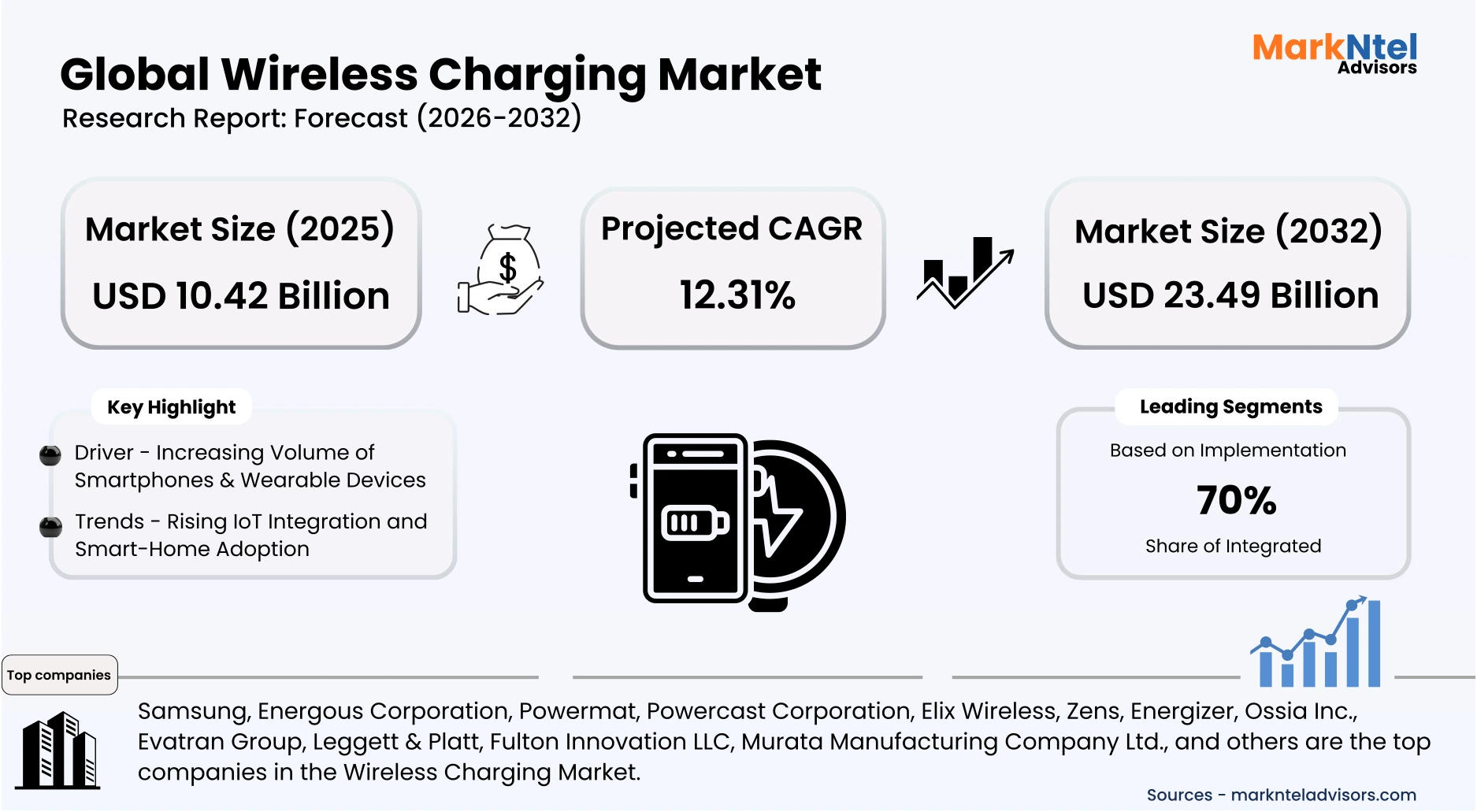
- Market size was valued at around USD10.42 billion in 2025 and is projected to reach USD23.49 billion by 2032. The estimated CAGR from 2026 to 2032 is around 12.31%, indicating strong growth.
- The Asia-Pacific holds the largest market share of about 55% in the Global Wireless Charging Market in 2025.
- By Technology, the Magnetic Induction segment represented a significant share of about 65% in the Global Wireless Charging Market in 2025.
- By Implementation, the Integrated segment presented a significant share of about 70% in the Global Wireless Charging Market in 2025.
- Leading Wireless Charging Companies in the Global Market are Samsung, Energous Corporation, Powermat, Powercast Corporation, Elix Wireless, Zens, Energizer, Ossia Inc., Evatran Group, Leggett & Platt, Fulton Innovation LLC, Murata Manufacturing Company Ltd., Qualcomm Technologies, Inc., Sony Corporation, Texas Instruments, Inc., and Others.
Market Insights & Analysis: Global Wireless Charging Market (2026-32):
The Global Wireless Charging Market size was valued at around USD10.42 billion in 2025 and is projected to reach USD23.49 billion by 2032. Along with this, the market is estimated to grow at a CAGR of around 12.31% during the forecast period, i.e., 2026-32.
The Global Wireless Charging Market is witnessing a significant growth powered by advances in fast-charging standards, expanding device compatibility, and growing adoption in electric mobility. In July 2025, the Wireless Power Consortium introduced the Qi2 25-watt standard to enhance charging efficiency and speed for smartphones and wearables while ensuring broad device compatibility. Over 13,000 products have now received Qi certification worldwide, reflecting the widespread adoption of wireless charging in everyday electronics . At the same time, the rapid shift to electric vehicles is driving demand for wireless charging infrastructure, with the International Energy Agency reporting over 1.3 million public charging stations globally by 2024.
Beyond consumer electronics, industries are exploring innovative applications, including long-range inductive power systems for logistics, agriculture, and renewable-energy-powered wireless greenhouses. In homes and offices, furniture-embedded and multi-device charging solutions are improving convenience, while automotive wireless charging is advancing to support EVs and public mobility networks. The Asia-Pacific region is emerging as a production and adoption leader, bolstered by consumer electronics hubs and government support.
Additionally, developments in long-range and resonant charging technologies are expanding spatial flexibility and multi-device capabilities. Together, these factors illustrate a technology-driven, demand-led trajectory, positioning the global wireless charging industry for sustained growth.
Global Wireless Charging Market Recent Developments:
- August 2025: Alongside the Pixel 10 series, Google LLC introduced its first range of magnetic wireless charging accessories with up to 25W of power and Qi2 compliance. The deployment demonstrates how large OEMs are using standardized wireless charging and magnetic alignment at scale.
- July 2025: The Qi2 25W standard, which raises the maximum wireless power transfer from 15W to 25W, nearly 70% more, was formally launched, according to the Wireless Power Consortium. There is widespread industry support for faster and more effective wireless charging for smartphones, as seen by the fourteen devices that have already received certification under this standard .
Global Wireless Charging Market Scope:
| Category | Segments |
|---|---|
| By Technology | Magnetic Resonance, Magnetic Induction, Radio Frequency |
| By Implementation | Transmitters, Receivers, Aftermarket, Integrated |
| By Application | Consumer Electronics, Automotive, Healthcare, Industrial, Others |
Global Wireless Charging Market Driver:
Increasing Volume of Smartphones & Wearable Devices
One of the main factors propelling the size & volume of the Global Wireless Charging Market is the rapid growth of smartphones and wearable devices, as these devices increasingly incorporate wireless charging features and ecosystems. According to the Indian Commerce Ministry, smartphone exports from India reached USD24.14 billion in fiscal year 2024–2025, a 55% increase from USD 15.57 billion in 2023–2024 . According to figures provided to the Indian government, India's mobile phone exports for May 2025 reached over USD3.09 billion, representing a 74% year-over-year growth .
Consumer expectations for ease, improved power transmission, and smooth charging experiences are rising due to the growing installed base of wireless-capable gadgets. Adoption grows into accessories, furniture, and public infrastructure as manufacturers include wireless charging coils and magnetic alignment into more smartphones and wearables. This boosts market reach and encourages the development of higher-power chargers.
Rising Electric-Vehicle (EV) Adoption and Charging Infrastructure
The Global Wireless Charging Industry is growing significantly due to the rising electric-vehicle (EV) adoption and charging infrastructure. Since customers and fleets want convenience, flexibility, and less cable clutter, the rise in electric car adoption directly increases demand for advanced charging solutions, such as wireless systems. The International Energy Agency (IEA) reports that sales of electric cars (EVs) exceeded 17 million units globally in 2024, surpassing the 20% mark of total new car sales worldwide, and are expected to account for more than one in four new vehicles in 2025 . Concurrently, the global number of public EV charging stations quadrupled from 2022 to over 5 million by the end of 2024, with China accounting for two-thirds of the total . Wireless charging in residential hubs, commercial fleets, and urban mobility is made possible by the quick development of infrastructure.
For instance, wireless systems provide faster installation and retrofit possibilities without requiring heavy wiring, while new charging hubs reach hundreds of thousands of ports per year. The need for quick-drop, cable-free charging increases as EVs become more prevalent in shared mobility, ride-hailing, and delivery fleets. Therefore, the expansion of the wireless charging market is being driven by the convergence of large-scale infrastructure development and increasing EV volume.
Global Wireless Charging Market Trend:
Rising IoT Integration and Smart-Home Adoption
Rising IoT integration and smart home adoption are changing the dynamics of the Wireless Charging Industry. About 70.9% of EU citizens used internet-connected devices in 2024, and 12.8% used smart-home appliances, according to Eurostat, demonstrating the growing prevalence of IoT platforms in homes . In order to improve convenience and reduce cable clutter, there is a growing need for embedded charging surfaces in furniture, workstations, and public spaces due to the development of intelligent gadgets, which range from smart speakers and thermostats to security systems and lights.
These advancements support wireless charging designs that are integrated into workstations, counters, and living areas, providing seamless charging inside the IoT ecosystem and facilitating a broader uptake of wireless power in residences and workplaces.
Resource-Efficiency and Sustainability Initiatives Changing Market Landscape
The Global Wireless Charging Market is witnessing drastic changes due to the trend of resource-efficiency and sustainability initiatives aligned with government aims for cleaner energy systems and reduced e‑waste. In line with government goals for cleaner energy systems and less e-waste, resource-efficiency and sustainability measures are becoming key trends in the wireless-charging sector. As recycling infrastructure lags behind end-of-life battery growth, consumers and manufacturers are likely to favor technologies that enhance energy efficiency and durability. Wireless charging minimizes wear on battery ports and supports sustainable energy management, aligning with the global push to lessen e-waste and dependence on disposable batteries. By eliminating the need for many of these batteries, wireless power modules reduce waste and the demand for resources.
A project supported by the European Commission was awarded USD17.34 million to test a 25-kW bidirectional wireless charging system in Zaragoza, Spain. By balancing renewable energy supply and demand and promoting sustainable transportation innovation, the technology enables electric vehicles to function as mobile energy storage units and further support the grid. These illustrations show how smart grids, renewable energy, and circular economy flows are supported by the scale and deployment of wireless charging stations. Wireless charging helps reduce life-cycle emissions and material consumption by distributing charging loads more evenly, integrating with microgrids, and getting rid of cables and batteries. These advancements decrease operational carbon footprints, simplify infrastructure, and promote sector-wide sustainability objectives.
Global Wireless Charging Market Challenge:
High Infrastructure and Implementation Costs
The Global Wireless Charging sector faces a major challenge due to high infrastructure and implementation costs. For instance, a thorough assessment of a battery-powered vehicle dynamic wireless charging lane in Indiana calculated the overall infrastructure expenditures to be between USD6.3 and USD6.6 million per mile . Significant financial barriers to widespread deployment are created by such a large upfront expenditure, particularly since usage rates are unpredictable and benefits could only materialize over extended periods of time. Adoption is slowed, and capital intensity is increased by the requirement to adapt road or parking infrastructure, update grid connections, and insert complex power transmission coils.
Global Wireless Charging Market (2026-32) Segmentation Analysis:
The Global Wireless Charging Market study of MarkNtel Advisors evaluates & highlights the major trends and influencing factors in each segment. It includes predictions for the period 2026–32 at the Global level. Based on the analysis, the market has been further classified as;
Based on Technology
- Magnetic Resonance
- Magnetic Induction
- Radio Frequency
The magnetic induction segment holds the top spot in the Global Wireless Charging Market, accounting for 65% market share. Its widespread use in consumer devices, ease of use, and effectiveness in short-range charging are the reasons for its leadership. Smartphones and wearables benefit greatly from inductive charging as it offers quick, safe, and dependable charging without the need for physical connectors.
The broad use of this technology stems from its well-established infrastructure and interoperability with many device makers. For instance, magnetic induction is used by the majority of Qi-certified wireless chargers, including Samsung models, which provide users with ease and universal applicability. Industry leaders' ongoing expenditures to improve charging speed and energy efficiency help the category even more.
Based on Implementation
- Transmitters
- Receivers
- Aftermarket
- Integrated
The integrated category leads the Global Wireless Charging Industry, accounting for 70% market share. With the OEM integration of wireless charging components directly into products like smartphones and automobiles, the integrated category leads this market with a massive market share. This integration facilitates the increasing uptake of luxurious products and provides smooth user experiences.
To improve customer convenience and device functioning, Samsung incorporates wireless charging pads into its Galaxy smartphone line. Its dominant market position is fueled by seamless integration, which increases efficiency and decreases reliance on aftermarket accessories.
Global Wireless Charging Market (2026-32): Regional Projection
The Global Wireless Charging Market is dominated by the Asia-Pacific region, with a market share of about 55%, due to the existence of significant electronics manufacturing centers like China, South Korea, and Japan. In 2024, the region held over half of the market share. Adoption is fueled by customer demand for convenience, increasing disposable income, and rapid urbanization. Through advantageous policies and subsidies, governments also promote technological progress.
For example, wireless charging integration in smartphones and electric automobiles has advanced due to China's vigorous drive for 5G and IoT businesses. North America comes next, driven by robust innovation ecosystems and early uptake in the medical and automotive industries. With its emphasis on smart infrastructure development and sustainability, Europe also makes a substantial contribution.
Gain a Competitive Edge with Our Global Wireless Charging Market Report
- Global Wireless Charging Market Report by MarkNtel Advisors provides a detailed & thorough analysis of market size & share, growth rate, competitive landscape, and key players. This comprehensive analysis helps businesses gain a holistic understanding of the market dynamics & make informed decisions.
- This report also highlights current market trends & future projections, allowing businesses to identify emerging opportunities & potential challenges. By understanding market forecasts, companies can align their strategies & stay ahead of the competition.
- Global Wireless Charging Market Report aids in assessing & mitigating risks associated with entering or operating in the market. By understanding market dynamics, regulatory frameworks, and potential challenges, businesses can develop strategies to minimize risks & optimize their operations.
*Reports Delivery Format - Market research studies from MarkNtel Advisors are offered in PDF, Excel and PowerPoint formats. Within 24 hours of the payment being successfully received, the report will be sent to your email address.
Frequently Asked Questions
- Market Segmentation
- Introduction
- Product Definition
- Research Process
- Assumptions
- Executive Summary
- Global Wireless Charging Market Trends & Insights
- Global Wireless Charging Market Dynamics
- Growth Drivers
- Challenges
- Global Wireless Charging Market Hotspot & Opportunities
- Global Wireless Charging Market Policies & Regulations
- Global Wireless Charging Market Outlook, 2022-2032F
- Market Size & Analysis
- By Revenue (USD Million)
- Market Share & Analysis
- By Technology
- Magnetic Resonance
- Magnetic Induction
- Radio Frequency
- By Implementation
- Transmitters
- Receivers
- Aftermarket
- Integrated
- By Application
- Consumer Electronics
- Automotive
- Healthcare
- Industrial
- Others (Aerospace and Defence, etc.)
- By Region
- North America
- South America
- Europe
- The Middle East & Africa
- Asia-Pacific
- By Competitors
- Competition Characteristics
- Market Share & Analysis
- By Technology
- Market Size & Analysis
- North America Wireless Charging Market Outlook, 2022-2032F
- Market Size & Analysis
- By Revenue (USD Million)
- Market Share & Analysis
- By Technology
- By Implementation
- By Application
- By Country
- The US
- Canada
- Mexico
- The US Wireless Charging Market Outlook, 2022-2032F
- Market Size & Analysis
- By Revenue (USD Million)
- Market Share & Analysis
- By Technology
- By Application
- Market Size & Analysis
- Canada Wireless Charging Market Outlook, 2022-2032F
- Market Size & Analysis
- By Revenue (USD Million)
- Market Share & Analysis
- By Technology
- By Application
- Market Size & Analysis
- Mexico Wireless Charging Market Outlook, 2022-2032F
- Market Size & Analysis
- By Revenue (USD Million)
- Market Share & Analysis
- By Technology
- By Application
- Market Size & Analysis
- Market Size & Analysis
- South America Wireless Charging Market Outlook, 2022-2032F
- Market Size & Analysis
- By Revenue (USD Million)
- Market Share & Analysis
- By Technology
- By Implementation
- By Application
- By Country
- Brazil
- Argentina
- Rest of South America
- Brazil Wireless Charging Market Outlook, 2022-2032F
- Market Size & Analysis
- By Revenue (USD Million)
- Market Share & Analysis
- By Technology
- By Application
- Market Size & Analysis
- Argentina Wireless Charging Market Outlook, 2022-2032F
- Market Size & Analysis
- By Revenue (USD Million)
- Market Share & Analysis
- By Technology
- By Application
- Market Size & Analysis
- Market Size & Analysis
- Europe Wireless Charging Market Outlook, 2022-2032F
- Market Size & Analysis
- By Revenue (USD Million)
- Market Share & Analysis
- By Technology
- By Implementation
- By Application
- By Country
- The UK
- Germany
- France
- Italy
- Spain
- Rest of Europe
- The UK Wireless Charging Market Outlook, 2022-2032F
- Market Size & Analysis
- By Revenue (USD Million)
- Market Share & Analysis
- By Technology
- By Application
- Market Size & Analysis
- Germany Wireless Charging Market Outlook, 2022-2032F
- Market Size & Analysis
- By Revenue (USD Million)
- Market Share & Analysis
- By Technology
- By Application
- Market Size & Analysis
- France Wireless Charging Market Outlook, 2022-2032F
- Market Size & Analysis
- By Revenue (USD Million)
- Market Share & Analysis
- By Technology
- By Application
- Market Size & Analysis
- Italy Wireless Charging Market Outlook, 2022-2032F
- Market Size & Analysis
- By Revenue (USD Million)
- Market Share & Analysis
- By Technology
- By Application
- Market Size & Analysis
- Spain Wireless Charging Market Outlook, 2022-2032F
- Market Size & Analysis
- By Revenue (USD Million)
- Market Share & Analysis
- By Technology
- By Application
- Market Size & Analysis
- Market Size & Analysis
- The Middle East & Africa Wireless Charging Market Outlook, 2022-2032F
- Market Size & Analysis
- By Revenue (USD Million)
- Market Share & Analysis
- By Technology
- By Implementation
- By Application
- By Country
- The UAE
- Saudi Arabia
- Turkey
- South Africa
- Rest of Middle East & Africa
- The UAE Wireless Charging Market Outlook, 2022-2032F
- Market Size & Analysis
- By Revenue (USD Million)
- Market Share & Analysis
- By Technology
- By Application
- Market Size & Analysis
- Saudi Arabia Wireless Charging Market Outlook, 2022-2032F
- Market Size & Analysis
- By Revenue (USD Million)
- Market Share & Analysis
- By Technology
- By Application
- Market Size & Analysis
- Turkey Wireless Charging Market Outlook, 2022-2032F
- Market Size & Analysis
- By Revenue (USD Million)
- Market Share & Analysis
- By Technology
- By Application
- Market Size & Analysis
- South Africa Wireless Charging Market Outlook, 2022-2032F
- Market Size & Analysis
- By Revenue (USD Million)
- Market Share & Analysis
- By Technology
- By Application
- Market Size & Analysis
- Market Size & Analysis
- Asia-Pacific Wireless Charging Market Outlook, 2022-2032F
- Market Size & Analysis
- By Revenue (USD Million)
- Market Share & Analysis
- By Technology
- By Implementation
- By Application
- By Country
- China
- Japan
- South Korea
- India
- Australia
- Rest of Asia Pacific
- China Wireless Charging Market Outlook, 2022-2032F
- Market Size & Analysis
- By Revenue (USD Million)
- Market Share & Analysis
- By Technology
- By Application
- Market Size & Analysis
- Japan Wireless Charging Market Outlook, 2022-2032F
- Market Size & Analysis
- By Revenue (USD Million)
- Market Share & Analysis
- By Technology
- By Application
- Market Size & Analysis
- South Korea Wireless Charging Market Outlook, 2022-2032F
- Market Size & Analysis
- By Revenue (USD Million)
- Market Share & Analysis
- By Technology
- By Application
- Market Size & Analysis
- India Wireless Charging Market Outlook, 2022-2032F
- Market Size & Analysis
- By Revenue (USD Million)
- Market Share & Analysis
- By Technology
- By Application
- Market Size & Analysis
- Australia and New Zealand Wireless Charging Market Outlook, 2022-2032F
- Market Size & Analysis
- By Revenue (USD Million)
- Market Share & Analysis
- By Technology
- By Application
- Market Size & Analysis
- Market Size & Analysis
- Global Wireless Charging Market Key Strategic Imperatives for Success & Growth
- Competition Outlook
- Competition Matrix
- Target Markets
- Research & Development
- Collaborations & Strategic Alliances
- Key Business Expansion Initiatives
- Business Restructuring- Mergers, Acquisitions, JVs
- Strategic Initiatives
- Company Profiles (Business Description, Product Segments, Business Segments, Financials, Strategic Alliances/ Partnerships, Future Plans)
- Samsung
- Energous Corporation
- Powermat
- Powercast Corporation
- Elix Wireless
- Zens
- Energizer
- Ossia Inc.
- Evatran Group
- Leggett & Platt
- Fulton Innovation LLC
- Murata Manufacturing Company Ltd.
- Qualcomm Technologies, Inc.
- Sony Corporation
- Texas Instruments, Inc.
- Others
- Competition Matrix
- Disclaimer
MarkNtel Advisors follows a robust and iterative research methodology designed to ensure maximum accuracy and minimize deviation in market estimates and forecasts. Our approach combines both bottom-up and top-down techniques to effectively segment and quantify various aspects of the market. A consistent feature across all our research reports is data triangulation, which examines the market from three distinct perspectives to validate findings. Key components of our research process include:
1. Scope & Research Design At the outset, MarkNtel Advisors define the research objectives and formulate pertinent questions. This phase involves determining the type of research—qualitative or quantitative—and designing a methodology that outlines data collection methods, target demographics, and analytical tools. They also establish timelines and budgets to ensure the research aligns with client goals.
2. Sample Selection and Data Collection In this stage, the firm identifies the target audience and determines the appropriate sample size to ensure representativeness. They employ various sampling methods, such as random or stratified sampling, based on the research objectives. Data collection is carried out using tools like surveys, interviews, and observations, ensuring the gathered data is reliable and relevant.
3. Data Analysis and Validation Once data is collected, MarkNtel Advisors undertake a rigorous analysis process. This includes cleaning the data to remove inconsistencies, employing statistical software for quantitative analysis, and thematic analysis for qualitative data. Validation steps are taken to ensure the accuracy and reliability of the findings, minimizing biases and errors.

4. Data Forecast and FinalizationThe final phase involves forecasting future market trends based on the analyzed data. MarkNtel Advisors utilize predictive modeling and time series analysis to anticipate market behaviors. The insights are then compiled into comprehensive reports, featuring visual aids like charts and graphs, and include strategic recommendations to inform client decision-making
We offer flexible licensing options to cater to varying organizational needs. Choose the pricing pack that best suits your requirements:
Buy Now Inquire Before Buying
 Request Customization
 Talk to our Consultant







