

Global Artificial Intelligence Robots Market Research Report: Forecast (2026-2032)
Artificial Intelligence Robots Market - By Component Type (Software, Hardware, Services), By Robot Type (Industrial Robots, Service Robots, Others), By Deployment Mode (Cloud-based ... , On-Premises), By Technology (Machine Learning, Computer Vision, Natural Language Processing (NLP), Motion Planning & Control Algorithms, Context Awareness, Localization, Mapping & SLAM), By Application (Logistics & Warehousing, Healthcare & Medical Assistance, Personal Assistance & Caregiving, Security & Surveillance, Education & Entertainment, Agriculture, Hazardous Environment (Nuclear, O&G, Defense, etc), Automobile, Others), and others Read more
- ICT & Electronics
- Jan 2026
- Pages 198
- Report Format: PDF, Excel, PPT
Global Artificial Intelligence Robots Market
Projected 34.07% CAGR from 2026 to 2032
Study Period
2026-2032
Market Size (2025)
USD 7.38 Billion
Market Size (2032)
USD 57.46 Billion
Largest Region
Asia-Pacific
Projected CAGR
34.07%
Leading Segments
By Application: Personal Assistance & Caregiving
Global Artificial Intelligence Robots Market Report Key Takeaways:
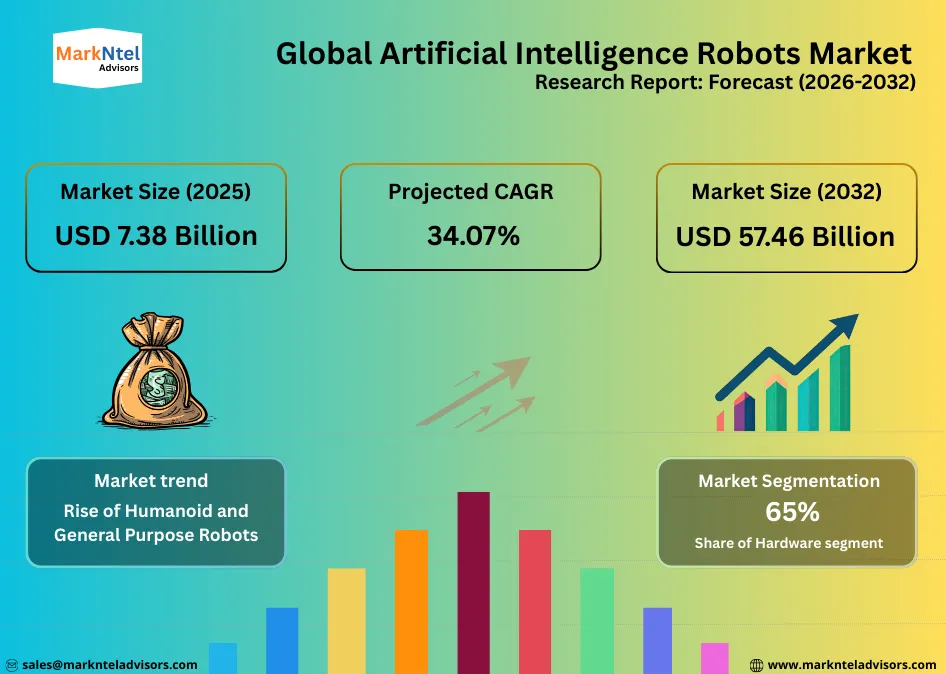
- The Global Artificial Intelligence Robots Market size was valued at around USD 7.38 billion in 2025 and is projected to reach USD 57.46 billion by 2032. The estimated CAGR from 2026 to 2032 is around 34.07%, indicating strong growth.
- By Component Type, the hardware segment represented 65% of the Global Artificial Intelligence Robots Market size in 2025.
- By Application, the personal assistance & caregiving segment represented 25% of the Global Artificial Intelligence Robots Market size in 2025.
- By Region, Asia Pacific leads the Global Artificial Intelligence Robots Market with a dominant 44% share, while China emerges as the fastest-growing major market, projected to expand at a robust 45.19% CAGR during 2026-32.
- The leading Artificial Intelligence Robots companies are IBM Corporation, Panasonic Corporation, Boston Dynamics, Inc., NVIDIA Corporation, Yaskawa Electric Corporation, Sony Group Corporation, Intel Corporation, Qualcomm Technologies, Inc., Nidec Corporation, Advanced Micro Devices, Inc., Brain Corporation, Nabtesco Corporation, Infineon Technologies AG, ABB, Texas Instruments Incorporated, and others.
Market Insights & Analysis: Global Artificial Intelligence Robots Market (2026- 2032):
The Global Artificial Intelligence Robots Market size was valued at around USD 7.38 billion in 2025 and is projected to reach USD 57.46 billion by 2032. Along with this, the market is estimated to grow at a CAGR of around 34.07% during the forecast period, i.e., 2026-32.
The Global Artificial Intelligence Robots Market is experiencing rapid growth, driven by continuous advancements in artificial intelligence and machine learning, together with the accelerating adoption of humanoid and general-purpose robots that are redefining automation across industrial and service environments.
In Europe, the launch of GenAI4EU under Horizon Europe commits nearly USD 740 million to accelerate generative and multimodal AI systems. These capabilities are critical for robotics, enabling natural language interaction, visual reasoning, and adaptive learning. Such frameworks elevate Europe’s capacity to develop autonomous robots for healthcare, manufacturing, and public services.
Meanwhile, North America continues to advance AI foundations through coordinated federal strategies. The U.S. Department of State’s Enterprise Artificial Intelligence Strategy (FY 2024–2025) promotes responsible AI deployment across government operations, indirectly supporting robotics applications in manufacturing, logistics, and services. The Genesis Mission, announced in November 2025, aims to create a centralized AI computation platform for scientific research, including intelligent robotics. In Canada, the Regional Artificial Intelligence Initiative (RAII) channels funding into AI-driven projects, strengthening machine learning models for perception, navigation, and autonomous decision-making in robots.
Asia-Pacific remains the most aggressive in translating AI policy into robotics acceleration. For example, Japan updated its national robotics strategy, allocating approximately around USD 215 million for AI-driven robotics R&D to expand autonomous systems across industries.
Singapore’s National Robotics Programme launched RoboNexus in March 2025, a government-backed accelerator enabling robotics startups to scale globally by combining AI, ML, and commercialization support for logistics, healthcare, and industrial automation.
The rise of humanoid and general-purpose robots further amplifies this outlook. As South Korea’s K-Humanoid Alliance, launched in 2025, targets the development of a shared AI “brain” for humanoids by 2028, enabling machines capable of lifting heavy loads and performing complex tasks.
On the technology front, NVIDIA’s Jetson Thor and Isaac platforms deliver edge-based “brains” for robots, providing perception, planning, and generative reasoning essential for next-generation humanoids and autonomous systems.
Beyond 2025, emerging markets are laying the foundations for AI-led robotics growth. India’s National AI strategy projects AI could add USD 500–600 billion to GDP by 2035 through expanded compute infrastructure and sectoral adoption, creating strong demand for intelligent robots in manufacturing, agriculture, and services.
Similarly, Taiwan’s USD 3.2 billion AI hub initiative focuses on national data centers and advanced computing platforms through 2028, directly enhancing robotics AI development. Meanwhile, Morocco plans USD 1.2 billion in AI infrastructure and training 200,000 specialists by 2030, expanding robotics potential across Africa.
Global investments in AI infrastructure, compute capacity, and policy frameworks are structurally strengthening robotic intelligence. Combined with the emergence of humanoid and general-purpose robots, these initiatives will accelerate deployment across industries, positioning AI-driven robotics as a central pillar of automation and economic productivity through the next decade.
Global Artificial Intelligence Robots Market Recent Developments:
- June 2025: Amazon has deployed its one millionth warehouse robot and launched a new generative AI foundation model, DeepFleet, to optimise its global robotic fleet. DeepFleet enhances the coordination and travel efficiency of robots by about 10%, supporting faster order fulfillment and lower operational costs. The milestone reflects Amazon’s continued investment in AI-driven automation across more than 300 fulfillment centers worldwide.
- March 2025: NVIDIA unveiled Isaac GR00T N1, the world’s first open, fully customizable humanoid robot foundation model, to accelerate AI-driven robotics development. The release includes simulation tools and synthetic data generation frameworks to speed training and deployment of general-purpose robot skills such as manipulation and navigation. Early access is granted to leading robotics developers, broadening adoption across research and industry.
Global Artificial Intelligence Robots Market Scope:
| Category | Segments |
|---|---|
| Component Type | Software, Hardware, Services |
| Robot Type | Industrial Robots, Service Robots, Others |
| Deployment Mode | Cloud-based, On-Premises |
| Technology | Machine Learning, Computer Vision, Natural Language Processing (NLP), Motion Planning & Control Algorithms, Context Awareness, Localization, Mapping & SLAM |
| Application | Logistics & Warehousing, Healthcare & Medical Assistance, Personal Assistance & Caregiving, Security & Surveillance, Education & Entertainment, Agriculture, Hazardous Environment (Nuclear, O&G, Defense, etc), Automobile, Others |
Global Artificial Intelligence Robots Market Drivers:
Expanding AI Computing Infrastructure
Rapid expansion of AI computing infrastructure and cross-border collaboration is becoming a decisive growth driver for the Artificial Intelligence Robots Market. Governments are increasingly investing in high-performance computing and AI ecosystems that directly enhance the intelligence, autonomy, and adaptability of robots.
In Latin America, Mexico’s federal government has announced plans to build the region’s most powerful supercomputer, Coatlicue, with projected performance exceeding 314 petaflops. This system is designed to strengthen national AI research capacity, enabling the training of far more complex machine-learning models. Such computing power is essential for robotics applications requiring real-time perception, multimodal learning, and autonomous decision-making, particularly in manufacturing, logistics, and urban services.
In Europe, the European Union’s Horizon Europe framework allocated approximately USD 183.5 million during 2023–2025 specifically for robotics and AI research. These funds support projects focused on autonomy, human–robot interaction, and intelligent motion control, accelerating the integration of advanced ML into industrial and service robots across member states.
Asia is reinforcing this momentum through ecosystem-building initiatives. The Guangdong–Hong Kong–Macao Greater Bay Area International AI & Robotics Summit 2025, backed by the Innovation, Technology, and Industry Bureau and the Hong Kong Productivity Council, emphasized AI-driven “embodied intelligence” and cross-sector robot deployment, linking research directly with real-world industrial adoption.
Large-scale AI infrastructure investments and government-led robotics ecosystems are strengthening the computational and collaborative foundations of intelligent machines. These initiatives will significantly accelerate the development and deployment of smarter, more autonomous robots, driving sustained market growth beyond 2025.
Global Artificial Intelligence Robots Market Trends:
Rise of Humanoid and General Purpose Robots
The rapid development of humanoid and general-purpose robots is reshaping the Artificial Intelligence Robots Market, supported by strong government backing and advances in embedded AI. Nations increasingly view humanoid robotics as strategic infrastructure to offset labor shortages and enhance productivity.
In China, a Ministry of Industry and Information Technology roadmap sets clear targets for breakthroughs in cognition, mobility, and actuation, aiming to enable scalable humanoid robot production by 2025.
Reflecting this strategic focus, China’s public procurement of humanoid robots increased sharply from USD 0.03 million in 2023 to USD 1.4million in 2024. Complementing this market uptake, central and provincial authorities have allocated more than USD 20 billion in direct subsidies and established an approximate USD 137 billion robotics fund to catalyze AI and robotics innovation. Additional state-backed capital totaling USD 9.7 billion supports regional robotics innovation clusters, accelerating commercialization and industrial research.
Industry leaders are integrating advanced AI to realize functional general-purpose robots. For example, IBM’s collaboration with Boston Dynamics embeds AI analytics into the Spot mobile robot, enabling real-time interpretation of sensor data and edge-based anomaly detection. This reduces dependence on cloud computing and improves autonomous decision-making in unstructured environments.
Strategic public funding and private-sector AI integration are catalyzing the transition from task-specific machines to autonomous, adaptive humanoid systems, significantly broadening application potential and supporting robust market expansion.
Global Artificial Intelligence Robots Market Challenges:
High Development and Deployment Costs
A significant challenge constraining the Artificial Intelligence Robots Market is the high cost of developing, producing, and deploying advanced robotic systems. Despite rapid AI progress, turning sophisticated prototypes into commercially viable machines remains expensive due to specialized hardware requirements and low production volumes.
Advanced humanoid robots typically cost between approximately USD 50,000 and USD 400,000 per unit, significantly higher than many industrial robots priced below USD 30,000, because they require multiple sensors, high-performance processors, and precision mechanical components that are costly to manufacture at scale.
These costs arise not only from physical hardware but also from engineering integration and testing. Components such as LiDAR and RGB-D cameras, essential for perception and autonomy, can individually run into thousands of dollars, further driving up total system expenses.
High upfront investment needs are compounded by ongoing maintenance, safety certification, and software development costs, making it challenging for many organizations to justify ROI in the short term.
Unless hardware costs decline materially or supportive financing mechanisms increase, elevated development and deployment costs will continue to limit widespread adoption, particularly among budget-constrained sectors, thereby slowing overall market growth.
Global Artificial Intelligence Robots Market (2026-32) Segmentation Analysis:
The Global Artificial Intelligence Robots Market Report and Forecast 2026-2032 offers a detailed analysis of the market based on the following segments:
Based on Component Type:
- Software
- Hardware
- Services
The hardware segment holds the top spot in the Global Artificial Intelligence Robots Market, with a market share of around 65%, reflecting the capital-intensive nature of intelligent robotic systems.
AI robots rely on a complex physical architecture comprising high-performance processors, vision systems, sensors, actuators, motors, batteries, and precision mechanical structures. Unlike software, which can be replicated at low marginal cost, each robotic unit requires a full set of these components, making hardware the primary cost driver across production and deployment.
The rise of humanoid and general-purpose robots further amplifies hardware intensity. These platforms demand multi-sensor fusion (LiDAR, depth cameras, force-torque sensors), edge AI chips, and advanced mobility systems capable of dynamic balance and manipulation. In industrial and logistics environments, robots must also meet stringent durability, safety, and compliance standards, increasing material and engineering complexity.
Additionally, global investments in domestic manufacturing of semiconductors, actuators, and robotics components are strengthening hardware ecosystems, accelerating unit shipments. As AI robots transition from pilots to fleet-scale deployments in factories, warehouses, healthcare, and public services, the cumulative demand for physical systems continues to outpace software growth, sustaining hardware’s structural dominance in the market.
Based on Application:
- Logistics & Warehousing
- Healthcare & Medical Assistance
- Personal Assistance & Caregiving
- Security & Surveillance
- Education & Entertainment
- Agriculture
- Hazardous Environment (Nuclear, O&G, Defense, etc.)
- Automobile
- Others
The personal assistance & caregiving category leads the Global Artificial Intelligence Robots Industry, with a 25% of market share. Market dominance is driven by rapid aging populations, chronic caregiver shortages, and rising demand for independent living solutions.
AI-powered assistive robots are increasingly deployed for mobility support, medication reminders, companionship, fall detection, and daily task assistance, particularly among elderly and differently abled individuals.
In developed economies, the ratio of caregivers to seniors is steadily declining, compelling healthcare systems and families to adopt robotic support to maintain quality of care. These robots combine computer vision, speech recognition, and adaptive learning to interact naturally with users, monitor health indicators, and respond in real time. Unlike industrial robots, personal care robots operate continuously in the home and assisted-living environments, generating sustained demand.
Advances in natural language processing and emotional AI have also improved user acceptance, enabling robots to provide social engagement and reduce loneliness. Governments and healthcare providers increasingly view assistive robotics as cost-effective alternatives to full-time human care, reinforcing adoption. This convergence of demographic pressure, healthcare cost containment, and AI maturity positions personal assistance and caregiving as the leading application segment.
Global Artificial Intelligence Robots Market (2026-32): Regional Projection
The Global Artificial Intelligence Robots Market is dominated by the Asia Pacific region, which holds a commanding 44% market share, supported by expansive manufacturing bases, strong state backing, and rapid commercialization of AI technologies.
Economies such as China, Japan, South Korea, and Singapore have embedded robotics and artificial intelligence into national development agendas, accelerating deployment across manufacturing plants, logistics networks, healthcare facilities, and public services.
China’s large-scale investment in intelligent manufacturing and humanoid robotics, Japan’s entrenched leadership in industrial and service robots, and South Korea’s emphasis on smart factories and next-generation humanoids collectively generate unmatched production and adoption momentum.
In November 2025, South Korea’s president proposed tripling AI-related public spending to USD 6.9 billion, prioritizing AI computing infrastructure, advanced semiconductors, and robotics R&D to accelerate humanoid development and expand smart factory and service robot deployment nationwide.
Within this regional dominance, China emerges as the fastest-growing major market, projected to expand at a robust 45.19% CAGR, followed by the United States at 42%, and Taiwan at 40.18%. This convergence of policy commitment, industrial depth, and demographic pressure firmly anchors Asia-Pacific’s leadership in the global AI robots landscape.
Gain a Competitive Edge with Our Global Artificial Intelligence Robots Market Report
- Global Artificial Intelligence Robots Market Report by MarkNtel Advisors provides a detailed & thorough analysis of market size & share, growth rate, competitive landscape, and key players. This comprehensive analysis helps businesses gain a holistic understanding of the market dynamics & make informed decisions.
- This report also highlights current market trends & future projections, allowing businesses to identify emerging opportunities & potential challenges. By understanding market forecasts, companies can align their strategies & stay ahead of the competition.
- Global Artificial Intelligence Robots Market Report aids in assessing & mitigating risks associated with entering or operating in the market. By understanding market dynamics, regulatory frameworks, and potential challenges, businesses can develop strategies to minimize risks & optimize their operations.
*Reports Delivery Format - Market research studies from MarkNtel Advisors are offered in PDF, Excel and PowerPoint formats. Within 24 hours of the payment being successfully received, the report will be sent to your email address.
Frequently Asked Questions
- Market Segmentation
- Introduction
- Product Definition
- Research Process
- Assumptions
- Executive Summary
- Global Artificial Intelligence Robots Market Investment, Funding, and M&A Trends
- Venture funding by segment
- Corporate investment and strategic partnerships
- M&A case studies and integration rationale
- Patent and IP activity trends
- Global Artificial Intelligence Robots Market Policies, Regulations, and Product Standards
- Robot safety standards overview
- AI governance and compliance implications
- Data privacy in vision-enabled robots
- Liability, certification, and deployment approvals
- Workplace safety and human-robot interaction
- Global Artificial Intelligence Robots Market Technology Landscape
- AI stack in robots: perception, planning, control, learning
- Foundation models and VLMs in robotics
- Autonomy levels and human in the loop designs
- Simulation, digital twins, and synthetic data
- Edge AI, cloud robotics, and connectivity
- Safety, reliability, and functional validation
- Interoperability standards and middleware: ROS2, OPC UA, APIs
- Global Artificial Intelligence Robots Market Supply Chain, Manufacturing, and Distribution
- Key component supply risks
- Contract manufacturing and localization trends
- Channel strategies: direct, integrator-led, distributor networks
- After-sales service footprint and spare parts strategy
- Global Artificial Intelligence Robots Market Trends & Developments
- Global Artificial Intelligence Robots Market Dynamics
- Growth Drivers
- Challenges
- Global Artificial Intelligence Robots Market Hotspot & Opportunities
- Global Artificial Intelligence Robots Market Outlook, 2022-2032
- Market Size & Outlook
- By Revenues (USD Million)
- Market Share & Outlook
- By Component Type – Market Size & Forecast 2022-2032, USD Million
- Software
- Hardware
- Services
- By Robot Type – Market Size & Forecast 2022-2032, USD Million
- Industrial Robots
- Service Robots
- Others
- By Deployment Mode – Market Size & Forecast 2022-2032, USD Million
- Cloud-based
- On-Premises
- By Technology – Market Size & Forecast 2022-2032, USD Million
- Machine Learning
- Computer Vision
- Natural Language Processing (NLP)
- Motion Planning & Control Algorithms
- Context Awareness
- Localization, Mapping & SLAM
- By Application – Market Size & Forecast 2022-2032, USD Million
- Logistics & Warehousing
- Healthcare & Medical Assistance
- Personal Assistance & Caregiving
- Security & Surveillance
- Education & Entertainment
- Agriculture
- Hazardous Environment (Nuclear, O&G, Defense, etc)
- Automobile
- Others
- By Region
- North America
- South America
- Europe
- Middle East & Africa
- Asia-Pacific
- By Company
- Competition Characteristics
- Market Share & Analysis
- By Component Type – Market Size & Forecast 2022-2032, USD Million
- Market Size & Outlook
- North America Artificial Intelligence Robots Market Outlook, 2022-2032
- Market Size & Analysis
- By Revenue (USD Million)
- Market Share & Analysis
- By Component Type – Market Size & Forecast 2022-2032, USD Million
- By Robot Type – Market Size & Forecast 2022-2032, USD Million
- By Deployment Mode – Market Size & Forecast 2022-2032, USD Million
- By Technology – Market Size & Forecast 2022-2032, USD Million
- By Application – Market Size & Forecast 2022-2032, USD Million
- By Country
- The US
- Canada
- Mexico
- The US Artificial Intelligence Robots Market Outlook, 2022-2032
- Market Size & Analysis
- By Revenue (USD Million)
- Market Share & Analysis
- By Component Type – Market Size & Forecast 2022-2032, USD Million
- By Robot Type – Market Size & Forecast 2022-2032, USD Million
- By Deployment Mode – Market Size & Forecast 2022-2032, USD Million
- By Technology – Market Size & Forecast 2022-2032, USD Million
- By Application – Market Size & Forecast 2022-2032, USD Million
- Market Size & Analysis
- Canada Artificial Intelligence Robots Market Outlook, 2022-2032
- Market Size & Analysis
- By Revenue (USD Million)
- Market Share & Analysis
- By Component Type – Market Size & Forecast 2022-2032, USD Million
- By Robot Type – Market Size & Forecast 2022-2032, USD Million
- By Deployment Mode – Market Size & Forecast 2022-2032, USD Million
- By Technology – Market Size & Forecast 2022-2032, USD Million
- By Application – Market Size & Forecast 2022-2032, USD Million
- Market Size & Analysis
- Mexico Artificial Intelligence Robots Market Outlook, 2022-2032
- Market Size & Analysis
- By Revenue (USD Million)
- Market Share & Analysis
- By Component Type – Market Size & Forecast 2022-2032, USD Million
- By Robot Type – Market Size & Forecast 2022-2032, USD Million
- By Deployment Mode – Market Size & Forecast 2022-2032, USD Million
- By Technology – Market Size & Forecast 2022-2032, USD Million
- By Application – Market Size & Forecast 2022-2032, USD Million
- Market Size & Analysis
- Market Size & Analysis
- South America Artificial Intelligence Robots Market Outlook, 2022-2032
- Market Size & Analysis
- By Revenue (USD Million)
- Market Share & Analysis
- By Component Type – Market Size & Forecast 2022-2032, USD Million
- By Robot Type – Market Size & Forecast 2022-2032, USD Million
- By Deployment Mode – Market Size & Forecast 2022-2032, USD Million
- By Technology – Market Size & Forecast 2022-2032, USD Million
- By Application – Market Size & Forecast 2022-2032, USD Million
- By Country
- Brazil
- Argentina
- Rest of South America
- Brazil Artificial Intelligence Robots Market Outlook, 2022-2032
- Market Size & Analysis
- By Revenue (USD Million)
- Market Share & Analysis
- By Component Type – Market Size & Forecast 2022-2032, USD Million
- By Robot Type – Market Size & Forecast 2022-2032, USD Million
- By Deployment Mode – Market Size & Forecast 2022-2032, USD Million
- By Technology – Market Size & Forecast 2022-2032, USD Million
- By Application – Market Size & Forecast 2022-2032, USD Million
- Argentina Artificial Intelligence Robots Market Outlook, 2022-2032
- Market Size & Analysis
- By Revenue (USD Million)
- Market Share & Analysis
- By Component Type – Market Size & Forecast 2022-2032, USD Million
- By Robot Type – Market Size & Forecast 2022-2032, USD Million
- By Deployment Mode – Market Size & Forecast 2022-2032, USD Million
- By Technology – Market Size & Forecast 2022-2032, USD Million
- By Application – Market Size & Forecast 2022-2032, USD Million
- Market Size & Analysis
- Market Size & Analysis
- Europe Artificial Intelligence Robots Market Outlook, 2022-2032
- Market Size & Analysis
- By Revenue (USD Million)
- Market Share & Analysis
- By Component Type – Market Size & Forecast 2022-2032, USD Million
- By Robot Type – Market Size & Forecast 2022-2032, USD Million
- By Deployment Mode – Market Size & Forecast 2022-2032, USD Million
- By Technology – Market Size & Forecast 2022-2032, USD Million
- By Application – Market Size & Forecast 2022-2032, USD Million
- By Country
- The UK
- Germany
- France
- Italy
- Spain
- Rest of Europe
- By Country
- The UK Artificial Intelligence Robots Market Outlook, 2022-2032
- Market Size & Analysis
- By Revenue (USD Million)
- Market Share & Analysis
- By Component Type – Market Size & Forecast 2022-2032, USD Million
- By Robot Type – Market Size & Forecast 2022-2032, USD Million
- By Deployment Mode – Market Size & Forecast 2022-2032, USD Million
- By Technology – Market Size & Forecast 2022-2032, USD Million
- By Application – Market Size & Forecast 2022-2032, USD Million
- Market Size & Analysis
- Germany Artificial Intelligence Robots Market Outlook, 2022-2032
- Market Size & Analysis
- By Revenue (USD Million)
- Market Share & Analysis
- By Component Type – Market Size & Forecast 2022-2032, USD Million
- By Robot Type – Market Size & Forecast 2022-2032, USD Million
- By Deployment Mode – Market Size & Forecast 2022-2032, USD Million
- By Technology – Market Size & Forecast 2022-2032, USD Million
- By Application – Market Size & Forecast 2022-2032, USD Million
- Market Size & Analysis
- France Artificial Intelligence Robots Market Outlook, 2022-2032
- Market Size & Analysis
- By Revenue (USD Million)
- Market Share & Analysis
- By Component Type – Market Size & Forecast 2022-2032, USD Million
- By Robot Type – Market Size & Forecast 2022-2032, USD Million
- By Deployment Mode – Market Size & Forecast 2022-2032, USD Million
- By Technology – Market Size & Forecast 2022-2032, USD Million
- By Application – Market Size & Forecast 2022-2032, USD Million
- Market Size & Analysis
- Italy Artificial Intelligence Robots Market Outlook, 2022-2032
- Market Size & Analysis
- By Revenue (USD Million)
- Market Share & Analysis
- By Component Type – Market Size & Forecast 2022-2032, USD Million
- By Robot Type – Market Size & Forecast 2022-2032, USD Million
- By Deployment Mode – Market Size & Forecast 2022-2032, USD Million
- By Technology – Market Size & Forecast 2022-2032, USD Million
- By Application – Market Size & Forecast 2022-2032, USD Million
- Market Size & Analysis
- Spain Artificial Intelligence Robots Market Outlook, 2022-2032
- Market Size & Analysis
- By Revenue (USD Million)
- Market Share & Analysis
- By Component Type – Market Size & Forecast 2022-2032, USD Million
- By Robot Type – Market Size & Forecast 2022-2032, USD Million
- By Deployment Mode – Market Size & Forecast 2022-2032, USD Million
- By Technology – Market Size & Forecast 2022-2032, USD Million
- By Application – Market Size & Forecast 2022-2032, USD Million
- Market Size & Analysis
- Market Size & Analysis
- The Middle East & Africa Artificial Intelligence Robots Market Outlook, 2022-2032
- Market Size & Analysis
- By Revenue (USD Million)
- Market Share & Analysis
- By Component Type – Market Size & Forecast 2022-2032, USD Million
- By Robot Type – Market Size & Forecast 2022-2032, USD Million
- By Deployment Mode – Market Size & Forecast 2022-2032, USD Million
- By Technology – Market Size & Forecast 2022-2032, USD Million
- By Application – Market Size & Forecast 2022-2032, USD Million
- By Country
- Saudi Arabia
- The UAE
- South Africa
- Egypt
- Rest of the Middle East and Africa
- Saudi Arabia Artificial Intelligence Robots Market Outlook, 2022-2032
- Market Size & Analysis
- By Revenue (USD Million)
- Market Share & Analysis
- By Component Type – Market Size & Forecast 2022-2032, USD Million
- By Robot Type – Market Size & Forecast 2022-2032, USD Million
- By Deployment Mode – Market Size & Forecast 2022-2032, USD Million
- By Technology – Market Size & Forecast 2022-2032, USD Million
- By Application – Market Size & Forecast 2022-2032, USD Million
- Market Size & Analysis
- The UAE Artificial Intelligence Robots Market Outlook, 2022-2032
- Market Size & Analysis
- By Revenue (USD Million)
- Market Share & Analysis
- By Component Type – Market Size & Forecast 2022-2032, USD Million
- By Robot Type – Market Size & Forecast 2022-2032, USD Million
- By Deployment Mode – Market Size & Forecast 2022-2032, USD Million
- By Technology – Market Size & Forecast 2022-2032, USD Million
- By Application – Market Size & Forecast 2022-2032, USD Million
- Market Size & Analysis
- South Africa Artificial Intelligence Robots Market Outlook, 2022-2032
- Market Size & Analysis
- By Revenue (USD Million)
- Market Share & Analysis
- By Component Type – Market Size & Forecast 2022-2032, USD Million
- By Robot Type – Market Size & Forecast 2022-2032, USD Million
- By Deployment Mode – Market Size & Forecast 2022-2032, USD Million
- By Technology – Market Size & Forecast 2022-2032, USD Million
- By Application – Market Size & Forecast 2022-2032, USD Million
- Market Size & Analysis
- Egypt Artificial Intelligence Robots Market Outlook, 2022-2032
- Market Size & Analysis
- By Revenue (USD Million)
- Market Share & Analysis
- By Component Type – Market Size & Forecast 2022-2032, USD Million
- By Robot Type – Market Size & Forecast 2022-2032, USD Million
- By Deployment Mode – Market Size & Forecast 2022-2032, USD Million
- By Technology – Market Size & Forecast 2022-2032, USD Million
- By Application – Market Size & Forecast 2022-2032, USD Million
- Market Size & Analysis
- Market Size & Analysis
- Asia-Pacific Artificial Intelligence Robots Market Outlook, 2022-2032
- Market Size & Analysis
- By Revenue (USD Million)
- Market Share & Analysis
- By Component Type – Market Size & Forecast 2022-2032, USD Million
- By Robot Type – Market Size & Forecast 2022-2032, USD Million
- By Deployment Mode – Market Size & Forecast 2022-2032, USD Million
- By Technology – Market Size & Forecast 2022-2032, USD Million
- By Application – Market Size & Forecast 2022-2032, USD Million
- By Country
- China
- Japan
- India
- South Korea
- Australia
- Rest of Asia-Pacific
- China Artificial Intelligence Robots Market Outlook, 2022-2032
- Market Size & Analysis
- By Revenue (USD Million)
- Market Share & Analysis
- By Component Type – Market Size & Forecast 2022-2032, USD Million
- By Robot Type – Market Size & Forecast 2022-2032, USD Million
- By Deployment Mode – Market Size & Forecast 2022-2032, USD Million
- By Technology – Market Size & Forecast 2022-2032, USD Million
- By Application – Market Size & Forecast 2022-2032, USD Million
- Market Size & Analysis
- Japan Artificial Intelligence Robots Market Outlook, 2022-2032
- Market Size & Analysis
- By Revenue (USD Million)
- Market Share & Analysis
- By Component Type – Market Size & Forecast 2022-2032, USD Million
- By Robot Type – Market Size & Forecast 2022-2032, USD Million
- By Deployment Mode – Market Size & Forecast 2022-2032, USD Million
- By Technology – Market Size & Forecast 2022-2032, USD Million
- By Application – Market Size & Forecast 2022-2032, USD Million
- Market Size & Analysis
- India Artificial Intelligence Robots Market Outlook, 2022-2032
- Market Size & Analysis
- By Revenue (USD Million)
- Market Share & Analysis
- By Component Type – Market Size & Forecast 2022-2032, USD Million
- By Robot Type – Market Size & Forecast 2022-2032, USD Million
- By Deployment Mode – Market Size & Forecast 2022-2032, USD Million
- By Technology – Market Size & Forecast 2022-2032, USD Million
- By Application – Market Size & Forecast 2022-2032, USD Million
- Market Size & Analysis
- South Korea Artificial Intelligence Robots Market Outlook, 2022-2032
- Market Size & Analysis
- By Revenue (USD Million)
- Market Share & Analysis
- By Component Type – Market Size & Forecast 2022-2032, USD Million
- By Robot Type – Market Size & Forecast 2022-2032, USD Million
- By Deployment Mode – Market Size & Forecast 2022-2032, USD Million
- By Technology – Market Size & Forecast 2022-2032, USD Million
- By Application – Market Size & Forecast 2022-2032, USD Million
- Market Size & Analysis
- Australia Artificial Intelligence Robots Market Outlook, 2022-2032
- Market Size & Analysis
- By Revenue (USD Million)
- Market Share & Analysis
- By Component Type – Market Size & Forecast 2022-2032, USD Million
- By Robot Type – Market Size & Forecast 2022-2032, USD Million
- By Deployment Mode – Market Size & Forecast 2022-2032, USD Million
- By Technology – Market Size & Forecast 2022-2032, USD Million
- By Application – Market Size & Forecast 2022-2032, USD Million
- Market Size & Analysis
- Market Size & Analysis
- Global Artificial Intelligence Robots Market Key Strategic Imperatives for Success & Growth
- Competition Outlook
- Company Profiles
- IBM Corporation
- Business Description
- Product Portfolio
- Strategic Alliances or Partnerships
- Recent Developments
- Financial Details
- Others
- Panasonic Corporation
- Business Description
- Product Portfolio
- Strategic Alliances or Partnerships
- Recent Developments
- Financial Details
- Others
- Boston Dynamics, Inc.
- Business Description
- Product Portfolio
- Strategic Alliances or Partnerships
- Recent Developments
- Financial Details
- Others
- NVIDIA Corporation
- Business Description
- Product Portfolio
- Strategic Alliances or Partnerships
- Recent Developments
- Financial Details
- Others
- Yaskawa Electric Corporation
- Business Description
- Product Portfolio
- Strategic Alliances or Partnerships
- Recent Developments
- Financial Details
- Others
- Sony Group Corporation
- Business Description
- Product Portfolio
- Strategic Alliances or Partnerships
- Recent Developments
- Financial Details
- Others
- Intel Corporation
- Business Description
- Product Portfolio
- Strategic Alliances or Partnerships
- Recent Developments
- Financial Details
- Others
- Qualcomm Technologies, Inc.
- Business Description
- Product Portfolio
- Strategic Alliances or Partnerships
- Recent Developments
- Financial Details
- Others
- Nidec Corporation
- Business Description
- Product Portfolio
- Strategic Alliances or Partnerships
- Recent Developments
- Financial Details
- Others
- Advanced Micro Devices, Inc.
- Business Description
- Product Portfolio
- Strategic Alliances or Partnerships
- Recent Developments
- Financial Details
- Others
- Brain Corporation
- Business Description
- Product Portfolio
- Strategic Alliances or Partnerships
- Recent Developments
- Financial Details
- Others
- Nabtesco Corporation
- Business Description
- Product Portfolio
- Strategic Alliances or Partnerships
- Recent Developments
- Financial Details
- Others
- Infineon Technologies AG
- Business Description
- Product Portfolio
- Strategic Alliances or Partnerships
- Recent Developments
- Financial Details
- Others
- ABB
- Business Descriptions
- Product Portfolio
- Strategic Alliances or Partnerships
- Recent Developments
- Financial Details
- Others
- Texas Instruments Incorporated
- Business Descriptions
- Product Portfolio
- Strategic Alliances or Partnerships
- Recent Developments
- Financial Details
- Others
- Others
- IBM Corporation
- Company Profiles
- Disclaimer
MarkNtel Advisors follows a robust and iterative research methodology designed to ensure maximum accuracy and minimize deviation in market estimates and forecasts. Our approach combines both bottom-up and top-down techniques to effectively segment and quantify various aspects of the market. A consistent feature across all our research reports is data triangulation, which examines the market from three distinct perspectives to validate findings. Key components of our research process include:
1. Scope & Research Design At the outset, MarkNtel Advisors define the research objectives and formulate pertinent questions. This phase involves determining the type of research—qualitative or quantitative—and designing a methodology that outlines data collection methods, target demographics, and analytical tools. They also establish timelines and budgets to ensure the research aligns with client goals.
2. Sample Selection and Data Collection In this stage, the firm identifies the target audience and determines the appropriate sample size to ensure representativeness. They employ various sampling methods, such as random or stratified sampling, based on the research objectives. Data collection is carried out using tools like surveys, interviews, and observations, ensuring the gathered data is reliable and relevant.
3. Data Analysis and Validation Once data is collected, MarkNtel Advisors undertake a rigorous analysis process. This includes cleaning the data to remove inconsistencies, employing statistical software for quantitative analysis, and thematic analysis for qualitative data. Validation steps are taken to ensure the accuracy and reliability of the findings, minimizing biases and errors.

4. Data Forecast and FinalizationThe final phase involves forecasting future market trends based on the analyzed data. MarkNtel Advisors utilize predictive modeling and time series analysis to anticipate market behaviors. The insights are then compiled into comprehensive reports, featuring visual aids like charts and graphs, and include strategic recommendations to inform client decision-making
We offer flexible licensing options to cater to varying organizational needs. Choose the pricing pack that best suits your requirements:
Buy Now Inquire Before Buying
 Request Customization
 Talk to our Consultant







