

Saudi Arabia Electric Vehicle Market Research Report: Forecast (2026-2032)
By Vehicle Type (Passenger Cars, Commercial Vehicles, Two Wheelers, Three Wheelers), By Propulsion Type (Battery Electric Vehicle (BEV), Plug-in hybrid electric vehicles, Fuel-cell ... electric vehicles), By Charging Type (AC Charging, DC Fast Charging, Ultra-Fast / High-Power Charging), By Range (Less than 200 km, 200–400 km, Above 400 km), By Battery Type (Lithium-Ion Battery, Lithium Iron Phosphate (LFP), Nickel Manganese Cobalt (NMC), Solid-State Battery, Nickel Metal Hydride (NiMH)), and others Read more
- Automotive
- Jul 2026
- Pages 140
- Report Format: PDF, Excel, PPT
Saudi Arabia Electric Vehicle Market
Projected 32.3% CAGR from 2026 to 2032
Study Period
2026-2032
Market Size (2026)
USD 5.8 Billion
Market Size (2032)
USD 31.1 Billion
Base Year
2025
Projected CAGR
32.3%
Leading Segments
By Vehicle Type: Passengers cars
Saudi Arabia Electric Vehicle Market Key Takeaways
- The Saudi Arabia electric vehicle market was valued at USD 5.8 billion in 2026 and is projected to reach USD 31.1 billion by 2032, expanding at a CAGR of 32.3% during 2026-2032.
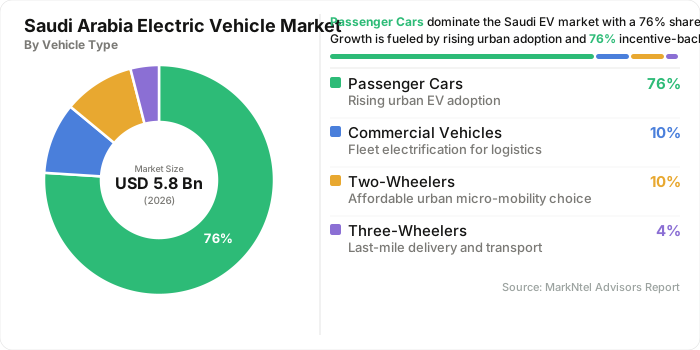
- Passenger Cars are projected to dominate the market, accounting for approximately 76% market share in 2026.
- Battery Electric Vehicles (BEVs) are expected to account for nearly 69% market share in 2026.
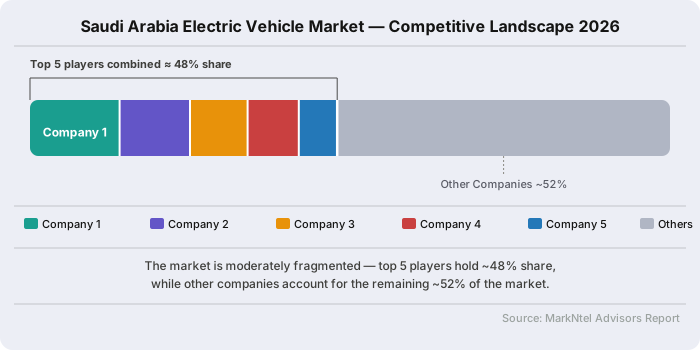
- The industry remains moderately consolidated, with top five companies collectively accounting for approximately 48% market share in 2026.
Saudi Arabia Electric Vehicle Market Size and Outlook
The electric vehicle market size in Saudi Arabia was valued at USD 4.2 billion in 2025 and is projected to grow from USD 5.8 billion in 2026 to USD 31.1 billion by 2032. Along with this, the market is estimated to grow at a CAGR of around 32.3% during the forecast period, i.e., 2026-2032.
The market is expected to witness a significant transformation as the Kingdom strengthens its regulatory framework and expands institutional support for advanced mobility technologies. In 2025, the Transport General Authority (TGA) continued implementing the Land Transport Strategy, which prioritizes sustainable mobility, smart transport systems, and private-sector participation to improve transport efficiency. Complementing these efforts, the Saudi Standards, Metrology and Quality Organization (SASO) approved the Technical Regulation for Autonomous Vehicles, effective from April 2026, establishing unified safety, testing, and certification requirements for autonomous and connected vehicles. These initiatives provide greater regulatory certainty for global EV manufacturers while encouraging investments in next-generation electric mobility solutions and intelligent transportation systems.
The market outlook is further reinforced by Saudi Arabia's expanding innovation ecosystem, which extends beyond vehicle manufacturing to advanced automotive technologies. In 2025, King Abdullah University of Science and Technology (KAUST) accelerated research programs focusing on battery materials, artificial intelligence, autonomous mobility, and energy storage technologies through collaborations with automotive and technology companies. Simultaneously, the Research, Development and Innovation Authority (RDIA) continued supporting national innovation programs aimed at commercializing advanced technologies and strengthening industrial competitiveness. These initiatives are expected to accelerate the development of locally driven EV innovations, improve technology commercialization, and enhance Saudi Arabia's position as a regional hub for sustainable mobility research, advanced automotive engineering, and future electric transportation solutions.
Saudi Arabia Electric Vehicle Market Key Indicators
- Hyundai Motor Manufacturing Middle East (HMMME) will produce its first vehicle in Q4 2026 with an annual production target of 50,000 vehicles. The joint venture is owned 70% by PIF and 30% by Hyundai Motor Company. The project significantly expands Saudi Arabia's domestic automotive production capacity and supports long-term EV manufacturing localization.
- EVIQ plans to deploy more than 5,000 fast chargers by 2030 and has already established a network covering 7 cities, 50 charging locations, 125 chargers, and 242 charging connectors. Higher charging density improves nationwide EV accessibility, encourages intercity travel, and supports increasing consumer confidence in electric mobility.
- EVIQ's deployment strategy targets approximately 1,000 charging sites across Saudi Arabia by 2030, with high-power chargers exceeding 100 kW designed for rapid charging on urban and highway corridors. Large-scale charging deployment reduces charging time and expands infrastructure coverage, directly supporting higher EV penetration across passenger and commercial vehicle segments.
- The Hyundai-PIF manufacturing project represents an investment exceeding USD 500 million to establish Hyundai's first manufacturing plant in the Middle East.
Rising capital investment attracts automotive suppliers, promotes technology transfer, and strengthens Saudi Arabia's competitiveness as a regional EV manufacturing destination. - Lucid's AMP-2 facility in King Abdullah Economic City is transitioning from semi-knocked-down assembly to full vehicle production while expanding recruitment across manufacturing, engineering, quality, and supply chain functions.
Expansion of advanced manufacturing capabilities increases local production value, develops skilled employment, and strengthens Saudi Arabia's EV industrial ecosystem. - EVIQ has established the Middle East's first dedicated EV charger Research & Development facility to validate charging hardware and software under Saudi operating conditions before nationwide deployment. Local testing enhances charger reliability, interoperability, and operational performance, supporting a robust charging ecosystem and improving the overall EV ownership experience.
Saudi Arabia Electric Vehicle Market Scope
| Category | Segments |
|---|---|
| By Vehicle Type | Passenger Cars, Commercial Vehicles, Two Wheelers, Three Wheelers |
| By Propulsion Type | Battery Electric Vehicle (BEV), Plug-in hybrid electric vehicles, Fuel-cell electric vehicles |
| By Charging Type | AC Charging, DC Fast Charging, Ultra-Fast / High-Power Charging |
| By Range | Less than 200 km, 200–400 km, Above 400 km |
| By Battery Type | Lithium-Ion Battery, Lithium Iron Phosphate (LFP), Nickel Manganese Cobalt (NMC), Solid-State Battery, Nickel Metal Hydride (NiMH |
Saudi Arabia Electric Vehicle Market Growth Drivers
Expansion of a Nationwide Fast-Charging Network is Accelerating Electric Vehicle Adoption in Saudi Arabia
The rapid deployment of public fast EV charging infrastructure has emerged as a key growth driver for the Saudi Arabia electric vehicle market by addressing range anxiety and improving the practicality of EV ownership. The availability of reliable charging stations across urban centers and intercity highways is encouraging greater consumer confidence while supporting commercial fleet electrification. As charging accessibility improves, automakers are expanding their product offerings and strengthening their presence in the Kingdom, creating a more mature EV ecosystem. This infrastructure-led approach is expected to significantly accelerate EV adoption and support Saudi Arabia's long-term sustainable mobility objectives.
Supporting this trend, EVIQ inaugurated its first highway fast-charging station at SASCO Aljazeera on the Riyadh–Qassim Highway in March 2025, marking the beginning of its nationwide highway charging rollout. As a joint venture between the Public Investment Fund (PIF) and the Saudi Electricity Company (SEC), EVIQ aims to deploy more than 5,000 fast chargers by 2030, creating one of the region's largest public charging networks. The initiative is improving long-distance EV travel, reducing charging accessibility barriers, and strengthening the supporting infrastructure necessary for sustained growth of Saudi Arabia's electric vehicle industry.
Recent Trends
Growing Consumer Preference for Premium Long-Range Electric SUVs is Reshaping Saudi Arabia's EV Market
The electric vehicle industry in Saudi Arabia is witnessing a growing preference for premium long-range electric SUVs as consumers increasingly prioritize extended driving range, advanced driver assistance systems, luxury features, and superior performance for intercity travel. The Kingdom's vast geography and improving highway charging infrastructure have strengthened demand for electric SUVs capable of covering longer distances with fewer charging stops. Consequently, global manufacturers are expanding their premium SUV portfolios rather than focusing solely on compact electric vehicles, reflecting a shift in consumer purchasing behavior toward high-performance, technologically advanced models tailored to regional mobility requirements.
Supporting this trend, BYD expanded its premium product portfolio in Saudi Arabia by introducing the fully electric SEALION 7 SUV, offering an extended driving range, intelligent cockpit technologies, and advanced safety features for the Kingdom's growing premium EV segment. The launch highlights manufacturers' increasing emphasis on larger, long-range electric SUVs designed for Middle Eastern driving conditions and demonstrates how product innovation is broadening consumer choice while intensifying competition in Saudi Arabia's premium electric vehicle industry. The continued introduction of premium SUV models is expected to accelerate EV adoption among high-income consumers and strengthen the country's transition toward sustainable mobility.
Saudi Arabia Electric Vehicle Market Opportunities and Challenges
Saudi Arabia's Lithium Supply Chain Push Signals Growth in Localized EV Battery Material Production
Saudi Aramco and Ma'aden signed an agreement to form a lithium joint venture, targeting the start of domestic lithium production by 2027 using direct lithium extraction technology on high-concentration deposits within the Kingdom. This government-backed upstream investment signals a structural shift toward securing domestic battery material supply, gradually reducing Saudi Arabia's historical reliance on imported lithium-ion cells for electric vehicle production.
Domestic EV OEMs and battery pack assemblers that depend on imported refined lithium compounds may continue to face cost pressure and supply volatility until the Kingdom's own extraction and processing capacity matures, since the Aramco-Ma'aden joint venture targets 2027 for first output. Although imported battery materials will remain significant during the forecast period, expanding domestic lithium supply is expected to reshape cost structures across the battery and vehicle manufacturing chain, requiring companies to plan localization strategies well in advance.
EV Metals Group is developing its Lithium Chemicals Plant in Yanbu Industrial City, engineered to produce battery-grade lithium hydroxide monohydrate and lithium carbonate for electric vehicle and battery cell manufacturers. Its phased production capacity and Saudi-based manufacturing footprint create opportunities for local battery and vehicle producers to secure supply as output scales. Manufacturers that establish early offtake or processing partnerships can offset import dependency while strengthening their position within Saudi Arabia's electric vehicle value chain over the forecast period.
Segmentation Insights
Passenger Cars Held Approximately 76% Share of the Saudi Arabia Electric Vehicle Market in 2026
Passenger cars lead the Saudi Arabia electric vehicle industry in 2026, making them the dominant vehicle category. Growing consumer preference for premium electric SUVs and sedans, rising disposable incomes, and government initiatives under Vision 2030 have accelerated passenger EV adoption. SUVs represent the largest sub-segment due to their suitability for long-distance travel, spacious interiors, and strong demand among Saudi households. The segment is further supported by expanding charging infrastructure, attractive financing solutions, and increasing model availability from global automakers, encouraging private consumers to transition from conventional internal combustion engine vehicles to battery-powered alternatives.
The passenger car segment is expected to maintain its leadership as manufacturers strengthen their local presence through dealerships, service networks, and localized production investments. For instance, in April 2025, Tesla officially entered the Saudi Arabian market by launching its first retail and service operations in Riyadh while introducing Supercharger infrastructure to support EV adoption across the Kingdom. This development significantly enhanced consumer accessibility, improved charging confidence, and intensified competition among premium EV manufacturers, reinforcing the continued dominance of passenger cars in Saudi Arabia's evolving electric mobility landscape. Based on the vehicle type , market is further bifurcated into:
- Passengers cars
- Commercial vehicles
- Two-wheelers
- Three – wheelers
Battery Electric Vehicles (BEVs) Held Approximately 69% Share of the Saudi Arabia Electric Vehicle Market in 2026
Battery Electric Vehicles (BEVs) captured the significant share of the Saudi Arabia electric vehicle industry in 2026, supported by the Kingdom's decarbonization strategy, expanding public charging infrastructure, and strong policy emphasis on local EV manufacturing. Compared with hybrid technologies, BEVs are witnessing faster adoption owing to improvements in driving range, declining battery costs, and the increasing availability of premium and mass-market models. Government-backed industrial investments and favorable consumer perception toward zero-emission mobility continue to strengthen BEVs as the preferred propulsion technology across both personal and fleet applications.
The segment is expected to record sustained growth as Saudi Arabia expands domestic production capabilities and develops a localized EV supply chain. Supporting this trend, CEER Motors signed 16 localization agreements worth approximately USD 987 million in February 2025 to strengthen domestic component manufacturing and accelerate electric vehicle production within the Kingdom. The initiative enhances supply chain resilience, promotes industrial localization, and supports wider adoption of battery electric vehicles by improving production efficiency and long-term market competitiveness. Based on the propulsion type, the market is further bifurcated into :
- Battery Electric Vehicle (BEV)
- Plug-in hybrid electric vehicles
- Fuel-cell electric vehicles
Saudi Arabia Electric Vehicle Market Competitive Landscape
The Saudi Arabia electric vehicle industry is moderately consolidated, with Lucid Group, Tesla, Inc., Ceer Motors, BYD Company Ltd., and Hyundai Motor Company collectively accounting for an estimated 48% market share in 2026. These companies maintain competitive advantages through local manufacturing investments, government-backed partnerships, expanding EV portfolios, and strengthening dealership and charging infrastructure networks across the Kingdom.
Key Companies in the Saudi Arabia Electric Vehicle Market
- Lucid Group
- Tesla, Inc.
- Ceer Motors
- BYD Company Ltd.
- Hyundai Motor Company
- BMW AG
- Toyota Motor Corporation
- Nissan Motor Corporation
- Ford Motor Company
- MG Motor (SAIC Motor Corporation)
Saudi Arabia Electric Vehicle Industry News and Recent Developments
February 2026: CEER Signs 16 Supply Chain Agreements Worth USD 987 Million to Accelerate EV Localization
Saudi Arabia's homegrown electric vehicle manufacturer, CEER, signed 16 commercial agreements valued at approximately USD 987 million during the 2026 PIF Private Sector Forum. The agreements strengthen CEER's domestic supplier network and support its objective of achieving 45% local content by 2034, reinforcing the Kingdom's strategy to establish a competitive automotive manufacturing ecosystem under Vision 2030.
Impact Analysis: The agreements significantly expand Saudi Arabia's EV manufacturing supply chain and reduce dependence on imported automotive components. Greater localization is expected to improve production efficiency, stimulate domestic industrial investment, and strengthen the Kingdom's position as a regional electric vehicle manufacturing hub while supporting long-term employment and technology transfer.
April 2026: Lucid Expands AMP-2 Manufacturing Facility and Workforce in Saudi Arabia
Lucid Motors announced the next phase of expansion at its Advanced Manufacturing Plant-2 (AMP-2) in King Abdullah Economic City, transitioning from semi-knockdown assembly toward full-scale vehicle production. The company also launched a major hiring program covering manufacturing, engineering, quality, supply chain, and operations, further strengthening Saudi Arabia's first international EV production facility.
Impact Analysis: The expansion enhances Saudi Arabia's domestic EV production capacity and supports localization of advanced automotive manufacturing. Increased manufacturing capability is expected to improve regional vehicle availability, attract component suppliers, and strengthen Saudi Arabia's competitiveness within the Middle East's rapidly expanding electric mobility sector.
January 2026: CEER Selects Dürr to Build One of the World's Most Advanced Automotive Paint Shops
CEER announced a partnership with German engineering company Dürr to install one of the world's most advanced automotive paint shops at the CEER Manufacturing Complex in King Abdullah Economic City. The facility will incorporate highly automated and energy-efficient paint technologies to support future production of Saudi-built electric vehicles.
Impact Analysis: The investment strengthens Saudi Arabia's advanced automotive manufacturing capabilities by integrating globally recognized production technologies. Enhanced manufacturing quality and automation are expected to improve production efficiency, vehicle quality, and international competitiveness while supporting sustainable manufacturing objectives.
April 2026: Lucid Secures Approximately USD 1.05 Billion to Accelerate EV Growth
Lucid Group announced a registered public offering raising approximately USD 1.05 billion, supported by previously announced investments from Saudi Arabia's Public Investment Fund (PIF) and Uber. The financing is intended to support manufacturing expansion, product development, and strategic growth initiatives, including continued investment in Saudi production capabilities.
Impact Analysis: The capital infusion strengthens Lucid's financial position while supporting expansion of manufacturing operations in Saudi Arabia. Continued investment enhances confidence in the Kingdom's EV industry, supports future production capacity, and reinforces Saudi Arabia's ambitions to become a global center for electric vehicle manufacturing.
May 2025: Lucid and KAUST Establish Strategic Partnership to Advance EV Technologies
Lucid Motors and King Abdullah University of Science and Technology (KAUST) entered a strategic partnership to accelerate research in autonomous driving, advanced driver assistance systems (ADAS), artificial intelligence, and next-generation electric vehicle technologies. The collaboration leverages Saudi Arabia's research capabilities to support innovation across Lucid's future vehicle platforms.
Impact Analysis: The partnership strengthens Saudi Arabia's EV innovation ecosystem by connecting industrial manufacturing with advanced academic research. It is expected to accelerate commercialization of next-generation vehicle technologies, develop local engineering expertise, and enhance the Kingdom's long-term competitiveness in global electric mobility innovation.
Frequently Asked Questions
- Market Segmentation
- Introduction
- Product Definition
- Research Process
- Assumptions
- Executive Summary
- Saudi Arabia Electric Vehicle Market Import & Export Data Analysis 2022-2032
- Saudi Arabia Electric Vehicle Market Supply Chain Analysis 2022-2032
- Saudi Arabia Electric Vehicle Production (Thousand Units) Trend 2022-2032
- Saudi Arabia Electric Vehicle Production (Thousand Units) Trend by Type of Vehicle
- Passenger Cars
- Commercial Vehicle
- Two Wheelers
- Three Wheelers
- Company-Wise Production Plants and Statistics
- Installed Production Capacity
- Actual Production
- . Planned Production Target
- Saudi Arabia Electric Vehicle Production (Thousand Units) Trend by Type of Vehicle
- Saudi Arabia Electric Vehicle Market Policies, Regulations, and Product Standards
- Saudi Arabia Electric Vehicle Market Trends & Developments
- Saudi Arabia Electric Vehicle Market Dynamics
- Growth Factors
- Challenges
- Saudi Arabia Electric Vehicle Market Hotspot & Opportunities
- Saudi Arabia Electric Vehicle Market Outlook, 2022-2032
- Market Size & Outlook
- By Revenues (USD Million)
- By Units Sold (Thousands Units)
- Market Segmentation & Outlook
- By Vehicle Type- Market Size & Forecast 2022-2032, USD Million
- Passenger Cars
- Sedan
- Hatchback
- SUV
- Commercial Vehicles
- Light Commercial Vehicles
- Light Trucks
- Minivans
- Medium & Heavy Commercial Vehicles
- Trucks
- Bus
- Light Commercial Vehicles
- Two Wheelers
- Scooters
- Motorcycles
- Moped
- Three Wheelers
- Passenger Carrier
- Load Carrier
- Passenger Cars
- By Propulsion Type- Market Size & Forecast 2022-2032, USD Million
- Battery Electric Vehicle (BEV)
- Plug-in hybrid electric vehicles
- Fuel-cell electric vehicles
- By Charging Type- Market Size & Forecast 2022-2032, USD Million
- AC Charging
- DC Fast Charging
- Ultra-Fast / High-Power Charging
- By Range- Market Size & Forecast 2022-2032, USD Million
- Less than 200 km
- 200–400 km
- Above 400 km
- By Battery Type- Market Size & Forecast 2022-2032, USD Million
- Lithium-Ion Battery
- Lithium Iron Phosphate (LFP)
- Nickel Manganese Cobalt (NMC)
- Solid-State Battery
- Nickel Metal Hydride (NiMH)
- By Region- Market Size & Forecast 2022-2032, USD Million
- Central
- East
- West
- South
- By Company
- Competition Characteristics
- Market Share & Analysis
- By Vehicle Type- Market Size & Forecast 2022-2032, USD Million
- Market Size & Outlook
- Saudi Arabia Electric Passenger Cars Market Outlook, 2022-2032
- Market Size & Outlook
- By Revenues (USD Million)
- By Units Sold (Thousands Units)
- Market Segmentation & Outlook
- By Propulsion Type- Market Size & Forecast 2022-2032, USD Million
- By Charging Type- Market Size & Forecast 2022-2032, USD Million
- By Range- Market Size & Forecast 2022-2032, USD Million
- By End User- Market Size & Forecast 2022-2032, USD Million
- By Battery Type- Market Size & Forecast 2022-2032, USD Million
- By Region- Market Size & Forecast 2022-2032, USD Million
- Market Size & Outlook
- Saudi Arabia Electric Commercial Vehicles Market Outlook, 2022-2032
- Market Size & Outlook
- By Revenues (USD Million)
- By Units Sold (Thousands Units)
- Market Segmentation & Outlook
- By Propulsion Type- Market Size & Forecast 2022-2032, USD Million
- By Charging Type- Market Size & Forecast 2022-2032, USD Million
- By Range- Market Size & Forecast 2022-2032, USD Million
- By End User- Market Size & Forecast 2022-2032, USD Million
- By Battery Type- Market Size & Forecast 2022-2032, USD Million
- By Region- Market Size & Forecast 2022-2032, USD Million
- Market Size & Outlook
- Saudi Arabia Electric Two Wheelers Market Outlook, 2022-2032
- Market Size & Outlook
- By Revenues (USD Million)
- By Units Sold (Thousands Units)
- Market Segmentation & Outlook
- By Propulsion Type- Market Size & Forecast 2022-2032, USD Million
- By Charging Type- Market Size & Forecast 2022-2032, USD Million
- By Range- Market Size & Forecast 2022-2032, USD Million
- By End User- Market Size & Forecast 2022-2032, USD Million
- By Battery Type- Market Size & Forecast 2022-2032, USD Million
- By Region- Market Size & Forecast 2022-2032, USD Million
- Market Size & Outlook
- Saudi Arabia Electric Three Wheelers Market Outlook, 2022-2032
- Market Size & Outlook
- By Revenues (USD Million)
- By Units Sold (Thousands Units)
- Market Segmentation & Outlook
- By Propulsion Type- Market Size & Forecast 2022-2032, USD Million
- By Charging Type- Market Size & Forecast 2022-2032, USD Million
- By Range- Market Size & Forecast 2022-2032, USD Million
- By End User- Market Size & Forecast 2022-2032, USD Million
- By Battery Type- Market Size & Forecast 2022-2032, USD Million
- By Region- Market Size & Forecast 2022-2032, USD Million
- Market Size & Outlook
- Saudi Arabia Electric Vehicle Market Key Strategic Imperatives for Success & Growth
- Competitive Outlook
- Company Profiles
- Ford Motor Company
- Business Description
- Product Portfolio
- Collaborations & Alliances
- Recent Developments
- Financial Details
- Others
- Lucid Group
- Business Description
- Product Portfolio
- Collaborations & Alliances
- Recent Developments
- Financial Details
- Others
- Tesla, Inc.
- Business Description
- Product Portfolio
- Collaborations & Alliances
- Recent Developments
- Financial Details
- Others
- Ceer Motors
- Business Description
- Product Portfolio
- Collaborations & Alliances
- Recent Developments
- Financial Details
- Others
- BYD Company Ltd.
- Business Description
- Product Portfolio
- Collaborations & Alliances
- Recent Developments
- Financial Details
- Others
- Hyundai Motor Company
- Business Description
- Product Portfolio
- Collaborations & Alliances
- Recent Developments
- Financial Details
- Others
- BMW AG
- Business Description
- Product Portfolio
- Collaborations & Alliances
- Recent Developments
- Financial Details
- Others
- Nissan Motor Corporation
- Business Description
- Product Portfolio
- Collaborations & Alliances
- Recent Developments
- Financial Details
- Others
- MG Motor (SAIC Motor Corporation)
- Business Description
- Product Portfolio
- Collaborations & Alliances
- Recent Developments
- Financial Details
- Others
- Toyota Motor Corporation
- Business Description
- Product Portfolio
- Collaborations & Alliances
- Recent Developments
- Financial Details
- Others
- Others
- Ford Motor Company
- Company Profiles
- Disclaimer
MarkNtel Advisors follows a robust and iterative research methodology designed to ensure maximum accuracy and minimize deviation in market estimates and forecasts. Our approach combines both bottom-up and top-down techniques to effectively segment and quantify various aspects of the market. A consistent feature across all our research reports is data triangulation, which examines the market from three distinct perspectives to validate findings. Key components of our research process include:
1. Scope & Research Design At the outset, MarkNtel Advisors define the research objectives and formulate pertinent questions. This phase involves determining the type of research—qualitative or quantitative—and designing a methodology that outlines data collection methods, target demographics, and analytical tools. They also establish timelines and budgets to ensure the research aligns with client goals.
2. Sample Selection and Data Collection In this stage, the firm identifies the target audience and determines the appropriate sample size to ensure representativeness. They employ various sampling methods, such as random or stratified sampling, based on the research objectives. Data collection is carried out using tools like surveys, interviews, and observations, ensuring the gathered data is reliable and relevant.
3. Data Analysis and Validation Once data is collected, MarkNtel Advisors undertake a rigorous analysis process. This includes cleaning the data to remove inconsistencies, employing statistical software for quantitative analysis, and thematic analysis for qualitative data. Validation steps are taken to ensure the accuracy and reliability of the findings, minimizing biases and errors.

4. Data Forecast and FinalizationThe final phase involves forecasting future market trends based on the analyzed data. MarkNtel Advisors utilize predictive modeling and time series analysis to anticipate market behaviors. The insights are then compiled into comprehensive reports, featuring visual aids like charts and graphs, and include strategic recommendations to inform client decision-making
We offer flexible licensing options to cater to varying organizational needs. Choose the pricing pack that best suits your requirements:
Buy Now Inquire Before Buying
 Request Customization
 Talk to our Consultant







