

Vietnam Warehouse Automation Market Research Report: Growth Drivers & Forecast (2026-2032)
By Component (Hardware, Software, Services), By Automation Type (Automated Storage and Retrieval Systems (AS/RS), Autonomous Mobile Robots (AMRs), Automated Guided Vehicles (AGVs), ... Conveyor & Sortation Systems, Robotic Picking & Palletizing, Automated Packing & Labeling, Warehouse Management Systems (WMS / WES / WCS), Automated Identification Systems (RFID / Barcode / Vision), Automated Packaging Systems, Drones & Vision Inspection Automation), By End-Use Industry (Retail & E-commerce, Logistics Service Providers (3PL / 4PL), Manufacturing, Food & Beverage, Healthcare & Pharmaceuticals, Automotive & Industrial, Electronics & High-Tech, Cold Chain Specialists, Government / Defense Logistics, Warehouse Property Developers), and others Read more
- Buildings, Construction, Metals & Mining
- Feb 2026
- Pages 140
- Report Format: PDF, Excel, PPT
Vietnam Warehouse Automation Market
Projected 7.02% CAGR from 2026 to 2032
Study Period
2026-2032
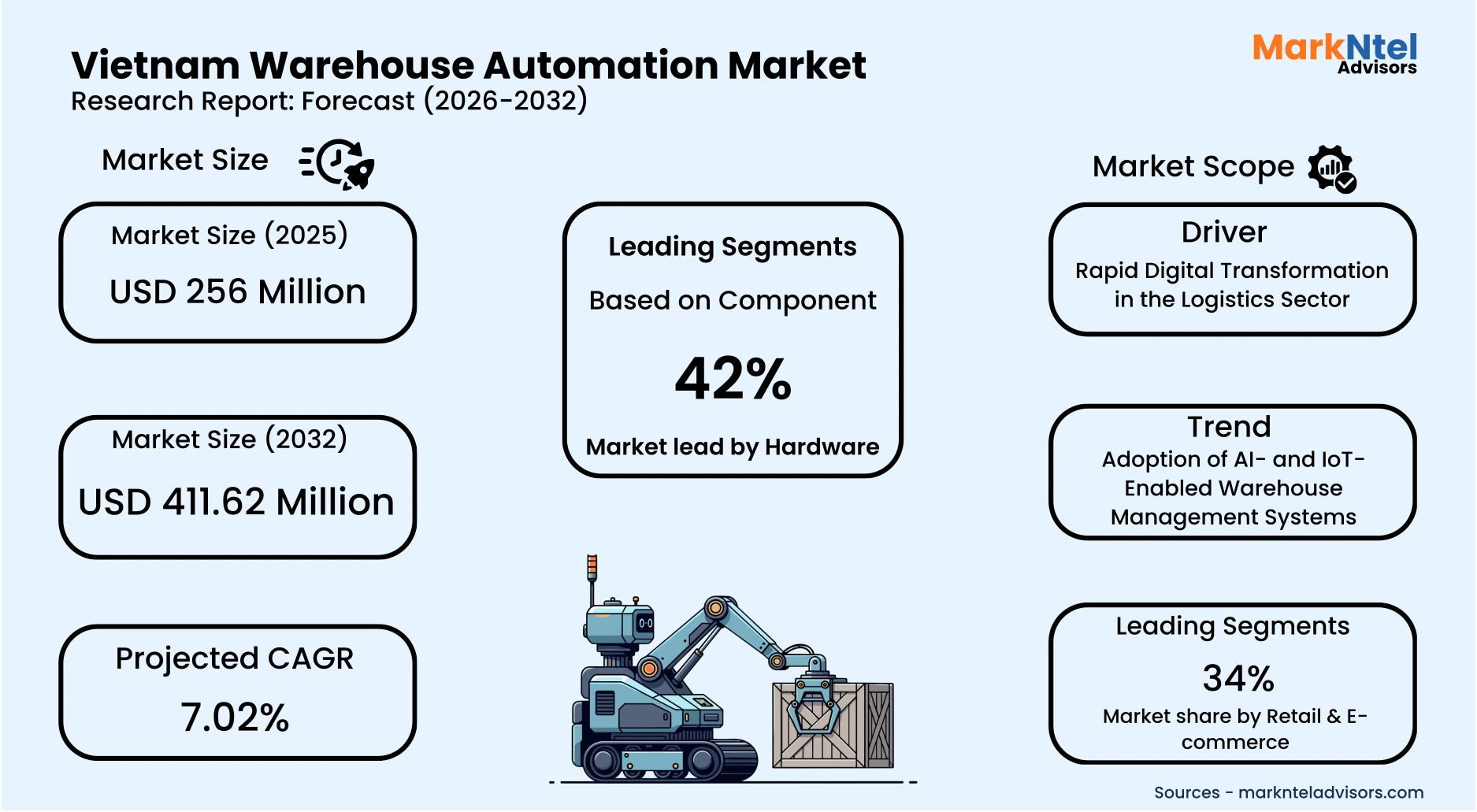
Market Size (2025)
USD 256 Million
Market Size (2032)
USD 411.62 Million
Base Year
2025
Projected CAGR
7.02%
Leading Segments
By Component: Hardware
Vietnam Warehouse Automation Market Report Key Takeaways:
- Market size was valued at around USD256 million in 2025 and is projected to reach USD411.62 million by 2032. The estimated CAGR from 2026 to 2032 is around 7.02%, indicating strong growth.
- By Component, hardware represented a significant share of about 42% in the Vietnam Warehouse Automation Market during 2026-32.
- By End Use Industry, the Retail & E-commerce sector seized a major share of around 34% in the Vietnam Warehouse Automation Market during 2026-32.
- Leading warehouse automation companies in Vietnam are SSI Schaefer, Daifuku, Honeywell Intelligrated, KION Group, Vanderlande, Intech Group, Swisslog Holding AG, Vinatech Group, and others.
Market Insights & Analysis: Vietnam Warehouse Automation Market (2026-32):
The Vietnam Warehouse Automation Market size was valued at around USD256 million in 2025 and is projected to reach USD411.62 million by 2032. Along with this, the market is estimated to grow at a CAGR of around 7.02% during the forecast period, i.e., 2026-32.
Vietnam’s warehouse automation market has grown significantly alongside the rapid expansion of the country’s logistics and warehousing sector, driven by sustained economic growth and an increase in industrial output of around 7–10% in 2025. The Government’s Logistics Services Development Strategy (to 2025 and beyond) targets logistics value‑added growth of 12–15 percent annually and wide digital transformation adoption among logistics firms, underscoring automation’s role in raising operational efficiency and competitive export capabilities. Vietnam’s GDP growth ambitions, aiming for 8.3–8.5% in 2025, further underpin demand for advanced logistics infrastructure to support manufacturing, e‑commerce, and trade flows .
Historically, warehouse automation adoption has accelerated with the proliferation of e‑commerce and global supply chain integration, leading major operators such as Viettel Post to deploy automated guided vehicles (AGVs) and smart sorting systems that increase throughput and reduce delivery times. End‑user segments like industrial manufacturers and commercial logistics providers have driven demand for automation to handle high volumes of goods, while software solutions such as warehouse management systems are increasingly used to optimize inventory and fulfilment operations. Collaborations between Vietnam Post Logistics and Phenikaa‑X to integrate autonomous mobile robots (AMRs) and AI tracking illustrate the private sector's commitment to smart logistics solutions .
Government policies like the National Digital Transformation Program (2025–2030) and technology‑friendly incentives under Decree 182/2024 support automation investments by encouraging Industry 4.0 technology adoption, R&D in high‑tech solutions, and innovation ecosystem development. These regulatory frameworks help reduce operational inefficiencies and bolster digital infrastructure across logistics, while Free Trade Zones (e.g., Da Nang FTZ) provide tax incentives and streamlined customs processes that enhance manufacturing‑logistics integration. Vietnam SuperPort’s deployment of AI‑powered robotics and carbon auditing aligns with the national Green Growth Strategy and sustainability goals, benefiting institutional and commercial logistics stakeholders.
Looking ahead, sustained FDI in manufacturing and warehousing, coupled with continuous policy support, suggests robust prospects for warehouse automation. Growing demand from retail, industrial, and institutional supply chains will require scalable automated solutions, while digitization efforts and workforce training initiatives are expected to mitigate current skills gaps. Integration of AI, IoT, and robotics will elevate service levels, lower costs, and enhance global competitiveness. With logistics aimed to contribute an increasing share of GDP and digital transformation prioritized across sectors, Vietnam’s warehouse automation outlook remains strong through the late 2020s, anchored in economic expansion and infrastructure modernization.
Vietnam Warehouse Automation Market Recent Developments:
- 2025 : The KION Group has opened a new facility in Ho Chi Minh City, Vietnam, to expand its material handling and warehouse automation solutions in the Asia-Pacific region. The location will serve the rapidly growing Vietnamese market while supporting regional growth and innovation, positioning Vietnam as a strategic hub for KION’s operations in Southeast Asia.
Vietnam Warehouse Automation Market Scope:
| Category | Segments |
|---|---|
| By Component | (Hardware, Software, Services), |
| By Automation Type | (Automated Storage and Retrieval Systems (AS/RS), Autonomous Mobile Robots (AMRs), Automated Guided Vehicles (AGVs), Conveyor & Sortation Systems, Robotic Picking & Palletizing, Automated Packing & Labeling, Warehouse Management Systems (WMS / WES / WCS), Automated Identification Systems (RFID / Barcode / Vision), Automated Packaging Systems, Drones & Vision Inspection Automation), |
| By End-Use Industry | (Retail & E-commerce, Logistics Service Providers (3PL / 4PL), Manufacturing, Food & Beverage, Healthcare & Pharmaceuticals, Automotive & Industrial, Electronics & High-Tech, Cold Chain Specialists, Government / Defense Logistics, Warehouse Property Developers), |
Vietnam Warehouse Automation Market Driver:
Rapid Digital Transformation in the Logistics Sector
The rapid digital transformation of Vietnam’s logistics sector is a key driver of warehouse automation adoption. For instance, under the Government’s Logistics Services Development Strategy 2025–2035, authorities mandate that 80 percent of logistics enterprises implement digital solutions , including AI-driven warehouse management and automated material handling systems, highlighting structural policy support for automation in one of Southeast Asia’s fastest-growing markets.
Enterprise adoption is reinforced by operational pressures from e-commerce and manufacturing growth. In 2025, Viettel Post’s automated sorting hub processed 1.4 million parcels daily using AI-enabled systems, reflecting measurable gains in throughput and efficiency that directly stimulate demand for scalable automation solutions across industrial, retail, and cold chain segments .
The push for digitalization is further shaped by national objectives to reduce logistics costs, which historically consumed 16–18 percent of GDP, while improving service quality and supply chain visibility. As firms increasingly invest in autonomous robotics, IoT-enabled tracking, and integrated digital platforms, the structural expansion of automated operations continues to drive sustained growth in warehouse automation demand across Vietnam.
Vietnam Warehouse Automation Market Trend:
Adoption of AI- and IoT-Enabled Warehouse Management Systems
The Vietnam warehouse automation market is increasingly driven by the adoption of AI- and IoT-enabled warehouse management systems, which enhance real-time monitoring, predictive replenishment, and operational efficiency. In 2025, several pharmaceutical and cold-chain distribution centers implemented IoT-based temperature tracking and AI-assisted slotting systems to improve inventory accuracy and maintain product integrity, reflecting a structural shift across regulated industries.
The introduction of AI-infused solutions like Infor WMS demonstrates the growing importance of generative AI and machine learning in warehouse operations. These technologies reduce human errors, optimize stock levels, cut operational costs, and accelerate order fulfillment, with AI-assisted workers reported by IDC to be 40% more productive than non-AI-assisted counterparts. By 2026, 60% of warehouses are expected to adopt some form of automation, including AI-driven systems and robotics, underscoring the rapid structural integration of these technologies .
Government programs such as the National Digital Transformation Program 2025–2030 actively promote Industry 4.0 adoption, providing incentives for technology integration and enabling warehouses to interconnect storage, transport, and distribution operations . Combined with sector-specific operational needs, multi-modal hub optimization, and industry-wide adoption of AI and IoT, these developments solidify AI- and IoT-enabled warehouse management systems as a defining structural trend in Vietnam’s warehouse automation market.
Vietnam Warehouse Automation Market Opportunity:
Growth of Multi-Modal Smart Logistics Hubs
The development of multi‑modal smart logistics hubs in Vietnam presents a significant structural growth opportunity for the warehouse automation market. Projects like Vietnam SuperPort, an 83‑hectare multimodal logistics hub integrating road, rail, air, and sea transport, are designed to streamline cargo movement, reduce costs, and support efficient supply chains by connecting industrial zones with seaports and inland container depots, creating substantial demand for automated warehousing and inventory systems.
In Hung Yen Province, the SPX Express Cargo Sorting Center, set to be the largest automated parcel processing facility in Southeast Asia when completed, demonstrates how logistics hubs are increasingly incorporating automation at scale to handle growing e‑commerce volumes , positioning the region as a high‑tech logistics node with strong automation requirements.
Government and municipal plans to establish global and regional logistics service centres in cities such as Ho Chi Minh City align investment incentives, infrastructure development, and smart logistics planning to boost regional connectivity and digital integration, further encouraging private sector participation in automated warehousing and related technologies.
Together, these developments create a scalable opportunity for new entrants to offer modular, interoperable automation solutions tailored to multi‑modal logistics hubs, enabling competitive differentiation by supporting the optimization of cross‑modal transfers, real‑time inventory tracking, and integrated supply‑chain operations across industrial, retail, and export‑oriented segments.
Vietnam Warehouse Automation Market Challenge:
Persistent Infrastructure Gaps and Connectivity Limitations
Vietnam’s warehouse automation market is constrained by persistent infrastructure gaps and limited multimodal connectivity, which structurally hinder the efficiency and scalability of automated systems. Despite ongoing investments, logistics infrastructure, including transport networks, warehousing facilities, and multimodal linkages, remains fragmented and poorly coordinated, preventing seamless freight movement between ports, industrial zones, and distribution centers. This fragmentation contributes to high logistics costs, which account for over 16% of GDP, significantly above the global average, thereby reducing competitiveness for automated operations.
The reliance on road transport constrains logistics performance, particularly since rail, inland waterways, and integrated transport modes are underdeveloped or underutilized, forcing warehouses and distribution centers to absorb inefficiencies that automation alone cannot resolve. As a result, freight delays, congestion around major hubs like Cat Lai Port, and bottlenecks on key routes raise operational costs and dampen returns on automation investments, especially for medium and smaller logistics providers operating across non‑urban regions .
These infrastructure constraints materially restrict market expansion by delaying delivery cycles, increasing operating expenditures, and discouraging deeper automation penetration across the supply chain. Without synchronized development of multimodal corridors and integrated logistics networks, automation demand is likely to remain concentrated in limited geographies and segments, thereby curbing wider adoption and limiting opportunities for scaling advanced warehouse technologies across Vietnam’s broader logistics ecosystem.
Vietnam Warehouse Automation Market (2026-32) Segmentation Analysis:
The Vietnam Warehouse Automation Market Report and Forecast 2026-2032 offers a detailed analysis of the market based on the following segments:
Based on Component:
- Hardware
- Software
- Services
The hardware segment dominates the Vietnam warehouse automation market, with 42% market share, because it forms the foundational infrastructure upon which all automation systems operate. Hardware components, including automated storage and retrieval systems (AS/RS), conveyors, sortation equipment, and robotics, are essential for both new warehouse implementations and the modernization of existing facilities, creating a large and stable demand base. With Vietnam’s growing e-commerce and industrial logistics sectors, warehouses increasingly prioritize physical systems to handle higher throughput and complex material flows .
In 2025, the majority of automation investments in industrial, retail, and cold-chain warehouses focused on hardware procurement over software or services, reflecting the critical need for tangible infrastructure to support operations. Leading logistics and manufacturing players in Ho Chi Minh City and Hanoi continue to expand automated handling capacities, ensuring consistent utilization of conveyors, AS/RS modules, and pallet handling equipment, which sustains hardware market share.
Additionally, production and deployment economics favor the hardware segment. Standardized components, modular designs, and multi-year lifecycles enable suppliers to serve multiple warehouses efficiently while ensuring durability and scalability. Earlier installations of hardware systems also continue to drive replacement, maintenance, and capacity expansion demand. Consequently, the combination of essential operational roles, sustained adoption across multiple end-user segments, and long-term utilization positions the hardware segment as the dominant contributor to Vietnam’s warehouse automation component market.
Based on End Use Industry:
- Retail & E-commerce
- Logistics Service Providers (3PL / 4PL)
- Manufacturing
- Food & Beverage
- Healthcare & Pharmaceuticals
- Automotive & Industrial
- Electronics & High-Tech
- Cold Chain Specialists
- Government / Defense Logistics
- Warehouse Property Developers
The Retail & E-commerce sector dominates the Vietnam warehouse automation market, accounting for around 34% market share, because it represents the largest and fastest-growing demand base for automated logistics solutions. Rapid expansion of online shopping, coupled with rising consumer expectations for same-day and next-day deliveries, has created a structural need for high-throughput, technology-driven warehouse operations.
For example, Vietnam’s e-commerce market recorded a transaction value exceeding USD 23 billion in 2025, driven by both domestic retail growth and regional cross-border sales, resulting in higher volumes of order fulfillment and inventory turnover . Leading players in e-commerce, such as Tiki, Shopee, and Lazada, continue to invest in automated sortation, conveyor systems, and robotic picking technologies in Ho Chi Minh City and Hanoi, ensuring the continuous adoption of warehouse automation hardware and software solutions.
Additionally, operational economics favor the retail & e-commerce segment. Standardized product packaging, predictable SKU flows, and high-volume order cycles enable operators to optimize warehouse layouts, implement scalable automation, and achieve faster ROI. Early investments in automated systems further reinforce replacement, capacity expansion, and lifecycle upgrades. Consequently, the combination of structural demand growth, sustained transaction volumes, and operational scalability positions the Retail & E-commerce segment as the dominant end-user industry in Vietnam’s warehouse automation market.
Gain a Competitive Edge with Our Vietnam Warehouse Automation Market Report:
- Vietnam Warehouse Automation Market Report by MarkNtel Advisors provides a detailed & thorough analysis of market size & share, growth rate, competitive landscape, and key players. This comprehensive analysis helps businesses gain a holistic understanding of the market dynamics & make informed decisions.
- This report also highlights current market trends & future projections, allowing businesses to identify emerging opportunities & potential challenges. By understanding market forecasts, companies can align their strategies & stay ahead of the competition.
- Vietnam Warehouse Automation Market Report aids in assessing & mitigating risks associated with entering or operating in the market. By understanding market dynamics, regulatory frameworks, and potential challenges, businesses can develop strategies to minimize risks & optimize their operations.
*Reports Delivery Format - Market research studies from MarkNtel Advisors are offered in PDF, Excel and PowerPoint formats. Within 24 hours of the payment being successfully received, the report will be sent to your email address.
Frequently Asked Questions
- Market Segmentation
- Introduction
- Product Definition
- Research Process
- Assumptions
- Executive Summary
- Vietnam Warehouse Automation Market Policies, Regulations, and Product Standards
- Vietnam Warehouse Automation Market Trends & Developments
- Vietnam Warehouse Automation Market Dynamics
- Growth Factors
- Challenges
- Vietnam Warehouse Automation Market Hotspot & Opportunities
- Vietnam Warehouse Automation Market Outlook, 2022-2032F
- Market Size & Outlook
- By Revenues (USD Million)
- Market Share & Outlook
- By Component- Market Size & Forecast 2022-2032, USD Million
- Hardware
- Robots (AMRs, AGVs, SCARA/Delta Arms)
- Conveyors & Sorters
- AS/RS Cranes & Shuttles
- Sensors & Scanners
- PLC / Controls
- Software
- WMS / Warehouse Execution Software
- Warehouse Control Systems
- Fleet / Robot Orchestration
- Analytics & Optimization
- Services
- Installation & Integration
- Maintenance & Support
- Training & Consulting
- Custom Engineering
- Hardware
- By Automation Type- Market Size & Forecast 2022-2032, USD Million
- Automated Storage and Retrieval Systems (AS/RS)
- Autonomous Mobile Robots (AMRs)
- Automated Guided Vehicles (AGVs)
- Conveyor & Sortation Systems
- Robotic Picking & Palletizing
- Automated Packing & Labeling
- Warehouse Management Systems (WMS / WES / WCS)
- Automated Identification Systems (RFID / Barcode / Vision)
- Automated Packaging Systems
- Drones & Vision Inspection Automation
- By Warehouse Scale- Market Size & Forecast 2022-2032, USD Million
- Small Warehouses (Below 10,000 sq. meters)
- Medium Warehouses (10,000–50,000 sq. meters)
- Large Warehouses (Above 50,000 sq. meters)
- By End-Use Industry- Market Size & Forecast 2022-2032, USD Million
- Retail & E-commerce
- Logistics Service Providers (3PL / 4PL)
- Manufacturing
- Food & Beverage
- Healthcare & Pharmaceuticals
- Automotive & Industrial
- Electronics & High-Tech
- Cold Chain Specialists
- Government / Defense Logistics
- Warehouse Property Developers
- By Region - Market Size & Forecast 2022-2032, USD Million
- Northern Vietnam
- Central Vietnam
- Southern Vietnam
- By Company
- Competition Characteristics
- Market Share & Analysis
- By Component- Market Size & Forecast 2022-2032, USD Million
- Market Size & Outlook
- Vietnam Hardware Market Outlook, 2022-2032
- Market Size & Outlook
- By Revenues (USD Million)
- Market Share & Outlook
- By Automation Type- Market Size & Forecast 2022-2032, USD Million
- By Warehouse Scale- Market Size & Forecast 2022-2032, USD Million
- By End-Use Industry- Market Size & Forecast 2022-2032, USD Million
- By Region - Market Size & Forecast 2022-2032, USD Million
- Market Size & Outlook
- Vietnam Software Market Outlook, 2022-2032
- Market Size & Outlook
- By Revenues (USD Million)
- Market Share & Outlook
- By Automation Type- Market Size & Forecast 2022-2032, USD Million
- By Warehouse Scale- Market Size & Forecast 2022-2032, USD Million
- By End-Use Industry- Market Size & Forecast 2022-2032, USD Million
- By Region - Market Size & Forecast 2022-2032, USD Million
- Market Size & Outlook
- Vietnam Services Market Outlook, 2022-2032
- Market Size & Outlook
- By Revenues (USD Million)
- Market Share & Outlook
- By Automation Type- Market Size & Forecast 2022-2032, USD Million
- By Warehouse Scale- Market Size & Forecast 2022-2032, USD Million
- By End-Use Industry- Market Size & Forecast 2022-2032, USD Million
- By Region - Market Size & Forecast 2022-2032, USD Million
- Market Size & Outlook
- Vietnam Warehouse Automation Market Key Strategic Imperatives for Success & Growth
- Competitive Outlook
- Company Profiles
- SSI Schaefer
- Business Description
- Product Portfolio
- Collaborations & Alliances
- Recent Developments
- Financial Details
- Others
- Daifuku
- Business Description
- Product Portfolio
- Collaborations & Alliances
- Recent Developments
- Financial Details
- Others
- Honeywell Intelligrated
- Business Description
- Product Portfolio
- Collaborations & Alliances
- Recent Developments
- Financial Details
- Others
- KION Group
- Business Description
- Product Portfolio
- Collaborations & Alliances
- Recent Developments
- Financial Details
- Others
- Vanderlande
- Business Description
- Product Portfolio
- Collaborations & Alliances
- Recent Developments
- Financial Details
- Others
- Intech Group
- Business Description
- Product Portfolio
- Collaborations & Alliances
- Recent Developments
- Financial Details
- Others
- Swisslog Holding AG
- Business Description
- Product Portfolio
- Collaborations & Alliances
- Recent Developments
- Financial Details
- Others
- Vinatech Group
- Business Description
- Product Portfolio
- Collaborations & Alliances
- Recent Developments
- Financial Details
- Others
- Others
- Business Description
- Product Portfolio
- Collaborations & Alliances
- Recent Developments
- Financial Details
- Others
- SSI Schaefer
- Company Profiles
- Disclaimer
MarkNtel Advisors follows a robust and iterative research methodology designed to ensure maximum accuracy and minimize deviation in market estimates and forecasts. Our approach combines both bottom-up and top-down techniques to effectively segment and quantify various aspects of the market. A consistent feature across all our research reports is data triangulation, which examines the market from three distinct perspectives to validate findings. Key components of our research process include:
1. Scope & Research Design At the outset, MarkNtel Advisors define the research objectives and formulate pertinent questions. This phase involves determining the type of research—qualitative or quantitative—and designing a methodology that outlines data collection methods, target demographics, and analytical tools. They also establish timelines and budgets to ensure the research aligns with client goals.
2. Sample Selection and Data Collection In this stage, the firm identifies the target audience and determines the appropriate sample size to ensure representativeness. They employ various sampling methods, such as random or stratified sampling, based on the research objectives. Data collection is carried out using tools like surveys, interviews, and observations, ensuring the gathered data is reliable and relevant.
3. Data Analysis and Validation Once data is collected, MarkNtel Advisors undertake a rigorous analysis process. This includes cleaning the data to remove inconsistencies, employing statistical software for quantitative analysis, and thematic analysis for qualitative data. Validation steps are taken to ensure the accuracy and reliability of the findings, minimizing biases and errors.

4. Data Forecast and FinalizationThe final phase involves forecasting future market trends based on the analyzed data. MarkNtel Advisors utilize predictive modeling and time series analysis to anticipate market behaviors. The insights are then compiled into comprehensive reports, featuring visual aids like charts and graphs, and include strategic recommendations to inform client decision-making
We offer flexible licensing options to cater to varying organizational needs. Choose the pricing pack that best suits your requirements:
Buy Now Inquire Before Buying
 Request Customization
 Talk to our Consultant







