

UAE Residential Real Estate Market Research Report: Forecast (2026-2032)
By Type (Apartments and Condominiums, Villas and Landed Houses), By Price Band (Affordable, Mid-market, Luxury), By Business Model (Sales, Rental), and others ... Read more
- Buildings, Construction, Metals & Mining
- Aug 2026
- Pages 145
- Report Format: PDF, Excel, PPT
UAE Residential Real Estate Market
Projected 9.05% CAGR from 2026 to 2032
Study Period
2026-2032
Market Size (2026)
USD 231 Billion
Market Size (2032)
USD 389 Billion
Base Year
2025
Projected CAGR
9.05%
Leading Segments
By Type: Apartments and Condominiums
UAE Residential Real Estate Market Key Takeaways
- UAE residential real estate market size was valued at USD 219 billion in 2025 and is projected to grow from USD 231 billion in 2026 to USD 389 billion by 2032.
- The market is projected to register a CAGR of 9.05% during 2026–2032.
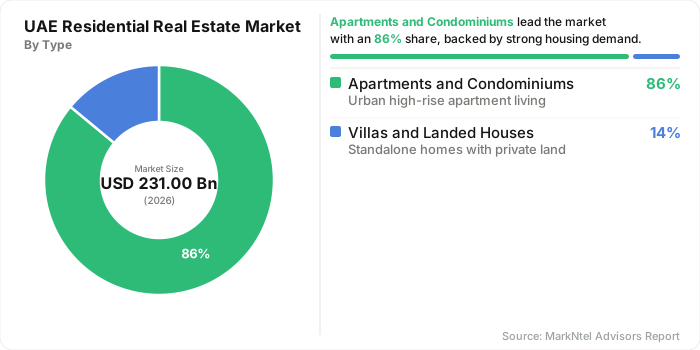
- By type, apartments & condominiums account for 86% of the market in 2026.
- By business model, sales led the market with a 73% share in 2026.
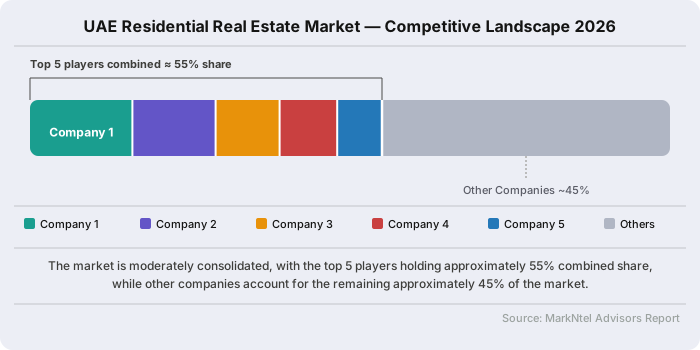
- The industry is moderately consolidated, with the top five players collectively accounting for approximately 55% of the market share in 2026.
UAE Residential Real Estate Market Size and Outlook
The UAE residential real estate industry was valued at USD 219 billion in 2025 and is currently standing at USD 231 billion in 2026. The industry is projected to grow to USD 389 billion by 2032, showcasing a CAGR of around 9.05% during the forecast period, i.e., 2026–32.
The market is witnessing sustained expansion, supported by a resilient non-oil economy, rising population, increasing housing demand, and continuous residential development across major emirates. Residential activity remained healthy during 2026 as demand from end users and investors continued to support new launches and transaction volumes. The central bank reported residential transactions in Abu Dhabi increased by nearly 120% year on year, while Dubai residential transaction value also recorded double-digit annual growth during Q1 2026.
The development pipeline remains robust as developers continue introducing large master planned communities and waterfront residential projects to address future housing requirements. Industry estimates indicate that tens of thousands of residential units are expected to be delivered across the UAE during 2026, with apartments accounting for the majority of new supply. At the same time, Dubai's population has surpassed four million, further strengthening structural housing demand and supporting long-term residential absorption.
Government policies continue to reinforce confidence in the sector through economic stability and infrastructure expansion. During 2026, the UAE introduced financial resilience measures alongside Dubai's USD 0.68 billion business support package and a three-year infrastructure budget exceeding USD 74 billion, supporting construction activity, urban development, and long-term residential growth. These initiatives, combined with a stable regulatory environment and continued infrastructure investment, continue to strengthen the outlook for the UAE residential real estate market.
UAE Residential Real Estate Market Key Indicators
- Dubai’s population reached 4.58 million by the end of 2025, increasing by approximately 332,000 people or 7.5% YoY. The daytime population reached 6.39 million when temporary workers and tourists are included, indicating a substantial expansion in the pool of potential tenants and homebuyers. This population growth supports demand for apartments, villas, and rental housing, particularly in employment and tourism-oriented locations.
- UAE tourism is strengthening the residential and short-term accommodation ecosystem, with 32.34 million hotel guests in 2025, up 5.2% YoY from 30.75 million in 2024. Hotel guest nights exceeded 110.62 million, while hotel revenues increased 9.7% to USD 13.40 billion and occupancy reached 79.3%. Rising visitor volumes increase demand for serviced apartments, holiday homes, and investment properties while improving rental and asset-income prospects in tourism-led locations.
- Dubai recorded 19.59 million international overnight visitors in 2025, up 5% YoY, while hotel occupancy increased to 80.7% from 78.2% in 2024. Strong tourism activity supports residential demand in areas such as Dubai Marina, Downtown Dubai, Palm Jumeirah, and other locations with high short-term rental and hospitality exposure.
- The UAE construction sector recorded USD 107.2 billion in construction output in 2024, while output is projected to reach USD 130.8 billion by 2029, representing approximately 22% growth. Construction accounted for 62% of the UAE's future project pipeline, creating a substantial development base for new residential communities, supporting housing supply and enabling developers to respond to population and investor demand.
- Dubai delivered approximately 46,700 residential units in 2025, with around 55,000 units expected in 2026. More than 490,000 units are under construction or announced for delivery between 2026 and 2030, although actual delivery is expected to be lower because of construction and execution constraints. The scale of this pipeline indicates continued developer confidence while also creating potential supply pressure, particularly because 67% of upcoming units are studios and one-bedroom apartments.
- Dubai’s rental market also expanded materially in 2025, with registered tenancy contracts increasing 6% to 1.38 million, while their combined value rose 17% to AED 126.4 billion. New tenancy contracts exceeded 513,000, up 10%, indicating continued inflow of residents and strengthening rental demand. This supports residential investment by improving rental-income visibility and encouraging landlords and developers to retain exposure to income-generating properties.
- Abu Dhabi's real estate market recorded USD 38.67 billion in transactions across 42,814 deals in 2025, representing a 48% increase in transaction value and a 52% increase in volume from 2024. Foreign investment in designated investment zones reached AED 54.13 billion, accounting for 72% of total real estate investment in those zones. Rising foreign participation strengthens demand for residential properties and broadens the UAE's overall residential investment base beyond Dubai.
UAE Residential Real Estate Market Scope
| Category | Segments |
|---|---|
| By Type | Apartments and Condominiums, Villas and Landed Houses |
| By Price Band | Affordable, Mid-market, Luxury |
| By Business Model | Sales, Rental |
UAE Residential Real Estate Market Growth Drivers
Foreign Capital Inflows and Golden Visa Reforms Accelerate Residential Demand
The market is experiencing sustained demand from international buyers, supported by progressive residency reforms and strong foreign capital inflows. During 2026, Dubai further strengthened its position as a preferred global residential investment destination by simplifying property-linked residency requirements, encouraging greater participation from expatriates and overseas investors. Attractive rental yields, a stable regulatory environment, and long-term residency benefits continue to reinforce buyer confidence, enabling the residential sector to attract capital across premium, mid-income, and luxury housing segments.
A major policy development came in February 2026, when the Dubai land department removed the previous upfront payment requirement for investors applying for a USD 0.54 million golden visa through property ownership, making eligibility more accessible. Reflecting this favourable environment, Aldar reported that 88% of its UAE residential sales during Q1 2026 were generated from expatriate and international buyers. Dubai also continued to attract a diverse overseas buyer base, with Indian investors accounting for 20.6% of property purchases, followed by buyers from other countries.
The growing international buyer pool has encouraged developers to strengthen their overseas sales networks and launch projects targeting foreign purchasers. During 2026, Danube Properties expanded its presence in the United Kingdom to improve access to Dubai's residential offerings for international investors. Supported by policy reforms, simplified investment procedures, and sustained overseas demand, foreign capital inflows continue to remain one of the strongest growth drivers for the UAE residential real estate market.
Recent Trends
Blockchain Based Property Tokenization is Reshaping Residential Transactions
The market is witnessing the emergence of blockchain enabled property tokenization, making residential assets more accessible while modernizing real estate transactions. In May 2025, the Dubai Land Department launched the Middle East and North Africa's first licensed tokenized real estate project through the Prypco mint platform in collaboration with VARA, the central bank of the UAE, and Dubai Future Foundation. The initiative allows investors to purchase fractional ownership in residential properties from as little as USD 545, expanding market accessibility without relying on cryptocurrency payments.
The initiative has continued to gain momentum during 2026 through the expansion of regulated digital property trading. Following the launch of the secondary marketplace in February 2026, tokenized real estate assets became tradable under a regulated framework with investor protection measures, including limits on individual ownership concentration. Early market participation has been encouraging, with the first tokenized residential property attracting investors from dozens of nationalities, many of whom were first-time participants in Dubai's real estate market.
Supported by an evolving virtual asset regulatory framework and continued collaboration between government authorities and technology partners, blockchain-based property tokenization is improving market accessibility, broadening investor participation, and establishing a more transparent and digitally enabled residential real estate ecosystem across the UAE.
UAE Residential Real Estate Market Challenges and Opportunities
Rising Housing Affordability Pressures Create Stronger Momentum for Value Housing Development
Rapid residential price appreciation has improved market value but has also intensified affordability pressures for middle-income buyers and tenants across the UAE. Between 2021 and 2026, apartment prices and rental values in Dubai increased by nearly 60% to 80%, raising home ownership costs despite sustained demand. The Central Bank of the UAE also identified housing costs as the largest contributor to Dubai's consumer inflation during early 2026, highlighting how rising residential prices are gradually widening the affordability gap and increasing demand for comparatively lower-priced housing options.
This affordability gap is simultaneously creating opportunities for developers and government authorities to expand the value housing segment. In April 2026, Aldar partnered with the Abu Dhabi Department of Municipalities and Transport to develop a value housing programme worth approximately USD 0.76 billion, delivering around 9,000 rental homes across Mohamed Bin Zayed City and Baniyas. Complementing private sector initiatives, the Mohammed Bin Rashid Housing Establishment continued progressing residential projects worth nearly USD 0.90 billion across multiple Dubai communities during 2025 and 2026.
While the Sheikh Rashid Bin Mohammed Bin Rashid Al Maktoum housing project is being delivered in phases through 2032 under the Dubai 2040 urban master plan. At the federal level, the Zayed housing programme approved nearly USD 0.56 billion in housing support during the first three quarters of 2025, reinforcing the UAE's long-term commitment to expanding affordable housing supply and creating sustained growth opportunities within the residential real estate market.
Segmentation Insights
Apartments and Condominiums Maintain Leadership Through Urban Demand and Strong Development Pipeline
Apartments and condominiums accounted for approximately 86% of the UAE residential real estate market in 2026, driven by their strong appeal among first-time buyers, expatriates, investors, and young professionals seeking homes in well-connected urban locations. The segment continues to benefit from rapid population growth, increasing inward migration, and sustained demand for compact, amenity-rich residential developments. In addition, apartments remain the preferred asset class within the off-plan market, supported by comparatively lower entry prices and attractive rental yields.
The segment's dominance is further reinforced by the country's residential development pipeline, where apartments account for nearly 85% of new housing supply scheduled for delivery during 2026. Leading developers, including Emaar, DAMAC, Aldar, Sobha, Danube, and Ellington, continue to prioritize apartment developments within large mixed-use communities and waterfront projects to address growing urban housing demand. Based on type, the market is further bifurcated into:
- Apartments and Condominiums
- Villas and Landed Houses
Sales Segment Leads the Market Amid Robust Off-Plan and Investor-Driven Transactions
The sales segment held around 73% share of the UAE residential real estate market in 2026, supported by strong domestic and international buyer activity across both completed and off-plan residential projects. Continued demand from expatriates, institutional investors, and high net worth individuals, together with long-term residency incentives, has encouraged residential property ownership across major emirates. Strong transaction activity in Dubai and Abu Dhabi has further reinforced the dominance of outright property sales over leasing transactions.
The segment also benefits from a highly active project launch environment, with developers introducing large master planned communities, waterfront developments, and branded residences across multiple price categories. Off-plan transactions continue to account for the majority of residential sales, supported by flexible payment plans, capital appreciation potential, and sustained investor confidence. Based on the business model, the market is further bifurcated into:
- Sales
- Rental
UAE Residential Real Estate Market Competitive Analysis
The UAE residential real estate market is moderately consolidated, with competition led by established master developers, diversified real estate companies, and premium residential developers operating across apartments, villas, mixed-use communities, branded residences, waterfront developments, and integrated townships. Major participants include Emaar Properties PJSC, DAMAC Properties Dubai Co PJSC, Azizi Developments, Sobha Limited, and Binghatti Developers FZE. The top five players collectively account for approximately 55% of the UAE residential real estate market.
Key Companies in the UAE Residential Real Estate Market
- Emaar Properties PJSC
- DAMAC Properties Dubai Co PJSC
- Azizi Developments
- Sobha Limited
- Binghatti Developers FZE
- Ellington Properties Development LLC
- MAG Property Development LLC
- Danube Properties Development L.L.C
- Seven Tides Limited
- Tiger Properties (Tiger Group)
UAE Residential Real Estate Industry News and Recent Developments
2026: Emaar Announces USD 55 Billion Dubai Urban Development Project
Emaar Properties announced in June 2026 the development of a new master planned urban district in Dubai with an estimated development value of approximately USD 55 billion. The project spans nearly 4.5 million square meters and is planned to accommodate around 150,000 residents through a mix of residential apartments, villas, commercial spaces, retail outlets, hospitality assets, and community infrastructure, further expanding Dubai's long term urban development pipeline.
Impact Analysis: The announcement strengthens confidence in the UAE Residential Real Estate Market by reinforcing the long term residential supply pipeline and supporting large scale urban expansion. The project is expected to stimulate construction activity, generate sustained housing demand, and enhance Dubai's attractiveness for both domestic and international homebuyers, while encouraging competing developers to accelerate integrated community developments.
2026: Arada Launches USD 5 Billion Real Estate Investment Platform
Arada announced the launch of Arada Capital in July 2026, establishing a real estate investment platform headquartered in Abu Dhabi Global Market with a target of managing USD 5 billion in assets within four years. The platform is designed to provide institutional investors with access to residential and mixed use real estate opportunities across the Gulf region, subject to regulatory approvals.
Impact Analysis: The launch reflects increasing institutional participation in the UAE Residential Real Estate Market by diversifying funding sources beyond traditional property sales. The platform is expected to improve capital availability for large residential developments, support long term project financing, and strengthen overall market liquidity while encouraging greater institutional investment across the sector.
Frequently Asked Questions
- Market Segmentation
- Introduction
- Product Definition
- Research Process
- Assumptions
- Executive Summary
- UAE Residential Real Estate Market Policies, Regulations, and Product Standards
- UAE Residential Real Estate Market Trends & Developments
- UAE Residential Real Estate Market Dynamics
- Growth Factors
- Challenges
- UAE Residential Real Estate Market Hotspots & Opportunities
- UAE Residential Real Estate Market Outlook, 2022-2032
- Market Size & Outlook
- By Revenues (USD Million)
- By Quantity (No. of Transactions)
- Market Segmentation & Outlook
- By Type- Market Size & Forecast 2022-2032, USD Million & No. of Transactions
- Apartments and Condominiums
- Villas and Landed Houses
- By Price Band- Market Size & Forecast 2022-2032, USD Million & No. of Transactions
- Affordable
- Mid-market
- Luxury
- By Business Model- Market Size & Forecast 2022-2032, USD Million & No. of Transactions
- Sales
- Rental
- By Region- Market Size & Forecast 2022-2032, USD Million & No. of Transactions
- Abu Dhabi & Al Ain
- Dubai
- Sharjah & Northern Emirates
- By Company
- Competition Characteristics
- Market Share & Analysis
- By Type- Market Size & Forecast 2022-2032, USD Million & No. of Transactions
- Market Size & Outlook
- UAE Abu Dhabi & Al Ain Market Outlook, 2022-2032
- Market Size & Outlook
- By Revenues (USD Million)
- By Quantity (No. of Transactions)
- Market Segmentation & Outlook
- By Price Band- Market Size & Forecast 2022-2032, USD Million & No. of Transactions
- By Business Model- Market Size & Forecast 2022-2032, USD Million & No. of Transactions
- By Region- Market Size & Forecast 2022-2032, USD Million & No. of Transactions
- Market Size & Outlook
- UAE Dubai Market Outlook, 2022-2032
- Market Size & Outlook
- By Revenues (USD Million)
- By Quantity (No. of Transactions)
- Market Segmentation & Outlook
- By Price Band- Market Size & Forecast 2022-2032, USD Million & No. of Transactions
- By Business Model- Market Size & Forecast 2022-2032, USD Million & No. of Transactions
- By Region- Market Size & Forecast 2022-2032, USD Million & No. of Transactions
- Market Size & Outlook
- UAE Sharjah & Northern Emirates Market Outlook, 2022-2032
- Market Size & Outlook
- By Revenues (USD Million)
- By Quantity (No. of Transactions)
- Market Segmentation & Outlook
- By Price Band- Market Size & Forecast 2022-2032, USD Million & No. of Transactions
- By Business Model- Market Size & Forecast 2022-2032, USD Million & No. of Transactions
- By Region- Market Size & Forecast 2022-2032, USD Million & No. of Transactions
- Market Size & Outlook
- UAE Residential Real Estate Market Key Strategic Imperatives for Success & Growth
- Competitive Outlook
- Company Profiles
- Emaar Properties PJSC
- Business Description
- Product Portfolio
- Collaborations & Alliances
- Recent Developments
- Financial Details
- Others
- DAMAC Properties Dubai Co PJSC
- Business Description
- Product Portfolio
- Collaborations & Alliances
- Recent Developments
- Financial Details
- Others
- Azizi Developments
- Business Description
- Product Portfolio
- Collaborations & Alliances
- Recent Developments
- Financial Details
- Others
- Sobha Limited
- Business Description
- Product Portfolio
- Collaborations & Alliances
- Recent Developments
- Financial Details
- Others
- Binghatti Developers FZE
- Business Description
- Product Portfolio
- Collaborations & Alliances
- Recent Developments
- Financial Details
- Others
- Ellington Properties Development LLC
- Business Description
- Product Portfolio
- Collaborations & Alliances
- Recent Developments
- Financial Details
- Others
- MAG Property Development LLC
- Business Description
- Product Portfolio
- Collaborations & Alliances
- Recent Developments
- Financial Details
- Others
- Danube Properties Development L.L.C
- Business Description
- Product Portfolio
- Collaborations & Alliances
- Recent Developments
- Financial Details
- Others
- Seven Tides Limited
- Business Description
- Product Portfolio
- Collaborations & Alliances
- Recent Developments
- Financial Details
- Others
- Tiger Properties (Tiger Group)
- Business Description
- Product Portfolio
- Collaborations & Alliances
- Recent Developments
- Financial Details
- Others
- Emaar Properties PJSC
- Company Profiles
- Disclaimer
MarkNtel Advisors follows a robust and iterative research methodology designed to ensure maximum accuracy and minimize deviation in market estimates and forecasts. Our approach combines both bottom-up and top-down techniques to effectively segment and quantify various aspects of the market. A consistent feature across all our research reports is data triangulation, which examines the market from three distinct perspectives to validate findings. Key components of our research process include:
1. Scope & Research Design At the outset, MarkNtel Advisors define the research objectives and formulate pertinent questions. This phase involves determining the type of research—qualitative or quantitative—and designing a methodology that outlines data collection methods, target demographics, and analytical tools. They also establish timelines and budgets to ensure the research aligns with client goals.
2. Sample Selection and Data Collection In this stage, the firm identifies the target audience and determines the appropriate sample size to ensure representativeness. They employ various sampling methods, such as random or stratified sampling, based on the research objectives. Data collection is carried out using tools like surveys, interviews, and observations, ensuring the gathered data is reliable and relevant.
3. Data Analysis and Validation Once data is collected, MarkNtel Advisors undertake a rigorous analysis process. This includes cleaning the data to remove inconsistencies, employing statistical software for quantitative analysis, and thematic analysis for qualitative data. Validation steps are taken to ensure the accuracy and reliability of the findings, minimizing biases and errors.

4. Data Forecast and FinalizationThe final phase involves forecasting future market trends based on the analyzed data. MarkNtel Advisors utilize predictive modeling and time series analysis to anticipate market behaviors. The insights are then compiled into comprehensive reports, featuring visual aids like charts and graphs, and include strategic recommendations to inform client decision-making
We offer flexible licensing options to cater to varying organizational needs. Choose the pricing pack that best suits your requirements:
Buy Now Inquire Before Buying
 Request Customization
 Talk to our Consultant







