

India Sugar Market Research Report: Forecast (2026-2032)
By Product Type (Raw Sugar, White Crystal Sugar, Refined Sugar, Brown Sugar, Specialty Sugar), By Form (Granulated, Liquid Syrup, Powdered, Others), By Application (Bakery & Confec ... tionery, Beverages, Dairy, Household & Institutional Direct Consumption, Pharmaceuticals, Others), By Distribution Channel (Direct Sales, Wholesalers & Distributors, Traditional Retail, Modern Trade, Online Retail), By End User (Commercial, Non-Commercial), and others Read more
- Food & Beverages
- Jul 2026
- Pages 145
- Report Format: PDF, Excel, PPT
India Sugar Market
Projected 4.5% CAGR from 2026 to 2032
Study Period
2026-2032
Market Size (2026)
USD 14.4 Billion
Market Size (2032)
USD 18.7 Billion
Base Year
2025
Projected CAGR
4.5%
Leading Segments
By Product Type: White Crystal Sugar
India Sugar Market Key Takeaways
- The India sugar market was valued at USD 10.9 billion in 2025 and is projected to reach USD 18.7 billion by 2032 from USD 14.4 billion in 2026, growing at a CAGR of 4.5%.
- White crystal sugar led the market by form, accounting for 78% of total market share in 2026.
- Bakery and confectionery led sugar demand with 28% share in 2026
- North India led the market by region, accounting for 35% of total market share in 2026.
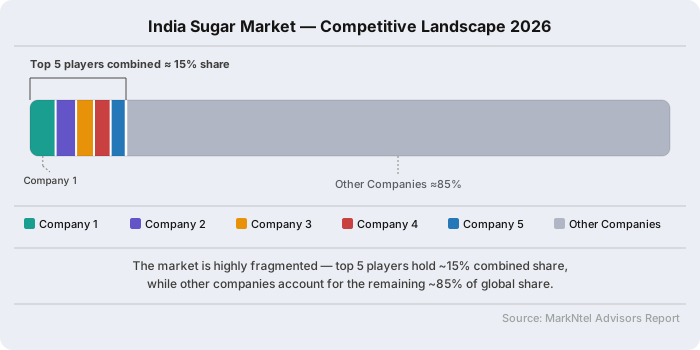
- The industry is fragmented, with the top five companies collectively accounting for 15% of market revenue.
India Sugar Market Size and Outlook
The sugar market size in India was valued at USD 10.9 billion in 2025 and is projected to grow from USD 14.4 billion in 2026 to USD 18.7 billion by 2032. Along with this, the market is estimated to grow at a CAGR of around 4.5% during the forecast period, i.e., 2026-32.
This significant growth is anchored by a production base set for strong recovery after a weaker prior season. According to the United States Department of Agriculture (USDA) Foreign Agricultural Service's India Sugar Annual, published in April 2026, sugar production for marketing year 2026/27 is forecasted at 33.6 million metric tons on a raw value basis, a 12% increase over the current year's revised estimate of 30 million tons, supported by sugarcane area expanding 2% to 5.9 million hectares. Because domestic consumption remains steady at around 31 million tons, this production recovery directly determines how much sugar is available for both food use and export.
This production cycle is reinforced by government price support for farmers. The Cabinet Committee on Economic Affairs raised the Fair and Remunerative Price for sugarcane to USD 41.28 per quintal for the 2025-26 season, a 4.41% increase, with a further USD 0.12 per quintal increase approved for 2026-27. Consequently, the market's long-term outlook is tied to this pricing mechanism, as guaranteed minimum prices sustain farmer participation in sugarcane cultivation regardless of open-market sugar price fluctuations.
Specifically, one dynamic anchors sustained pressure on supply: mandatory ethanol diversion. India advanced its 20% ethanol blending target from 2030 to the 2025-26 ethanol supply year, with the Sugar (Control) Order, 2025 explicitly regulating how much sugarcane juice, syrup, and molasses mills divert to ethanol production versus sugar output. As a result, a growing share of India's sugarcane crop is structurally redirected away from sugar production, tightening domestic sugar availability even as overall cane output grows.
In response, sugar producers are shifting toward higher-margin, branded, and specialty sugar products rather than competing purely on commodity volumes. This shift reflects the market's gradual move from undifferentiated bulk sugar toward packaged, organized-retail products, pushing Indian sugar companies toward higher-value segments as ethanol diversion compresses the volume available for traditional bulk sugar sales.
India Sugar Market Key Indicators
India's food processing sector, the adjacent industry that consumes sugar as a core input, continues expanding under sustained government support. As per the India Brand Equity Foundation, a Government of India trade promotion body, the Pradhan Mantri Kisan SAMPADA Yojana had approved around 1,607 food processing and preservation projects as of late 2025, with roughly 1,185 already completed and operational, benefiting over 3.6 million farmers. As this downstream processing capacity expands, it directly widens the industrial base of bakeries, confectioners, and beverage manufacturers that purchase sugar as a raw material input.
Broader food-price movements shape how much room consumers and food manufacturers have to absorb sugar costs within their overall food budgets. According to India's Ministry of Statistics and Programme Implementation, the Consumer Food Price Index rose 5.32% year-on-year in May 2026, outpacing the broader Consumer Price Index's 4.38% increase for the same month. As food inflation continues running above headline inflation, sugar-dependent products face tighter margin pressure within an already rising overall food-basket cost.
Rising household income directly expands the purchasing power available for sugar-based discretionary products like bakery, confectionery, and beverages. According to India's National Statistics Office, real GDP is estimated to grow 7.4% in FY 2025-26, up from 6.5% in FY 2024-25, with nominal GDP growth estimated at 8.0% for the same year. As national income continues expanding at this pace, household spending capacity for processed and packaged sugar-containing products grows in step, supporting demand beyond basic staple consumption.
India Sugar Market Scope
| Category | Segments |
|---|---|
| By Product Type | Raw Sugar, White Crystal Sugar, Refined Sugar, Brown Sugar, Specialty Sugar |
| By Form | Granulated, Liquid Syrup, Powdered, Others |
| By Application | Bakery & Confectionery, Beverages, Dairy, Household & Institutional Direct Consumption, Pharmaceuticals, Others |
| By Distribution Channel | Direct Sales, Wholesalers & Distributors, Traditional Retail, Modern Trade, Online Retail |
| By End User | Commercial, Non-Commercial |
India Sugar Market Growth Drivers
E20 Fuel Mandate Accelerating Ethanol Capacity Expansion Across India's Sugar Sector
India's sugar mills are under pressure to keep expanding ethanol distillation capacity to meet the country's fuel-blending commitments. According to the USDA Foreign Agricultural Service's Biofuels Annual report, India's ethanol production capacity stood at 16 billion litres as of March 2025, while sustaining the national E20 target requires a capacity of 17 billion litres, assuming 80% plant efficiency. The report also notes that the Ethanol Blended Petrol Programme has already reduced gasoline consumption by more than 5 billion litres in a single ethanol supply year, cutting carbon emissions by 10.8 million metric tons.
Because sugarcane-derived molasses and juice remain a primary ethanol feedstock, this capacity gap translates directly into continued capital investment by sugar mills in distillation infrastructure rather than a one-time buildout. As mills add the remaining capacity needed to close this gap, ethanol increasingly functions as a second, government-backed revenue stream alongside conventional sugar sales, supporting overall market value growth even as bulk sugar itself faces separate pricing pressures.
Recent Trends
Sugarcane Farms Using AI to Achieve a 40% Yield Increase in Pilot Program
Artificial intelligence is moving from pilot testing into national-scale deployment across India's sugarcane farms. According to Microsoft's own newsroom, a 2024 pilot conducted by the Agriculture Development Trust in Baramati, in partnership with Microsoft and Oxford University, used AI-powered weather stations, soil sensors, and satellite imagery to help farmers predict pest outbreaks, optimize irrigation, and time their harvest for peak sugar content. Building on these results, the Indian Sugar and Bio-energy Manufacturers Association formed a National AI-ML Network Program in August 2025 with the Agriculture Development Trust and agri-tech platform Map My Crop, expanding the approach across major sugarcane-growing states including Uttar Pradesh, Maharashtra, and Karnataka.
The original pilot delivered concrete gains directly relevant to sugar production: a 40% increase in crop yield, a 30% reduction in water usage, and improved harvest timing tied to peak sucrose content, the sugar concentration that determines how much usable sugar a mill can extract from each tons of cane. As this AI network scales nationally, it directly targets higher sugar recovery rates at the farm level, before cane ever reaches a mill for processing.
India Sugar Market Opportunities and Challenges
Stagnating Household Sugar Consumption Creating Demand Shift Toward Commercial Buyers
India's sugar consumption pattern is increasingly diverging across consumer segments, creating a structural challenge for producer’s dependent on household demand while simultaneously opening opportunities in commercial food manufacturing. According to the USDA Foreign Agricultural Service's India Sugar Annual, per capita sugar consumption has stabilized at approximately 18 kilograms annually, as affluent urban households increasingly adopt healthier sweetener alternatives and reduce incremental consumption of conventional sugar. This trend is limiting growth in the traditional household retail segment, particularly across higher-income urban markets that have historically contributed to premium consumption.
However, this moderation in household demand is being offset by expanding consumption from commercial and institutional buyers. The USDA reports that approximately 70% of India's total sugar consumption now originates from food and beverage manufacturers, bakeries, confectionery producers, dairy processors, and other institutional users. Rising demand for processed foods, packaged beverages, and convenience products is steadily increasing industrial sugar consumption, enabling producers to diversify their customer base beyond retail households. Consequently, while changing consumer preferences constrain direct household consumption, the growing commercial food processing sector presents a significant opportunity to sustain long-term demand growth in India sugar industry.
Segmentation Insights
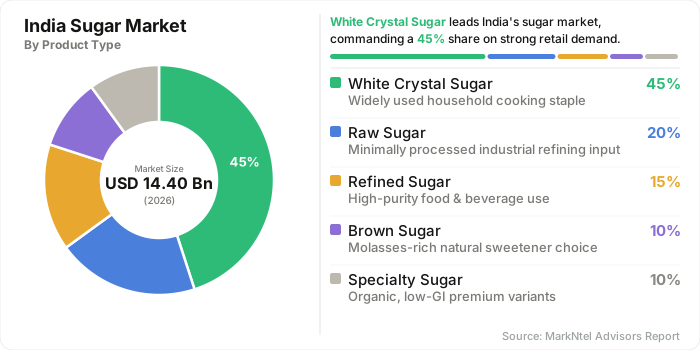
White Crystal Sugar Commanding 45% Share as India’s Standard Grade for Everyday Consumption
White crystal sugar holds the largest share of the India sugar market as it offers the optimal combination of purity, affordability, shelf stability, and broad applicability across both household and industrial consumption. Unlike raw sugar, which requires further refining before retail use, or refined, brown, and specialty sugars that cater to niche applications at higher production costs, white crystal sugar is suitable for immediate consumption and industrial processing directly after production. Its versatility and cost efficiency make it the preferred sugar grade across households, food manufacturers, beverage producers, bakeries, confectionery companies, and institutional buyers.
The widespread adoption of white crystal sugar is further supported by stringent quality standardization across leading domestic producers. For instance, Bajaj Hindusthan Sugar classifies its white crystal sugar according to the National Sugar Institute's specifications for colour and grain size, while maintaining sugar retention levels exceeding 85%, significantly higher than the prescribed minimum standard of 70%. Such standardized production practices ensure consistent quality, enabling seamless utilization across diverse end-use industries without requiring additional processing.
With its standardized quality, ready-to-use nature, and competitive production costs, white crystal sugar continues to maintain a structural advantage over raw, refined, brown, and specialty sugar varieties. Its ability to efficiently serve both retail consumers and commercial food-processing industries reinforces its position as the dominant product segment in the India sugar market. By the product type, the market is further segmented into the following sub-categories:
- White Crystal Sugar
- Raw Sugar
- Refined Sugar
- Brown Sugar
- Specialty Sugar
Bakery and Confectionery Commanding 28% Share as India’s Largest FMCG Makers Scale Capacity
Bakery and confectionery leads sugar demand by application because it spans some of India's highest-volume packaged food categories, biscuits, cakes, and chocolates, each requiring sugar as a core formulation ingredient rather than an optional additive. Unlike beverages or dairy, where sugar content can be adjusted or substituted more easily, bakery and confectionery recipes depend on sugar for structure, texture, and shelf life, not just sweetness, making substitution far more difficult at scale.
Reflecting the scale of this demand, ITC, whose FMCG portfolio includes the Sunfeast biscuit and Fabelle chocolate brands, reported gross revenue of USD 9.4 billion and EBITDA of USD 2.9 billion as of March 31, 2026, according to the company's own investor relations disclosures. ITC's FMCG business alone represents an annual consumer spend of over USD 4 billion, reaching more than 260 million households across India, and the company has reaffirmed a medium-term capital expenditure plan exceeding USD 2.3 billion, with 35 to 40% directed toward expanding FMCG manufacturing capacity.
As India's largest packaged food companies continue scaling bakery and confectionery production at this magnitude, sugar demand from this application grows in direct proportion to their expanding manufacturing footprint. By application, the market is further segmented into the following sub-categories:
- Bakery & Confectionery
- Beverages
- Dairy
- Household & Institutional Direct Consumption
- Pharmaceuticals
- Others
India Sugar Market Competitive Landscape
The India sugar industry is fragmented, led by established integrated sugar producers with strong regional manufacturing bases across Uttar Pradesh, Maharashtra, Karnataka, and Tamil Nadu. Shree Renuka Sugars, Balrampur Chini Mills, E.I.D. Parry, Triveni Engineering & Industries, and Bajaj Hindusthan Sugar collectively account for approximately 15% of market revenue, reflecting a landscape where numerous regional and family-owned sugar mills compete alongside these larger integrated players rather than a small group of firms holding dominant share.
Major Companies of India Sugar Market
- Shree Renuka Sugars Limited (Wilmar International)
- Balrampur Chini Mills Limited
- I.D. Parry (India) Limited (Murugappa Group)
- Triveni Engineering & Industries Limited
- Bajaj Hindusthan Sugar Limited (Bajaj Group – Shishir Bajaj)
- Dalmia Bharat Sugar and Industries Limited (Dalmia Bharat Group)
- Dhampur Sugar Mills Limited
- Dwarikesh Sugar Industries Limited
- DCM Shriram Industries Limited
- Bannari Amman Sugars Limited
India Sugar Market News and Recent Developments
2025: FSSAI Launches Sugar and Oil Boards Nationwide Under Eat Right India Programme
In June 2025, Union Health Minister J.P. Nadda launched Food Safety and Standards Authority of India (FSSAI)'s "Sugar and Oil Boards" initiative at the World Food Safety Day event in Bengaluru, themed "Stop Obesity by Eating Safe and Healthy." The boards are visual displays placed in schools, workplaces, and public institutions to show the hidden sugar content of everyday food items, part of a broader push under the Eat Right India programme to curb rising obesity, which the minister said had risen 39.6% in urban India.
Impact Analysis: This nationwide awareness push is shaping consumer sugar consumption habits directly, pressuring food manufacturers to reformulate high-sugar products as public sugar-literacy improves across schools and workplaces.
2025: ISMA Launches National AI Network to Boost Sugarcane Productivity
In August 2025, the Indian Sugar and Bio-energy Manufacturers Association partnered with the Agriculture Development Trust, Baramati, and agri-tech platform Map My Crop to launch a National AI-ML Network Program, building on a 2024 pilot with Microsoft and Oxford University that delivered a 40% yield increase and 30% reduction in water usage for sugarcane farmers.
Impact Analysis: Scaling AI-driven farming nationally directly targets higher sugar recovery rates at the farm level, expanding raw material efficiency before cane ever reaches a mill.
2026: Cabinet Approves USD 4.24 Sugarcane FRP for 2026-27 Season
On May 5, 2026, the Cabinet Committee on Economic Affairs approved a Fair and Remunerative Price of USD 4.24 per quintal for sugarcane for the 2026-27 season, a 2.81% increase over the prior season, benefiting nearly fifty million farmers and over five hundred thousand mill workers.
Impact Analysis: This guaranteed price floor sustains farmer participation in sugarcane cultivation regardless of open-market sugar price fluctuations, underpinning the raw material supply that the entire sugar market depends on.
Frequently Asked Questions
- Market Segmentation
- Introduction
- Product Definition
- Research Process
- Assumptions
- Executive Summary
- India Sugar Market Policies, Regulations, and Product Standards
- India Sugar Market Trends & Developments
- India Sugar Market Dynamics
- Growth Factors
- Challenges
- India Sugar Market Hotspot & Opportunities
- India Sugar Market Outlook, 2022-2032
- Market Size & Outlook
- By Revenues (USD Million)
- By Quantity Sold (Thousand Tons)
- Market Share & Outlook
- By Product Type- Market Size & Forecast 2022-2032, USD Million and Thousand Tons
- Raw Sugar
- White Crystal Sugar
- Refined Sugar
- Brown Sugar
- Specialty Sugar
- By Form- Market Size & Forecast 2022-2032, USD Million and Thousand Tons
- Granulated
- Liquid Syrup
- Powdered
- Others
- By Application- Market Size & Forecast 2022-2032, USD Million and Thousand Tons
- Bakery & Confectionery
- Beverages
- Dairy
- Household & Institutional Direct Consumption
- Pharmaceuticals
- Others
- By Distribution Channel- Market Size & Forecast 2022-2032, USD Million and Thousand Tons
- Direct Sales
- Wholesalers & Distributors
- Traditional Retail
- Modern Trade
- Online Retail
- By End User- Market Size & Forecast 2022-2032, USD Million and Thousand Tons
- Commercial
- Non-Commercial
- By Region- Market Size & Forecast 2022-2032, USD Million and Thousand Tons
- North
- South
- East
- West
- By Company
- Competition Characteristics
- Market Share & Analysis
- By Product Type- Market Size & Forecast 2022-2032, USD Million and Thousand Tons
- Market Size & Outlook
- India Raw Sugar Market Outlook, 2022-2032
- Market Size & Outlook
- By Revenues (USD Million)
- By Quantity Sold (Thousand Tons)
- Market Share & Outlook
- By Form- Market Size & Forecast 2022-2032, USD Million and Thousand Tons
- By Application- Market Size & Forecast 2022-2032, USD Million and Thousand Tons
- By Distribution Channel- Market Size & Forecast 2022-2032, USD Million and Thousand Tons
- By End User- Market Size & Forecast 2022-2032, USD Million and Thousand Tons
- By Region- Market Size & Forecast 2022-2032, USD Million and Thousand Tons
- Market Size & Outlook
- India White Crystal Sugar Market Outlook, 2022-2032
- Market Size & Outlook
- By Revenues (USD Million)
- By Quantity Sold (Thousand Tons)
- Market Share & Outlook
- By Form- Market Size & Forecast 2022-2032, USD Million and Thousand Tons
- By Application- Market Size & Forecast 2022-2032, USD Million
- By Distribution Channel- Market Size & Forecast 2022-2032, USD Million and Thousand Tons
- By End User- Market Size & Forecast 2022-2032, USD Million and Thousand Tons
- By Region- Market Size & Forecast 2022-2032, USD Million and Thousand Tons
- Market Size & Outlook
- India Refined Sugar Market Outlook, 2022-2032
- Market Size & Outlook
- By Revenues (USD Million)
- By Quantity Sold (Thousand Tons)
- Market Share & Outlook
- By Form- Market Size & Forecast 2022-2032, USD Million and Thousand Tons
- By Application- Market Size & Forecast 2022-2032, USD Million and Thousand Tons
- By Distribution Channel- Market Size & Forecast 2022-2032, USD Million and Thousand Tons
- By End User- Market Size & Forecast 2022-2032, USD Million and Thousand Tons
- By Region- Market Size & Forecast 2022-2032, USD Million and Thousand Tons
- Market Size & Outlook
- India Brown Sugar Market Outlook, 2022-2032
- Market Size & Outlook
- By Revenues (USD Million)
- By Quantity Sold (Thousand Tons)
- Market Share & Outlook
- By Form- Market Size & Forecast 2022-2032, USD Million and Thousand Tons
- By Application- Market Size & Forecast 2022-2032, USD Million and Thousand Tons
- By Distribution Channel- Market Size & Forecast 2022-2032, USD Million and Thousand Tons
- By End User- Market Size & Forecast 2022-2032, USD Million and Thousand Tons
- By Region- Market Size & Forecast 2022-2032, USD Million and Thousand Tons
- Market Size & Outlook
- India Specialty Sugar Market Outlook, 2022-2032
- Market Size & Outlook
- By Revenues (USD Million)
- By Quantity Sold (Thousand Tons)
- Market Share & Outlook
- By Form- Market Size & Forecast 2022-2032, USD Million and Thousand Tons
- By Application- Market Size & Forecast 2022-2032, USD Million and Thousand Tons
- By Distribution Channel- Market Size & Forecast 2022-2032, USD Million and Thousand Tons
- By End User- Market Size & Forecast 2022-2032, USD Million and Thousand Tons
- By Region- Market Size & Forecast 2022-2032, USD Million and Thousand Tons
- Market Size & Outlook
- India Sugar Market Key Strategic Imperatives for Success & Growth
- Competitive Outlook
- Company Profiles
- Shree Renuka Sugars Limited (Wilmar International)
- Business Description
- Product Portfolio
- Collaborations & Alliances
- Recent Developments
- Financial Details
- Others
- Balrampur Chini Mills Limited
- Business Description
- Product Portfolio
- Collaborations & Alliances
- Recent Developments
- Financial Details
- Others
- E.I.D. Parry (India) Limited (Murugappa Group)
- Business Description
- Product Portfolio
- Collaborations & Alliances
- Recent Developments
- Financial Details
- Others
- Triveni Engineering & Industries Limited
- Business Description
- Product Portfolio
- Collaborations & Alliances
- Recent Developments
- Financial Details
- Others
- Bajaj Hindusthan Sugar Limited (Bajaj Group – Shishir Bajaj)
- Business Description
- Product Portfolio
- Collaborations & Alliances
- Recent Developments
- Financial Details
- Others
- Dalmia Bharat Sugar and Industries Limited (Dalmia Bharat Group)
- Business Description
- Product Portfolio
- Collaborations & Alliances
- Recent Developments
- Financial Details
- Others
- Dhampur Sugar Mills Limited
- Business Description
- Product Portfolio
- Collaborations & Alliances
- Recent Developments
- Financial Details
- Others
- Dwarikesh Sugar Industries Limited
- Business Description
- Product Portfolio
- Collaborations & Alliances
- Recent Developments
- Financial Details
- Others
- DCM Shriram Industries Limited
- Business Description
- Product Portfolio
- Collaborations & Alliances
- Recent Developments
- Financial Details
- Others
- Bannari Amman Sugars Limited
- Business Description
- Product Portfolio
- Collaborations & Alliances
- Recent Developments
- Financial Details
- Others
- Shree Renuka Sugars Limited (Wilmar International)
- Company Profiles
- Disclaimer
MarkNtel Advisors follows a robust and iterative research methodology designed to ensure maximum accuracy and minimize deviation in market estimates and forecasts. Our approach combines both bottom-up and top-down techniques to effectively segment and quantify various aspects of the market. A consistent feature across all our research reports is data triangulation, which examines the market from three distinct perspectives to validate findings. Key components of our research process include:
1. Scope & Research Design At the outset, MarkNtel Advisors define the research objectives and formulate pertinent questions. This phase involves determining the type of research—qualitative or quantitative—and designing a methodology that outlines data collection methods, target demographics, and analytical tools. They also establish timelines and budgets to ensure the research aligns with client goals.
2. Sample Selection and Data Collection In this stage, the firm identifies the target audience and determines the appropriate sample size to ensure representativeness. They employ various sampling methods, such as random or stratified sampling, based on the research objectives. Data collection is carried out using tools like surveys, interviews, and observations, ensuring the gathered data is reliable and relevant.
3. Data Analysis and Validation Once data is collected, MarkNtel Advisors undertake a rigorous analysis process. This includes cleaning the data to remove inconsistencies, employing statistical software for quantitative analysis, and thematic analysis for qualitative data. Validation steps are taken to ensure the accuracy and reliability of the findings, minimizing biases and errors.

4. Data Forecast and FinalizationThe final phase involves forecasting future market trends based on the analyzed data. MarkNtel Advisors utilize predictive modeling and time series analysis to anticipate market behaviors. The insights are then compiled into comprehensive reports, featuring visual aids like charts and graphs, and include strategic recommendations to inform client decision-making
We offer flexible licensing options to cater to varying organizational needs. Choose the pricing pack that best suits your requirements:
Buy Now Inquire Before Buying
 Request Customization
 Talk to our Consultant







