

South Korea EdTech Market Research Report: Forecast (2026-2032)
By Component (Hardware, Software, Content, Services), By Deployment Mode (Cloud-Based, On-Premise), By Learning Mode (Online, Offline), By End-User (Pre-K / Early Childhood Educati ... on, K-12 Schools (Public Schools, Private Schools & Hagwons (Private Academies)), Higher Education Institutions, Corporate Learning, Enterprises & Government Training, Individual Consumers / Lifelong D2C Learners), and others Read more
- ICT & Electronics
- Jul 2026
- Pages 140
- Report Format: PDF, Excel, PPT
South Korea EdTech Market
Projected 3.22% CAGR from 2026 to 2032
Study Period
2026-2032
Market Size (2026)
USD 6.76 Billion
Market Size (2032)
USD 8.18 Billion
Base Year
2025
Projected CAGR
3.22%
Leading Segments
By Component: Hardware
South Korea EdTech Market Key Takeaways
- South Korea Education Technology Market size was valued at USD 6.34 billion in 2025 and is projected to grow from USD 6.76 billion in 2026 to USD 8.18 billion by 2032.
- The market is projected to register a CAGR of 3.22% during 2026–2032.
- K-12 schools constitute a clear dominance in the industry, capturing a substantial 40% market share in 2026.
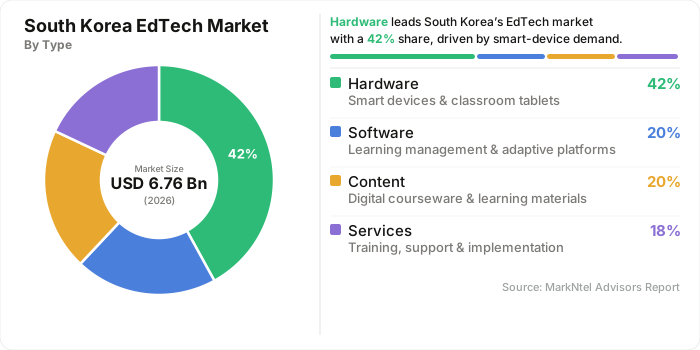
- Based on Components, Hardware shows a clear dominance in the market, commanding an impressive 42% market share in 2026.
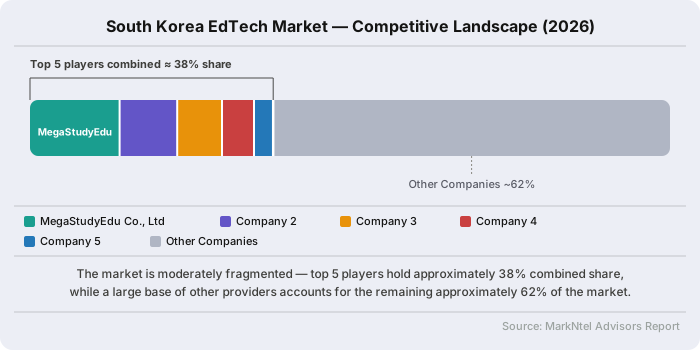
- The industry is moderately consolidated, with the top five players collectively accounting for approximately 38% of the market share in 2026.
South Korea EdTech Market Size and Outlook
The education technology industry in South Korea was valued at USD 6.34 billion in 2025 and is currently standing at USD 6.76 billion in 2026. The industry is projected to grow to USD 8.18 billion by 2032, showcasing a CAGR of around 3.22% during the forecast period, i.e., 2026–32. The market is advancing toward a more mature and innovation-driven ecosystem, supported by strong government backing, expanding AI integration across education, and sustained collaboration between public institutions and technology companies.
Supporting this transition, South Korea entered a more structured regulatory environment in 2026 following the implementation of the Framework Act on the Development of Artificial Intelligence and Establishment of a Foundation for Trustworthiness. Effective January 22, 2026, the legislation recognizes education as a high-impact AI sector, introducing requirements for risk management, transparency, and impact assessment of AI solutions deployed in educational settings. The framework strengthens governance for AI-powered learning technologies while supporting long-term confidence in digital education adoption.
The regulatory framework is complemented by significant public investment in AI-enabled education. In November 2025, the Ministry of Education announced an approx. USD 910 million AI Talent Development Plan to establish AI Education Support Centres across three regional education offices in 2026 before expanding to all 17 regional offices by 2028. The plan also expands AI-focused schools from 730 to 2,000 by 2028, increases AI-oriented Meister high schools through 2030, and completes intelligent science laboratories across schools by 2027, reinforcing long-term digital capability development.
Government priorities further support this momentum. South Korea approved a USD 495 billion national budget for 2026, positioning AI-led innovation among its strategic priorities. The Ministry of Science and ICT also partnered with Google DeepMind to establish an AI Campus in Seoul, advance AI safety research, and strengthen talent development. Complementing these initiatives, the Ministry of Education continues promoting classroom innovation through the EdTech Promotion Framework and EdTech Soft Lab program, while the annual EdTech Korea Fair strengthens collaboration across the education ecosystem.
Beyond public initiatives, private sector participation continues to expand, with Upstage and Day1 Company partnering in January 2026 to deliver industry-aligned AI training programs integrating practical curricula, GPU infrastructure, technical mentoring, and employment pathways.
South Korea EdTech Market Key Indicators
- South Korea's private education expenditure reached approximately USD 20.4 billion in 2025, highlighting the scale of household investment in supplementary education and reinforcing a strong commercial foundation for digital learning and EdTech solutions.
- The Ministry of Education committed approximately USD 960 million under the AI Talent Development Plan in 2025 to expand AI education support centres, AI-focused schools, and intelligent science laboratories, accelerating digital transformation across South Korea's education ecosystem.
- Private education accounted for a record 13.5% of monthly household expenditure during the second quarter of 2025, becoming one of the country's largest household spending categories and underscoring the sustained priority placed on education investment.
- Generative AI adoption in South Korea exceeded 30% of the population during the second half of 2025, making the country the world's second-largest Gen AI subscriber market after the United States and strengthening the foundation for AI-enabled education services.
- Average monthly spending per participating student increased to a record approximately USD 412 in 2025, reflecting continued willingness among households to invest in premium learning experiences, personalized tutoring, and technology-enabled education services.
South Korea EdTech Market Scope
| Category | Segments |
|---|---|
| By Component | Hardware, Software, Content, Services |
| By Deployment Mode | Cloud-Based, On-Premise |
| By Learning Mode | Online, Offline |
| By End-User | Pre-K / Early Childhood Education, K-12 Schools (Public Schools, Private Schools & Hagwons (Private Academies)), Higher Education Institutions, Corporate Learning, Enterprises & Government Training, Individual Consumers / Lifelong D2C Learners |
South Korea EdTech Market Growth Drivers
Rising Household Investment in Education Continues to Strengthen EdTech Demand
South Korean households continue to increase investment in quality education, creating favourable conditions for EdTech solutions and personalized learning services. According to the Ministry of Education's 2025 Private Education Survey, average monthly spending per participating student reached a record USD 412 in 2025. The higher per-student expenditure reflects parents' growing willingness to invest in academic achievement and technology-enabled learning experiences.
This investment trend is particularly pronounced in secondary education. High school students participating in private education recorded average monthly spending of USD 541 in 2025, significantly above the national average, highlighting sustained demand for advanced learning support and examination preparation. Reinforcing this trend, private education accounted for a record 13.5% of monthly household expenditure during the second quarter of 2025, becoming one of the largest components of household discretionary spending according to KOSIS.
Investment in education is also expanding across earlier learning stages. Spending on elementary-level private education increased 74.1% over the decade through 2024, reaching USD 9.0 billion, demonstrating parents' growing emphasis on building academic foundations from a young age. These long-term spending patterns continue to create opportunities for AI-powered learning platforms, adaptive education technologies, digital tutoring services, and personalized learning ecosystems, supporting sustained growth across South Korea's EdTech industry.
Recent Trends
AI-Driven Language Learning and Intelligent Assessment Are Expanding Across the Education Ecosystem
Artificial intelligence is becoming increasingly embedded in South Korea's language learning and student assessment ecosystem, enabling more personalized instruction, automated evaluation, and inclusive learning experiences. The growing integration of AI across national education initiatives reflects a broader shift toward intelligent digital learning environments that improve learning accessibility while supporting scalable assessment across diverse student populations.
This transition is being supported through government-led digital education initiatives. In December 2025, the Ministry of Education announced that the Test of Proficiency in Korean (TOPIK) will transition to a fully digital, computer-based examination by 2029, incorporating AI-powered grading capabilities. The same initiative also introduced AI-based Korean language learning modules and developmentally tailored proficiency assessments for primary and secondary students, alongside curriculum enhancements designed to strengthen learning outcomes for multicultural learners.
Adoption of AI-enabled language learning continues to expand beyond assessment. By May 2026, the Ministry of Education broadened access to its "Korean for Everyone" platform, simplifying enrolment as multicultural student enrolment reached approx. 200,000, representing a 37% increase compared with 2020. Reflecting similar technology adoption across the commercial sector, Samsung Electronics introduced AI-powered education display solutions featuring multilingual transcription, automated lesson summaries, and AI-generated quizzes during ISTE Live 2026. Together, these developments highlight the growing role of AI in enhancing language learning, classroom accessibility, and intelligent assessment, reinforcing innovation across South Korea's EdTech market.
South Korea EdTech Market Challenges and Opportunities
Policy Realignment Reshapes Commercial Strategies Across South Korea's EdTech Ecosystem
The reclassification of South Korea's AI Digital Textbook initiative from mandatory to optional adoption created a significant commercial setback for publishers that had invested heavily in AI textbook development. The industry faced an estimated USD 545 million in stranded investment, while the Korea textbook association and several publishers initiated legal action following the policy change. Adoption also declined from 37% during the first semester of 2025 to 19% in the second semester, reducing visibility over expected returns from government-led deployments.
The policy shift exposed the risks associated with relying heavily on a single public procurement channel for commercialization. Several publishers were forced to restructure AI textbook operations, scale back investments, or redirect resources toward alternative business segments, highlighting the importance of diversified revenue streams within South Korea's rapidly evolving EdTech ecosystem.
The changing policy landscape has simultaneously encouraged companies to accelerate commercialization beyond government-led education programs. Publishers are increasingly expanding into private hagwon partnerships, direct-to-consumer subscription platforms, and overseas markets, where adoption decisions are driven by institutions and consumers rather than centralized procurement. Existing AI-powered adaptive learning technologies are also being repurposed into personalized learning applications, extending their commercial value across multiple education segments.
This strategic diversification is already translating into new growth opportunities. Consumer-focused AI learning providers such as Mathpresso (QANDA) and Riiid have continued expanding through subscription-based learning models independent of the AIDT initiative. Likewise, Kyowon Red Pen's AiCANDO received the Grand Prize in the EdTech category of the 2026 National Service Awards, reflecting sustained demand for AI-enabled personalized learning solutions and reinforcing broader commercialization opportunities across South Korea's EdTech market.
Segmentation Insights
K-12 Institutional Adoption Anchors National Educational Technology Ecosystem
K-12 schools constitute a clear dominance in the educational technology industry, capturing a substantial 40% market share in 2026. This massive share is heavily propelled by the public education sector alongside the country's hyper-competitive private academy network, locally known as hagwons. Because academic achievement is deeply tied to university admissions, parents and institutions aggressively invest in modern digital learning solutions. This foundational demand ensures that primary and secondary education remain the primary drivers of total industry spending.
The ongoing dominance of this segment is further solidified by aggressive national policies, such as the Ministry of Education's digital transformation initiatives. The deployment of AI-powered digital textbooks across thousands of public classrooms has created a mandatory baseline for advanced technology integration. Private academies match this institutional shift by deploying localized adaptive learning software to maintain their competitive edge. Based on end-user, the market is further bifurcated into:
- Pre-K / Early Childhood Education
- K-12 Schools
- Higher Education Institutions
- Corporate Learning, Enterprises & Government Training
- Individual Consumers / Lifelong D2C Learners
Hardware Segment Lead the Industry with Potential Market Shares
Hardware shows a clear dominance in the market, commanding an impressive 42% market share in 2026. The requirement for physical infrastructure serves as the essential baseline for any digital classroom framework, making hardware procurement the largest upfront expenditure for schools. From interactive displays to individual student tablets, physical devices are necessary to run the complex software architectures being introduced into modern schools. This necessity keeps hardware spending ahead of software and specialized digital services.
A significant portion of this hardware dominance stems from large-scale government funding designed to supply public schools with modern tools. Massive provincial budgets are designated annually to ensure that classroom facilities feature high-speed PC infrastructure and immersive AR/VR devices. These public investments, paired with the frequent hardware upgrade cycles typical of South Korea's tech-forward society, ensure steady market volume. Based on component, the market is further bifurcated into:
- Hardware
- Software
- Content
- Services
South Korea EdTech Market Competitive Analysis
The South Korea EdTech market is moderately consolidated, with competition led by established domestic EdTech providers, AI-powered learning platform developers, digital content publishers, and online tutoring specialists. Leading participants leverage proprietary AI technologies, extensive educational content libraries, strategic partnerships with educational institutions, and subscription-based business models to strengthen their competitive positioning.
Major players such as MegaStudyEdu Co., Ltd., I-Scream Edu Co., Ltd. (I-Scream), Mathpresso Inc. (QANDA), Riiid Inc., and The Pinkfong Company, Inc. (formerly SmartStudy) collectively account for approximately 38% of the South Korean EdTech market.
Key Companies in the South Korea EdTech Market
- MegaStudyEdu Co., Ltd.
- I-Scream Edu Co., Ltd. (I-Scream)
- Mathpresso Inc. (QANDA)
- Riiid Inc.
- The Pinkfong Company, Inc. (formerly SmartStudy)
- Etoos Education Co., Ltd.
- Ringle Co., Ltd.
- Classting Inc.
- GLORANG Inc.
- Knowre Inc.
South Korea EdTech Industry News and Recent Developments
2026: Microsoft Launches AI Literacy Credential Program to Strengthen South Korea's Digital Education Ecosystem
In 2026, Microsoft expanded its education footprint in South Korea through the launch of the Elevate for Educators Korea initiative, introducing a localized AI Literacy Credential Program in collaboration with Seoul National University. The program equips K-12 educators with practical AI competencies, responsible AI usage guidelines, and classroom integration strategies to enhance digital teaching capabilities. Beyond teacher training, Microsoft broadened its community outreach by delivering AI literacy programs to students and educators across Gangwon and Busan, supporting the country's broader digital transformation agenda. The initiative aligns with South Korea's national focus on AI talent development by strengthening educator readiness and accelerating AI adoption within classrooms. Through collaboration with academic institutions and localized curriculum development, Microsoft is helping establish a stronger foundation for AI-enabled education while supporting workforce readiness and digital skills development across the education ecosystem.
Impact Analysis: Microsoft's localized AI literacy initiative strengthens South Korea's EdTech ecosystem by accelerating educator readiness for AI-integrated teaching and expanding institutional demand for digital learning solutions. The program reinforces collaboration between global technology providers, universities, and schools, supporting broader adoption of AI-powered education platforms. It is also expected to encourage further investment in teacher training, digital content, and AI-enabled classroom technologies, strengthening long-term growth opportunities across the South Korea EdTech market.
2026: FastCampus Becomes South Korea's First Private Enterprise to Adopt OpenAI Edu
In 2026, FastCampus, operated by Day1 Company, became South Korea's first private enterprise to adopt OpenAI Edu, marking a significant advancement in AI-powered professional education. The company integrated OpenAI's advanced reasoning models, Deep Research capabilities, and agent-based learning tools into its training programs, enabling learners to develop practical AI competencies aligned with evolving industry requirements. The initiative also introduced structured certification pathways linked to employment-focused learning, strengthening workforce development across AI-related disciplines. By combining advanced AI technologies with industry-oriented curricula, FastCampus expanded opportunities for professionals and enterprises seeking AI upskilling, while reinforcing South Korea's position as a leading adopter of enterprise-focused digital learning solutions beyond the traditional K-12 education segment.
Impact Analysis: The adoption of OpenAI Edu highlights the growing commercialization of AI-enabled learning platforms within South Korea's enterprise education sector. It expands the addressable market for EdTech providers beyond schools and universities while accelerating demand for AI-powered corporate learning, professional certification, and workforce development solutions. The development is expected to encourage similar collaborations between global AI providers and domestic EdTech companies, strengthening innovation and supporting sustained market expansion across institutional and enterprise learning environments.
Frequently Asked Questions
- Market Segmentation
- Introduction
- Product Definition
- Research Process
- Assumptions
- Executive Summary
- South Korea EdTech Market Policies, Regulations, and Product Standards
- South Korea EdTech Market Trends & Developments
- South Korea EdTech Market Dynamics
- Growth Factors
- Challenges
- South Korea EdTech Market Hotspot & Opportunities
- South Korea EdTech Market Outlook, 2022-2032F
- Market Size & Outlook
- By Revenues (USD Million)
- Market Segmentation & Outlook
- By Component- Market Size & Forecast 2022-2032, USD Million
- Hardware
- Software
- Content
- Services
- By Deployment Mode- Market Size & Forecast 2022-2032, USD Million
- Cloud-Based
- On-Premise
- By Learning Mode- Market Size & Forecast 2022-2032, USD Million
- Online
- Offline
- By End-User- Market Size & Forecast 2022-2032, USD Million
- Pre-K / Early Childhood Education
- K-12 Schools
- Public Schools
- Private Schools & Hagwons (Private Academies)
- Higher Education Institutions
- Corporate Learning, Enterprises & Government Training
- Individual Consumers / Lifelong D2C Learners
- By Region- Market Size & Forecast 2022-2032, USD Million
- Seoul Capital Area
- Yeongnam (Southeastern Region)
- Honam (Southwestern Region)
- Hoseo (Central Region)
- By Company
- Competition Characteristics
- Market Share & Analysis
- By Component- Market Size & Forecast 2022-2032, USD Million
- Market Size & Outlook
- South Korea Hardware EdTech Market Outlook, 2022-2032
- Market Size & Outlook
- By Revenues (USD Million)
- Market Segmentation & Outlook
- By Component- Market Size & Forecast 2022-2032, USD Million
- By Pricing Model - Market Size & Forecast 2022-2032, USD Million
- By Deployment Mode- Market Size & Forecast 2022-2032, USD Million
- By Learning Mode- Market Size & Forecast 2022-2032, USD Million
- By Application- Market Size & Forecast 2022-2032, USD Million
- By End User- Market Size & Forecast 2022-2032, USD Million
- By Region- Market Size & Forecast 2022-2032, USD Million
- Market Size & Outlook
- South Korea Software EdTech Market Outlook, 2022-2032
- Market Size & Outlook
- By Revenues (USD Million)
- Market Segmentation & Outlook
- By Component- Market Size & Forecast 2022-2032, USD Million
- By Pricing Model - Market Size & Forecast 2022-2032, USD Million
- By Deployment Mode- Market Size & Forecast 2022-2032, USD Million
- By Learning Mode- Market Size & Forecast 2022-2032, USD Million
- By Application- Market Size & Forecast 2022-2032, USD Million
- By End User- Market Size & Forecast 2022-2032, USD Million
- By Region- Market Size & Forecast 2022-2032, USD Million
- Market Size & Outlook
- South Korea Services EdTech Market Outlook, 2022-2032
- Market Size & Outlook
- By Revenues (USD Million)
- Market Segmentation & Outlook
- By Component- Market Size & Forecast 2022-2032, USD Million
- By Pricing Model - Market Size & Forecast 2022-2032, USD Million
- By Deployment Mode- Market Size & Forecast 2022-2032, USD Million
- By Learning Mode- Market Size & Forecast 2022-2032, USD Million
- By Application- Market Size & Forecast 2022-2032, USD Million
- By End User- Market Size & Forecast 2022-2032, USD Million
- By Region- Market Size & Forecast 2022-2032, USD Million
- Market Size & Outlook
- South Korea Content EdTech Market Outlook, 2022-2032
- Market Size & Outlook
- By Revenues (USD Million)
- Market Segmentation & Outlook
- By Component- Market Size & Forecast 2022-2032, USD Million
- By Pricing Model - Market Size & Forecast 2022-2032, USD Million
- By Deployment Mode- Market Size & Forecast 2022-2032, USD Million
- By Learning Mode- Market Size & Forecast 2022-2032, USD Million
- By Application- Market Size & Forecast 2022-2032, USD Million
- By End User- Market Size & Forecast 2022-2032, USD Million
- By Region- Market Size & Forecast 2022-2032, USD Million
- Market Size & Outlook
- South Korea EdTech Market Key Strategic Imperatives for Success & Growth
- Competitive Outlook
- Company Profiles
- MegaStudyEdu Co., Ltd.
- Business Description
- Product Portfolio
- Collaborations & Alliances
- Recent Developments
- Financial Details
- Others
- I-Scream Edu Co., Ltd. (I-Scream)
- Business Description
- Product Portfolio
- Collaborations & Alliances
- Recent Developments
- Financial Details
- Others
- Mathpresso Inc. (QANDA)
- Business Description
- Product Portfolio
- Collaborations & Alliances
- Recent Developments
- Financial Details
- Others
- Riiid Inc.
- Business Description
- Product Portfolio
- Collaborations & Alliances
- Recent Developments
- Financial Details
- Others
- The Pinkfong Company, Inc. (formerly SmartStudy)
- Business Description
- Product Portfolio
- Collaborations & Alliances
- Recent Developments
- Financial Details
- Others
- Etoos Education Co., Ltd.
- Business Description
- Product Portfolio
- Collaborations & Alliances
- Recent Developments
- Financial Details
- Others
- Ringle Co., Ltd.
- Business Description
- Product Portfolio
- Collaborations & Alliances
- Recent Developments
- Financial Details
- Others
- Classting Inc.
- Business Description
- Product Portfolio
- Collaborations & Alliances
- Recent Developments
- Financial Details
- Others
- GLORANG Inc.
- Business Description
- Product Portfolio
- Collaborations & Alliances
- Recent Developments
- Financial Details
- Others
- Knowre Inc.
- Business Description
- Product Portfolio
- Collaborations & Alliances
- Recent Developments
- Financial Details
- Others
- MegaStudyEdu Co., Ltd.
- Company Profiles
- Disclaimer
MarkNtel Advisors follows a robust and iterative research methodology designed to ensure maximum accuracy and minimize deviation in market estimates and forecasts. Our approach combines both bottom-up and top-down techniques to effectively segment and quantify various aspects of the market. A consistent feature across all our research reports is data triangulation, which examines the market from three distinct perspectives to validate findings. Key components of our research process include:
1. Scope & Research Design At the outset, MarkNtel Advisors define the research objectives and formulate pertinent questions. This phase involves determining the type of research—qualitative or quantitative—and designing a methodology that outlines data collection methods, target demographics, and analytical tools. They also establish timelines and budgets to ensure the research aligns with client goals.
2. Sample Selection and Data Collection In this stage, the firm identifies the target audience and determines the appropriate sample size to ensure representativeness. They employ various sampling methods, such as random or stratified sampling, based on the research objectives. Data collection is carried out using tools like surveys, interviews, and observations, ensuring the gathered data is reliable and relevant.
3. Data Analysis and Validation Once data is collected, MarkNtel Advisors undertake a rigorous analysis process. This includes cleaning the data to remove inconsistencies, employing statistical software for quantitative analysis, and thematic analysis for qualitative data. Validation steps are taken to ensure the accuracy and reliability of the findings, minimizing biases and errors.

4. Data Forecast and FinalizationThe final phase involves forecasting future market trends based on the analyzed data. MarkNtel Advisors utilize predictive modeling and time series analysis to anticipate market behaviors. The insights are then compiled into comprehensive reports, featuring visual aids like charts and graphs, and include strategic recommendations to inform client decision-making
We offer flexible licensing options to cater to varying organizational needs. Choose the pricing pack that best suits your requirements:
Buy Now Inquire Before Buying
 Request Customization
 Talk to our Consultant







