GCC EdTech Market Research Report: Forecast (2026-2032)
By Education Type (Institutional & Curriculum Based (K-12 (Core Curriculum, STEM/Robotics, Test Prep), Higher Education (Bachelors, Masters, Professional Degrees)), Professional & ... Corporate Upskilling (Tech & IT Skills (AI, Coding, Cyber Security), Business Management, Finance & HR, Compliance, Soft Skills & Leadership Training, Vocational & Technical Training (TVET)), Consumer, Supplemental & Lifelong Learning (Language Learning (English, Arabic, Foreign Languages), Test Preparation, Enrichment (Arts, Crafts, Social-Emotional Learning))), By Platform Type (Asynchronous (Pre-Recorded, Self-Paced Courses, LMS), Synchronous (Real-time Virtual Classrooms, Live Tutoring)), By Language of Delivery (English, Arabic, Bilingual/Others), and others Read more
- ICT & Electronics
- Jul 2026
- Pages 240
- Report Format: PDF, Excel, PPT
GCC EdTech Market
Projected 1.09% CAGR from 2026 to 2032
Study Period
2026-2032
Market Size (2026)
USD 4.79 Billion
Market Size (2032)
USD 5.11 Billion
Base Year
2025
Projected CAGR
1.09%
Leading Segments
By Education Type: Institutional & Curriculum Based
GCC EdTech Market Key Takeaways
- The GCC EdTech market size was valued at USD 4.52 billion in 2025 and is projected to grow from USD 4.79 billion in 2026 to USD 5.11 billion by 2032.
- The market is projected to register a CAGR of 1.09% during 2026–2032.
- By education type, institutional & curriculum-based led the market, having an estimated share of around 55% in 2026.
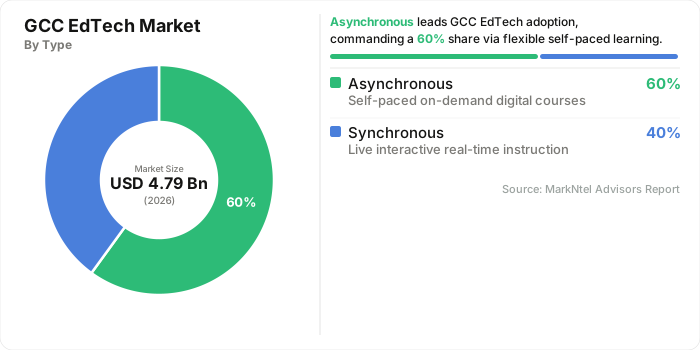
- By platform type, asynchronous platform had the dominant share of around 60% in 2026.
- By geography, UAE held a leading share of about 28% of the market size in 2026.
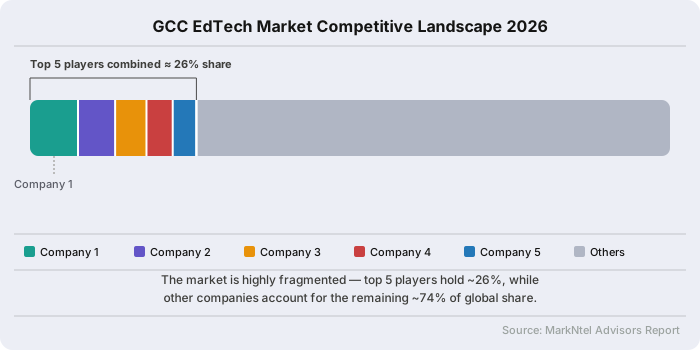
- The industry is fragmented, with the top five players collectively accounting for approximately 26% of the market share in 2026.
GCC EdTech Market Size and Outlook
The GCC EdTech industry was valued at USD 4.52 billion in 2025 and is currently valued at USD 4.79 billion in 2026. The industry is projected to grow to USD 5.11 billion by 2032, showcasing a CAGR of around 1.09% during the forecast period, i.e., 2026–32. The market is transitioning to a tech-enabled education ecosystem with an integral component of academic delivery, workforce development, and lifelong learning across the region. Regional providers are also expanding alongside global solution providers, reflecting increasing institutional adoption across both public and private education systems.
Rising digital education demand is supported by expanding student populations, increasing private school enrolment, and wider adoption of international curricula. The introduction of the CBSE global curriculum across the UAE from 2026 is expected to strengthen demand for curriculum-aligned digital content, assessment platforms, and personalized learning applications within expatriate-focused schools. At the same time, universities and employers are increasingly adopting artificial intelligence-enabled learning platforms, micro-credential programs, and digital certification tools to address evolving workforce skill requirements and economic diversification objectives.
Government policy has become a key structural enabler for the market by embedding digital learning within national education transformation strategies rather than treating it as a supplementary tool. Across the GCC, initiatives including Saudi Arabia's human capability development program, the UAE's national strategy for artificial intelligence 2031, and Qatar's third national development strategy 2024 to 2030 continue to accelerate investments in smart classrooms, digital curriculum integration, and AI enabled learning infrastructure. These initiatives are encouraging broader institutional deployment of EdTech solutions across schools, universities, and vocational education providers.
GCC EdTech Market Key Indicators
- 5G accounted for 53% of all mobile subscriptions across the GCC by the end of 2025 and is projected to approach 90% by 2031, providing the digital infrastructure required for cloud-based, AI-enabled, and interactive EdTech platforms.
- New student enrolment in UAE higher education institutions reached 57,035 during the 2024 to 2025 academic year, representing 13% year-on-year growth and indicating expanding demand for digital learning platforms.
- By 2025, 46% of Saudi Arabia's population aged 25 to 34 years had completed tertiary education, highlighting a large addressable learner base for higher education technologies, digital credentials, and professional upskilling platforms.
- Saudi Arabia disbursed approximately USD 41.8 billion toward the education sector during the first nine months of 2025, demonstrating strong execution of planned education expenditure and continued investment in digital learning, institutional modernization, and education infrastructure.
- Qatar's Ministry of Education launched more than 40 new digital services in 2025, including compulsory education registration integrated with the national student information system, accelerating digital education administration.
GCC EdTech Market Scope
| Category | Segments |
|---|---|
| By Education Type | Institutional & Curriculum Based (K-12 (Core Curriculum, STEM/Robotics, Test Prep), Higher Education (Bachelors, Masters, Professional Degrees)), Professional & Corporate Upskilling (Tech & IT Skills (AI, Coding, Cyber Security), Business Management, Finance & HR, Compliance, Soft Skills & Leadership Training, Vocational & Technical Training (TVET)), Consumer, Supplemental & Lifelong Learning (Language Learning (English, Arabic, Foreign Languages), Test Preparation, Enrichment (Arts, Crafts, Social-Emotional Learning |
| By Platform Type | Asynchronous (Pre-Recorded, Self-Paced Courses, LMS), Synchronous (Real-time Virtual Classrooms, Live Tutoring |
| By Language of Delivery | English, Arabic, Bilingual/Others |
GCC EdTech Market Growth Drivers
Rising Public Education Investments Accelerating Institutional EdTech Deployment
Government education spending across the GCC is creating a strong foundation for sustained EdTech adoption by expanding digital infrastructure, modernizing learning environments, and supporting technology-integrated education systems. In 2025, Saudi Arabia allocated USD 53.6 billion to education, representing the country's second-largest budget allocation, with funding directed toward schools, universities, scholarship programs, research, and institutional capacity building. The Ministry of Education also projected nearly USD 13.3 billion in private sector investment opportunities by 2030, reinforcing long-term confidence in the education ecosystem.
Similar investment momentum is evident across the wider GCC, strengthening regional demand for education technology solutions. Qatar increased its education allocation from USD 5.3 billion in 2025 to USD 6.0 billion in 2026, while also advancing a public-private partnership programme to deliver 45 new government schools equipped for modern learning environments. In Bahrain, the Ministry of Education partnered with Beyon Solutions in 2025 to implement the country's largest Cisco-powered network upgrade across government schools, enhancing digital connectivity and supporting technology-enabled learning.
As governments continue prioritizing education infrastructure and institutional modernization, procurement of learning management systems, digital content platforms, classroom technologies, and AI-enabled education solutions is expected to expand steadily across the GCC.
Recent Trends
Mandatory AI Curricula Driving the Next Phase of EdTech Adoption
The integration of AI into national curricula is emerging as a defining trend across the GCC, shifting EdTech demand from digital classroom enablement toward AI-supported teaching and personalized learning. Governments are increasingly embedding AI literacy, computational thinking, and responsible technology use within school education, creating sustained demand for adaptive learning platforms, intelligent assessment tools, and AI-enabled content delivery.
Unlike infrastructure-focused investments, these curriculum reforms are expanding the functional role of EdTech by making AI-based learning an essential component of classroom instruction rather than an optional digital resource. The policy shift is also accelerating adoption beyond public education into private institutions. In 2026, Alef Education extended its AI-powered learning platform to five private school groups across the UAE, covering 28 schools and approximately 33,000 students after supporting AI curriculum delivery within the country's public education system.
The company's AI-integrated platform also served nearly 1.8 million registered students across the UAE, Indonesia, and Morocco in 2025, demonstrating the scalability of AI-enabled education models. Complementing this trend, Qatar introduced digital citizenship curricula for Grades 5 and 8 in 2026 in collaboration with the national cybersecurity agency, reinforcing responsible AI and digital skills development within formal education.
As national AI curricula continue to expand, education providers are expected to increase investments in adaptive learning technologies, intelligent tutoring systems, and curriculum-aligned AI solutions across the GCC.
GCC EdTech Market Challenges and Opportunities
Fragmented Digital Adoption Creating Opportunities for Standardized Edtech Platforms
Despite strong policy support, the market continues to face uneven implementation across member states due to differences in digital readiness, education infrastructure, and institutional capabilities. These disparities result in inconsistent implementation timelines, procurement capabilities, and digital learning outcomes across the region.
The pace of AI adoption is also constrained by educator preparedness and localized digital content availability. In February 2026, Kuwait's Ministry of Education launched a national AI programme with Google to enable about 40,000 secondary school teachers and department heads to use AI tools safely and ethically, illustrating the scale of workforce upskilling still required before AI can be fully embedded into classroom instruction.
At the same time, Alef Education's Arabic assessment platform required field testing across more than 110,000 students, 204 schools, and nine countries before commercial deployment, reflecting the complexity of developing standardized learning and assessment infrastructure for the region.
These implementation and localization gaps are creating opportunities for globally standardized learning platforms that can deliver consistent content, assessments, and industry-aligned credentials across diverse education systems. Rather than developing separate digital ecosystems for individual institutions, governments and universities are increasingly adopting scalable platforms that support curriculum alignment, faculty development, and workforce-focused learning pathways.
In January 2026, Coursera highlighted the University of Prince Mugrin's Institution-wide deployment of its platform, integrating professional certificates from companies including Google, IBM, Microsoft, and Meta into academic programmes while creating a unified learning ecosystem across university departments. This model demonstrates how standardized digital platforms can accelerate cross-institutional deployment, improve employability outcomes, and support the broader modernization of higher education across the GCC.
Segmentation Insights
Institutional & Curriculum-Based Education Leading Through Government-Led Digital Learning Integration
The institutional & curriculum-based segment held the largest share of the market, accounting for an estimated 55% in 2026. Its leadership is primarily driven by large-scale government investments in digital education, mandatory AI curriculum integration, and the growing adoption of technology-enabled learning across K to 12 schools and higher education institutions. National education transformation strategies are encouraging ministries and universities to deploy learning management systems, adaptive learning platforms, and digital assessment tools as part of mainstream academic delivery, making institutional procurement the primary source of EdTech demand across the region.
The dominance of this segment is further reinforced by the region's expanding student population, increasing enrolment in private international curriculum schools, and rising investments in higher education modernization. The developments illustrate the growing preference for institution wide deployments over individual consumer subscriptions, supporting sustained demand across both K to 12 and higher education. Based on education type, the market is further bifurcated into:
- Institutional & Curriculum Based
- Professional & Corporate Upskilling
- Consumer, Supplemental & Lifelong Learning
Asynchronous Platforms Dominating Through Scalable and Flexible Digital Learning Delivery
The Asynchronous segment accounted for the largest share of the market, capturing an estimated around 60% in 2026. The segment's leadership is supported by widespread deployment of self-paced learning platforms, learning management systems, and digital course libraries across schools, universities, and corporate training environments. These platforms enable institutions to deliver standardized educational content to large learner populations while reducing dependency on instructor availability and improving operational efficiency through reusable digital resources.
Growing adoption of AI enabled personalized learning and industry recognized digital certification programmes has further strengthened demand for asynchronous platforms across the GCC. Universities and enterprises are increasingly integrating self-paced professional courses into academic and workforce development programmes to improve learner flexibility and expand access to in demand skills. Based on platform type, the market is further bifurcated into:
- Asynchronous (Pre-Recorded, Self-Paced Courses, LMS)
- Synchronous (Real-time Virtual Classrooms, Live Tutoring)
GCC EdTech Market Geographical Outlook
The UAE held the largest share of the GCC EdTech industry, accounting for around 28% in 2026. The country's leadership is driven by its highly digitalized education ecosystem, strong government support for AI integration, and widespread adoption of technology across K-12, higher education, and corporate learning. Through initiatives under the UAE digital government strategy and the national artificial intelligence strategy 2031, the country continues to accelerate digital transformation across the education sector, encouraging greater deployment of AI powered learning platforms, smart classrooms, and personalized education solutions.
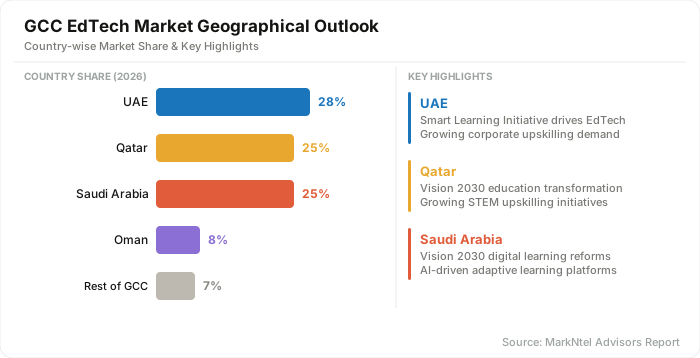
The country's advanced digital infrastructure and innovation focused education policies continue to reinforce demand for scalable EdTech solutions. In 2026, the ministry of education launched the national AI upskilling programme for teachers, making AI training available to educators across public schools to accelerate AI enabled classroom adoption. Furthermore, the newly introduced UAE skills platform serves more than 200,000 students and around 200 educational institutions, using AI driven skills mapping to align education pathways with labor market requirements. These initiatives strengthen adoption of learning management systems, adaptive learning platforms, and digital content, reinforcing the UAE's position as the dominant EdTech industry across the GCC.
GCC EdTech Market Competitive Analysis
The GCC EdTech industry is fragmented, with competition distributed among regional education technology providers, institutional learning platform developers, AI enabled education companies, higher education service providers, and global online learning platforms. Major participants include Alef Education Holding PLC, Noon Tech Ltd, Classera Inc., Coursera, Inc., and Abwaab Technologies Limited. The top five players collectively account for approximately 26% of the GCC EdTech Market.
Key Companies in the GCC EdTech Market
- Alef Education Holding PLC
- Noon Tech Ltd
- Tatweer Educational Technologies Company
- Abwaab Technologies Limited
- Baims for Educational Technology Company W.L.L.
- Lamsa FZ-LLC
- Orcas for Information Technology S.A.E.
- Apex Higher Education Advisory LLC
- Classera Inc.
- Coursera, Inc.
- Udemy, Inc.
- UpGrad Education Private Limited
GCC EdTech Industry News and Recent Developments
May 2026: Classera partnered with Zain KSA to launch one of the world's largest AI-powered education initiatives in Saudi Arabia
Classera signed a strategic partnership with Zain KSA to develop an AI-enabled digital education ecosystem that combines advanced connectivity, smart devices, and intelligent learning solutions for students and families. The initiative is designed to expand AI-driven education services across Saudi Arabia, with plans for future regional expansion into additional GCC and international markets.
Impact Analysis: The collaboration strengthens the convergence of telecommunications and EdTech, enabling wider deployment of AI-enabled learning platforms while accelerating digital education adoption through scalable infrastructure and connectivity.
May 2026: Alef Education and TMRW Edtech signed an MoU to develop an AI-powered education ecosystem across the GCC and MENA
Alef Education entered a strategic memorandum of understanding with TMRW Edtech during the Education World Forum in London to integrate AI-driven learning technologies with school management and enterprise resource planning systems. The collaboration will explore Microsoft Azure, Dynamics 365, and Copilot-based education solutions tailored for governments and educational institutions across the GCC and MENA region.
Impact Analysis: The partnership expands Alef Education's enterprise offerings beyond classroom learning by combining academic delivery with institutional management, supporting the development of integrated digital education ecosystems across the region.
Frequently Asked Questions
- Market Segmentation
- Introduction
- Product Definition
- Research Process
- Assumptions
- Executive Summary
- GCC Education Industry Outlook, 2024
- Country-wise Education Budget
- Number of Schools
- By Sector (Private & Government)
- By Country
- Number of Students
- By Classroom
- By Country
- GCC EdTech Market Startup, Investment, and Ecosystem, 2020-2030
- Entrepreneurial Activity
- Year-on-Year Funding Received
- Funding Received by Top Companies
- Key Investors Active in the Market
- Series-wise Funding Received
- Seed Funding
- Angel Investing
- Venture Capitalists (VC) Funding
- Others
- GCC EdTech Market Policies, Regulations, and Product Standards
- GCC EdTech Market Trends & Developments
- GCC EdTech Market Dynamics
- Growth Factors
- Challenges
- GCC EdTech Market Hotspot & Opportunities
- GCC EdTech Market Outlook, 2022-2032
- Market Size & Outlook
- By Revenues (USD Million)
- Market Segmentation & Outlook
- By Education Type- Market Size & Forecast 2022-2032, USD Million
- Institutional & Curriculum Based
- K-12 (Core Curriculum, STEM/Robotics, Test Prep)
- Higher Education (Bachelors, Masters, Professional Degrees)
- Professional & Corporate Upskilling
- Tech & IT Skills (AI, Coding, Cyber Security)
- Business Management, Finance & HR
- Compliance, Soft Skills & Leadership Training
- Vocational & Technical Training (TVET)
- Consumer, Supplemental & Lifelong Learning
- Language Learning (English, Arabic, Foreign Languages)
- Test Preparation
- Enrichment (Arts, Crafts, Social-Emotional Learning)
- Institutional & Curriculum Based
- By Platform Type- Market Size & Forecast 2022-2032, USD Million
- Asynchronous (Pre-Recorded, Self-Paced Courses, LMS)
- Synchronous (Real-time Virtual Classrooms, Live Tutoring)
- By Language of Delivery- Market Size & Forecast 2022-2032, USD Million
- English
- Arabic
- Bilingual/Others
- By Country
- The UAE
- Saudi Arabia
- Qatar
- Oman
- Bahrain
- Kuwait
- By Company
- Competition Characteristics
- Market Share & Analysis
- By Education Type- Market Size & Forecast 2022-2032, USD Million
- Market Size & Outlook
- The UAE EdTech Market Outlook, 2022-2032
- Market Size & Outlook
- By Revenues (USD Million)
- Market Segmentation & Outlook
- By Education Type- Market Size & Forecast 2022-2032, USD Million
- By Platform Type- Market Size & Forecast 2022-2032, USD Million
- By Language of Delivery- Market Size & Forecast 2022-2032, USD Million
- Market Size & Outlook
- Saudi Arabia EdTech Market Outlook, 2022-2032
- Market Size & Outlook
- By Revenues (USD Million)
- Market Segmentation & Outlook
- By Education Type- Market Size & Forecast 2022-2032, USD Million
- By Platform Type- Market Size & Forecast 2022-2032, USD Million
- By Language of Delivery- Market Size & Forecast 2022-2032, USD Million
- Market Size & Outlook
- Qatar EdTech Market Outlook, 2022-2032
- Market Size & Outlook
- By Revenues (USD Million)
- Market Segmentation & Outlook
- By Education Type- Market Size & Forecast 2022-2032, USD Million
- By Platform Type- Market Size & Forecast 2022-2032, USD Million
- By Language of Delivery- Market Size & Forecast 2022-2032, USD Million
- Market Size & Outlook
- Oman EdTech Market Outlook, 2022-2032
- Market Size & Outlook
- By Revenues (USD Million)
- Market Segmentation & Outlook
- By Education Type- Market Size & Forecast 2022-2032, USD Million
- By Platform Type- Market Size & Forecast 2022-2032, USD Million
- By Language of Delivery- Market Size & Forecast 2022-2032, USD Million
- Market Size & Outlook
- Bahrain EdTech Market Outlook, 2022-2032
- Market Size & Outlook
- By Revenues (USD Million)
- Market Segmentation & Outlook
- By Education Type- Market Size & Forecast 2022-2032, USD Million
- By Platform Type- Market Size & Forecast 2022-2032, USD Million
- By Language of Delivery- Market Size & Forecast 2022-2032, USD Million
- Market Size & Outlook
- Kuwait EdTech Market Outlook, 2022-2032
- Market Size & Outlook
- By Revenues (USD Million)
- Market Segmentation & Outlook
- By Education Type- Market Size & Forecast 2022-2032, USD Million
- By Platform Type- Market Size & Forecast 2022-2032, USD Million
- By Language of Delivery- Market Size & Forecast 2022-2032, USD Million
- Market Size & Outlook
- GCC EdTech Market Key Strategic Imperatives for Success & Growth
- Competitive Outlook
- Company Profiles
- Alef Education Holding PLC
- Business Description
- Product Portfolio
- Collaborations & Alliances
- Recent Developments
- Financial Details
- Others
- Noon Tech Ltd
- Business Description
- Product Portfolio
- Collaborations & Alliances
- Recent Developments
- Financial Details
- Others
- Tatweer Educational Technologies Company
- Business Description
- Product Portfolio
- Collaborations & Alliances
- Recent Developments
- Financial Details
- Others
- Abwaab Technologies Limited
- Business Description
- Product Portfolio
- Collaborations & Alliances
- Recent Developments
- Financial Details
- Others
- Baims for Educational Technology Company W.L.L.
- Business Description
- Product Portfolio
- Collaborations & Alliances
- Recent Developments
- Financial Details
- Others
- Lamsa FZ-LLC
- Business Description
- Product Portfolio
- Collaborations & Alliances
- Recent Developments
- Financial Details
- Others
- Orcas for Information Technology S.A.E.
- Business Description
- Product Portfolio
- Collaborations & Alliances
- Recent Developments
- Financial Details
- Others
- Apex Higher Education Advisory LLC
- Business Description
- Product Portfolio
- Collaborations & Alliances
- Recent Developments
- Financial Details
- Others
- Classera Inc.
- Business Description
- Product Portfolio
- Collaborations & Alliances
- Recent Developments
- Financial Details
- Others
- Coursera, Inc.
- Business Description
- Product Portfolio
- Collaborations & Alliances
- Recent Developments
- Financial Details
- Others
- Udemy, Inc.
- Business Description
- Product Portfolio
- Collaborations & Alliances
- Recent Developments
- Financial Details
- Others
- UpGrad Education Private Limited
- Business Description
- Product Portfolio
- Collaborations & Alliances
- Recent Developments
- Financial Details
- Others
- Alef Education Holding PLC
- Company Profiles
- Disclaimer
MarkNtel Advisors follows a robust and iterative research methodology designed to ensure maximum accuracy and minimize deviation in market estimates and forecasts. Our approach combines both bottom-up and top-down techniques to effectively segment and quantify various aspects of the market. A consistent feature across all our research reports is data triangulation, which examines the market from three distinct perspectives to validate findings. Key components of our research process include:
1. Scope & Research Design At the outset, MarkNtel Advisors define the research objectives and formulate pertinent questions. This phase involves determining the type of research—qualitative or quantitative—and designing a methodology that outlines data collection methods, target demographics, and analytical tools. They also establish timelines and budgets to ensure the research aligns with client goals.
2. Sample Selection and Data Collection In this stage, the firm identifies the target audience and determines the appropriate sample size to ensure representativeness. They employ various sampling methods, such as random or stratified sampling, based on the research objectives. Data collection is carried out using tools like surveys, interviews, and observations, ensuring the gathered data is reliable and relevant.
3. Data Analysis and Validation Once data is collected, MarkNtel Advisors undertake a rigorous analysis process. This includes cleaning the data to remove inconsistencies, employing statistical software for quantitative analysis, and thematic analysis for qualitative data. Validation steps are taken to ensure the accuracy and reliability of the findings, minimizing biases and errors.

4. Data Forecast and FinalizationThe final phase involves forecasting future market trends based on the analyzed data. MarkNtel Advisors utilize predictive modeling and time series analysis to anticipate market behaviors. The insights are then compiled into comprehensive reports, featuring visual aids like charts and graphs, and include strategic recommendations to inform client decision-making
We offer flexible licensing options to cater to varying organizational needs. Choose the pricing pack that best suits your requirements:
Buy Now Inquire Before Buying
 Request Customization
 Talk to our Consultant