

Saudi Arabia Ice Cream Market Research Report: Forecast (2026-2032)
By Type (Impulse Ice Cream, Unpackaged Ice Cream, Take-Home Ice Cream), By Flavor (Chocolate, Mango, Vanilla, Strawberry, Butterscotch, Others), By Format (Cup, Stick, Cone, Brick) ... , By Composition (Dairy Ice Cream, Plant-based Ice Cream), By Positioning (Mass Market Ice Cream, Artisanal Ice Cream), By Trade Type (HoReCa, Individual Consumers), By Sales Channel (Grocery Retailers, Hypermarkets/Supermarkets, Brand-Owned Outlets, Ice Cream Carts, Online, Convenience Stores, Others), and others Read more
- Food & Beverages
- Mar 2026
- Pages 180
- Report Format: PDF, Excel, PPT
Saudi Arabia Ice Cream Market
Projected 7.57% CAGR from 2026 to 2032
Study Period
2026-2032
Market Size (2026)
USD 0.705 Billion
Market Size (2032)
USD 1.17 Billion
Base Year
2025
Projected CAGR
7.57%
Leading Segments
By Flavor: Chocolate
Saudi Arabia Ice Cream Market Report Key Takeaways:
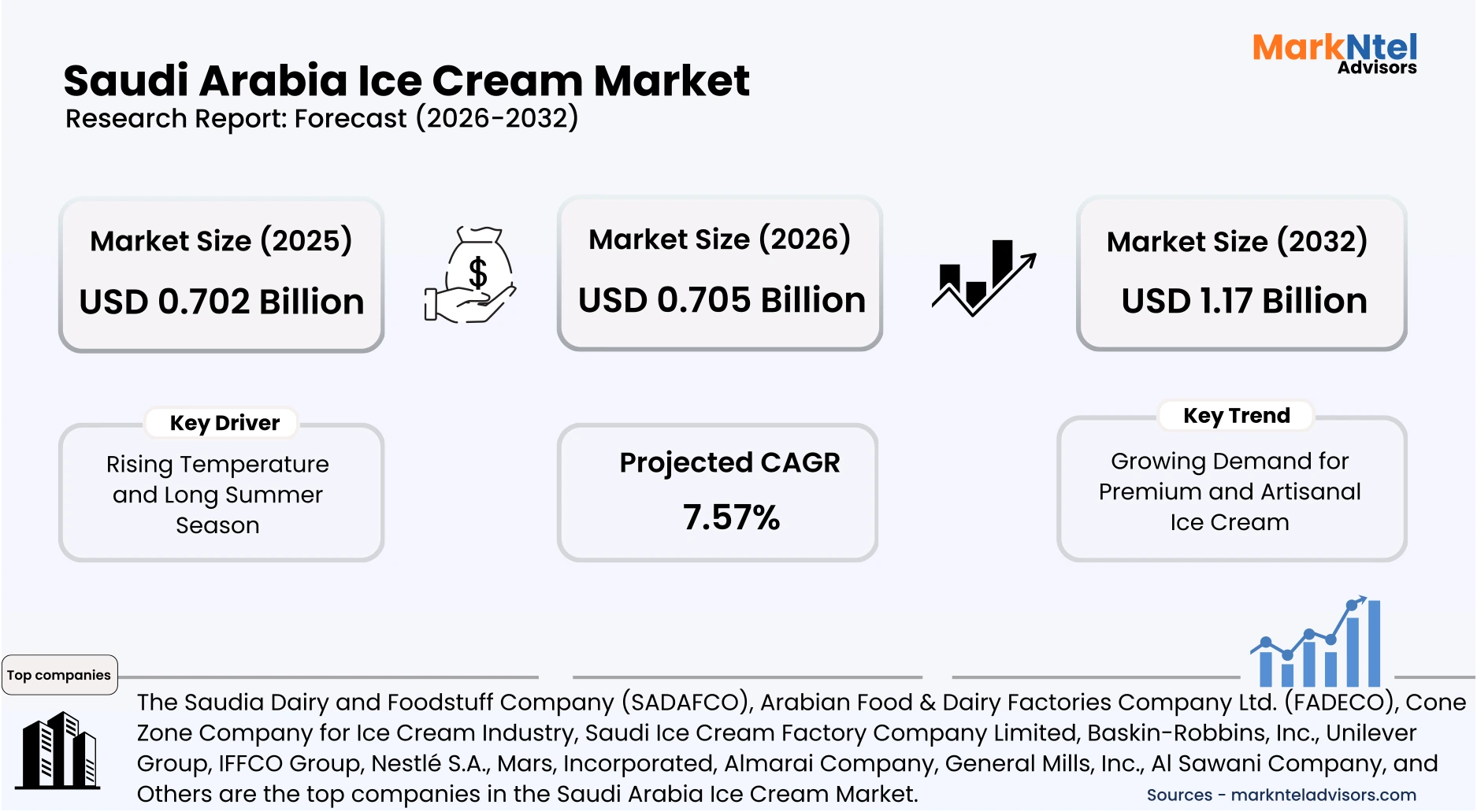
- The Saudi Arabia Ice Cream market size was valued at USD 0.702 billion in 2025 and is projected to grow from USD 0.705 billion in 2026 to USD 1.17 billion by 2032, exhibiting a CAGR of 7.57% during the forecast period.
- By type, the impulse ice cream segment represented a significant share of about 58% in the Saudi Arabia Ice Cream Market in 2026.
- By flavor, the chocolate segment seized a significant share of about 30% in the Saudi Arabia Ice Cream Market in 2026.
- Leading ice cream companies in the Saudi Arabia Market are Saudia Dairy and Foodstuff Company (SADAFCO), Arabian Food & Dairy Factories Company Ltd. (FADECO), Cone Zone Company for Ice Cream Industry, Saudi Ice Cream Factory Company Limited, Baskin-Robbins, Inc., Unilever Group, IFFCO Group, Nestlé S.A., Mars, Incorporated, Almarai Company, General Mills, Inc., Al Sawani Company, and Others.
Market Insights & Analysis: Saudi Arabia Ice Cream Market (2026-32):
The Saudi Arabia Ice Cream Market size was valued at around USD 0.702 billion in 2025 and is projected to grow from USD 0.705 billion in 2026 to USD 1.17 billion by 2032. Along with this, the market is estimated to grow at a CAGR of around 7.57% during the forecast period, i.e., 2026-32.
The Saudi Arabia Ice Cream Market is projected to expand steadily, driven by the country’s rising temperatures and prolonged summer season, along with increasing consumer preference for premium and artisanal ice cream products that offer distinctive flavors, high-quality ingredients, and enhanced dessert experiences.
According to the National Center for Meteorology, the meteorological summer season in the Kingdom begins on June 1, when temperatures start rising rapidly across most regions. In many cases, intense heat conditions appear even earlier. For instance, in May 2025, temperatures in Jeddah reached approximately 47 °C, indicating the early onset of severe summer weather. These climatic conditions contribute to a significant increase in the consumption of cold beverages and frozen desserts during extended hot periods.
Extreme heat events further illustrate the country’s challenging climate. During the Hajj pilgrimage in 2024, temperatures in Mecca exceeded 50 °C, demonstrating the severity of seasonal heat across the region.
Climate observations also recorded an extreme heatwave in 2024, during which some areas of Saudi Arabia experienced temperatures surpassing 54 °C, setting new national temperature records. Such conditions reinforce the consistent need for cooling food products and support strong seasonal demand for ice cream and related frozen desserts.
Beyond climate-driven demand, the market is also benefiting from rising consumer interest in premium and artisanal ice-cream offerings. Rapid urbanization, increasing disposable incomes, and the expansion of café and dessert culture in cities such as Riyadh and Jeddah are encouraging consumers to explore gourmet frozen desserts made with high-quality ingredients and innovative flavors. Premium brands such as Noug have introduced camel-milk gelato products with distinctive regional flavors, reflecting the growing popularity of premium frozen desserts within the country.
Looking ahead, climatic projections suggest that high temperatures will remain a defining factor in consumer demand. Forecasts from the National Center for Meteorology indicate that heatwaves expected in 2026 could push summer temperatures in the Riyadh region to approximately 46–48 °C, further intensifying the need for cooling food products during peak summer months.
The combination of extreme temperatures, prolonged summers, and increasing demand for premium dessert experiences is expected to sustain strong growth in the Saudi Arabia ice-cream market. As climate conditions remain intense and consumer preferences evolve, the market is likely to witness continued expansion in the coming years.
Saudi Arabia Ice Cream Market Recent Developments:
- 2025: Saudi dairy company Saudia Dairy and Foodstuff Company (SADAFCO) announced the expansion of its operations through a new ice-cream factory in Saudi Arabia to strengthen production capacity and support growing regional demand. The company reported USD 75.2 million net profit in 2024, driven by rising sales and improved margins, highlighting strong momentum in the dairy and frozen-dessert sector.
- 2025: Egypt’s dessert brand Dara’s Ice Cream opened its first outlet in Jeddah at La Paz Plaza in 2025, expanding its presence beyond Cairo and Riyadh. The parlor offers fresh, small-batch gelato made with natural ingredients, featuring popular flavors such as Honeycomb and Belgian Chocolate, quickly gaining attention among dessert consumers in the city.
Saudi Arabia Ice Cream Market Scope:
| Category | Segments |
|---|---|
| By Type | (Impulse Ice Cream, Unpackaged Ice Cream, Take-Home Ice Cream), |
| By Flavor | (Chocolate, Mango, Vanilla, Strawberry, Butterscotch, Others), |
| By Format | (Cup, Stick, Cone, Brick), |
| By Composition | (Dairy Ice Cream, Plant-based Ice Cream), |
| By Positioning | (Mass Market Ice Cream, Artisanal Ice Cream), |
| By Trade Type | (HoReCa, Individual Consumers), |
| By Sales Channel | (Grocery Retailers, Hypermarkets/Supermarkets, Brand-Owned Outlets, Ice Cream Carts, Online, Convenience Stores, Others), |
Saudi Arabia Ice Cream Market Driver:
Rising Temperature and Long Summer Season
Extreme climatic conditions in Saudi Arabia represent a key factor stimulating demand for frozen desserts, particularly ice cream. The country experiences prolonged summer periods characterized by very high temperatures, which naturally increase consumer preference for cooling food and beverage products.
According to the National Center for Meteorology, several regions in the Kingdom frequently experience temperatures ranging between 46 °C and 50 °C during peak summer heatwaves. Major metropolitan areas such as Riyadh, Jeddah, and Dammam have recorded summer temperatures of 45–48 °C, reflecting the widespread intensity of heat across densely populated urban centers.
Certain regions face even more extreme temperature levels. In July 2024, the city of Al-Ahsa recorded 51.3 °C, among the highest temperatures documented in the Kingdom . Such extreme and prolonged heatwaves significantly influence food consumption patterns, as residents increasingly rely on chilled beverages and frozen desserts to manage the intense summer climate. Ice cream, gelato, and similar frozen products, therefore, witness higher demand during extended periods of extreme heat, particularly in urban areas with large consumer populations and active retail and foodservice sectors.
Sustained high temperatures and frequent heatwaves strongly stimulate the consumption of frozen desserts in Saudi Arabia. As climate patterns continue to produce extreme summer conditions, the demand for ice cream is expected to remain robust, contributing positively to the long-term expansion of the market.
Saudi Arabia Ice Cream Market Trend:
Growing Demand for Premium and Artisanal Ice Cream
The preference for premium and artisanal ice cream is strengthening in Saudi Arabia, driven by consumers seeking high-quality ingredients, authentic flavors, and upscale dessert experiences. A notable example is the launch of Noug, a camel-milk gelato brand developed by Sawani, which operates under the investment portfolio of the Public Investment Fund.
In 2024, Noug introduced seven camel-milk gelato flavors, including pistachio, saffron-vanilla, hazelnut, and dark chocolate, distributed through premium supermarkets and specialty outlets in major cities such as Riyadh and Jeddah. Each container is priced at approximately USD 4.5, demonstrating the willingness of consumers to pay higher prices for gourmet frozen desserts prepared using locally sourced camel milk and artisanal production techniques, according to regional business news reports.
The artisanal dessert segment is also expanding through hospitality partnerships and café culture. In 2024, premium camel-milk gelato and dairy desserts were integrated into restaurant and café menus across Riyadh as part of initiatives to promote locally produced gourmet food products. This reflects broader efforts to highlight traditional Saudi ingredients such as camel milk, cardamom, and saffron within modern dessert formats.
Increasing consumer interest in gourmet desserts, combined with strategic investments in camel-dairy production and tourism infrastructure, is strengthening the premium ice-cream segment in Saudi Arabia. As artisanal brands and upscale foodservice venues expand, demand for high-value frozen desserts is expected to rise steadily in the coming years.
Saudi Arabia Ice Cream Market Opportunity:
Expansion of International Ice-Cream Chains
The entry of international dessert and ice-cream brands presents a strong opportunity for the Saudi Arabia Ice Cream Market, driven by rapid tourism growth and the expansion of modern retail infrastructure.
According to the Saudi Ministry of Tourism, the Kingdom recorded 116 million tourists in 2024, including 29.7 million international visitors, generating tourism spending of approximately USD 75.7 billion. This surge in visitor inflows has accelerated the growth of cafés, dessert boutiques, and foodservice outlets where international ice-cream chains typically operate.
International dessert brands are expanding across Riyadh and Jeddah, particularly in malls and entertainment hubs. These chains introduce formats such as gelato and soft-serve, expanding flavor variety and benefiting from Saudi Arabia’s young population and growing café and dessert culture.
Future government initiatives will further strengthen this opportunity. Under Saudi Vision 2030, the Kingdom aims to attract 150 million tourists annually by 2030, requiring large investments in hospitality, entertainment, and retail infrastructure. These developments are expected to attract additional international food and dessert franchises seeking to capitalize on the expanding consumer base.
The rapid expansion of tourism and lifestyle destinations is creating a favorable environment for international ice-cream chains. As more global brands enter Saudi Arabia, the market will benefit from greater product innovation, wider distribution, and increased consumer demand for premium frozen desserts.
Saudi Arabia Ice Cream Market Challenge:
High Manufacturing Costs Impeding Wider Consumption
Ice-cream manufacturers in Saudi Arabia are increasingly facing pressure from rising raw-material and production costs, particularly for dairy inputs and imported food ingredients. Ice cream production relies heavily on milk, cream, sugar, stabilizers, and flavoring agents, making dairy supply a critical cost component.
According to the Ministry of Environment, Water, and Agriculture, Saudi Arabia produced approximately 2.7 billion liters of raw milk in 2024, highlighting the significant scale of dairy consumption across the country’s food processing and dessert industries . Large dairy demand from sectors such as confectionery, bakery, and frozen desserts places additional pressure on milk supply and pricing.
Global commodity fluctuations are raising production costs. The Saudi Central Bank inflation report (2025) noted global dairy prices increased by about 15% year-on-year, while vegetable oil prices rose by 21.9% , significantly increasing ingredient expenses for ice-cream manufacturers relying on imported inputs and premium flavoring components.
Rising dairy and commodity prices significantly increase production costs for ice-cream manufacturers. As companies face shrinking profit margins and higher retail prices, sustained cost pressures may reduce affordability for consumers and slow the overall expansion of the Saudi ice-cream market.
Saudi Arabia Ice Cream Market (2026-32) Segmentation Analysis:
The Saudi Arabia Ice Cream Market study of MarkNtel Advisors evaluates & highlights the major trends and influencing factors in each segment. It includes predictions for the period 2026–32 at the country level. Based on the analysis, the market has been further classified as;
Based on Type:
- Impulse Ice Cream
- Single Portion Dairy Ice Cream
- Single Portion Water Ice Cream
- Unpackaged Ice Cream
- Take-Home Ice Cream
- Bulk Dairy Ice Cream
- Ice Cream Desserts
The impulse ice cream segment dominates the Saudi Arabia Ice Cream market, accounting for around 58% of the market size, due to strong consumer demand for convenient and immediately consumable frozen desserts.
Impulse ice creams, including single-portion dairy ice creams and single-portion water-based ice creams, are designed for instant consumption and are typically purchased as spontaneous treats rather than planned household purchases. This characteristic makes them highly popular among urban consumers, younger populations, and tourists seeking quick refreshment during daily activities.
Climatic conditions in the Kingdom significantly contribute to the dominance of this segment. Cities such as Riyadh, Jeddah, and Dammam regularly experience extremely high summer temperatures, encouraging consumers to purchase single-serve frozen desserts while traveling, shopping, or engaging in outdoor activities. As a result, impulse ice creams are widely available through convenience stores, petrol stations, supermarkets, and kiosks located in high-footfall areas, including shopping malls, entertainment venues, and tourist districts.
In addition, the segment benefits from extensive product variety offered by both international and regional ice-cream brands, including cones, sticks, cups, and popsicles. These products are generally offered at accessible price points, which encourages frequent purchases and supports strong retail turnover.
With continued urbanization, growth in organized retail infrastructure, and rising demand for convenient snack options, the impulse ice-cream segment is expected to retain its dominant position within the Saudi Arabian ice-cream industry.
Based on Flavor:
- Chocolate
- Mango
- Vanilla
- Strawberry
- Butterscotch
- Others
The chocolate segment dominates the Saudi Arabia Ice Cream market, accounting for about 30% of the total market value, largely due to its broad consumer acceptance and strong demand across diverse demographic groups.
Chocolate is widely regarded as a classic dessert flavor, offering a rich taste profile that appeals to both younger consumers and adults. This universal preference has enabled chocolate-flavored ice cream to maintain consistent popularity across retail and foodservice channels throughout the Kingdom.
One of the key factors supporting its dominance is the extensive availability of chocolate-based products across multiple ice-cream formats. Manufacturers frequently incorporate chocolate flavor in single-serve cones, cups, sticks, and large take-home tubs, ensuring wide accessibility for consumers.
In major urban centers such as Riyadh, Jeddah, and Dammam, supermarkets, convenience stores, and dessert cafés prominently feature chocolate-based frozen desserts as core menu items. Additionally, chocolate serves as a versatile base for premium offerings, often combined with ingredients such as nuts, caramel, cookies, and brownie pieces to create indulgent variations that attract consumers seeking richer dessert experiences.
Overall, the consistent consumer preference for chocolate flavor, combined with its versatility and strong availability across retail and foodservice channels, continues to support its dominant position in the Saudi Arabia ice-cream market.
Gain a Competitive Edge with Our Saudi Arabia Ice Cream Market Report:
- Saudi Arabia Ice Cream Market Report by MarkNtel Advisors provides a detailed & thorough analysis of market size & share, growth rate, competitive landscape, and key players. This comprehensive analysis helps businesses gain a holistic understanding of the market dynamics & make informed decisions.
- This report also highlights current market trends & future projections, allowing businesses to identify emerging opportunities & potential challenges. By understanding market forecasts, companies can align their strategies & stay ahead of the competition.
- Saudi Arabia Ice Cream Market Report aids in assessing & mitigating risks associated with entering or operating in the market. By understanding market dynamics, regulatory frameworks, and potential challenges, businesses can develop strategies to minimize risks & optimize their operations.
*Reports Delivery Format - Market research studies from MarkNtel Advisors are offered in PDF, Excel and PowerPoint formats. Within 24 hours of the payment being successfully received, the report will be sent to your email address.
Frequently Asked Questions
- Market Segmentation
- Introduction
- Product Definition
- Research Process
- Assumptions
- Executive Summary
- Saudi Arabia Ice Cream Market Policies, Regulations, and Product Standards
- Saudi Arabia Ice Cream Market Trends & Developments
- Saudi Arabia Ice Cream Market Dynamics
- Growth Factors
- Challenges
- Saudi Arabia Ice Cream Market Hotspot & Opportunities
- Saudi Arabia Ice Cream Market Outlook, 2022-2032F
- Market Size & Outlook
- By Revenues (USD Million)
- By Volume (Million Liters)
- Market Share & Outlook
- By Type- Market Size & Forecast 2022-2032, USD Million & Million Liters
- Impulse Ice Cream
- Single Portion Dairy Ice Cream
- Single Portion Water Ice Cream
- Unpackaged Ice Cream
- Take-Home Ice Cream
- Bulk Dairy Ice Cream
- Ice Cream Desserts
- Impulse Ice Cream
- By Flavor- Market Size & Forecast 2022-2032, USD Million & Million Liters
- Chocolate
- Mango
- Vanilla
- Strawberry
- Butterscotch
- Others
- By Format- Market Size & Forecast 2022-2032, USD Million & Million Liters
- Cup
- Stick
- Cone
- Brick
- Others (Sandwich, Tub, etc.)
- By Composition- Market Size & Forecast 2022-2032, USD Million & Million Liters
- Dairy Ice Cream
- Plant-based Ice Cream
- By Positioning- Market Size & Forecast 2022-2032, USD Million & Million Liters
- Mass Market Ice Cream
- Artisanal Ice Cream
- By Trade Type- Market Size & Forecast 2022-2032, USD Million & Million Liters
- HoReCa
- Individual Consumers
- By Sales Channel- Market Size & Forecast 2022-2032, USD Million & Million Liters
- Grocery Retailers
- Hypermarkets/Supermarkets
- Brand-Owned Outlets
- Ice Cream Carts
- Online
- Convenience Stores
- Others
- By Region- Market Size & Forecast 2022-2032, USD Million & Million Liters
- Riyadh
- Jeddah
- Damam
- Mecca & Madinah
- Others
- By Company
- Competition Characteristics
- Market Share & Analysis
- By Type- Market Size & Forecast 2022-2032, USD Million & Million Liters
- Market Size & Outlook
- Saudi Arabia Impulse Ice Cream Market Outlook, 2022-2032
- Market Size & Outlook
- By Revenues (USD Million)
- By Volume (Million Liters)
- Market Share & Outlook
- By Flavor- Market Size & Forecast 2022-2032, USD Million & Million Liters
- By Format- Market Size & Forecast 2022-2032, USD Million & Million Liters
- By Composition- Market Size & Forecast 2022-2032, USD Million & Million Liters
- By Positioning- Market Size & Forecast 2022-2032, USD Million & Million Liters
- By Trade Type- Market Size & Forecast 2022-2032, USD Million & Million Liters
- By Sales Channel- Market Size & Forecast 2022-2032, USD Million & Million Liters
- By Region- Market Size & Forecast 2022-2032, USD Million & Million Liters
- Market Size & Outlook
- Saudi Arabia Unpackaged Ice Cream Market Outlook, 2022-2032
- Market Size & Outlook
- By Revenues (USD Million)
- By Volume (Million Liters)
- Market Share & Outlook
- By Flavor- Market Size & Forecast 2022-2032, USD Million & Million Liters
- By Format- Market Size & Forecast 2022-2032, USD Million & Million Liters
- By Composition- Market Size & Forecast 2022-2032, USD Million & Million Liters
- By Positioning- Market Size & Forecast 2022-2032, USD Million & Million Liters
- By Trade Type- Market Size & Forecast 2022-2032, USD Million & Million Liters
- By Sales Channel- Market Size & Forecast 2022-2032, USD Million & Million Liters
- By Region- Market Size & Forecast 2022-2032, USD Million & Million Liters
- Market Size & Outlook
- Saudi Arabia Take-Home Ice Cream Market Outlook, 2022-2032
- Market Size & Outlook
- By Revenues (USD Million)
- By Volume (Million Liters)
- Market Share & Outlook
- By Flavor- Market Size & Forecast 2022-2032, USD Million & Million Liters
- By Format- Market Size & Forecast 2022-2032, USD Million & Million Liters
- By Composition- Market Size & Forecast 2022-2032, USD Million & Million Liters
- By Positioning- Market Size & Forecast 2022-2032, USD Million & Million Liters
- By Trade Type- Market Size & Forecast 2022-2032, USD Million & Million Liters
- By Sales Channel- Market Size & Forecast 2022-2032, USD Million & Million Liters
- By Region- Market Size & Forecast 2022-2032, USD Million & Million Liters
- Market Size & Outlook
- Saudi Arabia Ice Cream Market Key Strategic Imperatives for Success & Growth
- Competitive Outlook
- Company Profiles
- Saudia Dairy and Foodstuff Company (SADAFCO)
- Business Description
- Product Portfolio
- Collaborations & Alliances
- Recent Developments
- Financial Details
- Others
- Arabian Food & Dairy Factories Company Ltd. (FADECO)
- Business Description
- Product Portfolio
- Collaborations & Alliances
- Recent Developments
- Financial Details
- Others
- Cone Zone Company for Ice Cream Industry
- Business Description
- Product Portfolio
- Collaborations & Alliances
- Recent Developments
- Financial Details
- Others
- Saudi Ice Cream Factory Company Limited
- Business Description
- Product Portfolio
- Collaborations & Alliances
- Recent Developments
- Financial Details
- Others
- Baskin-Robbins, Inc.
- Business Description
- Product Portfolio
- Collaborations & Alliances
- Recent Developments
- Financial Details
- Others
- Unilever Group
- Business Description
- Product Portfolio
- Collaborations & Alliances
- Recent Developments
- Financial Details
- Others
- IFFCO Group
- Business Description
- Product Portfolio
- Collaborations & Alliances
- Recent Developments
- Financial Details
- Others
- Nestlé S.A.
- Business Description
- Product Portfolio
- Collaborations & Alliances
- Recent Developments
- Financial Details
- Others
- Mars, Incorporated
- Business Description
- Product Portfolio
- Collaborations & Alliances
- Recent Developments
- Financial Details
- Others
- Almarai Company
- Business Description
- Product Portfolio
- Collaborations & Alliances
- Recent Developments
- Financial Details
- Others
- General Mills, Inc.
- Business Description
- Product Portfolio
- Collaborations & Alliances
- Recent Developments
- Financial Details
- Others
- Al Sawani Company
- Business Description
- Product Portfolio
- Collaborations & Alliances
- Recent Developments
- Financial Details
- Others
- Saudia Dairy and Foodstuff Company (SADAFCO)
- Company Profiles
- Disclaimer
MarkNtel Advisors follows a robust and iterative research methodology designed to ensure maximum accuracy and minimize deviation in market estimates and forecasts. Our approach combines both bottom-up and top-down techniques to effectively segment and quantify various aspects of the market. A consistent feature across all our research reports is data triangulation, which examines the market from three distinct perspectives to validate findings. Key components of our research process include:
1. Scope & Research Design At the outset, MarkNtel Advisors define the research objectives and formulate pertinent questions. This phase involves determining the type of research—qualitative or quantitative—and designing a methodology that outlines data collection methods, target demographics, and analytical tools. They also establish timelines and budgets to ensure the research aligns with client goals.
2. Sample Selection and Data Collection In this stage, the firm identifies the target audience and determines the appropriate sample size to ensure representativeness. They employ various sampling methods, such as random or stratified sampling, based on the research objectives. Data collection is carried out using tools like surveys, interviews, and observations, ensuring the gathered data is reliable and relevant.
3. Data Analysis and Validation Once data is collected, MarkNtel Advisors undertake a rigorous analysis process. This includes cleaning the data to remove inconsistencies, employing statistical software for quantitative analysis, and thematic analysis for qualitative data. Validation steps are taken to ensure the accuracy and reliability of the findings, minimizing biases and errors.

4. Data Forecast and FinalizationThe final phase involves forecasting future market trends based on the analyzed data. MarkNtel Advisors utilize predictive modeling and time series analysis to anticipate market behaviors. The insights are then compiled into comprehensive reports, featuring visual aids like charts and graphs, and include strategic recommendations to inform client decision-making
We offer flexible licensing options to cater to varying organizational needs. Choose the pricing pack that best suits your requirements:
Buy Now Inquire Before Buying
 Request Customization
 Talk to our Consultant







