

Saudi Arabia Catering Services Market Research Report: Forecast (2026-2032)
By Type (Outsourced, In-House), By End User (Construction, Corporate Offices, Pilgrims & Religious, Education, Healthcare, Oil & Gas, Defence & Law Enforcement, Government, In-Flig ... ht, Mining & EPC, Others), By Model (B2B, Retail/B2C), and others Read more
- Food & Beverages
- Jul 2026
- Pages 140
- Report Format: PDF, Excel, PPT
Saudi Arabia Catering Services Market
Projected 12.06% CAGR from 2026 to 2032
Study Period
2026-2032
Market Size (2026)
USD 3.02 Billion
Market Size (2032)
USD 5.98 Billion
Base Year
2025
Projected CAGR
12.06%
Leading Segments
By Type: Outsourced
Saudi Arabia Catering Services Market Key Takeaways
- The Saudi Arabia catering services market size was valued at USD 2.80 billion in 2025 and is projected to grow from USD 3.02 billion in 2026 to USD 5.98 billion by 2032.
- The market is projected to register a CAGR of 12.06% during 2026–2032.
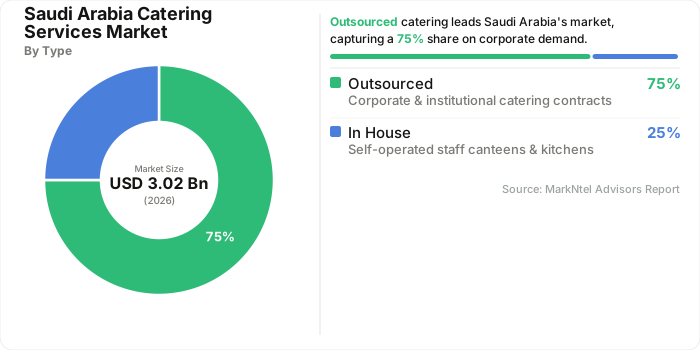
- Outsourced catering holds an estimated 75% share of market in 2026.
- In-flight catering dominates by end user, accounting for approximately 35% of the market in 2026.
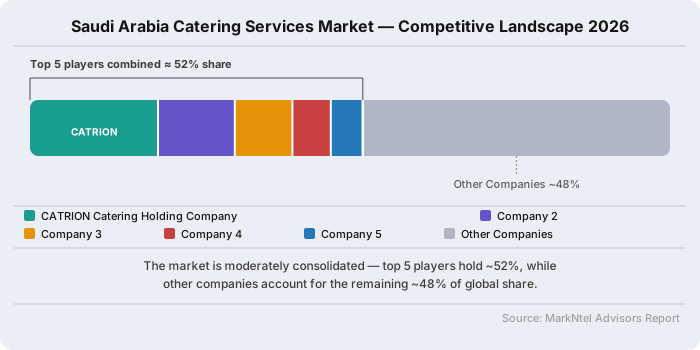
- The industry is moderately consolidated, with the top five players collectively accounting for approximately 52% of the market share in 2026.
Saudi Arabia Catering Services Market Size and Outlook
The Saudi Arabia catering services industry was valued at USD 2.80 billion in 2025 and is currently standing at USD 3.02 billion in 2026. The industry is projected to grow to USD 5.98 billion by 2032 showcasing a CAGR of around 12.06% during the forecast period, i.e., 2026–32.
The market is evolving alongside the Kingdom's expanding institutional and hospitality ecosystem, where demand for professionally managed food services continues to rise across aviation, healthcare, education, industrial operations, and religious tourism. This demand is supported by approximately 140 million airport passengers, more than 500 hospitals, over 6 million students enrolled in educational institutions, and a construction and industrial workforce exceeding 2.4 million people, creating a strong foundation for institutional catering services.
To meet these evolving requirements, catering companies are strengthening their capabilities beyond conventional meal preparation by integrating hospitality and logistics into comprehensive service solutions. Reflecting this transition, Leylaty Hospitality, in 2026, inaugurated an 8,000 square metre purpose-built catering and events facility in Riyadh to expand production capacity for corporate, government, and large-scale events. Similarly, CATRION is preparing to launch a central production facility at the Red Sea Global Project to support catering requirements associated with giga project developments, demonstrating the sector's increasing focus on scale and integrated service delivery.
Government initiatives are further supporting this transformation through stronger regulatory oversight and operational standardization. The Saudi food and drug authority introduced mandatory nutrition transparency regulations in July 2025, while the Vision 2030 pilgrim experience program is targeting capacity for 30 million pilgrims annually by 2030, a 77% increase from the pilgrims recorded in 2019, expanding the scale of catering demand tied to religious tourism. Together, these initiatives are positioning the catering ecosystem to scale in step with the Kingdom's rising pilgrim volumes over the coming decade.
Saudi Arabia Catering Services Market Key Indicators
- Licensed tourism and hospitality facilities across the Kingdom totalled 6,122 in the first quarter of 2026, up 22.7 percent year on year, reflecting the rapid formalization of the hospitality base.
- Total Hajj pilgrim volume reached 1.6 million in 2025, with external pilgrims accounting for 92.4 percent of arrivals, reflecting sustained large scale institutional catering demand tied to religious tourism.
- Total Umrah pilgrim volume reached 11.2 million in the fourth quarter of 2025 alone, split nearly evenly between international and domestic performers, underscoring the scale and year round consistency of religious tourism catering demand across the Kingdom.
- Hotel room occupancy stood at 60.8 percent in the first quarter of 2026, pointing to expanding room supply outpacing near term demand growth.
- Total air passenger traffic reached 140.9 million travellers in 2025, up 9.6 percent year on year, reinforcing aviation linked catering demand.
- The employed population rate stood at 67.4 percent in the fourth quarter of 2025, indicating a broadly stable labour market base available to support staffing needs across catering and food service operations.
- Restaurant and cafe spending through point of sale terminals reached USD 420 million in June, 2026, signalling sustained consumer demand momentum.
Saudi Arabia Catering Services Market Scope
| Category | Segments |
|---|---|
| By Type | Outsourced, In-House |
| By End User | Construction, Corporate Offices, Pilgrims & Religious, Education, Healthcare, Oil & Gas, Defence & Law Enforcement, Government, In-Flight, Mining & EPC, Others |
| By Model | B2B, Retail/B2C |
Saudi Arabia Catering Services Market Growth Drivers
Growing Preference for Integrated Outsourced Contract Catering Services
Organizations across Saudi Arabia are increasingly shifting from standalone food service arrangements to integrated contract catering models that combine meal production, hospitality, manpower deployment, logistics, and facility support under a single service provider. This transition is evident across major institutional sectors, with Catrion securing a five-year USD 613.3 million in-flight catering agreement with Riyadh Air in January 2025, along with a USD 8.8 million catering contract with Saudi Aramco, in June 2025.
This reflects the increasing adoption of comprehensive catering solutions across the aviation sector and industrial operations, where operational efficiency and service standardization remain critical. The growing reliance on integrated catering services is further reinforced by evolving institutional procurement models across the Kingdom. In 2026, the Ministry of Hajj and Umrah introduced an integrated accommodation, transportation, and catering framework for the 1448 AH pilgrimage cycle, encouraging bundled service delivery through licensed operators.
Supporting this transition, catrion secured a USD 6.2 million contract with Saudi Arabian Airlines to provide catering, hospitality, and manpower services for pilgrimage operations, demonstrating the increasing preference for end-to-end outsourced catering solutions. As organizations continue to consolidate multiple support services under specialized providers, demand for integrated contract catering is expected to strengthen across Saudi Arabia's key institutional end user sectors.
Recent Trends
Digitalization and Centralized Production Transforming Institutional Catering Operations
Saudi Arabia's catering providers are increasingly adopting centralized production models and digital foodservice technologies to improve operational efficiency, service consistency, and cost control across large institutional contracts. While cloud kitchen operators continue to expand production capacity, the underlying centralized kitchen model is also influencing institutional catering by enabling high-volume meal preparation, optimized kitchen utilization, and standardized food quality across multiple client locations.
This evolution is evident as UAE-based Kaykroo continues expanding its technology-driven kitchen network across major Saudi cities, operating a portfolio of more than 77 digital-first brands, while local operator IKCON strengthens centralized, delivery-focused kitchen formats. Reflecting this broader shift toward scalable production, Leylaty Hospitality Group launched Avala Catering in 2026, expanding its capacity to serve corporate, government, and large-scale institutional catering requirements.
The transition toward digital catering operations is being reinforced by regulatory and technological developments. From July 2025, the Saudi food and drug authority, mandated nutrition transparency across both physical and digital menus, accelerating the adoption of digital menu management and standardized nutritional reporting across foodservice providers.
As institutional caterers continue investing in centralized production kitchens, digital ordering platforms, inventory management systems, and automated food preparation processes, these technologies are expected to improve operational efficiency, reduce food waste, and strengthen service delivery across aviation, healthcare, education, industrial, and government catering contracts.
Saudi Arabia Catering Services Market Challenges and Opportunities
Import-Reliant Protein Supply Chains Creating a Shift Toward Vertical Integration and Localized Sourcing
The catering services industry in Saudi Arabia remains structurally exposed to imported food inputs, particularly across protein categories that form the backbone of institutional, healthcare, education, and industrial catering menus. Since operators typically secure multi-year contracts with fixed pricing, fluctuations in imported meat, poultry, seafood, and other key ingredients directly compress operating margins. The challenge is becoming more pronounced as large-scale catering contracts expand under Vision 2030, increasing procurement volumes while limiting operators' ability to transfer higher food costs to customers.
This dependence is reinforced by the country's production constraints, with less than 2% of Saudi Arabia's land classified as arable and more than 90% of national water needs met through groundwater extraction and desalination rather than rain-fed agriculture. These structural limits mean protein production cannot scale domestically regardless of capital investment, keeping the sector's supply closely tied to international markets and exposed to global price movements. Import dependence and food price volatility together create persistent cost uncertainty for catering providers operating under long-term institutional and government agreements.
This land and water ceiling means the response can't simply be more domestic farming, and the more resilient operators recognize that. Some are instead securing supply upstream through overseas agribusiness ownership rather than competing for the Kingdom's limited arable land. The Saudi agricultural and livestock investment company's 1.8 billion USD acquisition of an 80% stake in Singapore-based Olam Agri reflects this logic directly; it locks in protein and ingredient supply through ownership abroad, sidestepping the domestic scarcity altogether rather than attempting to farm around it.
Where local production is viable, it works because it doesn't depend on land or water at scale. Dairy products and table eggs already run above full self-sufficiency, at 131% and 103% respectively, achieved largely through controlled-environment and technology-intensive methods rather than expanded farmland. Catering operators that pair overseas-secured supply for land-intensive proteins like red meat with domestic, technology-driven sourcing for categories such as dairy and eggs are best positioned to stabilize costs and strengthen their standing on long-term institutional and government contracts
Segmentation Insights
Outsourced Catering Dominates Through Institutional Reliability and Tourism-Led Demand
Outsourced catering holds an estimated 75% share of Saudi Arabia catering services market. This dominance is reinforced by Saudi Arabia surpassing its original 100 million annual tourist target, prompting the government to raise its 2030 goal to 150 million, directly expanding demand for outsourced aviation and hospitality catering.
Rising pilgrim volumes reinforce this trend, as government entities increasingly rely on third-party caterers for large-scale religious tourism operations, illustrated by Catrion's contract with Saudi Arabian Airlines for pilgrimage catering. Globally, outsourcing continues to dominate contract catering as organizations prefer specialized providers over self-operated models, citing cost efficiency, staffing expertise, and food-safety compliance as the primary reasons for this shift. Based on type, the market is further bifurcated into:
- Outsourced
- Contractual
- Non Contractual
- In-House
In-Flight Catering Leads End-User Demand Amid Record Aviation Growth and Fleet Expansion
In-flight catering dominates the Saudi Arabia catering services market by end user, accounting for approximately 35% of the market in 2026. The segment's leadership is supported by rapid expansion of the Kingdom's aviation sector, rising domestic and international passenger volumes, and increasing demand for premium onboard dining services. The segment continues to benefit from Saudi Arabia's aviation expansion under Vision 2030.
According to the general authority of civil aviation (GACA), passenger traffic reached 140.9 million in 2025, reflecting sustained growth in air travel. Regulatory developments are further supporting demand, with GACA granting Riyadh Air its Air Operator Certificate in 2025, followed by CATRION Catering Holding Company's five-year, USD 613.3 million in-flight catering agreement with the airline. Continued fleet expansion, new airline launches, and rising religious and leisure tourism are expected to sustain demand for in-flight catering services throughout the forecast period. Based on end user, the market is further bifurcated into:
- Construction
- Corporate Offices
- Pilgrims & Religious
- Education
- Healthcare
- Oil & Gas
- Defence & Law Enforcement
- Government
- In-Flight
- Mining & EPC.
- Others
Saudi Arabia Catering Services Market Competitive Analysis
The Saudi Arabia catering services market is moderately consolidated, with competition distributed among domestic catering specialists, integrated facility management providers, contract catering companies, and international foodservice operators. Major participants include CATRION Catering Holding Company, Tamimi Global Company Limited, Nesma Catering Company Limited, Rezayat Catering & Support Services Company Limited, and Sodexo Saudi Arabia Limited. The top five players collectively account for approximately 52% of the Saudi Arabia Catering Services market.
Key Companies in the Saudi Arabia Catering Services Market
- CATRION Catering Holding Company
- Tamimi Global Company Limited
- Nesma Catering Company Limited
- Rezayat Catering & Support Services Company Limited
- Jawdah Investment Company (Gulf Catering Company for Contracting Limited)
- Albert Abela Group (Saudi Catering and Contracting Company)
- Xenel Industries Limited (Al-Karam Al-Arabi for Catering Services Limited)
- Sodexo Saudi Arabia Limited
- Algosaibi Services Company Limited
- Gulf Mahmal Support Services Company Limited
Saudi Arabia’s Catering Services Industry News and Recent Developments
2025: Al Kuzama Trading Secures USD 12 Million Government Catering Contract
In December 2025, Al Kuzama Trading Company secured a USD 12 million contract to provide daily catering and hospitality services to a government entity for a period of 36 months. The agreement covers the provision of food preparation, meal services, and hospitality operations under a long-term outsourcing arrangement, reflecting the continued preference of public sector organizations for specialized contract catering providers. The contract strengthens Al Kuzama Trading's position in Saudi Arabia's institutional catering segment while highlighting the steady pipeline of government-led catering opportunities across the Kingdom.
Impact Analysis: The contract reinforces the growing adoption of outsourced catering services within Saudi Arabia's public sector, supporting stable long-term revenue opportunities for catering providers. Increasing government outsourcing is expected to encourage investment in centralized kitchen infrastructure, operational capabilities, and service quality, while intensifying competition among catering companies for multi-year institutional contracts.
2025: CATRION Signs 15-Year Lease Agreement with Jeddah Airport Company
In November 2025, CATRION Catering Holding Company entered into a 15-year lease agreement with Jeddah Airport Company (JEDCO) to expand and modernize its airport catering infrastructure at King Abdulaziz International Airport. The long-term investment is intended to enhance production capacity, operational efficiency, and service capabilities in response to rising passenger traffic and growing demand for aviation catering services. The development aligns with Saudi Arabia's broader aviation expansion strategy and supports the country's objective of strengthening airport service infrastructure under Vision 2030.
Impact Analysis: The lease agreement highlights continued investment in aviation catering infrastructure as airlines expand capacity and passenger volumes increase. Enhanced production facilities are expected to improve operational scalability and service reliability, enabling catering providers to secure additional airline contracts while supporting the long-term growth of the in-flight catering segment in Saudi Arabia.
Frequently Asked Questions
- Market Segmentation
- Introduction
- Product Definition
- Research Process
- Assumptions
- Executive Summary
- 4. Macroeconomic Outlook
- Saudi Arabia Catering Services Market Policies, Regulations, and Product Standards
- Saudi Arabia Catering Services Market Trends & Developments
- Saudi Arabia Catering Services Market Dynamics
- Growth Factors
- Challenges
- Saudi Arabia Catering Services Market Hotspot & Opportunities
- Saudi Arabia Catering Services Market Winning Strategies, 2024
- Investment Scenario
- Hotspots
- Saudi Arabia Catering Services Market Pricing Analysis
- Price Per Plate
- Annual Price Increase Trend
- Key Factors Impacting Prices
- Saudi Arabia Catering Services Market Outlook, 2022-2032F
- Market Size & Outlook
- By Revenues (USD Million)
- By No. of Meals Served (Million Meals)
- Market Segmentation & Outlook
- By Type- Market Size & Forecast 2022-2032, USD Million
- Outsourced
- Contractual
- Non-Contractual
- In-House
- Outsourced
- By End User- Market Size & Forecast 2022-2032, USD Million
- Construction
- Corporate Offices
- Pilgrims & Religious
- Education
- Healthcare
- Oil & Gas
- Defence & Law Enforcement
- Government
- In-Flight
- Mining & EPC
- Others
- By Model- Market Size & Forecast 2022-2032, USD Million
- B2B
- Retail/B2C
- By Region- Market Size & Forecast 2022-2032, USD Million
- Riyadh
- Jeddah
- Damam
- Rest of Saudi Arabia
- By Company
- Competition Characteristics
- Market Share & Analysis
- By Type- Market Size & Forecast 2022-2032, USD Million
- Market Size & Outlook
- Riyadh Catering Services Market Outlook, 2022-2032
- Market Size & Outlook
- By Revenues (USD Million)
- By No. of Meals Served (Million Meals)
- Market Segmentation & Outlook
- By End User- Market Size & Forecast 2022-2032, USD Million
- By Model- Market Size & Forecast 2022-2032, USD Million
- By Region- Market Size & Forecast 2022-2032, USD Million
- Market Size & Outlook
- Jeddah Catering Services Market Outlook, 2022-2032
- Market Size & Outlook
- By Revenues (USD Million)
- By No. of Meals Served (Million Meals)
- Market Segmentation & Outlook
- By End User- Market Size & Forecast 2022-2032, USD Million
- By Model- Market Size & Forecast 2022-2032, USD Million
- By Region- Market Size & Forecast 2022-2032, USD Million
- Market Size & Outlook
- Damam Catering Services Market Outlook, 2022-2032
- Market Size & Outlook
- By Revenues (USD Million)
- By No. of Meals Served (Million Meals)
- Market Segmentation & Outlook
- By End User- Market Size & Forecast 2022-2032, USD Million
- By Model- Market Size & Forecast 2022-2032, USD Million
- By Region- Market Size & Forecast 2022-2032, USD Million
- Market Size & Outlook
- Saudi Arabia Catering Services Market Key Strategic Imperatives for Success & Growth
- Competitive Outlook
- Company Profiles
- CATRION Catering Holding Company
- Business Description
- Product Portfolio
- Collaborations & Alliances
- Recent Developments
- Financial Details
- Others
- Tamimi Global Company Limited
- Business Description
- Product Portfolio
- Collaborations & Alliances
- Recent Developments
- Financial Details
- Others
- Nesma Catering Company Limited
- Business Description
- Product Portfolio
- Collaborations & Alliances
- Recent Developments
- Financial Details
- Others
- Rezayat Catering & Support Services Company Limited
- Business Description
- Product Portfolio
- Collaborations & Alliances
- Recent Developments
- Financial Details
- Others
- Gulf Catering Company
- Business Description
- Product Portfolio
- Collaborations & Alliances
- Recent Developments
- Financial Details
- Others
- Saudi Catering and Contracting Company
- Business Description
- Product Portfolio
- Collaborations & Alliances
- Recent Developments
- Financial Details
- Others
- Al-Karam Al-Arabi for Catering Services Limited
- Business Description
- Product Portfolio
- Collaborations & Alliances
- Recent Developments
- Financial Details
- Others
- Sodexo Saudi Arabia Limited
- Business Description
- Product Portfolio
- Collaborations & Alliances
- Recent Developments
- Financial Details
- Others
- Algosaibi Services Company Limited
- Business Description
- Product Portfolio
- Collaborations & Alliances
- Recent Developments
- Financial Details
- Others
- Gulf Mahmal Support Services Company Limited
- Business Description
- Product Portfolio
- Collaborations & Alliances
- Recent Developments
- Financial Details
- Others
- CATRION Catering Holding Company
- Company Profiles
- Disclaimer
MarkNtel Advisors follows a robust and iterative research methodology designed to ensure maximum accuracy and minimize deviation in market estimates and forecasts. Our approach combines both bottom-up and top-down techniques to effectively segment and quantify various aspects of the market. A consistent feature across all our research reports is data triangulation, which examines the market from three distinct perspectives to validate findings. Key components of our research process include:
1. Scope & Research Design At the outset, MarkNtel Advisors define the research objectives and formulate pertinent questions. This phase involves determining the type of research—qualitative or quantitative—and designing a methodology that outlines data collection methods, target demographics, and analytical tools. They also establish timelines and budgets to ensure the research aligns with client goals.
2. Sample Selection and Data Collection In this stage, the firm identifies the target audience and determines the appropriate sample size to ensure representativeness. They employ various sampling methods, such as random or stratified sampling, based on the research objectives. Data collection is carried out using tools like surveys, interviews, and observations, ensuring the gathered data is reliable and relevant.
3. Data Analysis and Validation Once data is collected, MarkNtel Advisors undertake a rigorous analysis process. This includes cleaning the data to remove inconsistencies, employing statistical software for quantitative analysis, and thematic analysis for qualitative data. Validation steps are taken to ensure the accuracy and reliability of the findings, minimizing biases and errors.

4. Data Forecast and FinalizationThe final phase involves forecasting future market trends based on the analyzed data. MarkNtel Advisors utilize predictive modeling and time series analysis to anticipate market behaviors. The insights are then compiled into comprehensive reports, featuring visual aids like charts and graphs, and include strategic recommendations to inform client decision-making
We offer flexible licensing options to cater to varying organizational needs. Choose the pricing pack that best suits your requirements:
Buy Now Inquire Before Buying
 Request Customization
 Talk to our Consultant







