

UAE Quick Commerce Market Research Report: Forecast (2026-2032)
By Product Category (Grocery & Staples, Snacks & Beverages, Fresh Produce & Dairy& Units, Personal Care & OTC Pharma, Home & Cleaning Supplies, Electronics & Accessories, Pet Care, ... Flowers & Gifts, Others), By By Delivery Time (Under 10 Minutes, 11–30 Minutes, 31–60 Minutes), By Platform Type (Mobile App-Based Platforms, Web-Based Platforms , Traditional Retail), By End-User (Urban Population, Suburban & Rural, Corporate & Institutional), and others Read more
- FMCG
- Jun 2026
- Pages 140
- Report Format: PDF, Excel, PPT
UAE Quick Commerce Market
Projected 3.72% CAGR from 2026 to 2032
Study Period
2026-2032
Market Size (2026)
USD 154 Million
Market Size (2032)
USD 198.9 Million
Base Year
2025
Projected CAGR
3.72%
Leading Segments
By Distribution Channel: Web Portals & Mobile Apps
UAE Quick Commerce Market Report Key Takeaways
- Market size was valued at around USD 75.2 million in 2025 and is projected to grow from USD 154 million in 2026 to USD 198.9 million by 2032, exhibiting a CAGR of 3.72% during the forecast period.
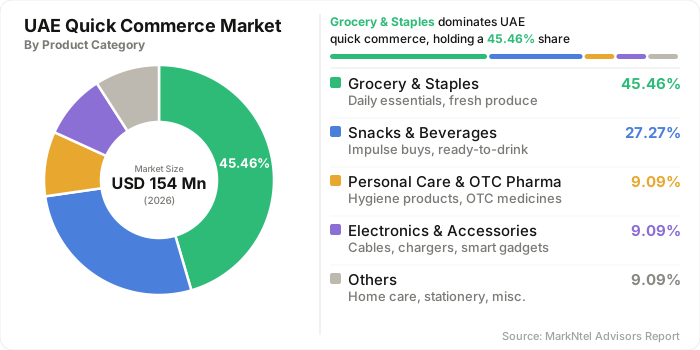
- By product category, Grocery & Essentials dominated the market with approximately 50% share in 2026.
- By delivery time, the 11–30 minutes’ segment held the largest share of approximately 54% in 2026.
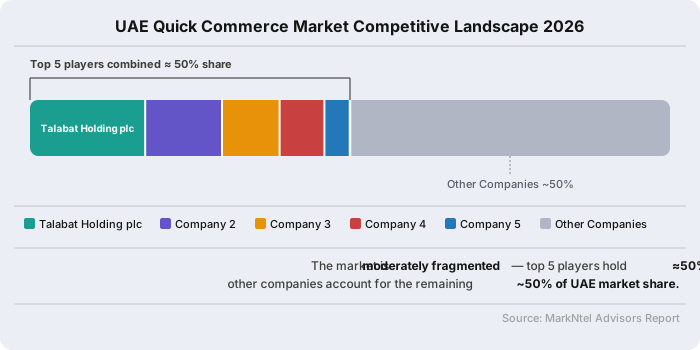
- The industry is moderately fragment, with top 5 company hold the combine share of 50%.
UAE Quick Commerce Market Size & Outlook
The UAE Quick Commerce Market was valued at approximately USD 75.2 million in 2025 and is projected to increase from USD 154 million in 2026 to USD 198.9 million by 2032, registering a CAGR of around 3.72% during the forecast period (2026–2032).
The market's growth is supported by the UAE's rapidly expanding digital economy and strong e-commerce ecosystem. The broader UAE online retail sector reached approximately USD 8.8 billion in 2024, creating a favorable environment for app-based and on-demand retail services. High internet penetration, widespread smartphone usage, and increasing consumer familiarity with digital platforms have accelerated the adoption of quick commerce services across the country.
A key demand driver is the evolving shopping behavior of urban consumers, who increasingly prefer ordering daily essentials through mobile applications and receiving them within minutes. Rather than making infrequent bulk purchases, consumers are shifting toward frequent, smaller orders, boosting demand for ultra-fast delivery services across grocery, convenience, and household product categories.
The market is also benefiting from ongoing urban development initiatives. Long-term infrastructure and urban planning programs, including Dubai 2040, are promoting the development of compact mixed-use communities and residential hubs. These developments reduce last-mile delivery distances, improve delivery density, and enhance operational efficiency for quick commerce providers.
Industry consolidation and strategic investments are further strengthening the market landscape. In 2025, Talabat acquired InstaShop for approximately USD 32 million. Following the acquisition, InstaShop became a wholly owned subsidiary under Talabat's Grocery & Retail vertical. The transaction is expected to enhance technological capabilities, expand the partner ecosystem across the UAE and the wider MENA region, improve delivery efficiency, and generate operational synergies within the quick commerce grocery segment.
Looking ahead, the UAE quick commerce market is expected to maintain steady growth, supported by rising digital payment adoption, expanding logistics infrastructure, increasing app-based consumption among the country's large expatriate population, and continued investor interest in the sector. These factors, combined with ongoing platform consolidation and operational optimization, are expected to strengthen the market's long-term growth trajectory through 2032.
UAE Quick Commerce Market Key Indicators
- Mobile internet penetration in the UAE is projected to reach around 95% of the population, making it one of the most digitally connected countries globally. High smartphone and mobile internet usage facilitate app-based ordering, real-time tracking, and digital payments, which are critical enablers for quick commerce operations and customer adoption.
- Approximately 81% of grocery retailers in the UAE are small neighborhood stores (baqalas), and around 60% of residents visit such stores weekly. This widespread local retail infrastructure provides quick commerce operators with opportunities for hyperlocal fulfillment partnerships, inventory sourcing, and last-mile delivery optimization.
- Major grocery retailers continue expanding their footprint across the UAE. For example, Lulu operates more than 240 stores across the Gulf region, while Spinneys operates 75 stores across the UAE and Oman. The growth of organized grocery retail increases product availability, strengthens supply chains, and enables partnerships that support rapid fulfillment models used by quick commerce platforms.
- The UAE became the world's first “10 Giga” nation with the commercial deployment of ultra-high-speed internet infrastructure. Advanced digital connectivity enhances platform reliability, order management systems, route optimization, and customer experience, thereby strengthening the operational capabilities of quick commerce providers.
UAE Quick Commerce Market Scope
| Category | Segments |
|---|---|
| By Product Category | Grocery & Staples, Snacks & Beverages, Fresh Produce & Dairy& Units, Personal Care & OTC Pharma, Home & Cleaning Supplies, Electronics & Accessories, Pet Care, Flowers & Gifts, Others |
| By By Delivery Time | Under 10 Minutes, 11–30 Minutes, 31–60 Minutes |
| By Platform Type | Mobile App-Based Platforms, Web-Based Platforms , Traditional Retail |
| By End-User | Urban Population, Suburban & Rural, Corporate & Institutional |
UAE Quick Commerce Market Growth Drivers
Growing Demand for Instant Delivery & Convenience
The Quick Commerce Market in the UAE is strongly driven by increasing consumer preference for instant delivery of groceries, meals, and daily essentials, supported by high smartphone penetration and widespread digital payment adoption. Urban residents in Dubai, Abu Dhabi, and Sharjah rely heavily on app-based shopping for convenience and time-saving. According to TheGlobalEconomy, the urban population of the UAE reached 88.01% in 2024, creating dense clusters ideal for rapid fulfilment networks. This concentration allows operators to optimize delivery routes, expand micro-fulfilment centres, and meet rising demand efficiently.
Digital adoption further amplifies this growth, enabling seamless app-based transactions and real-time order tracking. The Telecommunications and Digital Government Regulatory Authority (TDRA) reports that over 97% of UAE residents use smartphones, supporting AI-driven delivery optimization and contactless payments. Consumers now expect fast order confirmation and short delivery windows, compelling platforms to enhance logistics capabilities and improve operational reliability. These factors encourage frequent use of quick commerce apps, further accelerating market adoption.
For example, Deliveroo UAE’s expansion of its Deliveroo HOP grocery service into Abu Dhabi in January 2025, in partnership with Choithrams, provides deliveries in as little as 15 minutes. This initiative extends service coverage, strengthens operational efficiency, and boosts consumer confidence in instant-delivery platforms. Together with high urbanization, digital adoption, and growing consumer demand, such strategic expansions are fuelling higher adoption, repeat usage, and long-term sustainable growth in the demand for quick commerce market.
Recent Trends
Integration of AI and Data Analytics in Operations
Integration of AI and data analytics is rapidly transforming the UAE quick commerce market by making operations more efficient and customer-centric. A notable example is Talabat, which has introduced AI-driven tools such as Talabat AI, a ChatGPT-powered grocery shopping assistant. This feature helps users discover recipe ingredients, check nutritional information, and explore available products in nearby Talabat Mart stores. By offering personalized recommendations, it simplifies decision-making, improves user engagement, and encourages higher basket values.
On the operational side, AI and data analytics are playing a crucial role in optimizing logistics and delivery systems. Companies are using real-time route optimization, automated order bundling, and AI-assisted scheduling to enhance last-mile delivery efficiency. Predictive demand forecasting models, combined with live traffic data and customer location insights, allow platforms to anticipate order surges and allocate resources more effectively.
As a result, delivery times are reduced, operational costs are minimized, and service reliability improves. Overall, the integration of AI is enabling UAE quick commerce players to scale faster while maintaining speed, accuracy, and customer satisfaction.
UAE Quick Commerce Market Challenges & Opportunities
High Operational Costs is enabling Innovation Opportunities
A key challenge in the UAE quick commerce market is the high operational cost structure, particularly driven by last-mile delivery. The requirement for ultra-fast deliveries forces companies to maintain dense networks of dark stores, delivery personnel, and advanced logistics systems, significantly increasing capital and operating expenses. Last-mile logistics alone can account for up to 53% of total shipping costs.
Additionally, rapid fulfilment expectations put pressure on inventory management and infrastructure efficiency. For example, micro-warehousing initiatives in Dubai aim to support faster deliveries, but they further add to fixed costs. Even players like Talabat face margin pressure in operations such as tMart due to maintaining multiple fulfilment centres and high-speed delivery commitments.
Despite these challenges, strong opportunities are emerging in infrastructure optimisation and urban fulfilment redesign. The high cost burden is accelerating investment in micro-warehousing and compact dark store networks located closer to high-demand consumer clusters, reducing delivery distance and improving efficiency. This shift is also enabling faster order processing and better inventory utilisation.
At the same time, it is driving rapid adoption of AI-powered logistics solutions, including predictive demand forecasting, route optimisation, and intelligent hub placement. For companies like Talabat, this creates opportunities to build more efficient, data-driven delivery ecosystems. It is also opening space for logistics tech providers and shared delivery infrastructure models, supporting scalable and more sustainable growth in the UAE quick commerce market.
Segmentation Analysis
Grocery & Essentials Segment Dominates the Market Growth
The UAE Quick Commerce Market is strongly driven by the grocery and essentials category due to rising demand for instant access to daily-use products. Urban consumers across Dubai, Abu Dhabi, and Sharjah increasingly rely on app-based platforms for routine household replenishment, driven by fast-paced lifestyles, high smartphone penetration, and seamless digital payment infrastructure. Frequent, small-basket purchasing behaviour has become the norm, reinforcing the category's structural dominance within the quick commerce ecosystem.
Accounting for approximately 50% market share in 2026, the grocery and essentials segment leads the UAE quick commerce landscape by a considerable margin. Platforms such as Talabat, Careem NOW, and Amazon UAE continue to invest heavily in dark stores and micro-fulfilment centres to sustain 10–20-minute delivery commitments. AI-enabled demand forecasting, hyperlocal inventory optimisation, and expanding partner networks are further strengthening availability and operational efficiency. Rising disposable incomes and convenience-driven consumption patterns ensure this segment remains the primary growth engine across the UAE quick commerce market. The market is bifurcated into the following sub-segments:
- Grocery & Staples
- Snacks & Beverages
- Fresh Produce & Dairy& Units
- Personal Care & OTC Pharma
- Home & Cleaning Supplies
- Electronics & Accessories
- Pet Care
- Flowers & Gifts
- Others
Mobile App-Based Platforms Segment Drives the UAE Quick Commerce Market
The UAE Quick Commerce Market is led by the 11–30 minutes’ delivery time window, reflecting the operational balance platforms have achieved between speed and logistical feasibility across dense urban centres. Consumers across Dubai, Abu Dhabi, and Sharjah have demonstrated strong acceptance of this window, as it aligns with real-world fulfilment capabilities while still meeting expectations for rapid gratification. The growing density of dark stores and micro-fulfilment centres across key residential clusters has made this delivery band both commercially viable and scalable.
With approximately 54% market share in 2026, the 11–30 minutes’ segment dominates the UAE quick commerce landscape. Platforms such as Talabat, Careem NOW, and Amazon Now have structured their fulfilment networks around this window, enabling consistent delivery performance without the prohibitive infrastructure costs associated with sub-10-minute commitments. Rising consumer confidence in this delivery tier, supported by real-time tracking and seamless app-based interfaces, continues to reinforce its dominance. The market is bifurcated into the following sub-segments:
- Under 10 Minutes
- 11–30 Minutes
- 31–60 Minutes
UAE Quick Commerce Market Competitive Analysis
The UAE Quick Commerce Market remains moderately fragmented, with Talabat, Careem NOW, Deliveroo UAE, Amazon UAE, and Carrefour UAE representing some of the most influential players in the market due to their strong digital ecosystems, extensive delivery networks, and rapid expansion in grocery and essentials quick commerce services. The top five companies collectively accounted for approximately 50% of the Global UAE Quick Commerce Market in 2026.
Key Quick Commerce Companies in the UAE
- Talabat
- Careem NOW
- Deliveroo UAE
- Amazon UAE
- Carrefour UAE
- Lulu Hypermarket
- Spinneys
- Baraka Market
- The Grocery Store
UAE Quick Commerce Market News and Recent Developments
2025: Amazon UAE Opened Its First Fulfilment Centre in Abu Dhabi
In 2025, Amazon UAE inaugurated its first fulfilment centre in Abu Dhabi, designed to handle up to 8 million units spanning more than 30 product categories, including groceries, electronics, and beauty products. The facility was developed to strengthen Amazon's last-mile delivery infrastructure across the emirate, enabling same-day delivery capabilities and significantly faster order processing for consumers across the UAE.
Impact Analysis: The opening of Amazon UAE's Abu Dhabi fulfilment centre marks a significant infrastructural commitment to the region's quick commerce landscape. By consolidating high-volume inventory closer to end consumers, the facility is expected to reduce delivery lead times, improve order accuracy, and support the scalability of Amazon Now's ultra-fast delivery operations. The development also signals growing platform confidence in sustained demand growth across the UAE, with broader implications for competitive intensity and infrastructure benchmarking among quick commerce operators in the market.
2025: Careem Announced the Launch of Careem Quik Across the UAE
In 2025, Careem announced the upcoming launch of Careem Quik in Sharjah, a dedicated 15-minute quick-commerce delivery service covering groceries and electronics. The initiative formed part of a broader service expansion in Sharjah that also introduced Careem Food, Careem Box courier services, and home services including laundry, cleaning, and beauty, reinforcing the platform's effort to build a comprehensive last-mile delivery ecosystem in the UAE.
Impact Analysis: The introduction of Careem Quik reflects the intensifying competition among platform operators to capture urban consumer demand for ultra-fast delivery. By extending sub-15-minute fulfilment capabilities to Sharjah, Careem is broadening the geographic reach of quick commerce beyond Dubai and Abu Dhabi. The move is expected to accelerate adoption among Sharjah's dense residential population, strengthen Careem's positioning in the grocery and essentials segment, and increase competitive pressure on incumbent quick commerce players operating in the northern emirates.
Frequently Asked Questions
- Market Segmentation
- Introduction
- Product Definition
- Research Process
- Assumptions
- Executive Summary
- UAE Quick Commerce Market Regulations, Policies & Product Standards
- UAE Quick Commerce Market Trends & Developments
- UAE Quick Commerce Market Industry Dynamics
- Growth Drivers
- Challenges
- UAE Quick Commerce Market Hotspots & Opportunities
- UAE Quick Commerce Market Value Chain Analysis
- UAE Quick Commerce Market Outlook, 2022-2032F
- Market Size & Analysis
- By Revenues (USD Million)
- Market Share & Analysis
- By Product Category- Market Size & Forecast 2022-2032, USD Million
- Grocery & Staples
- Snacks & Beverages
- Fresh Produce & Dairy& Units
- Personal Care & OTC Pharma
- Home & Cleaning Supplies
- Electronics & Accessories
- Pet Care
- Flowers & Gifts
- Others
- By Delivery Time- Market Size & Forecast 2022-2032, USD Million
- Under 10 Minutes
- 11–30 Minutes
- 31–60 Minutes
- By Platform Type- Market Size & Forecast 2022-2032, USD Million
- Mobile App-Based Platforms
- Web-Based Platforms
- By End-User- Market Size & Forecast 2022-2032, USD Million
- Urban Population
- Suburban & Rural
- Corporate & Institutional
- By Region
- Dubai
- Abu Dhabi
- Sharjah & Northern Emirates
- By Competitors
- Competition Characteristics
- Market Share & Analysis
- By Product Category- Market Size & Forecast 2022-2032, USD Million
- Market Size & Analysis
- Dubai Quick Commerce Market Outlook, 2022-2032F
- Market Size & Analysis
- By Revenues USD Million
- Market Share & Analysis
- By Product Category- Market Size & Forecast 2022-2032, USD Million
- By Delivery Time- Market Size & Forecast 2022-2032, USD Million
- By Platform Type- Market Size & Forecast 2022-2032, USD Million
- Market Size & Analysis
- Abu Dhabi Quick Commerce Market Outlook, 2022-2032F
- Market Size & Analysis
- By Revenues USD Million
- Market Share & Analysis
- By Product Category- Market Size & Forecast 2022-2032, USD Million
- By Delivery Time- Market Size & Forecast 2022-2032, USD Million
- By Platform Type- Market Size & Forecast 2022-2032, USD Million
- Market Size & Analysis
- Sharjah & Northern Emirates Quick Commerce Market Outlook, 2022-2032F
- Market Size & Analysis
- By Revenues USD Million
- Market Share & Analysis
- By Product Category- Market Size & Forecast 2022-2032, USD Million
- By Delivery Time- Market Size & Forecast 2022-2032, USD Million
- By Platform Type- Market Size & Forecast 2022-2032, USD Million
- Market Size & Analysis
- UAE Quick Commerce Market Key Strategic Imperatives for Growth & Success
- Competitive Outlook
- Company Profiles
- Careem NOW
- Business Description
- Product Portfolio
- Strategic Alliances or Partnerships
- Recent Developments
- Financial Details
- Others
- Deliveroo UAE
- Business Description
- Product Portfolio
- Strategic Alliances or Partnerships
- Recent Developments
- Financial Details
- Others
- Talabat
- Business Description
- Product Portfolio
- Strategic Alliances or Partnerships
- Recent Developments
- Financial Details
- Others
- Zomato UAE
- Business Description
- Product Portfolio
- Strategic Alliances or Partnerships
- Recent Developments
- Financial Details
- Others
- Amazon UAE
- Business Description
- Product Portfolio
- Strategic Alliances or Partnerships
- Recent Developments
- Financial Details
- Others
- Carrefour UAE
- Business Description
- Product Portfolio
- Strategic Alliances or Partnerships
- Recent Developments
- Financial Details
- Others
- Lulu Hypermarket
- Business Description
- Product Portfolio
- Strategic Alliances or Partnerships
- Recent Developments
- Financial Details
- Others
- Spinneys
- Business Description
- Product Portfolio
- Strategic Alliances or Partnerships
- Recent Developments
- Financial Details
- Others
- Baraka Market
- Business Description
- Product Portfolio
- Strategic Alliances or Partnerships
- Recent Developments
- Financial Details
- Others
- The Grocery Store
- Business Description
- Product Portfolio
- Strategic Alliances or Partnerships
- Recent Developments
- Financial Details
- Others
- Others
- Careem NOW
- Company Profiles
- Disclaimer
MarkNtel Advisors follows a robust and iterative research methodology designed to ensure maximum accuracy and minimize deviation in market estimates and forecasts. Our approach combines both bottom-up and top-down techniques to effectively segment and quantify various aspects of the market. A consistent feature across all our research reports is data triangulation, which examines the market from three distinct perspectives to validate findings. Key components of our research process include:
1. Scope & Research Design At the outset, MarkNtel Advisors define the research objectives and formulate pertinent questions. This phase involves determining the type of research—qualitative or quantitative—and designing a methodology that outlines data collection methods, target demographics, and analytical tools. They also establish timelines and budgets to ensure the research aligns with client goals.
2. Sample Selection and Data Collection In this stage, the firm identifies the target audience and determines the appropriate sample size to ensure representativeness. They employ various sampling methods, such as random or stratified sampling, based on the research objectives. Data collection is carried out using tools like surveys, interviews, and observations, ensuring the gathered data is reliable and relevant.
3. Data Analysis and Validation Once data is collected, MarkNtel Advisors undertake a rigorous analysis process. This includes cleaning the data to remove inconsistencies, employing statistical software for quantitative analysis, and thematic analysis for qualitative data. Validation steps are taken to ensure the accuracy and reliability of the findings, minimizing biases and errors.

4. Data Forecast and FinalizationThe final phase involves forecasting future market trends based on the analyzed data. MarkNtel Advisors utilize predictive modeling and time series analysis to anticipate market behaviors. The insights are then compiled into comprehensive reports, featuring visual aids like charts and graphs, and include strategic recommendations to inform client decision-making
We offer flexible licensing options to cater to varying organizational needs. Choose the pricing pack that best suits your requirements:
Buy Now Inquire Before Buying
 Request Customization
 Talk to our Consultant







