

Saudi Arabia Production Chemicals Market Research Report: Forecast (2026-2032)
Saudi Arabia Production Chemicals Market - By Production Challenge (Water Cut Management Chemicals, Corrosion Control Chemicals, Scale Control Chemicals, Flow Assurance Chemicals, ... Sour Field Treatment Chemicals, Microbial Control Chemicals), By Product Type (Demulsifiers, Scale Inhibitors, Corrosion Inhibitors, Asphaltene Inhibitors, Biocides, Scavengers, Surfactants, Others), By Oilfield Type (Mature and Aging Oilfields, New and Brownfield Developments, Gas and Condensate Fields), By Treatment Method (Continuous Injection Programs, Batch Treatment Programs, Squeeze Treatment Programs), and others Read more
- Chemicals
- Jan 2026
- Pages 135
- Report Format: PDF, Excel, PPT
Saudi Arabia Production Chemicals Market
Projected 6.55% CAGR from 2026 to 2032
Study Period
2026-2032
Market Size (2025)
USD 1.52 Billion
Market Size (2032)
USD 2.37 Billion
Base Year
2025
Projected CAGR
6.55%
Leading Segments
By Oilfield Type: New & Brownfield Developments
Saudi Arabia Production Chemicals Market Report Key Takeaways:
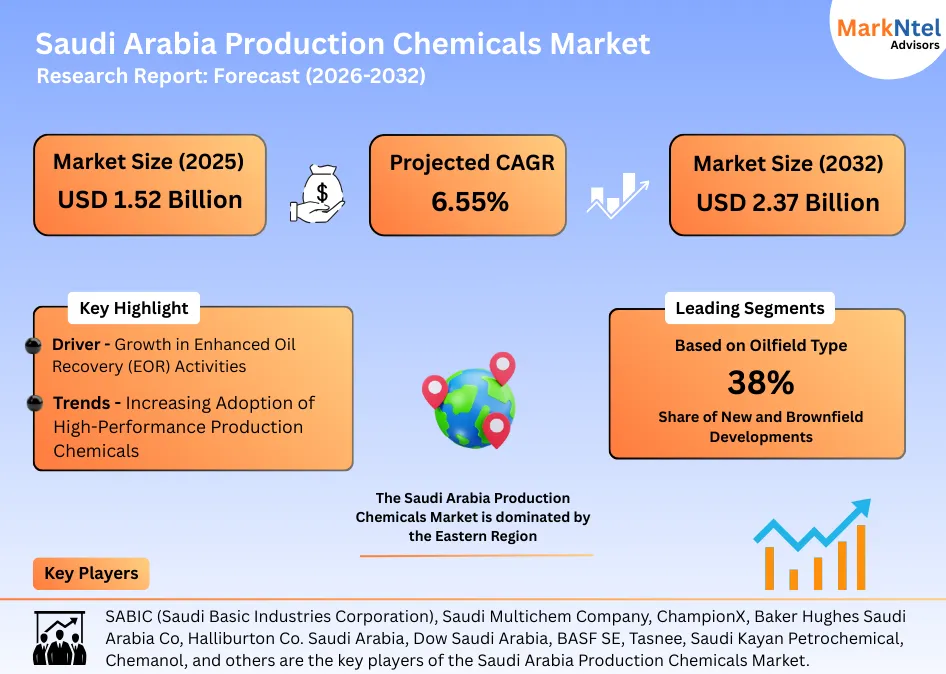
- The Saudi Arabia Production Chemicals Market size was valued at around USD 1.52 billion in 2025 and is projected to reach USD 2.37 billion by 2032. The estimated CAGR from 2026 to 2032 is around 6.55%, indicating strong growth.
- By Oilfield Type, the New and Brownfield Developments represented 38% of the Saudi Arabia Production Chemicals Market size in 2025.
- By Region, the Eastern region leads the Saudi Arabia Production Chemicals Market with a dominant 53% share in 2025.
- The leading production chemicals companies are SABIC (Saudi Basic Industries Corporation), Saudi Multichem Company, ChampionX, Baker Hughes Saudi Arabia Co, Halliburton Co. Saudi Arabia, Dow Saudi Arabia, BASF SE, Tasnee, Saudi Kayan Petrochemical, Chemanol, and others.
Market Insights & Analysis: Saudi Arabia Production Chemicals Market (2026-2032):
The Saudi Arabia Production Chemicals Market size was valued at around USD 1.52 billion in 2025 and is projected to reach USD 2.37 billion by 2032. Along with this, the market is estimated to grow at a CAGR of around 6.55% during the forecast period, i.e., 2026-32. The Saudi Arabia Production Chemicals Market is set for sustained growth, underpinned by strategic upstream and downstream investments that expand chemical demand across the oil and petrochemical value chain. A major catalyst is the development of the USD 11 billion Amiral petrochemical complex, a mixed‑feed steam cracker in Jubail capable of producing 1.65 million tonnes of ethylene annually, plus polyethylene and derivatives, with commercial operations targeted for 2027. This project enhances the Kingdom’s liquids‑to‑chemicals strategy, linking refinery output with high‑value chemical production .
Coupled with this, carbon management initiatives such as the Saudi CCS hub in Jubail are expanding; phase one aims to capture and store up to 9 million tonnes of CO₂ per year by 2027, enabling CO₂ injection for Enhanced Oil Recovery (EOR) and supporting chemical utilization in reservoir boosting operations . These activities drive demand for advanced production chemicals that improve fluid properties, corrosion control, and flow assurance during EOR campaigns.
Further downstream integration is highlighted by the Samref refinery upgrade venture, where ExxonMobil, Aramco, and Samref are evaluating expansion into an integrated petrochemical complex focused on high‑performance chemicals and lower emissions.
Moreover, other major refinery‑plus‑petrochemical transformations, including SASREF and Yasref expansions with mixed‑feed crackers and aromatics units, emphasize Saudi Arabia’s shift toward higher chemical output and value‑added derivatives.
Saudi Arabia Production Chemicals Market Recent Developments:
- December 2025: Saudi Arabia’s water chemicals sector attracted about USD 266.4 million in foreign investment. Plans include local manufacturing of chemical washing and anti‑scalant materials through three new factories, with export potential, marking diversification in specialty chemicals.
Saudi Arabia Production Chemicals Market Scope:
| Category | Segments |
|---|---|
| Production Challenge | Water Cut Management Chemicals, Corrosion Control Chemicals, Scale Control Chemicals, Flow Assurance Chemicals, Sour Field Treatment Chemicals, Microbial Control Chemicals |
| Product Type | Demulsifiers, Scale Inhibitors, Corrosion Inhibitors, Asphaltene Inhibitors, Biocides, Scavengers, Surfactants, Others |
| Oilfield Type | Mature and Aging Oilfields, New and Brownfield Developments, Gas and Condensate Fields |
| Treatment Method | Continuous Injection Programs, Batch Treatment Programs, Squeeze Treatment Programs |
Saudi Arabia Production Chemicals Market Drivers:
Growth in Enhanced Oil Recovery (EOR) Activities
One of the key drivers of the Saudi Arabia Production Chemicals Market is the expanding implementation of Enhanced Oil Recovery (EOR) methods, particularly those using CO₂ injection to boost oil production from mature reservoirs. The Kingdom’s state oil company, Saudi Aramco, captures CO₂ at its Hawiyah natural gas liquids plant and transports it 85 km to the Uthmaniyah field for injection into the reservoir. This process both sequesters about 0.8 million tons of CO₂ per year and supports reservoir pressure maintenance, helping extract more oil beyond conventional water flooding .
To support broader CO₂‑EOR initiatives, Saudi Arabia, in partnership with the Ministry of Energy, is developing a Carbon Capture and Storage (CCS) hub in Jubail, projected to capture and store up to 9 million metric tons of CO₂ annually from 2028 and identified for expansion to 44 million t/year by 2035. This captured CO₂ will enable injection in additional fields, maximizing recovery while aligning with national net‑zero ambitions.
These CO₂‑EOR techniques drive demand for production chemicals such as chemical injectants, surfactants, and reservoir modifiers, which are essential to enhance sweep efficiency and oil mobilization during CO₂ flooding.
Overall, as Saudi Arabia scales CO₂‑based EOR through CCS infrastructure and extended field programs beyond 2025, the sustained use of advanced production chemicals will grow, strengthening the overall market trajectory.
Saudi Arabia Production Chemicals Market Trends:
Increasing Adoption of High-Performance Production Chemicals
One notable trend in the Saudi Arabia Production Chemicals Market is the increasing adoption of high-performance production chemical solutions, driven by national oil companies’ strategies to improve efficiency and extract greater value from hydrocarbons. Saudi Aramco and its partners are pushing innovation through advanced chemical and processing technologies that enhance performance across the hydrocarbon value chain. For example, Aramco has signed a joint development agreement with Honeywell and King Abdullah University of Science and Technology to co-develop next-generation crude-to-chemicals (CTC) technologies aimed at enhancing fuel efficiency, improving carbon utilization, and making chemical production more cost-effective and efficient at scale . These efforts align with broader Vision 2030 goals of diversifying industrial output and boosting the Kingdom’s petrochemical and chemical capabilities.
In addition, Aramco and SABIC continue to advance crude-to-chemicals initiatives focused on direct conversion processes that improve yield and reduce energy intensity. This pivot toward high-performance chemical production routes supports increased output of light olefins and other specialized chemical products with higher value and efficiency compared with conventional pathways.
Overall, as Saudi Arabia intensifies investments in advanced chemical technologies and digitalized, high-efficiency processes, the adoption of high-performance production chemicals will accelerate, supporting operational efficiency improvements and market growth through 2030 and beyond.
Saudi Arabia Production Chemicals Market Challenges:
Raw Material & Feedstock Price Volatility
One significant challenge facing the Saudi Arabia Production Chemicals Market is the volatility in raw material and feedstock prices, which directly affects production costs and profit margins for chemical producers and users. In 2025, state‑owned Saudi Aramco officially increased feedstock prices, including ethane and methane, impacting downstream industries like petrochemicals. Ethane prices, a crucial feedstock for many chemical processes, were raised from approximately USD 2.50 to levels closer to global benchmarks in early 2025, marking the second increase since 2016 and reflecting broader global energy cost dynamics. These increases influence operational budgets for firms relying on consistent feedstock pricing.
Saudi petrochemical companies such as SABIC and Sipchem have publicly disclosed that these hikes can raise their cost of sales by roughly 1–3%, directly compressing margins and forcing supply chain adjustments.
- For instance, in May 2025, SABIC reported a first-quarter net loss of approximately USD 323 million, largely driven by rising feedstock costs and weaker chemical margins. This financial setback highlighted how sustained cost pressures from volatile raw material pricing continue to strain profitability across Saudi Arabia’s chemical production sector. Additionally, recent adjustments effective 1 January 2026 further elevated costs for key inputs like methane and ethane, pushing domestic feedstock costs toward international levels, which increases financial pressure on chemical producers and users.
Price instability in feedstocks like ethane, methane, and other hydrocarbons, which are essential for producing water cut management, flow assurance, and corrosion control chemicals, complicates long‑term planning and cost forecasting. As a result, companies often face profit margin compression and must adopt efficiency strategies, hedging mechanisms, and operational optimization to remain competitive.
Overall, feedstock price volatility, driven by global energy market shifts and domestic pricing reforms, remains a persistent challenge for the production of chemicals market, directly increasing operational costs and impacting investment decisions.
Saudi Arabia Production Chemicals Market (2026-32) Segmentation Analysis:
The Saudi Arabia Production Chemicals Market Report and Forecast 2026-2032 offers a detailed analysis of the market based on the following segments:
Based on Production Challenge:
- Water Cut Management Chemicals
- Corrosion Control Chemicals
- Scale Control Chemicals
- Flow Assurance Chemicals
- Sour Field Treatment Chemicals
- Microbial Control Chemicals
Water Cut Management Chemicals (Demulsifiers) dominate the Saudi Arabia Production Chemicals Market, with a market share of around 36%. The high water content in crude oil, especially from mature fields, drives strong demand for these chemicals. Efficient separation of water from oil is essential to maintain production efficiency, prevent equipment damage, and reduce downstream processing costs. Water cut management chemicals are applied continuously across most oilfields, ensuring steady and recurring consumption. This widespread and ongoing use gives them an edge over other subsegments such as corrosion control, scale control, flow assurance, sour field treatment, and microbial control chemicals. The necessity to manage water in crude production, coupled with its direct impact on operational efficiency, positions water cut management as the most critical and high-value production chemical in the Saudi market.
Based on Oilfield Type:
- Mature and Aging Oilfields
- New and Brownfield Developments
- Gas and Condensate Fields
The New and Brownfield Developments segment holds around 38% market share. New oilfields require chemical treatments for commissioning and optimized production, while brownfield developments rely on continuous chemical use to enhance recovery and address operational challenges such as water cut, scale formation, and corrosion. This combination of initial treatment in new fields and ongoing optimization in brownfields drives the highest consumption of production chemicals. Compared to mature and aging oilfields or gas and condensate fields, new and brownfield developments demand more frequent and higher-volume chemical applications. Consequently, this segment is the largest in terms of consumption and revenue, reflecting its central role in sustaining production efficiency and maximizing oil recovery across Saudi Arabia’s expanding and upgraded oilfields.
Saudi Arabia Production Chemicals Market (2026-32): Regional Projection
The Saudi Arabia Production Chemicals Market is dominated by the Eastern Region, with 53% market share. This region is the heart of the Kingdom’s oil and gas industry, hosting major oilfields such as Ghawar, Shaybah, and Abqaiq, along with extensive downstream facilities including refineries and petrochemical complexes. The concentration of crude production and processing infrastructure drives high demand for production chemicals, including water cut management, corrosion inhibitors, and scale control solutions. Companies operating in the Eastern Region prioritize chemical injection programs to maintain production efficiency, manage water content, and prevent equipment damage.
Moreover, the presence of large oil operators such as Saudi Aramco and its joint ventures ensures consistent procurement of chemicals for both onshore and offshore fields. This industrial concentration, combined with ongoing exploration, new field development, and brownfield optimization projects, solidifies the Eastern Region as the leading market for production chemicals in Saudi Arabia.
Gain a Competitive Edge with Our Saudi Arabia Production Chemicals Market Report
- Saudi Arabia Production Chemicals Market Report by MarkNtel Advisors provides a detailed & thorough analysis of market size & share, growth rate, competitive landscape, and key players. This comprehensive analysis helps businesses gain a holistic understanding of the market dynamics & make informed decisions.
- This report also highlights current market trends & future projections, allowing businesses to identify emerging opportunities & potential challenges. By understanding market forecasts, companies can align their strategies & stay ahead of the competition.
- Saudi Arabia Production Chemicals Market Report aids in assessing & mitigating risks associated with entering or operating in the market. By understanding market dynamics, regulatory frameworks, and potential challenges, businesses can develop strategies to minimize risks & optimize their operations.
*Reports Delivery Format - Market research studies from MarkNtel Advisors are offered in PDF, Excel and PowerPoint formats. Within 24 hours of the payment being successfully received, the report will be sent to your email address.
Frequently Asked Questions
- Market Segmentation
- Introduction
- Product Definition
- Research Process
- Assumptions
- Executive Summary
- Saudi Arabia Production Chemicals Market Policies, Regulations, and Product Standards
- Saudi Arabia Production Chemicals Market Supply Chain Analysis
- Saudi Arabia Production Chemicals Market Trends & Developments
- Saudi Arabia Production Chemicals Market Dynamics
- Growth Drivers
- Challenges
- Saudi Arabia Production Chemicals Market Hotspot & Opportunities
- Saudi Arabia Production Chemicals Market Outlook, 2022-2032
- Market Size & Outlook
- By Revenues (USD Million)
- By Volume (Thousand Tons)
- Market Share & Outlook
- By Production Challenge- Market Size & Forecast 2022-2032F, USD Million & Thousand Tons
- Water Cut Management Chemicals
- Corrosion Control Chemicals
- Scale Control Chemicals
- Flow Assurance Chemicals
- Sour Field Treatment Chemicals
- Microbial Control Chemicals
- By Product Type- Market Size & Forecast 2022-2032F, USD Million & Thousand Tons
- Demulsifiers
- Scale Inhibitors
- Corrosion Inhibitors
- Asphaltene Inhibitors
- Biocides
- Scavengers
- Surfactants
- Others
- By Oilfield Type- Market Size & Forecast 2022-2032F, USD Million & Thousand Tons
- Mature and Aging Oilfields
- New and Brownfield Developments
- Gas and Condensate Fields
- By Treatment Method - Market Size & Forecast 2022-2032F, USD Million & Thousand Tons
- Continuous Injection Programs
- Batch Treatment Programs
- Squeeze Treatment Programs
- By Region - Market Size & Forecast 2022-2032F, USD Million & Thousand Tons
- Central
- East
- West
- South
- By Company - Market Size & Forecast 2022-2032F, USD Million & Thousand Tons
- Company Revenue Shares
- Competitor Characteristics
- By Production Challenge- Market Size & Forecast 2022-2032F, USD Million & Thousand Tons
- Market Size & Outlook
- Saudi Arabia Mature & Aging Oilfield Chemicals Market Outlook, 2022-2032
- Market Size & Analysis
- Market Revenues (USD Million)
- By Volume (Thousand Tons)
- Market Share & Analysis
- By Production Challenge - Market Size & Forecast 2022-2032, USD Million & Thousand Tons
- By Treatment Method - Market Size & Forecast 2022-2032, USD Million & Thousand Tons
- By Product Type- Market Size & Forecast 2022-2032, USD Million & Thousand Tons
- Market Size & Analysis
- Saudi Arabia New Brownfield Oilfields Chemicals Market Outlook, 2022-2032
- Market Size & Analysis
- Market Revenues (USD Million)
- By Volume (Thousand Tons)
- Market Share & Analysis
- By Production Challenge - Market Size & Forecast 2022-2032, USD Million & Thousand Tons
- By Treatment Method - Market Size & Forecast 2022-2032, USD Million & Thousand Tons
- By Product Type- Market Size & Forecast 2022-2032, USD Million & Thousand Tons
- Market Size & Analysis
- Saudi Arabia Gas Condensate Oilfield Chemicals Market Outlook, 2022-2032
- Market Size & Analysis
- Market Revenues (USD Million)
- By Volume (Thousand Tons)
- Market Share & Analysis
- By Production Challenge - Market Size & Forecast 2022-2032, USD Million & Thousand Tons
- By Treatment Method - Market Size & Forecast 2022-2032, USD Million & Thousand Tons
- By Product Type- Market Size & Forecast 2022-2032, USD Million & Thousand Tons
- Market Size & Analysis
- Saudi Arabia Production Chemicals Market Key Strategic Imperatives for Success & Growth
- Competition Outlook
- Company Profiles
- SABIC (Saudi Basic Industries Corporation)
- Business Description
- Product Portfolio
- Strategic Alliances or Partnerships
- Recent Developments
- Financial Details
- Others
- Saudi Multichem Company
- Business Description
- Product Portfolio
- Strategic Alliances or Partnerships
- Recent Developments
- Financial Details
- Others
- ChampionX
- Business Description
- Product Portfolio
- Strategic Alliances or Partnerships
- Recent Developments
- Financial Details
- Others
- Baker Hughes Saudi Arabia Co
- Business Description
- Product Portfolio
- Strategic Alliances or Partnerships
- Recent Developments
- Financial Details
- Others
- Halliburton Co. Saudi Arabia
- Business Description
- Product Portfolio
- Strategic Alliances or Partnerships
- Recent Developments
- Financial Details
- Others
- Dow Saudi Arabia
- Business Description
- Product Portfolio
- Strategic Alliances or Partnerships
- Recent Developments
- Financial Details
- Others
- BASF SE
- Business Description
- Product Portfolio
- Strategic Alliances or Partnerships
- Recent Developments
- Financial Details
- Others
- Tasnee
- Business Description
- Product Portfolio
- Strategic Alliances or Partnerships
- Recent Developments
- Financial Details
- Others
- Saudi Kayan Petrochemical
- Business Description
- Product Portfolio
- Strategic Alliances or Partnerships
- Recent Developments
- Financial Details
- Others
- Chemanol
- Business Description
- Product Portfolio
- Strategic Alliances or Partnerships
- Recent Developments
- Financial Details
- Others
- Others
- SABIC (Saudi Basic Industries Corporation)
- Company Profiles
- Disclaimer
MarkNtel Advisors follows a robust and iterative research methodology designed to ensure maximum accuracy and minimize deviation in market estimates and forecasts. Our approach combines both bottom-up and top-down techniques to effectively segment and quantify various aspects of the market. A consistent feature across all our research reports is data triangulation, which examines the market from three distinct perspectives to validate findings. Key components of our research process include:
1. Scope & Research Design At the outset, MarkNtel Advisors define the research objectives and formulate pertinent questions. This phase involves determining the type of research—qualitative or quantitative—and designing a methodology that outlines data collection methods, target demographics, and analytical tools. They also establish timelines and budgets to ensure the research aligns with client goals.
2. Sample Selection and Data Collection In this stage, the firm identifies the target audience and determines the appropriate sample size to ensure representativeness. They employ various sampling methods, such as random or stratified sampling, based on the research objectives. Data collection is carried out using tools like surveys, interviews, and observations, ensuring the gathered data is reliable and relevant.
3. Data Analysis and Validation Once data is collected, MarkNtel Advisors undertake a rigorous analysis process. This includes cleaning the data to remove inconsistencies, employing statistical software for quantitative analysis, and thematic analysis for qualitative data. Validation steps are taken to ensure the accuracy and reliability of the findings, minimizing biases and errors.

4. Data Forecast and FinalizationThe final phase involves forecasting future market trends based on the analyzed data. MarkNtel Advisors utilize predictive modeling and time series analysis to anticipate market behaviors. The insights are then compiled into comprehensive reports, featuring visual aids like charts and graphs, and include strategic recommendations to inform client decision-making
We offer flexible licensing options to cater to varying organizational needs. Choose the pricing pack that best suits your requirements:
Buy Now Inquire Before Buying
 Request Customization
 Talk to our Consultant







