

Philippines High Density Polythene Pipe Market Research Report: Forecast (2026-2032)
Philippines High Density Polythene Pipe Market - By Product Type (Solid Wall HDPE Pipes, Dual-Wall HDPE Pipes, HDPE Conduit & Ducts, Composite HDPE Pipes, Fittings & Accessories), ... By Nominal Diameter (20 – 90 mm, 110 – 225 mm, 250 – 630 mm, 710 – 2000+ mm), By Pressure Class (4.0 – 6.3, 8.0 – 12.5, 16 – 20), By Distribution Channel (Direct Sales, Distributors / Dealers, EPC Contractors, Online), By End User (Water & Drainge, Construction, Oil & Gas Operators, Telecom, Industrial, Mining Firms, Agriculture, Government & Public Sector, Others), and others Read more
- Chemicals
- Jan 2026
- Pages 135
- Report Format: PDF, Excel, PPT
Philippines High Density Polythene Pipe Market
Projected 4.02% CAGR from 2026 to 2032
Study Period
2026-2032
Market Size (2025)
USD 410 Million
Market Size (2032)
USD 540 Million
Base Year
2025
Projected CAGR
4.02%
Leading Segments
By Nominal Diameter: 110–225 mm
Philippines High Density Polythene Pipe Market Report Key Takeaways:
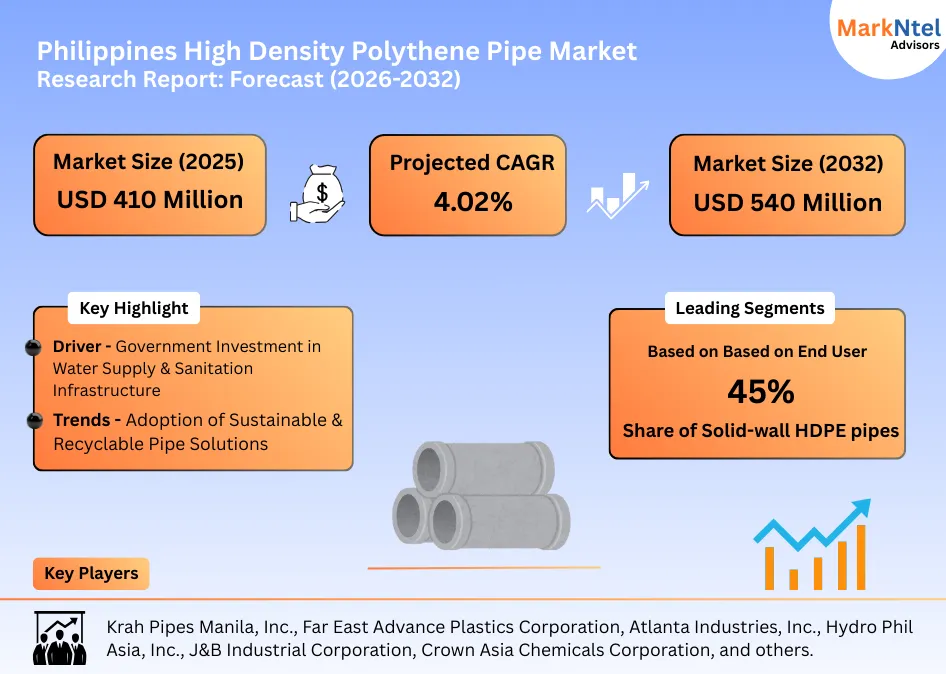
- Market size was valued at around USD410 million in 2025 and is projected to reach USD540 million by 2032. The estimated CAGR from 2026 to 2032 is around 4.02%, indicating strong growth.
- By Product Type, the Solid Wall HDPE Pipes segment represented a significant share of about 45% in the Philippines High Density Polythene Pipe Market in 2025.
- By Nominal Diameter, the 110–225 mm segment presented a significant share of about 36% in the Philippines High Density Polythene Pipe Market in 2025.
- Leading High Density Polythene Pipe companies in the Philippines are Krah Pipes Manila, Inc., Far East Advance Plastics Corporation, Atlanta Industries, Inc., Hydro Phil Asia, Inc., J&B Industrial Corporation, Crown Asia Chemicals Corporation, Biofit Manufacturing Corporation, Moldex Products, Inc., Radius / HDPEph, Dosuju, Techglobal Incorporated, Jhaycor Industries, Inc., and Others.
Market Insights & Analysis: Philippines High Density Polythene Pipe Market (2026-32):
The Philippines High Density Polythene Pipe Market size was valued at around USD 410 million in 2025 and is projected to reach USD 540 million by 2032. Along with this, the market is estimated to grow at a CAGR of around 4.02% during the forecast period, i.e., 2026-32.
Urbanization, infrastructure densification, and pipeline replacement are increasingly shaping demand in the Philippines HDPE pipe market. As utilities and local governments prioritize system rehabilitation over short-term repairs, HDPE pipes are gaining preference for their corrosion resistance, flexibility, and long operational life, particularly in flood-prone and seismically active environments.
Achieving nationwide improvements in water access and sanitation coverage requires sustained, pipe-intensive infrastructure investment, especially in distribution and sewer networks. This requirement is reinforced by the government’s USD25 billion infrastructure allocation in 2024, which prioritizes water distribution, irrigation systems, and flood-control assets. These capital programs translate directly into continuous procurement of pressure and gravity pipe systems, strengthening long-term demand visibility for HDPE manufacturers.
Beyond utilities, agriculture acts as a major volume driver. The Department of Agriculture’s USD3.5 billion 2024 budget and National Irrigation Administration programs are expanding irrigation coverage, where HDPE is favored for conveyance and on-farm distribution due to ease of installation and low leakage. Construction and urban development further raise demand for non-pressure HDPE pipes in drainage and building services.
At the same time, digital infrastructure and industrial activity broaden end-use adoption. The USD287 million World Bank–supported national fiber-optic program increases demand for HDPE conduits, while mining and industrial projects use HDPE for dewatering, process water, and cable protection. Collectively, these interconnected drivers support a resilient, multi-sector growth outlook for the Philippines HDPE pipe market, despite ongoing challenges from resin import dependence and price volatility.
Philippines High Density Polythene Pipe Market Recent Developments:
- 2025: Krah Pipes Manila, Inc. introduced larger-diameter HDPE pipes, including its first 3500 mm mandrel pipe and expanded production capabilities, added new offices and specialized transport units, and secured ISO recertification to support broader infrastructure projects.
Philippines High Density Polythene Pipe Market Scope:
| Category | Segments |
|---|---|
| By Product Type | Solid Wall HDPE Pipes, Dual-Wall HDPE Pipes, HDPE Conduit & Ducts, Composite HDPE Pipes, Fittings & Accessories |
| By Nominal Diameter | 20 – 90 mm, 110 – 225 mm, 250 – 630 mm, 710 – 2000+ mm |
| By Pressure Class | 4.0 – 6.3, 8.0 – 12.5, 16 – 20 |
| By Distribution Channel | Direct Sales, Distributors / Dealers, EPC Contractors, Online |
| By End User | Water & Drainge, Construction, Oil & Gas Operators, Telecom, Industrial, Mining Firms, Agriculture, Government & Public Sector, Others), and others |
Philippines High Density Polythene Pipe Market Driver:
Government Investment in Water Supply & Sanitation Infrastructure
Government investment in water supply and sanitation infrastructure is a major catalyst for rising demand in the Philippine HDPE pipe market because public projects form the largest and most stable source of pipe procurement nationwide. Under the 2024 Philippine National Budget, infrastructure spending continues to prioritize water and sanitation improvements, with specific funding for potable water system expansion, distribution networks, and sewerage upgrades. These projects require durable, corrosion-resistant piping, and HDPE pipes, known for their long service life and leak-free fusion joints, are increasingly specified over traditional materials such as concrete or metal.
Additionally, as per the World Bank sector analyses, estimate that the Philippines needs around USD838 million annually to expand improved water supply access and about USD619 million per year through 2028 for sanitation coverage expansion. These investment requirements translate into extensive pipeline projects where HDPE’s advantages, flexibility, corrosion resistance, and low maintenance are valued by engineers and utilities.
Moreover, multilateral development banks and institutions, such as the Asian Development Bank (ADB) and World Bank, also support water and sanitation programs with financing that further expands project pipelines. These financed projects often include specifications for HDPE pipe systems because they provide lifecycle cost benefits and durability in aggressive soil and seismic conditions common in the Philippines. As a result of sustained government and donor investment, demand for HDPE pipes has risen sharply.
Philippines High Density Polythene Pipe Market Trend:
Adoption of Sustainable & Recyclable Pipe Solutions
The Philippines is gradually adopting sustainable and recyclable HDPE pipe solutions, driven by increasing policy emphasis on plastics circularity and rising buyer awareness of environmental performance in infrastructure procurement. For instance, national roadmaps and development programs now encourage higher material efficiency and recycling across plastic value chains, creating momentum for recycled-content applications in non-critical uses. As a result, domestic manufacturers and smaller suppliers have begun introducing non-pressure HDPE pipes made partly from recycled feedstock, particularly for irrigation, drainage, cable protection, and conduit applications, where safety risks are lower than in potable-water systems.
For instance, Dosuju has explicitly marketed HDPE Commercial S-40 pipes produced using high-quality recycled material, reflecting early commercial adoption of circular practices at the SME level. This trend aligns with structural realities identified by the World Bank, which reports that the Philippines is a net importer of plastic resins and recycled approximately 28% of key plastic resins in past years, indicating both dependence on virgin imports and untapped recycling potential. Additionally, limited domestic resin production and volatile virgin HDPE prices are pushing manufacturers to explore recycled inputs to stabilize costs and meet sustainability expectations.
Philippines High Density Polythene Pipe Market Challenges:
Raw-Material Price Volatility Impeding Market Growth
In the Philippines, raw-material price volatility is a critical challenge for the HDPE pipe industry because the country is structurally dependent on imported plastic resins, including HDPE. For instance, official trade data compiled from Philippine customs and UN Comtrade show that the Philippines imported about USD4.49 billion worth of plastics and plastic raw materials in 2024, underscoring heavy reliance on overseas supply for polymer inputs. Additionally, World Bank assessments indicate that around two-thirds, approximately 66% of plastic resin demand in the Philippines is met through imports, exposing manufacturers directly to global price shocks.
Because HDPE resin prices are closely linked to crude oil and ethylene feedstock movements, global volatility quickly translates into domestic cost pressure. For instance, international oil price swings between USD 75–90 per barrel during 2023–2024 caused sharp fluctuations in polymer pricing, resulting in hundreds of USD per metric-ton changes in HDPE resin costs within short periods. Since resin typically represents 60–70% of total HDPE pipe production costs, these swings significantly disrupt cost planning.
Philippines High Density Polythene Pipe Market (2026-32) Segmentation Analysis:
The Philippines High Density Polythene Pipe Market Report and Forecast 2026-2032 offers a detailed analysis of the market based on the following segments:
Based on Product Type:
- Solid Wall HDPE Pipes
- Dual-Wall HDPE Pipes
- HDPE Conduit & Ducts
- Composite HDPE Pipes
- Fittings & Accessories
Solid-wall HDPE pipes dominate the Philippine HDPE Pipe Market with a market share of around 45%, primarily because most high-value demand is generated by pressure-based applications, especially potable water transmission, distribution networks, and industrial utilities. These segments require pipes with uniform wall thickness, high-pressure ratings (PN/SDR compliance), and leak-free joints, making solid-wall HDPE the preferred engineering solution. International water-infrastructure guidance from organizations such as the Plastics Pipe Institute confirms that heat-fused HDPE joints are as strong as the pipe itself, which minimizes leakage and reduces long-term water losses, an important consideration in a country facing persistent non-revenue water issues.
This technical advantage aligns closely with government-funded water and irrigation investments, which form the largest demand base for pipes in the Philippines. Public water systems prioritize lifecycle performance and durability, leading utilities and contractors to specify solid-wall HDPE for pressure mains and trunk lines, while reserving structured-wall pipes mainly for non-pressure drainage. Reflecting this demand, Philippine manufacturers such as Krah Pipes Manila, Far East Advance Plastics, and Atlanta Industries have expanded solid-wall HDPE offerings, including large-diameter pressure pipes for transmission projects.
Based on Nominal Diameter:
- 20 – 90 mm
- 110 – 225 mm
- 250 – 630 mm
- 710 – 2000+ mm
The 110–225 mm segment holds the largest market share, around 36%. The dominance of 110–225 mm HDPE pipes in the Philippines is rooted in how closely this diameter range aligns with the country’s most frequent infrastructure and utility requirements. Across water supply, irrigation, drainage, telecom ducting, and small distribution networks, projects are typically designed around service lines and laterals rather than large transmission mains, placing sustained volume demand squarely in this mid-size band.
From a supply perspective, Philippine manufacturers and distributors consistently list 110 mm, 160 mm, 200 mm, and 225 mm as standard production and inventory sizes, reflecting high turnover and repeat procurement. The 110 mm size is commonly supplied in coils, making it ideal for household water connections, irrigation laterals, and conduit installations where rapid deployment and fewer joints are critical. As diameters increase toward 160–225 mm, pipes are widely used for barangay-level distribution, secondary sewer lines, and drainage networks, applications that dominate local government and utility projects. As a result, these diameters account for the highest consumption volumes, making them the most dominant segment in the Philippine HDPE pipe market.
Gain a Competitive Edge with Our Philippines High Density Polythene Pipe Market Report:
- The Philippines High Density Polythene Pipe Market Report by MarkNtel Advisors provides a detailed & thorough analysis of market size & share, growth rate, competitive landscape, and key players. This comprehensive analysis helps businesses gain a holistic understanding of the market dynamics & make informed decisions.
- This report also highlights current market trends & future projections, allowing businesses to identify emerging opportunities & potential challenges. By understanding market forecasts, companies can align their strategies & stay ahead of the competition.
- The Philippines High Density Polythene Pipe Market Report aids in assessing & mitigating risks associated with entering or operating in the market. By understanding market dynamics, regulatory frameworks, and potential challenges, businesses can develop strategies to minimize risks & optimize their operations.
*Reports Delivery Format - Market research studies from MarkNtel Advisors are offered in PDF, Excel and PowerPoint formats. Within 24 hours of the payment being successfully received, the report will be sent to your email address.
Frequently Asked Questions
- Market Segmentation
- Introduction
- Product Definition
- Research Process
- Assumptions
- Executive Summary
- Philippines High Density Polythene Pipe Market Regulations, Policies & Standards
- Philippines High Density Polythene Pipe Market Trends & Developments
- Philippines High Density Polythene Pipe Market Supply Chain Analysis
- Philippines High Density Polythene Pipe Market Import/Export
- Philippines High Density Polythene Pipe Market Pricing Analysis
- Philippines High Density Polythene Pipe Market Dynamics
- Growth Drivers
- Challenges
- Philippines High Density Polythene Pipe Market Hotspots & Opportunities
- Philippines High Density Polythene Pipe Market Outlook, 2022-2032F
- Market Size & Analysis
- By Revenue (USD Million)
- By Quantity Sold (Thousand Units)
- Market Share & Analysis
- By Product Type- (USD Million & Thousand Units)
- Solid Wall HDPE Pipes
- Dual-Wall HDPE Pipes
- HDPE Conduit & Ducts
- Composite HDPE Pipes
- Fittings & Accessories
- By Nominal Diameter- (USD Million & Thousand Units)
- 20 – 90 mm
- 110 – 225 mm
- 250 – 630 mm
- 710 – 2000+ mm
- By Pressure Class- (USD Million & Thousand Units)
- 4.0 – 6.3
- 8.0 – 12.5
- 16 – 20
- By Distribution Channel- (USD Million & Thousand Units)
- Direct Sales
- Distributors / Dealers
- EPC Contractors
- Online
- By End User- (USD Million & Thousand Units)
- Water & Drainge
- Construction
- Oil & Gas Operators
- Telecom
- Industrial
- Mining Firms
- Agriculture
- Government & Public Sector
- Others
- By Region
- Central Luzon
- Visayas
- Mindanao
- Others
- By Competitors
- Competition Characteristics
- Market Share & Analysis
- By Product Type- (USD Million & Thousand Units)
- Market Size & Analysis
- Philippines Solid Wall High Density Polythene Pipe Market Outlook, 2022-2032F
- Market Size & Analysis
- By Revenue (USD Million)
- By Quantity Sold (Thousand Units)
- Market Share & Analysis
- By Nominal Diameter- (USD Million & Thousand Units)
- By Pressure Class- (USD Million & Thousand Units)
- By Distribution Channel- (USD Million & Thousand Units)
- By End-User- (USD Million & Thousand Units)
- Market Size & Analysis
- Philippines Dual Wall High Density Polythene Pipe Market Outlook, 2022-2032F
- Market Size & Analysis
- By Revenue (USD Million)
- By Quantity Sold (Thousand Units)
- Market Share & Analysis
- By Nominal Diameter- (USD Million & Thousand Units)
- By Pressure Class- (USD Million & Thousand Units)
- By Distribution Channel- (USD Million & Thousand Units)
- By End-User- (USD Million & Thousand Units)
- Market Size & Analysis
- Philippines High Density Polythene Conduit & Ducts Market Outlook, 2022-2032F
- Market Size & Analysis
- By Revenue (USD Million)
- By Quantity Sold (Thousand Units)
- Market Share & Analysis
- By Nominal Diameter- (USD Million & Thousand Units)
- By Pressure Class- (USD Million & Thousand Units)
- By Distribution Channel- (USD Million & Thousand Units)
- By End-User- (USD Million & Thousand Units)
- Market Size & Analysis
- Philippines Composite High Density Polythene Pipe Market Outlook, 2022-2032F
- Market Size & Analysis
- By Revenue (USD Million)
- By Quantity Sold (Thousand Units)
- Market Share & Analysis
- By Nominal Diameter- (USD Million & Thousand Units)
- By Pressure Class- (USD Million & Thousand Units)
- By Distribution Channel- (USD Million & Thousand Units)
- By End-User- (USD Million & Thousand Units)
- Market Size & Analysis
- Philippines High Density Polythene Fittings & Accessories Market Outlook, 2022-2032F
- Market Size & Analysis
- By Revenue (USD Million)
- By Quantity Sold (Thousand Units)
- Market Share & Analysis
- By Nominal Diameter- (USD Million & Thousand Units)
- By Pressure Class- (USD Million & Thousand Units)
- By Distribution Channel- (USD Million & Thousand Units)
- By End-User- (USD Million & Thousand Units)
- Market Size & Analysis
- Philippines High Density Polythene Pipe Market Key Strategic Imperatives for Growth & Success
- Competitive Outlook
- Company Profiles
- Krah Pipes Manila, Inc.
- Business Description
- Product Portfolio
- Strategic Alliances or Partnerships
- Recent Developments
- Financial Details
- Others
- Far East Advance Plastics Corporation
- Business Description
- Product Portfolio
- Strategic Alliances or Partnerships
- Recent Developments
- Financial Details
- Others
- Atlanta Industries, Inc.
- Business Description
- Product Portfolio
- Strategic Alliances or Partnerships
- Recent Developments
- Financial Details
- Others
- Hydro Phil Asia, Inc.
- Business Description
- Product Portfolio
- Strategic Alliances or Partnerships
- Recent Developments
- Financial Details
- Others
- J&B Industrial Corporation
- Business Description
- Product Portfolio
- Strategic Alliances or Partnerships
- Recent Developments
- Financial Details
- Others
- Crown Asia Chemicals Corporation
- Business Description
- Product Portfolio
- Strategic Alliances or Partnerships
- Recent Developments
- Financial Details
- Others
- Biofit Manufacturing Corporation
- Business Description
- Product Portfolio
- Strategic Alliances or Partnerships
- Recent Developments
- Financial Details
- Others
- Moldex Products, Inc.
- Business Description
- Product Portfolio
- Strategic Alliances or Partnerships
- Recent Developments
- Financial Details
- Others
- Radius / HDPEph
- Business Description
- Product Portfolio
- Strategic Alliances or Partnerships
- Recent Developments
- Financial Details
- Others
- Dosuju
- Business Description
- Product Portfolio
- Strategic Alliances or Partnerships
- Recent Developments
- Financial Details
- Others
- Techglobal Incorporated
- Business Description
- Product Portfolio
- Strategic Alliances or Partnerships
- Recent Developments
- Financial Details
- Others
- Jhaycor Industries, Inc.
- Business Description
- Product Portfolio
- Strategic Alliances or Partnerships
- Recent Developments
- Financial Details
- Others
- Others
- Krah Pipes Manila, Inc.
- Company Profiles
- Disclaimer
MarkNtel Advisors follows a robust and iterative research methodology designed to ensure maximum accuracy and minimize deviation in market estimates and forecasts. Our approach combines both bottom-up and top-down techniques to effectively segment and quantify various aspects of the market. A consistent feature across all our research reports is data triangulation, which examines the market from three distinct perspectives to validate findings. Key components of our research process include:
1. Scope & Research Design At the outset, MarkNtel Advisors define the research objectives and formulate pertinent questions. This phase involves determining the type of research—qualitative or quantitative—and designing a methodology that outlines data collection methods, target demographics, and analytical tools. They also establish timelines and budgets to ensure the research aligns with client goals.
2. Sample Selection and Data Collection In this stage, the firm identifies the target audience and determines the appropriate sample size to ensure representativeness. They employ various sampling methods, such as random or stratified sampling, based on the research objectives. Data collection is carried out using tools like surveys, interviews, and observations, ensuring the gathered data is reliable and relevant.
3. Data Analysis and Validation Once data is collected, MarkNtel Advisors undertake a rigorous analysis process. This includes cleaning the data to remove inconsistencies, employing statistical software for quantitative analysis, and thematic analysis for qualitative data. Validation steps are taken to ensure the accuracy and reliability of the findings, minimizing biases and errors.

4. Data Forecast and FinalizationThe final phase involves forecasting future market trends based on the analyzed data. MarkNtel Advisors utilize predictive modeling and time series analysis to anticipate market behaviors. The insights are then compiled into comprehensive reports, featuring visual aids like charts and graphs, and include strategic recommendations to inform client decision-making
We offer flexible licensing options to cater to varying organizational needs. Choose the pricing pack that best suits your requirements:
Buy Now Inquire Before Buying
 Request Customization
 Talk to our Consultant







