

Global Silicon Carbide Market Research Report: Forecast (2026-2032)
Silicon Carbide Market - By Product Type (Black Silicon Carbide, Green Silicon Carbide), By Form (Powder, Grains, Crystals, Wafers / Substrates, Ceramic Components & Parts, Others) ... , By Device Type (SiC Power MOSFETs, SiC Schottky Barrier Diodes (SBDs), SiC Power Modules, Others (BJTs, JFETs, Hybrid Modules)), By Voltage (Low Voltage (Below 650 V), Medium Voltage (650–1,200 V), High Voltage (1,200–1,700 V), Very High Voltage (1,700–3,300 V), Ultra-High Voltage (Above 3,300 V)), By Wafer Size (Below 100 mm, 150-200 mm, Above 200 mm), By Grade (Metallurgical Grade, Abrasive Grade, Electronic / Semiconductor Grade, Ultra-High Purity Grade), By Process (Acheson Process, Physical Vapor Transport (PVT), Chemical Vapor Deposition (CVD), Sintering & Reaction Bonding, Others), By End-User (Automotive, Energy & Power, Industrial, Consumer Electronics, Data Centers & IT Infrastructure, Telecommunications, Aerospace & Defense, Railway & Transportation Infrastructure, Oil & Gas, Chemical Processing, Metallurgy, Refractories & Abrasives), and others Read more
- Chemicals
- Jan 2026
- Pages 195
- Report Format: PDF, Excel, PPT
Global Silicon Carbide Market
Projected 27.12% CAGR from 2026 to 2032
Study Period
2026-2032
Market Size (2026)
USD 3.01 Billion
Market Size (2032)
USD 12.70 Billion
Largest Region
Asia-Pacific
Projected CAGR
27.12%
Leading Segments
By Grade: Abrasive-Grade
Global Silicon Carbide Market Report Key Takeaways:
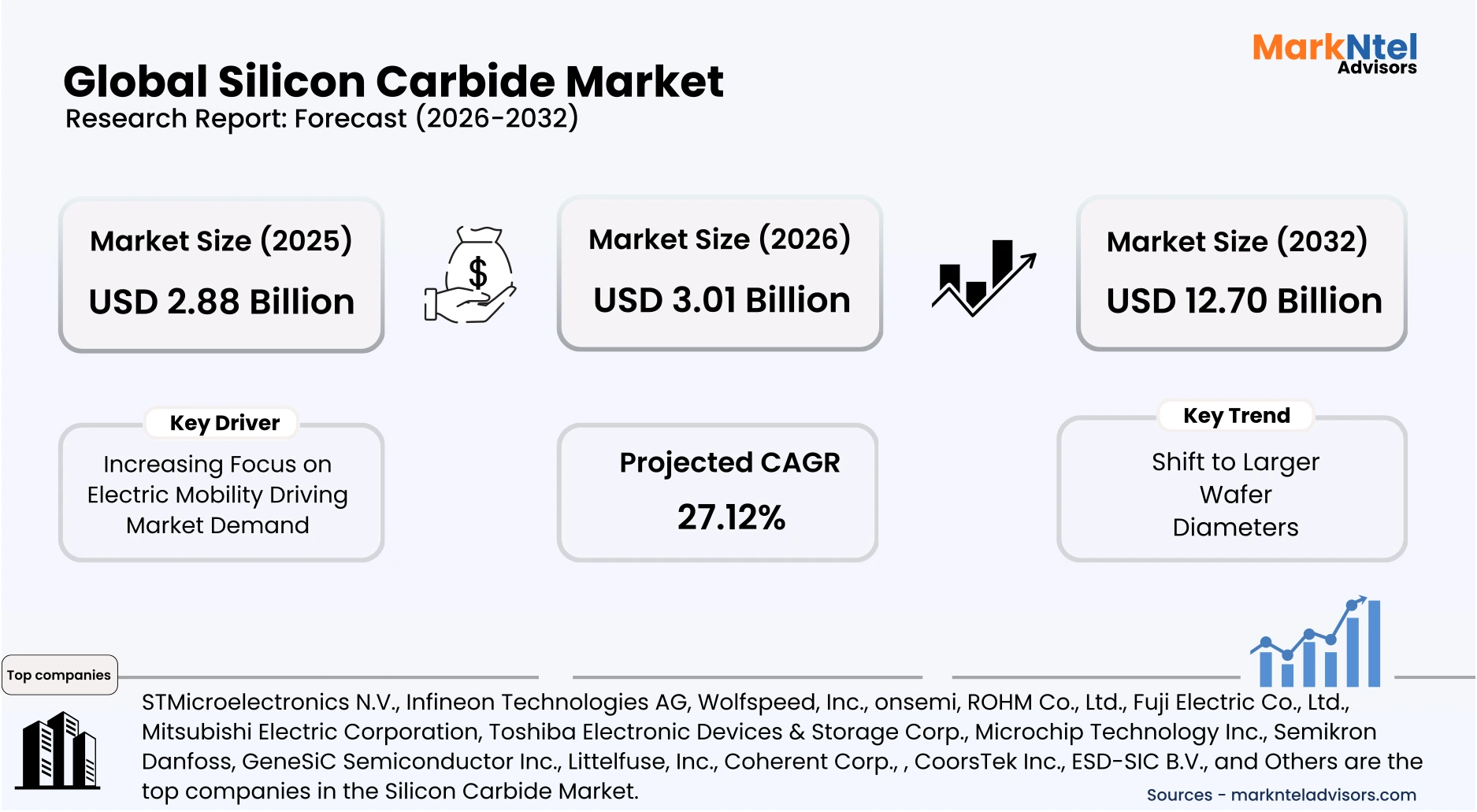
- Market size was valued at around USD 2.88 billion in 2025 and is projected to grow from USD 3.01 billion in 2026 to USD 12.70 billion by 2032. The estimated CAGR from 2026 to 2032 is around 27.12%, indicating strong growth.
- By Region, Asia-Pacific, led by the Gulf Coast, holds the largest market share of about 63% in the Global Silicon Carbide Market in 2026.
- By Product Type, the Black Silicon Carbide segment represented a significant share of about 54% in the Global Silicon Carbide Market in 2026.
- By Grade, the Abrasive Grade segment presented a significant share of about 34% in the Global Silicon Carbide Market in 2026.
- Leading Silicon Carbide Companies in the Global Market are STMicroelectronics N.V., Infineon Technologies AG, Wolfspeed, Inc., onsemi, ROHM Co., Ltd., Fuji Electric Co., Ltd., Mitsubishi Electric Corporation, Toshiba Electronic Devices & Storage Corp., Microchip Technology Inc., Semikron Danfoss, GeneSiC Semiconductor Inc., Littelfuse, Inc., Coherent Corp., Xiamen Powerway Advanced Material Co., Resonac Holdings, SK Siltron Co., Ltd., Carborundum Universal Ltd., Washington Mills, CoorsTek Inc., ESD-SIC B.V., and Others.
Market Insights & Analysis: Global Silicon Carbide Market (2026-32):
The Global Silicon Carbide Market size was valued at around USD 2.88 billion in 2025 and is projected to grow from USD 3.01 billion in 2026 to USD 12.70 billion by 2032. Along with this, the market is estimated to grow at a CAGR of around 27.12% during the forecast period, i.e., 2026-32.
The Global Silicon Carbide (SiC) Market is increasingly shaped by coordinated national industrial strategies that link manufacturing scale-up, policy incentives, and surging demand from EVs, renewables, and industrial electrification. In the United States, the CHIPS and Science Act allocates roughly USD52.7 billion in direct subsidies for semiconductor manufacturing and R&D, plus USD24 billion in tax incentives to encourage facility investments, measures that catalyze SiC capacity expansion and workforce development. Notably, SiC leader Wolfspeed secured up to USD2.5 billion in combined CHIPS funding, private investment, and anticipated tax refunds to expand U.S. SiC wafer and device manufacturing, tightening the domestic supply chain for EV power electronics.
In Europe, the European Chips Act is mobilizing about USD50 billion in public and private semiconductor investment through 2030, targeting broader chip manufacturing capability, including next-generation power devices vital for EVs and smart grids. As part of this, the European Commission approved USD525 million in Czech support for onsemi’s integrated SiC power device facility, backed by a wider USD1.9 billion total investment to bring SiC production stages under one roof.
China is also reinforcing semiconductor independence via the China Integrated Circuit Industry Investment Fund, with assets of about USD95.7 billion, extending Phase III capital specifically to reinforce capacity, including wide-bandgap materials such as SiC. In India, semiconductor support schemes under the India Semiconductor Mission link fiscal incentives to capital expenditure, enabling projects such as the first commercial SiC device fab in Odisha, backed by central support in the range of billions of dollars.
These cross-regional policies and large capital commitments are tightly interconnected with the rising adoption of SiC in EV inverters, fast chargers, and renewable power systems, creating a resilient, globally diversified SiC manufacturing and innovation ecosystem.
Global Silicon Carbide Market Recent Developments:
- 2025: Infineon began delivering its first silicon carbide products made on advanced 200 mm SiC wafers from its Villach, Austria, facility, boosting high-voltage EV, renewable energy, and industrial power applications.
- 2025: ST confirmed progress on its new Silicon Carbide Campus in Catania, Italy, with 200 mm SiC wafer production scheduled to begin in Q4 2025, strengthening its leadership in next-generation power semiconductor manufacturing.
- 2025: Silan Microelectronics advanced the construction of their large-diameter wafer facilities, while STMicroelectronics, in partnership with Sanan Optoelectronics, progressed toward initial production at its Chongqing-based SiC manufacturing site, which commenced early-stage wafer output. This milestone marks a critical step toward large-scale commercialization of automotive-grade silicon carbide devices, aimed at supporting the growing demand from electric vehicles and industrial power applications.
Global Silicon Carbide Market Scope:
| Category | Segments |
|---|---|
| Product Type | Black Silicon Carbide, Green Silicon Carbide |
| Form | Powder, Grains, Crystals, Wafers / Substrates, Ceramic Components & Parts, Others |
| Device Type | SiC Power MOSFETs, SiC Schottky Barrier Diodes (SBDs), SiC Power Modules, Others (BJTs, JFETs, Hybrid Modules) |
| Voltage | Low Voltage (Below 650 V), Medium Voltage (650–1,200 V), High Voltage (1,200–1,700 V), Very High Voltage (1,700–3,300 V), Ultra-High Voltage (Above 3,300 V) |
| Wafer Size | Below 100 mm, 150-200 mm, Above 200 mm |
| Grade | Metallurgical Grade, Abrasive Grade, Electronic / Semiconductor Grade, Ultra-High Purity Grade |
| Process | Acheson Process, Physical Vapor Transport (PVT), Chemical Vapor Deposition (CVD), Sintering & Reaction Bonding, Others |
| End-User | Automotive, Energy & Power, Industrial, Consumer Electronics, Data Centers & IT Infrastructure, Telecommunications, Aerospace & Defense, Railway & Transportation Infrastructure, Oil & Gas, Chemical Processing, Metallurgy, Refractories & Abrasives |
Global Silicon Carbide Market Driver:
Increasing Focus on Electric Mobility Driving Market Demand
The coordinated government push toward electric mobility, which structurally increases demand for high-efficiency power semiconductors, is driving this market. For instance, the International Energy Agency reported that nearly 14 million electric cars were sold globally in 2023, with China, Europe, and the United States accounting for around 95% of total EV sales. This concentration means policy decisions in these regions directly shape global SiC consumption.
Similarly, European Union fleet-emission regulations and national EV purchase incentives are pushing automakers toward 800-V vehicle platforms, where silicon devices become inefficient, and SiC becomes essential. For reference, the United States supports both EV adoption and semiconductor supply through the CHIPS and Science Act, linking EV growth with domestic power-semiconductor manufacturing. Likewise, India’s FAME-II incentives and India Semiconductor Mission connect EV deployment with local power-electronics production.
Global Silicon Carbide Market Trend:
Shift to Larger Wafer Diameters
The shift from 150 mm (6-inch) to 200 mm (8-inch) silicon carbide wafers is a defining manufacturing trend because it directly links cost reduction, capacity expansion, and long-term supply stability. For instance, a 200 mm wafer provides nearly 78% more surface area than a 150 mm wafer, allowing significantly more power devices to be produced per wafer, which lowers the cost per chip once yields stabilize.
Additionally, leading manufacturers are aligning capital investments with this transition. Infineon Technologies AG began delivering SiC products manufactured on 200 mm wafers in 2025, demonstrating that larger-diameter SiC has moved from pilot scale to commercial output. This directly supports rising demand from EV traction inverters and fast-charging infrastructure, where cost and volume are critical.
Similarly, STMicroelectronics N.V. is developing its Silicon Carbide Campus in Catania to support 200 mm SiC wafer production from late 2025, linking wafer scaling with Europe’s push for secure power-semiconductor supply. For reference, these investments are supported by public financing mechanisms, reflecting government recognition that wafer scaling is essential for competitiveness.
Global Silicon Carbide Market Challenges:
High Capital Requirement & Long Payback Periods
High capital intensity remains a critical challenge in the Global Silicon Carbide (SiC) Market because production requires specialized, high-temperature equipment and long facility build cycles. For instance, STMicroelectronics N.V. signed a USD1.1 billion financing agreement with the European Investment Bank to support advanced semiconductor manufacturing, including SiC, highlighting that even established manufacturers rely on large-scale public financing to expand capacity.
Additionally, SiC fabrication facilities take longer to reach economic utilization than conventional silicon fabs. For reference, Wolfspeed, Inc. has disclosed that its SiC fabs typically require several years from construction to stable high-volume output, as wafer qualification and yield optimization are more complex for wide-bandgap materials. This significantly delays revenue generation and lengthens payback periods.
Similarly, China’s industrial disclosures show that advanced SiC power-device fabrication lines require investments exceeding USD1.6 billion per project, reflecting the scale of upfront capital needed to compete globally. Likewise, SiC crystal growth processes consume large amounts of electricity due to sustained ultra-high temperatures, raising operating costs and increasing financial exposure during demand slowdowns.
Global Silicon Carbide Market (2026-32) Segmentation Analysis:
Global Silicon Carbide Market Report and Forecast 2026-2032 offers a detailed analysis of the market based on the following segments:
Based on Grade:
- Metallurgical Grade
- Abrasive Grade
- Electronic / Semiconductor Grade
- Ultra-High Purity Grade
With 34% share, Abrasive-Grade Silicon Carbide dominates the global silicon carbide industry because its intrinsic material properties directly match the needs of the largest consuming industries, and its production economics support large-scale supply. Abrasive-grade SiC has a hardness of about 9–9.5 on the Mohs scale, making it one of the hardest commercially available materials after diamond and boron carbide. This extreme hardness, combined with sharp, friable grains, allows continuous self-sharpening during grinding, which directly improves cutting efficiency and tool life.
These performance advantages connect abrasive-grade SiC to its largest applications. According to the U.S. Geological Survey (USGS), abrasives consistently represent the largest share of silicon carbide consumption by volume, ahead of specialty or electronic uses. This dominance is reinforced by end-use industries such as metal fabrication, construction, ceramics, stone processing, and glass manufacturing, all of which require high-volume, repeat-use abrasive materials rather than high-purity specialty grades.
Production scale further strengthens this position. China, the world’s leading silicon carbide producer, has historically generated hundreds of thousands of metric tons of SiC annually, with abrasive-grade material forming the bulk of output due to lower purity requirements and cost-efficient electric-furnace production. This large, stable supply supports global exports and competitive pricing. Together, material performance enables broad industrial use, broad use sustains high production volumes, and high volumes reinforce cost leadership, creating a connected cycle that secures abrasive-grade silicon carbide’s dominance in the Global SiC Market.
Based on Product Type:
- Black Silicon Carbide
- Green Silicon Carbide
Black Silicon Carbide dominates the Global Silicon Carbide Market with a market share of about 54% because its cost efficiency, production scale, and suitability for high-volume industrial applications are closely aligned. For instance, black SiC is produced in electric resistance furnaces at temperatures above 2,000 °C using silica sand and petroleum coke. This manufacturing route delivers higher output and lower cost per ton compared with green SiC, making it the preferred choice for large industrial consumers.
For example, production data from China’s abrasives and ferro-alloy industries show annual black SiC output of approximately 800,000–900,000 metric tons, representing more than 85-90% of total silicon carbide production during peak years. This scale advantage ensures a steady global supply and competitive pricing, reinforcing black SiC’s dominance in international trade. Similarly, refractory producers value black SiC for its high thermal conductivity and resistance to thermal shock, which extends furnace lining life, thus contributing to its dominance.
Global Silicon Carbide Market (2026-32): Regional Projection
Asia-Pacific holds the largest market share of about 63% in the Global Silicon Carbide (SiC) Market because the region combines large-scale end-use demand with expanding production capabilities across wafers, devices, and materials. For instance, China’s Ministry of Industry and Information Technology reported over 12.8 million electric vehicles produced in 2024, creating massive domestic demand for SiC power devices used in traction inverters and fast-charging systems. Additionally, China’s National Energy Administration confirmed more than 217 GW of new solar capacity installed in 2023, directly increasing demand for SiC-based inverter technologies.
For example, China has also begun scaling domestic SiC manufacturing, including high-value investments exceeding USD1.6 billion for advanced SiC power-device fabrication lines, strengthening local supply for EV and industrial applications. Similarly, Japan remains a core SiC production hub, supported by long-established wafer, substrate, and device manufacturers, with Japan’s Ministry of Economy, Trade, and Industry identifying power semiconductors such as SiC as strategic technologies for electrified transport and energy efficiency.
For instance, South Korea’s semiconductor strategy increasingly prioritizes compound semiconductors to support EV exports, while Taiwan contributes through its globally dominant semiconductor manufacturing ecosystem, accounting for a majority of advanced chip fabrication, which enables scalable SiC device fabrication, packaging, and testing. Additionally, India is emerging as a new SiC manufacturing base, with government-approved semiconductor projects targeting tens of thousands of wafers per month to support EV charging and power electronics.
Gain a Competitive Edge with Our US Silicon Carbide Market Report
- Global Silicon Carbide Market Report by MarkNtel Advisors provides a detailed & thorough analysis of market size & share, growth rate, competitive landscape, and key players. This comprehensive analysis helps businesses gain a holistic understanding of the market dynamics & make informed decisions.
- This report also highlights current market trends & future projections, allowing businesses to identify emerging opportunities & potential challenges. By understanding market forecasts, companies can align their strategies & stay ahead of the competition.
- Global Silicon Carbide Market Report aids in assessing & mitigating risks associated with entering or operating in the market. By understanding market dynamics, regulatory frameworks, and potential challenges, businesses can develop strategies to minimize risks & optimize their operations.
*Reports Delivery Format - Market research studies from MarkNtel Advisors are offered in PDF, Excel and PowerPoint formats. Within 24 hours of the payment being successfully received, the report will be sent to your email address.
Frequently Asked Questions
- Market Segmentation
- Introduction
- Product Definition
- Research Process
- Assumptions
- Executive Summary
- Global Silicon Carbide Market Trends & Development
- Global Silicon Carbide Market Supply Chain Analysis
- Global Silicon Carbide Market Import/Export
- Global Silicon Carbide Market Pricing Analysis
- Global Silicon Carbide Market Production Capabilities
- Global Silicon Carbide Market Dynamics
- Growth Drivers
- Challenges
- Global Silicon Carbide Market Policies & Regulations
- Global Silicon Carbide Market Hotspot & Opportunities
- Global Silicon Carbide Market Outlook, 2022-2032F
- Market Size & Analysis
- By Revenues (USD Million)
- By Volume (Thousand Tons)
- Market Share & Analysis
- By Product Type (USD Million & Thousand Tons)
- Black Silicon Carbide
- Green Silicon Carbide
- By Form (USD Million & Thousand Tons)
- Powder
- Grains
- Crystals
- Wafers / Substrates
- Ceramic Components & Parts
- Others
- By Device Type (USD Million & Thousand Tons)
- SiC Power MOSFETs
- SiC Schottky Barrier Diodes (SBDs)
- SiC Power Modules
- Others (BJTs, JFETs, Hybrid Modules)
- By Voltage (USD Million & Thousand Tons)
- Low Voltage (Below 650 V)
- Medium Voltage (650–1,200 V)
- High Voltage (1,200–1,700 V)
- Very High Voltage (1,700–3,300 V)
- Ultra-High Voltage (Above 3,300 V)
- By Wafer Size (USD Million & Thousand Tons)
- Below 100 mm
- 150-200 mm
- Above 200 mm
- By Grade (USD Million & Thousand Tons)
- Metallurgical Grade
- Abrasive Grade
- Electronic / Semiconductor Grade
- Ultra-High Purity Grade
- By Process (USD Million & Thousand Tons)
- Acheson Process
- Physical Vapor Transport (PVT)
- Chemical Vapor Deposition (CVD)
- Sintering & Reaction Bonding
- Others
- By End-User (USD Million & Thousand Tons)
- Automotive
- Energy & Power
- Industrial
- Consumer Electronics
- Data Centers & IT Infrastructure
- Telecommunications
- Aerospace & Defense
- Railway & Transportation Infrastructure
- Oil & Gas
- Chemical Processing
- Metallurgy, Refractories & Abrasives
- By Region
- North America
- South America
- Europe
- The Middle East & Africa
- Asia-Pacific
- By Company
- Competition Characteristics
- Market Share of Leading Companies
- By Product Type (USD Million & Thousand Tons)
- Market Size & Analysis
- North America Silicon Carbide Market Outlook, 2022-2032F
- Market Size & Analysis
- By Revenues (USD Million)
- By Volume (Thousand Tons)
- Market Share & Analysis
- By Product Type
- By Form
- By Device Type
- By Voltage
- By Wafer Size
- By Grade
- By Process
- By End-User
- By Country
- The US
- Canada
- Mexico
- The US Silicon Carbide Market Outlook, 2022-2032F
- Market Size & Analysis
- By Revenues (USD Million)
- By Volume (Thousand Tons)
- Market Share & Analysis
- By Product Type
- By Form
- By Device Type
- By Voltage
- By Wafer Size
- By Grade
- By Process
- By End-User
- Market Size & Analysis
- Canada Silicon Carbide Market Outlook, 2022-2032F
- Market Size & Analysis
- By Revenues (USD Million)
- By Volume (Thousand Tons)
- Market Share & Analysis
- By Product Type
- By Form
- By Device Type
- By Voltage
- By Wafer Size
- By Grade
- By Process
- By End-User
- Market Size & Analysis
- Mexico Silicon Carbide Market Outlook, 2022-2032F
- Market Size & Analysis
- By Revenues (USD Million)
- By Volume (Thousand Tons)
- Market Share & Analysis
- By Product Type
- By Form
- By Device Type
- By Voltage
- By Wafer Size
- By Grade
- By Process
- By End-User
- Market Size & Analysis
- Market Size & Analysis
- South America Silicon Carbide Market Outlook, 2022-2032F
- Market Size & Analysis
- By Revenues (USD Million)
- By Volume (Thousand Tons)
- Market Share & Analysis
- By Product Type
- By Form
- By Device Type
- By Voltage
- By Wafer Size
- By Grade
- By Process
- By End-User
- By Country
- Brazil
- Rest of South America
- Brazil Silicon Carbide Market Outlook, 2022-2032F
- Market Size & Analysis
- By Revenues (USD Million)
- By Volume (Thousand Tons)
- Market Share & Analysis
- By Product Type
- By Form
- By Device Type
- By Voltage
- By Wafer Size
- By Grade
- By Process
- By End-User
- Market Size & Analysis
- Market Size & Analysis
- Europe Silicon Carbide Market Outlook, 2022-2032F
- Market Size & Analysis
- By Revenues (USD Million)
- By Volume (Thousand Tons)
- Market Share & Analysis
- By Product Type
- By Form
- By Device Type
- By Voltage
- By Wafer Size
- By Grade
- By Process
- By End-User
- By Country
- The UK
- Germany
- France
- Russia
- Norway
- Spain
- Rest of Europe
- The UK Silicon Carbide Market Outlook, 2022-2032F
- Market Size & Analysis
- By Revenues (USD Million)
- By Volume (Thousand Tons)
- Market Share & Analysis
- By Product Type
- By Form
- By Device Type
- By Voltage
- By Wafer Size
- By Grade
- By Process
- By End-User
- Market Size & Analysis
- Germany Silicon Carbide Market Outlook, 2022-2032F
- Market Size & Analysis
- By Revenues (USD Million)
- By Volume (Thousand Tons)
- Market Share & Analysis
- By Product Type
- By Form
- By Device Type
- By Voltage
- By Wafer Size
- By Grade
- By Process
- By End-User
- Market Size & Analysis
- France Silicon Carbide Market Outlook, 2022-2032F
- Market Size & Analysis
- By Revenues (USD Million)
- By Volume (Thousand Tons)
- Market Share & Analysis
- By Product Type
- By Form
- By Device Type
- By Voltage
- By Wafer Size
- By Grade
- By Process
- By End-User
- Market Size & Analysis
- Russia Silicon Carbide Market Outlook, 2022-2032F
- Market Size & Analysis
- By Revenues (USD Million)
- By Volume (Thousand Tons)
- Market Share & Analysis
- By Product Type
- By Form
- By Device Type
- By Voltage
- By Wafer Size
- By Grade
- By Process
- By End-User
- Market Size & Analysis
- Norway Silicon Carbide Market Outlook, 2022-2032F
- Market Size & Analysis
- By Revenues (USD Million)
- By Volume (Thousand Tons)
- Market Share & Analysis
- By Product Type
- By Form
- By Device Type
- By Voltage
- By Wafer Size
- By Grade
- By Process
- By End-User
- Market Size & Analysis
- Spain Silicon Carbide Market Outlook, 2022-2032F
- Market Size & Analysis
- By Revenues (USD Million)
- By Volume (Thousand Tons)
- Market Share & Analysis
- By Product Type
- By Form
- By Device Type
- By Voltage
- By Wafer Size
- By Grade
- By Process
- By End-User
- Market Size & Analysis
- Market Size & Analysis
- The Middle East & Africa Silicon Carbide Market Outlook, 2022-2032F
- Market Size & Analysis
- By Revenues (USD Million)
- By Volume (Thousand Tons)
- Market Share & Analysis
- By Product Type
- By Form
- By Device Type
- By Voltage
- By Wafer Size
- By Grade
- By Process
- By End-User
- By Country
- Turkey
- Israel
- South Africa
- Rest of the Middle East & Africa
- Turkey Silicon Carbide Market Outlook, 2022-2032F
- Market Size & Analysis
- By Revenues (USD Million)
- By Volume (Thousand Tons)
- Market Share & Analysis
- By Product Type
- By Form
- By Device Type
- By Voltage
- By Wafer Size
- By Grade
- By Process
- By End-User
- Market Size & Analysis
- Israel Silicon Carbide Market Outlook, 2022-2032F
- Market Size & Analysis
- By Revenues (USD Million)
- By Volume (Thousand Tons)
- Market Share & Analysis
- By Product Type
- By Form
- By Device Type
- By Voltage
- By Wafer Size
- By Grade
- By Process
- By End-User
- Market Size & Analysis
- South Africa Silicon Carbide Market Outlook, 2022-2032F
- Market Size & Analysis
- By Revenues (USD Million)
- By Volume (Thousand Tons)
- Market Share & Analysis
- By Product Type
- By Form
- By Device Type
- By Voltage
- By Wafer Size
- By Grade
- By Process
- By End-User
- Market Size & Analysis
- Market Size & Analysis
- Asia-Pacific Silicon Carbide Market Outlook, 2022-2032F
- Market Size & Analysis
- By Revenues (USD Million)
- By Volume (Thousand Tons)
- Market Share & Analysis
- By Product Type
- By Form
- By Device Type
- By Voltage
- By Wafer Size
- By Grade
- By Process
- By End-User
- By Country
- China
- Japan
- India
- South Korea
- Taiwan
- Indonesia
- Vietnam
- Rest of Asia-Pacific
- China Silicon Carbide Market Outlook, 2022-2032F
- Market Size & Analysis
- By Revenues (USD Million)
- By Volume (Thousand Tons)
- Market Share & Analysis
- By Product Type
- By Form
- By Device Type
- By Voltage
- By Wafer Size
- By Grade
- By Process
- By End-User
- Market Size & Analysis
- Japan Silicon Carbide Market Outlook, 2022-2032F
- Market Size & Analysis
- By Revenues (USD Million)
- By Volume (Thousand Tons)
- Market Share & Analysis
- By Product Type
- By Form
- By Device Type
- By Voltage
- By Wafer Size
- By Grade
- By Process
- By End-User
- Market Size & Analysis
- India Silicon Carbide Market Outlook, 2022-2032F
- Market Size & Analysis
- By Revenues (USD Million)
- By Volume (Thousand Tons)
- Market Share & Analysis
- By Product Type
- By Form
- By Device Type
- By Voltage
- By Wafer Size
- By Grade
- By Process
- By End-User
- Market Size & Analysis
- South Korea Silicon Carbide Market Outlook, 2022-2032F
- Market Size & Analysis
- By Revenues (USD Million)
- By Volume (Thousand Tons)
- Market Share & Analysis
- By Product Type
- By Form
- By Device Type
- By Voltage
- By Wafer Size
- By Grade
- By Process
- By End-User
- Market Size & Analysis
- Taiwan Silicon Carbide Market Outlook, 2022-2032F
- Market Size & Analysis
- By Revenues (USD Million)
- By Volume (Thousand Tons)
- Market Share & Analysis
- By Product Type
- By Form
- By Device Type
- By Voltage
- By Wafer Size
- By Grade
- By Process
- By End-User
- Market Size & Analysis
- Indonesia Silicon Carbide Market Outlook, 2022-2032F
- Market Size & Analysis
- By Revenues (USD Million)
- By Volume (Thousand Tons)
- Market Share & Analysis
- By Product Type
- By Form
- By Device Type
- By Voltage
- By Wafer Size
- By Grade
- By Process
- By End-User
- Market Size & Analysis
- Vietnam Silicon Carbide Market Outlook, 2022-2032F
- Market Size & Analysis
- By Revenues (USD Million)
- By Volume (Thousand Tons)
- Market Share & Analysis
- By Product Type
- By Form
- By Device Type
- By Voltage
- By Wafer Size
- By Grade
- By Process
- By End-User
- Market Size & Analysis
- Market Size & Analysis
- Global Silicon Carbide Market Strategic Imperatives for Success & Growth
- Competitive Outlook
- Company Profiles
- STMicroelectronics N.V.
- Business Description
- Product Portfolio
- Strategic Alliances or Partnerships
- Recent Developments
- Financial Details
- Others
- Infineon Technologies AG
- Business Description
- Product Portfolio
- Strategic Alliances or Partnerships
- Recent Developments
- Financial Details
- Others
- Wolfspeed, Inc.
- Business Description
- Product Portfolio
- Strategic Alliances or Partnerships
- Recent Developments
- Financial Details
- Others
- Onsemi
- Business Description
- Product Portfolio
- Strategic Alliances or Partnerships
- Recent Developments
- Financial Details
- Others
- ROHM Co., Ltd.
- Business Description
- Product Portfolio
- Strategic Alliances or Partnerships
- Recent Developments
- Financial Details
- Others
- Fuji Electric Co., Ltd.
- Business Description
- Product Portfolio
- Strategic Alliances or Partnerships
- Recent Developments
- Financial Details
- Others
- Mitsubishi Electric Corporation
- Business Description
- Product Portfolio
- Strategic Alliances or Partnerships
- Recent Developments
- Financial Details
- Others
- Toshiba Electronic Devices & Storage Corp.
- Business Description
- Product Portfolio
- Strategic Alliances or Partnerships
- Recent Developments
- Financial Details
- Others
- Microchip Technology Inc.
- Business Description
- Product Portfolio
- Strategic Alliances or Partnerships
- Recent Developments
- Financial Details
- Others
- Semikron Danfoss
- Business Description
- Product Portfolio
- Strategic Alliances or Partnerships
- Recent Developments
- Financial Details
- Others
- GeneSiC Semiconductor Inc.
- Business Description
- Product Portfolio
- Strategic Alliances or Partnerships
- Recent Developments
- Financial Details
- Others
- Littelfuse, Inc.
- Business Description
- Product Portfolio
- Strategic Alliances or Partnerships
- Recent Developments
- Financial Details
- Others
- Coherent Corp.
- Business Description
- Product Portfolio
- Strategic Alliances or Partnerships
- Recent Developments
- Financial Details
- Others
- Xiamen Powerway Advanced Material Co.
- Business Description
- Product Portfolio
- Strategic Alliances or Partnerships
- Recent Developments
- Financial Details
- Others
- Resonac Holdings
- Business Description
- Product Portfolio
- Strategic Alliances or Partnerships
- Recent Developments
- Financial Details
- Others
- SK Siltron Co., Ltd.
- Business Description
- Product Portfolio
- Strategic Alliances or Partnerships
- Recent Developments
- Financial Details
- Others
- Carborundum Universal Ltd. (CUMI)
- Business Description
- Product Portfolio
- Strategic Alliances or Partnerships
- Recent Developments
- Financial Details
- Others
- Washington Mills
- Business Description
- Product Portfolio
- Strategic Alliances or Partnerships
- Recent Developments
- Financial Details
- Others
- Coorstek Inc.
- Business Description
- Product Portfolio
- Strategic Alliances or Partnerships
- Recent Developments
- Financial Details
- Others
- ESD-SIC b.v.
- Business Description
- Product Portfolio
- Strategic Alliances or Partnerships
- Recent Developments
- Financial Details
- Others
- Others
- STMicroelectronics N.V.
- Company Profiles
- Disclaimer
MarkNtel Advisors follows a robust and iterative research methodology designed to ensure maximum accuracy and minimize deviation in market estimates and forecasts. Our approach combines both bottom-up and top-down techniques to effectively segment and quantify various aspects of the market. A consistent feature across all our research reports is data triangulation, which examines the market from three distinct perspectives to validate findings. Key components of our research process include:
1. Scope & Research Design At the outset, MarkNtel Advisors define the research objectives and formulate pertinent questions. This phase involves determining the type of research—qualitative or quantitative—and designing a methodology that outlines data collection methods, target demographics, and analytical tools. They also establish timelines and budgets to ensure the research aligns with client goals.
2. Sample Selection and Data Collection In this stage, the firm identifies the target audience and determines the appropriate sample size to ensure representativeness. They employ various sampling methods, such as random or stratified sampling, based on the research objectives. Data collection is carried out using tools like surveys, interviews, and observations, ensuring the gathered data is reliable and relevant.
3. Data Analysis and Validation Once data is collected, MarkNtel Advisors undertake a rigorous analysis process. This includes cleaning the data to remove inconsistencies, employing statistical software for quantitative analysis, and thematic analysis for qualitative data. Validation steps are taken to ensure the accuracy and reliability of the findings, minimizing biases and errors.

4. Data Forecast and FinalizationThe final phase involves forecasting future market trends based on the analyzed data. MarkNtel Advisors utilize predictive modeling and time series analysis to anticipate market behaviors. The insights are then compiled into comprehensive reports, featuring visual aids like charts and graphs, and include strategic recommendations to inform client decision-making
We offer flexible licensing options to cater to varying organizational needs. Choose the pricing pack that best suits your requirements:
Buy Now Inquire Before Buying
 Request Customization
 Talk to our Consultant







