Global Carbon Fiber & Composites Market Research Report: Forecast (2026-2032)
Carbon Fiber & Composites Market - By Product Type Carbon Fiber, (PAN-Based Carbon Fiber, Pitch-Based Carbon Fiber), Carbon Fiber Composites (CFRP), (Carbon Fiber–Reinforced Plast ... ics (CFRP), Carbon–Carbon Composites, Hybrid Composites), By Matrix Polymer Matrix Composites (PMC), (Thermoset, Thermoplastic), Carbon–Carbon (C/C), Metal Matrix Composites (MMC), Ceramic Matrix Composites (CMC), By Tow Size (Small tow (1K–24K), Medium tow (25K–48K), Large tow (>48K), By Production Process Intermediate Processing, (Textiles, Bi-Directional Woven Fabrics, Unidirectional Woven Fabrics, Multiaxial / Non-Crimp Fabrics (Ncfs), 3D Fabrics, Braiding, Carbon Fiber Reinforcements, Prepregs, Resin Matrices, Prepreg Manufacturing Routes, Reinforcements for Prepregs, Carbon Fiber Molding Compounds (CFMCs), Direct Conversion, (Filament Winding, Fiber Placement, Pultrusion / Pulwinding, Carbon-Carbon Composites, Chemical Vapour Deposition (CVD), Resin Char Process, Polyacrylonitrile (PAN), Composite Production Processes, (Wet / Hand Lay-Up, Vacuum Bagging, Resin Transfer Molding (RTM), Resin Film Infusion (RFI), Compression Molding, Autoclave Molding, Injection Molding, Thermoforming, Mandrel Wrapping), By Application (Polyacrylonitrile (PAN), Small Tow Carbon Fiber, Small Tow Carbon Fiber, Pitch, Rayon, Others), By End-User (Aerospace and Defense, Civil Aircraft, Large Passenger Jet Aircraft, Regional Passenger Jet Aircraft, Military Aircraft, Helicopters, Unmanned Aircraft, Missile and Space Systems, Space Telescopes, Launch Vehicles, Missiles and Guided Bombs, Marine Defense, Ground Defense Vehicles), Automotive, Civil Engineering, Offshore Oil and Gas, (Drilling Risers, Production Risers, Choke and Kill Lines, Spoolable / Flexible Piping, Composite Tethers), Pressure Vessels (CNG Pressure Vessels, Bulk Gas Storage Pressure Vessels, Hydrogen Storage Vessels, Small Pressure Vessels), Wind Energy, Industrial, (Industrial Transmission Shafts and Rollers, Flywheels / Centrifuges), Sports and Leisure, (Golf Equipment, Racquets, Ski Poles and Snowboards, Fishing Rods, Bicycles), Chopped, Milled, and Recycled Carbon Fibers, (Sheet Molding Compounds (SMCs), Pa Read more
- Chemicals
- Mar 2026
- Pages 195
- Report Format: PDF, Excel, PPT
Global Carbon Fiber & Composites Market
Projected 8.55% CAGR from 2026 to 2032
Study Period
2026-2032
Market Size (2025)
USD 27.9 Billion
Market Size (2032)
USD 45.65 Billion
Largest Region
Asia-Pacific
Projected CAGR
8.55%
Leading Segments
By End-User: Aerospace & Defense
Global Carbon Fiber & Composites Market Report Key Takeaways:
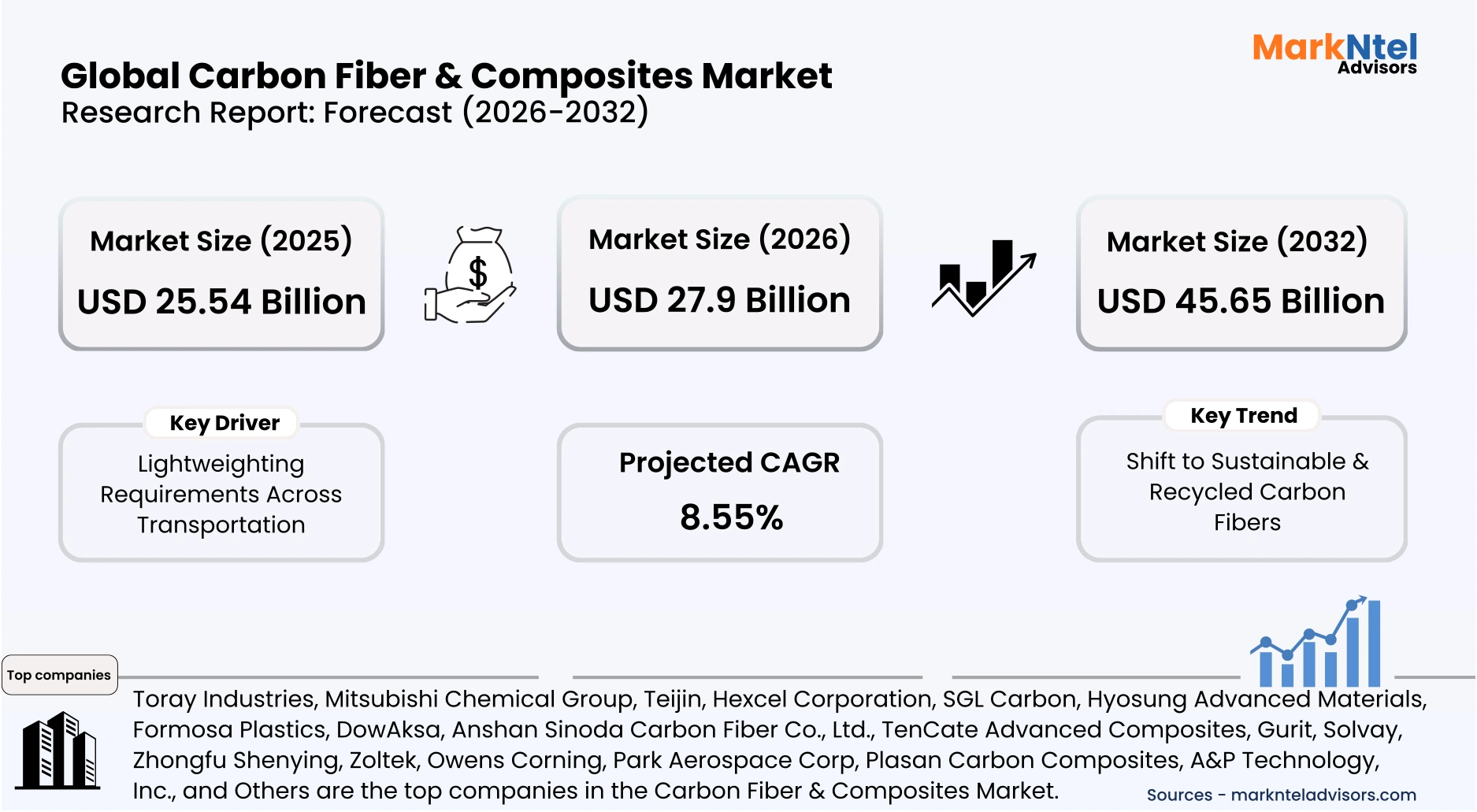
- Market size was valued at around USD 25.54 billion in 2025 and is projected to grow from USD 27.9 billion in 2026 to USD 45.65 billion by 2032. The estimated CAGR from 2026 to 2032 is around 8.55%, indicating strong growth.
- By Region, Asia-Pacific holds the largest market share of about 38% in the Global Carbon Fiber & Composites Market in 2026.
- By Matrix Type, the Polymer Matrix Composites (PMC) segment represented a significant share of about 78% in the Global Carbon Fiber & Composites Market in 2026.
- By End-User, the Aerospace & Defense segment presented a significant share of about 34% in the Global Carbon Fiber & Composites Market in 2026.
- Leading Carbon Fiber & Composites Companies in the Global Market are Toray Industries, Mitsubishi Chemical Group, Teijin, Hexcel Corporation, SGL Carbon, Hyosung Advanced Materials, Formosa Plastics, DowAksa, Anshan Sinoda Carbon Fiber Co., Ltd., TenCate Advanced Composites, Gurit, Solvay, Zhongfu Shenying, Zoltek, Owens Corning, Park Aerospace Corp, Plasan Carbon Composites, A&P Technology, Inc., and Others.
Market Insights & Analysis: Global Carbon Fiber & Composites Market (2026-32):
The Global Carbon Fiber & Composites Market size was valued at around USD25.54 billion in 2025 and is projected to grow from USD27.9 billion in 2026 to USD45.65 billion by 2032. Along with this, the market is estimated to grow at a CAGR of around 8.55% during the forecast period, i.e., 2026-32.
The Global Carbon Fiber & Composites Market is transitioning from niche, high-performance use toward broader structural adoption, driven by long-term shifts in transportation, energy, and industrial design. In aerospace, composites are no longer experimental materials but structural standards. For instance, Airbus confirms that composites now account for over 50% of the structural weight of its latest commercial aircraft programs , reflecting a permanent material shift rather than a cyclical trend. This adoption is tied directly to fuel efficiency, corrosion resistance, and lower lifetime maintenance costs.
On land, regulatory pressure reinforces demand. The U.S. Department of Energy identifies mass reduction as one of the most effective pathways to energy savings in vehicles, with lightweight materials delivering efficiency gains that cannot be achieved through powertrain optimization alone. As electrification accelerates, reducing structural mass becomes essential to offset battery weight and extend driving range.
In renewable energy, composite demand is expanding with turbine scale. According to IEA wind-technology briefings, next-generation offshore turbines increasingly exceed 14–15 MW, requiring longer, stiffer blades where carbon fiber is critical to control deflection and fatigue . This links composite demand directly to global decarbonization goals rather than discretionary spending.
Meanwhile, sustainability expectations are reshaping supply chains. Governments in Europe and Asia are tightening landfill restrictions for composite waste, pushing manufacturers toward recyclable materials and closed-loop systems. Together, regulatory mandates, proven performance benefits, and energy-transition investments position carbon fiber and composites for steady, structurally supported growth rather than short-term cyclical expansion.
Global Carbon Fiber & Composites Market Recent Developments:
- 2024 : Mitsubishi developed a 1,500 °C heat-resistant carbon fiber ceramic composite in 2024 and, in late 2025, announced plans to boost high-end carbon fiber capacity in Japan and the U.S. for aerospace, sports, and hypercar markets.
- 2025 : Toray showcased next-generation composite technologies at JEC World 2025, including advanced TORAYCA carbon fibers, new towpreg materials, high-performance thermoset and thermoplastic composites, and bio-circular/recycled composite components.
Global Carbon Fiber & Composites Market Scope:
| Category | Segments |
|---|---|
| By Product Type | Carbon Fiber, (PAN-Based Carbon Fiber, Pitch-Based Carbon Fiber), Carbon Fiber Composites (CFRP), (Carbon Fiber–Reinforced Plastics (CFRP), Carbon–Carbon Composites, Hybrid Composites |
| By Matrix | Polymer Matrix Composites (PMC), (Thermoset, Thermoplastic), Carbon–Carbon (C/C), Metal Matrix Composites (MMC), Ceramic Matrix Composites (CMC) |
| By Tow Size | Small tow (1K–24K), Medium tow (25K–48K), Large tow (>48K) |
| By Production Process | Intermediate Processing, (Textiles, Bi-Directional Woven Fabrics, Unidirectional Woven Fabrics, Multiaxial / Non-Crimp Fabrics (Ncfs), 3D Fabrics, Braiding, Carbon Fiber Reinforcements, Prepregs, Resin Matrices, Prepreg Manufacturing Routes, Reinforcements for Prepregs, Carbon Fiber Molding Compounds (CFMCs), Direct Conversion, (Filament Winding, Fiber Placement, Pultrusion / Pulwinding, Carbon-Carbon Composites, Chemical Vapour Deposition (CVD), Resin Char Process, Polyacrylonitrile (PAN), Composite Production Processes, (Wet / Hand Lay-Up, Vacuum Bagging, Resin Transfer Molding (RTM), Resin Film Infusion (RFI), Compression Molding, Autoclave Molding, Injection Molding, Thermoforming, Mandrel Wrapping |
| By Application | Polyacrylonitrile (PAN), Small Tow Carbon Fiber, Small Tow Carbon Fiber, Pitch, Rayon, Others |
| By End-User | Aerospace and Defense, Civil Aircraft, Large Passenger Jet Aircraft, Regional Passenger Jet Aircraft, Military Aircraft, Helicopters, Unmanned Aircraft, Missile and Space Systems, Space Telescopes, Launch Vehicles, Missiles and Guided Bombs, Marine Defense, Ground Defense Vehicles), Automotive, Civil Engineering, Offshore Oil and Gas, (Drilling Risers, Production Risers, Choke and Kill Lines, Spoolable / Flexible Piping, Composite Tethers), Pressure Vessels (CNG Pressure Vessels, Bulk Gas Storage Pressure Vessels, Hydrogen Storage Vessels, Small Pressure Vessels), Wind Energy, Industrial, (Industrial Transmission Shafts and Rollers, Flywheels / Centrifuges), Sports and Leisure, (Golf Equipment, Racquets, Ski Poles and Snowboards, Fishing Rods, Bicycles), Chopped, Milled, and Recycled Carbon Fibers, (Sheet Molding Compounds (SMCs), Paper, Reinforcement / Electrical Conductivity), Marine, Others), and others |
Global Carbon Fiber & Composites Market Driver:
Lightweighting Requirements Across Transportation
Lightweighting has emerged as a fundamental driver of the carbon fiber and composites market because transportation systems are under sustained pressure to cut energy use and emissions while maintaining safety and performance. As fuel-efficiency and emissions regulations tighten globally, vehicle manufacturers increasingly focus on mass reduction as one of the most effective levers for compliance. For instance, studies by U.S. government agencies show that a 10% reduction in vehicle weight can improve fuel economy by roughly 6–8% in internal-combustion vehicles, directly lowering operating costs and CO₂ emissions.
For example, carbon-fiber-reinforced composites can deliver 50–70% weight savings compared with steel and 20–30% versus aluminum for equivalent structural strength . This unique strength-to-weight advantage explains their growing adoption in mass-critical transportation segments. In commercial aviation, this shift is already visible, as the Boeing 787 uses composites for about 50% of its structural weight, enabling approximately 25% lower fuel consumption than previous aircraft generations , thus increasing the market demand.
Global Carbon Fiber & Composites Market Trend:
Shift to Sustainable & Recycled Carbon Fibers
The shift toward sustainable and recycled carbon fibers is accelerating as manufacturers confront both high energy intensity and growing composite waste streams. Conventional PAN-based carbon fiber production requires extreme heat and high energy input, while thermoset composites have historically been difficult to recycle. Consequently, leading producers are now investing in scalable recycling technologies that preserve performance while reducing environmental impact.
For instance, Toray Industries, which in 2024–2025 commercialized a recycling process that decomposes thermoset CFRP and produces recycled carbon fiber retaining around 95% of virgin tensile strength. This development enables recycled fibers to be reused in semi-structural and industrial applications rather than being downcycled or landfilled. Similarly, Mitsubishi Chemical Group has advanced carbon fiber recycling and reuse technologies alongside capacity investments, aligning circularity with aerospace and industrial supply chains.
These industrial efforts are reinforced by academic and government-supported life-cycle studies showing that recycled carbon fiber can reduce energy use and CO₂ emissions by up to 80–95% compared with virgin fiber production, primarily by avoiding stabilization and carbonization steps, thus transforming this market.
Global Carbon Fiber & Composites Market Challenges:
High Production Costs and Energy Intensity
High production costs remain one of the most critical challenges in the global carbon fiber and composites market, largely because the manufacturing process is extremely energy-intensive. Carbon fiber production involves polymer stabilization, carbonization, and surface treatment, with carbonization requiring furnace temperatures exceeding 1,000–1,500 °C . As a result, government-backed research estimates energy consumption between 300 and over 1,000 MJ per kilogram of carbon fiber , far higher than steel or aluminum production.
This heavy energy demand directly raises operating costs and exposes manufacturers to electricity and natural-gas price volatility. Additionally, polyacrylonitrile (PAN) precursor, which accounts for over 90 % of global carbon fiber production , is derived from acrylonitrile, linking fiber costs to petrochemical feedstock prices and refinery disruptions. Together, precursor costs and energy expenses form the largest share of total production costs.
Global Carbon Fiber & Composites Market (2026-32) Segmentation Analysis:
Global Carbon Fiber & Composites Market Report and Forecast 2026-2032 offers a detailed analysis of the market based on the following segments:
Based on Matrix Type:
- Polymer Matrix Composites (PMC)
- Thermoset
- Thermoplastic
- Carbon–Carbon (C/C)
- Metal Matrix Composites (MMC)
- Ceramic Matrix Composites (CMC)
Polymer Matrix Composites (PMCs) largely dominate the Global Carbon Fiber & Composites Market with a market share of about 78% because they represent the most widely deployable composite architecture across structural, industrial, and energy applications. For reference, more than 95% of composite materials used globally are polymer-matrix based , while metal-matrix and ceramic-matrix composites remain confined to niche, high-cost environments such as space or extreme-temperature systems.
This dominance is driven by application breadth. In wind energy alone, government-supported research confirms that over 90% of all wind turbine blades worldwide are made from glass-fiber and carbon-fiber PMCs, primarily epoxy and polyester systems, due to their fatigue resistance, corrosion immunity, and ease of large-scale molding. Similarly, U.S. infrastructure agencies report widespread use of PMC-based FRP pipes, tanks, bridge decks, and rebar because they offer service lifetimes exceeding 50 years in corrosive environments where steel degrades rapidly. These factors are contributing to their dominance.
Based on End-User:
- Aerospace and Defense
- Civil Aircraft
- Large Passenger Jet Aircraft
- Regional Passenger Jet Aircraft
- Military Aircraft
- Helicopters
- Unmanned Aircraft
- Missile and Space Systems
- Space Telescopes
- Launch Vehicles
- Missiles and Guided Bombs
- Marine Defence
- Ground Defence Vehicles
- Civil Aircraft
- Automotive
- Civil Engineering
- Offshore Oil and Gas
- Drilling Risers
- Production Risers
- Choke and Kill Lines
- Spoolable / Flexible Piping
- Composite Tethers
- Pressure Vessels
- CNG Pressure Vessels
- Bulk Gas Storage Pressure Vessels
- Hydrogen Storage Vessels
- Small Pressure Vessels
- Wind Energy
- Industrial
- Industrial Transmission Shafts and Rollers
- Flywheels / Centrifuges
- Sports and Leisure
- Golf Equipment
- Racquets
- Ski Poles and Snowboards
- Fishing Rods
- Bicycles
- Chopped, Milled, and Recycled Carbon Fibers
- Sheet Moulding Compounds (SMCs)
- Paper
- Reinforcement / Electrical Conductivity
- Marine
- Others
The aerospace and defense sector leads global carbon fiber & composite use with a market share of about 34% because aircraft performance critically depends on lightweight, high-strength materials that improve fuel efficiency and payload capacity. For example, long-range commercial jets such as the Boeing 787 Dreamliner and Airbus A350 XWB incorporate over 50% carbon-fiber-reinforced composites by structural weight in their airframes, reducing mass and enhancing operational efficiency.
This substitution directly affects fuel consumption. In aviation, roughly each 1% reduction in weight yields about a 0.75% decrease in fuel use, a key metric tracked by industry standards bodies and aviation regulators. Beyond commercial airliners, carbon fiber composites are integral in defense platforms (e.g., UAVs, helicopters, radar domes) where strength-to-weight and high fatigue resistance are mission-critical. Therefore, this segment is leading in the market.
Global Carbon Fiber & Composites Market (2026-32): Regional Projection
The Asia-Pacific region is the largest regional contributor in the global carbon fiber and composites market, holding around 38% of the market size in 2025 due to rapid industrialization and booming demand from automotive, aerospace, renewable energy, and industrial manufacturing sectors, particularly in China, Japan, and South Korea.
China leads the region in sheer production volume, with total carbon fiber production capacity reaching around 135,500 metric tons by the end of 2024 . Additionally, production is geographically concentrated across major eastern and northeastern industrial clusters.
Japan remains crucial in high-performance and aerospace-grade carbon fiber production, with companies such as Toray Industries maintaining substantial global capacity of about 35,000 t/year for Toray alone by 2025 , and Japanese firms holding a significant portion of the premium fiber market.
In South Korea, producers like Hyosung Advanced Materials have been expanding output, and government support via early industry “Carbon Valley” initiatives helped develop domestic carbon fiber capacity and technology. Together, these countries form a powerful APAC manufacturing base that supplies global automotive, aerospace, renewable energy, and industrial composites markets, explaining the region’s leadership.
Gain a Competitive Edge with Our Global Carbon Fiber & Composites Market Report
- Global Carbon Fiber & Composites Market Report by MarkNtel Advisors provides a detailed & thorough analysis of market size & share, growth rate, competitive landscape, and key players. This comprehensive analysis helps businesses gain a holistic understanding of the market dynamics & make informed decisions.
- This report also highlights current market trends & future projections, allowing businesses to identify emerging opportunities & potential challenges. By understanding market forecasts, companies can align their strategies & stay ahead of the competition.
- Global Carbon Fiber & Composites Market Report aids in assessing & mitigating risks associated with entering or operating in the market. By understanding market dynamics, regulatory frameworks, and potential challenges, businesses can develop strategies to minimize risks & optimize their operations.
*Reports Delivery Format - Market research studies from MarkNtel Advisors are offered in PDF, Excel and PowerPoint formats. Within 24 hours of the payment being successfully received, the report will be sent to your email address.
Frequently Asked Questions
- Market Segmentation
- Introduction
- Product Definition
- Research Process
- Assumptions
- Executive Summary
- Global Carbon Fiber & Composites Market Trends & Development
- Global Carbon Fiber & Composites Market Supply Chain Analysis
- Global Carbon Fiber & Composites Market Import/Export
- Global Carbon Fiber & Composites Market Pricing Analysis
- Global Carbon Fiber & Composites Market Production Capabilities
- Global Carbon Fiber & Composites Market Dynamics
- Growth Drivers
- Challenges
- Global Carbon Fiber & Composites Market Policies & Regulations
- Global Carbon Fiber & Composites Market Hotspot & Opportunities
- Global Carbon Fiber & Composites Market Outlook, 2022-2032F
- Market Size & Analysis
- By Revenues (USD Million)
- By Volume (Thousand Tons)
- Market Share & Analysis
- By Product Type - (USD Million & Thousand Tons)
- Carbon Fiber
- PAN-Based Carbon Fiber
- Pitch-Based Carbon Fiber
- Carbon Fiber Composites (CFRP)
- Carbon Fiber–Reinforced Plastics (CFRP)
- Carbon–Carbon Composites
- Hybrid Composites
- Carbon Fiber
- By Matrix - (USD Million & Thousand Tons)
- Polymer Matrix Composites (PMC)
- Thermoset
- Thermoplastic
- Carbon–Carbon (C/C)
- Metal Matrix Composites (MMC)
- Ceramic Matrix Composites (CMC)
- Polymer Matrix Composites (PMC)
- By Tow Size - (USD Million & Thousand Tons)
- Small tow (1K–24K)
- Medium tow (25K–48K)
- Large tow (>48K)
- By Production Process- (USD Million & Thousand Tons)
- Intermediate Processing
- Textiles
- Bi-Directional Woven Fabrics
- Unidirectional Woven Fabrics
- Multiaxial / Non-Crimp Fabrics (Ncfs)
- 3D Fabrics
- Braiding
- Carbon Fiber Reinforcements
- Prepregs
- Resin Matrices
- Prepreg Manufacturing Routes
- Reinforcements for Prepregs
- Carbon Fiber Molding Compounds (CFMCs)
- Textiles
- Direct Conversion
- Filament Winding
- Fiber Placement
- Pultrusion / Pulwinding
- Carbon-Carbon Composites
- Chemical Vapour Deposition (CVD)
- Resin Char Process
- Polyacrylonitrile (PAN)
- Filament Winding
- Composite Production Processes
- Wet / Hand Lay-Up
- Vacuum Bagging
- Resin Transfer Molding (RTM)
- Resin Film Infusion (RFI)
- Compression Molding
- Autoclave Molding
- Injection Molding
- Thermoforming
- Mandrel Wrapping
- By Application - (USD Million & Thousand Tons)
- Polyacrylonitrile (PAN)
- Small Tow Carbon Fiber
- Small Tow Carbon Fiber
- Pitch
- Rayon
- Others
- Polyacrylonitrile (PAN)
- Intermediate Processing
- By End-User - (USD Million & Thousand Tons)
- Aerospace and Defense
- Civil Aircraft
- Large Passenger Jet Aircraft
- Regional Passenger Jet Aircraft
- Military Aircraft
- Helicopters
- Unmanned Aircraft
- Missile and Space Systems
- Space Telescopes
- Launch Vehicles
- Missiles and Guided Bombs
- Marine Defense
- Ground Defense Vehicles
- Civil Aircraft
- Automotive
- Civil Engineering
- Offshore Oil and Gas
- Drilling Risers
- Production Risers
- Choke and Kill Lines
- Spoolable / Flexible Piping
- Composite Tethers
- Pressure Vessels
- CNG Pressure Vessels
- Bulk Gas Storage Pressure Vessels
- Hydrogen Storage Vessels
- Small Pressure Vessels
- Wind Energy
- Industrial
- Industrial Transmission Shafts and Rollers
- Flywheels / Centrifuges
- Sports and Leisure
- Golf Equipment
- Racquets
- Ski Poles and Snowboards
- Fishing Rods
- Bicycles
- Chopped, Milled, and Recycled Carbon Fibers
- Sheet Molding Compounds (SMCs)
- Paper
- Reinforcement / Electrical Conductivity
- Marine
- Others
- Aerospace and Defense
- By Region
- North America
- South America
- Europe
- The Middle East & Africa
- Asia-Pacific
- By Company
- Competition Characteristics
- Market Share of Leading Companies
- By Product Type - (USD Million & Thousand Tons)
- Market Size & Analysis
- North America Carbon Fiber & Composites Market Outlook, 2022-2032F
- Market Size & Analysis
- By Revenues (USD Million)
- By Volume (Thousand Tons)
- Market Share & Analysis
- By Product Type
- By Matrix
- By Tow Size
- By Production Process
- By Application
- By End-User
- By Country
- The US
- Canada
- Mexico
- The US Carbon Fiber & Composites Market Outlook, 2022-2032F
- Market Size & Analysis
- By Revenues (USD Million)
- By Volume (Thousand Tons)
- Market Share & Analysis
- By Product Type
- By Matrix
- By Tow Size
- By Production Process
- By Application
- By End-User
- Market Size & Analysis
- Canada Carbon Fiber & Composites Market Outlook, 2022-2032F
- Market Size & Analysis
- By Revenues (USD Million)
- By Volume (Thousand Tons)
- Market Share & Analysis
- By Product Type
- By Matrix
- By Tow Size
- By Production Process
- By Application
- By End-User
- Market Size & Analysis
- Mexico Carbon Fiber & Composites Market Outlook, 2022-2032F
- Market Size & Analysis
- By Revenues (USD Million)
- By Volume (Thousand Tons)
- Market Share & Analysis
- By Product Type
- By Matrix
- By Tow Size
- By Production Process
- By Application
- By End-User
- Market Size & Analysis
- Market Size & Analysis
- South America Carbon Fiber & Composites Market Outlook, 2022-2032F
- Market Size & Analysis
- By Revenues (USD Million)
- By Volume (Thousand Tons)
- Market Share & Analysis
- By Product Type
- By Matrix
- By Tow Size
- By Production Process
- By Application
- By End-User
- By Country
- Brazil
- Argentina
- Rest of South America
- Brazil Carbon Fiber & Composites Market Outlook, 2022-2032F
- Market Size & Analysis
- By Revenues (USD Million)
- By Volume (Thousand Tons)
- Market Share & Analysis
- By Product Type
- By Matrix
- By Tow Size
- By Production Process
- By Application
- By End-User
- Market Size & Analysis
- Argentina Carbon Fiber & Composites Market Outlook, 2022-2032F
- Market Size & Analysis
- By Revenues (USD Million)
- By Volume (Thousand Tons)
- Market Share & Analysis
- By Product Type
- By Matrix
- By Tow Size
- By Production Process
- By Application
- By End-User
- Market Size & Analysis
- Market Size & Analysis
- Europe Carbon Fiber & Composites Market Outlook, 2022-2032F
- Market Size & Analysis
- By Revenues (USD Million)
- By Volume (Thousand Tons)
- Market Share & Analysis
- By Product Type
- By Product Type
- By Matrix
- By Tow Size
- By Production Process
- By Application
- By End-User
- By Country
- The UK
- Germany
- France
- Italy
- Spain
- Rest of Europe
- The UK Carbon Fiber & Composites Market Outlook, 2022-2032F
- Market Size & Analysis
- By Revenues (USD Million)
- By Volume (Thousand Tons)
- Market Share & Analysis
- By Product Type
- By Matrix
- By Tow Size
- By Production Process
- By Application
- By End-User
- Market Size & Analysis
- Germany Carbon Fiber & Composites Market Outlook, 2022-2032F
- Market Size & Analysis
- By Revenues (USD Million)
- By Volume (Thousand Tons)
- Market Share & Analysis
- By Product Type
- By Matrix
- By Tow Size
- By Production Process
- By Application
- By End-User
- Market Size & Analysis
- France Carbon Fiber & Composites Market Outlook, 2022-2032F
- Market Size & Analysis
- By Revenues (USD Million)
- By Volume (Thousand Tons)
- Market Share & Analysis
- By Product Type
- By Matrix
- By Tow Size
- By Production Process
- By Application
- By End-User
- Market Size & Analysis
- Italy Carbon Fiber & Composites Market Outlook, 2022-2032F
- Market Size & Analysis
- By Revenues (USD Million)
- By Volume (Thousand Tons)
- Market Share & Analysis
- By Product Type
- By Matrix
- By Tow Size
- By Production Process
- By Application
- By End-User
- Market Size & Analysis
- Spain Carbon Fiber & Composites Market Outlook, 2022-2032F
- Market Size & Analysis
- By Revenues (USD Million)
- By Volume (Thousand Tons)
- Market Share & Analysis
- By Product Type
- By Matrix
- By Tow Size
- By Production Process
- By Application
- By End-User
- Market Size & Analysis
- Market Size & Analysis
- The Middle East & Africa Carbon Fiber & Composites Market Outlook, 2022-2032F
- Market Size & Analysis
- By Revenues (USD Million)
- By Volume (Thousand Tons)
- Market Share & Analysis
- By Product Type
- By Matrix
- By Tow Size
- By Production Process
- By Application
- By End-User
- By Country
- Saudi Arabia
- UAE
- Turkey
- Israel
- South Africa
- Rest of the Middle East & Africa
- Saudi Arabia Carbon Fiber & Composites Market Outlook, 2022-2032F
- Market Size & Analysis
- By Revenues (USD Million)
- By Volume (Thousand Tons)
- Market Share & Analysis
- By Product Type
- By Matrix
- By Tow Size
- By Production Process
- By Application
- By End-User
- Market Size & Analysis
- UAE Carbon Fiber & Composites Market Outlook, 2022-2032F
- Market Size & Analysis
- By Revenues (USD Million)
- By Volume (Thousand Tons)
- Market Share & Analysis
- By Product Type
- By Matrix
- By Tow Size
- By Production Process
- By Application
- By End-User
- Market Size & Analysis
- Turkey Carbon Fiber & Composites Market Outlook, 2022-2032F
- Market Size & Analysis
- By Revenues (USD Million)
- By Volume (Thousand Tons)
- Market Share & Analysis
- By Product Type
- By Matrix
- By Tow Size
- By Production Process
- By Application
- By End-User
- Market Size & Analysis
- Israel Carbon Fiber & Composites Market Outlook, 2022-2032F
- Market Size & Analysis
- By Revenues (USD Million)
- By Volume (Thousand Tons)
- Market Share & Analysis
- By Product Type
- By Matrix
- By Tow Size
- By Production Process
- By Application
- By End-User
- Market Size & Analysis
- South Africa Carbon Fiber & Composites Market Outlook, 2022-2032F
- Market Size & Analysis
- By Revenues (USD Million)
- By Volume (Thousand Tons)
- Market Share & Analysis
- By Product Type
- By Matrix
- By Tow Size
- By Production Process
- By Application
- By End-User
- Market Size & Analysis
- Market Size & Analysis
- Asia-Pacific Carbon Fiber & Composites Market Outlook, 2022-2032F
- Market Size & Analysis
- By Revenues (USD Million)
- By Volume (Thousand Tons)
- Market Share & Analysis
- By Product Type
- By Matrix
- By Tow Size
- By Production Process
- By Application
- By End-User
- By Country
- China
- Japan
- India
- South Korea
- Australia
- Rest of Asia-Pacific
- China Carbon Fiber & Composites Market Outlook, 2022-2032F
- Market Size & Analysis
- By Revenues (USD Million)
- By Volume (Thousand Tons)
- Market Share & Analysis
- By Product Type
- By Matrix
- By Tow Size
- By Production Process
- By Application
- By End-User
- Market Size & Analysis
- Japan Carbon Fiber & Composites Market Outlook, 2022-2032F
- Market Size & Analysis
- By Revenues (USD Million)
- By Volume (Thousand Tons)
- Market Share & Analysis
- By Product Type
- By Matrix
- By Tow Size
- By Production Process
- By Application
- By End-User
- Market Size & Analysis
- India Carbon Fiber & Composites Market Outlook, 2022-2032F
- Market Size & Analysis
- By Revenues (USD Million)
- By Volume (Thousand Tons)
- Market Share & Analysis
- By Product Type
- By Matrix
- By Tow Size
- By Production Process
- By Application
- By End-User
- Market Size & Analysis
- South Korea Carbon Fiber & Composites Market Outlook, 2022-2032F
- Market Size & Analysis
- By Revenues (USD Million)
- By Volume (Thousand Tons)
- Market Share & Analysis
- By Product Type
- By Matrix
- By Tow Size
- By Production Process
- By Application
- By End-User
- Market Size & Analysis
- Australia Carbon Fiber & Composites Market Outlook, 2022-2032F
- Market Size & Analysis
- By Revenues (USD Million)
- By Volume (Thousand Tons)
- Market Share & Analysis
- By Product Type
- By Matrix
- By Tow Size
- By Production Process
- By Application
- By End-User
- Market Size & Analysis
- Market Size & Analysis
- Global Carbon Fiber & Composites Market Strategic Imperatives for Success & Growth
- Competitive Outlook
- Company Profiles
- Toray Industries
- Business Description
- Product Portfolio
- Strategic Alliances or Partnerships
- Recent Developments
- Financial Details
- Others
- Mitsubishi Chemical Group
- Business Description
- Product Portfolio
- Strategic Alliances or Partnerships
- Recent Developments
- Financial Details
- Others
- Teijin
- Business Description
- Product Portfolio
- Strategic Alliances or Partnerships
- Recent Developments
- Financial Details
- Others
- Hexcel Corporation
- Business Description
- Product Portfolio
- Strategic Alliances or Partnerships
- Recent Developments
- Financial Details
- Others
- SGL Carbon
- Business Description
- Product Portfolio
- Strategic Alliances or Partnerships
- Recent Developments
- Financial Details
- Others
- Hyosung Advanced Materials
- Business Description
- Product Portfolio
- Strategic Alliances or Partnerships
- Recent Developments
- Financial Details
- Others
- Formosa Plastics
- Business Description
- Product Portfolio
- Strategic Alliances or Partnerships
- Recent Developments
- Financial Details
- Others
- DowAksa
- Business Description
- Product Portfolio
- Strategic Alliances or Partnerships
- Recent Developments
- Financial Details
- Others
- Anshan Sinoda Carbon Fiber Co., Ltd.
- Business Description
- Product Portfolio
- Strategic Alliances or Partnerships
- Recent Developments
- Financial Details
- Others
- TenCate Advanced Composites
- Business Description
- Product Portfolio
- Strategic Alliances or Partnerships
- Recent Developments
- Financial Details
- Others
- Gurit
- Business Description
- Product Portfolio
- Strategic Alliances or Partnerships
- Recent Developments
- Financial Details
- Others
- Solvay
- Business Description
- Product Portfolio
- Strategic Alliances or Partnerships
- Recent Developments
- Financial Details
- Others
- Zhongfu Shenying
- Business Description
- Product Portfolio
- Strategic Alliances or Partnerships
- Recent Developments
- Financial Details
- Others
- Zoltek
- Business Description
- Product Portfolio
- Strategic Alliances or Partnerships
- Recent Developments
- Financial Details
- Others
- Owens Corning
- Business Description
- Product Portfolio
- Strategic Alliances or Partnerships
- Recent Developments
- Financial Details
- Others
- Park Aerospace Corp
- Business Description
- Product Portfolio
- Strategic Alliances or Partnerships
- Recent Developments
- Financial Details
- Others
- Plasan Carbon Composites
- Business Description
- Product Portfolio
- Strategic Alliances or Partnerships
- Recent Developments
- Financial Details
- Others
- A&P Technology, Inc.
- Business Description
- Product Portfolio
- Strategic Alliances or Partnerships
- Recent Developments
- Financial Details
- Others
- Others
- Toray Industries
- Company Profiles
- Disclaimer
MarkNtel Advisors follows a robust and iterative research methodology designed to ensure maximum accuracy and minimize deviation in market estimates and forecasts. Our approach combines both bottom-up and top-down techniques to effectively segment and quantify various aspects of the market. A consistent feature across all our research reports is data triangulation, which examines the market from three distinct perspectives to validate findings. Key components of our research process include:
1. Scope & Research Design At the outset, MarkNtel Advisors define the research objectives and formulate pertinent questions. This phase involves determining the type of research—qualitative or quantitative—and designing a methodology that outlines data collection methods, target demographics, and analytical tools. They also establish timelines and budgets to ensure the research aligns with client goals.
2. Sample Selection and Data Collection In this stage, the firm identifies the target audience and determines the appropriate sample size to ensure representativeness. They employ various sampling methods, such as random or stratified sampling, based on the research objectives. Data collection is carried out using tools like surveys, interviews, and observations, ensuring the gathered data is reliable and relevant.
3. Data Analysis and Validation Once data is collected, MarkNtel Advisors undertake a rigorous analysis process. This includes cleaning the data to remove inconsistencies, employing statistical software for quantitative analysis, and thematic analysis for qualitative data. Validation steps are taken to ensure the accuracy and reliability of the findings, minimizing biases and errors.

4. Data Forecast and FinalizationThe final phase involves forecasting future market trends based on the analyzed data. MarkNtel Advisors utilize predictive modeling and time series analysis to anticipate market behaviors. The insights are then compiled into comprehensive reports, featuring visual aids like charts and graphs, and include strategic recommendations to inform client decision-making
We offer flexible licensing options to cater to varying organizational needs. Choose the pricing pack that best suits your requirements:
Buy Now Inquire Before Buying
 Request Customization
 Talk to our Consultant