

Philippines Aquaculture Market Research Report: Growth Drivers & Forecast (2026-2032)
By Product Type (Fish, Crustaceans, Mollusks, Seaweed / Aquatic Plants, Others), By Environment (Freshwater, Marine Water, Brackish Water), By Distribution Channel (Traditional Ret ... ail, Supermarkets & Hypermarkets, Specialized Seafood Stores, Online Channels, Food Service / Restaurants), By End Use (Human Consumption, Nutraceutical & Pharmaceutical Ingredients, Animal Feed & Aquafeed Production, Cosmetics & Bio-Products), and others Read more
- Environment
- Mar 2026
- Pages 120
- Report Format: PDF, Excel, PPT
Philippines Aquaculture Market
Projected 5.53% CAGR from 2026 to 2032
Study Period
2026-2032
Market Size (2026)
USD 0.42 Million
Market Size (2032)
USD 0.58 Million
Base Year
2025
Projected CAGR
5.53%
Leading Segments
By Distribution Channel: Food Service / Restaurants
Philippines Aquaculture Market Report Key Takeaways:
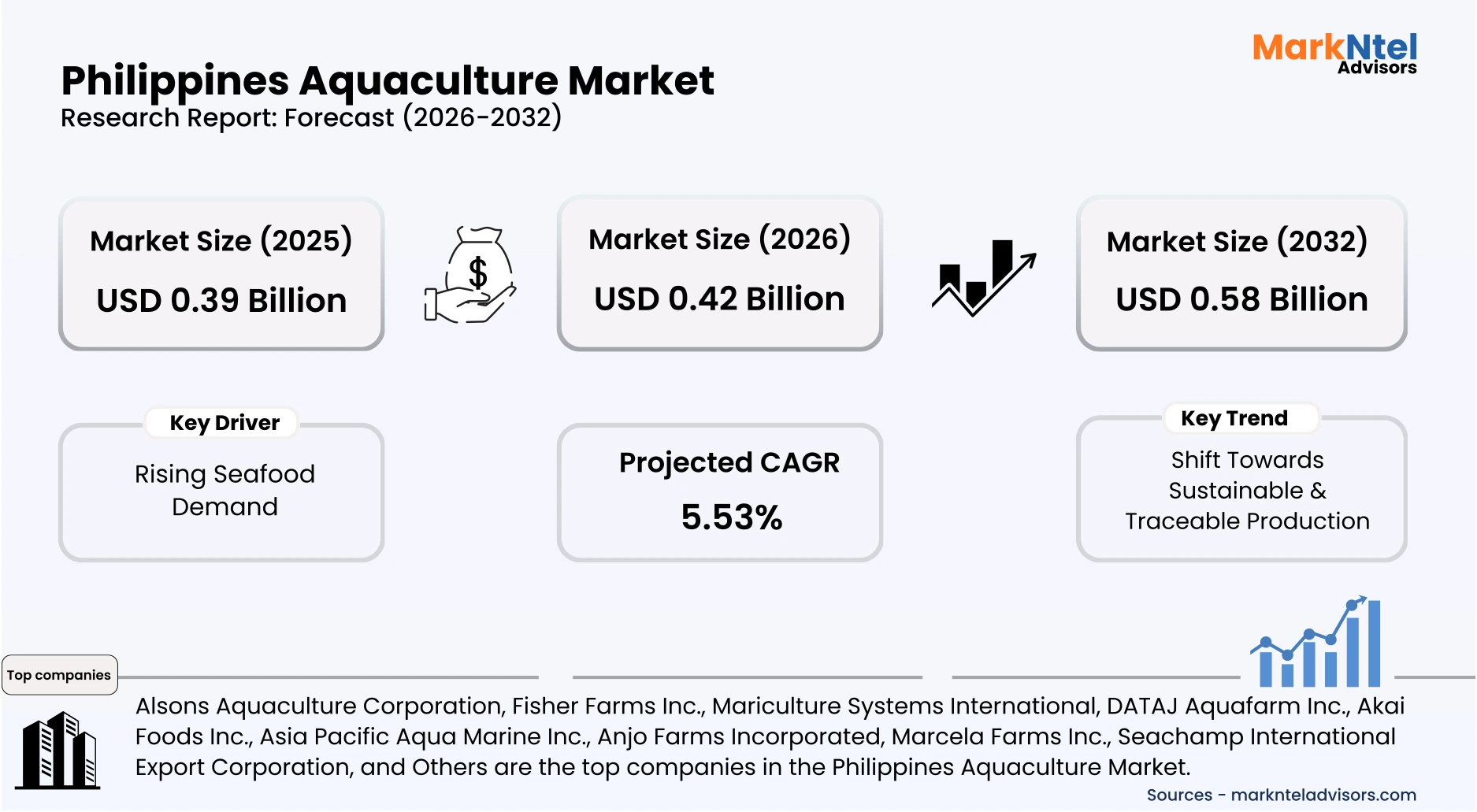
- The Philippines Aquaculture market size was valued at USD 0.39 million in 2025 and is projected to grow from USD 0.42 million in 2026 to USD 0.58 million by 2032, exhibiting a CAGR of 5.53% during the forecast period.
- By Product Type, the seaweed / aquatic plants segment represented a significant share of about 65% in the Philippines Aquaculture Market in 2026.
- By Distribution Channel, the Food Service / Restaurants seized a significant share of about 44% in the Philippines Aquaculture Market in 2026.
- Leading aquaculture companies in the Philippines Market are Alsons Aquaculture Corporation, Fisher Farms Inc., Mariculture Systems International, DATAJ Aquafarm Inc., Akai Foods Inc., Asia Pacific Aqua Marine Inc., Anjo Farms Incorporated, Marcela Farms Inc., Seachamp International Export Corporation, and Others.
Market Insights & Analysis: Philippines Aquaculture Market (2026-32):
The Philippines Aquaculture Market size was valued at around USD 0.39 million in 2025 and is projected to grow from USD 0.42 million in 2026 to USD 0.58 million by 2032. Along with this, the market is estimated to grow at a CAGR of around 5.53% during the forecast period, i.e., 2026-32.
The Philippines aquaculture market is positioned for sustained growth, underpinned by strong domestic seafood consumption, expanding export demand, and supportive government planning. Seafood remains central to Filipino diets, with average per capita consumption among the highest in Southeast Asia, creating persistent demand for cultured fish, crustaceans, and seaweed. With wild capture fisheries approaching biological limits, aquaculture fills critical supply gaps, prompting investments in production efficiency, species diversification, and broader market access.
Regional performance illustrates this momentum. In the Visayas, official Philippine Statistics Authority (PSA) data for 2024 reveal that Western Visayas total fisheries production increased by 8.5%, with aquaculture as a key contributor, growing 29.9% year‑on‑year. This reflects the ability of cultured systems to respond rapidly to local consumption needs and stabilize seafood supplies across island economies. The Visayas, with its combination of coastal geography and established cultural practices, continues to be an important engine of production growth.
Meanwhile, in Mindanao, the Bangsamoro Autonomous Region in Muslim Mindanao (BARMM) emerged as the top aquaculture producer in 2024, generating 944,530.44 MT of aquaculture output, equivalent to approximately 42.5% of the nation’s total aquaculture volume . This concentration of production highlights how regional specialization leverages environmental assets and workforce experience to satisfy both internal and inter‑island market demand.
Alongside volume expansion, a notable market trend is the shift toward sustainable and traceable production. The sector has increasingly adopted frameworks such as Good Aquaculture Practices (GAqP) to embed environmental responsibility, biosecurity, and product traceability into the culture value chain. This trend responds to both consumer expectations for food safety and the quality requirements of export markets, where traceability from seed to plate is often a prerequisite for trade. Sustainable practices also align with ecosystem protection goals, reducing water pollution and improving resource use efficiency.
Looking forward, the aquaculture market is expected to benefit from government initiatives outlined in strategic planning documents that emphasize resilience, technology adoption, and capacity building. Continued enhancements in hatchery operations, seed quality, and climate adaptation will support broad‑based growth.
Overall, the Philippines aquaculture market is robust, driven by rising seafood demand, regional production strength, and a trend toward sustainability and traceability. These dynamics will support long‑term sector growth, improve food security, and enhance export competitiveness through 2026 and beyond.
Philippines Aquaculture Market Recent Developments:
- 2025: The Department of Agriculture and BFAR backed a 1,280 m² nursery to mass‑produce Australian redclaw crayfish, enhancing high‑value aquaculture supply. The hub uses water recycling tech and can produce 48,000 fry bi‑weekly, supporting local farmers and export‑oriented growth .
Philippines Aquaculture Market Scope:
| Category | Segments |
|---|---|
| By Product Type | (Fish, Crustaceans, Mollusks, Seaweed / Aquatic Plants, Others), |
| By Environment | (Freshwater, Marine Water, Brackish Water), |
| By Distribution Channel | (Traditional Retail, Supermarkets & Hypermarkets, Specialized Seafood Stores, Online Channels, Food Service / Restaurants), |
| By End Use | (Human Consumption, Nutraceutical & Pharmaceutical Ingredients, Animal Feed & Aquafeed Production, Cosmetics & Bio-Products), |
Philippines Aquaculture Market Driver:
Rising Seafood Demand
Increasing demand for seafood remains a fundamental driver of the Philippines aquaculture market, fueled by both domestic consumption patterns and national food-security objectives. According to the Philippine Statistics Authority (PSA), total fisheries production reached 2.38 million MT in 2023, with aquaculture contributing nearly 56% of that volume, highlighting its growing role in meeting the country’s seafood requirements .
Wild capture fisheries alone cannot satisfy this demand due to overexploitation, declining stocks, and environmental pressures. Consequently, aquaculture continues to expand, providing a stable, scalable supply. In 2025, the Department of Agriculture Bureau of Fisheries and Aquatic Resources (DA-BFAR) reported aquaculture fry and fingerling output rising to 335.3 million pieces, reflecting government-led efforts to boost farm productivity and future harvest volumes .
Regionally, aquaculture plays a critical role in meeting local seafood demand. In Luzon, PSA data show that Central Luzon produced 87,540.7 MT of aquaculture output in Q2 2025, up 6.6% from Q2 2024, with aquaculture accounting for 86.9% of total fisheries in the period. This demonstrates how regional demand in densely populated areas drives the expansion of cultured production.
Looking beyond 2025, the National Aquaculture Development and Management Plan aims to expand sustainable capacities, diversify species, and improve seedstock quality, ensuring that both domestic consumption and export requirements are met.
Overall, strong seafood consumption, coupled with targeted government initiatives and regional production growth, positions aquaculture as a key growth engine for the Philippines, reinforcing market expansion and long-term food security.
Philippines Aquaculture Market Trend:
Shift Towards Sustainable & Traceable Production
A prominent trend shaping the Philippines aquaculture sector is the growing emphasis on sustainable and traceable production, driven by government policies and industry standards that prioritize environmental stewardship, food safety, and supply chain integrity. The Department of Agriculture Bureau of Fisheries and Aquatic Resources (DA‑BFAR) has institutionalized the Good Aquaculture Practices (GAqP) certification framework to ensure adherence to best practices across aquaculture operations. GAqP mandates compliance with standards covering environmental management, biosecurity, animal health, and product traceability, enabling producers to deliver high-quality seafood while mitigating ecological impact.
In 2025, GAqP certification was extended to over 120 shrimp and milkfish farms in Western Visayas, incorporating rigorous water quality monitoring, biosecurity protocols, and feed traceability systems. These measures not only enhance farm-level sustainability and food safety but also facilitate access to international markets, including Japan and South Korea, where traceable and certified seafood is a prerequisite.
This trend aligns with the National Aquaculture Development and Management Plan 2025–2030, which promotes sustainable hatchery operations, climate-resilient production systems, and full traceability from seed to market. By embedding sustainability and traceability into national strategy, the sector strengthens food security, ensures regulatory compliance, and enhances competitiveness in both domestic and export markets.
Overall, the adoption of sustainable and traceable production is fostering a resilient, internationally compliant aquaculture industry in the Philippines, safeguarding ecosystems, ensuring high-quality seafood, and driving long-term market growth.
Philippines Aquaculture Market Opportunity:
Export-Oriented Aquaculture Products Showing Bright Growth Prospect
The Philippines aquaculture sector holds significant potential for expansion into export-oriented products, driven by strong global demand and a well-established seafood trade network. According to the Department of Agriculture Bureau of Fisheries and Aquatic Resources (DA‑BFAR), the country exported approximately 324,830 MT of fish and fishery products in 2024, earning around USD 1.19 billion in foreign exchange. This demonstrates aquaculture’s capacity to contribute substantially to national revenue while meeting international market requirements .
High-value species such as tuna, seaweed, and crabs dominate exports. Tuna generated USD 391.81 million, seaweed and carrageenan USD 299.78 million, and crabs USD 90.89 million in export revenue in 2023. Seaweed production alone reached 1,626,245 MT in 2023, a 21 % increase from 2021, reinforcing the Philippines’ position as a leading supplier of raw and processed seaweed for food, cosmetics, and pharmaceuticals .
Government initiatives to improve cold-chain logistics, processing facilities, and export certification programs further enhance the sector’s ability to meet international standards. By capitalizing on these mechanisms, Philippine aquaculture producers can increase revenue, diversify export markets, and strengthen the country’s role in the global seafood supply chain.
Overall, expansion into export-oriented aquaculture presents a strategic opportunity for the Philippines, leveraging high-value species, government support, and rising global demand to drive sector growth and foreign exchange earnings.
Philippines Aquaculture Market Challenge:
Climate & Environmental Vulnerabilities
The Philippines aquaculture sector faces significant challenges from climate change and environmental stressors, which threaten both production stability and infrastructure. As an archipelagic nation, the Philippines is highly susceptible to typhoons, rising sea temperatures, sea-level rise, and altered rainfall patterns, all of which directly affect aquaculture operations and coastal farming communities. The Department of Agriculture National Fisheries Research and Development Institute (DA‑NFRDI) identifies provinces such as Capiz, Cebu, and Oriental Mindoro as particularly vulnerable, where extreme weather events and deteriorating water quality can lead to reduced fish growth, higher mortality rates, and disrupted cultivation cycles .
Historical events demonstrate the scale of this challenge. During Super Typhoon Haiyan, approximately 33% of the country’s aquaculture production, primarily in Eastern, Central, and Western Visayas and Mimaropa, was significantly affected, highlighting the sector’s vulnerability to extreme weather and its impact on both output and farm infrastructure .
In response, the National Aquaculture Development and Management Plan emphasizes climate-resilient farming systems, adaptive resource management, and ecosystem protection, aiming to strengthen the sector’s resilience and reduce operational risks.
Overall, climate and environmental vulnerabilities pose persistent risks to Philippine aquaculture, disrupting production cycles, increasing operational costs, and undermining long-term growth. Implementing adaptive, resilient strategies is essential to sustain sector performance and safeguard livelihoods.
Philippines Aquaculture Market (2026-32) Segmentation Analysis:
The Philippines Aquaculture Market study of MarkNtel Advisors evaluates & highlights the major trends and influencing factors in each segment. It includes predictions for the period 2026–32 at the country level. Based on the analysis, the market has been further classified as;
Based on Product Type
- Fish
- Crustaceans
- Mollusks
- Seaweed / Aquatic Plants
- Others
In the Philippines aquaculture market, seaweed and aquatic plants hold the largest share, around 65%. The country’s extensive shallow coastal waters provide ideal conditions for seaweed cultivation, which requires minimal infrastructure and feed compared to finfish or crustaceans. Seaweed species such as Eucheuma and Kappaphycus are fast-growing, resilient, and accessible to smallholder farmers, enabling widespread adoption across coastal communities.
The dominance of seaweed is further reinforced by strong export demand, particularly for carrageenan production, which is extensively used in food processing, personal care, and pharmaceutical industries. Its high commercial value, combined with low production risk and established supply chains, positions seaweed as a highly profitable segment within aquaculture. Additionally, advances in drying and processing technologies have improved product quality and shelf life, enabling broader industrial applications beyond traditional uses.
Based on Distribution Channel:
- Traditional Retail
- Supermarkets & Hypermarkets
- Specialized Seafood Stores
- Online Channels
- Food Service / Restaurants
Within distribution channels, food service and restaurants hold the largest share, around 44% of the Philippine aquaculture market. Rising urbanization, increased disposable income, and a rebound in tourism have driven higher demand for fresh, locally sourced seafood. Restaurants and catering services rely on aquaculture products such as tilapia, shrimp, milkfish (bangus), and seaweed, due to their consistent quality and supply, making this channel a critical revenue source for producers.
The growth of this segment is also supported by evolving consumer preferences toward high-protein and sustainable seafood options. Unlike traditional retail, food service channels often establish direct supply contracts with farms or cooperatives, ensuring stable pricing, quality, and volume. Furthermore, the popularity of specialty seafood menus and themed dining experiences has increased the visibility and consumption of aquaculture products, reinforcing the strategic importance of the food service channel in the overall market.
Philippines Aquaculture Market (2026-32): Regional Projection
The Philippines aquaculture market is largely dominated by the Visayas region, driven by a combination of natural, infrastructural, and institutional advantages. The region’s extensive coastline, sheltered bays, and moderate water conditions provide ideal environments for the farming of high-value species such as fish, shrimp, and shellfish. These geographic and environmental advantages allow for consistent production cycles and high yields, giving the Visayas a comparative edge over other regions.
In addition to natural resources, the region benefits from established aquaculture infrastructure, including hatcheries, nurseries, and farm networks, which facilitate large-scale production. Local expertise and a skilled workforce further contribute to efficient farm operations and the adoption of best practices. The proximity of the Visayas to key domestic markets enables timely distribution, reducing post-harvest losses and ensuring fresh supply for urban and rural consumers alike.
Government support through the Department of Agriculture Bureau of Fisheries and Aquatic Resources (DA‑BFAR) reinforces the region’s dominance by providing technical guidance, promoting sustainable farming practices, and facilitating compliance with export standards. Combined, these factors make Visayas the primary contributor to the national aquaculture sector, sustaining both domestic supply and trade potential while driving long-term market growth.
Gain a Competitive Edge with Our Philippines Aquaculture Market Report:
- Philippines Aquaculture Market Report by MarkNtel Advisors provides a detailed & thorough analysis of market size & share, growth rate, competitive landscape, and key players. This comprehensive analysis helps businesses gain a holistic understanding of the market dynamics & make informed decisions.
- This report also highlights current market trends & future projections, allowing businesses to identify emerging opportunities & potential challenges. By understanding market forecasts, companies can align their strategies & stay ahead of the competition.
- Philippines Aquaculture Market Report aids in assessing & mitigating risks associated with entering or operating in the market. By understanding market dynamics, regulatory frameworks, and potential challenges, businesses can develop strategies to minimize risks & optimize their operations.
*Reports Delivery Format - Market research studies from MarkNtel Advisors are offered in PDF, Excel and PowerPoint formats. Within 24 hours of the payment being successfully received, the report will be sent to your email address.
Frequently Asked Questions
- Market Segmentation
- Introduction
- Product Definition
- Research Process
- Assumptions
- Executive Summary
- Philippines Aquaculture Market Policies, Regulations, and Product Standards
- Philippines Aquaculture Market Trends & Developments
- Philippines Aquaculture Market Dynamics
- Growth Factors
- Challenges
- Philippines Aquaculture Market Hotspot & Opportunities
- Philippines Aquaculture Market Outlook, 2022-2032F
- Market Size & Outlook
- By Revenues (USD Million)
- Market Share & Outlook
- By Product Type- Market Size & Forecast 2022-2032, USD Million
- Fish
- Crustaceans
- Mollusks
- Seaweed / Aquatic Plants
- Others
- By Environment- Market Size & Forecast 2022-2032, USD Million
- Freshwater
- Marine Water
- Brackish Water
- By Distribution Channel- Market Size & Forecast 2022-2032, USD Million
- Traditional Retail
- Supermarkets & Hypermarkets
- Specialized Seafood Stores
- Online Channels
- Food Service / Restaurants
- By End Use- Market Size & Forecast 2022-2032, USD Million
- Human Consumption
- Nutraceutical & Pharmaceutical Ingredients
- Animal Feed & Aquafeed Production
- Cosmetics & Bio-Products
- By Region- Market Size & Forecast 2022-2032, USD Million
- Luzon
- Visayas
- Mindanao
- Others
- By Company
- Competition Characteristics
- Market Share & Analysis
- By Product Type- Market Size & Forecast 2022-2032, USD Million
- Market Size & Outlook
- Philippines Fish Market Outlook, 2022-2032
- Market Size & Outlook
- By Revenues (USD Million)
- Market Share & Outlook
- By Environment- Market Size & Forecast 2022-2032, USD Million
- By Distribution Channel- Market Size & Forecast 2022-2032, USD Million
- By End Use- Market Size & Forecast 2022-2032, USD Million
- By Region- Market Size & Forecast 2022-2032, USD Million
- Market Size & Outlook
- Philippines Crustaceans Market Outlook, 2022-2032
- Market Size & Outlook
- By Revenues (USD Million)
- Market Share & Outlook
- By Environment- Market Size & Forecast 2022-2032, USD Million
- By Distribution Channel- Market Size & Forecast 2022-2032, USD Million
- By End Use- Market Size & Forecast 2022-2032, USD Million
- By Region- Market Size & Forecast 2022-2032, USD Million
- Market Size & Outlook
- Philippines Mollusks Market Outlook, 2022-2032
- Market Size & Outlook
- By Revenues (USD Million)
- Market Share & Outlook
- By Environment- Market Size & Forecast 2022-2032, USD Million
- By Distribution Channel- Market Size & Forecast 2022-2032, USD Million
- By End Use- Market Size & Forecast 2022-2032, USD Million
- By Region- Market Size & Forecast 2022-2032, USD Million
- Market Size & Outlook
- Philippines Seaweed / Aquatic Plants Market Outlook, 2022-2032
- Market Size & Outlook
- By Revenues (USD Million)
- Market Share & Outlook
- By Environment- Market Size & Forecast 2022-2032, USD Million
- By Distribution Channel- Market Size & Forecast 2022-2032, USD Million
- By End Use- Market Size & Forecast 2022-2032, USD Million
- By Region- Market Size & Forecast 2022-2032, USD Million
- Market Size & Outlook
- Philippines Aquaculture Market Key Strategic Imperatives for Success & Growth
- Competitive Outlook
- Company Profiles
- Alsons Aquaculture Corporation
- Business Description
- Product Portfolio
- Collaborations & Alliances
- Recent Developments
- Financial Details
- Others
- Fisher Farms Inc.
- Business Description
- Product Portfolio
- Collaborations & Alliances
- Recent Developments
- Financial Details
- Others
- Mariculture Systems International
- Business Description
- Product Portfolio
- Collaborations & Alliances
- Recent Developments
- Financial Details
- Others
- DATAJ Aquafarm Inc.
- Business Description
- Product Portfolio
- Collaborations & Alliances
- Recent Developments
- Financial Details
- Others
- Asia Pacific Aqua Marine Inc.
- Business Description
- Product Portfolio
- Collaborations & Alliances
- Recent Developments
- Financial Details
- Others
- Anjo Farms Incorporated
- Business Description
- Product Portfolio
- Collaborations & Alliances
- Recent Developments
- Financial Details
- Others
- Marcela Farms Inc.
- Business Description
- Product Portfolio
- Collaborations & Alliances
- Recent Developments
- Financial Details
- Others
- Akai Foods Inc.
- Business Description
- Product Portfolio
- Collaborations & Alliances
- Recent Developments
- Financial Details
- Others
- Seachamp International Export Corporation
- Business Description
- Product Portfolio
- Collaborations & Alliances
- Recent Developments
- Financial Details
- Others
- Others
- Business Description
- Product Portfolio
- Collaborations & Alliances
- Recent Developments
- Financial Details
- Others
- Alsons Aquaculture Corporation
- Company Profiles
- Disclaimer
MarkNtel Advisors follows a robust and iterative research methodology designed to ensure maximum accuracy and minimize deviation in market estimates and forecasts. Our approach combines both bottom-up and top-down techniques to effectively segment and quantify various aspects of the market. A consistent feature across all our research reports is data triangulation, which examines the market from three distinct perspectives to validate findings. Key components of our research process include:
1. Scope & Research Design At the outset, MarkNtel Advisors define the research objectives and formulate pertinent questions. This phase involves determining the type of research—qualitative or quantitative—and designing a methodology that outlines data collection methods, target demographics, and analytical tools. They also establish timelines and budgets to ensure the research aligns with client goals.
2. Sample Selection and Data Collection In this stage, the firm identifies the target audience and determines the appropriate sample size to ensure representativeness. They employ various sampling methods, such as random or stratified sampling, based on the research objectives. Data collection is carried out using tools like surveys, interviews, and observations, ensuring the gathered data is reliable and relevant.
3. Data Analysis and Validation Once data is collected, MarkNtel Advisors undertake a rigorous analysis process. This includes cleaning the data to remove inconsistencies, employing statistical software for quantitative analysis, and thematic analysis for qualitative data. Validation steps are taken to ensure the accuracy and reliability of the findings, minimizing biases and errors.

4. Data Forecast and FinalizationThe final phase involves forecasting future market trends based on the analyzed data. MarkNtel Advisors utilize predictive modeling and time series analysis to anticipate market behaviors. The insights are then compiled into comprehensive reports, featuring visual aids like charts and graphs, and include strategic recommendations to inform client decision-making
We offer flexible licensing options to cater to varying organizational needs. Choose the pricing pack that best suits your requirements:
Buy Now Inquire Before Buying
 Request Customization
 Talk to our Consultant







