

Europe Orthopaedic Implants Market Research Report: Forecast (2025-2030)
Europe Orthopaedic Implants Market - By Type (Joint Reconstruction Implants, Trauma Implants, Spinal Implants, Dental Implants, Orthobiologics, Cranio-Maxillofacial (CMF) Implants, ... Others), By Application (Neck Fracture, Spine Fracture, Hip Replacement, Shoulder Replacement, Others), By Procedure (Open Surgery, Minimally Invasive Surger, Others), By Material (Metallic Biomaterials, Polymeric Materials, Ceramic Biomaterials, Natural Biomaterials), By End User (Hospitals, Ambulatory Surgery Centers, Orthopaedic Specialty Clinics, Trauma & Emergency Care Facilities), and Others Read more
- Healthcare
- Sep 2025
- Pages 165
- Report Format: PDF, Excel, PPT
Europe Orthopaedic Implants Market
Projected 9.28% CAGR from 2025 to 2030
Study Period
2025-2030
Market Size (2025)
USD 13.5 Billion
Market Size (2030)
USD 20.9 Billion
Base Year
2024
Projected CAGR
9.28%
Leading Segments
By Procedure: Minimally Invasive Surgery (MIS)
Market Insights & Analysis: Europe Orthopaedic Implants Market (2025-30):
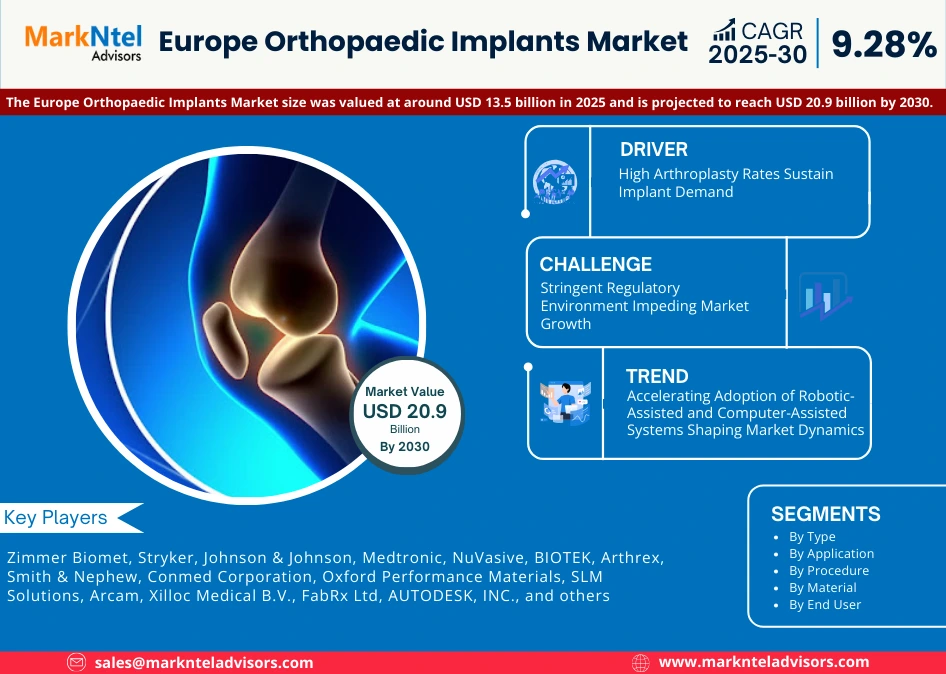
The Europe Orthopaedic Implants Market size was valued at around USD 13.5 billion in 2025 and is projected to reach USD 20.9 billion by 2030. Along with this, the market is estimated to grow at a CAGR of around 9.28% during the forecast period, i.e., 2025-30.
Various factors are attributed to the growing market. As more individuals in Europe are actively participating in sports activities, this has resulted in an increase in sports-related injuries, creating demand for orthopedic procedures and implants. Also, the demand for smart orthopedic solutions is increasing rapidly due to the adoption of digital and connected implants, paired with data services that align with European Health Data Space requirements. Moreover, various patients in the European region now require revision surgeries due to implant longevity. This has further pushed the market of revision orthopedic implants towards growth. Apart from this, the market is shifting from traditional product-only sales to integrated product plus data/service bundles while offering enhanced patient outcomes and ongoing care. Furthermore, the fragmented procurement and reimbursement systems across Europe necessitate flexible product and pricing strategies. This opens new opportunities for specialized orthopedic offerings like 3D-printed joint implants, robotic-assisted joint reconstruction systems, and smart implants with embedded sensors, along with others.
The growing number of sports activities among various people in Europe has increased the incidence of sports-related injuries. Around 6.2 million people in Europe are admitted annually who need hospital treatment for sports-related injuries. Out of them, around 402,000 cases (7%) require further treatments that involve orthopedic implants as well. Team ball sports account for 42% of all hospital-treated sports injuries, with 71% of these linked to football. As these injuries often require surgical intervention ranging from ligament reconstructions to knee and hip replacements, the demand for Orthopaedic implants continues to grow.
Moreover, Digital and connected orthopaedic implants are becoming more important in Europe due to the change in health data rules. As of January 2025, the European Health Data Space requires health systems to share electronic health records in a standard format and allows their reuse for research and monitoring. This gives an advantage to Orthopaedic implants that can provide reliable digital data. Also, the European Commission activated EUDAMED UDI & device registration rules in 2024 (Regulation EU 2024/1860) that expand traceability to the legacy devices. This has resulted in the increasing demand in hospitals for implants with strong digital identification features, including orthopaedic implants. National joint registries further add to this trend, with the UK registry passing 4 million procedures in 2024, and Sweden continues to publish detailed implant data through its Swedish Knee Arthroplasty Register and the Swedish Hip Arthroplasty Register.
Also, there is an increasing demand for revision orthopedic implants in Europe due to the prosthetics from the 1990s-2000s reaching their 15-25-year lifespan. As of 2023, 5,783 knee revisions were recorded by the National Joint Registry, along with a total of 47,090 revisions of hip replacement and 443 revisions in the elbow, confirming the clear uptick in revision procedures. Also, the National Arthroplasty Register in Sweden logs around 2,400 hip revisions and about 1,000 knee revisions every year, demonstrating persistent demand for corrective surgery. These growing numbers of revision orthopaedic implants are also the result of implant wear, failure, and issues like infection or loosening that are common in long-term joint replacements. With a shift towards modern implants from legacy devices, the growth of revision orthopedic implants will continue to rise during the forecast period.
Europe Orthopaedic Implants Market Scope:
| Category | Segments |
|---|---|
| By Type | Joint Reconstruction Implants, Trauma Implants, Spinal Implants, Dental Implants, Orthobiologics, Cranio-Maxillofacial (CMF) Implants, Others |
| By Application | Neck Fracture, Spine Fracture, Hip Replacement, Shoulder Replacement, Others |
| By Procedure | Open Surgery, Minimally Invasive Surger, Others |
| By Material | Metallic Biomaterials, Polymeric Materials, Ceramic Biomaterials, Natural Biomaterials |
| By End User | Hospitals, Ambulatory Surgery Centers, Orthopaedic Specialty Clinics, Trauma & Emergency Care Facilities), and Others |
Europe Orthopaedic Implants Market Driver:
High Arthroplasty Rates Sustain Implant Demand- Europe records some of the world’s highest arthroplasty volumes, which creates a steady baseline demand for orthopaedic implants. In Germany, over 2,29,551 knee replacements were performed in 2023, making them the most common inpatient surgeries. The UK National Joint Registry has logged more than 4 million hip and knee procedures since its creation, confirming the scale of implant use. Population ageing is expanding this candidate pool further, as by 2050, over 33% of the EU population will be over 65, sharply increasing the risk of degenerative joint disease, while further increasing arthroplasty rates. Alongside ageing, unintentional injuries, especially falls, in older adults, also sustain implant demand in Europe. The average fallers prevalence among European older adults is around 30% which creates a heavy risk for joint breakage, hence, creating the demand for orthopaedic implants in the country.
Europe Orthopaedic Implants Market Opportunity:
Growing Expansion of Orthopaedic Procedures in Ambulatory Surgery Centers Offering Lucrative Opportunity– The expansion of Orthopaedic Procedures in Ambulatory Surgery Centers (ASCs) in Europe presents a significant opportunity for the market players. This is because Day-case and short-stay joint procedures allow the Ambulatory Surgery Centers to treat more patients without extra inpatient beds. Due to this, these centres are buying implants and instruments that support fast recovery and same-day discharge. Moreover, UK guidance and delivery packs for ambulatory hip and knee replacement outline safe peri-operative pathways for day-case surgery, creating further opportunities by making these procedures routinable at scale. Furthermore, the increasing adoption of day-case hip and knee replacement in Europe is creating further demand for these products. Device makers are grabbing this opportunity by partnering with ASC operators and health systems in Europe. For instance, Smith & Nephew and Standard Health have partnered on the first Orthopaedic Ambulatory Surgery Centre in the UK in 2025. Also, Stryker publicly positions an ASC business to support customers moving to outpatient models.
Europe Orthopaedic Implants Market Challenge:
Stringent Regulatory Environment Impeding Market Growth– The European Union has revised its regulatory framework for medical devices to improve patient safety and public health. This includes the Medical Device Regulation, operational since 2021, that has strengthened requirements on orthopaedic implant manufacturers. These include enhanced clinical data requirements for higher-risk implants with post-market surveillance and mandatory UDI registration in the EUDAMED database. This has led to the added workload of detailed technical documentation and clinical evaluations, which further adds to the operational cost of the companies. Many have shrunk their product portfolios, risking supply shortages and dampening innovation. The full extent of the Medical Device Regulations' impact on clinical practice is still unclear. However, many European companies lack the necessary resources that lead to bottlenecks in the availability of medical devices. These tighter regulatory demands and limited conformity-assessment capacity create real hurdles for companies while impeding new implant roll-outs and slow market responsiveness across Europe.
Europe Orthopaedic Implants Market Trend:
Accelerating Adoption of Robotic-Assisted and Computer-Assisted Systems Shaping Market Dynamics – Robotic-assisted and computer-assisted systems are becoming a strong trend in Europe’s orthopaedic implant market, as the adoption is no longer limited to pilot projects but is now part of routine care. The adoption is increasing with the NHS robot drive as millions of patients will benefit from cutting-edge NHS robotic surgery every year by 2035, up from 70,000 in 2023-24, according to NHS projections. This includes multiple procedures along with orthopaedic procedures, where the robots are programmed to perform elements of the procedure. Moreover, Hospital Clinic Barcelona has carried out more than 530 robotic knee replacements in under four years with the ROSA Knee System & CORI Surgical System robot. Furthermore, there are more than 350 hospitals in Germany that are performing robotic-assisted surgeries each year, including orthopaedic implant procedures. This trend is growing further in the European market with the product expansion from various companies like Zimmer Biomet’s ROSA knee system, Stryker’s MAKO Smart Robotics, among others. This shift shows that implants designed for robotic precision are in higher demand, making robotics a central driver of innovation in Europe.
Europe Orthopaedic Implants Market (2025-30): Segmentation Analysis
The Europe Orthopaedic Implants Market study of MarkNtel Advisors evaluates & highlights the major trends and influencing factors in each segment. It includes predictions for the period 2025–2030 at the European level. Based on the analysis, the market has been further classified as:
Based on Procedure:
- Open Surgery
- Minimally Invasive Surgery
- Others
The Minimally Invasive Surgery (MIS) segment dominates the market. It holds more than 70% of the total market share. This is because of its alignment with the healthcare priorities of Europe, which focus on the reduction of hospital stays. The MIS helps in reducing this by enabling faster patient recovery through minimal post-operative complications. Moreover, hospitals in Europe are performing the majority of orthopaedic surgeries by minimally invasive techniques, as they are performed using smaller cuts to avoid damaging the surrounding tissues. Moreover, various European countries like the UK, Germany & France are actively supporting MIS through their orthopaedic joint replacement guidelines. This makes it a preferred method over open surgery, which is now mainly used in complex cases or revision surgeries. It will continue to dominate the market during the forecast period.
Based on End User:
- Hospitals
- Ambulatory surgery centers
- Orthopaedic Specialty Clinics
- Trauma & Emergency Care Facilities
- Others
Out of them, Hospitals lead the market. It holds approx. 63% of the total market share. These facilities are highly preferred by the patients due to the reimbursement policies that favour hospital-based care in Europe. Moreover, the highly advanced infrastructure of these hospitals is more than capable of handling the highest volume of complex procedures like hip and knee replacements, spinal surgeries, and trauma repairs. Also, their ability to respond to emergencies and maintain a wide inventory of implants further strengthens their position in the European market. Furthermore, hospitals remain the most trusted and capable providers in the orthopaedic implants sector across Europe by continually investing in modern surgical technologies and training.
Europe Orthopaedic Implants Market (2025-30): Regional Projections
Geographically, the European Orthopaedic Implants Market expands across:
- France
- Germany
- Spain
- Italy
- Benelux
- Scandinavia
- UK
- Others
Out of them, Germany leads the Europe Orthopaedic Implants Market. It holds approx. 28% of the total market share. This is because of the country’s robust healthcare infrastructure that provides high surgical capacity with high procedural volumes. Also, the presence of well-funded public and private hospitals ensures broad market access in Germany. This helps them clear regulatory pathways to accelerate the introduction of new devices and establish their market leadership. Additionally, the country is home to several leading implant manufacturers and precision engineering firms, which helps them to enable consistent supply along with rapid innovation. Its healthcare system maintains short waiting times for orthopaedic surgeries as compared to many European countries. Moreover, Germany’s medical technology clusters are supported by research institutions and specialized training programs for enhancing surgeon expertise and the adoption of cutting-edge implant solutions. This allows them to maintain their leadership in the regional market.
Europe Orthopaedic Implants Industry Recent Developments:
- In September 2025, Medtronic expands the AiBLE spine surgery ecosystem in Europe with new technologies and a Siemens Healthineers partnership, with the launch of several new software, including O-arm 4.3 software, UNiD Adaptive Spine Intelligence (ASI), Mazor robotic guidance system, and a new implant innovation with ModuLeX™ Spinal System.
- In April 2024, Johnson & Johnson launched the TriALTIS Spine System globally, including Europe. It is a next-generation posterior thoracolumbar pedicle screw system that offers a comprehensive implant portfolio and advanced instrumentation designed for integration with enabling technology.
Gain a Competitive Edge with Our Europe Orthopaedic Implants Market Report
- The Europe Orthopaedic Implants Market Report by MarkNtel Advisors provides a detailed & thorough analysis of market size & share, growth rate, competitive landscape, and key players. This comprehensive analysis helps businesses gain a holistic understanding of the market dynamics & make informed decisions.
- This report also highlights current market trends & future projections, allowing businesses to identify emerging opportunities & potential challenges. By understanding market forecasts, companies can align their strategies & stay ahead of the competition.
- The Europe Orthopaedic Implants Market Report aids in assessing & mitigating risks associated with entering or operating in the market. By understanding market dynamics, regulatory frameworks, and potential challenges, businesses can develop strategies to minimize risks & optimize their operations.
*Reports Delivery Format - Market research studies from MarkNtel Advisors are offered in PDF, Excel and PowerPoint formats. Within 24 hours of the payment being successfully received, the report will be sent to your email address.
Frequently Asked Questions
- Market Segmentation
- Introduction
- Market Definition
- Research Process
- Assumptions
- Executive Summary
- Europe Orthopedic Implants Market Trends & Insights
- Europe Orthopedic Implants Market Dynamics
- Growth Drivers
- Challenges
- Europe Orthopedic Implants Market Hotspot & Opportunities
- Europe Orthopedic Implants Market Supply Chain Analysis
- Europe Orthopedic Implants Market Regulation & Policy
- Europe Orthopedic Implants Market Outlook, 2020-2030F
- Market Size & Analysis
- By Revenues (USD Million)
- Market Share & Analysis
- By Type
- Joint Reconstruction Implants-Market Size & Forecast 2020-2030F, USD Million
- Trauma Implants-Market Size & Forecast 2020-2030F, USD Million
- Spinal Implants-Market Size & Forecast 2020-2030F, USD Million
- Dental Implants-Market Size & Forecast 2020-2030F, USD Million
- Orthobiologics-Market Size & Forecast 2020-2030F, USD Million
- Cranio-Maxillofacial (CMF) Implants-Market Size & Forecast 2020-2030F, USD Million
- Others-Market Size & Forecast 2020-2030F, USD Million
- By Application
- Neck Fracture -Market Size & Forecast 2020-2030F, USD Million
- Spine Fracture-Market Size & Forecast 2020-2030F, USD Million
- Hip Replacement-Market Size & Forecast 2020-2030F, USD Million
- Shoulder Replacement-Market Size & Forecast 2020-2030F, USD Million
- Others-Market Size & Forecast 2020-2030F, USD Million
- By Procedure
- Open Surgery-Market Size & Forecast 2020-2030F, USD Million
- Minimally Invasive Surgery-Market Size & Forecast 2020-2030F, USD Million
- Others-Market Size & Forecast 2020-2030F, USD Million
- By Material
- Metallic Biomaterials-Market Size & Forecast 2020-2030F, USD Million
- Polymeric Materials-Market Size & Forecast 2020-2030F, USD Million
- Ceramic Biomaterials-Market Size & Forecast 2020-2030F, USD Million
- Natural Biomaterials-Market Size & Forecast 2020-2030F, USD Million
- By End User
- Hospitals-Market Size & Forecast 2020-2030F, USD Million
- Ambulatory Surgery Centers -Market Size & Forecast 2020-2030F, USD Million
- Orthopaedic Specialty Clinics-Market Size & Forecast 2020-2030F, USD Million
- Trauma & Emergency Care Facilities-Market Size & Forecast 2020-2030F, USD Million
- Others-Market Size & Forecast 2020-2030F, USD Million
- By Country
- France
- Germany
- Spain
- Italy
- Benelux
- Scandinavia
- UK
- Others
- By Competitors
- Competition Characteristics
- Market Share & Analysis
- By Type
- Market Size & Analysis
- France Orthopedic Implants Market Outlook, 2020-2030F
- Market Size & Analysis
- By Revenues (USD Million)
- Market Share & Analysis
- By Type - Market Size & Forecast 2020-2030, USD Million
- By Application - Market Size & Forecast 2020-2030, USD Million
- By Procedure- Market Size & Forecast 2020-2030, USD Million
- By Material- Market Size & Forecast 2020-2030, USD Million
- By End User- Market Size & Forecast 2020-2030, USD Million
- Market Size & Analysis
- Germany Orthopedic Implants Market Outlook, 2020-2030F
- Market Size & Analysis
- By Revenues (USD Million)
- Market Share & Analysis
- By Type - Market Size & Forecast 2020-2030, USD Million
- By Application - Market Size & Forecast 2020-2030, USD Million
- By Procedure- Market Size & Forecast 2020-2030, USD Million
- By Material- Market Size & Forecast 2020-2030, USD Million
- By End User- Market Size & Forecast 2020-2030, USD Million
- Market Size & Analysis
- Spain Orthopedic Implants Market Outlook, 2020-2030F
- Market Size & Analysis
- By Revenues (USD Million)
- Market Share & Analysis
- By Type - Market Size & Forecast 2020-2030, USD Million
- By Application - Market Size & Forecast 2020-2030, USD Million
- By Procedure- Market Size & Forecast 2020-2030, USD Million
- By Material- Market Size & Forecast 2020-2030, USD Million
- By End User- Market Size & Forecast 2020-2030, USD Million
- Market Size & Analysis
- Italy Orthopedic Implants Market Outlook, 2020-2030F
- Market Size & Analysis
- By Revenues (USD Million)
- Market Share & Analysis
- By Type - Market Size & Forecast 2020-2030, USD Million
- By Application - Market Size & Forecast 2020-2030, USD Million
- By Procedure- Market Size & Forecast 2020-2030, USD Million
- By Material- Market Size & Forecast 2020-2030, USD Million
- By End User- Market Size & Forecast 2020-2030, USD Million
- Market Size & Analysis
- Benelux Orthopedic Implants Market Outlook, 2020-2030F
- Market Size & Analysis
- By Revenues (USD Million)
- Market Share & Analysis
- By Type - Market Size & Forecast 2020-2030, USD Million
- By Application - Market Size & Forecast 2020-2030, USD Million
- By Procedure- Market Size & Forecast 2020-2030, USD Million
- By Material- Market Size & Forecast 2020-2030, USD Million
- By End User- Market Size & Forecast 2020-2030, USD Million
- Market Size & Analysis
- Scandinavia Orthopedic Implants Market Outlook, 2020-2030F
- Market Size & Analysis
- By Revenues (USD Million)
- Market Share & Analysis
- By Type - Market Size & Forecast 2020-2030, USD Million
- By Application - Market Size & Forecast 2020-2030, USD Million
- By Procedure- Market Size & Forecast 2020-2030, USD Million
- By Material- Market Size & Forecast 2020-2030, USD Million
- By End User- Market Size & Forecast 2020-2030, USD Million
- Market Size & Analysis
- Europe Orthopedic Implants Market Strategic Imperatives for Success & Growth
- Competition Outlook
- Company Profiles
- Zimmer Biomet
- Business Description
- Product Portfolio
- Strategic Alliances or Partnerships
- Recent Developments
- Financial Details
- Others
- Stryker
- Business Description
- Product Portfolio
- Strategic Alliances or Partnerships
- Recent Developments
- Financial Details
- Others
- Johnson & Johnson
- Business Description
- Product Portfolio
- Strategic Alliances or Partnerships
- Recent Developments
- Financial Details
- Others
- Medtronic
- Business Description
- Product Portfolio
- Strategic Alliances or Partnerships
- Recent Developments
- Financial Details
- Others
- NuVasive
- Business Description
- Product Portfolio
- Strategic Alliances or Partnerships
- Recent Developments
- Financial Details
- Others
- BIOTEK
- Business Description
- Product Portfolio
- Strategic Alliances or Partnerships
- Recent Developments
- Financial Details
- Others
- Arthrex
- Business Description
- Product Portfolio
- Strategic Alliances or Partnerships
- Recent Developments
- Financial Details
- Others
- Smith & Nephew
- Business Description
- Product Portfolio
- Strategic Alliances or Partnerships
- Recent Developments
- Financial Details
- Others
- Conmed Corporation
- Business Description
- Product Portfolio
- Strategic Alliances or Partnerships
- Recent Developments
- Financial Details
- Others
- DePuy Synthes.
- Business Description
- Product Portfolio
- Strategic Alliances or Partnerships
- Recent Developments
- Financial Details
- Others
- SLM Solutions
- Business Description
- Product Portfolio
- Strategic Alliances or Partnerships
- Recent Developments
- Financial Details
- Others
- Arcam
- Business Description
- Product Portfolio
- Strategic Alliances or Partnerships
- Recent Developments
- Financial Details
- Others
- Xilloc Medical B.V.
- Business Description
- Product Portfolio
- Strategic Alliances or Partnerships
- Recent Developments
- Financial Details
- Others
- FabRx Ltd
- Business Description
- Product Portfolio
- Strategic Alliances or Partnerships
- Recent Developments
- Financial Details
- Others
- AUTODESK, INC
- Business Description
- Product Portfolio
- Strategic Alliances or Partnerships
- Recent Developments
- Financial Details
- Others
- Others
- Zimmer Biomet
- Company Profiles
- Disclaimer
MarkNtel Advisors follows a robust and iterative research methodology designed to ensure maximum accuracy and minimize deviation in market estimates and forecasts. Our approach combines both bottom-up and top-down techniques to effectively segment and quantify various aspects of the market. A consistent feature across all our research reports is data triangulation, which examines the market from three distinct perspectives to validate findings. Key components of our research process include:
1. Scope & Research Design At the outset, MarkNtel Advisors define the research objectives and formulate pertinent questions. This phase involves determining the type of research—qualitative or quantitative—and designing a methodology that outlines data collection methods, target demographics, and analytical tools. They also establish timelines and budgets to ensure the research aligns with client goals.
2. Sample Selection and Data Collection In this stage, the firm identifies the target audience and determines the appropriate sample size to ensure representativeness. They employ various sampling methods, such as random or stratified sampling, based on the research objectives. Data collection is carried out using tools like surveys, interviews, and observations, ensuring the gathered data is reliable and relevant.
3. Data Analysis and Validation Once data is collected, MarkNtel Advisors undertake a rigorous analysis process. This includes cleaning the data to remove inconsistencies, employing statistical software for quantitative analysis, and thematic analysis for qualitative data. Validation steps are taken to ensure the accuracy and reliability of the findings, minimizing biases and errors.

4. Data Forecast and FinalizationThe final phase involves forecasting future market trends based on the analyzed data. MarkNtel Advisors utilize predictive modeling and time series analysis to anticipate market behaviors. The insights are then compiled into comprehensive reports, featuring visual aids like charts and graphs, and include strategic recommendations to inform client decision-making
We offer flexible licensing options to cater to varying organizational needs. Choose the pricing pack that best suits your requirements:
Buy Now Inquire Before Buying
 Request Customization
 Talk to our Consultant







