

North America 3D Printed Homes Market Research Report: Forecast (2025-2030)
North America 3D Printed Homes Market - By Construction Method (Extrusion, Powder Bonding, Others (Metal technology, Sand 3D Printing, etc.)), By Construction Material (Plastic , C ... oncrete, Metal, Composite, Others (Rice Waste, Mud, etc.)), By Country (The US, Canada, Mexico), By Company (3D Printed Homes Providers (ALQUIST., Apis Cor., ICON Technology, Inc., Mighty Buildings, Inc., nidus3D Inc., PERI SE, SQ4D), 3D Printed Technology Providers (3D Systems, Inc., GE Additive, Massive Dimension, MudBots 3D Concrete Printing, LLC, SIKA CORPORATION)), and others Read more
- Buildings, Construction, Metals & Mining
- May 2025
- Pages 167
- Report Format: PDF, Excel, PPT
Market Definition
3D-printed homes are designed and built using construction technologies that use the 3D printing method. These homes are faster to create and are way better than the traditionally constructed structures.
Market Insights & Analysis: North America 3D Printed Homes Market (2025-30):
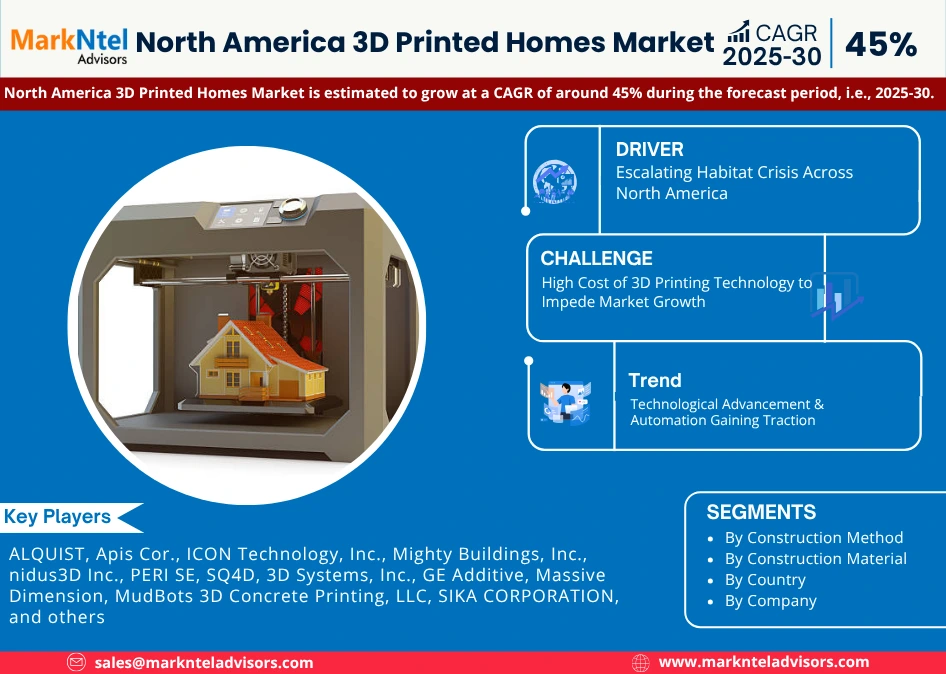
The North America 3D Printed Homes Market is estimated to grow at a CAGR of around 45% during the forecast period, i.e., 2025-30. The market is predominantly driven by the steady adoption of 3D printers in the construction industry in order to prototype and develop exact final products while lowering production costs. The propensity to create homes that not just downsize production hours but also reduce carbon footprints has accelerated 3D-printed homes production across North America. With their ability to replace manual labor while facilitating cost-effective, convenient, and environmentally friendly homes, 3D printers have gained traction in recent years.
Besides, owing to its ability to infiltrate and choose only the required material, the technology aids in reducing construction waste, thereby furthering the adoption of 3D printed technology in residential projects. Another factor backing the incorporation of 3D printed technologies in buildings is the minimal logistical processes involved during the construction. It is primarily because these printers, unlike conventional methods, directly mold raw material into the buildings while eliminating the need for a wooden counterpart. Therefore, with greater design freedom, shorter lead times, and digital manufacturing, 3D printing techniques are emerging as an area of remunerative opportunities for accredited investors and tech giants looking forward to trying their hands on residential projects.
| Report Coverage | Details |
|---|---|
| Historical Years | 2020–23 |
| Forecast Years | 2025–30 |
| CAGR (2025–30) | 45% |
| Top Key Players | ALQUIST, Apis Cor., ICON Technology, Inc., Mighty Buildings, Inc., nidus3D Inc., PERI SE, SQ4D, 3D Systems, Inc., GE Additive, Massive Dimension, MudBots 3D Concrete Printing, LLC, SIKA CORPORATION, and others |
| Segmentation | By Construction Method (Extrusion, Powder Bonding, Others (Metal technology, Sand 3D Printing, etc.)), By Construction Material (Plastic , Concrete, Metal, Composite, Others (Rice Waste, Mud, etc.)), By Country (The US, Canada, Mexico), By Company (3D Printed Homes Providers (ALQUIST., Apis Cor., ICON Technology, Inc., Mighty Buildings, Inc., nidus3D Inc., PERI SE, SQ4D), 3D Printed Technology Providers (3D Systems, Inc., GE Additive, Massive Dimension, MudBots 3D Concrete Printing, LLC, SIKA CORPORATION)), and others |
| Key Report Highlights |
|
*Boost strategic growth with in-depth market analysis - Get a free sample preview today!
In addition, besides, the dependency on robotic or automated builders for creating houses is expected to increase in the next 5 to 10 years, thereby compelling the persistent adoption of 3D printing technologies in creating single-family homes. Multiple single-story buildings in the US have been printed using 3D technology in recent years. These buildings have gained momentum because of their ability to sustain hurricanes and earthquakes while costing 30% less than a traditionally built house. Moreover, with the rapid urbanization entwined with the large influx of migrants, the North American region is likely to witness a shortage of homes in the future. Thus, with the surging need for bulk production of such futuristic homes in a bid to cater to such expansive habitat demand, the 3D-printed homes market is expected to traverse an upward trajectory in the coming years.
North America 3D Printed Homes Market Driver:
Escalating Habitat Crisis Across North America – According to the World Economic Forum, by 2030, three billion people would need improved housing; therefore, nearly 96,000 new homes need to be constructed every day. In line with this, numerous construction companies would face immense pressure to alleviate housing shortages across the region, especially in Texas.
Thus, to overcome the pressure, 3D printing technology would act as a helpful aspect, as it can build high-quality homes in a fraction of the time, efficiently fixing the housing crisis. Because of these benefits, the newer residential projects have been witnessing the adoption of 3D printing for the past few years. More companies are now investing in these technologies, owing to the ever-increasing demand for family homes across North America, further driving the 3D Printed Homes Industry in the region.
North America 3D Printed Homes Market Challenge:
High Cost of 3D Printing Technology to Impede Market Growth – Despite the numerous benefits of 3D printing technology in creating affordable and durable homes, the market may face certain hindrances in terms of higher purchasing or renting costs of 3D printers. In fact, getting them to the site is itself a tedious task and is likely to impede the market growth as construction professionals are getting a bit hesitant while making the adoption. In addition, the initial purchase expenditure excludes materials or maintenance, making 3D printers a bit pricey.
Furthermore, the lack of widespread financing options or leasing models for such large-scale printers adds another layer of financial constraint for small- and mid-sized builders. Regulatory uncertainty around building codes and compliance for 3D printed structures can also delay investment decisions. Additionally, the need for specialized technical training to operate and maintain these machines creates a skills gap that some companies may struggle to fill. These aspects may influence the market growth negatively in the coming years.
North America 3D Printed Homes Market Trend:
Technological Advancement & Automation Gaining Traction – During recent years, various advanced technologies, especially robotics and automation, have played a pivotal role in accelerating the adoption of 3D-printed homes across the country. These innovations are changing the way of building homes. Despite heavy reliance on manual labor, construction companies are using robotic arms and automated systems for printing houses layer by layer with high precision. This upgrade works as a game-changer, specifically at a time when the industry is dealing with skilled labor shortages. Also, with these tools, builders can create complex designs in a shorter time while keeping costs down and reducing waste.
For instance, a company ICON’s project in Georgetown is using robotic printers to build an entire neighborhood of 3D printed homes. These homes are not only faster to construct but also durable and energy-efficient. Many other companies are also exploring and opting for these technologies for construction purposes. As these technologies are experiencing a quicker adoption, the market is expected to see broader adoption of automated 3D printing for residential and even commercial construction across North America in the coming years.
North America 3D Printed Homes Market (2025-30): Segmentation Analysis
The North America 3D Printed Homes Market study of MarkNtel Advisors evaluates & highlights the major trends and influencing factors in each segment. It includes predictions for the period 2025–2030 at the national level. Based on the analysis, the market has been further classified as:
Based on Construction Method:
- Extrusion
- Powder Bonding
- Others (Metal technology, Sand 3D Printing, etc.)
Out of all these, the Extrusion method acquired the maximum share of the North American 3D-Printed Homes Market in the historical period. It is primarily because this is a basic 3D printing technique adopted while erecting a residential building. With plastic filament as a primary printing material, extrusion 3D printing finds applications in modeling, production, and prototyping. The 3D printer's printing head aids in filament heating and further melting. These additive manufacturing technologies are often preferred for on-site building applications, thereby driving the market further during the forecast period.
On the other hand, powder bonding methods are expected to emerge as the second-largest segment with a higher growth pace exhibited in the historical period. It is primarily due to the swift adoption of these technologies in realizing complex structures. Thus, powder bonding methods are comparatively less labor-intensive, time-consuming, and precisely accurate than traditional methods of building homes.
Based on Construction Material:
- Plastic
- Concrete
- Metal
- Composite
- Others (Rice Waste, Mud, etc.)
Among these, concrete stands out as the dominant construction material, holding the largest market share. This is due to widespread availability, cost-efficiency, and structural strength, making it a highly preferred option for 3D printing in home construction. Further, advanced concrete formulations are enhancing the suitability for 3D printing, which enables the creation of complex architectural designs while reducing material wastage. Also, the increasing usage of 3D printed concrete contributes to decreasing the cost of construction, labor requirements, and time, thereby increasing overall productivity in the 3D Printed Homes Industry across the region. Other than this, materials like plastic, metal, and composites are also showing a significant impact on the market growth, however, with a slower pace. Therefore, concrete remains the material of choice in North America for 3D printed homes, owing to its proven performance, economic advantages, and adaptability to various construction needs.
North America 3D Printed Homes Industry Recent Development:
- 2024: nidus3D Inc. partnered with 1Print Construction to develop a multi-unit project in Florida.
- 2023: Mighty Buildings, Inc. raised around USD52 million to expand their construction capabilities globally, with investments from Wa’ed Ventures and BOLD Capital Partners.
Gain a Competitive Edge with Our Global North America 3D Printed Homes Market Report
- North America 3D Printed Homes Market Report by MarkNtel Advisors provides a detailed & thorough analysis of market size & share, growth rate, competitive landscape, and key players. This comprehensive analysis helps businesses gain a holistic understanding of the market dynamics & make informed decisions.
- This report also highlights current market trends & future projections, allowing businesses to identify emerging opportunities & potential challenges. By understanding market forecasts, companies can align their strategies & stay ahead of the competition.
- North America 3D Printed Homes Market Report aids in assessing & mitigating risks associated with entering or operating in the market. By understanding market dynamics, regulatory frameworks, and potential challenges, businesses can develop strategies to minimize risks & optimize their operations.
*Reports Delivery Format - Market research studies from MarkNtel Advisors are offered in PDF, Excel and PowerPoint formats. Within 24 hours of the payment being successfully received, the report will be sent to your email address.
Frequently Asked Questions
- Market Segmentation
- Introduction
- Product Definition
- Research Process
- Assumptions
- Executive Summary
- Impact of COVID-19 on North America 3D Printed Homes Market
- North America 3D Printed Homes Projects, By Countries
- The US
- Canada
- Mexico
- North America 3D Printed Technology Start-up Ecosystem
- Entrepreneurial Activity
- Year on Year Funding Received
- Funding Received by Top Companies
- Key Investors Active in the Market
- Series Wise Funding Received
- Seed Funding
- Angel Investing
- Venture Capitalists (VC) Funding
- Others
- North America 3D Printed Homes Market Trends & Insights
- North America 3D Printed Homes Market Dynamics
- Drivers
- Challenges
- North America 3D Printed Homes Market Porters Five Forces Analysis
- North America 3D Printed Homes Market Regulations & Policies
- North America 3D Printed Homes Market Hotspots & Opportunities
- North America 3D Printed Homes Market Outlook, 2020-2030
- Market Size & Analysis
- By Revenues (USD Million)
- Market Share & Analysis
- By Construction Method
- Extrusion
- Powder Bonding
- Others (Metal technology, Sand 3D Printing, etc.)
- By Construction Material
- Plastic
- Concrete
- Metal
- Composite
- Others (Rice Waste, Mud, etc.)
- By Country
- The US
- Canada
- Mexico
- By Company
- Competition Characteristics
- Revenue Share
- By Construction Method
- The US 3D Printed Homes Market Outlook, 2020-2030
- Market Size & Analysis
- By Revenues (USD Million)
- Market Share & Analysis
- By Construction Method
- By Construction Material
- Market Size & Analysis
- Canada 3D Printed Homes Market Outlook, 2020-2030
- Market Size & Analysis
- By Revenues (USD Million)
- Market Share & Analysis
- By Construction Method
- By Construction Material
- Market Size & Analysis
- Mexico 3D Printed Homes Market Outlook, 2020-2030
- Market Size & Analysis
- By Revenues (USD Million)
- Market Share & Analysis
- By Construction Method
- By Construction Material
- Market Size & Analysis
- Market Size & Analysis
- North America 3D Printed Homes Market Key Strategic Imperatives for Growth & Success
- Competition Outlook
- Competition Matrix
- Brand Specialization
- Target Markets
- Target End Users
- Research & Development
- Strategic Alliances
- Strategic Initiatives
- Company Profiles
- 3D Printed Homes Providers
- ALQUIST.
- Apis Cor.
- ICON Technology, Inc.
- Mighty Buildings, Inc.
- nidus3D Inc.
- PERI SE
- SQ4D
- 3D Printed Technology Providers
- 3D Systems, Inc.
- GE Additive
- Massive Dimension
- MudBots 3D Concrete Printing, LLC
- SIKA CORPORATION
- 3D Printed Homes Providers
- Competition Matrix
- Disclaimer
MarkNtel Advisors follows a robust and iterative research methodology designed to ensure maximum accuracy and minimize deviation in market estimates and forecasts. Our approach combines both bottom-up and top-down techniques to effectively segment and quantify various aspects of the market. A consistent feature across all our research reports is data triangulation, which examines the market from three distinct perspectives to validate findings. Key components of our research process include:
1. Scope & Research Design At the outset, MarkNtel Advisors define the research objectives and formulate pertinent questions. This phase involves determining the type of research—qualitative or quantitative—and designing a methodology that outlines data collection methods, target demographics, and analytical tools. They also establish timelines and budgets to ensure the research aligns with client goals.
2. Sample Selection and Data Collection In this stage, the firm identifies the target audience and determines the appropriate sample size to ensure representativeness. They employ various sampling methods, such as random or stratified sampling, based on the research objectives. Data collection is carried out using tools like surveys, interviews, and observations, ensuring the gathered data is reliable and relevant.
3. Data Analysis and Validation Once data is collected, MarkNtel Advisors undertake a rigorous analysis process. This includes cleaning the data to remove inconsistencies, employing statistical software for quantitative analysis, and thematic analysis for qualitative data. Validation steps are taken to ensure the accuracy and reliability of the findings, minimizing biases and errors.

4. Data Forecast and FinalizationThe final phase involves forecasting future market trends based on the analyzed data. MarkNtel Advisors utilize predictive modeling and time series analysis to anticipate market behaviors. The insights are then compiled into comprehensive reports, featuring visual aids like charts and graphs, and include strategic recommendations to inform client decision-making
We offer flexible licensing options to cater to varying organizational needs. Choose the pricing pack that best suits your requirements:
Buy Now Inquire Before Buying
 Request Customization
 Talk to our Consultant







