

India 3D Printer Market Research Report: Forecast (2025-2030)
India 3D Printer Market - By Product (Industrial 3D Printer, Desktop 3D Printer), By Technology (Fused Deposition Modelling, Selective Laser Sintering, Stereolithography, Digital L ... ight Processing), By Application (Medical (Bio Printing, Medical Devices, Pills), Industrial (Apparel, Automotive, Construction, Consumer Electronics), Others (Education & Research, Art & Jewelry, Aerospace & Defense)), and others Read more
- Energy
- Sep 2025
- Pages 115
- Report Format: PDF, Excel, PPT
India 3D Printer Market
Projected 12.55% CAGR from 2025 to 2030
Study Period
2025-2030
Market Size (2025)
USD 387 Million
Market Size (2030)
USD 699 Million
Base Year
2024
Projected CAGR
12.55%
Leading Segments
By Product:
Market Definition
3D printers are technologically advanced machines used for additive manufacturing of specialized, complex, & customized products that require high accuracy. These printers are gaining swift momentum across various industries like automotive, aerospace, consumer electronics, and art & jewelry in India, principally due to their capabilities to create lightweight & geometrically complex parts.
Market Insights & Analysis: India 3D Printer Market (2025-30):
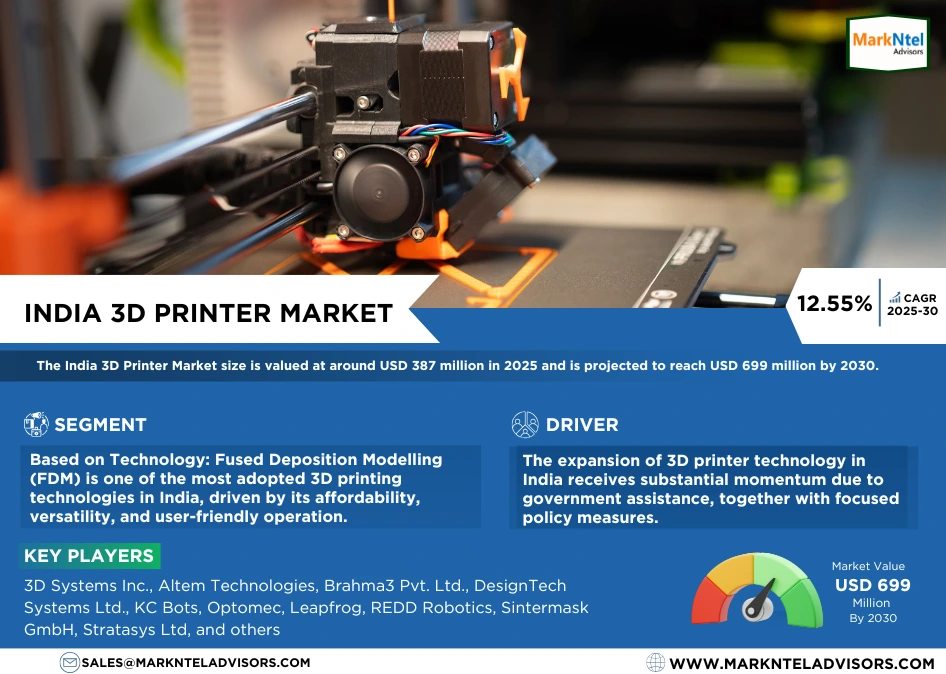
The India 3D Printer Market size is valued at around USD 387 million in 2025 and is projected to reach USD 699 million by 2030. Along with this, the market is estimated to grow at a CAGR of around 12.55% during the forecast period, i.e., 2025-30. In India, the growth of 3D printing is being pushed forward by the need for more accurate and flexible manufacturing. Companies want to save time, reduce waste, and still deliver products that meet specific requirements. With stronger materials now available—like advanced polymers, composites, and metals—the technology has moved beyond simple prototypes to producing tough, lightweight parts that perform well across different industries. For instance, in 2024, the Government Secondary School in Pachin, Itanagar, Arunachal Pradesh, underwent 3D concrete printing construction to demonstrate the technology's potential for large-scale infrastructure projects.
Moreover, 3D printing technology finds expanding applications in the healthcare sector, automotive & aerospace industries for their changing market requirements. Modern healthcare facilities utilize customized implants alongside prosthetics and surgical guides, which enhance patient treatment success and surgical accuracy. Automotive and aerospace industries apply this technology for fast prototyping and lightweight part manufacturing, which reduces expenses and speeds up product delivery times.
India 3D Printer Market Scope:
| Category | Segments |
|---|---|
| By Product | Industrial 3D Printer, Desktop 3D Printer |
| By Technology | Fused Deposition Modelling, Selective Laser Sintering, Stereolithography, Digital Light Processing |
| By Application | Medical (Bio Printing, Medical Devices, Pills), Industrial (Apparel, Automotive, Construction, Consumer Electronics), Others (Education & Research, Art & Jewelry, Aerospace & Defense)), and others |
India 3D Printer Market Driver:
Government Support & Policy Initiatives – The expansion of 3D printer technology in India receives substantial momentum due to government assistance, together with focused policy measures. The government enables startups, MSMEs, and research institutions to access advanced manufacturing technology through its strategic programs and infrastructure investments. These measures lower startup costs and innovation expenses while establishing a favorable space for industry development.
For instance, on February 2, 2025, the Ministry of Electronics and Information Technology (MeitY) sanctioned around USD12.28 million to establish a Common Facility Center (CFC) in Nava Raipur through the EMC 2.0 scheme. The facility will offer cutting-edge infrastructure, which includes 3D printing and PCB prototyping, along with product validation labs to enable innovators to use world-class resources at no substantial capital expense.
These programs establish a robust foundation for the Indian additive manufacturing industry, thus attracting investments, which makes India a leading center for 3D printing technology development. The government supports technology adoption through financial incentives and infrastructure development, and skill enhancement programs, which create a robust ecosystem that enables India to compete in the global additive manufacturing field.
India 3D Printer Market Opportunity:
Expanding Personalized Healthcare Solution through 3D printing – India's healthcare industry provides 3D printing to develop personalized medical implants, operational guides, and anatomical models. This technology will create patient-specific solutions using safe materials or improve treatment precision, reduce surgical procedures, and provide faster recovery times. In April 2024, Incredible 3D reported producing over 3,000 custom patient implants since 2018 while maintaining Indian FDA compliance and ISO certifications. The company leads the metal 3D printing industry in India and Southeast Asia by delivering innovative solutions to medical facilities.
Medical devices created by 3D printing are becoming increasingly common in everyday healthcare practices due to this technological development. Personalized medical manufacturing appears as a growth opportunity for 3D printer manufacturers and material suppliers in India because of increased healthcare funding and simplified approval methods.
India 3D Printer Market Challenge:
High Cost Restricting Wider Adoption – The Indian 3D printer industry faces a major challenge due to industrial 3D printers needing expensive starting investments, particularly metal 3D printers. For instance, industrial-grade metal 3D printers cost between USD228,000 and USD570,000 while also requiring imported raw materials and specialized maintenance and operator expenses. This is restricting small and medium enterprises, as they constitute the majority of manufacturing businesses in India. Similarly, in January 2024, at the IMTEX exhibition in Bengaluru, STPL3D presented the first large-format SLS 3D printer for India, which included a 500 × 500 × 500 mm build volume and a 100 W CO₂ laser. Due to the high cost, most MSMEs cannot afford it and are basically used by the large enterprises and research institutions.
Moreover, many small manufacturers, with limited access to advanced equipment, will rely on traditional production methods or outsource 3D printing services, resulting in slowing down the country's overall 3D printing adoption.
India 3D Printer Market Trend:
Increasing Demand from Aerospace & Private Space Ventures – The rapidly expanding aerospace and private space exploration industry reflects a major trend that significantly influences the Indian 3D printer market. The country showcases its growing manufacturing capabilities through 3D printer innovations. For instance, in May 2025, Agnikul Cosmos launched Agnibaan, the first Indian private rocket with a single-piece 3D-printed engine, achieving a 3-day production cycle compared to traditional methods that take 6 to 11 months.
The Indian private aerospace sector enhances its 3D printing skills through Skyroot Aerospace's fully 3D-printed cryogenic engines, while IIT Madras advances research via its dedicated additive fabrication laboratories. These groundbreaking developments are opening new doors for industrial uses, promoting Make in India, and positioning India as a leading high-performance additive manufacturing hub.
India 3D Printer Market (2025-30): Segmentation Analysis
The India 3D Printer Market study of MarkNtel Advisors evaluates & highlights the major trends and influencing factors in each segment. It includes predictions for the period 2025–30 at the country level. Based on the analysis, the market has been further classified as:
Based on Product:
- Industrial 3D Printer
- Desktop 3D Printer
Based on the product, Industrial 3D printers hold the largest market share of the India 3D Printer Industry, driven by their extensive use in high-value sectors such as aerospace, defense, automotive, and healthcare. Industrial printers function as high-volume manufacturing equipment that delivers precise production results from metals and composites to advanced polymers in large build volumes. Industrial-grade systems differ from desktop models because they produce final-use components that fulfill strict safety and performance requirements for critical mission needs.
Industrial 3D printing receives growth support from India's growing manufacturing base, as well as government programs to advance manufacturing technology and domestic production demands that decrease reliance on foreign imports. Manufacturers achieve higher efficiency through industrial 3D printing while achieving waste reduction benefits from its capability to produce intricate designs and customized lightweight products. Production line integration of these systems helps manufacturers develop prototypes faster and generate customized high-value components with reduced lead times.
For instance, in July 2024, INDO-MIM partnered with HP to deploy three Metal Jet S100 printers, which will operate in Bengaluru and Texas for aerospace defense and automotive manufacturers. The initiative demonstrates how industrial 3D printing functions as a key technology to achieve precision manufacturing standards at global levels.
Based on Technology:
- Fused Deposition Modelling
- Selective Laser Sintering
- Stereolithography
- Digital Light Processing
- Others
Based on Technology, Fused Deposition Modelling (FDM) is one of the most adopted 3D printing technologies in India, driven by its affordability, versatility, and user-friendly operation. This technology functions by depositing thermoplastic filaments in successive layers to create parts suitable for applications ranging from prototyping and educational tasks to producing functional end-use components. FDM operates with various materials, including PLA and ABS, as well as PETG and engineering-grade composites that allow users to select based on performance needs and budget constraints. The low setup cost, together with basic operational requirements, makes FDM the preferred choice for MSMEs and startups as well as research institutes and service bureaus.
FDM leads the market because it remains more accessible than SLS and SLA technologies, which need higher financial investment and controlled environments. FDM printers continue to evolve through improvements that enable multi-material printing capabilities and larger build capacities, and broaden their industrial applications beyond basic prototyping. For Instance, in June 2025, ITC Ltd. partnered with Fabheads to create 3D-printed consumer electronics display covers through advanced FDM techniques.
India 3D Printer Industry Recent Development:
- April 2025: Stratasys launched the Neo800+ stereolithography 3D printer, delivering up to 50% faster print speeds with advanced ScanControl+™ technology, optimized for large-format, high-precision industrial applications in sectors like automotive and aerospace. This upgrade features a 4W laser, enhanced optics, certified materials for reliable performance, and automated environmental safeguards for improved reliability and lower cost per part.
- September 2024: EDS Technologies Partnered with Optomec, which operates as a U.S.-based leader in additive manufacturing systems. The collaboration introduces to India Optomec’s cutting-edge Aerosol Jet and LENS (Laser Engineered Net Shaping) 3D printing systems. The technologies allow exact electronic printing of high-density interconnects and flexible circuits, metal components manufacturing, and repair capabilities.
Gain a Competitive Edge with Our India 3D Printer Market Report
- India 3D Printer Market Report by MarkNtel Advisors provides a detailed & thorough analysis of market size & market share, growth rate, competitive landscape, and key players. This comprehensive analysis helps businesses gain a holistic understanding of market dynamics & make informed decisions.
- This report also highlights current market trends & future projections, allowing businesses to identify emerging opportunities & potential challenges. By understanding market forecasts, companies can align their strategies & stay ahead of the competition.
- India 3D Printer Market Report aids in assessing & mitigating risks associated with entering or operating in the market. By understanding market dynamics, regulatory frameworks, and potential challenges, businesses can develop strategies to minimize risks & optimize their operations.
*Reports Delivery Format - Market research studies from MarkNtel Advisors are offered in PDF, Excel and PowerPoint formats. Within 24 hours of the payment being successfully received, the report will be sent to your email address.
Frequently Asked Questions
- Introduction
- Product Definition
- Research Process
- Assumptions
- Market Segmentation
- Executive Summary
- Expert Verbatim- What our Experts Say?
- Macro-Economic Indicators
- India 3D Printer Market Outlook, 2019-2030
- Market Size & Analysis
- Units Sold
- Market Revenues
- Market Share & Analysis
- By Product
- Industrial 3D Printer
- Desktop 3D Printer
- By Technology
- Fused Deposition Modelling
- Selective Laser Sintering
- Stereolithography
- Digital Light Processing
- Others
- By Application
- Medical
- Bio Printing
- Medical Devices
- Pills
- Industrial
- Apparel
- Automotive
- Construction
- Consumer Electronics
- Others
- Education and Research
- Art and Jewelry
- Aerospace & Defense
- Medical
- By Region
- North
- South
- West
- East
- North-East
- By Competitors
- Competitor-Wise Revenue Share
- Strategic Factorial Indexing
- Competitor Placement on MarkNtel Quadrant
- By Product
- Market Size & Analysis
- India 3D Printer Market Attractiveness Index
- By Product
- By Technology
- By Application
- By End Users
- By Region
- India 3D Printer Market Policy & Regulations
- India 3D Printer Market Trends & Developments
- India 3D Printer Market Dynamics
- Impact Analysis
- Drivers
- Challenges
- India 3D Printer Market Import Export Analysis
- India 3D Printer Market- Price Analysis
- India 3D Printer Market- Buyer’s Behavior
- Selection – Price, Quality, Technology, Brand, Support Services
- India 3D Printer Market Winning Strategies
- Investment Scenario
- Hotspots
- India 3D Printer Market Porter’s Five Forces Analysis
- India 3D Printer Market Key Success Imperatives for Growth & Success
- Competitive Benchmarking
- Competition Matrix
- Product Portfolio
- Target Markets
- Target End Users
- After-Sale Service
- Strategic Alliances
- Company Profiles (Business Description, Product Offering, Strategic Alliances or Partnerships, etc.)
- 3D Systems Inc.
- Altem Technologies
- Brahma3 Pvt. Ltd.
- DesignTech Systems Ltd.
- KC Bots
- Optomec
- Leapfrog
- REDD Robotics
- Sintermask GmbH
- Stratasys Ltd.
- Competition Matrix
- Disclaimer
MarkNtel Advisors follows a robust and iterative research methodology designed to ensure maximum accuracy and minimize deviation in market estimates and forecasts. Our approach combines both bottom-up and top-down techniques to effectively segment and quantify various aspects of the market. A consistent feature across all our research reports is data triangulation, which examines the market from three distinct perspectives to validate findings. Key components of our research process include:
1. Scope & Research Design At the outset, MarkNtel Advisors define the research objectives and formulate pertinent questions. This phase involves determining the type of research—qualitative or quantitative—and designing a methodology that outlines data collection methods, target demographics, and analytical tools. They also establish timelines and budgets to ensure the research aligns with client goals.
2. Sample Selection and Data Collection In this stage, the firm identifies the target audience and determines the appropriate sample size to ensure representativeness. They employ various sampling methods, such as random or stratified sampling, based on the research objectives. Data collection is carried out using tools like surveys, interviews, and observations, ensuring the gathered data is reliable and relevant.
3. Data Analysis and Validation Once data is collected, MarkNtel Advisors undertake a rigorous analysis process. This includes cleaning the data to remove inconsistencies, employing statistical software for quantitative analysis, and thematic analysis for qualitative data. Validation steps are taken to ensure the accuracy and reliability of the findings, minimizing biases and errors.

4. Data Forecast and FinalizationThe final phase involves forecasting future market trends based on the analyzed data. MarkNtel Advisors utilize predictive modeling and time series analysis to anticipate market behaviors. The insights are then compiled into comprehensive reports, featuring visual aids like charts and graphs, and include strategic recommendations to inform client decision-making
We offer flexible licensing options to cater to varying organizational needs. Choose the pricing pack that best suits your requirements:
Buy Now Inquire Before Buying
 Request Customization
 Talk to our Consultant







