

Global Microgrid Controller Market Research Report: Forecast (2026-2032)
Global Microgrid Controller Market - By Offering (Hardware, Software, Services), By End User (Commercial, Remote Areas, Military, Government, Utilities, Institutes & Campuses, Hea ... lthcare), and others Read more
- Energy
- Jan 2026
- Pages 195
- Report Format: PDF, Excel, PPT
Global Microgrid Controller Market
Projected 15.53% CAGR from 2026 to 2032
Study Period
2026-2032
Market Size (2025)
USD 8.73 Billion
Market Size (2032)
USD 23.98 Billion
Largest Region
Asia-Pacific
Projected CAGR
15.53%
Leading Segments
By End Users: Commercial
Global Microgrid Controller Market Report Key Takeaways:
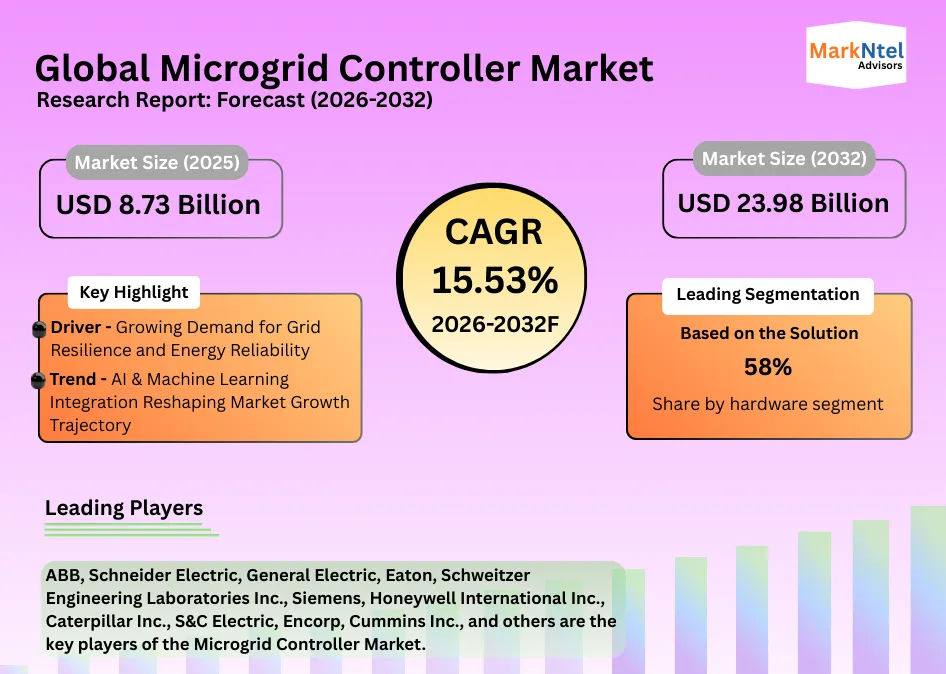
- The Global Microgrid Controller Market size was valued at around USD 8.73 billion in 2025 and is projected to reach USD 23.98 billion by 2032. The estimated CAGR from 2026 to 2032 is around 15.53%, indicating strong growth.
- By offering, the hardware represented 58% of the Global Microgrid Controller Market size in 2025.
- By end user, the Commercial segment represented 36% of the Global Microgrid Controller Market size in 2025.
- By Region, Asia-Pacific leads the Global Microgrid Controller Market with a dominant 43% market share in 2025.
- The leading microgrid controller companies are ABB, Schneider Electric, General Electric, Eaton, Schweitzer Engineering Laboratories Inc., Siemens, Honeywell International Inc., Caterpillar Inc., S&C Electric, Encorp, Cummins Inc., and others.
Market Insights & Analysis: Global Microgrid Controller Market (2026- 2032):
The Global Microgrid Controller Market size was valued at around USD 8.73 billion in 2025 and is projected to reach USD 23.98 billion by 2032. Along with this, the market is estimated to grow at a CAGR of around 15.53% during the forecast period, i.e., 2026-32. The Global Microgrid Controller Market is primarily driven by rising concerns around grid resilience, climate-induced disruptions, and the need for intelligent energy management. Governments, utilities, and enterprises are increasingly prioritizing localized, digitally controlled power systems capable of operating independently during outages and supporting renewable-heavy energy mixes.
In 2025, the National Renewable Energy Laboratory (NREL) emphasized that microgrids can significantly reduce blackout durations and help communities recover faster from extreme weather events, reinforcing their role as critical resilience infrastructure for hospitals, emergency services, and remote communities. This institutional recognition strengthens long-term adoption of microgrid control platforms that enable autonomous operation and rapid system restoration.
Technological advancements are further accelerating momentum. At Energy Taiwan 2025, Delta Electronics launched an AI-enabled microgrid solution for data centers and industrial facilities, integrating renewables, energy storage, hydrogen fuel cells, and advanced controllers. The solution is designed to handle rapid load fluctuations with high efficiency, highlighting how intelligent controllers are becoming central to managing complex, power-intensive environments.
On the innovation front, Schneider Electric’s USD 2.4 billion global R&D investment, including the opening of new microgrid and data-center testing laboratories in Massachusetts in 2025, underscores a strong industry commitment to advancing controller performance, interoperability, and commercialization readiness.
Overall, continued investments in grid modernization, AI-driven control systems, and resilient energy infrastructure are expected to sustain strong demand for microgrid controllers. As decentralized power systems become integral to national energy strategies, advanced controllers will remain essential enablers of reliability, efficiency, and long-term market expansion.
Global Microgrid Controller Market Recent Developments:
- September 2025: Eaton partnered with Xendee Corporation to co-develop AI-powered microgrid design and control solutions. The collaboration integrates Eaton’s hardware with Xendee’s predictive software, aiming to deliver optimized energy resilience, greater efficiency, and operating cost savings for microgrid deployments globally.
- November 2025: U.S. microgrid installations are accelerating, with capacity expected to reach 10 GW by the end of 2025 as data centers and communities seek reliable decentralized power. This expansion reflects rising demand for advanced microgrid controllers and DER integration to meet reliability and resilience goals.
Global Microgrid Controller Market Scope:
| Category | Segments |
|---|---|
| By Offering | Hardware, Software, Services |
| By End User | Commercial, Remote Areas, Military, Government, Utilities, Institutes & Campuses, Healthcare |
Global Microgrid Controller Market Drivers:
Growing Demand for Grid Resilience and Energy Reliability
The increasing need for grid resilience and reliable electricity is a key driver of the Global Microgrid Controller Market. Microgrids enhance energy reliability by enabling localized power generation and autonomous operation during widespread grid disruptions, a growing concern for utilities and policymakers as traditional grids face aging infrastructure and escalating demand. According to the U.S. Department of Energy (DOE), microgrids are being advanced through targeted funding programs, with more than USD 8 million allocated in 2025 under the Community Microgrid Assistance Partnership to support resilient microgrid innovation in remote and underserved communities across the United States. This strategic investment reflects governmental priorities to reduce outage vulnerability and enhance localized reliability through smart energy systems.
In addition, the DOE’s Microgrid Program Strategy aims for microgrids to become “essential building blocks of the future electricity delivery system by 2035,” underscoring long-term planning that will drive controller demand as integration with distributed energy resources (DERs) scales.
On a broader scale, massive grid modernization plans worldwide, such as the European Commission’s USD 633 billion investment in grid digitalization by 2030, will necessitate resilient, automated control technologies like microgrid controllers to manage increasingly decentralized and renewable-rich power systems.
In addition, as governments invest heavily in grid resilience, digitalization, and energy security beyond 2025, the need for robust microgrid controllers will accelerate, making them critical tools for reliable and resilient power delivery.
Global Microgrid Controller Market Trends:
AI & Machine Learning Integration Reshaping Market Growth Trajectory
The integration of Artificial Intelligence (AI) and Machine Learning (ML) into microgrid controllers is emerging as a critical trend, driven by the need for advanced forecasting, autonomous decision-making, and efficient management of distributed energy resources. Government-supported research institutions are actively advancing AI-based control architectures to enhance grid resilience and operational efficiency.
For instance, Sandia National Laboratories, funded by the U.S. Department of Energy’s Office of Electricity, is developing the MOSAIC microgrid controller concept, which uses AI-based optimization to manage distributed energy resources more effectively, improving reliability and automated decision-making in microgrid operations. This program highlights government support for AI-enhanced microgrid control to bolster energy resilience and efficiency.
Similarly, the National Renewable Energy Laboratory (NREL) is developing AI-based tools for predictive energy management, including machine-learning models that enhance renewable generation forecasting and automated dispatch decisions. According to NREL, AI-supported control systems can significantly reduce operational inefficiencies by enabling predictive maintenance and adaptive energy balancing in decentralized power networks.
Overall, institutional emphasis on AI/ML integration confirms that smarter, predictive microgrid controllers are becoming a core requirement for resilient, efficient energy systems, driving adoption and technological investment throughout the market.
Global Microgrid Controller Market Challenges:
High Capital & Operating Costs Impeding Market Growth
One of the most significant barriers to the adoption of microgrid controllers and broader microgrid systems is the high upfront capital investment required for development, integration, and deployment. Establishing a fully functional microgrid involves not only controllers but also generation assets, energy storage, power electronics, and infrastructure upgrades, all of which contribute to elevated initial costs. According to a U.S. Department of Energy (DOE) cost analysis, a typical microgrid project can range between about USD 2.5 million and USD 4.4 million per megawatt of installed capacity, depending on complexity and component mix. Controller hardware and related infrastructure alone can cost from approximately USD 6,200 to USD 470,000 per megawatt, with an average of around USD 155,000/MW reported in the NREL database, a substantial financial outlay for many communities and organizations.
These high initial costs can delay or deter investment, especially in regions with limited financial resources or low electricity prices, where long payback periods make financing difficult. The unique nature of each installation also means that microgrids often lack standardized, modular designs, increasing design and engineering expenses.
Moreover, ambitious decentralized energy initiatives such as rural solar microgrid plans in India faced scalability challenges due to elevated unit costs and infrastructure complexities, leading to shelving of early proposals.
Because high initial costs make securing financing challenging and increase project risk, stakeholders often require substantial government incentives, grants, or innovative financing mechanisms to make microgrid controller–enabled systems financially viable in the long run. This cost barrier remains a key challenge that must be addressed for broader adoption and market growth.
Global Microgrid Controller Market(2026-32) Segmentation Analysis:
The Global Microgrid Controller Market Report and Forecast 2026-2032 offers a detailed analysis of the market based on the following segments:
Based on Offering:
- Hardware
- Software
- Services
The hardware segment accounts for around 58% of the Global Microgrid Controller Market. Market dominance is due to its foundational role in microgrid deployment. Hardware components such as controllers, sensors, protection relays, communication modules, and power electronics are essential for real-time monitoring, control, and coordination of distributed energy resources. Every microgrid project requires robust physical infrastructure to ensure grid stability, islanding capability, voltage and frequency regulation, and secure integration with renewable energy sources and energy storage systems. Unlike software or services, hardware investments are largely non-negotiable and front-loaded, significantly increasing their share in overall spending. Additionally, the growing deployment of microgrids in critical applications such as data centers, military bases, hospitals, and utilities demands high-reliability, industrial-grade hardware, which further elevates costs. As grid resilience becomes a priority amid rising climate-related disruptions, investments in advanced control hardware with higher redundancy, cybersecurity features, and interoperability continue to rise, reinforcing hardware’s dominance in market revenue.
Based on End Users:
- Commercial
- Remote Areas
- Military
- Government
- Utilities
- Institutes & Campuses
- Healthcare
The commercial end-user segment, representing around 36% of total market revenue, dominates due to its strong demand for uninterrupted, cost-efficient, and controllable power supply. Manufacturing facilities, data centers, logistics hubs, and large commercial complexes face significant financial losses from power outages, making microgrid controllers a strategic investment rather than an optional upgrade. These users increasingly deploy microgrids to integrate on-site renewables, battery storage, and backup generators, requiring advanced controllers to optimize energy flows and manage peak loads.
Additionally, rising electricity tariffs and corporate decarbonization commitments are pushing C&I players toward energy self-reliance and efficiency improvements. Microgrid controllers enable demand response participation, real-time energy optimization, and seamless grid-to-island transitions, directly improving operational resilience. Compared to residential or remote users, commercial and industrial entities also have greater capital availability and faster return-on-investment expectations, accelerating adoption and positioning this segment as the leading contributor to market growth.
Global Microgrid Controller Market (2026-32): Regional Projection
The Global Microgrid Controller Market is dominated by the Asia-Pacific region, accounting for nearly 43% share of the overall market. This dominance is driven by rapid urbanization, large-scale renewable energy deployment, and rising electricity demand across China, India, Japan, South Korea, and Southeast Asian economies. Governments in the region are actively promoting distributed energy systems to strengthen grid resilience, reduce transmission losses, and improve energy access in remote and islanded areas.
Countries such as China and India are investing heavily in solar, wind, battery storage, and smart grid infrastructure, creating strong demand for advanced microgrid controllers. Industrial expansion, growth of data centers, and increasing electrification of transportation further accelerate adoption among commercial and utility users. In addition, frequent climate-related disruptions and grid congestion issues push utilities and industrial operators toward localized power management solutions. Strong policy support and infrastructure investment sustain the Asia Pacific’s market leadership.
Gain a Competitive Edge with Our Global Microgrid Controller Market Report
- Global Microgrid Controller Market Report by MarkNtel Advisors provides a detailed & thorough analysis of market size & share, growth rate, competitive landscape, and key players. This comprehensive analysis helps businesses gain a holistic understanding of the market dynamics & make informed decisions.
- This report also highlights current market trends & future projections, allowing businesses to identify emerging opportunities & potential challenges. By understanding market forecasts, companies can align their strategies & stay ahead of the competition.
- Global Microgrid Controller Market Report aids in assessing & mitigating risks associated with entering or operating in the market. By understanding market dynamics, regulatory frameworks, and potential challenges, businesses can develop strategies to minimize risks & optimize their operations.
Frequently Asked Questions
- Market Segmentation
- Introduction
- Product Definition
- Research Process
- Assumptions
- Executive Summary
- Global Microgrid Controller Market Policies, Regulations, Product Standards
- Global Microgrid Controller Market Trends & Development
- Global Microgrid Controller Market Dynamics
- Growth Drivers
- Challenges
- Global Microgrid Controller Market Hotspot & Opportunities
- Global Microgrid Controller Market Outlook, 2022-2032F
- Market Size & Analysis
- By Revenue (USD Million)
- Market Share & Analysis
- By Connectivity- (USD Million)
- Grid-Connected
- Off-Grid/Remote
- By Offering- (USD Million)
- Hardware
- Software
- Services
- By End User- (USD Million)
- Commercial
- Remote Areas
- Military
- Government
- Utilities
- Institutes & Campuses
- Healthcare
- By Region
- North America
- South America
- Europe
- Middle East & Africa
- Asia-Pacific
- By Company
- Competition Characteristics
- Market Share & Analysis
- By Connectivity- (USD Million)
- Market Size & Analysis
- North America Microgrid Controller Market Outlook, 2022-2032F
- Market Size & Analysis
- By Revenue (USD Million)
- Market Share & Analysis
- By Connectivity- (USD Million)
- By Offering- (USD Million)
- By End User- (USD Million)
- By Country
- The US
- Canada
- Mexico
- The US Microgrid Controller Market Outlook, 2022-2032F
- Market Size & Analysis
- By Revenue (USD Million)
- Market Share & Analysis
- By Connectivity- (USD Million)
- By Offering- (USD Million)
- By End User- (USD Million)
- Market Size & Analysis
- Canada Microgrid Controller Market Outlook, 2022-2032F
- Market Size & Analysis
- By Revenue (USD Million)
- Market Share & Analysis
- By Connectivity- (USD Million)
- By Offering- (USD Million)
- By End User- (USD Million)
- Market Size & Analysis
- Mexico Microgrid Controller Market Outlook, 2022-2032F
- Market Size & Analysis
- By Revenue (USD Million)
- Market Share & Analysis
- By Connectivity- (USD Million)
- By Offering- (USD Million)
- By End User- (USD Million)
- Market Size & Analysis
- Market Size & Analysis
- South America Microgrid Controller Market Outlook, 2022-2032F
- Market Size & Analysis
- By Revenue (USD Million)
- Market Share & Analysis
- By Connectivity- (USD Million)
- By Offering- (USD Million)
- By End User- (USD Million)
- By Country
- Brazil
- Argentina
- Rest of South America
- Brazil Microgrid Controller Market Outlook, 2022-2032F
- Market Size & Analysis
- By Revenue (USD Million)
- Market Share & Analysis
- By Connectivity- (USD Million)
- By Offering- (USD Million)
- By End User- (USD Million)
- Market Size & Analysis
- Argentina Microgrid Controller Market Outlook, 2022-2032F
- Market Size & Analysis
- By Revenue (USD Million)
- Market Share & Analysis
- By Connectivity- (USD Million)
- By Offering- (USD Million)
- By End User- (USD Million)
- Market Size & Analysis
- Market Size & Analysis
- Europe Microgrid Controller Market Outlook, 2022-2032F
- Market Size & Analysis
- By Revenue (USD Million)
- Market Share & Analysis
- By Connectivity- (USD Million)
- By Offering- (USD Million)
- By End User- (USD Million)
- By Country
- The UK
- Italy
- Germany
- France
- Spain
- BENELUX
- Rest of Europe
- The US Microgrid Controller Market Outlook, 2022-2032F
- Market Size & Analysis
- By Revenue (USD Million)
- Market Share & Analysis
- By Connectivity- (USD Million)
- By Offering- (USD Million)
- By End User- (USD Million)
- Market Size & Analysis
- Italy Microgrid Controller Market Outlook, 2022-2032F
- Market Size & Analysis
- By Revenue (USD Million)
- Market Share & Analysis
- By Connectivity- (USD Million)
- By Offering- (USD Million)
- By End User- (USD Million)
- Market Size & Analysis
- Germany Microgrid Controller Market Outlook, 2022-2032F
- Market Size & Analysis
- By Revenue (USD Million)
- Market Share & Analysis
- By Connectivity- (USD Million)
- By Offering- (USD Million)
- By End User- (USD Million)
- Market Size & Analysis
- France Microgrid Controller Market Outlook, 2022-2032F
- Market Size & Analysis
- By Revenue (USD Million)
- Market Share & Analysis
- By Connectivity- (USD Million)
- By Offering- (USD Million)
- By End User- (USD Million)
- Market Size & Analysis
- Spain Microgrid Controller Market Outlook, 2022-2032F
- Market Size & Analysis
- By Revenue (USD Million)
- Market Share & Analysis
- By Connectivity- (USD Million)
- By Offering- (USD Million)
- By End User- (USD Million)
- Market Size & Analysis
- BENELUX Microgrid Controller Market Outlook, 2022-2032F
- Market Size & Analysis
- By Revenue (USD Million)
- Market Share & Analysis
- By Connectivity- (USD Million)
- By Offering- (USD Million)
- By End User- (USD Million)
- Market Size & Analysis
- Market Size & Analysis
- Middle East & Africa Microgrid Controller Market Outlook, 2022-2032F
- Market Size & Analysis
- By Revenue (USD Million)
- Market Share & Analysis
- By Connectivity- (USD Million)
- By Offering- (USD Million)
- By End User- (USD Million)
- By Country
- Saudi Arabia
- UAE
- South Africa
- Rest of Middle East & Africa
- Saudi Arabia Microgrid Controller Market Outlook, 2022-2032F
- Market Size & Analysis
- By Revenue (USD Million)
- Market Share & Analysis
- By Connectivity- (USD Million)
- By Offering- (USD Million)
- By End User- (USD Million)
- Market Size & Analysis
- UAE Microgrid Controller Market Outlook, 2022-2032F
- Market Size & Analysis
- By Revenue (USD Million)
- Market Share & Analysis
- By Connectivity- (USD Million)
- By Offering- (USD Million)
- By End User- (USD Million)
- Market Size & Analysis
- South Africa Microgrid Controller Market Outlook, 2022-2032F
- Market Size & Analysis
- By Revenue (USD Million)
- Market Share & Analysis
- By Connectivity- (USD Million)
- By Offering- (USD Million)
- By End User- (USD Million)
- Market Size & Analysis
- Market Size & Analysis
- Asia-Pacific Microgrid Controller Market Outlook, 2022-2032F
- Market Size & Analysis
- By Revenue (USD Million)
- Market Share & Analysis
- By Connectivity- (USD Million)
- By Offering- (USD Million)
- By End User- (USD Million)
- By Country
- China
- Japan
- India
- South Korea
- Indonesia
- Rest of APAC
- China Microgrid Controller Market Outlook, 2022-2032F
- Market Size & Analysis
- By Revenue (USD Million)
- Market Share & Analysis
- By Connectivity- (USD Million)
- By Offering- (USD Million)
- By End User- (USD Million)
- Market Size & Analysis
- Japan Microgrid Controller Market Outlook, 2022-2032F
- Market Size & Analysis
- By Revenue (USD Million)
- Market Share & Analysis
- By Connectivity- (USD Million)
- By Offering- (USD Million)
- By End User- (USD Million)
- Market Size & Analysis
- India Microgrid Controller Market Outlook, 2022-2032F
- Market Size & Analysis
- By Revenue (USD Million)
- Market Share & Analysis
- By Connectivity- (USD Million)
- By Offering- (USD Million)
- By End User- (USD Million)
- Market Size & Analysis
- South Korea Microgrid Controller Market Outlook, 2022-2032F
- Market Size & Analysis
- By Revenue (USD Million)
- Market Share & Analysis
- By Connectivity- (USD Million)
- By Offering- (USD Million)
- By End User- (USD Million)
- Market Size & Analysis
- Indonesia Microgrid Controller Market Outlook, 2022-2032F
- Market Size & Analysis
- By Revenue (USD Million)
- Market Share & Analysis
- By Connectivity- (USD Million)
- By Offering- (USD Million)
- By End User- (USD Million)
- Market Size & Analysis
- Market Size & Analysis
- Global Microgrid Controller Market Key Strategic Imperatives for Success & Growth
- Competition Outlook
- Company Profiles
- ABB
- Business Description
- Product Portfolio
- Strategic Alliances or Partnerships
- Recent Developments
- Financial Details
- Others
- SCHNEIDER ELECTRIC
- Business Description
- Product Portfolio
- Strategic Alliances or Partnerships
- Recent Developments
- Financial Details
- Others
- GENERAL ELECTRIC
- Business Description
- Product Portfolio
- Strategic Alliances or Partnerships
- Recent Developments
- Financial Details
- Others
- EATON
- Business Description
- Product Portfolio
- Strategic Alliances or Partnerships
- Recent Developments
- Financial Details
- Others
- Schweitzer Engineering Laboratories Inc.
- Business Description
- Product Portfolio
- Strategic Alliances or Partnerships
- Recent Developments
- Financial Details
- Others
- SIEMENS
- Business Description
- Product Portfolio
- Strategic Alliances or Partnerships
- Recent Developments
- Financial Details
- Others
- Honeywell International Inc.
- Business Description
- Product Portfolio
- Strategic Alliances or Partnerships
- Recent Developments
- Financial Details
- Others
- Caterpillar Inc.
- Business Description
- Product Portfolio
- Strategic Alliances or Partnerships
- Recent Developments
- Financial Details
- Others
- S&C Electric
- Business Description
- Product Portfolio
- Strategic Alliances or Partnerships
- Recent Developments
- Financial Details
- Others
- ENCORP
- Business Description
- Product Portfolio
- Strategic Alliances or Partnerships
- Recent Developments
- Financial Details
- Others
- CUMMINS INC.
- Business Description
- Product Portfolio
- Strategic Alliances or Partnerships
- Recent Developments
- Financial Details
- Others
- Others
- ABB
- Company Profiles
- Disclaimer
MarkNtel Advisors follows a robust and iterative research methodology designed to ensure maximum accuracy and minimize deviation in market estimates and forecasts. Our approach combines both bottom-up and top-down techniques to effectively segment and quantify various aspects of the market. A consistent feature across all our research reports is data triangulation, which examines the market from three distinct perspectives to validate findings. Key components of our research process include:
1. Scope & Research Design At the outset, MarkNtel Advisors define the research objectives and formulate pertinent questions. This phase involves determining the type of research—qualitative or quantitative—and designing a methodology that outlines data collection methods, target demographics, and analytical tools. They also establish timelines and budgets to ensure the research aligns with client goals.
2. Sample Selection and Data Collection In this stage, the firm identifies the target audience and determines the appropriate sample size to ensure representativeness. They employ various sampling methods, such as random or stratified sampling, based on the research objectives. Data collection is carried out using tools like surveys, interviews, and observations, ensuring the gathered data is reliable and relevant.
3. Data Analysis and Validation Once data is collected, MarkNtel Advisors undertake a rigorous analysis process. This includes cleaning the data to remove inconsistencies, employing statistical software for quantitative analysis, and thematic analysis for qualitative data. Validation steps are taken to ensure the accuracy and reliability of the findings, minimizing biases and errors.

4. Data Forecast and FinalizationThe final phase involves forecasting future market trends based on the analyzed data. MarkNtel Advisors utilize predictive modeling and time series analysis to anticipate market behaviors. The insights are then compiled into comprehensive reports, featuring visual aids like charts and graphs, and include strategic recommendations to inform client decision-making
We offer flexible licensing options to cater to varying organizational needs. Choose the pricing pack that best suits your requirements:
Buy Now Inquire Before Buying
 Request Customization
 Talk to our Consultant







