

India Battery Energy Storage System (BESS) Market Research Report: Forecast (2026-2032)
By Battery Type (Lithium-Ion Battery, Advanced Lead-Acid Battery, Flow Battery, Sodium-Ion Battery, Others), By Power Capacity (Below 1 MW, 1–10 MW, 10–100 MW, Above 100 MW), By Co ... nnection Type (On-Grid, Off-Grid), By End User (Residential, Commercial & Industrial, Utility), By Ownership (Customer-Owned, Third-Party-Owned, Utility-Owned), By Component (Battery Pack & Racks, Power Conversion System (PCS), Energy Management System (EMS), Balance of Plant & Services), and others Read more
- Energy
- Aug 2026
- Pages 145
- Report Format: PDF, Excel, PPT
India Battery Energy Storage System (BESS) Market
Projected 33.73 % CAGR from 2026 to 2032
Study Period
2026-2032
Market Size (2026)
USD 2 Billion
Market Size (2032)
USD 11.44 Billion
Base Year
2025
Projected CAGR
33.73 %
Leading Segments
By Type Battery: Lithium-Ion Battery
India Battery Energy Storage System (BESS) Market Key Takeaways
- The India battery energy storage system market was valued at USD 1.50 billion in 2025 and is projected to reach USD 11.44 billion by 2032 from USD 2 billion in 2026.
- The industry is projected to witness strong growth at a CAGR of 33.73 % during the forecast period (2026–2032).
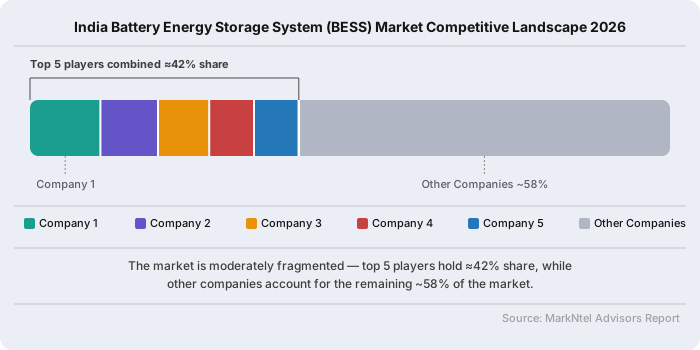
- The market exhibits a moderately fragmented structure, with the top five companies collectively accounting for approximately 42% of the total market share.
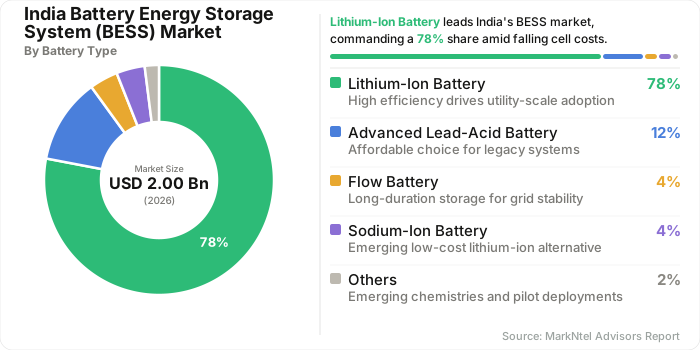
- Lithium-ion battery represents the largest technology segment, capturing approximately 78% of the market.
- Utility is the leading ownership segment, accounting for approximately 61% of the market.
India Battery Energy Storage System (BESS) Market Size and Outlook
The battery energy storage system market in India was valued at USD 1.50 billion in 2025 and is projected to grow from USD 2.00 billion in 2026 to USD 11.44 billion by 2032. The market is estimated to expand at a CAGR of 33.73% during 2026–2032. The industry is gaining momentum as storage becomes increasingly important for renewable energy integration, peak-demand management, and grid flexibility. The Central Electricity Authority (CEA) estimates India’s storage requirement at approximately 45.9 GWh by 2034–35, highlighting the growing need for flexible power resources. Rising renewable capacity, changing electricity-demand patterns, and grid-reliability requirements are supporting broader BESS deployment across India.
India Battery Energy Storage System (BESS) Market Key Indicators
- India’s renewable energy expansion is creating a measurable requirement for flexible energy storage. As of July 2026, India had 164.59 GW of installed solar capacity and 58.14 GW of wind capacity, providing a combined variable-renewable base of more than 222 GW. The rapid addition of intermittent solar and wind generation increases the need for BESS to shift surplus daytime generation toward evening peak periods, balance short-term fluctuations, and improve grid reliability, thereby supporting BESS deployment.
- India’s BESS requirement is projected to reach 236.22 GWh by 2031–32, compared with 34.72 GWh in 2026–27, representing nearly a 6.8-fold increase in the requirement over the period. This projected expansion reflects the increasing need to integrate renewable generation and provide peak shifting, ancillary services, and grid balancing, directly strengthening the addressable demand for battery-based storage systems.
- The National Electricity Plan 2023 estimates that India will need 73.93 GW / 411.4 GWh of total energy storage capacity by 2031–32, including 47.24 GW / 236.22 GWh from BESS, to support the integration of approximately 364 GW of solar and 121 GW of wind capacity. The scale of storage required relative to planned renewable capacity indicates that BESS is becoming an essential grid-integration asset rather than a supplementary technology, supporting sustained market growth.
- India’s actual BESS deployment remains significantly below its projected requirement, creating a substantial capacity-development gap. CEA reported only 0.11 GW of installed BESS capacity as of December 2024, compared with the 47.24 GW BESS capacity requirement projected for 2031–32. This implies that the market must add more than 47 GW of BESS capacity over the intervening period, creating a large pipeline opportunity for utility-scale battery storage projects, particularly for renewable integration and peak-demand management.
- The government’s Energy Storage Obligation (ESO) is also creating a quantifiable demand mechanism for storage. The obligation increases from 1% in FY2023–24 to 4% by FY2029–30, with a 0.5-percentage-point annual increase, and at least 85% of the stored energy must be sourced from renewable energy. The progressively higher obligation increases the volume of storage that obligated entities must procure, supporting predictable demand for BESS projects and associated battery systems.
- India’s electricity distribution modernization is simultaneously expanding the need for flexible grid resources. National AT&C losses declined from 21.91% in FY2020–21 to 15.04% in FY2024–25, while smart-meter installations increased from 1.05 crore at the end of FY2024 to 2.58 crore at the end of FY2025 and reached 5.59 crore installations subsequently. Greater digitalization and visibility of electricity consumption can facilitate demand management, time-of-use optimization, distributed storage, and aggregation of flexible loads, creating additional applications for BESS beyond conventional utility-scale renewable projects.
- Government-backed BESS financing is also improving project economics. In June 2025, the Ministry of New and Renewable Energy introduced a Viability Gap Funding scheme for BESS through the Power System Development Fund, followed by amendments in August and September 2025. The government has also provided a framework for waiving interstate transmission charges for energy-storage systems. These measures reduce the financial and transmission-cost barriers associated with storage projects, improving the viability of large-scale BESS deployments and supporting market expansion.
- India’s broader non-fossil capacity expansion further reinforces the requirement for storage. By November 2025, the country had reached 262.74 GW of non-fossil installed power capacity, equivalent to 51.5% of total installed electricity capacity, while the government continues to target 500 GW of non-fossil capacity by 2030. As the share of variable renewable generation rises, the mismatch between renewable generation profiles and electricity demand becomes more pronounced, increasing the requirement for BESS for energy shifting, balancing, and grid stability
India Battery Energy Storage System (BESS) Market Scope
| Category | Segments |
|---|---|
| By Battery Type | Lithium-Ion Battery, Advanced Lead-Acid Battery, Flow Battery, Sodium-Ion Battery, Others |
| By Power Capacity | Below 1 MW, 1–10 MW, 10–100 MW, Above 100 MW |
| By Connection Type | On-Grid, Off-Grid |
| By End User | Residential, Commercial & Industrial, Utility |
| By Ownership | Customer-Owned, Third-Party-Owned, Utility-Owned |
| By Component | Battery Pack & Racks, Power Conversion System (PCS), Energy Management System (EMS), Balance of Plant & Services |
India Battery Energy Storage System (BESS) Market Growth Drivers
Government Viability Gap Funding Improving BESS Project Economics
Government support through Viability Gap Funding (VGF) is strengthening the commercial viability of large-scale BESS projects in India by reducing the upfront cost burden for developers. In June 2025, the Ministry of Power approved a VGF scheme supporting 30 GWh of BESS capacity, with approximately USD 630 million in financial support through the Power System Development Fund. The scheme is expected to attract around approximately USD 3.86 billion in investment and accelerate storage deployment for renewable energy integration.
The new programme complements an earlier VGF scheme supporting 13,220 MWh of BESS capacity with approximately USD 440 million in budgetary support. Government intervention is becoming more important as storage economics improve: BESS costs discovered through competitive bidding declined from approximately USD 0.11/kWh in 2022–23 to USD 0.023/kWh in recent bids without VGF for two daily cycles. VGF reduces project-financing barriers, improves investment attractiveness, and encourages utilities and renewable developers to undertake larger storage projects. Combined with the ISTS-charge waiver for eligible co-located BESS projects through June 2028, the policy framework is supporting faster commercial deployment and improving the overall economics of India's BESS market.
Recent Trends
AI-Based Energy Management Enhancing BESS Efficiency and Grid Integration
AI-based energy management is becoming an important trend in India’s BESS market as storage projects become larger and increasingly integrated with renewable-energy assets. In May 2026, Schneider Electric launched a next-generation BESS in India that combines utility-grade electrical infrastructure with Energy Management System (EMS), Distributed Energy Resource Management System (DERMS), Power Plant Controller (PPC), and microgrid controls. The battery-agnostic platform is designed to optimize storage operations, improve interoperability, support predictive maintenance, and enable intelligent charging and dispatch.
The trend is supported by the rapid expansion of India's BESS deployment. As of June 2026, installed BESS capacity above 1 MWh reached 2.93 GW/8.66 GWh, while 2.67 GW/7.79 GWh was added during 2026. AI-enabled EMS becomes increasingly valuable as the government projects BESS requirements to reach 47.24 GW/236 GWh by 2031–32, creating a larger fleet requiring real-time monitoring, forecasting, automated dispatch, and asset optimization. The adoption of intelligent EMS can improve BESS utilization, support renewable-energy integration, reduce operational inefficiencies, and strengthen grid reliability as India's storage market moves toward larger and more complex projects.
India Battery Energy Storage System (BESS) Market Opportunities and Challenges
Tender-to-Project Conversion Gaps Driving BESS Execution Services
India’s BESS procurement pipeline is expanding, but converting tendered and awarded capacity into operational projects remains an important execution challenge in India battery energy storage system industry. As of June 2026, 19.19 GW/67.57 GWh of BESS capacity was under tendering, 11.75 GW/38.43 GWh had been awarded, and 15.75 GW/42.53 GWh was under construction. The substantial capacity distributed across these development stages highlights the complexity of moving projects from procurement through engineering, equipment delivery, installation, testing, and commissioning. Delays at any stage can postpone revenue generation for developers and defer the availability of contracted storage capacity.
This execution requirement is creating a broader commercial market for BESS EPC contractors, system integrators, commissioning specialists, project-management firms, and lifecycle service providers. SECI's 600 MW/1,200 MWh BESS procurement requires the selected supplier to provide comprehensive service and maintenance for 15 years, with commissioning scheduled within 11–14 months after the contractual start date. Separately, its Nandiyal BESS balance-of-system contract covers design, engineering, procurement, installation, testing, commissioning, and five years of comprehensive O&M. These procurement structures expand revenue opportunities beyond battery supply into project delivery and long-term asset services.
Segmentation Insights
Lithium-Ion Battery Captures an Estimated 78% Share as Domestic Cell Manufacturing Expands
The Lithium-ion battery segment remains the leading technology in India's BESS market, supported by established deployment and government efforts to build a domestic advanced-cell ecosystem. India has been promoting domestic production because rising demand for batteries across electric vehicles and stationary energy storage creates a need to reduce import dependence and strengthen supply-chain resilience. Government data projects lithium-ion battery demand to increase from 40 GWh in 2025 to approximately 210 GWh by 2030. Under the ACC-PLI programme, 40 GWh of manufacturing capacity had been awarded by August 2025, including 10 GWh specifically earmarked for grid-scale stationary storage.
This policy direction is particularly relevant to BESS because the approximately USD 1.89 billion ACC-PLI programme targets 50 GWh of domestic advanced-cell manufacturing capacity, creating a larger local supply base for storage developers. The dedicated stationary-storage allocation also demonstrates that the government is directly anticipating future BESS requirements rather than focusing exclusively on EV batteries. Greater domestic cell production can reduce exposure to international supply disruptions, improve procurement visibility, encourage localization of the BESS value chain, and support the scaling of lithium-ion storage projects across utility and commercial applications. Based on the type of battery, the market is further bifurcated into:
- Lithium-Ion Battery
- Advanced Lead-Acid Battery
- Flow Battery
- Sodium-Ion Battery
- Others
Utility Segment Accounts for an Estimated 61% Share as Large-Scale Storage Procurement Expands
The Utility segment is supported by the increasing scale of storage projects developed for electricity-system requirements. The CEA has projected a requirement of 41.65 GW/208.25 GWh of BESS capacity by 2029–30, indicating substantial future demand from grid-connected applications. Utility procurement is also increasingly being structured around specific power-system needs, including peak and off-peak supply. This is strengthening the role of large-scale storage in India's electricity infrastructure and supporting continued utility-led BESS deployment.
A significant 2025 development further demonstrates this shift toward utility-scale storage. In November 2025, SECI and the Government of Andhra Pradesh finalized a 1,200 MW BESS project at Nandyal, alongside a 50 MW hybrid solar project. The project is designed to provide storage capacity for electricity-system operations and represents a substantial increase in the scale of individual BESS developments. Such projects demonstrate how utilities and public-sector power institutions are moving beyond small demonstration systems toward large, dedicated storage assets, reinforcing the Utility segment's leading position in India's BESS market. Based on ownership, the market is further bifurcated into:
- Customer-Owned
- Third-Party-Owned
- Utility-Owned
India Battery Energy Storage System (BESS) Market Competitive Analysis
The India battery energy storage system (BESS) industry is moderately fragmented, with Tata Power Renewable Energy Ltd., JSW Energy Ltd., Adani Energy Solutions Ltd., Exide Energy Solutions Ltd., and Amara Raja Energy & Mobility Ltd. emerging as leading participants. These five companies collectively account for an estimated 42% market share, supported by expanding utility-scale storage portfolios, domestic battery manufacturing capabilities, renewable-energy integration, and investments in large-scale BESS projects.
Key Companies in the India Battery Energy Storage System (BESS) Market
- Exide Energy Solutions Ltd.
- Amara Raja Energy & Mobility Ltd.
- Tata Power Renewable Energy Ltd.
- JSW Energy Ltd.
- Reliance New Energy Ltd.
- Adani Energy Solutions Ltd.
- Delta Electronics India Pvt. Ltd.
- ABB India Ltd.
- Hitachi Energy India Ltd.
- Fluence Energy, Inc.
- Others
India Battery Energy Storage System (BESS) Industry News and Recent Developments
January 2026: SWELECT Energy Systems Launches NUMERGY BESS Portfolio
SWELECT Energy Systems launched its NUMERGY product portfolio, a dedicated range of Battery Energy Storage Systems (BESS) for residential and commercial applications. The launch accompanied the company's new corporate identity and marked a strategic expansion from its established solar and power-electronics activities into energy storage. NUMERGY is positioned to address increasing requirements for reliable backup, renewable-energy utilization, grid stability, and energy independence as electricity consumption and renewable penetration increase across India.
Impact Analysis: The NUMERGY launch expands the domestic supplier base for distributed BESS and increases competition in residential and commercial storage. It also demonstrates the growing convergence between India's solar, inverter, and battery-storage markets, potentially accelerating adoption of integrated solar-plus-storage systems.
August 2026: SolarYaan Launches Hybrid, BESS and All-in-One Inverter Portfolio
SolarYaan launched a new portfolio in August 2026 combining hybrid inverters, All-in-One energy storage systems, BESS, grid-tied inverters, and microinverters. The portfolio targets applications ranging from residential solar installations to commercial and industrial projects. The launch represents SolarYaan's expansion from an inverter-focused business toward an integrated energy-solutions provider, with storage positioned as a core component of its offering for improving energy independence and enabling greater utilization of distributed renewable power.
Impact Analysis: The launch supports the development of India's distributed BESS market by combining generation, conversion, and storage within integrated product offerings. Such product convergence can lower system complexity for customers and strengthen adoption among residential and C&I users seeking greater energy independence and reduced dependence on conventional grid supply.
Frequently Asked Questions
- Market Segmentation
- Introduction
- Product Definition
- Research Process
- Assumptions
- Executive Summary
- India Battery Energy Storage System (BESS) Market Policies, Regulations, and Product Standards
- India Battery Energy Storage System (BESS) Market Production (USD Million) Trend 2022-2032
- India Battery Energy Storage System (BESS) Production (USD Million) Trend by Type of Battery
- Lithium-Ion Battery
- Advanced Lead-Acid Battery
- Flow Battery
- Sodium-Ion Battery
- Other
- Company Wise Production Plants and Statistics
- Installed Production Capacity
- Actual Production
- Planned Production Target
- India Battery Energy Storage System (BESS) Production (USD Million) Trend by Type of Battery
- India Battery Energy Storage System (BESS) Market Value Supply Chain Analysis
- India Battery Energy Storage System (BESS) Market Import & Export Analysis
- India Battery Energy Storage System (BESS) Market Trends & Developments
- India Battery Energy Storage System (BESS) Market Dynamics
- Growth Factors
- Challenges
- India Battery Energy Storage System (BESS) Market Hotspot & Opportunities
- India Battery Energy Storage System (BESS) Market Outlook, 2022-2032
- Market Size & Outlook
- By Revenues (USD Million)
- Market Segmentation & Outlook
- By Battery Type- Market Size & Forecast 2022-2032, USD Million
- Lithium-Ion Battery
- Advanced Lead-Acid Battery
- Flow Battery
- Sodium-Ion Battery
- Others
- By Power Capacity- Market Size & Forecast 2022-2032, USD Million
- Below 1 MW
- 1–10 MW
- 10–100 MW
- Above 100 MW
- By Connection Type- Market Size & Forecast 2022-2032, USD Million
- On-Grid
- Off-Grid
- By End User- Market Size & Forecast 2022-2032, USD Million
- Residential
- Commercial & Industrial
- Utility
- By Ownership- Market Size & Forecast 2022-2032, USD Million
- Customer-Owned
- Third-Party-Owned
- Utility-Owned
- By Component- Market Size & Forecast 2022-2032, USD Million
- Battery Pack & Racks
- Power Conversion System (PCS)
- Energy Management System (EMS)
- Balance of Plant & Services
- By Region- Market Size & Forecast 2022-2032, USD Million
- North
- South
- West
- East
- By Company
- Competition Characteristics
- Market Share & Analysis
- By Battery Type- Market Size & Forecast 2022-2032, USD Million
- Market Size & Outlook
- India Lithium-Ion Battery Energy Storage System (BESS) Market Outlook, 2022-2032
- Market Size & Outlook
- By Revenues (USD Million)
- Market Segmentation & Outlook
- By Power Capacity- Market Size & Forecast 2022-2032, USD Million
- By Connection Type- Market Size & Forecast 2022-2032, USD Million
- By End User- Market Size & Forecast 2022-2032, USD Million
- By Ownership- Market Size & Forecast 2022-2032, USD Million
- By Component- Market Size & Forecast 2022-2032, USD Million
- By Region- Market Size & Forecast 2022-2032, USD Million
- Market Size & Outlook
- India Advanced Lead-Acid Battery Energy Storage System (BESS) Market Outlook, 2022-2032
- Market Size & Outlook
- By Revenues (USD Million)
- Market Segmentation & Outlook
- By Power Capacity- Market Size & Forecast 2022-2032, USD Million
- By Connection Type- Market Size & Forecast 2022-2032, USD Million
- By End User- Market Size & Forecast 2022-2032, USD Million
- By Ownership- Market Size & Forecast 2022-2032, USD Million
- By Component- Market Size & Forecast 2022-2032, USD Million
- By Region- Market Size & Forecast 2022-2032, USD Million
- Market Size & Outlook
- India Flow Battery Energy Storage System (BESS) Market Outlook, 2022-2032
- Market Size & Outlook
- By Revenues (USD Million)
- Market Segmentation & Outlook
- By Power Capacity- Market Size & Forecast 2022-2032, USD Million
- By Connection Type- Market Size & Forecast 2022-2032, USD Million
- By End User- Market Size & Forecast 2022-2032, USD Million
- By Ownership- Market Size & Forecast 2022-2032, USD Million
- By Component- Market Size & Forecast 2022-2032, USD Million
- By Region- Market Size & Forecast 2022-2032, USD Million
- Market Size & Outlook
- India Sodium-ion Battery Energy Storage System (BESS) Market Outlook, 2022-2032
- Market Size & Outlook
- By Revenues (USD Million)
- Market Segmentation & Outlook
- By Power Capacity- Market Size & Forecast 2022-2032, USD Million
- By Connection Type- Market Size & Forecast 2022-2032, USD Million
- By End User- Market Size & Forecast 2022-2032, USD Million
- By Ownership- Market Size & Forecast 2022-2032, USD Million
- By Component- Market Size & Forecast 2022-2032, USD Million
- By Region- Market Size & Forecast 2022-2032, USD Million
- Market Size & Outlook
- India Battery Energy Storage System (BESS) Market Key Strategic Imperatives for Success & Growth
- Competitive Outlook
- Company Profiles
- Tata Power Renewable Energy Ltd
- Business Description
- Product Portfolio
- Collaborations & Alliances
- Recent Developments
- Financial Details
- Others
- Exide Energy Solutions Ltd.
- Business Description
- Product Portfolio
- Collaborations & Alliances
- Recent Developments
- Financial Details
- Others
- Amara Raja Energy & Mobility Ltd.
- Business Description
- Product Portfolio
- Collaborations & Alliances
- Recent Developments
- Financial Details
- Others
- Fluence Energy, Inc.
- Business Description
- Product Portfolio
- Collaborations & Alliances
- Recent Developments
- Financial Details
- Others
- JSW Energy Ltd.
- Business Description
- Product Portfolio
- Collaborations & Alliances
- Recent Developments
- Financial Details
- Others
- Reliance New Energy Ltd.
- Business Description
- Product Portfolio
- Collaborations & Alliances
- Recent Developments
- Financial Details
- Others
- Adani Energy Solutions Ltd.
- Business Description
- Product Portfolio
- Collaborations & Alliances
- Recent Developments
- Financial Details
- Others
- Delta Electronics India Pvt. Ltd.
- Business Description
- Product Portfolio
- Collaborations & Alliances
- Recent Developments
- Financial Details
- Others
- ABB India Ltd.
- Business Description
- Product Portfolio
- Collaborations & Alliances
- Recent Developments
- Financial Details
- Others
- Hitachi Energy India Ltd.
- Business Description
- Product Portfolio
- Collaborations & Alliances
- Recent Developments
- Financial Details
- Others
- Others
- Tata Power Renewable Energy Ltd
- Company Profiles
- Disclaimer
MarkNtel Advisors follows a robust and iterative research methodology designed to ensure maximum accuracy and minimize deviation in market estimates and forecasts. Our approach combines both bottom-up and top-down techniques to effectively segment and quantify various aspects of the market. A consistent feature across all our research reports is data triangulation, which examines the market from three distinct perspectives to validate findings. Key components of our research process include:
1. Scope & Research Design At the outset, MarkNtel Advisors define the research objectives and formulate pertinent questions. This phase involves determining the type of research—qualitative or quantitative—and designing a methodology that outlines data collection methods, target demographics, and analytical tools. They also establish timelines and budgets to ensure the research aligns with client goals.
2. Sample Selection and Data Collection In this stage, the firm identifies the target audience and determines the appropriate sample size to ensure representativeness. They employ various sampling methods, such as random or stratified sampling, based on the research objectives. Data collection is carried out using tools like surveys, interviews, and observations, ensuring the gathered data is reliable and relevant.
3. Data Analysis and Validation Once data is collected, MarkNtel Advisors undertake a rigorous analysis process. This includes cleaning the data to remove inconsistencies, employing statistical software for quantitative analysis, and thematic analysis for qualitative data. Validation steps are taken to ensure the accuracy and reliability of the findings, minimizing biases and errors.

4. Data Forecast and FinalizationThe final phase involves forecasting future market trends based on the analyzed data. MarkNtel Advisors utilize predictive modeling and time series analysis to anticipate market behaviors. The insights are then compiled into comprehensive reports, featuring visual aids like charts and graphs, and include strategic recommendations to inform client decision-making
We offer flexible licensing options to cater to varying organizational needs. Choose the pricing pack that best suits your requirements:
Buy Now Inquire Before Buying
 Request Customization
 Talk to our Consultant







