

Middle East Facility Management Market Research Report: Forecast (2026-2032)
By Type (Hard, Soft, Risk, Administrative), By Operating Model (In-house, Outsourced), By Service Delivery (Integrated, Bundled, Single Service), By Enterprise Size (Large, Mid-Siz ... e, Small), By End User (Commercial, Residential, Government, Retail, Education, Healthcare, Hospitality, Others), and others Read more
- Buildings, Construction, Metals & Mining
- Jul 2026
- Pages 240
- Report Format: PDF, Excel, PPT
Middle East Facility Management Market
Projected 12.06% CAGR from 2026 to 2032
Study Period
2026-2032
Market Size (2026)
USD 80.7 Billion
Market Size (2032)
USD 159.8 Billion
Base Year
2025
Projected CAGR
12.06%
Leading Segments
By Type: Hard
Middle East Facility Management Market Key Takeaways
- The Middle East facility management market was valued at around USD 76.7 billion in 2025 to USD 80.7 billion in 2026, projected to reach USD 159.8 billion by 2032, at a CAGR of 12.06%.
- Saudi Arabia is expected to dominate the market, accounting for approximately 47% share in 2026.
- By service type, hard facility management is anticipated to hold nearly 60% of the regional market share in 2026.
- By end user, the commercial segment is projected to account for approximately 36% of the market share in 2026.
- The industry is highly fragmented, with numerous regional and global providers competing; the top five players collectively hold approximately 10% market share.
Middle East Facility Management Market Size and Outlook
The Middle East facility management market is estimated to grow at a CAGR of around 12.06% during the forecast period, i.e., 2026–2032, supported by large-scale government-led economic diversification programs, expanding commercial and hospitality infrastructure, rising foreign direct investment, and increasing adoption of outsourced, technology-enabled building operations across the region. Facility management providers continue to benefit as governments and private developers prioritize operational efficiency, asset lifecycle management, and compliance-driven maintenance across newly developed commercial, industrial, and public assets.
According to Saudi Arabia's General Authority for Statistics (GASTAT), the Kingdom's Industrial Production Index rose 8.9% year-on-year in February 2026, supported by growth in mining, manufacturing, and utilities activity, while foreign direct investment inflows climbed 24% in 2024 to reach USD 31.7 billion, with a further 44% year-on-year surge recorded in the first quarter of 2025. This expanding industrial base and rising investment activity are accelerating the development of manufacturing facilities, logistics assets, and corporate infrastructure that require ongoing technical maintenance, energy management, and integrated facility operations.
Government-led economic diversification frameworks are further reinforcing long-term market expansion. Saudi Arabia's Vision 2030 continues to drive large-scale investment across construction, industrial development, and urban infrastructure, with GASTAT reporting sustained momentum in the Kingdom's Construction Cost Index amid ongoing megaproject activity. Similar diversification strategies across other Gulf economies are expanding the region's stock of commercial, hospitality, and institutional real estate, creating sustained, long-term demand for professionally managed, integrated facility management services.
Going forward, expanding industrial activity, rising foreign investment, and continued government-backed infrastructure development are expected to strengthen facility management demand across the Middle East over the long term, supporting growth of the Middle East facility management industry from USD 80.7 billion in 2026 to USD 159.8 billion by 2032.
Middle East Facility Management Market Key Indicators
- Saudi Arabia's non-oil activities grew by 4.3% in 2025, according to the General Authority for Statistics (GASTAT), supported by expansion in construction, real estate, trade, and business services. The growth is increasing commercial developments, industrial facilities, and mixed-use projects requiring integrated facility management throughout their operational lifecycle. Rising non-oil economic activity expands the asset base requiring long-term technical, soft, and integrated facility management services.
- The UAE welcomed 30.7 million hotel guests in 2025, according to the Ministry of Economy, while the tourism sector continued to strengthen its contribution to the national economy. The growing number of hotels, resorts, entertainment venues, and mixed-use developments is increasing demand for housekeeping, engineering maintenance, security, and energy management services .Expansion of hospitality infrastructure directly increases outsourced facility management requirements.
- Qatar continues implementing Qatar National Vision 2030, prioritizing sustainable urban development, transport infrastructure, healthcare, education, and public facilities. Ongoing investment in long-term public assets creates continuous demand for technical maintenance, asset management, cleaning, and integrated facility management throughout operational phases. Public infrastructure expansion strengthens long-term demand for integrated facility management contracts.
- Bahrain continues implementing Economic Vision 2030, promoting investment in commercial real estate, tourism, healthcare, logistics, and public infrastructure. New developments require lifecycle maintenance, asset management, security, and sustainability services, supporting continued expansion of the facility management industry . Economic diversification increases demand for outsourced and integrated facility management across commercial and government assets.
Middle East Facility Management Market Scope
| Category | Segments |
|---|---|
| By Type | Hard, Soft, Risk, Administrative |
| By Operating Model | In-house, Outsourced |
| By Service Delivery | Integrated, Bundled, Single Service |
| By Enterprise Size | Large, Mid-Size, Small |
| By End User | Commercial, Residential, Government, Retail, Education, Healthcare, Hospitality, Others |
Middle East Facility Management Market Growth Drivers
Government-Led Infrastructure and Smart City Investments Accelerate Demand for Facility Management Services
Large-scale government investments in infrastructure, smart cities, and mixed-use urban developments are significantly driving demand for integrated facility management services across the Middle East. The expansion of transportation networks, commercial districts, healthcare facilities, educational institutions, and public infrastructure is creating long-term requirements for technical maintenance, energy management, security, cleaning, and building operations. Supporting this trend, the UAE Government continues implementing the Dubai 2040 Urban Master Plan, which aims to increase land allocated for hotels and tourism activities by 134%, expand public beaches by 400%, and increase land designated for education and healthcare facilities by 25%, generating substantial demand for lifecycle facility management services.
Complementing these initiatives, Farnek announced in May 2026 that it secured new integrated facility management contracts worth approximately USD 15.8 million across the education, transportation, commercial, residential, and retail sectors. The combination of sustained public infrastructure investment and expanding private-sector developments is expected to reinforce long-term growth opportunities for facility management providers throughout the Middle East.
Recent Trends
AI-Driven Predictive Maintenance Gains Momentum Across Commercial Assets
The adoption of artificial intelligence, Internet of Things sensors, and predictive maintenance is accelerating across the Middle East as building owners increasingly prioritize operational efficiency, asset reliability, and lifecycle optimization. Governments are advancing national AI strategies that encourage digital transformation across infrastructure and public services. In January 2025, Imdaad launched its AI Centre of Excellence, integrating AI, robotic process automation (RPA), IoT-enabled asset monitoring, and business intelligence to improve predictive maintenance, automate workflows, and support real-time operational decision-making.
The initiative reflects the growing shift from reactive maintenance to data-driven facility management. At the government level, the UAE continues implementing its National Artificial Intelligence Strategy 2031, which promotes AI adoption across priority sectors to enhance productivity and digital infrastructure. The convergence of government-led digital initiatives and private-sector innovation is expected to accelerate the deployment of intelligent building management systems, predictive maintenance platforms, and AI-powered analytics, strengthening operational efficiency while reducing maintenance costs across commercial, industrial, and public facilities.
Middle East Facility Management Market Opportunities and Challenges
Emiratization Compliance Pressures Create Opportunity for Facility Management Providers Investing in National Workforce Development
A key challenge facing the Middle East facility management industry is the region's reliance on a largely expatriate technical workforce, combined with tightening workforce nationalization mandates. According to the UAE Ministry of Human Resources and Emiratization (MoHRE), private-sector companies with 50 or more employees are required to increase their Emirati workforce in skilled roles by 2% annually, reaching an Emiratization rate of 10% by the end of 2026, while companies with 20–49 employees across 14 targeted sectors including construction, real estate, and technical and professional activities must also meet mandatory hiring targets. Non-compliant companies face escalating financial contributions, reaching USD 29.4 thousand per unfilled position starting January 2026, creating direct cost and operational pressure on facility management providers that traditionally depend on expatriate technical labor for HVAC, electrical, and engineering roles.
This compliance pressure, however, is generating a corresponding opportunity. MoHRE data shows that compliant companies gain access to enhanced government support, including participation in the Emiratization Partners Club, discounts of up to 80% on MoHRE service fees, and priority status in government procurement processes. Facility management providers that proactively invest in Emirati recruitment, training, and career development, leveraging government-backed programs such as Nafis are better positioned to secure public-sector and government-linked FM contracts, reduce compliance costs, and strengthen their competitive standing as regulatory enforcement intensifies across the region.
Segmentation Insights
Hard Facility Management with a Market Share of 60%, Would Remain the Leading Service Type in the Market
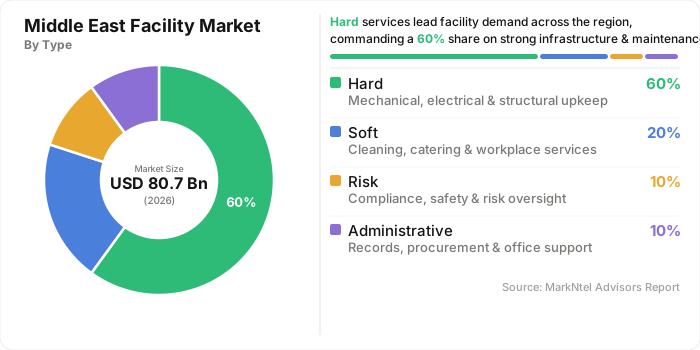
The extensive maintenance requirements of commercial buildings, airports, healthcare facilities, industrial assets, and mixed-use developments have enabled hard facility management to remain the leading service type in the Middle East facility management market, accounting for approximately 60% of total market revenue in 2026. The segment's dominance is driven by critical technical services such as HVAC maintenance, district cooling, electrical installations, plumbing systems, energy management, and building automation.
Supporting this demand, the UAE Government continues implementing its updated Nationally Determined Contribution (NDC), which prioritizes higher building energy efficiency through periodic updates to building codes, retrofitting existing buildings, and improving the performance of commercial and public assets under its Net Zero strategy. These initiatives increase the need for ongoing technical maintenance, energy optimization, and building management services, reinforcing the leadership of Hard Facility Management across the region. Based on type, the market is segmented into:
- Hard
- Soft
- Risk
- Administrative
Commercial Sector with the Market Share of 36%, Would Continue to Dominate the Middle East Facility Management Market by End User
The concentration of office buildings, shopping malls, business parks, hotels, mixed-use developments, and corporate campuses has enabled the Commercial segment to maintain the largest share of the Middle East facility management market, accounting for approximately 36% of total market revenue in 2026. Demand is driven by increasing investments in commercial real estate, hospitality assets, retail destinations, and smart office developments that require integrated facility management services to ensure operational efficiency and sustainability.
Further supporting this trend, the UAE Government reaffirmed in its 2025 Smart Sustainable Cities initiative its commitment to expanding digitally enabled, sustainable urban infrastructure and smart commercial developments. These projects require integrated building operations, predictive maintenance, energy management, cleaning, security, and asset lifecycle management, thereby strengthening demand for commercial facility management services across the Middle East. Based on end user, the market is segmented into:
- Commercial
- Residential
- Government
- Retail
- Education
- Healthcare
- Hospitality
- Others
Middle East Facility Management Market Regional Analysis
Saudi Arabia dominates the Middle East facility management industry, accounting for approximately 47% of the regional market in 2026. The country's leadership is driven by its extensive portfolio of commercial buildings, industrial facilities, airports, healthcare institutions, hospitality assets, and government infrastructure. Continuous investments in economic diversification, urban development, and large-scale mixed-use projects are increasing the demand for integrated facility management services across the Kingdom.
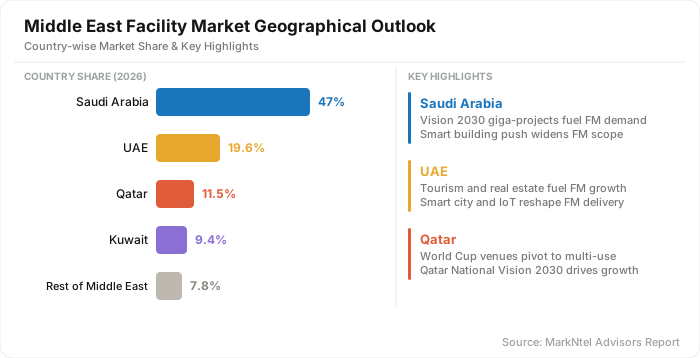
The growing preference for outsourced facility management, the adoption of digital building technologies, and the emphasis on energy-efficient operations are further strengthening market growth. Additionally, sustained expansion of commercial real estate, logistics infrastructure, and public facilities continues to create long-term opportunities for providers offering hard, soft, and integrated facility management services, reinforcing Saudi Arabia's leading position in the Middle East market.
Middle East Facility Management Market Competitive Landscape
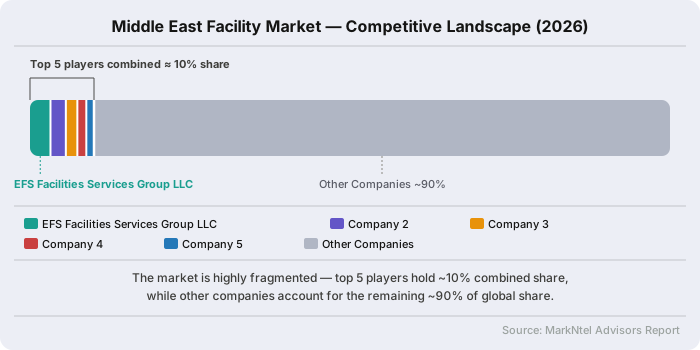
The Middle East facility management industry is highly fragmented, led by EFS Facilities Services Group, Emrill Services, Farnek Services, Imdaad, and Transguard Group. These five companies collectively account for an estimated 10% of the market share. Competition remains strong due to numerous regional providers, government-backed organizations, and international facility management companies operating across the Middle East.
Key Companies in the Middle East Facility Market
- EFS Facilities Services Group LLC
- Emrill Services LLC
- Farnek Services LLC
- Imdaad LLC
- Khidmah LLC
- Transguard Group
- ENGIE Solutions Middle East
- Serco Middle East
- e& Facilities Management
- United Facilities Management (UFM Kuwait)
- Emcor Facilities Services WLL
- Sodexo Qatar Services
- Al-Asmakh Facilities Management
- G4S Qatar SPC
- Cofely Besix Facility Management (CBFM)
Middle East Facility Industry News and Recent Developments
May 2026: HITEK AI Launches GCC's First AI-Powered HSEQ Platform
HITEK AI, part of the Farnek Group, launched SafeNexus.ai, the GCC's first AI-powered white-label Health, Safety, Environment, and Quality (HSEQ) platform. The solution enables organizations to digitize compliance management, automate reporting, and improve workplace safety using artificial intelligence and analytics.
Impact Analysis: The launch demonstrates the growing adoption of AI-driven digital platforms within facility management. As organizations prioritize compliance, operational efficiency, and ESG performance, intelligent HSEQ solutions are expected to become an important differentiator for FM providers across the Middle East.
May 2026: HITEK AI Expands Sustainability and ESG Consultancy into Saudi Arabia
Farnek's digital subsidiary, HITEK AI, expanded its operations into Saudi Arabia by introducing sustainability and ESG consultancy services. The expansion supports organizations in achieving energy efficiency, carbon reduction, ESG reporting, and digital asset management in line with the country's infrastructure development goals.
Impact Analysis: The expansion reflects increasing demand for sustainability-focused facility management solutions across Saudi Arabia. As Vision 2030 accelerates infrastructure development, FM providers are broadening their service portfolios beyond traditional maintenance to include digital sustainability and ESG advisory services.
January 2025: Imdaad Launches AI Centre of Excellence
Imdaad established an AI Centre of Excellence (AI CoE) to accelerate the adoption of artificial intelligence, robotic process automation (RPA), and business intelligence across its facility management operations. The initiative focuses on improving predictive maintenance, operational efficiency, resource optimization, and data-driven decision-making.
Impact Analysis: The launch reflects the rapid digital transformation of the Middle East facility management sector. Increased adoption of AI-powered asset management and predictive maintenance is expected to improve service quality, reduce operating costs, and strengthen the region's transition toward smart building management.
June 2025: Farnek Secures Hospitality Facility Management Contracts Worth Over USD 2.7 Million
Farnek secured new hospitality facility management contracts valued at more than approximately USD 2.7 million across the UAE. The company mobilized over 330 additional employees to deliver housekeeping, technical maintenance, stewarding, and public-area management services for newly awarded hospitality projects.
Impact Analysis: The contract expansion reflects sustained investment in the hospitality sector and growing demand for outsourced integrated FM services. It also indicates increasing confidence among hotel operators in specialist FM providers capable of delivering operational efficiency and high service standards.
October 2025: BEEAH Launches Next-Generation Facility Management Services
BEEAH introduced a new generation of integrated facility management services focused on smart operations, sustainability, and digital asset management. The service portfolio combines advanced technologies with environmental management practices to deliver comprehensive operational support for commercial, industrial, and public-sector assets across the Middle East.
Impact Analysis: The launch highlights the industry's transition toward digitally enabled and sustainability-focused facility management. As organizations increasingly prioritize operational resilience and ESG objectives, integrated smart FM solutions are becoming a key competitive differentiator across the Middle East.
Frequently Asked Questions
- Market Segmentation
- Introduction
- Product Definition
- Research Process
- Assumptions
- Executive Summary
- Middle East Facility Management Market Porter’s Five Forces Analysis
- Middle East Facility Management Market Policies, Regulations, and Product Standards
- Middle East Facility Management Market Trends & Developments
- Middle East Facility Management Market Dynamics
- Growth Factors
- Challenges
- Middle East Facility Management Market Voice of Customer
- Brand Awareness
- End User Expectation
- Key Factors Impacting Vendor Selection
- Key Issues Encountered
- Vendor’s Receptiveness to Address Key Customer Issues
- Future Requirements
- Middle East Facility Management Market Pricing Analysis, 2026
- Country wise * Services Prices
- District Cooling (USD/sq. ft.)
- Building Management (USD/sq. ft.)
- Plumbing, Pumps & Sanitary Units (USD/sq. ft.)
- Electrical Installation (USD/sq. ft.)
- Energy Management (USD/sq. ft.)
- Air Conditioning System (USD/sq. ft.)
- Roads & Street Lighting (USD/km)
- Cleaning Services (USD/sq. ft.)
- Catering (USD/person/day)
- Pest Control (USD/sq. ft.)
- Landscaping (USD/sq. m.)
- Insurance Management (USD/sq. ft.)
- Security (USD/guard/month)
- Disaster Management (USD/site/year)
- Reserve/Sinking Fund (% of service charge)
- Mail Management (USD/site/month)
- Front Office Management (USD/FTE/month)
- Space Planning & Management (USD/sq. ft.)
- Inventory Management (USD/site/month)
- Country Wise * Operating Model Wise Prices
- Integrated
- Bundled
- Single Service
- Country wise * Services Prices
- Middle East Facility Management Market Hotspot & Opportunities
- Middle East Facility Management Market Outlook, 2022-2032
- Market Segmentation & Outlook
- By Revenues (USD Million)
- Market Segmentation & Outlook
- By Type- Market Size & Forecast 2022-2032, USD Million
- Hard
- District Cooling
- Building Management
- Plumbing Apparatus, Pumps, Sanitary units, etc.
- Electrical Installation
- Energy Management
- Air Conditioning System
- Roads & Street Lighting System
- Others
- Soft
- Cleaning Services
- Catering
- Pest Control
- Landscaping
- Other
- Risk
- Insurance Management
- Security
- Disaster Management
- Reserve/Sinking Fund
- Others
- Administrative
- Mail Management
- Front Office Management
- Space Planning & Management
- Inventory Management
- Others
- Hard
- By Operating Model- Market Size & Forecast 2022-2032, USD Million
- In-house
- Outsourced
- By Service Delivery- Market Size & Forecast 2022-2032, USD Million
- Integrated
- Bundled
- Single Service
- By Enterprise Size- Market Size & Forecast 2022-2032, USD Million
- Large
- Mid-Size
- Small
- By End User- Market Size & Forecast 2022-2032, USD Million
- Commercial
- Residential
- Government
- Retail
- Education
- Healthcare
- Hospitality
- Others
- By Country
- Saudi Arabia
- UAE
- Qatar
- Oman
- Kuwait
- Egypt
- Iraq
- Others
- By Company
- Competition Characteristics
- Market Segmentation & Outlook
- By Type- Market Size & Forecast 2022-2032, USD Million
- Market Segmentation & Outlook
- Saudi Arabia Facility Management Market Outlook, 2022-2032
- Market Segmentation & Outlook
- By Revenues (USD Million)
- Market Segmentation & Outlook
- By Type- Market Size & Forecast 2022-2032, USD Million
- By Operating Model- Market Size & Forecast 2022-2032, USD Million
- By Service Delivery- Market Size & Forecast 2022-2032, USD Million
- By Enterprise Size- Market Size & Forecast 2022-2032, USD Million
- By End User- Market Size & Forecast 2022-2032, USD Million
- Market Segmentation & Outlook
- UAE Facility Management Market Outlook, 2022-2032
- Market Segmentation & Outlook
- By Revenues (USD Million)
- Market Segmentation & Outlook
- By Type- Market Size & Forecast 2022-2032, USD Million
- By Operating Model- Market Size & Forecast 2022-2032, USD Million
- By Service Delivery- Market Size & Forecast 2022-2032, USD Million
- By Enterprise Size- Market Size & Forecast 2022-2032, USD Million
- By End User- Market Size & Forecast 2022-2032, USD Million
- Market Segmentation & Outlook
- Qatar Facility Management Market Outlook, 2022-2032
- Market Segmentation & Outlook
- By Revenues (USD Million)
- Market Segmentation & Outlook
- By Type- Market Size & Forecast 2022-2032, USD Million
- By Operating Model- Market Size & Forecast 2022-2032, USD Million
- By Service Delivery- Market Size & Forecast 2022-2032, USD Million
- By Enterprise Size- Market Size & Forecast 2022-2032, USD Million
- By End User- Market Size & Forecast 2022-2032, USD Million
- Market Segmentation & Outlook
- Oman Facility Management Market Outlook, 2022-2032
- Market Segmentation & Outlook
- By Revenues (USD Million)
- Market Segmentation & Outlook
- By Type- Market Size & Forecast 2022-2032, USD Million
- By Operating Model- Market Size & Forecast 2022-2032, USD Million
- By Service Delivery- Market Size & Forecast 2022-2032, USD Million
- By Enterprise Size- Market Size & Forecast 2022-2032, USD Million
- By End User- Market Size & Forecast 2022-2032, USD Million
- Market Segmentation & Outlook
- Kuwait Facility Management Market Outlook, 2022-2032
- Market Segmentation & Outlook
- By Revenues (USD Million)
- Market Segmentation & Outlook
- By Type- Market Size & Forecast 2022-2032, USD Million
- By Operating Model- Market Size & Forecast 2022-2032, USD Million
- By Service Delivery- Market Size & Forecast 2022-2032, USD Million
- By Enterprise Size- Market Size & Forecast 2022-2032, USD Million
- By End User- Market Size & Forecast 2022-2032, USD Million
- Market Segmentation & Outlook
- Egypt Facility Management Market Outlook, 2022-2032
- Market Segmentation & Outlook
- By Revenues (USD Million)
- Market Segmentation & Outlook
- By Type- Market Size & Forecast 2022-2032, USD Million
- By Operating Model- Market Size & Forecast 2022-2032, USD Million
- By Service Delivery- Market Size & Forecast 2022-2032, USD Million
- By Enterprise Size- Market Size & Forecast 2022-2032, USD Million
- By End User- Market Size & Forecast 2022-2032, USD Million
- Market Segmentation & Outlook
- Iraq Facility Management Market Outlook, 2022-2032
- Market Segmentation & Outlook
- By Revenues (USD Million)
- Market Segmentation & Outlook
- By Type- Market Size & Forecast 2022-2032, USD Million
- By Operating Model- Market Size & Forecast 2022-2032, USD Million
- By Service Delivery- Market Size & Forecast 2022-2032, USD Million
- By Enterprise Size- Market Size & Forecast 2022-2032, USD Million
- By End User- Market Size & Forecast 2022-2032, USD Million
- Market Segmentation & Outlook
- Middle East Facility Management Market Technology Landscape & Use Cases, 2026
- IoT & Smart Building Systems
- AI & Predictive Maintenance
- Building Information Modeling (BIM)
- Digital Twin Technology
- Robotics & Automation
- Drones for Facility Inspection
- CAFM/CMMS Cloud Platforms
- Mobile Workforce Management Apps
- Data Analytics & Reporting Dashboards
- Blockchain for Contract/SLA Management
- Middle East Facility Management Market Key Strategic Imperatives for Success & Growth
- Competitive Outlook
- Company Profiles
- Zahran Facilities Management
- Business Description
- Product Portfolio
- Collaborations & Alliances
- Recent Developments
- Financial Details
- Others
- EFS Facilities Services Group LLC
- Business Description
- Product Portfolio
- Collaborations & Alliances
- Recent Developments
- Financial Details
- Others
- Emrill Services LLC
- Business Description
- Product Portfolio
- Collaborations & Alliances
- Recent Developments
- Financial Details
- Others
- Farnek Services LLC
- Business Description
- Product Portfolio
- Collaborations & Alliances
- Recent Developments
- Financial Details
- Others
- Imdaad LLC
- Business Description
- Product Portfolio
- Collaborations & Alliances
- Recent Developments
- Financial Details
- Others
- Khidmah LLC
- Business Description
- Product Portfolio
- Collaborations & Alliances
- Recent Developments
- Financial Details
- Others
- Transguard Group
- Business Description
- Product Portfolio
- Collaborations & Alliances
- Recent Developments
- Financial Details
- Others
- ENGIE Solutions Middle East
- Business Description
- Product Portfolio
- Collaborations & Alliances
- Recent Developments
- Financial Details
- Others
- Serco Middle East
- Business Description
- Product Portfolio
- Collaborations & Alliances
- Recent Developments
- Financial Details
- Others
- United Facilities Management
- Business Description
- Product Portfolio
- Collaborations & Alliances
- Recent Developments
- Financial Details
- Others
- Emcor Facilities Services WLL
- Business Description
- Product Portfolio
- Collaborations & Alliances
- Recent Developments
- Financial Details
- Others
- Sodexo Qatar Services
- Business Description
- Product Portfolio
- Collaborations & Alliances
- Recent Developments
- Financial Details
- Others
- Al-Asmakh Facilities Management
- Business Description
- Product Portfolio
- Collaborations & Alliances
- Recent Developments
- Financial Details
- Others
- G4S Qatar SPC
- Business Description
- Product Portfolio
- Collaborations & Alliances
- Recent Developments
- Financial Details
- Others
- Musanadah Facilities Management
- Business Description
- Product Portfolio
- Collaborations & Alliances
- Recent Developments
- Financial Details
- Others
- Kharafi National
- Business Description
- Product Portfolio
- Collaborations & Alliances
- Recent Developments
- Financial Details
- Others
- Al Shirawi Facilities Management
- Business Description
- Product Portfolio
- Collaborations & Alliances
- Recent Developments
- Financial Details
- Others
- Enova
- Business Description
- Product Portfolio
- Collaborations & Alliances
- Recent Developments
- Financial Details
- Others
- Saudi Facilities Management Company (FMTECH)
- Business Description
- Product Portfolio
- Collaborations & Alliances
- Recent Developments
- Financial Details
- Others
- CBRE Global Workplace Solutions
- Business Description
- Product Portfolio
- Collaborations & Alliances
- Recent Developments
- Financial Details
- Others
- Others
- Zahran Facilities Management
- Company Profiles
- Disclaimer
MarkNtel Advisors follows a robust and iterative research methodology designed to ensure maximum accuracy and minimize deviation in market estimates and forecasts. Our approach combines both bottom-up and top-down techniques to effectively segment and quantify various aspects of the market. A consistent feature across all our research reports is data triangulation, which examines the market from three distinct perspectives to validate findings. Key components of our research process include:
1. Scope & Research Design At the outset, MarkNtel Advisors define the research objectives and formulate pertinent questions. This phase involves determining the type of research—qualitative or quantitative—and designing a methodology that outlines data collection methods, target demographics, and analytical tools. They also establish timelines and budgets to ensure the research aligns with client goals.
2. Sample Selection and Data Collection In this stage, the firm identifies the target audience and determines the appropriate sample size to ensure representativeness. They employ various sampling methods, such as random or stratified sampling, based on the research objectives. Data collection is carried out using tools like surveys, interviews, and observations, ensuring the gathered data is reliable and relevant.
3. Data Analysis and Validation Once data is collected, MarkNtel Advisors undertake a rigorous analysis process. This includes cleaning the data to remove inconsistencies, employing statistical software for quantitative analysis, and thematic analysis for qualitative data. Validation steps are taken to ensure the accuracy and reliability of the findings, minimizing biases and errors.

4. Data Forecast and FinalizationThe final phase involves forecasting future market trends based on the analyzed data. MarkNtel Advisors utilize predictive modeling and time series analysis to anticipate market behaviors. The insights are then compiled into comprehensive reports, featuring visual aids like charts and graphs, and include strategic recommendations to inform client decision-making
We offer flexible licensing options to cater to varying organizational needs. Choose the pricing pack that best suits your requirements:
Buy Now Inquire Before Buying
 Request Customization
 Talk to our Consultant







