

Malaysia Agribusiness Market Research Report: Trends, Forecast & Opportunities (2026-2032)
By Product (Grains and cereals, Dairy, Oilseeds, Livestock, Others), By Application (Crop Production, Livestock Production, Aquaculture, Agroforestry), By Farming Type (Conventiona ... l Farming, Organic Farming, Precision Farming, Contract Farming, Vertical & Controlled Environment Farming), By Farm Size (Small-Scale Farms, Medium-Scale Farms, Large-Scale Farms), By End-Use Industry (Food & Beverage Industry, Textile Industry (Cotton, Jute), Biofuel Industry, Pharmaceutical Industry, Animal Husbandry & Dairy Industry), and others Read more
- Environment
- Mar 2026
- Pages 170
- Report Format: PDF, Excel, PPT
Malaysia Agribusiness Market
Projected 2.06% CAGR from 2026 to 2032
Study Period
2026-2032
Market Size (2026)
USD 14.45 Billion
Market Size (2032)
USD 16.33 Billion
Base Year
2025
Projected CAGR
2.06%
Leading Segments
By Product: livestock
Malaysia Agribusiness Market Report Key Takeaways:
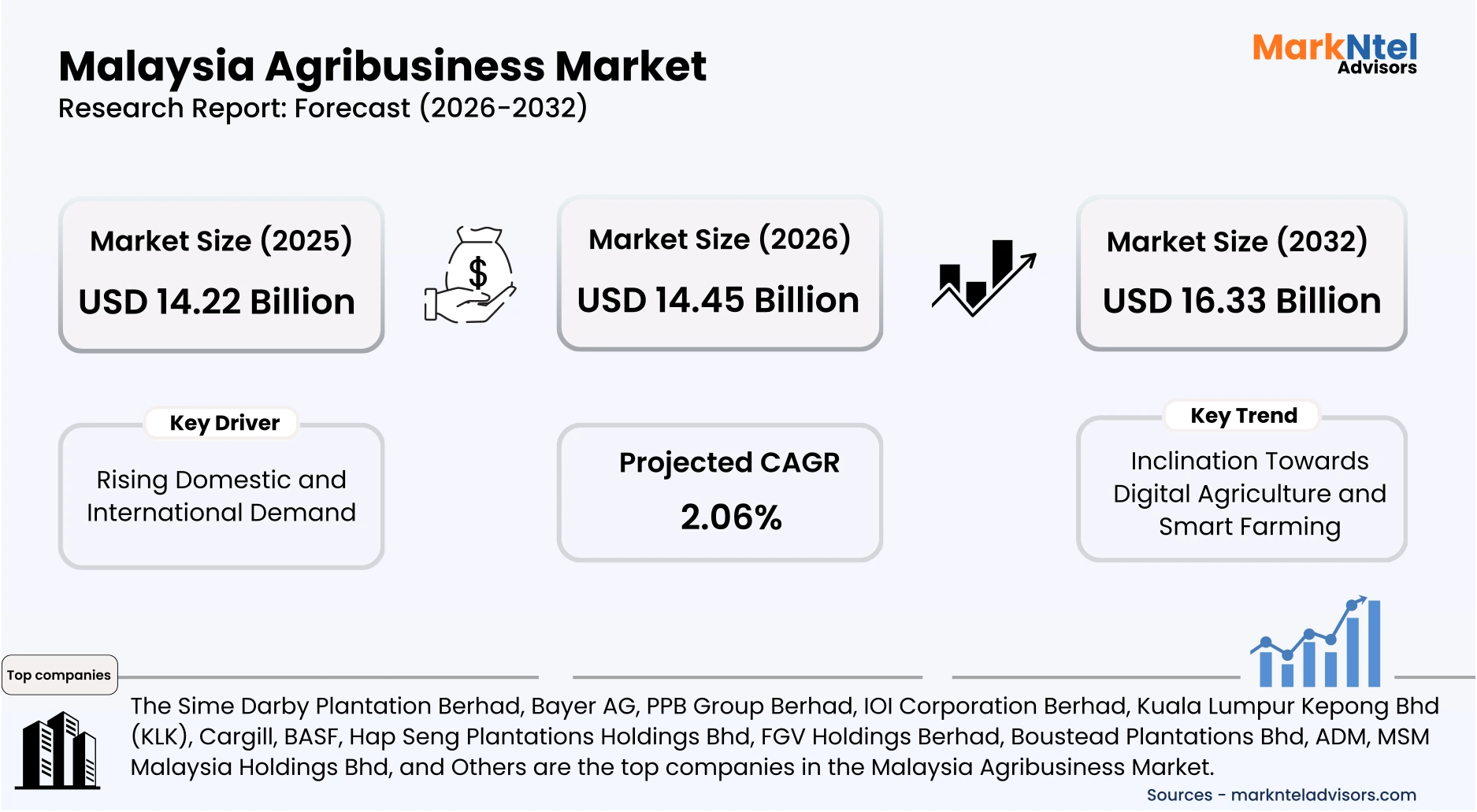
- The Malaysia Agribusiness Market size was valued at USD 14.22 billion in 2025 and is projected to grow from USD 14.45 billion in 2026 to USD 16.33 billion by 2032, exhibiting a CAGR of 2.06% during the forecast period.
- By Product, the livestock segment represented a significant share of about 35% in the Malaysia Agribusiness Market in 2026.
- By end-use industry, the food & beverage industry segment presented a significant share of about 47% in the Malaysia Agribusiness Market in 2026.
- Leading agribusiness companies in Malaysia are Sime Darby Plantation Berhad, Bayer AG, PPB Group Berhad, IOI Corporation Berhad, Kuala Lumpur Kepong Bhd (KLK), Cargill, BASF, Hap Seng Plantations Holdings Bhd, FGV Holdings Berhad, Boustead Plantations Bhd, ADM, MSM Malaysia Holdings Bhd, and Others.
Market Insights & Analysis: Malaysia Agribusiness Market (2026-32):
The Malaysia Agribusiness Market size was valued at approximately USD 14.22 billion in 2025 and is projected to grow from USD 14.45 billion in 2026 to USD 16.33 billion by 2032. Along with this, the market is estimated to grow at a CAGR of around 2.06% during the forecast period, i.e., 2026-32.
The Malaysia agribusiness market is expected to experience steady growth in the coming years, supported by increasing domestic food demand, strong agricultural exports, and the ongoing modernization of farming practices. Agriculture remains an important pillar of Malaysia’s economy, supplying raw materials for the food processing industry while supporting employment and rural development. As population growth, urbanization, and changing dietary preferences continue to influence consumption patterns, the demand for agricultural commodities such as palm oil, livestock products, grains, and processed food inputs is expected to remain strong.
One of the primary factors strengthening the outlook of the agribusiness sector is the expansion of agricultural exports. Malaysia is a major global supplier of commodities such as palm oil and related products, which contribute significantly to the country’s trade performance. According to Malaysia External Trade Development Corporation (MATRADE), agricultural exports reached approximately USD 2.1 billion in May 2025, reflecting an 8.3% year-on-year increase, supported largely by strong palm oil shipments and other agricultural products. This steady export growth highlights Malaysia’s competitive position in global agricultural markets and reinforces the importance of agribusiness production across key farming regions.
Domestic agricultural production is also strengthening in response to growing demand. Data from the Department of Statistics Malaysia (DOSM) indicates that the agriculture sector expanded by 3.1% in 2024, driven mainly by palm oil production. The palm oil subsector alone generated USD 9.4 billion in value added, demonstrating its critical role in the national economy . Other subsectors are also contributing to growth, with the livestock industry expanding by approximately 3.3%, reflecting increasing consumption of meat and dairy products. These developments illustrate a broad-based demand for agricultural commodities that continues to strengthen the overall agribusiness ecosystem in Malaysia.
Another important factor shaping the market is the rising adoption of digital agriculture and smart farming technologies. The integration of digital tools such as drones, Internet of Things (IoT) sensors, and precision farming systems is transforming traditional agricultural practices and improving operational efficiency. Government-backed digital initiatives are encouraging farmers to adopt data-driven farming techniques to optimize resource use and increase productivity. For example, the Malaysia Digital Economy Corporation (MDEC) reported that more than 600 digital agriculture solutions have been implemented nationwide, with over 30,000 agro-entrepreneurs trained in the use of technologies including data analytics, drones, and IoT-based monitoring systems .
Overall, Malaysia’s agribusiness sector is expected to maintain positive momentum as export growth, rising domestic food demand, and increasing technological adoption continue to strengthen the agricultural value chain. These factors collectively support long-term sector expansion, improve productivity, and enhance Malaysia’s competitiveness in global agricultural markets.
Malaysia Agribusiness Market Recent Developments:
- 2025: BASF SE and the Malaysian Agricultural Research and Development Institute (MARDI) launched two new Clearfield® rice varieties (MR CL3, MR CL4) in Malaysia. These non‑GM, herbicide‑tolerant varieties help farmers fight weedy rice and aim to boost yields above 7 t/ha, supporting national sustainable farming goals .
- 2025: Sabah, agreements worth USD 2.9 million were signed to develop the agriculture sector and improve food security. These collaborations involve farmers’ organizations and private firms to enhance supply services and marketing of agricultural inputs .
Malaysia Agribusiness Market Scope:
| Category | Segments |
|---|---|
| By Product | (Grains and cereals, Dairy, Oilseeds, Livestock, Others), |
| By Application | (Crop Production, Livestock Production, Aquaculture, Agroforestry), |
| By Farming Type | (Conventional Farming, Organic Farming, Precision Farming, Contract Farming, Vertical & Controlled Environment Farming), |
| By Farm Size | (Small-Scale Farms, Medium-Scale Farms, Large-Scale Farms), |
| By End-Use Industry | (Food & Beverage Industry, Textile Industry (Cotton, Jute), Biofuel Industry, Pharmaceutical Industry, Animal Husbandry & Dairy Industry), |
Malaysia Agribusiness Market Driver:
Rising Domestic and International Demand
Malaysia’s agribusiness market is strongly driven by growing demand both at home and abroad, anchored in robust production and export performance of key agricultural commodities. According to the Department of Statistics Malaysia (DOSM), the agricultural sector expanded 3.1% in 2024, rebounding from 0.2% the prior year, with palm oil leading value‑added contributions at USD 9.4 billion or 36.8% of the sector’s total output. Livestock and other agricultural activities also support the national food supply and economic stability.
Malaysia’s export of agricultural goods exhibited double‑digit growth in early 2025. Exports of agricultural products reached USD 10.5 billion in the first five months, up 10.5% year‑on‑year, driven largely by palm oil and oilseed derivatives . This export expansion reflects a strong global appetite, particularly in major markets like India, China, the EU, and Africa, where Malaysian palm oil remains competitive.
On the domestic side, rising incomes and urbanization are sustaining higher consumption of poultry, meat, and processed foods, which in turn spurs local agribusiness activity.
Looking ahead, government plans under Malaysia’s 2026–2030 economic strategy include increased investment approx. USD 331 million for palm oil replanting and productivity enhancement, aimed at sustaining output and export capacity through 2030 .
Overall, taken together, rising domestic consumption and expanding export markets are amplifying production incentives, securing Malaysia’s agribusiness growth trajectory in the medium term and reinforcing its role in both food security and international trade.
Malaysia Agribusiness Market Trend:
Inclination Towards Digital Agriculture and Smart Farming
Digital agriculture and smart farming are emerging as key trend in the Malaysia agribusiness market as farmers increasingly adopt technologies such as drones, IoT sensors, artificial intelligence, and data analytics to improve productivity and resource efficiency. These technologies allow farmers to monitor soil health, crop conditions, and weather patterns in real time, enabling better decision-making and reducing operational costs. Government initiatives promoting agricultural digitalization, including programs under Malaysia’s National Agrofood Policy 2021–2030, are encouraging the adoption of precision farming tools across crop, livestock, and aquaculture sectors.
The growing use of smart technologies is also supported by private sector innovation and collaborations. For instance, in 2025, Farmsent partnered with DroneDash and SkyX to deploy smart agriculture technologies across 2,000 hectares of Malaysian palm plantations, using drones and soil sensors for precision monitoring. The system can reduce water, fertilizer, and pesticide usage by up to 50%, improving farm productivity while promoting sustainable agricultural practices .
As Malaysia continues to modernize its agricultural sector, the integration of digital platforms, automated equipment, and data-driven farm management is expected to become increasingly common. This shift toward smart farming will enhance efficiency, improve crop yields, and strengthen the long-term competitiveness of the country’s agribusiness industry.
Malaysia Agribusiness Market Opportunity:
Growth of Organic and Sustainable Farming
The expansion of organic and sustainable farming presents a significant opportunity for the Malaysia agribusiness market as demand for safer and environmentally friendly food continues to rise. Increasing consumer awareness regarding food safety, chemical residues, and environmental protection has encouraged greater interest in organic agricultural products across Malaysia. In response, the government has implemented several initiatives to promote sustainable farming practices and strengthen the organic agriculture ecosystem.
According to the Department of Agriculture Malaysia, the total area under certified organic farming reached approximately 1,386 hectares by 2023, reflecting the gradual adoption of eco-friendly agricultural practices . However, this area still represents a very small proportion of Malaysia’s total agricultural land, indicating substantial room for expansion. In addition, the government continues to promote organic agriculture through certification programs such as the myOrganic scheme, which aims to ensure product quality, improve traceability, and encourage farmers to reduce chemical fertilizer and pesticide usage.
These initiatives support soil conservation, biodiversity protection, and sustainable resource management while opening opportunities for Malaysian farmers to access premium domestic and export markets for organic produce. As demand for healthier food products continues to grow and sustainability policies gain importance, the development of organic farming is expected to create new revenue streams for farmers and agribusiness companies.
Malaysia Agribusiness Market Challenge:
High Operational Costs in Agriculture
Rising operational expenditure has become a significant challenge for Malaysia’s agribusiness market, affecting the profitability and long-term sustainability of agricultural enterprises. Farming operations require substantial spending on inputs such as seeds, fertilizers, animal feed, equipment maintenance, logistics, and labor. As these costs increase, farmers and agribusiness companies face pressure on margins and reduced capacity to reinvest in modern technologies or productivity improvements.
According to the Department of Statistics Malaysia (DOSM), total agricultural expenditure in Malaysia reached approximately USD 14.5 billion based on findings from the Agricultural Census. The crops subsector accounted for the largest share of spending at 61.2%, reflecting the high cost of plantation inputs, irrigation systems, and land management. Meanwhile, the livestock subsector represented 25.1% of overall agricultural expenditure, largely due to expenses associated with animal feed, veterinary services, and facility maintenance .
These rising costs create operational constraints for many producers, particularly small and medium-scale farms that rely heavily on external inputs and transportation networks. Higher operational expenses can reduce farm profitability, limit capital investment, and slow the adoption of advanced technologies that could otherwise improve productivity and sustainability in the sector.
Overall, escalating input and operational costs remain a key structural challenge for Malaysia’s agribusiness market. Without improved cost efficiency and productivity enhancements, high expenditure levels may continue to constrain farm expansion and sectoral competitiveness.
Malaysia Agribusiness Market (2026-32) Segmentation Analysis:
The Malaysia Agribusiness Market study of MarkNtel Advisors evaluates and highlights the major trends and influencing factors in each segment. It includes predictions for the period 2026–32 at the country level. Based on the analysis, the market has been further classified as;
Based on Product:
-
- Grains and cereals
- Dairy
- Oilseeds
- Livestock
- Others
The livestock segment holds a 35% share in Malaysia’s agribusiness market, making it the leading product category. This prominence is primarily driven by increasing domestic demand for poultry, beef, and dairy products due to population growth, urbanization, and rising income levels. Government initiatives, including subsidies, breeding programs, and veterinary support, have improved productivity and ensured stable supply chains. Technological advancements in feed formulation, farm management, and disease control have further enhanced efficiency and output. Exports of poultry and meat products also contribute to the segment’s growth.
Additionally, changing dietary habits and heightened awareness of high-protein nutrition among consumers have encouraged higher consumption of livestock products. Overall, these factors position livestock as the most significant contributor to Malaysia’s agribusiness revenue.
Based on End-Use Industry:
- Agriculture and horticulture
- Aviation
- Architect and Construction
- Food Processing
- Gas and Oil Fields
- Others
The food and beverage (F&B) industry leads end-use applications with a 47% market share. This is because a large portion of agribusiness outputs, such as grains, livestock, and dairy, are consumed or processed by F&B manufacturers. Rising urban populations, increasing disposable incomes, and shifting dietary preferences drive demand for packaged foods, ready-to-eat meals, and processed beverages. The sector benefits from government support for food safety, quality standards, and modernized processing infrastructure. Integration with retail and distribution networks ensures a stable market for agricultural products, while innovation in food products and convenience-oriented offerings fuels consumption. Consequently, the F&B industry acts as the primary consumer of agribusiness products, making it the largest and most influential end-use segment in Malaysia.
Malaysia Agribusiness Market (2026-32): Regional Projection
The Malaysia agribusiness market is primarily dominated by Sabah and Sarawak, followed by key agricultural states such as Johor and Pahang. These regions lead the market due to their vast agricultural land availability, favorable tropical climate, and strong presence of plantation crops, particularly palm oil. Sabah and Sarawak together account for a significant share of Malaysia’s oil palm cultivation area, making them central to the country’s agricultural production and export activities. Large plantation companies and smallholder farms in these regions contribute substantially to the national output of palm oil, timber-related crops, and other agricultural commodities.
For instance, extensive oil palm plantations and agro-based industries operate across Sabah and Sarawak, supported by export infrastructure and government initiatives aimed at improving rural agricultural productivity. Additionally, these regions benefit from relatively lower land costs and continuous investments in plantation expansion and sustainable farming practices. As a result, Sabah and Sarawak remain critical hubs for agricultural production, supporting both domestic consumption and Malaysia’s global agricultural export market.
Gain a Competitive Edge with Our Malaysia Agribusiness Market Report:
- Malaysia Agribusiness Market Report by MarkNtel Advisors provides a detailed & thorough analysis of market size & share, growth rate, competitive landscape, and key players. This comprehensive analysis helps businesses gain a holistic understanding of the market dynamics & make informed decisions.
- This report also highlights current market trends & future projections, allowing businesses to identify emerging opportunities & potential challenges. By understanding market forecasts, companies can align their strategies & stay ahead of the competition.
- Malaysia Agribusiness Market Report aids in assessing & mitigating risks associated with entering or operating in the market. By understanding market dynamics, regulatory frameworks, and potential challenges, businesses can develop strategies to minimize risks & optimize their operations.
*Reports Delivery Format - Market research studies from MarkNtel Advisors are offered in PDF, Excel and PowerPoint formats. Within 24 hours of the payment being successfully received, the report will be sent to your email address.
Frequently Asked Questions
- Market Segmentation
- Introduction
- Product Definition
- Research Process
- Assumptions
- Executive Summary
- Malaysia Agribusiness Market Policies, Regulations, and Product Standards
- Malaysia Agribusiness Market Trends & Developments
- Malaysia Agribusiness Market Dynamics
- Growth Factors
- Challenges
- Malaysia Agribusiness Market Hotspot & Opportunities
- Malaysia Agribusiness Market Outlook, 2022-2032F
- Market Size & Outlook
- By Revenues (USD Million)
- Market Share & Outlook
- By Product - Market Size & Forecast 2022-2032, USD Million
- Grains and cereals
- Dairy
- Oilseeds
- Livestock
- Others
- By Application- Market Size & Forecast 2022-2032, USD Million
- Crop Production
- Livestock Production
- Aquaculture
- Agroforestry
- By Farming Type- Market Size & Forecast 2022-2032, USD Million
- Conventional Farming
- Organic Farming
- Precision Farming
- Contract Farming
- Vertical & Controlled Environment Farming
- By Farm Size- Market Size & Forecast 2022-2032, USD Million
- Small-Scale Farms
- Medium-Scale Farms
- Large-Scale Farms
- By End-Use Industry- Market Size & Forecast 2022-2032, USD Million
- Food & Beverage Industry
- Textile Industry (Cotton, Jute)
- Biofuel Industry
- Pharmaceutical Industry
- Animal Husbandry & Dairy Industry
- By Region- Market Size & Forecast 2022-2032, USD Million
- North
- East
- South
- Central
- Sarawak
- Sabah
- Others
- By Company
- Competition Characteristics
- Market Share & Analysis
- By Product - Market Size & Forecast 2022-2032, USD Million
- Market Size & Outlook
- Malaysia Grains and Cereals Market Outlook, 2022-2032
- Market Size & Outlook
- By Revenues (USD Million)
- Market Share & Outlook
- By Application- Market Size & Forecast 2022-2032, USD Million
- By Farming Type- Market Size & Forecast 2022-2032, USD Million
- By Farm Size- Market Size & Forecast 2022-2032, USD Million
- By End-Use Industry- Market Size & Forecast 2022-2032, USD Million
- By Region- Market Size & Forecast 2022-2032, USD Million
- Market Size & Outlook
- Malaysia Dairy Market Outlook, 2022-2032
- Market Size & Outlook
- By Revenues (USD Million)
- Market Share & Outlook
- By Application- Market Size & Forecast 2022-2032, USD Million
- By Farming Type- Market Size & Forecast 2022-2032, USD Million
- By Farm Size- Market Size & Forecast 2022-2032, USD Million
- By End-Use Industry- Market Size & Forecast 2022-2032, USD Million
- By Region- Market Size & Forecast 2022-2032, USD Million
- Market Size & Outlook
- Malaysia Oilseeds Market Outlook, 2022-2032
- Market Size & Outlook
- By Revenues (USD Million)
- Market Share & Outlook
- By Application- Market Size & Forecast 2022-2032, USD Million
- By Farming Type- Market Size & Forecast 2022-2032, USD Million
- By Farm Size- Market Size & Forecast 2022-2032, USD Million
- By End-Use Industry- Market Size & Forecast 2022-2032, USD Million
- By Region- Market Size & Forecast 2022-2032, USD Million
- Market Size & Outlook
- Malaysia Livestock Market Outlook, 2022-2032
- Market Size & Outlook
- By Revenues (USD Million)
- Market Share & Outlook
- By Application- Market Size & Forecast 2022-2032, USD Million
- By Farming Type- Market Size & Forecast 2022-2032, USD Million
- By Farm Size- Market Size & Forecast 2022-2032, USD Million
- By End-Use Industry- Market Size & Forecast 2022-2032, USD Million
- By Region- Market Size & Forecast 2022-2032, USD Million
- Market Size & Outlook
- Malaysia Agribusiness Market Key Strategic Imperatives for Success & Growth
- Competitive Outlook
- Company Profiles
- Sime Darby Plantation Berhad
- Business Description
- Product Portfolio
- Collaborations & Alliances
- Recent Developments
- Financial Details
- Others
- Bayer AG
- Business Description
- Product Portfolio
- Collaborations & Alliances
- Recent Developments
- Financial Details
- Others
- PPB Group Berhad
- Business Description
- Product Portfolio
- Collaborations & Alliances
- Recent Developments
- Financial Details
- Others
- IOI Corporation Berhad
- Business Description
- Product Portfolio
- Collaborations & Alliances
- Recent Developments
- Financial Details
- Others
- Kuala Lumpur Kepong Bhd (KLK)
- Business Description
- Product Portfolio
- Collaborations & Alliances
- Recent Developments
- Financial Details
- Others
- Cargill
- Business Description
- Product Portfolio
- Collaborations & Alliances
- Recent Developments
- Financial Details
- Others
- BASF
- Business Description
- Product Portfolio
- Collaborations & Alliances
- Recent Developments
- Financial Details
- Others
- Hap Seng Plantations Holdings Bhd
- Business Description
- Product Portfolio
- Collaborations & Alliances
- Recent Developments
- Financial Details
- Others
- FGV Holdings Berhad
- Business Description
- Product Portfolio
- Collaborations & Alliances
- Recent Developments
- Financial Details
- Others
- Boustead Plantations Bhd
- Business Description
- Product Portfolio
- Collaborations & Alliances
- Recent Developments
- Financial Details
- Others
- ADM
- Business Description
- Product Portfolio
- Collaborations & Alliances
- Recent Developments
- Financial Details
- Others
- MSM Malaysia Holdings Bhd
- Business Description
- Product Portfolio
- Collaborations & Alliances
- Recent Developments
- Financial Details
- Others
- Sime Darby Plantation Berhad
- Company Profiles
- Disclaimer
MarkNtel Advisors follows a robust and iterative research methodology designed to ensure maximum accuracy and minimize deviation in market estimates and forecasts. Our approach combines both bottom-up and top-down techniques to effectively segment and quantify various aspects of the market. A consistent feature across all our research reports is data triangulation, which examines the market from three distinct perspectives to validate findings. Key components of our research process include:
1. Scope & Research Design At the outset, MarkNtel Advisors define the research objectives and formulate pertinent questions. This phase involves determining the type of research—qualitative or quantitative—and designing a methodology that outlines data collection methods, target demographics, and analytical tools. They also establish timelines and budgets to ensure the research aligns with client goals.
2. Sample Selection and Data Collection In this stage, the firm identifies the target audience and determines the appropriate sample size to ensure representativeness. They employ various sampling methods, such as random or stratified sampling, based on the research objectives. Data collection is carried out using tools like surveys, interviews, and observations, ensuring the gathered data is reliable and relevant.
3. Data Analysis and Validation Once data is collected, MarkNtel Advisors undertake a rigorous analysis process. This includes cleaning the data to remove inconsistencies, employing statistical software for quantitative analysis, and thematic analysis for qualitative data. Validation steps are taken to ensure the accuracy and reliability of the findings, minimizing biases and errors.

4. Data Forecast and FinalizationThe final phase involves forecasting future market trends based on the analyzed data. MarkNtel Advisors utilize predictive modeling and time series analysis to anticipate market behaviors. The insights are then compiled into comprehensive reports, featuring visual aids like charts and graphs, and include strategic recommendations to inform client decision-making
We offer flexible licensing options to cater to varying organizational needs. Choose the pricing pack that best suits your requirements:
Buy Now Inquire Before Buying
 Request Customization
 Talk to our Consultant







