

Southeast Asia Light Truck Market Research Report Forecast (2026-2032)
Southeast Asia Light Truck Market - By Type (Pickup Trucks, Light Commercial Vans (Cargo Vans), Box Trucks / Cube Trucks, Chassis Cab Trucks, Mini Trucks, Others), By Gross Vehicle ... Weight Rating (GVWR) (Class 1 (≤ 6,000 lbs / ≤ 2.7 tons), Class 2 (6,001–10,000 lbs / 2.7–45 tons), Class 3 (10,001–14,000 lbs / 4.5–6.4 tons), By Fuel Type (Gasoline, Diesel, Hybrid, Electric, Others), By Powertrain Drivetrain (Two-Wheel Drive (2WD), Four-Wheel Drive (4WD), By Application (Last-Mile & Urban Delivery, Construction & Infrastructure, Utilities & Municipal Services, Logistics & Distribution, Agriculture & Rural Transport, Others), By End User (Individual Consumers, Commercial Fleets, Small & Medium Enterprises (SMEs), Government & Public Sector), and others Read more
- Automotive
- Dec 2025
- Pages 168
- Report Format: PDF, Excel, PPT
Southeast Asia Light Truck Market
Projected 3.37% CAGR from 2026 to 2032
Study Period
2026-2032
Market Size (2025)
USD 15.19 Billion
Market Size (2032)
USD 19.16 Billion
Base Year
2025
Projected CAGR
3.37%
Leading Segments
By Type: Pickup Trucks
Southeast Asia Light Truck Market Report Key Takeaways:
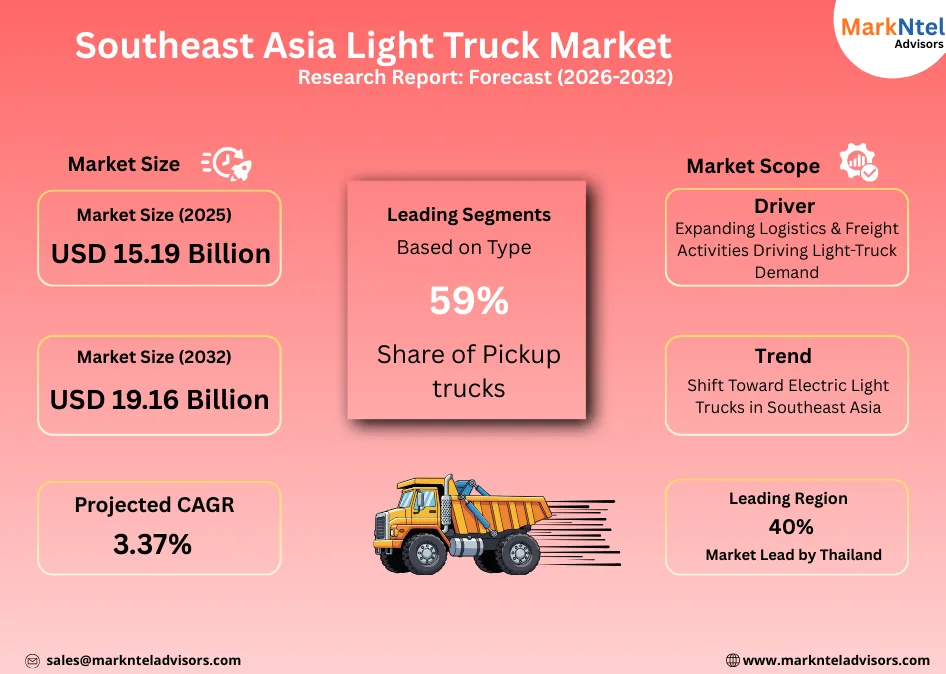
- Market size was valued at around USD15.19 billion in 2025 and is projected to reach USD19.16 billion by 2032. The estimated CAGR from 2026 to 2032 is around 3.37%, indicating strong growth.
- By Country, Thailand is dominating this market by accounting for around 40% market share in 2025.
- By Type, Pickup Trucks hold a 59% share in the total number of units sold in the Southeast Asia Light Truck Market in 2025.
- By Gross Vehicle Weight Rating (GVWR), Class 2 Trucks hold a 62% share in the total number of units sold in the Southeast Asia Light Truck Market in 2025.
- By Application, the logistics and distribution segment holds a 36% share in the total number of units sold in the Southeast Asia Light Truck Market in 2025.
- Leading Light Truck companies in Southeast Asia are Hino Motors, Daihatsu, Isuzu Motors, Mitsubishi Fuso, Ford, Foton, Toyota Motors, Nissan, Mazda, Suzuki, Iveco Group N.V., and Others.
Market Insights & Analysis: Southeast Asia Light Truck Market (2026-32):
The Southeast Asia Light Truck Market size was valued at around USD 15.19 billion in 2025 and is projected to reach USD 19.16 billion by 2032. Along with this, the market is estimated to grow at a CAGR of around 3.37% during the forecast period, i.e., 2026-32.
The Southeast Asia Light Truck Market is shaped by sustained freight demand, infrastructure expansion, and evolving regulatory frameworks across key economies. For reference, Indonesia continues to invest heavily in logistics-enabling infrastructure. The Indonesian government allocated more than USD25 billion annually in recent budgets to transport and public works, improving road connectivity between ports, industrial estates, and cities, which directly raises the utilization of light commercial vehicles, including light trucks.
Additionally, Vietnam recorded merchandise exports exceeding USD350 billion in 2023, reflecting strong manufacturing output that relies on light trucks for factory-to-port and intra-city movement. Likewise, the Philippines’ government has continued its “Build Better More” infrastructure program, supporting construction activity that drives demand for pickup trucks and small tippers.
Moreover, regulatory changes are also influencing fleet decisions. Similarly, several ASEAN countries have adopted Euro 4 or higher emission standards in recent years, pushing fleet owners to replace older trucks with newer, more efficient models.
Overall, rising urbanization, public infrastructure spending, export-led manufacturing, and regulatory upgrades are sustaining demand for light trucks across Southeast Asia. While affordability remains critical, these structural drivers point to steady long-term demand and gradual fleet modernization across the region.
Southeast Asia Light Truck Market Recent Developments:
- 2025: Isuzu began producing the electric D-MAX EV pickup in Thailand, marking a key step toward electrification. The company also progressed joint vehicle development initiatives aimed at supplying affordable, region-specific electric and low-emission light trucks across Asian markets.
- 2024: Mitsubishi Fuso started commercial sales and delivered its first light-duty eCanter electric trucks in Indonesia. This move supported cleaner urban logistics, pilot fleet adoption, and regional efforts to reduce emissions from last-mile delivery and municipal transport operations.
Southeast Asia Light Truck Market Scope:
| Category | Segments |
|---|---|
| By Type | Pickup Trucks, Light Commercial Vans (Cargo Vans), Box Trucks / Cube Trucks, Chassis Cab Trucks, Mini Trucks, Others, |
| By Gross Vehicle Weight Rating (GVWR) | Class 1 (≤ 6,000 lbs / ≤ 2.7 tons), Class 2 (6,001–10,000 lbs / 2.7–45 tons), Class 3 (10,001–14,000 lbs / 4.5–6.4 tons, |
| By Fuel Type | Gasoline, Diesel, Hybrid, Electric, Others), |
| By Powertrain Drivetrain | Two-Wheel Drive (2WD), Four-Wheel Drive (4WD, |
| By Application | Last-Mile & Urban Delivery, Construction & Infrastructure, Utilities & Municipal Services, Logistics & Distribution, Agriculture & Rural Transport, Others, |
| By End User | Individual Consumers, Commercial Fleets, Small & Medium Enterprises (SMEs, |
Southeast Asia Light Truck Market Driver:
Expanding Logistics & Freight Activities Driving Light-Truck Demand
One of the strongest drivers of light-truck demand in Southeast Asia is expanding logistics and freight activity, which depends heavily on road transport for moving goods across cities and borders. According to the World Bank Logistics Performance Index (LPI) 2023, countries with better logistics infrastructure and shipment efficiency tend to facilitate higher trade and freight movement, supporting transport demand. Singapore, for example, ranks among the top logistics performers globally, reflecting highly efficient transport networks that underpin dense freight activity.
In countries like Indonesia, household and commercial transport rely extensively on trucks for inland freight between ports, industrial areas, and urban centers, a dynamic seen in rising overall vehicle numbers across ASEAN urban corridors. Combined, rising trade volumes, infrastructure quality, and larger logistics networks directly increase the use of light commercial vehicles and trucks for short-haul freight and last-mile delivery, driving sustained market growth.
Southeast Asia Light Truck Market Trend:
Shift Toward Electric Light Trucks in Southeast Asia
Increasing electrification is steadily shifting from pilot projects to early commercial adoption in the Southeast Asia light-truck market, supported by clear OEM actions, government policy, and improving cost economics. For instance, Mitsubishi Fuso began commercial sales and delivered the first eCanter light-duty electric trucks in Indonesia in July 2024, targeting urban logistics, municipal fleets, and last-mile delivery, where predictable routes suit EV operations.
Additionally, Hino Motors and Toyota Motors are piloting electric and hybrid light-truck solutions for fleet customers in Southeast Asia. Likewise, early adoption is concentrated in urban logistics and fleet pilots where duty cycles and depot charging fit EV economics best. As infrastructure expands and scale improves, electrified light trucks are likely to move from niche pilots to broader commercial fleets across the region.
Southeast Asia Light Truck Market Challenges:
High Vehicle Cost Combined with Strong Price Sensitivity
High Vehicle Cost Combined with Strong Price Sensitivity is the most significant challenge in the Southeast Asia light truck market. Demand in this region is largely driven by small and medium-sized enterprises (SMEs), owner-operators, and informal logistics providers. As a result, higher upfront vehicle prices directly delay new purchases and extend replacement cycles.
Additionally, new vehicle demand across major ASEAN markets weakened in 2024, with total light-vehicle sales in ASEAN-6 declining by about 5.4% to nearly 3.3 million units, indicating strong resistance to higher prices. Additionally, Thailand, the region’s largest production and sales hub, recorded a sharp drop of around 20% in vehicle production in 2024, driven by weaker domestic demand and stricter auto-loan approvals.
Moreover, the rapid shift towards electrification further intensifies cost pressure. For reference, while lithium-ion battery pack prices have declined to roughly USD 115 per kWh by 2024, batteries still represent a substantial share of vehicle cost, keeping electric light trucks significantly more expensive upfront than diesel models. This creates long and uncertain payback periods for small fleets. Thus, restraining the market growth.
Southeast Asia Light Truck Market (2026-32) Segmentation Analysis:
The Southeast Asia Light Truck Market Report and Forecast 2026-2032 offers a detailed analysis of the market based on the following segments:
Based on Type
- Pickup Trucks
- Light Commercial Vans (Cargo Vans)
- Box Trucks / Cube Trucks
- Chassis Cab Trucks
- Mini Trucks
- Others
Pickup trucks hold a 59% share in the total number of units sold because demand, manufacturing scale, and export focus reinforce each other across the region. Thailand acts as Southeast Asia’s main automotive hub, producing vehicles in the millions each year with a strong export orientation, which anchors pickup-focused supply chains, skilled labor, and component ecosystems across ASEAN.
For instance, Toyota Motor Thailand operates multiple plants with a combined annual capacity of around 760,000 vehicles, allowing high-volume production of the Hilux for both domestic use and overseas markets. Additionally, Mitsubishi Motors Thailand runs facilities with more than 400,000 vehicles of aggregate capacity, supporting large-scale Triton pickup output and exports. Moreover, Isuzu’s Thailand operations are highly specialized in commercial vehicles, with around 130,000 pickups per year, reinforcing Thailand’s role as a regional center for pickup engineering and fleet sales. Thus, pickups remain central to Southeast Asia’s light-truck market growth.
Based on Application
- Last-Mile & Urban Delivery
- Construction & Infrastructure
- Utilities & Municipal Services
- Logistics & Distribution
- Agriculture & Rural Transport
- Others
The Logistics & Distribution segment captures around 36% of the total units sold, because rapid growth in parcel deliveries, strong logistics infrastructure, and regional trade integration create continuous demand for light trucks used in last-mile delivery, line-haul, and sorting operations. For instance, the region’s largest express carrier reported that parcel volume in Southeast Asia reached about 4.56 billion in 2024, up 40.8% year-on-year, reflecting explosive increases in e-commerce deliveries that require fleets of light trucks and pickups for frequent, short-haul distribution.
Additionally, Singapore, a key logistics hub connecting ASEAN countries, was ranked top globally in the World Bank’s 2023 Logistics Performance Index, highlighting its efficient customs, infrastructure, and logistics services that improve shipment speed and reduce cost for regional distributors.
These efficient logistics networks stimulate cross-border freight flows, meaning light trucks are essential for local and intra-regional goods movement. These underscoring widening freight and distribution activity supports light-truck demand.
Southeast Asia Light Truck Market (2026-32): Regional Projection
Thailand is the clear hub for light-truck production and trade in Southeast Asia, accounting for about 40% market share because it combines large-scale manufacturing capacity, deep supplier networks, and a strong OEM presence. For instance, Thailand produced about 1.47 million vehicles in 2024, underscoring its role as the region’s largest auto assembly base. Likewise, the country exported roughly 1.02 million vehicles in 2024, showing that two-thirds of output serves overseas markets.
Additionally, major global OEMs (Toyota, Honda, Isuzu, Mitsubishi, Ford, and others) operate large plants and localized supply chains in Thailand, concentrating pickup and light-truck production for ASEAN and export markets.
Moreover, recent government moves to loosen EV production rules and attract investment have already drawn about USD4 billion in new automotive commitments and set export targets (12,500 EVs in 2025; 52,000 in 2026), signaling Thailand’s pivot from ICE dominance toward electrified light commercial vehicles. These factors are contributing to the dominance of Thailand in this market.
Gain a Competitive Edge with Our Southeast Asia Light Truck Market Report
- Southeast Asia Light Truck Market Report by MarkNtel Advisors provides a detailed & thorough analysis of market size & share, growth rate, competitive landscape, and key players. This comprehensive analysis helps businesses gain a holistic understanding of the market dynamics & make informed decisions.
- This report also highlights current market trends & future projections, allowing businesses to identify emerging opportunities & potential challenges. By understanding market forecasts, companies can align their strategies & stay ahead of the competition.
- Southeast Asia Light Truck Market Report aids in assessing & mitigating risks associated with entering or operating in the market. By understanding market dynamics, regulatory frameworks, and potential challenges, businesses can develop strategies to minimize risks & optimize their operations.
*Reports Delivery Format - Market research studies from MarkNtel Advisors are offered in PDF, Excel and PowerPoint formats. Within 24 hours of the payment being successfully received, the report will be sent to your email address.
Frequently Asked Questions
- Market Segmentation
- Introduction
- Product Definition
- Research Process
- Assumptions
- Executive Summary
- Southeast Asia Light Truck Market Regulations, Policies & Standards
- Southeast Asia Light Truck Market Trends & Developments
- Southeast Asia Light Truck Market Supply Chain Analysis
- Southeast Asia Light Truck Market Imports/Exports
- Southeast Asia Light Truck Market Dynamics
- Growth Drivers
- Challenges
- Southeast Asia Light Truck Market Hotspots & Opportunities
- Southeast Asia Light Truck Market Pricing Analysis
- Southeast Asia Light Truck Market Outlook, 2022-2032F
- Market Size & Analysis
- By Revenue (USD Million)
- By Quantity Sold (Thousand Units)
- Market Share & Analysis
- By Type- (Thousand Units)
- Pickup Trucks
- Light Commercial Vans (Cargo Vans)
- Box Trucks / Cube Trucks
- Chassis Cab Trucks
- Mini Trucks
- Others
- By Gross Vehicle Weight Rating (GVWR)- (Thousand Units)
- Class 1 (≤ 6,000 lbs / ≤ 2.7 tons)
- Class 2 (6,001–10,000 lbs / 2.7–4.5 tons)
- Class 3 (10,001–14,000 lbs / 4.5–6.4 tons)
- By Fuel Type- (Thousand Units)
- Gasoline
- Diesel
- Hybrid
- Electric
- Others
- By Powertrain Drivetrain- (Thousand Units)
- Two-Wheel Drive (2WD)
- Four-Wheel Drive (4WD)
- By Application
- Last-Mile & Urban Delivery
- Construction & Infrastructure
- Utilities & Municipal Services
- Logistics & Distribution
- Agriculture & Rural Transport
- Others
- By End User- (Thousand Units)
- Individual Consumers
- Commercial Fleets
- Small & Medium Enterprises (SMEs)
- Government & Public Sector
- By Country
- Thailand
- Indonesia
- Vietnam
- Malaysia
- Philippines
- Singapore
- Rest of Southeast Asia
- By Competitors
- Competition Characteristics
- Market Share & Analysis
- By Type- (Thousand Units)
- Market Size & Analysis
- Thailand Light Truck Market Outlook, 2022-2032F
- Market Size & Analysis
- By Revenue (USD Million)
- By Quantity Sold (Thousand Units)
- Market Share & Analysis
- By Type- (Thousand Units)
- By Gross Vehicle Weight Rating (GVWR)- (Thousand Units)
- By Fuel Type- (Thousand Units)
- By Powertrain Drivetrain- (Thousand Units)
- By Application- (Thousand Units)
- By End User- (Thousand Units)
- Market Size & Analysis
- Indonesia Light Truck Market Outlook, 2022-2032F
- Market Size & Analysis
- By Revenue (USD Million)
- By Quantity Sold (Thousand Units)
- Market Share & Analysis
- By Type- (Thousand Units)
- By Gross Vehicle Weight Rating (GVWR)- (Thousand Units)
- By Fuel Type- (Thousand Units)
- By Powertrain Drivetrain- (Thousand Units)
- By Application- (Thousand Units)
- By End User- (Thousand Units)
- Market Size & Analysis
- Vietnam Light Truck Market Outlook, 2022-2032F
- Market Size & Analysis
- By Revenue (USD Million)
- By Quantity Sold (Thousand Units)
- Market Share & Analysis
- By Type- (Thousand Units)
- By Gross Vehicle Weight Rating (GVWR)- (Thousand Units)
- By Fuel Type- (Thousand Units)
- By Powertrain Drivetrain- (Thousand Units)
- By Application- (Thousand Units)
- By End User- (Thousand Units)
- Market Size & Analysis
- Malaysia Light Truck Market Outlook, 2022-2032F
- Market Size & Analysis
- By Revenue (USD Million)
- By Quantity Sold (Thousand Units)
- Market Share & Analysis
- By Type- (Thousand Units)
- By Gross Vehicle Weight Rating (GVWR)- (Thousand Units)
- By Fuel Type- (Thousand Units)
- By Powertrain Drivetrain- (Thousand Units)
- By Application- (Thousand Units)
- By End User- (Thousand Units)
- Market Size & Analysis
- Philippines Light Truck Market Outlook, 2022-2032F
- Market Size & Analysis
- By Revenue (USD Million)
- By Quantity Sold (Thousand Units)
- Market Size & Analysis
- Market Share & Analysis
- By Type- (Thousand Units)
- By Gross Vehicle Weight Rating (GVWR)- (Thousand Units)
- By Fuel Type- (Thousand Units)
- By Powertrain Drivetrain- (Thousand Units)
- By Application- (Thousand Units)
- By End User- (Thousand Units)
- Singapore Light Truck Market Outlook, 2022-2032F
- Market Size & Analysis
- By Revenue (USD Million)
- By Quantity Sold (Thousand Units)
- Market Size & Analysis
- Market Share & Analysis
- By Type- (Thousand Units)
- By Gross Vehicle Weight Rating (GVWR)- (Thousand Units)
- By Fuel Type- (Thousand Units)
- By Powertrain Drivetrain- (Thousand Units)
- By Application- (Thousand Units)
- By End User- (Thousand Units)
- Southeast Asia Light Truck Market Key Strategic Imperatives for Growth & Success
- Competitive Outlook
- Company Profiles
- Hino Motors
- Business Description
- Product Portfolio
- Strategic Alliances or Partnerships
- Recent Developments
- Financial Details
- Others
- Daihatsu
- Business Description
- Product Portfolio
- Strategic Alliances or Partnerships
- Recent Developments
- Financial Details
- Others
- Isuzu Motors
- Business Description
- Product Portfolio
- Strategic Alliances or Partnerships
- Recent Developments
- Financial Details
- Others
- Mitsubishi Fuso
- Business Description
- Product Portfolio
- Strategic Alliances or Partnerships
- Recent Developments
- Financial Details
- Others
- Ford
- Business Description
- Product Portfolio
- Strategic Alliances or Partnerships
- Recent Developments
- Financial Details
- Others
- Foton
- Business Description
- Product Portfolio
- Strategic Alliances or Partnerships
- Recent Developments
- Financial Details
- Others
- Toyota Motors
- Business Description
- Product Portfolio
- Strategic Alliances or Partnerships
- Recent Developments
- Financial Details
- Others
- Nissan
- Business Description
- Product Portfolio
- Strategic Alliances or Partnerships
- Recent Developments
- Financial Details
- Others
- Mazda
- Business Description
- Product Portfolio
- Strategic Alliances or Partnerships
- Recent Developments
- Financial Details
- Others
- Suzuki
- Business Description
- Product Portfolio
- Strategic Alliances or Partnerships
- Recent Developments
- Financial Details
- Others
- Iveco Group N.V.
- Business Description
- Product Portfolio
- Strategic Alliances or Partnerships
- Recent Developments
- Financial Details
- Others
- Others
- Hino Motors
- Company Profiles
- Disclaimer
MarkNtel Advisors follows a robust and iterative research methodology designed to ensure maximum accuracy and minimize deviation in market estimates and forecasts. Our approach combines both bottom-up and top-down techniques to effectively segment and quantify various aspects of the market. A consistent feature across all our research reports is data triangulation, which examines the market from three distinct perspectives to validate findings. Key components of our research process include:
1. Scope & Research Design At the outset, MarkNtel Advisors define the research objectives and formulate pertinent questions. This phase involves determining the type of research—qualitative or quantitative—and designing a methodology that outlines data collection methods, target demographics, and analytical tools. They also establish timelines and budgets to ensure the research aligns with client goals.
2. Sample Selection and Data Collection In this stage, the firm identifies the target audience and determines the appropriate sample size to ensure representativeness. They employ various sampling methods, such as random or stratified sampling, based on the research objectives. Data collection is carried out using tools like surveys, interviews, and observations, ensuring the gathered data is reliable and relevant.
3. Data Analysis and Validation Once data is collected, MarkNtel Advisors undertake a rigorous analysis process. This includes cleaning the data to remove inconsistencies, employing statistical software for quantitative analysis, and thematic analysis for qualitative data. Validation steps are taken to ensure the accuracy and reliability of the findings, minimizing biases and errors.

4. Data Forecast and FinalizationThe final phase involves forecasting future market trends based on the analyzed data. MarkNtel Advisors utilize predictive modeling and time series analysis to anticipate market behaviors. The insights are then compiled into comprehensive reports, featuring visual aids like charts and graphs, and include strategic recommendations to inform client decision-making
We offer flexible licensing options to cater to varying organizational needs. Choose the pricing pack that best suits your requirements:
Buy Now Inquire Before Buying
 Request Customization
 Talk to our Consultant







