

India Two-Wheeler Market Research Report: Growth Drivers & Forecast (2026-2032)
By Fuel Type (Petrol, Electric), By Vehicle Type (Moped, Scooter, Motorcycle), By Application (Personal Use, Food delivery, E commerce deliveries, Courier & Small Freight Services, ... Bike Taxis, Others), By Engine Capacity (Up to 125 cc, 126 to 250 cc, 251 to 500 cc, Above 500 cc), and others Read more
- Automotive
- Apr 2026
- Pages 155
- Report Format: PDF, Excel, PPT
India Two-Wheeler Market
Projected 6.2% CAGR from 2026 to 2032
Study Period
2026-2032
Market Size (2026)
USD 29.74 Billion
Market Size (2032)
USD 42.67 Billion
Base Year
2025
Projected CAGR
6.2%
Leading Segments
By Fuel Type: Petrol
India Two-Wheeler Market Report Key Takeaways:
- The India Two-Wheeler Market size was valued at around USD 28 billion in 2025 and is projected grow from USD 29.74 billion in 2026 to USD 42.67 billion by 2032, exhibiting a CAGR of 6.2% during the forecast period.
- North India holds the largest market share of about 31% in the India Two-Wheeler Market in 2026.
- By Fuel Type, the Petrol segment represented a significant share of about 88% in the India Two-Wheeler Market in 2026.
- By Vehicle Type, the Motorcycle segment presented a significant share of about 63% in the India Two-Wheeler Market in 2026.
Market Insights & Analysis: India Two-Wheeler Market (2026-32):
The India Two-Wheeler Market size was valued at around USD 28 billion in 2025 and is projected grow from USD 29.74 billion in 2026 to USD 42.67 billion by 2032, exhibiting a CAGR of 6.2% during the forecast period, i.e., 2026-32.
India’s two-wheeler market has demonstrated sustained expansion, supported by rising mobility demand and economic growth. According to data derived from the Ministry of Road Transport and Highways (VAHAN database), India had over 260 million registered two-wheelers by 2025, highlighting the segment’s deep penetration and dominance in the overall vehicle parc . Annual sales volumes recovered to approximately 20 million units in 2025, driven by post-pandemic normalization and rural demand revival. The segment remains integral to affordable mobility, particularly in price-sensitive and densely populated regions.
Demand dynamics are significantly influenced by end-user behavior, with two-wheelers primarily serving as personal mobility solutions across households. According to household ownership data compiled by Data for India based on government surveys, more than half of Indian households own a two-wheeler, while car ownership remains below 10%, reinforcing the dominance of two-wheelers for daily commuting. Commercial demand is also expanding due to the rapid growth of last-mile delivery services driven by companies such as Swiggy and Zomato.
Government policies have played a critical role in market development, particularly through electrification and manufacturing initiatives. Programs such as the FAME-II scheme (extended into 2025) and the Production-Linked Incentive (PLI) scheme for advanced automotive technologies provide financial incentives for EV adoption and local manufacturing. Additionally, the PM e-Drive initiative announced in 2025 aims to accelerate EV penetration through infrastructure expansion and subsidies. These regulatory frameworks have directly supported increased electric two-wheeler sales and domestic production capabilities.
Industry participants are actively aligning with these policy directions through investments and product innovation. Leading manufacturers such as TVS Motor Company and Bajaj Auto have expanded electric portfolios and localized supply chains to reduce costs. In 2025, multiple new EV models and upgraded ICE vehicles with enhanced fuel efficiency were launched, reflecting a dual transition strategy. Looking ahead, continued urbanization, infrastructure development, and policy support are expected to sustain market growth, with increasing electrification shaping long-term demand dynamics.
India Two-Wheeler Market Recent Developments:
- 2025 : Honda launched the 2025 Activa scooter, featuring a 109.51cc OBD2B-compliant engine, TFT display, Bluetooth connectivity, and USB-C charging. The upgrade enhances fuel efficiency and digital integration, reinforcing its leadership in the scooter segment. The model reflects regulatory compliance and evolving consumer demand for connected mobility.
- 2025: Yamaha introduced AEROX E and EC-06 electric scooters in India as part of its EV strategy. These models target the premium electric segment with performance-oriented design and advanced features. The move highlights Yamaha’s transition toward electrification in emerging markets like India.
India Two-Wheeler Market Scope:
| Category | Segments |
|---|---|
| By Fuel Type | (Petrol, Electric), |
| By Vehicle Type | (Moped, Scooter, Motorcycle), |
| By Application | (Personal Use, Food delivery, E commerce deliveries, Courier & Small Freight Services, Bike Taxis, Others), |
| By Engine Capacity | (Up to 125 cc, 126 to 250 cc, 251 to 500 cc, Above 500 cc), |
India Two-Wheeler Market Driver:
Rising Urbanization & Daily Commuting Needs
Rapid urbanization has emerged as a structural driver of India’s two-wheeler market, directly increasing mobility demand across cities and peri-urban regions. According to the Press Information Bureau, citing the Economic Survey 2023–24, over 40% of India’s population is expected to reside in urban areas by 2030. This demographic transition is significantly increasing daily commuting requirements across expanding urban clusters. As cities grow outward, commuting distances and travel frequency are rising, reinforcing dependence on personal mobility solutions.
The impact of this shift is further amplified by limitations in public transport infrastructure relative to demand growth. The International Energy Agency reports that India’s urban transport activity is expected to more than double by 2030, driven by economic expansion and population growth. However, public transport accessibility remains uneven, particularly in Tier II and Tier III cities. This imbalance has increased reliance on two-wheelers, which offer cost efficiency, faster travel in congested traffic, and greater accessibility for daily commuting needs.
This driver is structurally expanding market volume by increasing the number of individuals requiring independent transportation rather than influencing short-term adoption trends. Government initiatives such as the PM Gati Shakti National Master Plan are enhancing road connectivity and enabling higher vehicle utilization across regions. Additionally, the expansion of urban employment in services and gig economy sectors is increasing trip frequency and commuting intensity. As a result, urbanization continues to generate sustained, volume-driven demand growth, reinforcing long-term market expansion.
India Two-Wheeler Market Trend:
Shift Toward Electric Two-Wheelers
The transition toward electric two-wheelers has emerged as a defining structural trend in India, driven by policy support and rising cost consciousness. The Government of India, through the Press Information Bureau, reported that the FAME-II scheme has supported over 1.4 million electric vehicles, including a significant share of electric two-wheelers. This has reduced upfront costs through subsidies and accelerated adoption across urban markets. Additionally, rising fuel prices and lower operating costs of EVs have strengthened consumer preference for electric mobility.
This trend is reshaping the industry value chain by accelerating investments in battery manufacturing, localization, and new business models. The Production-Linked Incentive (PLI) scheme for advanced automotive technologies, with an outlay of approximately USD 3.1 billion , is promoting domestic manufacturing of EV components and reducing import dependence. Companies such as TVS Motor Company and Bajaj Auto have expanded electric portfolios, while startups are introducing software-integrated vehicles. These developments are transforming traditional manufacturing and distribution ecosystems.
The trend is expected to persist due to continued regulatory support, infrastructure development, and evolving consumer behavior. Government initiatives such as PM e-Drive (2025) aim to expand charging infrastructure and further incentivize adoption . Increasing urban pollution concerns and regulatory focus on emission reduction are also reinforcing the shift. As a result, electric two-wheelers are expected to play a central role in the long-term evolution of India’s mobility market, driving sustained structural transformation.
India Two-Wheeler Market Opportunity:
Growth in Premium & Leisure Segment
The premium and leisure motorcycle segment in India presents a strong structural opportunity driven by rising demand for higher-capacity and lifestyle-oriented vehicles. According to reporting by Reuters, Royal Enfield recorded a ~26.8% increase in higher-capacity motorcycle sales in 2025, reflecting growing consumer preference for premium models. This shift is supported by rising disposable incomes and evolving mobility preferences among urban consumers. As a result, demand is increasingly moving beyond basic commuting toward experience-driven ownership.
This opportunity is translating into tangible market expansion through continuous product innovation and new launches in the mid-premium segment. Triumph Motorcycles India launched the Scrambler 400X in 2025 , targeting adventure and touring riders, while Royal Enfield introduced the Guerrilla 450 for performance-oriented consumers. These models are specifically designed for leisure riding, long-distance touring, and lifestyle positioning . Such developments demonstrate a clear shift in consumer demand toward premium motorcycles with differentiated features and experiences.
The segment offers significant advantages for new entrants due to its lower dependence on scale-driven pricing and higher margin potential. Unlike the commuter segment, premium motorcycles allow differentiation through design, branding, and technology rather than cost leadership. Additionally, localization partnerships and contract manufacturing in India are enabling global brands to enter with competitive pricing strategies. This creates a favorable ecosystem for emerging players to establish niche positioning and scale operations within India’s evolving two-wheeler market.
India Two-Wheeler Market Challenge:
High Regulatory Cost
Regulatory cost pressures have become a key structural challenge in India’s two-wheeler market due to stricter emission norms. The transition to BS6 Phase 2 (OBD2) in 2025 requires advanced emission monitoring systems, additional sensors, and engine modifications. These upgrades increase manufacturing complexity and compliance costs for manufacturers. As a result, regulatory requirements are directly raising the overall cost of vehicle production.
The impact is clearly visible in market pricing, with industry reports indicating that BS6 Phase 2 compliance has led to price increases of around 1–2% . For example, models such as Hero Splendor Plus and HF 100 saw price hikes of approximately USD 20 and USD 13, respectively, due to regulatory upgrades. This reflects a direct cost pass-through to consumers, reducing affordability in a highly price-sensitive market.
These pressures restrict market growth by increasing entry barriers and limiting scalability for smaller players. Higher compliance costs require additional investment in R&D, testing, and certification, while frequent regulatory changes create uncertainty in product planning. Consequently, regulatory cost burdens continue to impact demand, compress margins, and slow expansion across India’s two-wheeler market.
India Two-Wheeler Market (2026-32) Segmentation Analysis:
The India Two-Wheeler Market study of MarkNtel Advisors evaluates & highlights the major trends and influencing factors in each segment. It includes predictions for the period 2026–32 at the country level. Based on the analysis, the market has been further classified as;
Based on Fuel Type:
- Petrol
- Electric
Petrol dominates the India Two-Wheeler Market by fuel type, accounting for approximately 88% of total demand, primarily due to extensive fuel availability and cost efficiency. According to the Press Information Bureau, citing the Ministry of Petroleum and Natural Gas, India has over 100,000 retail fuel outlets, ensuring uninterrupted petrol access across both urban and rural regions. This widespread infrastructure enables consistent vehicle usage without range limitations, reinforcing strong consumer preference for petrol-powered two-wheelers.
The dominance of petrol is further supported by large-scale production and entrenched industry capacity. Data reported by national publications based on the Society of Indian Automobile Manufacturers indicates that two-wheeler sales exceeded 20 million units in 2025, with the majority comprising petrol-powered models . Manufacturers such as Hero MotoCorp and Honda Motorcycle and Scooter India continue to produce high volumes, benefiting from localized supply chains and cost efficiencies.
Additionally, petrol vehicles maintain an advantage due to lower upfront costs and established servicing infrastructure. While government initiatives such as FAME-II are promoting electric adoption, petrol-powered two-wheelers remain more affordable and widely serviceable. This combination of accessibility, pricing advantage, and mature ecosystem continues to sustain petrol’s dominant position in India’s two-wheeler market.
Based on Vehicle Type:
- Moped
- Scooter
- Motorcycle
Motorcycles dominate the India Two-Wheeler Market by vehicle type, accounting for approximately 63% of total demand, primarily due to their structural suitability for rural mobility and long-distance commuting. According to the Ministry of Road Transport and Highways, a significant share of India’s road network spans rural and semi-urban areas, where commuting distances are longer, and infrastructure quality varies. In such conditions, motorcycles offer higher ground clearance, better suspension, and superior fuel efficiency compared to scooters. This makes them more reliable for daily travel across uneven terrains and inter-city routes, particularly in non-urban regions where mobility needs are functional rather than convenience-driven.
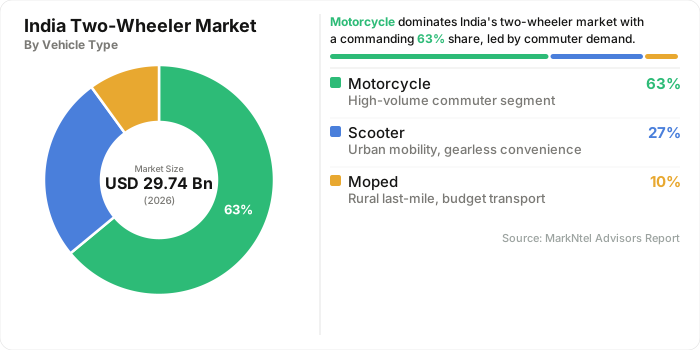
The dominance is further reinforced by income distribution and consumption patterns across India’s population. Household data compiled by Data for India shows that a large proportion of Indian consumers fall within lower- and middle-income groups, prioritizing affordability and operating cost over comfort features . Motorcycles, especially in the 100–125cc range, deliver higher mileage and lower maintenance costs, making them the preferred choice for cost-sensitive buyers. This aligns with demand patterns in both rural households and small-town commuters.
Additionally, motorcycles have broader utility across both personal and commercial use cases, including commuting, goods transport, and gig economy applications. Their ability to carry heavier loads and travel longer distances without performance loss gives them a clear functional advantage over scooters. This versatility, combined with cost efficiency and adaptability to diverse road conditions, continues to position motorcycles as the dominant vehicle type in India’s two-wheeler market.
India Two-Wheeler Market (2026-32): Regional Projection
North India dominates the India Two-Wheeler Market, accounting for approximately 31% of total regional demand, primarily due to its large and concentrated population base and strong state-level sales performance. According to data reported by national publications based on the Society of Indian Automobile Manufacturers, Uttar Pradesh alone contributes approximately 17–19% of total two-wheeler sales in India, making it the largest state-level market . Additionally, high-population states across the northern belt collectively account for a substantial share of the national population, creating a significantly larger demand pool for personal mobility solutions.
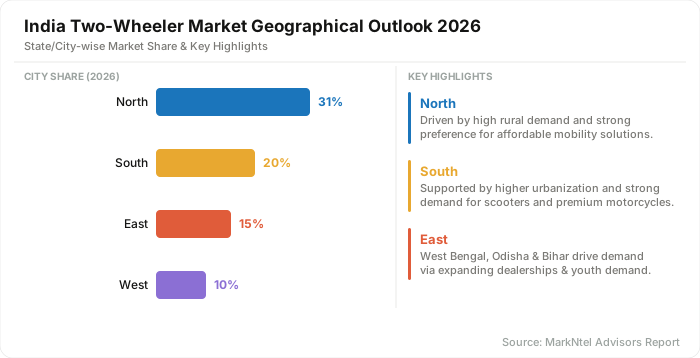
This dominance is further reinforced by strong rural demand dynamics across the region. Industry analysis indicates that rural two-wheeler demand has grown faster than urban markets in recent periods, driven by improving agricultural income and mobility needs. Given that North India has a high concentration of rural and semi-urban populations, this trend directly translates into increased motorcycle purchases. The preference for durable, fuel-efficient motorcycles suitable for longer distances further strengthens demand across these regions.
Additionally, expanding road infrastructure and connectivity are enabling higher vehicle usage and ownership. Government initiatives such as the Pradhan Mantri Gram Sadak Yojana have significantly improved rural road access, supporting mobility across villages and small towns. Combined with widespread dealer networks and financing accessibility, these factors continue to enhance market penetration. As a result, the combination of strong state-level sales, rural demand growth, and infrastructure development positions North India as the leading regional market for two-wheelers.
India Two-Wheeler Market Competitive Landscape
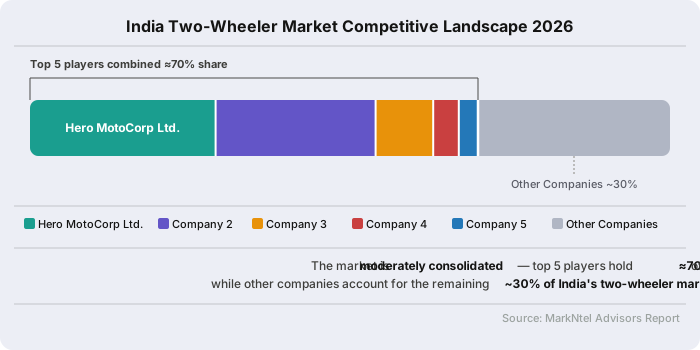
The market is moderately consolidated, with the top five players accounting for approximately 70% of the total market share. Leading companies include Hero MotoCorp Ltd., Honda Motorcycle and Scooter India Pvt. Ltd., TVS Motor Company Ltd., Bajaj Auto Ltd., and Suzuki Motorcycle India Pvt. Ltd.
Major Two-Wheeler Companies in India
- Hero MotoCorp Ltd.
- Honda Motorcycle and Scooter India Pvt. Ltd.
- TVS Motor Company Ltd.
- Bajaj Auto Ltd.
- Suzuki Motorcycle India Pvt. Ltd
- Eicher Motors Ltd
- Yamaha Motor India Pvt. Ltd.
- India Kawasaki Motors Pvt. Ltd.
- Ather Energy
- Others
Gain a Competitive Edge with Our India Two-Wheeler Market Report:
- India Two-Wheeler Market Report by MarkNtel Advisors provides a detailed & thorough analysis of market size & share, growth rate, competitive landscape, and key players. This comprehensive analysis helps businesses gain a holistic understanding of the market dynamics & make informed decisions.
- This report also highlights current market trends & future projections, allowing businesses to identify emerging opportunities & potential challenges. By understanding market forecasts, companies can align their strategies & stay ahead of the competition.
- India Two-Wheeler Market Report aids in assessing & mitigating risks associated with entering or operating in the market. By understanding market dynamics, regulatory frameworks, and potential challenges, businesses can develop strategies to minimize risks & optimize their operations.
*Reports Delivery Format - Market research studies from MarkNtel Advisors are offered in PDF, Excel and PowerPoint formats. Within 24 hours of the payment being successfully received, the report will be sent to your email address.
Frequently Asked Questions
- Market Segmentation
- Introduction
- Product Definition
- Research Process
- Assumptions
- Executive Summary
- India Two-Wheeler Market Policies, Regulations, and Product Standards
- India Two-Wheeler Market Supply Chain Analysis
- India Two-Wheeler Market Trends & Developments
- India Two-Wheeler Market Import/Export
- India Two-Wheeler Market Dynamics
- Growth Drivers
- Challenges
- India Two-Wheeler Market Hotspot & Opportunities
- India Two-Wheeler Market Outlook, 2022–2032
- Market Size & Outlook
- By Revenues (USD Million)
- By Unit Sold (Thousand Units)
- Market Share & Outlook
- By Fuel Type– Market Size & Forecast 2022–2032, USD Million & Thousand Units
- Petrol
- Electric
- By Vehicle Type– Market Size & Forecast 2022–2032, USD Million & Thousand Units
- Moped
- Scooter
- Motorcycle
- By Application– Market Size & Forecast 2022–2032, USD Million & Thousand Units
- Personal Use
- Food delivery
- E commerce deliveries
- Courier & Small Freight Services
- Bike Taxis
- Others
- By Engine Capacity– Market Size & Forecast 2022–2032, USD Million & Thousand Units
- Up to 125 cc
- 126 to 250 cc
- 251 to 500 cc
- Above 500 cc
- By Region
- North
- Uttar Pradesh
- Punjab
- Haryana
- Delhi NCR
- Others
- West
- Rajasthan
- Gujarat
- Maharashtra
- Madhya Pradesh
- Others
- South
- Tamil Nadu
- Karnataka
- Kerala
- Andhra
- Telangana
- Others
- East
- West Bengal
- Bihar
- Jharkhand
- North Eastern States
- Chhattisgarh
- Others
- North
- By Fuel Type– Market Size & Forecast 2022–2032, USD Million & Thousand Units
- Market Size & Outlook
- India Moped Market Outlook, 2022–2032
- Market Size & Outlook
- By Revenues (USD Million)
- By Unit Sold (Thousand Units)
- Market Share & Outlook
- By Fuel Type-Market Size & Forecast 2022–2032, USD Million & Thousand Units
- By Vehicle Type-Market Size & Forecast 2022–2032, USD Million & Thousand Units
- By Application -Market Size & Forecast 2022–2032, USD Million & Thousand Units
- By Engine Capacity-Market Size & Forecast 2022–2032, USD Million & Thousand Units
- Market Size & Outlook
- India Scooter Market Outlook, 2022–2032
- Market Size & Outlook
- By Revenues (USD Million)
- By Unit Sold (Thousand Units)
- Market Share & Outlook
- By Fuel Type-Market Size & Forecast 2022–2032, USD Million & Thousand Units
- By Vehicle Type-Market Size & Forecast 2022–2032, USD Million & Thousand Units
- By Application -Market Size & Forecast 2022–2032, USD Million & Thousand Units
- By Engine Capacity-Market Size & Forecast 2022–2032, USD Million & Thousand Units
- Market Size & Outlook
- India Motorcycle Market Outlook, 2022–2032
- Market Size & Outlook
- By Revenues (USD Million)
- By Unit Sold (Thousand Units)
- Market Share & Outlook
- By Fuel Type-Market Size & Forecast 2022–2032, USD Million & Thousand Units
- By Vehicle Type-Market Size & Forecast 2022–2032, USD Million & Thousand Units
- By Application -Market Size & Forecast 2022–2032, USD Million & Thousand Units
- By Engine Capacity-Market Size & Forecast 2022–2032, USD Million & Thousand Units
- Market Size & Outlook
- India Two-Wheeler Market Key Strategic Imperatives for Success & Growth
- Competition Outlook
- Company Profiles
- Hero MotoCorp Ltd.
- Business Description
- Product Portfolio
- Strategic Alliances or Partnerships
- Recent Developments
- Financial Details
- Others
- Honda Motorcycle and Scooter India Pvt. Ltd.
- Business Description
- Product Portfolio
- Strategic Alliances or Partnerships
- Recent Developments
- Financial Details
- Others
- TVS Motor Company Ltd.
- Business Description
- Product Portfolio
- Strategic Alliances or Partnerships
- Recent Developments
- Financial Details
- Others
- Bajaj Auto Ltd.
- Business Description
- Product Portfolio
- Strategic Alliances or Partnerships
- Recent Developments
- Financial Details
- Others
- Suzuki Motorcycle India Pvt. Ltd.
- Business Description
- Product Portfolio
- Strategic Alliances or Partnerships
- Recent Developments
- Financial Details
- Others
- Eicher Motors Ltd
- Business Description
- Product Portfolio
- Strategic Alliances or Partnerships
- Recent Developments
- Financial Details
- Others
- Yamaha Motor India Pvt. Ltd.
- Business Description
- Product Portfolio
- Strategic Alliances or Partnerships
- Recent Developments
- Financial Details
- Others
- Ather Energy
- Business Description
- Product Portfolio
- Strategic Alliances or Partnerships
- Recent Developments
- Financial Details
- Others
- India Kawasaki Motors Pvt. Ltd.
- Business Description
- Product Portfolio
- Strategic Alliances or Partnerships
- Recent Developments
- Financial Details
- Others
- Others
- Hero MotoCorp Ltd.
- Company Profiles
- Disclaimer
MarkNtel Advisors follows a robust and iterative research methodology designed to ensure maximum accuracy and minimize deviation in market estimates and forecasts. Our approach combines both bottom-up and top-down techniques to effectively segment and quantify various aspects of the market. A consistent feature across all our research reports is data triangulation, which examines the market from three distinct perspectives to validate findings. Key components of our research process include:
1. Scope & Research Design At the outset, MarkNtel Advisors define the research objectives and formulate pertinent questions. This phase involves determining the type of research—qualitative or quantitative—and designing a methodology that outlines data collection methods, target demographics, and analytical tools. They also establish timelines and budgets to ensure the research aligns with client goals.
2. Sample Selection and Data Collection In this stage, the firm identifies the target audience and determines the appropriate sample size to ensure representativeness. They employ various sampling methods, such as random or stratified sampling, based on the research objectives. Data collection is carried out using tools like surveys, interviews, and observations, ensuring the gathered data is reliable and relevant.
3. Data Analysis and Validation Once data is collected, MarkNtel Advisors undertake a rigorous analysis process. This includes cleaning the data to remove inconsistencies, employing statistical software for quantitative analysis, and thematic analysis for qualitative data. Validation steps are taken to ensure the accuracy and reliability of the findings, minimizing biases and errors.

4. Data Forecast and FinalizationThe final phase involves forecasting future market trends based on the analyzed data. MarkNtel Advisors utilize predictive modeling and time series analysis to anticipate market behaviors. The insights are then compiled into comprehensive reports, featuring visual aids like charts and graphs, and include strategic recommendations to inform client decision-making
We offer flexible licensing options to cater to varying organizational needs. Choose the pricing pack that best suits your requirements:
Buy Now Inquire Before Buying
 Request Customization
 Talk to our Consultant







