

Latin America Swimming Pool Equipment Market Research Report: Growth Drivers & Forecast (2026-2032)
By Equipment Type (Pumps, Filters, Heaters, Cleaners, Chemical Treatment Equipment, Pool Covers, Lighting Equipment, Automation & Control Systems, Others), By Pool Type (Commercial ... Pools, Residential Pools), By End-User (Hospitality, Residential, Institutional, Municipal), By Distribution Channel (Direct Sales, Distributors & Dealers, Online), and others Read more
- Environment
- Mar 2026
- Pages 235
- Report Format: PDF, Excel, PPT
Latin America Swimming Pool Equipment Market
Projected 5.25% CAGR from 2026 to 2032
Study Period
2026-2032
Market Size (2026)
USD 0.80 Billion
Market Size (2032)
USD 1.17 Billion
Base Year
2025
Projected CAGR
5.25%
Leading Segments
By End User: Residential
Latin America Swimming Pool Equipment Market Report Key Takeaways:
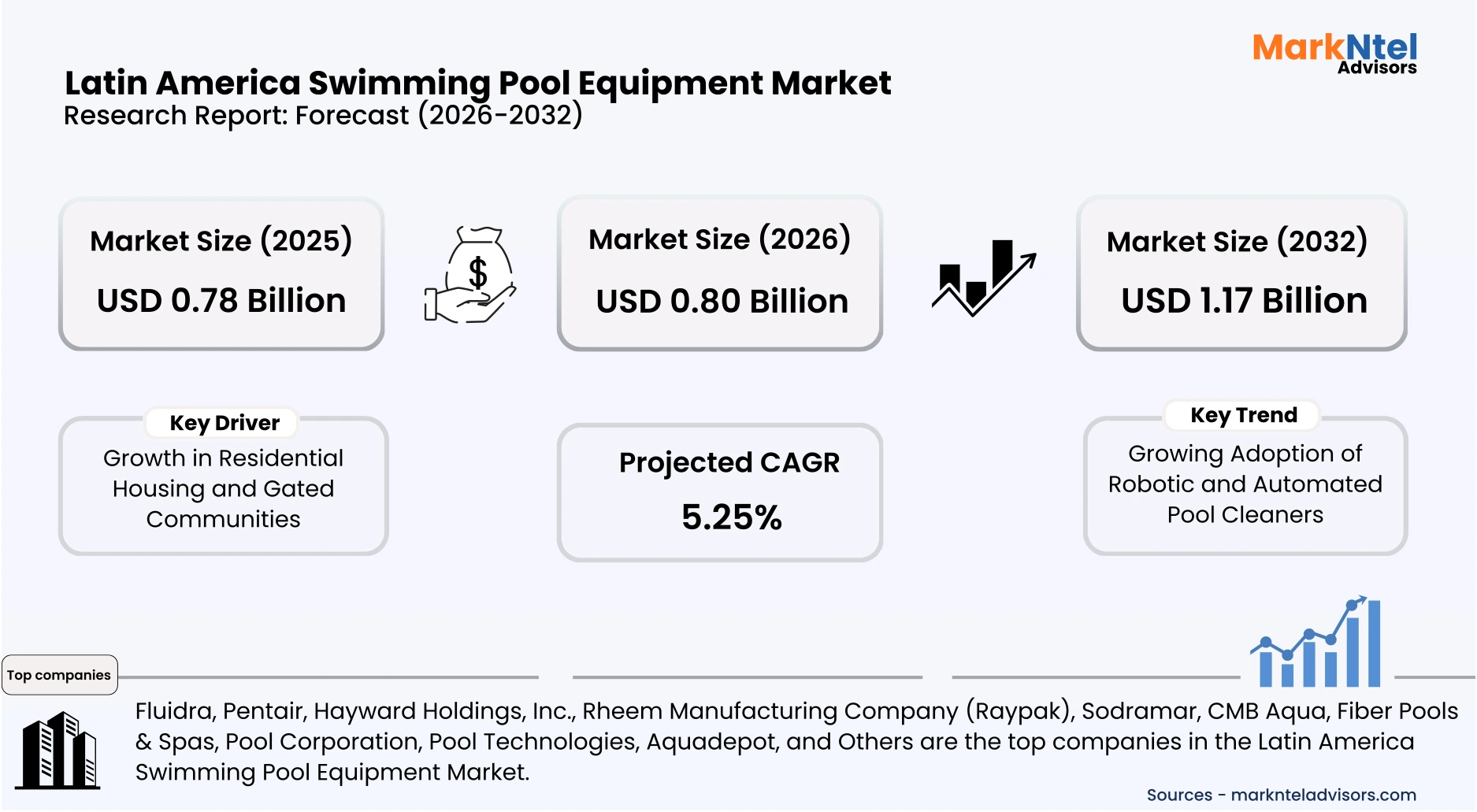
- The Latin America Swimming Pool Equipment Market size was valued at around USD 0.78 billion in 2025 and is projected to grow from USD 0.80 billion in 2026 to USD 1.17 billion by 2032, exhibiting a CAGR of 5.25% during 2026-32.
- Brazil holds the largest market share of about 38.32% in the Latin America Swimming Pool Equipment Market in 2026.
- By Equipment Type, the Pumps segment represented a significant share of about 23% in the Latin America Swimming Pool Equipment Market in 2026.
- By End User, the Residential segment seized a significant share of about 63% in the Latin America Swimming Pool Equipment Market in 2026.
- Leading swimming pool equipment companies in the Latin America market are Fluidra, Pentair, Hayward Holdings, Inc., Rheem Manufacturing Company (Raypak), Sodramar, CMB Aqua, Fiber Pools & Spas, Pool Corporation, Pool Technologies, Aquadepot, and Others.
Market Insights & Analysis: Latin America Swimming Pool Equipment Market (2026-32):
The Latin America Swimming Pool Equipment Market size was valued at around USD 0.78 billion in 2025 and is projected to grow from USD 0.80 billion in 2026 to USD 1.17 billion by 2032, exhibiting a CAGR of 5.25% during the forecast period, i.e., 2026-32.
The Latin America swimming pool equipment market has developed steadily over the past decade, supported by rising urbanization and expanding middle-income housing. According to the World Bank, over 80% of the region’s population resides in urban areas, driving demand for organized residential infrastructure. This transition has increased the adoption of private and shared pools, particularly in Brazil and Mexico. Historically, market expansion has been largely replacement-driven, supported by a growing installed base of residential pools.
Current market conditions reflect stable demand across both residential and commercial end users, with residential households accounting for the majority of installations. Government-backed housing programs such as Minha Casa Minha Vida, which accounts for nearly 50% of new housing supply and has supported around 2 million housing units with plans for an additional 1 million by 2026, continue to drive construction activity . Similarly, Mexico’s Infonavit issued approximately 590,000 housing loans in 2025 and targets over 3 million mortgages under its 2026 plan, significantly expanding residential development .
Infrastructure and tourism development have further strengthened commercial demand, particularly in hospitality and institutional segments. According to the UNWTO, international tourist arrivals to Latin America are steadily recovering, supporting hotel and resort expansion. Projects such as Fazenda Vista Verde in Brazil, which includes more than 500 planned residential plots alongside integrated swimming pools and leisure infrastructure, illustrate how mixed-use developments are increasing equipment demand. Manufacturers are also introducing energy-efficient pumps and automated cleaning systems to align with rising electricity costs.
Looking ahead, the market is expected to maintain moderate but stable growth, supported by continued housing expansion and gradual improvements in disposable income. The expansion of the middle-income population further reinforces this trend, with over 400 million people in Latin America classified as middle class, representing approximately 61% of the population and generating more than USD 5 trillion in annual spending power, according to the World Bank . While income volatility remains a constraint, these demographic and economic shifts are expected to sustain long-term demand.
Latin America Swimming Pool Equipment Market Scope:
| Category | Segments |
|---|---|
| By Equipment Type | (Pumps, Filters, Heaters, Cleaners, Chemical Treatment Equipment, Pool Covers, Lighting Equipment, Automation & Control Systems, Others), |
| By Pool Type | (Commercial Pools, Residential Pools), |
| By End-User | (Hospitality, Residential, Institutional, Municipal), |
| By Distribution Channel | (Direct Sales, Distributors & Dealers, Online), |
Latin America Swimming Pool Equipment Market Driver:
Growth in Residential Housing and Gated Communities
The expansion of residential housing, particularly gated communities and master-planned developments, has emerged as a key structural driver of swimming pool equipment demand in Latin America. This trend has intensified due to increasing private real estate investments and a shift toward lifestyle-oriented housing formats. Developers are increasingly incorporating recreational amenities such as swimming pools to enhance property value and attract middle- and upper-income buyers. As a result, pools are becoming a standard feature in new residential developments rather than a discretionary addition.
This growth is supported by measurable increases in residential construction activity across the region. According to the IBGE, the National Index of Civil Construction increased by 5.63% in 2025, reflecting sustained expansion in building activity . Housing expansion is further reinforced by Chile’s national development strategy, where approximately USD 82 billion was allocated under the 2025 national budget, alongside targets to construct 100,000–120,000 homes annually . Premium residential developments such as the Enseada project in Rio de Janeiro, which integrates amenities including an infinity-edge swimming pool, further highlight this shift toward amenity-driven housing .
This driver directly contributes to market volume expansion by increasing the installed base of swimming pools across new housing developments. Each additional residential unit with a pool generates long-term demand for essential equipment such as pumps, filtration systems, and water treatment solutions. As gated communities continue to expand across Brazil, Chile, and other Latin American markets, the cumulative pool base grows steadily. This creates a sustained replacement and maintenance cycle, structurally increasing equipment demand and reinforcing long-term market growth.
Latin America Swimming Pool Equipment Market Trend:
Growing Adoption of Robotic and Automated Pool Cleaners
The adoption of robotic and automated pool cleaners has accelerated significantly in recent years, driven by increasing demand for convenience, labor efficiency, and advanced maintenance solutions. Urban households and commercial operators are shifting away from manual cleaning toward intelligent systems that reduce operational effort. In 2026, Aiper introduced AI-powered robotic pool cleaners such as the Scuba V3 Ultra, capable of optimizing cleaning paths and performance based on real-time pool conditions, highlighting rapid technological advancement .
This trend is reshaping industry dynamics by shifting demand toward high-value, technology-driven equipment and transforming distribution models. In 2025, Fluidra invested approximately USD 100 million to acquire a 27% stake in Aiper, signaling a strong industry commitment to robotic and cordless cleaning technologies. With global adoption of robotic cleaners still below 25%, significant headroom remains for growth, while direct-to-consumer and retail channels are expanding access to these advanced solutions .
The trend is expected to persist as the installed base of pools grows and end users prioritize efficiency, water conservation, and reduced maintenance costs. Automated systems optimize cleaning cycles, reduce chemical usage, and improve long-term cost efficiency for both residential and hospitality segments. Continued innovation in AI-driven and cordless technologies is likely to accelerate adoption, establishing robotic cleaning as a structural shift that will influence product development, pricing strategies, and long-term market evolution.
Latin America Swimming Pool Equipment Market Opportunity:
Untapped Pool Penetration in Emerging Urban Areas
Untapped pool penetration across emerging urban areas presents a significant structural opportunity in Latin America, driven by expanding residential construction and evolving consumer preferences. While housing development is accelerating, swimming pool ownership remains relatively low compared to developed markets, creating a clear gap between infrastructure growth and amenity adoption. This disparity is increasingly visible in emerging urban regions where new housing supply is rising, but lifestyle infrastructure is still developing.
This opportunity is supported by measurable housing expansion initiatives across key markets. In 2025, IDB Invest committed approximately USD 35 million to support the construction of more than 17,000 housing units in Mexico, particularly in developing regions such as Quintana Roo . Such projects directly expand the residential base and create future demand for improved living standards. As these communities mature, demand for shared and private leisure amenities, including swimming pools, is expected to increase.
The opportunity is particularly advantageous for new entrants due to the fragmented and underpenetrated nature of these markets. Emerging urban areas are highly price-sensitive and less dominated by established global brands, allowing smaller players to compete through cost-effective and localized solutions. Additionally, first-time buyers are more open to alternative offerings, enabling new companies to establish early market presence. This creates scalable growth potential as pool adoption gradually increases alongside residential development.
Latin America Swimming Pool Equipment Market Challenge:
Economic Volatility and Fluctuating Consumer Spending
Economic volatility and fluctuating consumer spending represent a critical structural challenge for the swimming pool equipment market in Latin America, as demand is closely tied to discretionary income. The region continues to experience inflationary pressures and currency instability, affecting household purchasing power. According to the International Monetary Fund, inflation across Latin America is converging toward target levels at a slower pace, indicating persistent price pressures. This environment reduces consumers’ willingness to invest in non-essential amenities such as swimming pools and related equipment.
The impact is evident across major markets, where economic instability directly influences purchasing behavior and investment decisions. In Argentina, mortgage rates surged to approximately 15% in 2025 amid a currency crisis, significantly reducing lending activity and disrupting housing demand. Elevated borrowing costs and inflation in countries such as Brazil and Argentina have constrained access to housing finance and delayed discretionary upgrades. Currency depreciation further increases the cost of imported equipment, placing additional pressure on pricing strategies for manufacturers and distributors.
This challenge materially restricts market expansion by creating demand uncertainty and discouraging long-term investment. Market participants face difficulties in forecasting demand, managing inventory, and maintaining consistent pricing structures. Additionally, new entrants encounter barriers due to unpredictable returns and heightened financial risk in volatile economies. Consequently, despite underlying growth potential, economic instability continues to suppress adoption rates and slow the scalability of operations across the region.
Latin America Swimming Pool Equipment Market (2026-32) Segmentation Analysis:
The Latin America Swimming Pool Equipment Market study of MarkNtel Advisors evaluates & highlights the major trends and influencing factors in each segment. It includes predictions for the period 2026–32 at the regional level. Based on the analysis, the market has been further classified as;
Based on Equipment Type:
- Pumps
- Filters
- Heaters
- Cleaners
- Chemical Treatment Equipment
- Pool Covers
- Lighting Equipment
- Automation & Control Systems
- Others
The pumps segment dominates the Latin America Swimming Pool Equipment Market, accounting for approximately 23% of total demand, primarily because pumps are essential for the continuous circulation and filtration of pool water. Every swimming pool, regardless of size or type, requires a pump to maintain water quality and hygiene standards. According to the Pan American Health Organization, proper water circulation is critical to prevent contamination and ensure safe recreational water environments, reinforcing the mandatory role of pumps across residential and commercial pools.
This dominance is further supported by the large installed base of pools across key markets such as Brazil and Mexico, where equipment demand is largely replacement-driven. Pumps typically have shorter replacement cycles compared to structural components, leading to recurring demand over time. Additionally, increasing electricity costs across the region are encouraging the adoption of energy-efficient and variable-speed pumps, which are being promoted through energy efficiency initiatives and utility-driven programs in countries such as Brazil and Chile.
Industrial and distribution factors also strengthen the segment’s leading position. Manufacturers such as Pentair and Fluidra continue to expand their portfolios with energy-efficient pump technologies tailored for emerging markets. These products offer improved performance, durability, and cost savings, making them a preferred choice among consumers. As a result, the combination of essential functionality, recurring replacement demand, and ongoing product innovation continues to position pumps as the dominant equipment segment in the region.
Based on End User:
- Hospitality
- Residential
- Institutional
- Municipal
The residential segment dominates the Latin America Swimming Pool Equipment Market, accounting for approximately 63% of total demand, primarily because pool ownership in the region is concentrated within private households rather than commercial establishments. Residential properties, particularly in suburban and peri-urban areas, increasingly incorporate swimming pools as lifestyle amenities. This trend is supported by rising homeownership and large-scale housing expansion programs targeting middle- and upper-income households, where private leisure infrastructure enhances property value and buyer appeal.
This dominance is reinforced by the scale of residential construction across key markets. In 2025, Mexico announced plans to construct approximately 1.1 million affordable homes through national housing institutions, supported by long-term, low-interest financing schemes. Such large-scale housing initiatives significantly expand the residential base, creating future demand for lifestyle upgrades and recreational infrastructure. Compared to commercial developments, which are limited in number, residential projects are widely distributed, resulting in a higher volume of pool installations across individual households.
Additionally, residential users generate continuous and recurring demand due to frequent maintenance and replacement cycles. Homeowners regularly invest in pumps, filters, and cleaning systems to maintain water quality and operational efficiency. The growing availability of cost-effective and user-friendly equipment further supports adoption among households. This ongoing lifecycle demand, combined with a significantly larger installed base, ensures sustained equipment consumption and firmly positions residential users as the leading end-user segment in the market.
Latin America Swimming Pool Equipment Market (2026-32): Regional Projection
Brazil dominates the Latin America Swimming Pool Equipment Market, accounting for approximately 38.32% of total regional demand, primarily because it has the largest and most active residential construction and pool installation base in the region. The country’s favorable climate and strong preference for outdoor leisure living have led to widespread adoption of private swimming pools across suburban housing and gated communities. This extensive installed base generates continuous demand for essential equipment such as pumps, filters, and cleaning systems, positioning Brazil ahead of other regional markets.
This dominance is further reinforced by the scale of construction and real estate development across the country. According to industry data, Brazil’s construction sector is expected to mobilize over USD 500 billion in projects by 2030, including more than USD 60 billion in real estate development, highlighting the magnitude of residential expansion . This sustained pipeline of housing projects directly increases the number of properties incorporating leisure amenities such as swimming pools. As a result, the expanding residential footprint significantly contributes to higher equipment demand compared to other Latin American countries.
Brazil’s leadership is also supported by its well-established domestic manufacturing and distribution ecosystem. Local players ensure cost-effective production and widespread availability of pool equipment tailored to regional requirements, while strong service networks support ongoing maintenance and replacement needs. This combination of large-scale residential development, a substantial installed pool base, and localized supply infrastructure enables consistent demand generation. Consequently, Brazil maintains a clear competitive advantage, firmly positioning it as the dominant market within Latin America.
Gain a Competitive Edge with Our Latin America Swimming Pool Equipment Market Report:
- Latin America Swimming Pool Equipment Market Report by MarkNtel Advisors provides a detailed & thorough analysis of market size & share, growth rate, competitive landscape, and key players. This comprehensive analysis helps businesses gain a holistic understanding of the market dynamics & make informed decisions.
- This report also highlights current market trends & future projections, allowing businesses to identify emerging opportunities & potential challenges. By understanding market forecasts, companies can align their strategies & stay ahead of the competition.
- Latin America Swimming Pool Equipment Market Report aids in assessing & mitigating risks associated with entering or operating in the market. By understanding market dynamics, regulatory frameworks, and potential challenges, businesses can develop strategies to minimize risks & optimize their operations.
*Reports Delivery Format - Market research studies from MarkNtel Advisors are offered in PDF, Excel and PowerPoint formats. Within 24 hours of the payment being successfully received, the report will be sent to your email address.
Frequently Asked Questions
- Market Segmentation
- Introduction
- Product Definition
- Research Process
- Assumptions
- Executive Summary
- Latin America Swimming Pool Equipment Market Policies, Regulations, and Product Standards
- Latin America Swimming Pool Equipment Market Trends & Developments
- Latin America Swimming Pool Equipment Market Dynamics
- Growth Factors
- Challenges
- Latin America Swimming Pool Equipment Market Hotspot & Opportunities
- Latin America Swimming Pool Equipment Market Outlook, 2022-2032F
- Market Size & Outlook
- By Revenues (USD Million)
- Market Share & Analysis
- By Equipment Type- Market Size & Forecast 2022-2032, USD Million
- Pumps
- Filters
- Heaters
- Cleaners
- Chemical Treatment Equipment
- Pool Covers
- Lighting Equipment
- Automation & Control Systems
- Others
- By Pool Type- Market Size & Forecast 2022-2032, USD Million
- Commercial Pools
- Residential Pools
- By End-User- Market Size & Forecast 2022-2032, USD Million
- Hospitality
- Residential
- Institutional
- Municipal
- By Distribution Channel- Market Size & Forecast 2022-2032, USD Million
- Direct Sales
- Distributors & Dealers
- Online
- By Country
- Brazil
- Argentina
- Mexico
- Chile
- Peru
- Colombia
- Rest of Latin America
- By Company
- Competition Characteristics
- Market Share & Analysis
- By Equipment Type- Market Size & Forecast 2022-2032, USD Million
- Market Size & Outlook
- Brazil Swimming Pool Equipment Market Outlook, 2022-2032F
- Market Size & Outlook
- By Revenues (USD Million)
- Market Share & Analysis
- By Equipment Type- Market Size & Forecast 2022-2032, USD Million
- By Pool Type- Market Size & Forecast 2022-2032, USD Million
- By End-User- Market Size & Forecast 2022-2032, USD Million
- By Distribution Channel- Market Size & Forecast 2022-2032, USD Million
- Market Size & Outlook
- Argentina Swimming Pool Equipment Market Outlook, 2022-2032F
- Market Size & Outlook
- By Revenues (USD Million)
- Market Share & Analysis
- By Equipment Type- Market Size & Forecast 2022-2032, USD Million
- By Pool Type- Market Size & Forecast 2022-2032, USD Million
- By End-User- Market Size & Forecast 2022-2032, USD Million
- By Distribution Channel- Market Size & Forecast 2022-2032, USD Million
- Market Size & Outlook
- Mexico Swimming Pool Equipment Market Outlook, 2022-2032F
- Market Size & Outlook
- By Revenues (USD Million)
- Market Share & Analysis
- By Equipment Type- Market Size & Forecast 2022-2032, USD Million
- By Pool Type- Market Size & Forecast 2022-2032, USD Million
- By End-User- Market Size & Forecast 2022-2032, USD Million
- By Distribution Channel- Market Size & Forecast 2022-2032, USD Million
- Market Size & Outlook
- Chile Swimming Pool Equipment Market Outlook, 2022-2032F
- Market Size & Outlook
- By Revenues (USD Million)
- Market Share & Analysis
- By Equipment Type- Market Size & Forecast 2022-2032, USD Million
- By Pool Type- Market Size & Forecast 2022-2032, USD Million
- By End-User- Market Size & Forecast 2022-2032, USD Million
- By Distribution Channel- Market Size & Forecast 2022-2032, USD Million
- Market Size & Outlook
- Peru Swimming Pool Equipment Market Outlook, 2022-2032F
- Market Size & Outlook
- By Revenues (USD Million)
- Market Share & Analysis
- By Equipment Type- Market Size & Forecast 2022-2032, USD Million
- By Pool Type- Market Size & Forecast 2022-2032, USD Million
- By End-User- Market Size & Forecast 2022-2032, USD Million
- By Distribution Channel- Market Size & Forecast 2022-2032, USD Million
- Market Size & Outlook
- Colombia Swimming Pool Equipment Market Outlook, 2022-2032F
- Market Size & Outlook
- By Revenues (USD Million)
- Market Share & Analysis
- By Equipment Type- Market Size & Forecast 2022-2032, USD Million
- By Pool Type- Market Size & Forecast 2022-2032, USD Million
- By End-User- Market Size & Forecast 2022-2032, USD Million
- By Distribution Channel- Market Size & Forecast 2022-2032, USD Million
- Market Size & Outlook
- Latin America Swimming Pool Equipment Market Key Strategic Imperatives for Success & Growth
- Competitive Outlook
- Company Profiles
- Fluidra
- Business Description
- Product Portfolio
- Collaborations & Alliances
- Recent Developments
- Financial Details
- Others
- Pentair
- Business Description
- Product Portfolio
- Collaborations & Alliances
- Recent Developments
- Financial Details
- Others
- Haywar
- Business Description
- Product Portfolio
- Collaborations & Alliances
- Recent Developments
- Financial Details
- Others
- Rheem (Raypak)
- Business Description
- Product Portfolio
- Collaborations & Alliances
- Recent Developments
- Financial Details
- Others
- Sodramar
- Business Description
- Product Portfolio
- Collaborations & Alliances
- Recent Developments
- Financial Details
- Others
- CMB Aqua
- Business Description
- Product Portfolio
- Collaborations & Alliances
- Recent Developments
- Financial Details
- Others
- Fiber Pools & Spas
- Business Description
- Product Portfolio
- Collaborations & Alliances
- Recent Developments
- Financial Details
- Others
- Pool Corporation (POOLCORP)
- Business Description
- Product Portfolio
- Collaborations & Alliances
- Recent Developments
- Financial Details
- Others
- Pool Technologies
- Business Description
- Product Portfolio
- Collaborations & Alliances
- Recent Developments
- Financial Details
- Others
- Aquadepot
- Business Description
- Product Portfolio
- Collaborations & Alliances
- Recent Developments
- Financial Details
- Others
- Fluidra
- Company Profiles
- Disclaimer
MarkNtel Advisors follows a robust and iterative research methodology designed to ensure maximum accuracy and minimize deviation in market estimates and forecasts. Our approach combines both bottom-up and top-down techniques to effectively segment and quantify various aspects of the market. A consistent feature across all our research reports is data triangulation, which examines the market from three distinct perspectives to validate findings. Key components of our research process include:
1. Scope & Research Design At the outset, MarkNtel Advisors define the research objectives and formulate pertinent questions. This phase involves determining the type of research—qualitative or quantitative—and designing a methodology that outlines data collection methods, target demographics, and analytical tools. They also establish timelines and budgets to ensure the research aligns with client goals.
2. Sample Selection and Data Collection In this stage, the firm identifies the target audience and determines the appropriate sample size to ensure representativeness. They employ various sampling methods, such as random or stratified sampling, based on the research objectives. Data collection is carried out using tools like surveys, interviews, and observations, ensuring the gathered data is reliable and relevant.
3. Data Analysis and Validation Once data is collected, MarkNtel Advisors undertake a rigorous analysis process. This includes cleaning the data to remove inconsistencies, employing statistical software for quantitative analysis, and thematic analysis for qualitative data. Validation steps are taken to ensure the accuracy and reliability of the findings, minimizing biases and errors.

4. Data Forecast and FinalizationThe final phase involves forecasting future market trends based on the analyzed data. MarkNtel Advisors utilize predictive modeling and time series analysis to anticipate market behaviors. The insights are then compiled into comprehensive reports, featuring visual aids like charts and graphs, and include strategic recommendations to inform client decision-making
We offer flexible licensing options to cater to varying organizational needs. Choose the pricing pack that best suits your requirements:
Buy Now Inquire Before Buying
 Request Customization
 Talk to our Consultant







