

Japan Plant-Based Dairy Market Research Report: Growth Drivers & Forecast (2026-2032)
By Product Type (Plant-Based Milk, Plant-Based Cheese, Plant-Based Yoghurt), By Nature (Organic, Natural, Conventional), By End User (Individual Consumption, Food Processing Indust ... ries, Bakery & Confectionery, Snacks & Savouries, Ready Meals, HoReCa, Others), By Sales Channel (Offline, Online), By Region (Hokkaido, Tohoku, Kanto, Chubu, Others) Read more
- Food & Beverages
- Mar 2026
- Pages 170
- Report Format: PDF, Excel, PPT
Japan Plant-Based Dairy Market
Projected 6.99% CAGR from 2026 to 2032
Study Period
2026-2032
Market Size (2026)
USD 1.60 Billion
Market Size (2032)
USD 2.40 Billion
Base Year
2025
Projected CAGR
6.99%
Leading Segments
By Product Type: Plant-Based Milk
Japan Plant-Based Dairy Market Report Key Takeaways:
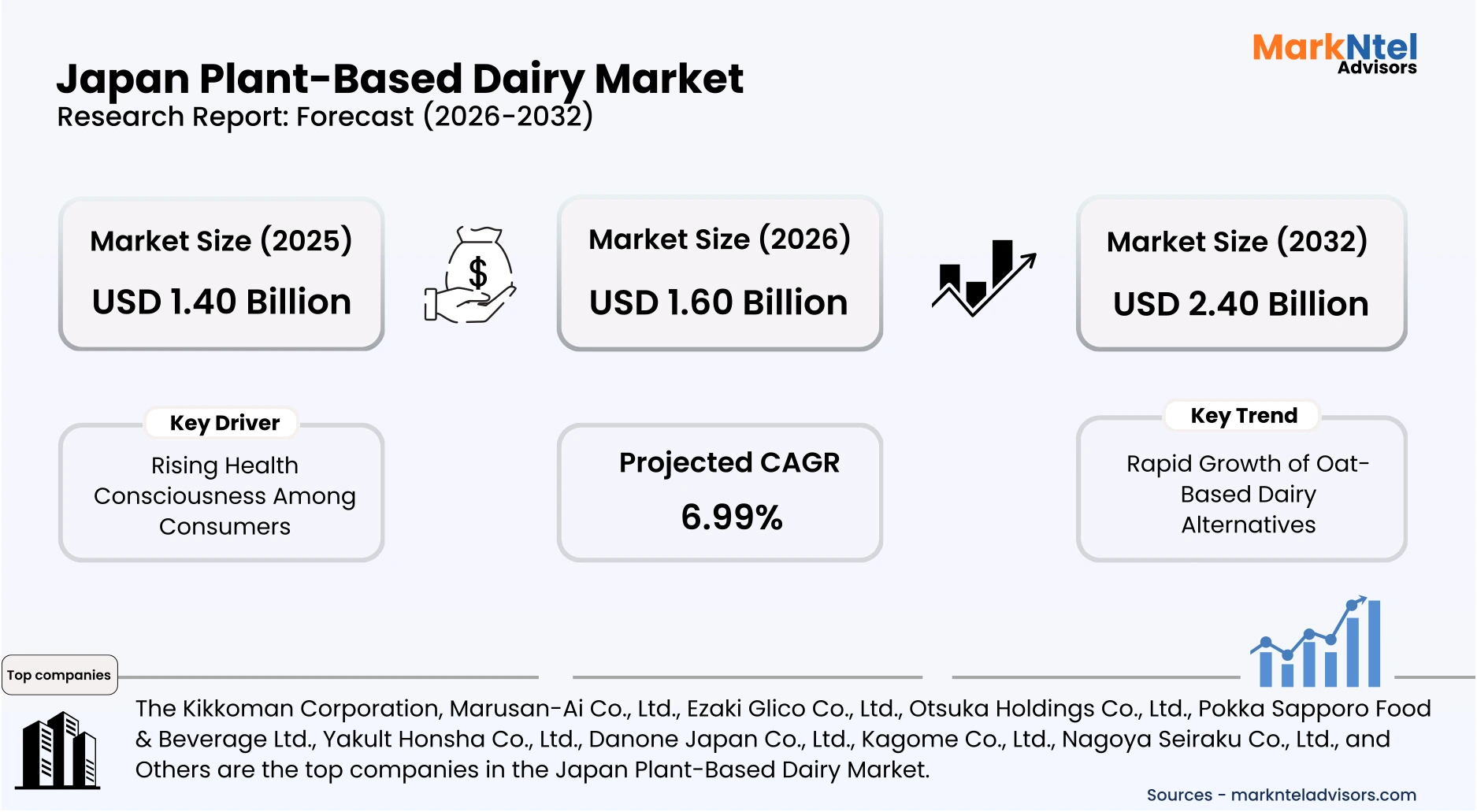
- The Japan Plant-Based Dairy Market size was valued at USD 1.40 billion in 2025 and is projected to grow from USD 1.60 billion in 2026 to USD 2.40 billion by 2032, exhibiting a CAGR of 6.99% during the forecast period.
- By product type, the plant-based milk segment represented a significant share of about 89% in the Japan Plant-Based Dairy Market in 2026.
- By sales channel, the offline segment captured a significant share of about 90% in the Japan Plant-Based Dairy Market in 2026.
- Leading plant-based dairy companies in Japan are Kikkoman Corporation, Marusan-Ai Co., Ltd., Ezaki Glico Co., Ltd., Otsuka Holdings Co., Ltd., Pokka Sapporo Food & Beverage Ltd., Yakult Honsha Co., Ltd., Danone Japan Co., Ltd., Kagome Co., Ltd., Nagoya Seiraku Co., Ltd., and Others.
Market Insights & Analysis: Japan Plant-Based Dairy Market (2026-32):
The Japan Plant-Based Dairy Market size was valued at USD 1.40 billion in 2025 and is projected to grow from USD 1.60 billion in 2026 to USD 2.40 billion by 2032. Along with this, the market is estimated to grow at a CAGR of around 6.99% during the forecast period, i.e., 2026-32.
The Japan Plant-Based Dairy Market is experiencing strong growth, primarily driven by increasing health consciousness and widespread awareness of lactose intolerance among consumers. A large proportion of the Japanese population struggles with lactose malabsorption, prompting a shift towards nutritious, lactose-free, and plant-based alternatives. Consumers are increasingly prioritizing foods that support overall health while minimizing digestive discomfort, boosting demand for soy, almond, oat, and other plant-derived dairy products.
Scientific research reinforces the health benefits of plant-based nutrition. A meta-analysis conducted on over 2.2 million participants demonstrated that adherence to plant-rich diets significantly improves health outcomes. Specifically, these diets reduce the risk of type-2 diabetes by 18%, cardiovascular disease by 10%, and cancer by 9%, while also lowering overall mortality risk by 16%. Such evidence underscores the nutritional advantages of plant-based dairy products and strengthens consumer confidence in integrating these alternatives into daily diets.
Another notable trend shaping the market is the rapid growth and mainstream adoption of oat-based dairy alternatives. Consumers increasingly favor oat milk for its lactose-free nature, high dietary fiber content, and sustainability profile. In July 2024, Misola Foods launched “Delicious Oat Milk Made by Mr. Tsukagoshi”, marketed as Japan’s first oat milk with a smooth taste and calcium content comparable to cow’s milk. The product targets both adults and children seeking dairy alternatives, highlighting how oat milk is transitioning from niche segments to mainstream acceptance .
Looking forward, Japan’s plant-based dairy sector is expected to benefit from ongoing product innovation, retail expansion, and digital distribution channels. Companies are focusing on developing functional beverages, fortified with vitamins and minerals, while leveraging e-commerce and direct-to-consumer platforms to reach health-conscious urban consumers. Increased investments in plant-based protein research and sustainable manufacturing processes are likely to further enhance product quality and affordability, making plant-based dairy an integral component of Japanese diets beyond 2025.
Overall, rising health awareness, scientific validation of plant-based diets, and the mainstream adoption of oat milk are set to propel the Japan Plant-Based Dairy Market. With continued innovation and strategic distribution, plant-based dairy products are poised to capture a larger share of Japan’s evolving functional and health-focused food landscape.
Japan Plant-Based Dairy Market Recent Developments:
- 2025: Asahi Group Japan introduced “LIKE MILK,” a dairy-free beverage produced using proprietary yeast technology. The product was initially released through a crowdfunding test launch with 200-ml packs to gauge market demand. The milk alternative is free from the 28 major allergens, targeting consumers seeking lactose-free and plant-based nutrition.
- 2025: Otsuka Foods Co., Ltd. announced the relaunch of its “Sugoi Daizu” whole-soybean beverage with redesigned packaging highlighting dietary fiber content. The company also introduced a new 200 ml “Unprocessed Type” pack, expanding consumer options in Japan’s plant-based beverage segment .
Japan Plant-Based Dairy Market Scope:
| Category | Segments |
|---|---|
| By Product Type | (Plant-Based Milk, Plant-Based Cheese, Plant-Based Yoghurt), |
| By Nature | (Organic, Natural, Conventional), |
| By End User | (Individual Consumption, Food Processing Industries, Bakery & Confectionery, Snacks & Savouries, Ready Meals, HoReCa, Others), |
| By Sales Channel | (Offline, Online), |
Japan Plant-Based Dairy Market Driver:
Rising Health Consciousness Among Consumers
Increasing health consciousness among Japanese consumers is a major driver of the plant-based dairy market. One key factor behind this trend is the high prevalence of lactose intolerance in East Asian populations. Studies indicate that approximately 73% of adults in Japan experience lactose malabsorption, meaning they have difficulty digesting lactose in conventional dairy products. This widespread digestive sensitivity has prompted many consumers to seek lactose-free alternatives, such as soy, oat, and almond milk, which provide essential nutrients like protein and calcium without gastrointestinal discomfort .
Local research further highlights the nutritional implications of lactose intolerance. A community-based study in Japan involving 843 adults found that 22.7% reported lactose intolerance, consuming significantly less milk and calcium. Their calcium intake averaged 243.7 mg/1000 kcal, compared with 285.5 mg among non-intolerant individuals, and was associated with lower bone mineral density. Such findings reinforce the demand for plant-based dairy products as a reliable source of nutrients.
Looking ahead, ongoing innovation in alternative proteins and fermentation-based technologies is expected to further expand Japan’s plant-based food ecosystem beyond 2025. Japanese manufacturers are developing dairy-free and allergen-friendly formulations to meet evolving health-focused consumer preferences.
Overall, rising awareness of digestive health, lactose intolerance, and balanced nutrition is driving Japanese consumers toward plant-based dairy products. This sustained shift toward healthier dietary choices is expected to continue fueling market growth in the coming years.
Japan Plant-Based Dairy Market Trend:
Rapid Growth of Oat-Based Dairy Alternatives
Oat‑based dairy alternatives are rapidly gaining traction in Japan as consumers increasingly seek healthier, lactose‑free beverages that deliver both nutrition and enjoyable taste. This trend is driven by rising awareness of digestive health, lactose intolerance, and nutritional benefits such as lower saturated fat and higher dietary fiber, making oat milk an attractive alternative to conventional dairy.
In April 2024, Meiji introduced “Meiji Marugoto Oats Oat Milk” in the Kanto region, tapping into the growing demand for plant‑based milk alternatives. Following a favorable initial reception, the product was rolled out nationwide in October 2024. Meiji further expanded its oat portfolio in April 2025 with a ready‑to‑drink (RTD) oat coffee beverage made from whole oats, priced at approximately USD 1.11 per 200 ml carton, highlighting functional fiber content and aligning with health‑focused consumption patterns .
In August 2025, Alpro (Danone Japan) launched its Barista Series Oat Milk across supermarkets nationwide, bringing café‑style oat milk into everyday home use. This launch reflects strong retail demand for plant‑based options that pair well with coffee, tea, and other beverages, reinforcing oat milk’s evolution from a niche product to a mainstream choice.
The growing presence of oat milk on retail shelves, in cafés, and within packaged goods underscores a broader shift toward plant‑based nutrition. As consumer awareness of health and dietary wellness continues to increase, oat‑based dairy alternatives are becoming a significant and expanding segment of Japan’s plant‑based dairy landscape.
Japan Plant-Based Dairy Market Opportunity:
Expansion via E-Commerce and Direct-to-Consumer Channels
The rapid growth of e-commerce and direct-to-consumer (D2C) channels in Japan presents a significant opportunity for plant-based dairy brands to reach a wider audience. As Japanese consumers increasingly adopt health-conscious and lactose-free diets, online retail platforms allow companies to directly connect with households and specialty consumers, bypassing traditional distribution constraints.
In 2025, Asahi Group Japan launched its yeast-derived dairy-free drink, “LIKE MILK,” in limited quantities on Amazon.co.jp as part of a test program. The product offers comparable protein and calcium levels to cow’s milk, making it an attractive alternative for health-conscious and lactose-intolerant consumers. The e-commerce launch allowed the company to gauge consumer response and expand market reach efficiently without heavy upfront retail investment.
Similarly, in September 2025, the next-generation plant-based “Eclipse Milk” was launched domestically and made available via Amazon Japan, targeting both professional and home users. This digital distribution enabled broader consumer access and encouraged trial adoption of dairy-free alternatives, reinforcing online platforms as a key channel for plant-based dairy expansion .
The increasing reliance on e-commerce and D2C channels provides plant-based dairy brands in Japan with scalable, cost-effective avenues to expand reach, engage health-conscious consumers, and accelerate adoption. Leveraging these platforms is expected to drive sustained growth for plant-based dairy products beyond 2025.
Japan Plant-Based Dairy Market Challenge:
Higher Prices Compared to Conventional Products
A key challenge for Japan’s plant-based dairy market is the higher retail price of plant-based alternatives compared with conventional cow’s milk, which can limit broader consumer adoption despite growing health awareness. Almond milk and other plant-based milks are often priced significantly higher than regular dairy at grocery stores. For instance, almond milk typically sells for USD 2.90 per liter, whereas conventional cow’s milk is around USD 1.35 per liter, reflecting nearly double the cost for plant-based options .
This price premium is largely due to higher raw material costs, specialized processing, and the use of imported ingredients. While plant-based dairy offers benefits such as lactose-free nutrition and lower saturated fat content, the cost barrier can deter everyday purchases, particularly among households buying milk for regular consumption.
As a result, producers must focus on strategies such as local sourcing, scale efficiencies, and targeted pricing to make plant-based alternatives more affordable. Overcoming the price gap will be crucial to accelerate mainstream adoption and strengthen market growth in Japan.
Japan Plant-Based Dairy Market (2026-32) Segmentation Analysis:
The Japan Plant-Based Dairy Market study of MarkNtel Advisors evaluates & highlights the major trends and influencing factors in each segment. It includes predictions for the period 2026–32 at the country level. Based on the analysis, the market has been further classified as;
Based on Product Type:
- Plant-Based Milk
- Soy
- Almond
- Oat
- Coconut
- Rice
- Blends
- Others
- Plant-Based Cheese
- Plant-Based Yoghurt
Plant-based milk is the leading segment in the Japan plant-based dairy industry, accounting for approximately 89% of the total market size. This dominance is largely due to the long-standing cultural acceptance of soy-based beverages in Japan, where soy milk has been consumed for decades as a nutritious alternative to traditional dairy. In recent years, the category has expanded significantly with the introduction of oat, almond, coconut, and blended plant-based milk products, giving consumers a wider variety of choices based on taste and nutritional preferences. Plant-based milk is also highly versatile and commonly used in beverages such as coffee, tea, and smoothies, as well as in cooking and baking applications.
Moreover, rising lactose intolerance awareness, growing vegan and flexitarian lifestyles, and increasing health consciousness among Japanese consumers have further accelerated demand. Compared with other plant-based dairy alternatives like cheese or yoghurt, plant-based milk is more accessible, widely available in supermarkets, and competitively priced, which continues to strengthen its leading position in the market.
Based on Sales Channel:
- Offline
- Online
The offline sales channel dominates the Japan plant-based dairy industry, holding around 90% of the total market value. This strong presence is primarily driven by Japan’s highly developed retail infrastructure, which includes supermarkets, convenience stores, specialty food stores, and hypermarkets. Consumers in Japan traditionally prefer purchasing food and beverage products from physical retail outlets, where they can directly compare brands, check product labels, and ensure product freshness. Major convenience store chains and supermarkets frequently stock a wide variety of plant-based dairy beverages, particularly soy and oat milk, making them easily accessible to everyday shoppers. In addition, in-store promotions, product sampling, and attractive shelf placement encourage impulse purchases and increase product visibility. While e-commerce is gradually expanding in the food and beverage sector, many consumers still rely on offline channels for regular grocery shopping. As a result, strong retail distribution networks and consumer purchasing habits continue to support the dominance of offline sales in the market.
Japan Plant-Based Dairy Market (2026-32): Regional Projection
The Japan Plant-Based Dairy Market is dominated by the Kanto region, which includes Tokyo, Kanagawa, Saitama, Chiba, Ibaraki, Tochigi, and Gunma prefectures. Kanto leads due to high urbanization, affluent populations, and greater health awareness, driving demand for lactose-free and plant-based alternatives. Tokyo, as the capital and largest metropolitan area, serves as a hub for cafés, restaurants, and retail chains that actively promote plant-based beverages. For example, The Matcha Tokyo café offers soy, almond, and oat milk options for matcha lattes and other beverages, catering to health-conscious and lactose-intolerant consumers .
Consumers in this region are more likely to adopt health-focused diets and explore functional foods, supported by higher disposable incomes and exposure to global dietary trends. The presence of major plant-based dairy brands’ headquarters and distribution centers in Kanto also enables efficient supply and faster product launches, reinforcing the region’s market dominance.
Gain a Competitive Edge with Our Japan Plant-Based Dairy Market Report:
- Japan Plant-Based Dairy Market Report by MarkNtel Advisors provides a detailed & thorough analysis of market size & share, growth rate, competitive landscape, and key players. This comprehensive analysis helps businesses gain a holistic understanding of the market dynamics & make informed decisions.
- This report also highlights current market trends & future projections, allowing businesses to identify emerging opportunities & potential challenges. By understanding market forecasts, companies can align their strategies & stay ahead of the competition.
-
Japan Plant-Based Dairy Market Report aids in assessing & mitigating risks associated with entering or operating in the market. By understanding market dynamics, regulatory frameworks, and potential challenges, businesses can develop strategies to minimize risks & optimize their operations.
*Reports Delivery Format - Market research studies from MarkNtel Advisors are offered in PDF, Excel and PowerPoint formats. Within 24 hours of the payment being successfully received, the report will be sent to your email address.
Frequently Asked Questions
- Market Segmentation
- Introduction
- Product Definition
- Research Process
- Assumptions
- Executive Summary
- Japan Plant-Based Dairy Market Policies, Regulations, and Product Standards
- Japan Plant-Based Dairy Market Trends & Developments
- Japan Plant-Based Dairy Market Dynamics
- Growth Factors
- Challenges
- Japan Plant-Based Dairy Market Hotspot & Opportunities
- Japan Plant-Based Dairy Market Outlook, 2022-2032F
- Market Size & Outlook
- By Revenues (USD Million)
- Market Share & Outlook
- By Product Type- Market Size & Forecast 2022-2032, USD Million
- Plant-Based Milk
- Soy
- Almond
- Oat
- Coconut
- Rice
- Blends
- Others
- Plant-Based Cheese
- Plant-Based Yoghurt
- Plant-Based Milk
- By Nature- Market Size & Forecast 2022-2032, USD Million
- Organic
- Natural
- Conventional
- By End User- Market Size & Forecast 2022-2032, USD Million
- Individual Consumption
- Food Processing Industries
- Bakery & Confectionery
- Snacks & Savouries
- Ready Meals
- HoReCa
- Others
- By Sales Channel- Market Size & Forecast 2022-2032, USD Million
- Offline
- Online
- By Region- Market Size & Forecast 2022-2032, USD Million
- Hokkaido
- Tohoku
- Kanto
- Chubu
- Others
- By Company
- Competition Characteristics
- Market Share & Analysis
- By Product Type- Market Size & Forecast 2022-2032, USD Million
- Market Size & Outlook
- Japan Plant-Based Milk Market Outlook, 2022-2032
- Market Size & Outlook
- By Revenues (USD Million)
- Market Share & Outlook
- By Nature- Market Size & Forecast 2022-2032, USD Million
- By End User- Market Size & Forecast 2022-2032, USD Million
- By Sales Channel- Market Size & Forecast 2022-2032, USD Million
- By Region- Market Size & Forecast 2022-2032, USD Million
- Market Size & Outlook
- Japan Plant-Based Cheese Market Outlook, 2022-2032
- Market Size & Outlook
- By Revenues (USD Million)
- Market Share & Outlook
- By Nature- Market Size & Forecast 2022-2032, USD Million
- By End User- Market Size & Forecast 2022-2032, USD Million
- By Sales Channel- Market Size & Forecast 2022-2032, USD Million
- By Region- Market Size & Forecast 2022-2032, USD Million
- Market Size & Outlook
- Japan Plant-Based Yoghurt Market Outlook, 2022-2032
- Market Size & Outlook
- By Revenues (USD Million)
- Market Share & Outlook
- By Nature- Market Size & Forecast 2022-2032, USD Million
- By End User- Market Size & Forecast 2022-2032, USD Million
- By Sales Channel- Market Size & Forecast 2022-2032, USD Million
- By Region- Market Size & Forecast 2022-2032, USD Million
- Market Size & Outlook
- Japan Plant-Based Dairy Market Key Strategic Imperatives for Success & Growth
- Competitive Outlook
- Company Profiles
- Kikkoman Corporation
- Business Description
- Product Portfolio
- Collaborations & Alliances
- Recent Developments
- Financial Details
- Others
- Marusan-Ai Co., Ltd.
- Business Description
- Product Portfolio
- Collaborations & Alliances
- Recent Developments
- Financial Details
- Others
- Ezaki Glico Co., Ltd.
- Business Description
- Product Portfolio
- Collaborations & Alliances
- Recent Developments
- Financial Details
- Others
- Otsuka Holdings Co., Ltd.
- Business Description
- Product Portfolio
- Collaborations & Alliances
- Recent Developments
- Financial Details
- Others
- Pokka Sapporo Food & Beverage Ltd.
- Business Description
- Product Portfolio
- Collaborations & Alliances
- Recent Developments
- Financial Details
- Others
- Yakult Honsha Co., Ltd.
- Business Description
- Product Portfolio
- Collaborations & Alliances
- Recent Developments
- Financial Details
- Others
- Danone Japan Co., Ltd.
- Business Description
- Product Portfolio
- Collaborations & Alliances
- Recent Developments
- Financial Details
- Others
- Kagome Co., Ltd.
- Business Description
- Product Portfolio
- Collaborations & Alliances
- Recent Developments
- Financial Details
- Others
- Nagoya Seiraku Co., Ltd.
- Business Description
- Product Portfolio
- Collaborations & Alliances
- Recent Developments
- Financial Details
- Others
- Others
- Business Description
- Product Portfolio
- Collaborations & Alliances
- Recent Developments
- Financial Details
- Others
- Kikkoman Corporation
- Company Profiles
- Disclaimer
MarkNtel Advisors follows a robust and iterative research methodology designed to ensure maximum accuracy and minimize deviation in market estimates and forecasts. Our approach combines both bottom-up and top-down techniques to effectively segment and quantify various aspects of the market. A consistent feature across all our research reports is data triangulation, which examines the market from three distinct perspectives to validate findings. Key components of our research process include:
1. Scope & Research Design At the outset, MarkNtel Advisors define the research objectives and formulate pertinent questions. This phase involves determining the type of research—qualitative or quantitative—and designing a methodology that outlines data collection methods, target demographics, and analytical tools. They also establish timelines and budgets to ensure the research aligns with client goals.
2. Sample Selection and Data Collection In this stage, the firm identifies the target audience and determines the appropriate sample size to ensure representativeness. They employ various sampling methods, such as random or stratified sampling, based on the research objectives. Data collection is carried out using tools like surveys, interviews, and observations, ensuring the gathered data is reliable and relevant.
3. Data Analysis and Validation Once data is collected, MarkNtel Advisors undertake a rigorous analysis process. This includes cleaning the data to remove inconsistencies, employing statistical software for quantitative analysis, and thematic analysis for qualitative data. Validation steps are taken to ensure the accuracy and reliability of the findings, minimizing biases and errors.

4. Data Forecast and FinalizationThe final phase involves forecasting future market trends based on the analyzed data. MarkNtel Advisors utilize predictive modeling and time series analysis to anticipate market behaviors. The insights are then compiled into comprehensive reports, featuring visual aids like charts and graphs, and include strategic recommendations to inform client decision-making
We offer flexible licensing options to cater to varying organizational needs. Choose the pricing pack that best suits your requirements:
Buy Now Inquire Before Buying
 Request Customization
 Talk to our Consultant







