

Iraq Air Conditioner Market Research Report: Forecast (2026-2032)
By Product Type (Room Air Conditioners (Window AC (By Tonnage Capacity (Upto 1 Ton, 1 Ton to 2 Ton, Above 2 Ton)), Split AC (By Tonnage Capacity (Upto 1 Ton, 1 Ton to 1.5 Ton, Abov ... e 1.6 to 2 Ton, Above 2 Ton))), VRF Systems, Chillers (Air cooled chillers, Water cooled chillers, Others), Packaged Air Conditioners (Upto 5 Tons, 6 to 10 Tons, 11 to 20 Tons, Above 20 Tons), Cassette Air Conditioners (Upto 2 Tons, 2.1 to 4 Tons, 4.1 to 5 Tons, Above 5 Tons), Ducted Split Systems (Upto 5 Tons, 6 to 10 Tons, 11 to 20 Tons, Above 20 Tons), Others (Air Handling Units (AHU) / Fan Coil Units (FCU), etc.)), By Refrigerant Type (R32, R410A, R134a, R290, R1234ze / R1234yf, Others), By Distribution Channel (Direct Sales, Authorized Dealers & Distributors, Multi Brand Stores, Online), By End User (Residential, Offices, Retail & Malls, Hotels & Hospitality, Hospitals & Healthcare, Educational Institutions, Manufacturing, Pharmaceuticals, Food & Beverage, Data Centers, Others) Read more
- Environment
- Jun 2026
- Pages 136
- Report Format: PDF, Excel, PPT
Iraq Air Conditioner Market
Projected 5.2% CAGR from 2026 to 2032
Study Period
2026-2032
Market Size (2026)
USD 901.33 Million
Market Size (2032)
USD 1222.01 Million
Base Year
2025
Projected CAGR
5.2%
Leading Segments
By End User Residential
Iraq Air Conditioner Market Key Takeaways
- Iraq air conditioner market size was valued at USD 850.34 million in 2025 and is projected to grow from USD 901.33 million in 2026 to USD 1222.01 million by 2032.
- The industry is projected to reflect sustained growth at a steady CAGR of 5.2% during 2026-2032.
- By type, split AC holds a significant share of about 60% in 2026.
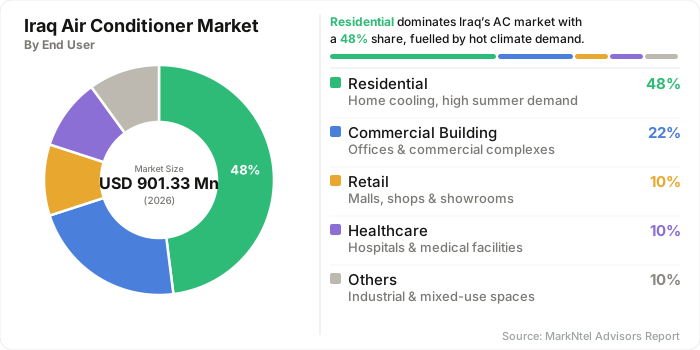
- By end user, the residential segment seized a significant share of about 48% in 2026.
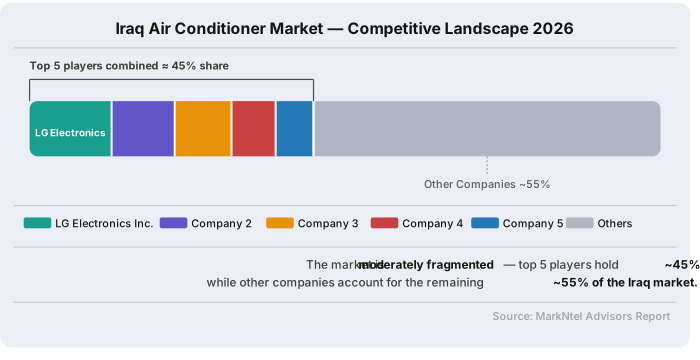
- The industry is moderately fragmented. However, the top five players collectively account for nearly 45% of the market share.
Iraq Air Conditioner Market Size and Outlook
The Iraq air conditioner market is estimated to grow at a CAGR of around 5.2% during the forecast period, i.e., 2026-32, driven by rising electricity demand, increasing cooling needs, and gradual adoption of advanced technologies. According to the International Energy Agency, cooling is one of the fastest-growing sources of electricity consumption globally, with air conditioning expected to add nearly 700 TWh of additional demand by 2035 . This trend is highly relevant for Iraq, where extreme summer conditions significantly increase reliance on cooling systems and place continuous pressure on the national power infrastructure.
Iraq’s energy consumption has been rising consistently, with total usage reaching approximately 64 Mtoe in 2024, reflecting strong demand growth across residential and commercial sectors. At the same time, electricity consumption reached nearly 67,000 GWh in 2024, indicating sustained expansion in power usage driven largely by cooling requirements These structural pressures are encouraging consumers to shift toward energy-efficient and inverter-based air conditioners, which can reduce electricity consumption by 20–30% compared to conventional systems.
The market is also being shaped by government and institutional efforts to improve energy efficiency and expand generation capacity. Iraq is planning to add around 15 GW of new power capacity along with 7.5 GW of solar energy projects, supporting long-term improvements in energy reliability and infrastructure. Additionally, global trends highlighted by the IEA emphasize that digital and AI-enabled systems can significantly improve building energy efficiency, supporting the gradual adoption of smart and IoT-integrated air conditioners.
In essence, the Iraq air conditioner market is set for sustained growth, expanding from USD 901.33 million in 2026 to USD 1,222.01 million by 2032, supported by rising cooling demand, infrastructure expansion, and a shift toward efficient and smart technologies. These structural drivers will continue to strengthen market penetration and support long-term market growth in the coming years.
Iraq Air Conditioner Market Key Indicators
- According to the World Bank, Iraq’s urban population reached over 33 million in 2024, accounting for nearly 72% of the total population, with continuous growth in cities such as Baghdad, Basra, and Erbil. This rapid urban concentration is driving expansion in residential apartments, commercial buildings, and mixed-use infrastructure, directly increasing demand for split and centralized air conditioning systems.
- Iraq’s rapid warming of 0.48°C per decade (2000–2023), significantly above global averages, is driving a structural rise in cooling demand, as extreme heatwaves increase reliance on air conditioning across residential and commercial sectors. Rising temperatures are also elevating cooling degree days, indicating sustained electricity and AC usage rather than seasonal demand. According to the IEA Climate Resilience Assessment for Iraq, this persistent heat exposure is a core long-term driver accelerating air conditioner penetration and market growth.
Iraq Air Conditioner Market Scope
| Category | Segments |
|---|---|
| By Product Type | Room Air Conditioners (Window AC |
| By Tonnage Capacity | Upto 1 Ton, 1 Ton to 2 Ton, Above 2 Ton)), Split AC |
| By Tonnage Capacity | Upto 1 Ton, 1 Ton to 1.5 Ton, Above 1.6 to 2 Ton, Above 2 Ton))), VRF Systems, Chillers (Air cooled chillers, Water cooled chillers, Others), Packaged Air Conditioners (Upto 5 Tons, 6 to 10 Tons, 11 to 20 Tons, Above 20 Tons), Cassette Air Conditioners (Upto 2 Tons, 2.1 to 4 Tons, 4.1 to 5 Tons, Above 5 Tons), Ducted Split Systems (Upto 5 Tons, 6 to 10 Tons, 11 to 20 Tons, Above 20 Tons), Others (Air Handling Units (AHU) / Fan Coil Units (FCU), etc. |
| By Refrigerant Type | R32, R410A, R134a, R290, R1234ze / R1234yf, Others |
| By Distribution Channel | Direct Sales, Authorized Dealers & Distributors, Multi Brand Stores, Online |
| By End User | Residential, Offices, Retail & Malls, Hotels & Hospitality, Hospitals & Healthcare, Educational Institutions, Manufacturing, Pharmaceuticals, Food & Beverage, Data Centers, Others |
Iraq Air Conditioner Market Growth Drivers
Rising Heat Intensity and Climate Change as a Structural Growth Driver
Iraq's geography makes it one of the most heat-exposed nations on earth. Over the past four decades, average temperatures in the country have increased by over 2.5°C, and by 2050, Iraq is expected to become the hottest country in the region, with average temperatures exceeding 36°C. Parts of Iraq have already recorded six to twelve days with highs above 50°C conditions that are life-threatening even for healthy adults. This relentless heat has effectively transformed air conditioning from a luxury into a daily necessity.
Looking ahead, the climate trajectory grows even more alarming. Iraq is expected to face drastic and escalating warming until the end of the century, especially under a high-emissions scenario. Under such a scenario, some areas in the south are projected to face a temperature rise of 5.8°C compared to the 1850–1900 baseline. As heatwaves grow longer and more intense, demand for reliable cooling solutions is rising sharply across residential, commercial, and industrial segments throughout the country.
In conclusion, extreme climate conditions are not a seasonal inconvenience in Iraq they are a permanent and worsening reality. This makes rising temperatures one of the most powerful and enduring structural drivers of Iraq's air conditioner market, sustaining strong demand well through 2032.
Recent Trends
Rising Adoption of AI-Powered Smart and Connected Air Conditioning Systems
A major trend driving growth in the Iraq air conditioner market is the rising adoption of AI-powered smart and connected air conditioning systems. Consumers and commercial users are increasingly shifting toward advanced cooling solutions that integrate artificial intelligence, IoT connectivity, and intelligent climate control features. These modern systems include AI-based sensors, machine learning algorithms, Wi-Fi connectivity, and mobile app controls that allow real-time monitoring, remote access, and automatic temperature adjustment based on occupancy, weather conditions, and user preferences.
The integration of AI and smart connectivity is transforming traditional air conditioners into intelligent systems capable of predictive maintenance, self-diagnostics, energy optimization, and seamless integration with smart home and building management platforms. This trend is gaining strong traction in urban residential projects, commercial offices, hotels, and premium real estate developments, where demand for automation and energy efficiency is increasing. For instance, in 2024, LG has introduced Iraq-adapted ICA+ Smart Air Conditioner technology, specifically designed to manage unstable electricity supply by optimizing cooling performance, reducing energy consumption, and improving durability in harsh conditions.
Overall, as Iraq continues to experience urbanization and digital transformation, the adoption of AI-enabled smart air conditioning systems is expected to significantly enhance market growth by improving efficiency, user convenience, and operational performance.
Iraq Air Conditioner Market Opportunities and Challenges
Electricity Deficits Driving Shift to Solar and Inverter ACs
One of the most significant challenges affecting the Iraq air conditioner market is the persistent electricity shortage and unstable power infrastructure. Frequent outages, transmission losses, and limited generation capacity make continuous AC usage difficult, especially during peak summer when temperatures exceed 45°C. Aging infrastructure and rising demand have widened the supply gap, forcing households and businesses to rely on costly diesel generators. This increases operating expenses and reduces willingness to adopt or frequently use air conditioning systems, thereby slowing overall market growth.
Despite these challenges, strong opportunities are emerging in solar-powered and energy-efficient inverter air conditioners. Iraq’s high solar potential supports the adoption of solar-assisted cooling systems in residential and commercial spaces. In response to unreliable electricity supply and high energy costs, consumers are increasingly shifting toward inverter ACs that consume less power and operate efficiently under voltage fluctuations. Hybrid solar-electric systems are also gaining traction, supported by rising renewable energy investments and growing awareness of energy-efficient cooling technologies.
While electricity shortages remain a major barrier, they are also accelerating demand for solar and energy-efficient HVAC solutions, creating long-term growth opportunities for the Iraq air conditioner market.
Segmentation Insights
Split Air Conditioners Lead in Terms of Usage Across Iraq’s AC Landscape
Split air conditioners account for around 60% of total revenue in Iraq’s AC market, driven by their strong balance of performance, affordability, and flexibility. These systems deliver efficient and consistent cooling, which is critical in Iraq’s extremely hot climate where temperatures remain high for extended periods.
Compared to centralized systems, split ACs require lower upfront investment and involve simpler installation, making them highly accessible for households as well as small and medium-sized commercial users. Their ability to cool individual rooms also allows users to manage energy consumption more effectively, which is particularly important in a market facing electricity shortages and rising power costs.
Furthermore, the growing availability of inverter-based and smart split ACs is accelerating their adoption, as these models significantly reduce electricity consumption while improving operational efficiency. Features such as temperature control, remote operation, and energy-saving modes enhance user convenience. Their versatility across residential apartments, offices, and retail outlets continues to strengthen their dominant position in the Iraq air conditioning market. Based on type, the scope has been segmented into
- Window AC
- Split AC
- Floor Standing AC
- Cassette AC
- Packaged AC
- Ducted Split AC
- Centralized AC
Residential Segment Emerges as the Leading End-User Category
The residential segment accounts for approximately 48% of total revenue, making it the largest end-user category in Iraq’s air conditioner market. This dominance is primarily driven by continuous and recurring demand, as households depend heavily on cooling systems during long and extremely hot summers. Unlike commercial establishments, residential users often install multiple AC units within a single home to maintain comfort across different rooms, significantly increasing overall sales volume.
Moreover, the segment benefits from a broad product portfolio, ranging from affordable window ACs to advanced inverter-based split systems, enabling adoption across various income groups. Increasing awareness of energy efficiency and the need to manage electricity expenses are also influencing purchase decisions, particularly in regions facing power supply challenges.
In addition, improving living standards and urban housing expansion are supporting sustained demand for residential cooling solutions. These factors collectively ensure stable demand cycles and reinforce the residential segment’s position as the leading contributor to revenue growth in Iraq’s air conditioning market. The key end users mapped in the study include:
- Residential
- Commercial Buildings
- Retail
- Health Care
- Hospitality
- Government & Transportation
- Oil & Gas
Iraq Air Conditioner Market Competitive Analysis
The Iraq air conditioner market is moderately fragmented, with several global HVAC manufacturers competing across residential and commercial segments. The top players Gree Electric Appliances, LG Electronics, Samsung Electronics, Carrier, York, Daikin, Midea, Mitsubishi Electric, Trane Technologies, and AUX Air collectively account for around 45% market share, driven by strong brand presence, wide product availability, and energy-efficient technologies.
Key Players in the Iraq Air Conditioner Industry
- Gree Electronic Appliances
- LG Electronics
- Samsung Electronics
- Carrier
- York
- Daikin
- Midea
- Mitsubishi Electric
- Trane Technologies
- Aux Air
- Others
Iraq Air Conditioner Industry News and Recent Developments
2025: LG Introduces Iraq-Adapted ICA+ Smart Air Conditioner Technology
LG Electronics introduced its ICA+ (I-Control Ampere) technology for the Iraq market, designed to address unstable electricity supply conditions. The system enables users to regulate power consumption in multiple ampere levels and optimize air conditioner performance during grid shortages and generator-based electricity use. It is specifically tailored for Iraq’s frequent outages and voltage fluctuations, improving operational stability in extreme summer temperatures.
Impact Analysis: This development enhances air conditioner adaptability in Iraq’s power-constrained environment. By allowing controlled energy consumption and improved voltage handling, ICA+ improves reliability during peak load periods and generator dependence. It supports rising demand for energy-resilient HVAC solutions in Iraq, where cooling continuity is critical during extreme heat and electricity shortages.
Frequently Asked Questions
- Market Segmentation
- Introduction
- Product Definition
- Research Process
- Assumptions
- Executive Summary
- Iraq Air Conditioners Market Regulations, Policies & Standards
- Iraq Air Conditioners Market Trends & Developments
- Iraq Air Conditioners Market Supply Chain Outlook
- Iraq Air Conditioners Market Imports/Exports
- Iraq Air Conditioners Market Dynamics
- Growth Drivers
- Challenges
- Iraq Air Conditioners Market Hotspots & Opportunities
- Iraq Air Conditioners Market Outlook, 2024-2030
- Market Size & Outlook
- By Revenue (USD Million)
- Market Share & Outlook
- By Product Type – Market Size & Forecast 2024-2030, USD Million & Thousand Units
- Room Air Conditioners
- Window AC
- By Tonnage Capacity
- Upto 1 Ton
- 1 Ton to 2 Ton
- Above 2 Ton
- By Tonnage Capacity
- Split AC
- By Tonnage Capacity
- Upto 1 Ton
- 1 Ton to 1.5 Ton
- Above 1.6 to 2 Ton
- Above 2 Ton
- By Tonnage Capacity
- Window AC
- VRF Systems
- Chillers
- Air cooled chillers
- Water cooled chillers
- Others
- Packaged Air Conditioners
- Upto 5 Tons
- 6 to 10 Tons
- 11 to 20 Tons
- Above 20 Tons
- Cassette Air Conditioners
- Upto 2 Tons
- 2.1 to 4 Tons
- 4.1 to 5 Tons
- Above 5 Tons
- Ducted Split Systems
- Upto 5 Tons
- 6 to 10 Tons
- 11 to 20 Tons
- Above 20 Tons
- Others (Air Handling Units (AHU) / Fan Coil Units (FCU), etc.)
- Room Air Conditioners
- By Refrigerant Type – Market Size & Forecast 2024-2030, USD Million
- R32
- R410A
- R134a
- R290
- R1234ze / R1234yf
- Others
- By Distribution Channel – Market Size & Forecast 2024-2030, USD Million
- Direct Sales
- Authorized Dealers & Distributors
- Multi Brand Stores
- Online
- By End User – Market Size & Forecast 2024-2030, USD Million
- Residential
- Offices
- Retail & Malls
- Hotels & Hospitality
- Hospitals & Healthcare
- Educational Institutions
- Manufacturing
- Pharmaceuticals
- Food & Beverage
- Data Centers
- Others
- By Competitors
- Competition Characteristics
- Market Share & Outlook
- By Product Type – Market Size & Forecast 2024-2030, USD Million & Thousand Units
- Market Size & Outlook
- Iraq Window Air Conditioners Market Outlook, 2024-2030
- Market Size & Outlook
- By Revenue (USD Million)
- By Units Sold (Thousand Units)
- Market Share & Outlook
- By Refrigerant Type – Market Size & Forecast 2024-2030, USD Million
- By Distribution Channel – Market Size & Forecast 2024-2030, USD Million
- By End User – Market Size & Forecast 2024-2030, USD Million
- By Region
- By Technology
- Inverter
- Non Inverter
- By Price Range
- By Automation
- Smart
- Non Smart
- By Star Rating
- Market Size & Outlook
- Iraq Split Air Conditioners Market Outlook, 2024-2030
- Market Size & Outlook
- By Revenue (USD Million)
- By Units Sold (Thousand Units)
- Market Share & Outlook
- By Refrigerant Type – Market Size & Forecast 2024-2030, USD Million
- By Distribution Channel – Market Size & Forecast 2024-2030, USD Million
- By End User – Market Size & Forecast 2024-2030, USD Million
- By Region
- By Technology
- By Price Range
- By Automation
- By Star Rating
- Market Size & Outlook
- Iraq VRF Systems Air Conditioners Market Outlook, 2024-2030
- Market Size & Outlook
- By Revenue (USD Million)
- Market Share & Outlook
- By Refrigerant Type – Market Size & Forecast 2024-2030, USD Million
- By Distribution Channel – Market Size & Forecast 2024-2030, USD Million
- By End User – Market Size & Forecast 2024-2030, USD Million
- Market Size & Outlook
- Iraq Chillers Air Conditioners Market Outlook, 2024-2030
- Market Size & Outlook
- By Revenue (USD Million)
- Market Share & Outlook
- By Cooling Type
- Air Cooled Chillers
- Water Cooled Chillers
- By Compressor Technology
- Reciprocating
- Scroll
- Screw
- Centrifugal
- By Refrigerant Type – Market Size & Forecast 2024-2030, USD Million
- By End User – Market Size & Forecast 2024-2030, USD Million
- By Installation
- New Installation
- Retrofit or Modernization
- By Cooling Type
- Market Size & Outlook
- Iraq Packaged Air Conditioners Market Outlook, 2024-2030
- Market Size & Outlook
- By Revenue (USD Million)
- Market Share & Outlook
- By Refrigerant Type – Market Size & Forecast 2024-2030, USD Million
- By Distribution Channel – Market Size & Forecast 2024-2030, USD Million
- By End User – Market Size & Forecast 2024-2030, USD Million
- Market Size & Outlook
- Iraq Cassette Air Conditioners Market Outlook, 2024-2030
- Market Size & Outlook
- By Revenue (USD Million)
- Market Share & Outlook
- By Refrigerant Type – Market Size & Forecast 2024-2030, USD Million
- By Distribution Channel – Market Size & Forecast 2024-2030, USD Million
- By End User – Market Size & Forecast 2024-2030, USD Million
- Market Size & Outlook
- Iraq Ducted Split Systems Air Conditioners Market Outlook, 2024-2030
- Market Size & Outlook
- By Revenue (USD Million)
- Market Share & Outlook
- By Refrigerant Type – Market Size & Forecast 2024-2030, USD Million
- By Distribution Channel – Market Size & Forecast 2024-2030, USD Million
- By End User – Market Size & Forecast 2024-2030, USD Million
- Market Size & Outlook
- Iraq Air Conditioners Market Key Strategic Imperatives for Growth & Success
- Competitive Outlook
- Company Profiles
- Gree Electronic Appliances
- Business Description
- Product Portfolio
- Strategic Alliances or Partnerships
- Recent Developments
- Financial Details
- Others
- LG Electronics
- Business Description
- Product Portfolio
- Strategic Alliances or Partnerships
- Recent Developments
- Financial Details
- Others
- Samsung Electronics
- Business Description
- Product Portfolio
- Strategic Alliances or Partnerships
- Recent Developments
- Financial Details
- Others
- Carrier
- Business Description
- Product Portfolio
- Strategic Alliances or Partnerships
- Recent Developments
- Financial Details
- Others
- York
- Business Description
- Product Portfolio
- Strategic Alliances or Partnerships
- Recent Developments
- Financial Details
- Others
- Daikin
- Business Description
- Product Portfolio
- Strategic Alliances or Partnerships
- Recent Developments
- Financial Details
- Others
- Midea
- Business Description
- Product Portfolio
- Strategic Alliances or Partnerships
- Recent Developments
- Financial Details
- Others
- Mitsubishi Electric
- Business Description
- Product Portfolio
- Strategic Alliances or Partnerships
- Recent Developments
- Financial Details
- Others
- Trane Technologies
- Business Description
- Product Portfolio
- Strategic Alliances or Partnerships
- Recent Developments
- Financial Details
- Others
- Aux Air
- Business Description
- Product Portfolio
- Strategic Alliances or Partnerships
- Recent Developments
- Financial Details
- Others
- Others
- Gree Electronic Appliances
- Company Profiles
- Disclaimer
MarkNtel Advisors follows a robust and iterative research methodology designed to ensure maximum accuracy and minimize deviation in market estimates and forecasts. Our approach combines both bottom-up and top-down techniques to effectively segment and quantify various aspects of the market. A consistent feature across all our research reports is data triangulation, which examines the market from three distinct perspectives to validate findings. Key components of our research process include:
1. Scope & Research Design At the outset, MarkNtel Advisors define the research objectives and formulate pertinent questions. This phase involves determining the type of research—qualitative or quantitative—and designing a methodology that outlines data collection methods, target demographics, and analytical tools. They also establish timelines and budgets to ensure the research aligns with client goals.
2. Sample Selection and Data Collection In this stage, the firm identifies the target audience and determines the appropriate sample size to ensure representativeness. They employ various sampling methods, such as random or stratified sampling, based on the research objectives. Data collection is carried out using tools like surveys, interviews, and observations, ensuring the gathered data is reliable and relevant.
3. Data Analysis and Validation Once data is collected, MarkNtel Advisors undertake a rigorous analysis process. This includes cleaning the data to remove inconsistencies, employing statistical software for quantitative analysis, and thematic analysis for qualitative data. Validation steps are taken to ensure the accuracy and reliability of the findings, minimizing biases and errors.

4. Data Forecast and FinalizationThe final phase involves forecasting future market trends based on the analyzed data. MarkNtel Advisors utilize predictive modeling and time series analysis to anticipate market behaviors. The insights are then compiled into comprehensive reports, featuring visual aids like charts and graphs, and include strategic recommendations to inform client decision-making
We offer flexible licensing options to cater to varying organizational needs. Choose the pricing pack that best suits your requirements:
Buy Now Inquire Before Buying
 Request Customization
 Talk to our Consultant







