

India Water and Wastewater Pump Market Research Report: Trends, Forecast & Opportunities (2026-2032)
By Pump Types (Centrifugal Pump (Overhung Pump (Vertical Inline, Horizontal End Suction), Split Case Pump (Single/Two Stage, Multistage), Vertical Pump (Turbine (Solid handling, No ... nsolid handling), Axial, Mixed Flow), Submersible Pump, Solid Handling, Non-solid Handling), Positive Displacement Pump (Diaphragm Pump, Piston Pump, Gear Pump, Lobe Pump, Progressive Cavity Pump, Screw Pump, Vane Pump, Peristaltic Pump)), By End User (Municipal water and wastewater, Industrial water and wastewater), By Application (Water, Wastewater), and others Read more
- Environment
- Apr 2026
- Pages 125
- Report Format: PDF, Excel, PPT
India Water and Wastewater Pump Market
Projected 5.0% CAGR from 2026 to 2032
Study Period
2026-2032
Market Size (2026)
USD 1.299 Billion
Market Size (2032)
USD 1.745 Billion
Base Year
2025
Projected CAGR
5.0%
Leading Segments
By End User: Municipal water and wastewater
India Water and Wastewater Pump Market Report Key Takeaways:
- India Water and Wastewater Pump Market size was valued at around USD 1.15 Billion in 2025 and is projected to grow from USD 1.299 Billion in 2026 to USD 1.745 Billion by 2032, exhibiting a CAGR of 5.0% during 2026-2032.
- In 2025, Centrifugal pumps lead the India water and wastewater pump market owing to their high efficiency in handling large fluid volumes, cost-effectiveness, low maintenance requirements, and operational reliability.
- In 2025, the municipal water & wastewater segment captured 65.24% of the India water and wastewater pump market. However, the industrial water and wastewater segment is poised to be the fastest-growing end-user category, with a projected 7.8% CAGR during 2026-32.
- Leading companies in the India water and wastewater pump industry are ITT, Kirloskar Brothers Limited, Dover, Flowserve, Sulzer AG, KSB, Xylem, Grundfos, Ebara, Franklin Electric, Wilo, Pentair PLC, and others.
- Market Insights & Analysis: India Water and Wastewater Pump Market (2026-32):
- The India Water and Wastewater Pump Market size was valued at around USD 1.05 billion in 2025 and is projected to reach USD 1.7 billion by 2032. Along with this, the market is estimated to grow at a CAGR of around 8.22% during the forecast period, i.e., 2026-32. The market growth trajectory is significantly aligned with India’s accelerating investments in water supply, sewerage networks, and wastewater treatment infrastructure. Rising urbanization, with the urban population expected to surpass 600 million by 2030, is intensifying the need for expanded municipal water distribution and sewage handling systems. This structural demand is directly translating into higher procurement of centrifugal, submersible, and high-capacity pumps across urban local bodies and industrial clusters.
- The expansion is further supported by large-scale government programs aimed at strengthening urban water security. Under AMRUT 2.0, the government has outlined investments of around USD 36 billion to enhance universal water supply coverage and sewerage infrastructure across statutory towns. In parallel, wastewater capacity addition under the Namami Gange Programme and various state-level river rejuvenation initiatives is accelerating the installation of sewage treatment plants (STPs) and associated pumping systems. These programs are not only driving new pump installations but also stimulating replacement demand for energy-efficient and automation-integrated pumping technologies.
- Moreover, the National Infrastructure Pipeline (NIP) envisages overall infrastructure investments of about USD 1.4–1.5 trillion during FY2020–25, with urban infrastructure accounting for an estimated 16% or more of the total allocation. This implies potential investments exceeding USD 200 billion toward urban development, including water supply and sanitation. Additionally, mega projects such as the Delhi–Mumbai Industrial Corridor (DMIC) and freight corridor-linked smart townships are creating incremental demand for bulk water transfer, effluent management, and industrial wastewater handling systems.
- Collectively, regulatory tightening on wastewater discharge norms, increasing deployment of STPs and CETPs in industrialized states such as Maharashtra, Gujarat, and Tamil Nadu, and the modernization of aging pumping infrastructure underpin the market’s sustained growth outlook. The transition toward 24x7 water supply models, reduction of non-revenue water, and rising electricity tariffs are further encouraging the adoption of energy-efficient pumps with IE3 and IE4 motors. These integrated infrastructure, regulatory, and industrial developments collectively justify the projected growth through 2032.
India Water and Wastewater Pump Industry Recent Developments:
- 2025: Shakti Pumps Limited showcased its comprehensive water and wastewater pumping solutions at IFAT India 2025, the country’s premier water, wastewater, and environmental technology exhibition held in Mumbai. The company exhibited a wide range of energy-efficient industrial and municipal pumping products, including booster, dewatering, sewage, and solar pump systems, highlighting advancements in product performance, sustainability, and digital readiness. This participation reflects strengthening market engagement by leading domestic pump manufacturers and underlines ongoing innovation in India’s water infrastructure equipment landscape.
- 2024: India’s Pump Academy Private Limited secured a USD1 million contract from the Bengaluru Water Supply and Sewerage Board (BWSSB) to implement a pumping station optimization project in Bengaluru. Under the engagement, Pump Academy will assess existing water pumping infrastructure, identify inefficiencies, and deploy its integrated performance management system, including iPUMPNET digital tools, to enhance energy efficiency, reduce operational costs, and improve reliability across several major pumping stations serving the city’s water distribution network.
India Water and Wastewater Pump Market Scope:
| Category | Segments |
|---|---|
| By Pump Types | (Centrifugal Pump (Overhung Pump (Vertical Inline, Horizontal End Suction), Split Case Pump (Single/Two Stage, Multistage), Vertical Pump (Turbine (Solid handling, Nonsolid handling), Axial, Mixed Flow), Submersible Pump, Solid Handling, Non-solid Handling), Positive Displacement Pump (Diaphragm Pump, Piston Pump, Gear Pump, Lobe Pump, Progressive Cavity Pump, Screw Pump, Vane Pump, Peristaltic Pump)), |
| By End User | (Municipal water and wastewater, Industrial water and wastewater), |
| By Application | (Water, Wastewater), |
India Water and Wastewater Pump Market Driver:
Jal Jeevan Mission & AMRUT-Driven Expansion of Piped Water and Sewerage Infrastructure
India’s large-scale public water infrastructure expansion, led by the Jal Jeevan Mission and Atal Mission for Rejuvenation and Urban Transformation (AMRUT), remains the single most powerful driver for the Water and Wastewater Pump market. These programs mandate universal household tap connections, sewage network expansion, and 24x7 urban water supply, requiring extensive deployment of centrifugal, submersible, booster, and sewage pumps across intake wells, treatment plants, and distribution networks.
The scale of ongoing infrastructure rollout is reflected in recent high-value project approvals and commissioning activities:
- 2025 – Bengaluru announced the unveiling of Asia’s largest water treatment facility, significantly expanding raw water intake, high-lift pumping stations, and treated water transmission capacity to cater to metropolitan demand growth.
- 2025 – Pune received approval for a USD 21.52 million water treatment plant under AMRUT 2.0, reinforcing structured investments in filtration, clear water pumping systems, and distribution network strengthening.
Such projects validate the strong execution pipeline under central and state-backed schemes. Rising per capita water supply norms and mandatory sewage treatment capacity addition in Tier II & III cities have structurally increased pump procurement volumes. Unlike replacement demand, this is predominantly greenfield infrastructure-led expansion, creating sustained consumption across rural and urban India. The long pipeline of sanctioned projects ensures continuous pump installation through EPC contracts and state-level utilities, directly stimulating domestic manufacturing, system integration, and long-term aftermarket service demand.
India Water and Wastewater Pump Market Trend:
Rapid Adoption of Smart, Energy-Efficient & IoT-Integrated Pumping Systems
A major trend reshaping India’s Water & Wastewater Pump market is the decisive shift toward energy-efficient, digitally monitored pumping systems. Electricity accounts for a substantial share of operating expenditure in municipal pumping stations, prompting utilities to transition toward IE3/IE4 motors, variable frequency drives (VFDs), and SCADA-integrated pump systems. This transformation is increasingly driven by performance benchmarking, lifecycle cost optimization, and real-time operational visibility rather than mere equipment upgrades.
The growing policy-backed push toward digital water governance is further reinforcing this transition:
- 2024 – At India Water Week 2024, the Ministry of Jal Shakti unveiled “iPUMPNET,” an AI- and IoT-enabled smart pumping station management platform designed to enhance real-time monitoring, predictive maintenance, and energy optimization across municipal and irrigation pump networks.
Such initiatives validate the institutional shift toward intelligent pump management frameworks. Urban utilities and industrial clusters are increasingly deploying IoT-enabled condition monitoring systems to reduce downtime, optimize load cycles, and extend asset life. Predictive maintenance is gradually replacing reactive servicing, minimizing system failures and energy wastage. This digital transformation aligns with national modernization efforts under Digital India, accelerating retrofit demand across existing installations while embedding smart pumping technologies into new infrastructure projects across metro cities and industrial corridors.
India Water and Wastewater Pump Market Opportunity:
Wastewater Reuse & Zero Liquid Discharge (ZLD) Industrial Mandates
India’s tightening environmental norms and rising freshwater stress are creating a substantial opportunity in treated wastewater reuse and Zero Liquid Discharge (ZLD) systems. Regulatory enforcement by the Central Pollution Control Board is compelling water-intensive industries, particularly textiles, chemicals, pharmaceuticals, and power generation, to deploy advanced effluent treatment, high-pressure pumping, and closed-loop recycling infrastructure. This regulatory push is shifting industrial investment from basic compliance to integrated reuse frameworks, significantly increasing demand for corrosion-resistant, slurry-handling, and multi-stage high-pressure pumps.
The opportunity is further reinforced by state-level water security initiatives that integrate reuse, canal strengthening, and groundwater management:
- 2025 – The Government of Haryana announced the USD 682 million ‘Water Secure Haryana’ Programme, aimed at upgrading treatment infrastructure, modernizing canal distribution systems, improving recharge mechanisms, and enhancing overall water efficiency across the state.
Such initiatives expand pump demand beyond conventional treatment plants into recharge systems, interlinking canals, tertiary treatment units, and reuse-based distribution networks. As urban India faces accelerating groundwater depletion, municipalities are increasingly investing in tertiary treatment facilities for industrial and non-potable reuse applications. This structural transition, from disposal-oriented wastewater management to resource recovery and reuse, creates long-term, multi-stage pump deployment across treatment, transfer, pressure boosting, and redistribution networks, positioning wastewater infrastructure as a high-growth frontier in the coming decade.
India Water and Wastewater Pump Market Challenge:
Financial Stress and Delayed Payments from Municipal Utilities
A major structural constraint in India’s Water and Wastewater Pump market is the weak financial health of municipal water boards and state utilities. Many urban local bodies operate under tariff deficits and rely heavily on state subsidies.
Delayed fund disbursement under centrally sponsored schemes often leads to postponed EPC payments, affecting pump manufacturers and contractors. Working capital cycles frequently extend beyond 120–180 days, increasing financial strain, particularly on mid-sized domestic manufacturers.
Additionally, fragmented procurement processes and lowest-bid tender systems prioritize cost over lifecycle performance, limiting the adoption of premium, high-efficiency pump systems. This financial and administrative inefficiency slows modernization efforts and constrains private sector participation, thereby restricting the pace of market expansion despite strong underlying infrastructure demand.
India Water and Wastewater Pump Market (2026-32): Segmentation Analysis
The India Water and Wastewater Pump Market study of MarkNtel Advisors evaluates & highlights the major trends and influencing factors in each segment. It includes predictions for the period 2026–2032 at the country level. Based on the analysis, the market has been further classified as:
Based on Types of Pump:
- Centrifugal Pump
- Overhung Pump
- Vertical Inline
- Horizontal End Suction
- Split Case Pump
- Single/Two Stage
- Multistage
- Vertical Pump
- Turbine
- Overhung Pump
- Solid Handling
- Non-Solid Handling
-
- Axial
- Mixed Flow
- Submersible Pump
- Solid Handling
- Non-solid Handling
-
- Positive Displacement Pump
- Diaphragm Pump
- Piston Pump
- Gear Pump
- Lobe Pump
- Progressive Cavity Pump
- Screw Pump
- Vane Pump
- Peristaltic Pump
- Others
Centrifugal pumps dominate the India water and wastewater pump market in 2025, accounting for the largest share, due to their high efficiency in handling large fluid volumes, cost-effectiveness, simple construction, and low maintenance requirements. Their widespread deployment across municipal water supply networks, sewage treatment plants, flood control systems, irrigation infrastructure, and industrial water management applications reinforces their market leadership. Strong government investments in urban water infrastructure modernization, wastewater treatment capacity expansion, and rural water supply schemes further support sustained demand. Owing to their operational reliability, scalability, and suitability for continuous-duty applications, centrifugal pumps are expected to maintain their dominant position throughout the forecast period.
Based on End User:
- Municipal water and wastewater
- Industrial water and wastewater
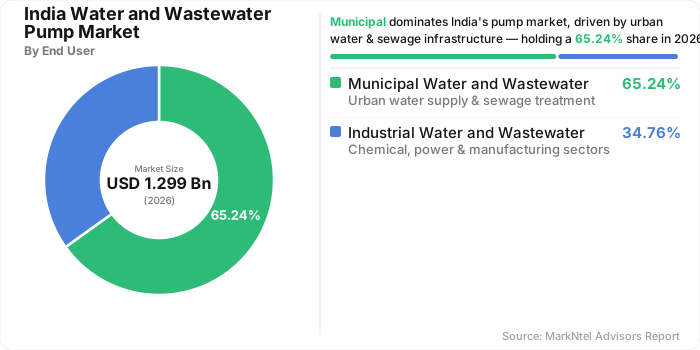
In 2025 the municipal water & wastewater end-user is clearly the market leader, holding 65.24% of the India market. Its dominance is driven by large public capex on urban sanitation and sewerage networks, ongoing upgrades to aging distribution and collection systems, and municipal sewage-treatment plant rollouts tied to regulatory targets. However, the industrial water & wastewater segment is the fastest-growing end-user (projected 7.8% CAGR, 2026–32), propelled by expanding manufacturing, tighter effluent norms, on-site treatment and water-reuse investments, and growth in process cooling and utility needs. Therefore, municipal would remain the largest segment through the forecast period, but industrial demand is projected to significantly narrow the share gap, becoming the primary driver of incremental market growth.
Gain a Competitive Edge with Our India Water and Wastewater Pump Market Report:
- India Water and Wastewater Pump Market Report by MarkNtel Advisors provides a detailed & thorough analysis of market size & share, growth rate, competitive landscape, and key players. This comprehensive analysis helps businesses gain a holistic understanding of the market dynamics & make informed decisions.
- This report also highlights current market trends & future projections, allowing businesses to identify emerging opportunities & potential challenges. By understanding market forecasts, companies can align their strategies & stay ahead of the competition.
- India Water and Wastewater Pump Market Report aids in assessing & mitigating risks associated with entering or operating in the market. By understanding market dynamics, regulatory frameworks, and potential challenges, businesses can develop strategies to minimize risks & optimize their operations.
*Reports Delivery Format - Market research studies from MarkNtel Advisors are offered in PDF, Excel and PowerPoint formats. Within 24 hours of the payment being successfully received, the report will be sent to your email address.
Frequently Asked Questions
- Market Segmentation
- Introduction
- Product Definition
- Research Process
- Assumptions
- Executive Summary
- India Water and Wastewater Pump Market Policies, Regulations, and Product Standards
- India Water and Wastewater Pump Market Trends & Developments
- India Water and Wastewater Pump Market Dynamics
- Growth Factors
- Challenges
- India Water and Wastewater Pump Market Hotspot & Opportunities
- India Water and Wastewater Pump Market Outlook, 2022-2032F
- Market Size & Outlook
- By Revenues (USD Million)
- Market Share & Outlook
- By Pump Types- Market Size & Forecast 2022-2032, USD Million
- Centrifugal Pump
- Overhung Pump
- Vertical Inline
- Horizontal End Suction
- Split Case Pump
- Single/Two Stage
- Multistage
- Vertical Pump
- Turbine
- Solid handling
- Nonsolid handling
- Axial
- Mixed Flow
- Turbine
- Submersible Pump
- Solid Handling
- Non-solid Handling
- Overhung Pump
- Positive Displacement Pump
- Diaphragm Pump
- Piston Pump
- Gear Pump
- Lobe Pump
- Progressive Cavity Pump
- Screw Pump
- Vane Pump
- Peristaltic Pump
- Centrifugal Pump
- By End User- Market Size & Forecast 2022-2032, USD Million
- Municipal water and wastewater
- Industrial water and wastewater
- By Application- Market Size & Forecast 2022-2032, USD Million
- Water
- Wastewater
- By Region- Market Size & Forecast 2022-2032, USD Million
- North India
- West and Central India
- South India
- East India
- By Company
- Competition Characteristics
- Market Share & Analysis
- By Pump Types- Market Size & Forecast 2022-2032, USD Million
- Market Size & Outlook
- India Centrifugal Water and Wastewater Pump Market Outlook, 2022-2032
- Market Size & Outlook
- By Revenues (USD Million)
- Market Share & Outlook
- By End User- Market Size & Forecast 2022-2032, USD Million
- By Application- Market Size & Forecast 2022-2032, USD Million
- By Region- Market Size & Forecast 2022-2032, USD Million
- Market Size & Outlook
- India Positive Displacement Water and Wastewater Pump Market Outlook, 2022-2032
- Market Size & Outlook
- By Revenues (USD Million)
- Market Share & Outlook
- By End User- Market Size & Forecast 2022-2032, USD Million
- By Application- Market Size & Forecast 2022-2032, USD Million
- By Region- Market Size & Forecast 2022-2032, USD Million
- Market Size & Outlook
- India Water and Wastewater Pump Market Key Strategic Imperatives for Success & Growth
- Competitive Outlook
- Company Profiles
- ITT
- Business Description
- Product Portfolio
- Collaborations & Alliances
- Recent Developments
- Financial Details
- Others
- Kirloskar Brothers Limited
- Business Description
- Product Portfolio
- Collaborations & Alliances
- Recent Developments
- Financial Details
- Others
- Dover
- Business Description
- Product Portfolio
- Collaborations & Alliances
- Recent Developments
- Financial Details
- Others
- Flowserve
- Business Description
- Product Portfolio
- Collaborations & Alliances
- Recent Developments
- Financial Details
- Others
- Sulzer AG
- Business Description
- Product Portfolio
- Collaborations & Alliances
- Recent Developments
- Financial Details
- Others
- KSB
- Business Description
- Product Portfolio
- Collaborations & Alliances
- Recent Developments
- Financial Details
- Others
- Xylem
- Business Description
- Product Portfolio
- Collaborations & Alliances
- Recent Developments
- Financial Details
- Others
- Grundfos
- Business Description
- Product Portfolio
- Collaborations & Alliances
- Recent Developments
- Financial Details
- Others
- Ebara
- Business Description
- Product Portfolio
- Collaborations & Alliances
- Recent Developments
- Financial Details
- Others
- Franklin Electric
- Business Description
- Product Portfolio
- Collaborations & Alliances
- Recent Developments
- Financial Details
- Others
- Wilo
- Business Description
- Product Portfolio
- Collaborations & Alliances
- Recent Developments
- Financial Details
- Others
- Pentair PLC
- Business Description
- Product Portfolio
- Collaborations & Alliances
- Recent Developments
- Financial Details
- Others
- ITT
- Company Profiles
- Disclaimer
MarkNtel Advisors follows a robust and iterative research methodology designed to ensure maximum accuracy and minimize deviation in market estimates and forecasts. Our approach combines both bottom-up and top-down techniques to effectively segment and quantify various aspects of the market. A consistent feature across all our research reports is data triangulation, which examines the market from three distinct perspectives to validate findings. Key components of our research process include:
1. Scope & Research Design At the outset, MarkNtel Advisors define the research objectives and formulate pertinent questions. This phase involves determining the type of research—qualitative or quantitative—and designing a methodology that outlines data collection methods, target demographics, and analytical tools. They also establish timelines and budgets to ensure the research aligns with client goals.
2. Sample Selection and Data Collection In this stage, the firm identifies the target audience and determines the appropriate sample size to ensure representativeness. They employ various sampling methods, such as random or stratified sampling, based on the research objectives. Data collection is carried out using tools like surveys, interviews, and observations, ensuring the gathered data is reliable and relevant.
3. Data Analysis and Validation Once data is collected, MarkNtel Advisors undertake a rigorous analysis process. This includes cleaning the data to remove inconsistencies, employing statistical software for quantitative analysis, and thematic analysis for qualitative data. Validation steps are taken to ensure the accuracy and reliability of the findings, minimizing biases and errors.

4. Data Forecast and FinalizationThe final phase involves forecasting future market trends based on the analyzed data. MarkNtel Advisors utilize predictive modeling and time series analysis to anticipate market behaviors. The insights are then compiled into comprehensive reports, featuring visual aids like charts and graphs, and include strategic recommendations to inform client decision-making
We offer flexible licensing options to cater to varying organizational needs. Choose the pricing pack that best suits your requirements:
Buy Now Inquire Before Buying
 Request Customization
 Talk to our Consultant







