

US Swimming Pool Chemicals Market Research Report: Growth Drivers & Forecast (2026-2032)
By Product (Sanitizers, pH Adjusters, Algaecides, Water Balancers), By Form (Tablets/Granules, Liquids, Cartridges/Pods, Other Forms), By Pool Type (Residential Pools, Commercial P ... ools, Public Pools), By End User (Hospitality Sector, Real Estate, Sports Facilities, Municipal Bodies, Other End Users), and others Read more
- Environment
- Mar 2026
- Pages 170
- Report Format: PDF, Excel, PPT
US Swimming Pool Chemicals Market
Projected 7.10% CAGR from 2026 to 2032
Study Period
2026-2032
Market Size (2026)
USD 4.52 Billion
Market Size (2032)
USD 6.82 Billion
Base Year
2025
Projected CAGR
7.10%
Leading Segments
By Product Type: Sanitizers
US Swimming Pool Chemicals Market Report Key Takeaways:
- The US Swimming Pool Chemicals market size was valued at USD 4.19 billion in 2025 and is projected to grow from USD 4.52 billion in 2026 to USD 6.82 billion by 2032, exhibiting a CAGR of 7.10% during the forecast period.
- South is the leading region with a significant share of 40% in 2026.
- By product type, the chlorine-based sanitizers segment represented a significant share of about 55% in the US Swimming Pool Chemicals Market in 2026.
- By end-user type, the hospitality segment seized a significant share of about 40% in the US Swimming Pool Chemicals Market in 2026.
- Leading US Swimming Pool Chemicals companies are BioLab Inc., Clearon Corp., HASA Inc., Haviland Pool & Spa Products, Regal Chemicals Inc., Robelle Industries Inc., Ecolab Inc., Lonza Water Care, Olin Corporation, Westlake Chemical Corporation, ICL Industrial Products Ltd., Solvay S.A., Orenda Technologies, National Chemical Laboratories, Waterline Technologies, and Others.
Market Insights & Analysis: US Swimming Pool Chemicals Market (2026-32):
The US Swimming Pool Chemicals market size was valued at USD 4.19 billion in 2025 and is projected to grow from USD 4.52 billion in 2026 to USD 6.82 billion by 2032, exhibiting a CAGR of 7.10% during the forecast period. i.e., 2026-32.
The U.S. swimming pool chemicals market has demonstrated steady expansion, supported by rising recreational infrastructure and sustained consumer spending on home improvement. According to the U.S. Census Bureau, residential construction spending remained above USD 900 billion in 2025, indirectly supporting pool installations and maintenance demand. The growing base of private housing units has strengthened recurring consumption of treatment chemicals. This structural growth reflects stable historical demand patterns driven by lifestyle upgrades and property value enhancement trends.
Commercial and institutional end users continue to reinforce market stability through compliance-driven chemical usage. Regulations under the Centers for Disease Control and Prevention, particularly the Model Aquatic Health Code updated guidelines in 2025, mandate strict water quality standards across public pools and aquatic facilities. These frameworks ensure consistent demand for sanitizers, pH balancers, and specialty chemicals. Hospitality operators and municipal bodies increasingly adopt automated dosing systems to maintain compliance, further supporting chemical consumption volumes across large-scale facilities.
Government-backed infrastructure and tourism initiatives have also contributed to market expansion by increasing aquatic facility development. Programs supported by the U.S. Department of Commerce in 2025 emphasized tourism infrastructure modernization, including resort and recreational amenities. This has led to new pool construction across hospitality and mixed-use developments, particularly in high-tourism states. The expansion of such facilities directly increases the need for continuous water treatment solutions, reinforcing long-term market demand across commercial segments.
Industry participants are actively strengthening market presence through product innovation and sustainability initiatives. Companies such as Ecolab Inc. and Olin Corporation have introduced advanced water treatment formulations and chlorine supply chain enhancements in 2025. These initiatives focus on improving efficiency, reducing chemical wastage, and ensuring supply reliability amid fluctuating raw material conditions. Looking ahead, continued regulatory enforcement, infrastructure growth, and innovation-led competition are expected to sustain a positive market outlook in the coming years.
US Swimming Pool Chemicals Market Scope:
| Category | Segments |
|---|---|
| By Product | (Sanitizers, pH Adjusters, Algaecides, Water Balancers), |
| By Form | (Tablets/Granules, Liquids, Cartridges/Pods, Other Forms), |
| By Pool Type | (Residential Pools, Commercial Pools, Public Pools), |
| By End User | (Hospitality Sector, Real Estate, Sports Facilities, Municipal Bodies, Other End Users), |
US Swimming Pool Chemicals Market Driver:
Expansion of Residential Pool Installations Driven by Rising Housing Development and Home Improvement Spending
The expansion of residential pool installations, supported by sustained housing development and renovation activity, represents the most influential driver of the U.S. swimming pool chemicals market. This expansion has been further reinforced by elevated homeowner investment in outdoor amenities, including private pools. As more households incorporate pools into residential properties, the installed base requiring regular chemical treatment continues to expand structurally.
This driver has intensified in recent years due to increased homeownership stability and rising expenditure on property upgrades. According to the National Association of Home Builders, The National Association of Home Builders reported remodeling spending grew by 8.2% in 2025. Residential pools require continuous maintenance involving sanitizers, algaecides, and water balancers, resulting in recurring chemical consumption rather than one-time purchases. This creates a direct and measurable increase in demand volume across suburban and high-income housing clusters.
The impact of this driver extends beyond short-term adoption, as each new pool contributes to long-term, repeat chemical usage over its lifecycle. Unlike discretionary purchases, pool maintenance is essential to meet safety and usability standards, ensuring consistent consumption patterns. Additionally, local regulatory guidance influenced by the Centers for Disease Control and Prevention encourages proper residential pool hygiene practices, further reinforcing routine chemical usage. Consequently, the continuous expansion of residential pools is materially increasing market size by driving sustained volume demand across the United States.
US Swimming Pool Chemicals Market Trend:
Shift Toward Automated and Smart Pool Water Management Systems
A significant structural trend in the U.S. swimming pool chemicals market is the rapid adoption of automated and smart pool water management systems. This shift has accelerated with increasing digital integration in residential and commercial infrastructure, supported by broader smart home adoption trends. The U.S. Energy Information Administration reported in 2025 that a growing share of U.S. households are incorporating connected technologies to improve energy and resource efficiency. Pool systems are increasingly integrated into these ecosystems, enabling automated chemical dosing and monitoring.
Leading companies such as Pentair are deploying automated water chemistry controllers that continuously monitor pool conditions and adjust chemical dosing in real time. These systems integrate with digital platforms, enabling remote monitoring and reducing manual intervention. By optimizing chemical usage and preventing overdosing, such technologies are improving operational efficiency while aligning with sustainability objectives, thereby reinforcing the long-term shift toward smart pool management solutions.
The persistence of this trend is supported by long-term efficiency, sustainability, and compliance benefits that extend beyond short-term cost considerations. Automated systems help reduce the overuse of chemicals, lowering operational expenses while meeting evolving environmental standards. Additionally, increasing emphasis on water conservation and smart infrastructure development across U.S. cities reinforces adoption. As digitalization continues to expand across residential and institutional sectors, smart pool management is expected to remain a defining factor influencing market evolution and chemical consumption patterns.
US Swimming Pool Chemicals Market Opportunity:
Smart Technology and Automation in Pool Water Management
The development of automated pool management systems presents a significant opportunity driven by the rapid expansion of connected technologies and smart infrastructure in the United States. The U.S. Energy Information Administration reported in 2025 that residential adoption of smart and energy-efficient devices continues to rise, reflecting broader digital integration trends. This shift has created demand for intelligent pool systems ca pable of monitoring water quality and optimizing chemical usage. As digital ecosystems expand, automated solutions are becoming increasingly viable and necessary across both residential and commercial settings.
This opportunity translates into tangible demand through the growing need for precision-based chemical dosing and real-time monitoring. Automated systems reduce manual testing and improve operational efficiency by continuously adjusting sanitizer and pH levels, ensuring compliance with safety standards. The Centers for Disease Control and Prevention emphasizes maintaining proper water chemistry to prevent health risks, reinforcing the adoption of reliable monitoring technologies. As a result, demand is shifting toward integrated hardware-software solutions that combine sensors, analytics, and chemical dispensing mechanisms.
The opportunity is particularly advantageous for new entrants due to the technology-driven nature of innovation and relatively lower dependence on large-scale chemical manufacturing. Emerging companies can leverage IoT, AI, and cloud-based platforms to offer differentiated solutions without competing directly with established chemical producers. Additionally, modular system design and software-based services allow scalable entry with lower capital investment. As automation becomes a standard expectation in facility management, new players are well-positioned to capture value through innovation, customization, and digital service integration.
US Swimming Pool Chemicals Market Challenge:
Stringent Regulatory Compliance and Chemical Handling Requirements
Stringent regulatory compliance governing chemical usage, storage, and disposal represents a critical structural challenge in the U.S. swimming pool chemicals market. Under FIFRA, the U.S. Environmental Protection Agency requires pesticide-based pool chemicals to undergo registration and comply with strict labeling and safety standards. In parallel, OSHA’s Hazard Communication Standard mandates safety data sheets, labeling, and worker training for hazardous chemicals, increasing compliance obligations across manufacturing and handling processes.
This regulatory burden significantly impacts market participants by increasing operational costs and extending product approval timelines. Companies must invest in toxicological testing, documentation, and regulatory submissions to meet EPA standards before commercialization. For example, EPA pesticide registration processes can take several months to years, depending on product classification and data requirements. Compliance with OSHA’s Hazard Communication Standard also requires continuous employee training and safety infrastructure, adding recurring operational expenses across manufacturing and distribution operations.
These requirements materially restrict market expansion, particularly for new entrants and small-scale manufacturers with limited regulatory expertise and financial capacity. High compliance costs and prolonged approval cycles delay market entry and reduce innovation speed. Furthermore, strict storage and transportation regulations for hazardous chemicals create logistical challenges, limiting scalability and distribution efficiency. As a result, regulatory complexity acts as a significant barrier, constraining competitive dynamics and slowing overall market growth despite underlying demand potential.
US Swimming Pool Chemicals Market (2026-32) Segmentation Analysis:
The Swimming Pool Chemicals Market study of MarkNtel Advisors evaluates & highlights the major trends and influencing factors in each segment. It includes predictions for the period 2026–32 at the country level. Based on the analysis, the market has been further classified as;
Based on Product Type:
- Sanitizers
- Oxygen‑Based
- Bromine‑Based
- Chlorine‑Based
- pH Adjusters
- pH Reducers
- pH Increasers
- Algaecides
- Natural Algaecides
- Quaternary Ammonium‑Based
- Copper‑Based
- Water Balancers
- Stabilizers
- Total Alkalinity Adjusters
- Calcium Hardness Increasers
- Others
- Enzymes
- Flocculants
- Clarifiers
Chlorine-based sanitizers dominate the U.S. swimming pool chemicals market with a market share of 55% due to their essential role in maintaining water safety and regulatory compliance. The Centers for Disease Control and Prevention emphasizes maintaining appropriate chlorine levels to effectively eliminate harmful pathogens in pool water. This has made chlorine the most widely adopted disinfectant across residential, commercial, and public pools. Its cost-effectiveness and high efficacy compared to alternatives further reinforce its widespread usage and long-term demand stability.
Regulatory frameworks and public health guidelines have strengthened chlorine’s dominance by mandating consistent disinfection standards across aquatic facilities. State and local authorities adopt CDC-backed guidelines, ensuring chlorine remains the primary treatment chemical in most jurisdictions. Companies such as Westlake Chemical are among the largest chlor‑alkali producers globally, ensuring continued investment and operational capacity in chlorine and caustic soda production, a nd the PCC Group announced plans to build a new chlor‑alkali facility with approximately 340,000 m etric tons of annual capacity in Mississippi, further strengthening domestic chlorine supply. These investments support uninterrupted availability, further embedding chlorine-based products as the backbone of pool water treatment systems.
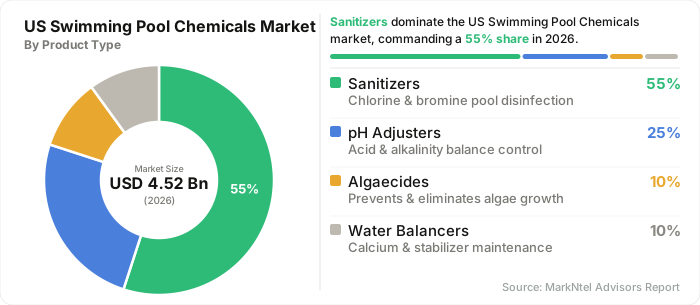
From a demand perspective, chlorine-based sanitizers generate recurring consumption due to continuous replenishment requirements. Residential pool owners and commercial operators rely on routine dosing to maintain water quality, creating consistent volume demand. Additionally, large-scale users such as hotels and municipal pools require bulk chemical procurement, amplifying segment share. The combination of regulatory necessity, industrial backing, and repeat usage cycles ensures sustained dominance of chlorine-based sanitizers in the market.
Based on the End User:
- Hospitality Sector
- Real Estate
- Sports Facilities
- Municipal Bodies
- Other End Users
The hospitality sector leads the U.S. swimming pool chemicals market with a market share of 40% due to its high concentration of commercial pools requiring continuous maintenance and regulatory compliance. Hotels, resorts, and vacation properties operate pools as essential guest amenities, driving consistent chemical consumption. The U.S. Travel Association projected that domestic leisure travel spending in 2025 was forecast to grow by about 1.9% to USD 895 billion, supported by continued U.S. travel demand despite economic uncertainty, to higher utilization of pool facilities and increased demand for treatment chemicals.
Regulatory compliance further strengthens the sector’s dominance, as commercial pools must adhere to strict water quality and safety standards. Guidelines influenced by the Centers for Disease Control and Prevention require frequent monitoring and maintenance of pool chemistry in public-use facilities. This necessitates continuous use of sanitizers, algaecides, and balancing chemicals, significantly increasing consumption compared to residential pools. Additionally, hospitality operators increasingly invest in automated systems to ensure compliance, further reinforcing chemical demand.
Industry practices and operational scale amplify the market impact of this segment. Large hotel chains and resort operators procure chemicals in bulk, creating stable and high-volume demand streams for suppliers. Companies such as Ecolab Inc. provide integrated water treatment solutions tailored for hospitality clients, highlighting the sector’s commercial significance . The combination of regulatory requirements, high usage frequency, and large-scale operations positions the hospitality sector as the leading end-user segment in the market.
US Swimming Pool Chemicals Market (2026-32) Regional Analysis:
The Southern region of the United States leads the swimming pool chemicals market with a market share of 40% due to strong structural and economic fundamentals, particularly high population growth and housing expansion. According to the U.S. Census Bureau, Southern states accounted for the largest share of U.S. population growth in 2025, with states such as Texas and Florida driving residential development. This rapid expansion has increased the number of housing units incorporating private pools, thereby expanding the installed base requiring regular chemical maintenance. The region’s favorable climate further supports year-round pool usage, directly increasing consumption frequency and volume.
Regulatory and infrastructure conditions also support regional dominance by enabling the sustained development of residential and commercial recreational facilities. Southern U.S. housing starts reached 810,000 units (annualized) in early 2026, confirming continued dominance in residential construction activity. Additionally, local building codes and public health regulations aligned with federal guidance ensure adherence to water quality standards, indirectly sustaining chemical demand. Investment in tourism infrastructure across Southern states further strengthens the presence of hotels, resorts, and recreational facilities requiring continuous pool maintenance.
End-user demand is highly concentrated in the region due to a strong presence of residential users alongside a large hospitality and leisure industry. Data from the U.S. Travel Association indicates that Southern states account for a significant share of domestic tourism activity, particularly in coastal and warm-weather destinations. This drives demand for well-maintained aquatic facilities across hotels and resorts, increasing reliance on treatment chemicals. The combination of demographic growth, infrastructure expansion, and high utilization rates positions the South as the leading regional market with sustained long-term demand.
US Swimming Pool Chemicals Market Competitive Landscape
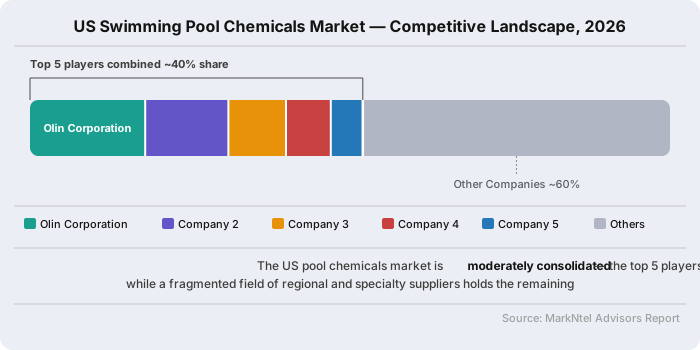
The market is moderately consolidated, with the top five players accounting for approximately 40% of the total market share. Leading companies include BioLab Inc., Clearon Corp., HASA Inc., Haviland Pool & Spa Products, and Olin Corporation.
Key Swimming Pool Chemicals Companies in Unites States
- BioLab Inc.
- Clearon Corp.
- HASA Inc.
- Haviland Pool & Spa Products
- Regal Chemicals Inc.
- Robelle Industries Inc.
- Ecolab Inc.
- Lonza Water Care
- Olin Corporation
- Westlake Chemical Corporation
- ICL Industrial Products Ltd.
- Solvay S.A.
- Orenda Technologies
- National Chemical Laboratories
- Waterline Technologies
- Others
Gain a Competitive Edge with Our US Swimming Pool Chemicals Market Report:
- The US Swimming Pool Chemicals Market Report by MarkNtel Advisors provides a detailed & thorough analysis of market size & share, growth rate, competitive landscape, and key players. This comprehensive analysis helps businesses gain a holistic understanding of the market dynamics & make informed decisions.
- This report also highlights current market trends & future projections, allowing businesses to identify emerging opportunities & potential challenges. By understanding market forecasts, companies can align their strategies & stay ahead of the competition.
- The US Swimming Pool Chemicals Market Report aids in assessing & mitigating risks associated with entering or operating in the market. By understanding market dynamics, regulatory frameworks, and potential challenges, businesses can develop strategies to minimize risks & optimize their operations.
*Reports Delivery Format - Market research studies from MarkNtel Advisors are offered in PDF, Excel and PowerPoint formats. Within 24 hours of the payment being successfully received, the report will be sent to your email address.
Frequently Asked Questions
- Market Segmentation
- Introduction
- Product Definition
- Research Process
- Assumptions
- Executive Summary
- US Swimming Pool Chemicals Market Policies, Regulations, and Product Standards
- US Swimming Pool Chemicals Market Trends & Developments
- US Swimming Pool Chemicals Market Dynamics
- Growth Factors
- Challenges
- US Swimming Pool Chemicals Market Hotspot & Opportunities
- US Swimming Pool Chemicals Market Outlook, 2022-2032F
- Market Size & Outlook
- By Revenues (USD Million)
- By Volume (Million Tons)
- Market Share & Outlook
- By Product- Market Size & Forecast 2022-2032, USD Million & Million Tons
- Sanitizers
- Oxygen-Based
- Bromine-Based
- Chlorine-Based
- pH Adjusters
- pH Reducers
- pH Increasers
- Algaecides
- Natural Algaecides
- Quaternary Ammonium Based
- Copper-Based
- Water Balancers
- Stabilizers
- Total Alkalinity Adjusters
- Calcium Hardness Increasers
- Enzymes
- Flocculants
- Clarifiers
- Sanitizers
- By Form- Market Size & Forecast 2022-2032, USD Million & Million Tons
- Tablets/Granules
- Liquids
- Cartridges/Pods
- Other Forms
- By Pool Type- Market Size & Forecast 2022-2032, USD Million & Million Tons
- Residential Pools
- Commercial Pools
- Public Pools
- By End User- Market Size & Forecast 2022-2032, USD Million & Million Tons
- Hospitality Sector
- Real Estate
- Sports Facilities
- Municipal Bodies
- Other End Users
- By Region- Market Size & Forecast 2022-2032, USD Million & Million Tons
- Northeast
- South
- Midwest
- West
- By Company
- Competition Characteristics
- Market Share & Analysis
- By Product- Market Size & Forecast 2022-2032, USD Million & Million Tons
- Market Size & Outlook
- US Residential Swimming Pool Chemicals Market Outlook, 2022-2032
- Market Size & Outlook
- By Revenues (USD Million)
- By Volume (Million Tons)
- Market Share & Outlook
- By Form- Market Size & Forecast 2022-2032, USD Million & Million Tons
- By Pool Type- Market Size & Forecast 2022-2032, USD Million & Million Tons
- By End User- Market Size & Forecast 2022-2032, USD Million & Million Tons
- By Region- Market Size & Forecast 2022-2032, USD Million & Million Tons
- Market Size & Outlook
- US Commercial Swimming Pool Chemicals Market Outlook, 2022-2032
- Market Size & Outlook
- By Revenues (USD Million)
- By Volume (Million Tons)
- Market Share & Outlook
- By Form- Market Size & Forecast 2022-2032, USD Million & Million Tons
- By Pool Type- Market Size & Forecast 2022-2032, USD Million & Million Tons
- By End User- Market Size & Forecast 2022-2032, USD Million & Million Tons
- By Region- Market Size & Forecast 2022-2032, USD Million & Million Tons
- Market Size & Outlook
- US Public Swimming Pool Chemicals Market Outlook, 2022-2032
- Market Size & Outlook
- By Revenues (USD Million)
- By Volume (Million Tons)
- Market Share & Outlook
- By Form- Market Size & Forecast 2022-2032, USD Million & Million Tons
- By Pool Type- Market Size & Forecast 2022-2032, USD Million & Million Tons
- By End User- Market Size & Forecast 2022-2032, USD Million & Million Tons
- By Region- Market Size & Forecast 2022-2032, USD Million & Million Tons
- Market Size & Outlook
- US Swimming Pool Chemicals Market Key Strategic Imperatives for Success & Growth
- Competitive Outlook
- Company Profiles
- BioLab Inc.
- Business Description
- Product Portfolio
- Collaborations & Alliances
- Recent Developments
- Financial Details
- Others
- Clearon Corp.
- Business Description
- Product Portfolio
- Collaborations & Alliances
- Recent Developments
- Financial Details
- Others
- HASA Inc.
- Business Description
- Product Portfolio
- Collaborations & Alliances
- Recent Developments
- Financial Details
- Others
- Haviland Pool & Spa Products
- Business Description
- Product Portfolio
- Collaborations & Alliances
- Recent Developments
- Financial Details
- Others
- Regal Chemicals Inc.
- Business Description
- Product Portfolio
- Collaborations & Alliances
- Recent Developments
- Financial Details
- Others
- Robelle Industries Inc.
- Business Description
- Product Portfolio
- Collaborations & Alliances
- Recent Developments
- Financial Details
- Others
- Ecolab Inc.
- Business Description
- Product Portfolio
- Collaborations & Alliances
- Recent Developments
- Financial Details
- Others
- Lonza Water Care
- Business Description
- Product Portfolio
- Collaborations & Alliances
- Recent Developments
- Financial Details
- Others
- Olin Corporation
- Business Description
- Product Portfolio
- Collaborations & Alliances
- Recent Developments
- Financial Details
- Others
- Westlake Chemical Corporation
- Business Description
- Product Portfolio
- Collaborations & Alliances
- Recent Developments
- Financial Details
- Others
- ICL Industrial Products Ltd.
- Business Description
- Product Portfolio
- Collaborations & Alliances
- Recent Developments
- Financial Details
- Others
- Solvay S.A.
- Business Description
- Product Portfolio
- Collaborations & Alliances
- Recent Developments
- Financial Details
- Others
- Orenda Technologies
- Business Description
- Product Portfolio
- Collaborations & Alliances
- Recent Developments
- Financial Details
- Others
- National Chemical Laboratories
- Business Description
- Product Portfolio
- Collaborations & Alliances
- Recent Developments
- Financial Details
- Others
- Waterline Technologies
- Business Description
- Product Portfolio
- Collaborations & Alliances
- Recent Developments
- Financial Details
- Others
- BioLab Inc.
- Company Profiles
- Disclaimer
MarkNtel Advisors follows a robust and iterative research methodology designed to ensure maximum accuracy and minimize deviation in market estimates and forecasts. Our approach combines both bottom-up and top-down techniques to effectively segment and quantify various aspects of the market. A consistent feature across all our research reports is data triangulation, which examines the market from three distinct perspectives to validate findings. Key components of our research process include:
1. Scope & Research Design At the outset, MarkNtel Advisors define the research objectives and formulate pertinent questions. This phase involves determining the type of research—qualitative or quantitative—and designing a methodology that outlines data collection methods, target demographics, and analytical tools. They also establish timelines and budgets to ensure the research aligns with client goals.
2. Sample Selection and Data Collection In this stage, the firm identifies the target audience and determines the appropriate sample size to ensure representativeness. They employ various sampling methods, such as random or stratified sampling, based on the research objectives. Data collection is carried out using tools like surveys, interviews, and observations, ensuring the gathered data is reliable and relevant.
3. Data Analysis and Validation Once data is collected, MarkNtel Advisors undertake a rigorous analysis process. This includes cleaning the data to remove inconsistencies, employing statistical software for quantitative analysis, and thematic analysis for qualitative data. Validation steps are taken to ensure the accuracy and reliability of the findings, minimizing biases and errors.

4. Data Forecast and FinalizationThe final phase involves forecasting future market trends based on the analyzed data. MarkNtel Advisors utilize predictive modeling and time series analysis to anticipate market behaviors. The insights are then compiled into comprehensive reports, featuring visual aids like charts and graphs, and include strategic recommendations to inform client decision-making
We offer flexible licensing options to cater to varying organizational needs. Choose the pricing pack that best suits your requirements:
Buy Now Inquire Before Buying
 Request Customization
 Talk to our Consultant







