Saudi Arabia Air Conditioner Market Research Report: Forecast (2026-2032)
By Product Type (Room Air Conditioners (Window AC (By Tonnage Capacity (Upto 1 Ton, 1 Ton to 2 Ton, Above 2 Ton)), Split AC (By Tonnage Capacity (Upto 1 Ton, 1 Ton to 1.5 Ton, Abov ... e 1.6 to 2 Ton, Above 2 Ton))), VRF Systems, Chillers (Air cooled chillers, Water cooled chillers, Others), Packaged Air Conditioners (Upto 5 Tons, 6 to 10 Tons, 11 to 20 Tons, Above 20 Tons), Cassette Air Conditioners (Upto 2 Tons, 2.1 to 4 Tons, 4.1 to 5 Tons, Above 5 Tons), Ducted Split Systems (Upto 5 Tons, 6 to 10 Tons, 11 to 20 Tons, Above 20 Tons), Others (Air Handling Units (AHU) / Fan Coil Units (FCU), etc.)), By Refrigerant Type (R32, R410A, R134a, R290, R1234ze / R1234yf, Others), By Distribution Channel (Direct Sales, Authorized Dealers & Distributors, Multi Brand Stores, Online), By End User (Residential, Offices, Retail & Malls, Hotels & Hospitality, Hospitals & Healthcare, Educational Institutions, Manufacturing, Pharmaceuticals, Food & Beverage, Data Centers, Others), and others Read more
- Environment
- May 2026
- Pages 140
- Report Format: PDF, Excel, PPT
Saudi Arabia Air Conditioner Market
Projected 8.45% CAGR from 2026 to 2032
Study Period
2026-2032
Market Size (2026)
USD 3.38 Billion
Market Size (2032)
USD 5.50 Billion
Base Year
2025
Projected CAGR
8.45%
Leading Segments
By End User: Residential
Saudi Arabia Air Conditioners Market Key Takeaways
- Saudi Arabia air conditioners market size was valued at USD 3.18 billion in 2025 and is projected to grow from USD 3.38 billion in 2026 to USD 5.50 billion by 2032, exhibiting a CAGR of 8.45% during 2026-2032.
- By product type, the Room Air Conditioners holds a significant share of about 50%
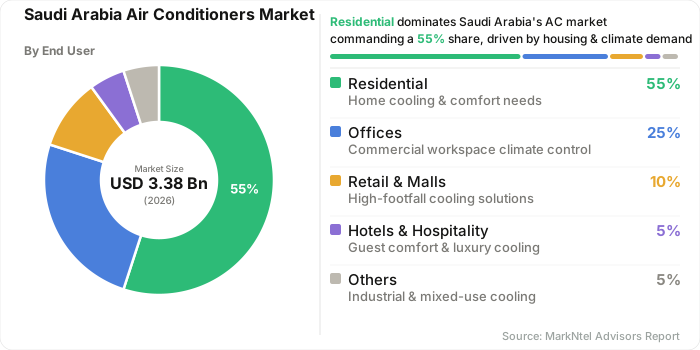
- By end user, the residential segment seized a significant share of about 55% in 2026.
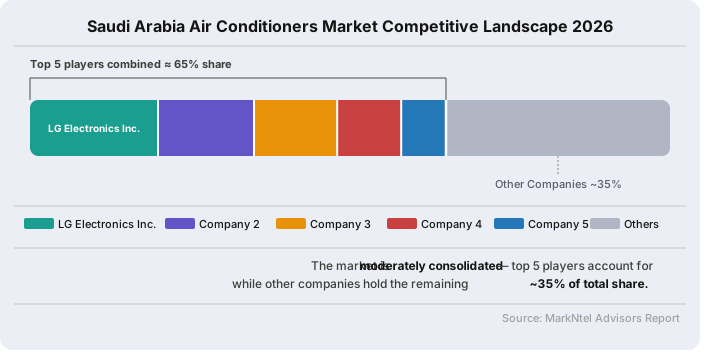
- The industry is moderately consolidated. However, the top five players collectively account for nearly 65% share.
Saudi Arabia Air Conditioners Market Size and Outlook
The Saudi Arabia air conditioners market is estimated to grow at a CAGR of around 8.45% during the forecast period, i.e., 2026-32, strongly supported by rapid economic diversification and large-scale development across residential, commercial, hospitality, and industrial sectors. Expanding urban infrastructure and rising investments from both government bodies and private developers are significantly increasing the installation base of air conditioning systems across the Kingdom.
A key growth driver is the government increasing focus on energy efficiency and environmental sustainability within the cooling sector. Saudi Arabia is currently advancing toward updated SASO energy efficiency regulations (SASO 2663/2025 revision framework), which further strengthen minimum energy performance requirements for air conditioning systems. The updated regulatory direction is expected to become fully enforceable by 2026, reinforcing SEER-based efficiency standards and pushing manufacturers toward higher-performance, low-energy cooling technologies. This is particularly significant in a market where cooling demand remains continuous due to extreme climatic conditions, ensuring more accurate efficiency evaluation and encouraging adoption of advanced HVAC systems.
Additionally, Saudi Vision 2030 continues to play a transformative role in accelerating infrastructure development, industrial expansion, and smart city projects across the Kingdom. Notably, in 2025, Saudi Arabia advanced new energy-efficiency enforcement pathways for HVAC and electrical cooling equipment, strengthening compliance requirements for imported and locally manufactured air conditioners to reduce national electricity consumption.
These initiatives are expected to significantly increase demand for advanced and energy-efficient cooling systems between 2025 and 2032, with the Saudi Arabia cooling lad projected to grow from USD 3.38 billion in 2026 to USD 5.50 billion by 2032. Combined with tightening regulatory standards and rising sustainability requirements, the market is steadily shifting toward smart, high-efficiency, and environmentally compliant cooling technologies, supporting long-term industry expansion in Saudi Arabia.
Saudi Arabia Air Conditioners Market Key Indicators
- According to the World Bank, Saudi Arabia’s urban population accounted for nearly 84% of the total population in 2024, reflecting rapid urban concentration across major cities such as Riyadh, Jeddah, and Dammam. Continuous expansion of residential towers, commercial complexes, and mixed-use developments is sustaining uninterrupted demand for split and centralized air conditioning systems across all building categories.
- In 2024, Carrier entered a strategic partnership with Saudi Arabia’s Alat to establish advanced HVAC manufacturing and R&D capabilities within the Kingdom. The initiative focuses on producing energy-efficient air conditioning systems, including VRF technologies, to support mega projects such as NEOM. This development highlights Saudi Arabia’s accelerating shift toward localized, high-efficiency, and sustainable HVAC production under Vision 2030 industrial goals.
- In September 2024, the Saudi Energy Efficiency Center (SEEC) expanded its nationwide Estbdal program across more than 350 showrooms and 50+ retail outlets. The initiative promotes the replacement of inefficient window air conditioners with modern energy-efficient models under the National Industrial Development and Logistics Program (NIDLP), reinforcing a structured transition toward low-energy cooling solutions across residential segments.
Saudi Arabia Air Conditioners Market Scope
| Category | Segments |
|---|---|
| By Product Type | Room Air Conditioners (Window AC |
| By Tonnage Capacity | Upto 1 Ton, 1 Ton to 2 Ton, Above 2 Ton)), Split AC |
| By Tonnage Capacity | Upto 1 Ton, 1 Ton to 1.5 Ton, Above 1.6 to 2 Ton, Above 2 Ton))), VRF Systems, Chillers (Air cooled chillers, Water cooled chillers, Others), Packaged Air Conditioners (Upto 5 Tons, 6 to 10 Tons, 11 to 20 Tons, Above 20 Tons), Cassette Air Conditioners (Upto 2 Tons, 2.1 to 4 Tons, 4.1 to 5 Tons, Above 5 Tons), Ducted Split Systems (Upto 5 Tons, 6 to 10 Tons, 11 to 20 Tons, Above 20 Tons), Others (Air Handling Units (AHU) / Fan Coil Units (FCU), etc. |
| By Refrigerant Type | R32, R410A, R134a, R290, R1234ze / R1234yf, Others |
| By Distribution Channel | Direct Sales, Authorized Dealers & Distributors, Multi Brand Stores, Online |
| By End User | Residential, Offices, Retail & Malls, Hotels & Hospitality, Hospitals & Healthcare, Educational Institutions, Manufacturing, Pharmaceuticals, Food & Beverage, Data Centers, Others |
Saudi Arabia Air Conditioners Industry Growth Drivers
Extreme Climatic Conditions Driving Year-Round Cooling Demand
Extreme climatic conditions remain one of the strongest growth drivers for the Saudi Arabia Air Conditioners Market, as cooling systems are essential across residential, commercial, hospitality, and industrial sectors throughout the year. According to the Saudi General Authority for Statistics, residential electricity consumption in the Kingdom reached nearly 161,207 GWh in 2024, reflecting the country’s exceptionally high dependence on cooling infrastructure amid prolonged summer temperatures frequently exceeding 45°C. Residential users alone accounted for around 47.4% of total national electricity consumption in 2024, highlighting the extensive utilization of air conditioning systems across households and urban developments.
The rising demand for energy-efficient air conditioners, commercial HVAC systems, and smart cooling solutions is further supported by large-scale urban and infrastructure expansion under Vision 2030. Saudi Arabia continues to invest heavily in mega projects such as NEOM, a futuristic smart city project backed by investments exceeding USD 500 billion, alongside tourism, hospitality, and data center developments requiring advanced cooling infrastructure. In February 2025, NEOM partnered with DataVolt to develop a large-scale AI-powered data center project with an initial investment of USD 5 billion, which is expected to become operational by 2028 and will require high-capacity precision cooling systems.
Furthermore, as urbanization, smart city developments, and commercial infrastructure projects continue expanding beyond 2025, the need for advanced air conditioning technologies is expected to accelerate significantly. Rising cooling demand under extreme climatic conditions will continue strengthening long-term growth openings for the Saudi Arabia Air Conditioners Market.
Recent Trends
Shift Toward Smart and Connected AC Systems
The Saudi Arabia Air Conditioners Market is witnessing a strong transition toward smart, connected, and digitally enabled cooling systems driven by rapid urban digitalization and the expansion of smart infrastructure under Vision 2030. Increasing integration of IoT-enabled appliances, AI-based automation, and smartphone-controlled devices is reshaping consumer expectations, with growing preference for air conditioners that offer remote operation, intelligent temperature control, and optimized energy performance. This shift is particularly visible in urban residential projects, premium housing developments, and modern commercial buildings where convenience and efficiency are key purchase factors.
Supporting this trend, LG introduced the LC242H0 split air conditioner for the Saudi market in October 2025, designed with advanced connectivity and intelligent cooling features. The model integrates LG ThinQ™ Wi-Fi control, enabling users to manage cooling operations remotely through mobile applications, improving accessibility and user convenience. It also features AI Pre-Cool technology, which automatically activates cooling based on user proximity, along with JETCOOL functionality for rapid temperature reduction in extreme heat conditions. In addition, the system incorporates Auto Cleaning and optimized operation modes that enhance energy efficiency and maintain indoor air quality in high-temperature environments.
The increasing adoption of smart air conditioning systems, AI-enabled HVAC technologies, and IoT-based cooling solutions is expected to significantly transform Saudi Arabia’s cooling infrastructure. As demand for automated and energy-efficient climate control continues to rise beyond 2025, smart AC systems will play a crucial role in enhancing operational efficiency, user comfort, and sustainable cooling across the Kingdom.
Saudi Arabia Air Conditioners Industry Opportunities and Challenges
High Electricity Consumption Creating Opportunities for Energy-Efficient VRF Cooling Systems
High electricity consumption is one of the key challenges restraining the growth of the Saudi Arabia Air Conditioners Market. Due to the Kingdom’s extreme climatic conditions, air conditioning systems operate continuously for extended periods across residential, commercial, hospitality, and industrial facilities. This significantly increases electricity usage and operational expenses, particularly during peak summer months when cooling demand reaches its highest level. In addition, the widespread use of conventional and aging cooling systems with lower energy efficiency places considerable pressure on the national power infrastructure while increasing maintenance and energy costs for end users. The gradual shift toward energy optimization and sustainable infrastructure development under Vision 2030 has further intensified the need for more efficient cooling technologies across the country.
At the same time, this challenge is creating strong opportunities for the adoption of VRF cooling systems, smart HVAC solutions, and energy-efficient air conditioners in Saudi Arabia. Commercial developers, businesses, and real estate operators are increasingly investing in advanced cooling technologies capable of reducing electricity consumption while maintaining high-performance cooling in large-scale buildings. For example, LG Electronics expanded local production of its MULTI V 5 VRF systems at the LG-Shaker factory in Riyadh in 2024 to support the Kingdom’s growing demand for energy-efficient infrastructure and smart commercial buildings. The increasing deployment of advanced VRF technologies is expected to accelerate the modernization of Saudi Arabia’s cooling infrastructure and support long-term market growth.
Segmentation Insights
Room Air Conditioners is Widely Used in Air Conditioners Market
Room Air Conditioners contributes approximately 50% share of the overall volume in the Saudi Arabia Air Conditioners Market, strong household penetration and continuous demand from residential infrastructure expansion. The segment benefits significantly from high replacement cycles, rising urban housing development, and increasing adoption of split and window AC systems across apartments and villas. Rapid growth in middle-income households and expanding residential construction in cities such as Riyadh and Jeddah further strengthen demand for compact, cost-effective cooling solutions. Additionally, the extreme climate conditions in the Kingdom sustain year-round usage, making room air conditioners an essential household appliance rather than a seasonal product.
Moreover, technological improvements such as inverter-based compressors, enhanced cooling efficiency, and compact design innovations are further supporting product adoption. Manufacturers are increasingly focusing on eco-friendly refrigerants and energy-optimized systems to align with national efficiency regulations. The rising availability of advanced residential cooling solutions, compact HVAC units, and energy-optimized split systems is also strengthening market penetration across new and replacement installations. Continuous innovation in noise reduction and smart temperature control is further enhancing consumer preference, ensuring sustained dominance of this segment in the Saudi market. Based on product type, the scope has been segmented into
- Room Air Conditioners
- VRF Systems
- Chillers
- Packaged Air Conditioners
- Cassette Air Conditioners
- Ducted Split Systems
Residential Leads the End-Use Vertical
The residential segment holds the largest share of approximately 55% in the Saudi Arabia Air Conditioners Market, primarily driven by rapid urbanization and strong housing development initiatives under Vision 2030. Expansion of residential complexes, government-backed housing projects, and increasing population density in urban centers are significantly boosting demand for air conditioning systems across households. Harsh climatic conditions further make cooling systems a necessity, resulting in consistent demand for both new installations and replacement units.
Rising disposable incomes and changing lifestyle preferences are also encouraging households to adopt advanced cooling systems that offer improved comfort, automation, and energy savings. Modern residential projects are increasingly integrating smart climate control technologies, including app-based monitoring and automated temperature regulation. This shift is further supported by the growing adoption of smart residential HVAC systems, home automation cooling solutions, and high-efficiency air cooling technologies.
Moreover, government emphasis on energy-efficient housing standards is accelerating the replacement of conventional systems with inverter-based and eco-friendly air conditioners. As residential construction continues to expand, this segment is expected to remain the dominant end-user category, strongly influencing overall market growth in Saudi Arabia. The key end users mapped in the study involve:
- Residential
- Offices
- Retail & Malls
- Hotels & Hospitality
- Hospitals & Healthcare
- Educational Institutions
- Manufacturing
- Pharmaceuticals
- Food & Beverage
- Data Centers
- Others
Saudi Arabia Air Conditioners Industry Competitive Analysis
The Saudi Arabia Air Conditioners Market is moderately consolidated, with the presence of several regional and international manufacturers operating across residential, commercial, and industrial cooling segments. The top five companies, including Zamil Air Conditioners, LG Electronics, Basic Electronics Company (GREE), Carrier Saudi Services Company Ltd, and Al Salem Johnson Controls (YORK), collectively account for approximately 65% of the total market share, reflecting a competitive landscape driven by strong distribution networks, localized manufacturing capabilities, and growing participation in large-scale infrastructure and residential projects across the Kingdom.
Major Air Conditioners Companies in KSA
- SKM
- Gree
- LG
- Haier
- Zamil
- Carrier
- Johnson Controls
- Samsung
- Ingersoll Rand
- Midea
- Hisense
- Others
Saudi Arabia Air Conditioners Industry News and Recent Developments
February 2025: Ceer Partners with Zamil Central Air Conditioners to Localize HVAC Components for EV Manufacturing
Ceer signed a strategic partnership with Zamil Central Air Conditioners Co. Ltd. during the PIF Private Sector Forum. The collaboration focuses on localizing HVAC system manufacturing for electric vehicles in Saudi Arabia, supporting the Kingdom’s automotive supply chain development and strengthening domestic industrial capabilities under Vision 2030 initiatives.
Impact Analysis: The partnership is expected to accelerate localization within Saudi Arabia’s HVAC and EV industries by increasing domestic production of advanced cooling components. It supports industrial diversification, enhances local supplier participation, and strengthens the Kingdom’s manufacturing ecosystem. The agreement may also create new investment opportunities, improve energy-efficient HVAC innovation, and reduce dependence on imported automotive air-conditioning systems.
January 2025: LG Launches Advanced Wired Remote Controller for HVAC Systems
LG Electronics introduced an advanced wired remote controller for HVAC systems in Saudi Arabia. The solution is designed to enhance control precision, energy efficiency, and system automation across residential and commercial cooling applications. It integrates seamlessly with LG’s HVAC portfolio, enabling smart scheduling, monitoring, and optimized temperature management aligned with Saudi Arabia’s Vision 2030 sustainability goals.
Impact Analysis: This development strengthens the shift toward smart and digitally controlled HVAC ecosystems in Saudi Arabia. By improving centralized control and operational efficiency, it supports reduced electricity consumption in high-demand cooling environments. It also enhances adoption of intelligent building management systems across commercial towers, hospitality projects, and residential complexes. Additionally, it reinforces LG’s positioning in the Kingdom’s HVAC market while aligning with the rising demand for energy-efficient and automation-driven air conditioning solutions.
May 2025: Johnson Controls Arabia Inaugurates Kingdom’s Largest YORK Air-Cooled Chiller Production Line
Johnson Controls Arabia inaugurated the Kingdom’s largest YORK air-cooled chiller production line at its manufacturing complex in King Abdullah Economic City, Jeddah. The facility also includes Saudi Arabia’s first AHRI-certified performance testing laboratory for high-capacity chillers. The development strengthens localized HVAC manufacturing and supports demand from mega infrastructure and industrial projects under Vision 2030.
Impact Analysis: This expansion significantly enhances Saudi Arabia’s HVAC manufacturing ecosystem by strengthening local production of high-capacity, energy-efficient cooling systems. It reduces dependency on imports and improves supply chain resilience for large-scale projects such as smart cities, industrial zones, and commercial complexes. The AHRI-certified testing capability also improves product reliability and global competitiveness. Overall, it accelerates the shift toward localized, high-performance cooling infrastructure aligned with Vision 2030 sustainability and industrial development goals.
Frequently Asked Questions
- Market Segmentation
- Introduction
- Product Definition
- Research Process
- Assumptions
- Executive Summary
- Saudi Arabia Air Conditioners Market Regulations, Policies & Standards
- Saudi Arabia Air Conditioners Market Trends & Developments
- Saudi Arabia Air Conditioners Market Supply Chain Analysis
- Saudi Arabia Air Conditioners Market Imports/Exports
- Saudi Arabia Air Conditioners Market Dynamics
- Growth Drivers
- Challenges
- Saudi Arabia Air Conditioners Market Hotspots & Opportunities
- Saudi Arabia Air Conditioners Market Outlook, 2022-2032
- Market Size & Analysis
- By Revenue (USD Million)
- Market Share & Analysis
- By Product Type – Market Size & Forecast 2022-2032, USD Million & Thousand Units
- Room Air Conditioners- USD Million & Thousand Units
- Window AC- USD Million & Thousand Units
- By Tonnage Capacity
- Upto 1 Ton
- 1 Ton to 2 Ton
- Above 2 Ton
- By Tonnage Capacity
- Split AC - USD Million & Thousand Units
- By Tonnage Capacity
- Upto 1 Ton
- 1 Ton to 1.5 Ton
- Above 1.6 to 2 Ton
- Above 2 Ton
- By Tonnage Capacity
- Window AC- USD Million & Thousand Units
- VRF Systems
- Chillers
- Air cooled chillers
- Water cooled chillers
- Others
- Packaged Air Conditioners
- Upto 5 Tons
- 6 to 10 Tons
- 11 to 20 Tons
- Above 20 Tons
- Cassette Air Conditioners
- Upto 2 Tons
- 2.1 to 4 Tons
- 4.1 to 5 Tons
- Above 5 Tons
- Ducted Split Systems
- Upto 5 Tons
- 6 to 10 Tons
- 11 to 20 Tons
- Above 20 Tons
- Others (Air Handling Units (AHU) / Fan Coil Units (FCU), etc.)
- Room Air Conditioners- USD Million & Thousand Units
- By Refrigerant Type – Market Size & Forecast 2022-2032, USD Million
- R32
- R410A
- R134a
- R290
- R1234ze / R1234yf
- Others
- By Distribution Channel – Market Size & Forecast 2022-2032, USD Million
- Direct Sales
- Authorized Dealers & Distributors
- Multi Brand Stores
- Online
- By End User – Market Size & Forecast 2022-2032, USD Million
- Residential
- Offices
- Retail & Malls
- Hotels & Hospitality
- Hospitals & Healthcare
- Educational Institutions
- Manufacturing
- Pharmaceuticals
- Food & Beverage
- Data Centers
- Others
- By Region
- East
- West
- South
- Central
- By Competitors
- Competition Characteristics
- Market Share & Analysis
- By Product Type – Market Size & Forecast 2022-2032, USD Million & Thousand Units
- Market Size & Analysis
- Saudi Arabia Window Air Conditioners Market Outlook, 2022-2032
- Market Size & Analysis
- By Revenue (USD Million)
- By Units Sold (Thousand Units)
- Market Share & Analysis
- By Refrigerant Type – Market Size & Forecast 2022-2032, USD Million
- By Distribution Channel – Market Size & Forecast 2022-2032, USD Million
- By End User – Market Size & Forecast 2022-2032, USD Million
- By Region
- By Technology
- Inverter
- Non Inverter
- By Price Range
- By Automation
- Smart
- Non Smart
- By Star Rating
- Market Size & Analysis
- Saudi Arabia Split Air Conditioners Market Outlook, 2022-2032
- Market Size & Analysis
- By Revenue (USD Million)
- By Units Sold (Thousand Units)
- Market Share & Analysis
- By Refrigerant Type – Market Size & Forecast 2022-2032, USD Million
- By Distribution Channel – Market Size & Forecast 2022-2032, USD Million
- By End User – Market Size & Forecast 2022-2032, USD Million
- By Region
- By Technology
- By Price Range
- By Automation
- By Star Rating
- Market Size & Analysis
- Saudi Arabia VRF Systems Air Conditioners Market Outlook, 2022-2032
- Market Size & Analysis
- By Revenue (USD Million)
- Market Share & Analysis
- By Refrigerant Type – Market Size & Forecast 2022-2032, USD Million
- By Distribution Channel – Market Size & Forecast 2022-2032, USD Million
- By End User – Market Size & Forecast 2022-2032, USD Million
- By Region
- Market Size & Analysis
- Saudi Arabia Chillers Air Conditioners Market Outlook, 2022-2032
- Market Size & Analysis
- By Revenue (USD Million)
- Market Share & Analysis
- By Cooling Type
- Air Cooled Chillers
- Water Cooled Chillers
- By Compressor Technology
- Reciprocating
- Scroll
- Screw
- Centrifugal
- By Refrigerant Type – Market Size & Forecast 2022-2032, USD Million
- By End User – Market Size & Forecast 2022-2032, USD Million
- By Installation
- New Installation
- Retrofit or Modernization
- By Region
- By Cooling Type
- Market Size & Analysis
- Saudi Arabia Packaged Air Conditioners Market Outlook, 2022-2032
- Market Size & Analysis
- By Revenue (USD Million)
- Market Share & Analysis
- By Refrigerant Type – Market Size & Forecast 2022-2032, USD Million
- By Distribution Channel – Market Size & Forecast 2022-2032, USD Million
- By End User – Market Size & Forecast 2022-2032, USD Million
- Market Size & Analysis
- Saudi Arabia Cassette Air Conditioners Market Outlook, 2022-2032
- Market Size & Analysis
- By Revenue (USD Million)
- Market Share & Analysis
- By Refrigerant Type – Market Size & Forecast 2022-2032, USD Million
- By Distribution Channel – Market Size & Forecast 2022-2032, USD Million
- By End User – Market Size & Forecast 2022-2032, USD Million
- By Region
- Market Size & Analysis
- Saudi Arabia Ducted Split Systems Air Conditioners Market Outlook, 2022-2032
- Market Size & Analysis
- By Revenue (USD Million)
- Market Share & Analysis
- By Refrigerant Type – Market Size & Forecast 2022-2032, USD Million
- By Distribution Channel – Market Size & Forecast 2022-2032, USD Million
- By End User – Market Size & Forecast 2022-2032, USD Million
- By Region
- Market Size & Analysis
- Saudi Arabia Air Conditioners Market Key Strategic Imperatives for Growth & Success
- Competitive Outlook
- Company Profiles
- SKM
- Business Description
- Product Portfolio
- Strategic Alliances or Partnerships
- Recent Developments
- Financial Details
- Others
- Gree
- Business Description
- Product Portfolio
- Strategic Alliances or Partnerships
- Recent Developments
- Financial Details
- Others
- LG
- Business Description
- Product Portfolio
- Strategic Alliances or Partnerships
- Recent Developments
- Financial Details
- Others
- Haier
- Business Description
- Product Portfolio
- Strategic Alliances or Partnerships
- Recent Developments
- Financial Details
- Others
- Zamil
- Business Description
- Product Portfolio
- Strategic Alliances or Partnerships
- Recent Developments
- Financial Details
- Others
- Carrier
- Business Description
- Product Portfolio
- Strategic Alliances or Partnerships
- Recent Developments
- Financial Details
- Others
- Johnson Controls
- Business Description
- Product Portfolio
- Strategic Alliances or Partnerships
- Recent Developments
- Financial Details
- Others
- Samsung
- Business Description
- Product Portfolio
- Strategic Alliances or Partnerships
- Recent Developments
- Financial Details
- Others
- Ingersoll Rand
- Business Description
- Product Portfolio
- Strategic Alliances or Partnerships
- Recent Developments
- Financial Details
- Others
- Midea
- Business Description
- Product Portfolio
- Strategic Alliances or Partnerships
- Recent Developments
- Financial Details
- Others
- Hisense
- Business Description
- Product Portfolio
- Strategic Alliances or Partnerships
- Recent Developments
- Financial Details
- Others
- Others
- SKM
- Company Profiles
- Disclaimer
MarkNtel Advisors follows a robust and iterative research methodology designed to ensure maximum accuracy and minimize deviation in market estimates and forecasts. Our approach combines both bottom-up and top-down techniques to effectively segment and quantify various aspects of the market. A consistent feature across all our research reports is data triangulation, which examines the market from three distinct perspectives to validate findings. Key components of our research process include:
1. Scope & Research Design At the outset, MarkNtel Advisors define the research objectives and formulate pertinent questions. This phase involves determining the type of research—qualitative or quantitative—and designing a methodology that outlines data collection methods, target demographics, and analytical tools. They also establish timelines and budgets to ensure the research aligns with client goals.
2. Sample Selection and Data Collection In this stage, the firm identifies the target audience and determines the appropriate sample size to ensure representativeness. They employ various sampling methods, such as random or stratified sampling, based on the research objectives. Data collection is carried out using tools like surveys, interviews, and observations, ensuring the gathered data is reliable and relevant.
3. Data Analysis and Validation Once data is collected, MarkNtel Advisors undertake a rigorous analysis process. This includes cleaning the data to remove inconsistencies, employing statistical software for quantitative analysis, and thematic analysis for qualitative data. Validation steps are taken to ensure the accuracy and reliability of the findings, minimizing biases and errors.

4. Data Forecast and FinalizationThe final phase involves forecasting future market trends based on the analyzed data. MarkNtel Advisors utilize predictive modeling and time series analysis to anticipate market behaviors. The insights are then compiled into comprehensive reports, featuring visual aids like charts and graphs, and include strategic recommendations to inform client decision-making
We offer flexible licensing options to cater to varying organizational needs. Choose the pricing pack that best suits your requirements:
Buy Now Inquire Before Buying
 Request Customization
 Talk to our Consultant