

India Swimming Pool Equipment Market Research Report: Trends, Forecast & Opportunities (2026-2032)
By Equipment Type (Pumps, Filters, Heaters, Cleaners, Chemical Treatment Equipment, Pool Covers, Lighting Equipment, Automation & Control Systems, Others), By Pool Type (Commercial ... Pools, Residential Pools), By End-User (Hospitality, Residential, Institutional, Municipal), By Distribution Channel (Direct Sales, Distributors & Dealers, Online), and others Read more
- Environment
- Mar 2026
- Pages 180
- Report Format: PDF, Excel, PPT
India Swimming Pool Equipment Market
Projected 6.48% CAGR from 2026 to 2032
Study Period
2026-2032
Market Size (2026)
USD 83 Million
Market Size (2032)
USD 121 Million
Base Year
2025
Projected CAGR
6.48%
Leading Segments
By End User: Hospitality
India Swimming Pool Equipment Market Report Key Takeaways:
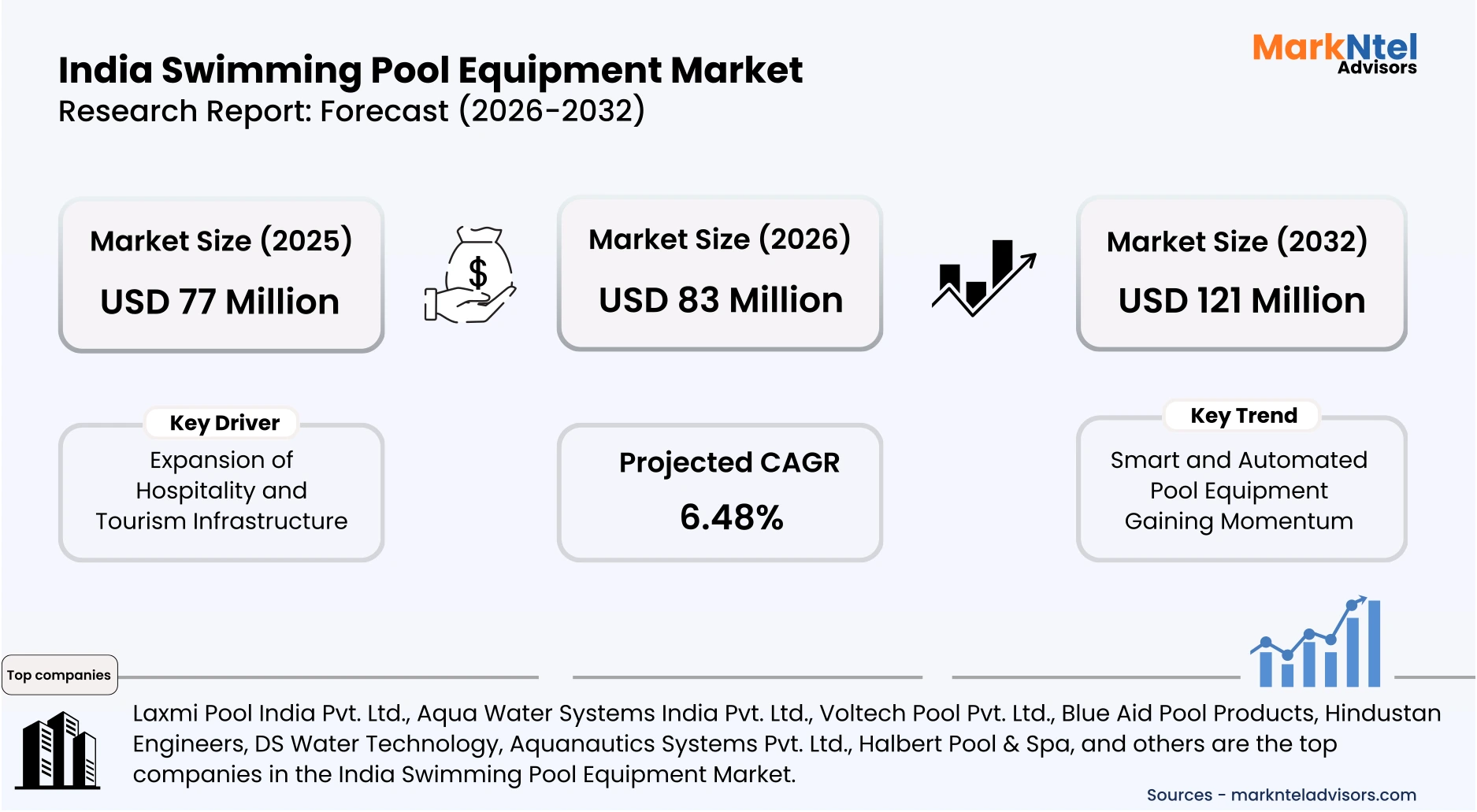
- The India Swimming Pool Equipment Market size was valued at around USD 77 million in 2025 and is projected grow from USD 83 million in 2026 to USD 121 million by 2032, exhibiting a CAGR of 6.48% during the forecast period.
- South India holds the largest market share of about 32.36% in the India Swimming Pool Equipment Market in 2026.
- By Equipment Type, the pumps segment represented a significant share of about 28% in the India Swimming Pool Equipment Market in 2026.
- By End User, the Hospitality segment seized a significant share of about 43% in the India Swimming Pool Equipment Market in 2026.
- Leading companies in the Indian market are Laxmi Pool India Pvt. Ltd., Aqua Water Systems India Pvt. Ltd., Voltech Pool Pvt. Ltd., Blue Aid Pool Products, Hindustan Engineers, DS Water Technology, Aquanautics Systems Pvt. Ltd., Halbert Pool & Spa, and others.
Market Insights & Analysis: India Swimming Pool Equipment Market (2026-32):
The India Swimming Pool Equipment Market size was valued at around USD 77 million in 2025 and is projected grow from USD 83 million in 2026 to USD 121 million by 2032, exhibiting a CAGR of 6.48% during the forecast period, i.e., 2026-32.
India’s swimming pool equipment market has demonstrated consistent expansion, supported by sustained growth in construction and urban infrastructure development. Government data indicates continued momentum in real estate activity and urban housing supply through 2025, particularly in Tier I and Tier II cities. Tier I cities alone recorded approximately USD 800 billion in housing sales in FY2025, indicating strong demand concentration in major urban centers . This has translated into rising installations of filtration systems, pumps, and water treatment solutions across residential and commercial spaces. Historically, demand has been anchored by premium housing and hospitality developments, creating a stable and recurring requirement for advanced pool equipment.
Current market conditions are being strengthened by rapid expansion in key end-user segments, especially hospitality and luxury residential construction. According to the report, in 2026, India’s hospitality sector is projected to record a 9–12% revenue growth in FY2026, driven by strong leisure travel, corporate demand, and event-led bookings. This growth is encouraging hotel developers to expand capacity and upgrade amenities, including swimming pool facilities. Additionally, InterContinental Hotels Group announced plans to expand its portfolio to over 400 hotels in India within five years, reflecting strong development momentum and increasing demand for hospitality infrastructure, including swimming pool facilities . Simultaneously, rising launches of high-end residential projects in cities such as Mumbai and Bengaluru are increasing the integration of private and community pools, further accelerating equipment demand.
Policy support and infrastructure initiatives are playing a critical role in shaping market growth by promoting sustainable water and energy practices. Programs such as the Smart Cities Mission and AMRUT 2.0 emphasize efficient water management, wastewater reuse, and improved urban infrastructure systems. These initiatives are indirectly driving the adoption of energy-efficient pumps, automated filtration systems, and eco-friendly disinfection technologies. Regulatory emphasis on sustainability is encouraging both developers and equipment manufacturers to align with evolving environmental standards and invest in technologically advanced solutions.
Looking ahead, the market outlook remains positive, supported by demographic expansion, rising disposable incomes, and continued tourism growth. According to the World Bank, India’s urban population is expected to reach around 600 million by 2036, reinforcing long-term demand for recreational and lifestyle infrastructure . Industry participants are responding through product innovation, localization strategies, and partnerships with real estate developers to capture emerging opportunities. In 2025, the Government of India also proposed granting infrastructure status to hotels, enabling easier financing and incentives, which is expected to accelerate hotel development and associated recreational facilities, including swimming pools. With sustained hospitality growth and increasing preference for premium amenities, the swimming pool equipment market is expected to witness stable demand expansion and gradual technological transformation in the coming years.
India Swimming Pool Equipment Market Recent Developments:
- 2025 : Mysuru’s Chamundi Vihar Stadium swimming pool is being upgraded with a USD 1.0 million tensile roofing system. The modernization is expected to improve usability and drive demand for advanced cleaning and maintenance equipment.
India Swimming Pool Equipment Market Scope:
| Category | Segments |
|---|---|
| By Equipment Type | (Pumps, Filters, Heaters, Cleaners, Chemical Treatment Equipment, Pool Covers, Lighting Equipment, Automation & Control Systems, Others), |
| By Pool Type | (Commercial Pools, Residential Pools), |
| By End-User | (Hospitality, Residential, Institutional, Municipal), |
| By Distribution Channel | (Direct Sales, Distributors & Dealers, Online), |
India Swimming Pool Equipment Market Driver:
Expansion of Hospitality and Tourism Infrastructure
The expansion of hospitality and tourism infrastructure has emerged as the most influential driver of India’s swimming pool equipment market, supported by sustained growth in travel demand and government-led initiatives. According to the Ministry of Tourism India, both domestic and international tourism activity continued to strengthen through 2025, accelerating investments in hotels and resorts. This trend has increased the integration of swimming pools as a standard amenity in hospitality developments. Consequently, demand for filtration systems, pumps, and treatment equipment has expanded alongside new project construction.
This driver is measurably impacting demand through rising hotel construction and tourism-linked infrastructure projects across key regions. As reported by the Press Information Bureau India in 2025–2026, the Government of India sanctioned over 100 tourism infrastructure projects under schemes such as Swadesh Darshan and related capital investment programs. These projects collectively represent investments exceeding USD 1.2 billion, supporting large-scale hospitality and destination development . Each new project requires the installation of complete pool systems, directly increasing equipment demand across commercial segments.
Importantly, this driver expands market volume rather than merely influencing pricing, as every new pool installation necessitates full equipment deployment and long-term maintenance. The World Tourism Organization emphasizes that tourism infrastructure development leads to durable asset creation and sustained service demand. This ensures a continuous need for replacement and upgrade of pool equipment over time. As a result, hospitality expansion contributes directly to both immediate equipment sales and recurring lifecycle demand, strengthening overall market growth.
India Swimming Pool Equipment Market Trend:
Smart and Automated Pool Equipment Gaining Momentum
The adoption of smart and automated pool equipment has emerged as a defining structural trend in India, driven by rising urbanization, premium housing developments, and increasing emphasis on water and energy efficiency. Government-led initiatives such as the Smart Cities Mission and stricter urban water management regulations introduced during 2025–2026 have accelerated the uptake of automated filtration systems, IoT-enabled monitoring, and energy-efficient pumps. Additionally, rising labor costs and limited availability of skilled maintenance personnel are compelling facility operators to adopt automation for consistent water quality and operational reliability. Reflecting this shift, in 2025, Milagrow introduced RP25 and RP30 robotic pool cleaners with intelligent navigation, enabling up to 93% energy savings and reducing chemical usage by nearly 30%.
This trend is fundamentally reshaping the industry value chain by driving deeper integration between hardware manufacturers, software developers, and service providers. Market participants are increasingly transitioning from traditional equipment sales to service-oriented models, including remote monitoring, predictive maintenance, and subscription-based pool management solutions. Across commercial settings such as hotels, gated communities, and wellness centers, automated dosing systems and real-time analytics are significantly lowering chemical consumption and minimizing downtime. Consequently, digital capabilities are emerging as a critical competitive differentiator among suppliers.
The long-term persistence of this trend is supported by tightening regulatory focus on water conservation and hygiene standards, along with steadily rising electricity tariffs in India. Smart pumps and automated systems can reduce energy consumption by up to 30%, aligning with national energy efficiency objectives. Continued investments in smart infrastructure and expanding IoT adoption further reinforce sustained demand. As a result, automation is expected to remain central to market evolution, influencing procurement strategies and operational frameworks across end-user segments.
India Swimming Pool Equipment Market Opportunity:
Growth in Luxury Real Estate and Wellness Segments
The expansion of luxury real estate and wellness-oriented housing in India presents a compelling opportunity due to rising wealth concentration and evolving lifestyle preferences. In 2025, a Bloomberg report highlighted that residential developments in Mumbai allocate nearly 43% of total building space to shared amenities such as pools and gyms, reflecting a structural design shift. This transformation is driven by urban congestion and increasing willingness among buyers to pay for premium amenities. Consequently, developers are prioritizing amenity-rich projects across major metropolitan regions.
This opportunity translates into tangible demand as developers increasingly integrate swimming pools, wellness zones, and recreational facilities into residential projects. In 2025, The Economic Times reported that luxury housing developments across cities such as Bengaluru, Delhi-NCR, and Hyderabad are incorporating high-end amenities, including swimming pools, to attract affluent buyers. Each such development requires installation of advanced pool systems, including pumps, filtration units, and automated controls. This creates direct and scalable demand for swimming pool equipment across multiple urban markets.
The opportunity is particularly advantageous for new and emerging players, as the segment emphasizes customization, design flexibility, and project-based execution. Unlike standardized mass markets, luxury developments require tailored equipment solutions aligned with developer specifications and aesthetic requirements. Smaller firms can differentiate through localized service, faster delivery, and cost-effective customization strategies. This enables easier market entry and scalable growth through partnerships with real estate developers and hospitality operators.
India Swimming Pool Equipment Market Challenge:
High Initial and Maintenance Costs
High initial and maintenance costs remain the most critical challenge in the India swimming pool equipment industry, primarily due to rising material, energy, and installation expenses. Pool systems require significant upfront investment in pumps, filtration units, piping, and civil integration, making them capital-intensive assets. According to the International Energy Agency, electricity costs associated with water circulation systems remain a major operational expense globally. In India, increasing power tariffs and utility costs in 2025 have further elevated the total cost of ownership for pool operators.
This challenge is visibly impacting market participants by limiting adoption to premium residential and commercial segments while restricting broader market penetration. In 2025, multiple Indian cities reported rising residential electricity tariffs, increasing operational expenses for energy-intensive systems such as pool pumps and heaters, as covered by The Economic Times. For hospitality operators, recurring maintenance costs, including chemical treatment and cleaning, significantly increase lifecycle expenditure. These cost pressures directly influence procurement decisions, often delaying or downsizing pool-related investments.
The high cost structure materially restricts market expansion by creating affordability barriers for mid-income housing and smaller commercial projects. Developers often exclude swimming pools or opt for lower-cost, basic systems to manage project budgets. Additionally, new entrants face challenges in scaling due to price-sensitive demand and intense competition from low-cost suppliers. As a result, high initial and ongoing costs continue to constrain widespread adoption and limit overall market growth potential.
India Swimming Pool Equipment Market (2026-32) Segmentation Analysis:
The India Swimming Pool Equipment market study of MarkNtel Advisors evaluates & highlights the major trends and influencing factors in each segment. It includes predictions for the period 2026–32 at the country level. Based on the analysis, the market has been further classified as;
Based on Equipment Type:
- Pumps
- Filters
- Heaters
- Cleaners
- Chemical Treatment Equipment
- Pool Covers
- Lighting Equipment
- Automation & Control Systems
- Others
The Pumps segment dominates the India Swimming Pool Equipment Market, accounting for approximately 28% of total demand, primarily because pumps are essential for water circulation, filtration, and maintaining pool hygiene. Every swimming pool requires continuous water movement to ensure proper chemical balance and cleanliness. According to the Ministry of Housing and Urban Affairs, rising urban residential developments and smart city projects are increasing the construction of housing complexes with swimming pool facilities, directly driving demand for pump systems.
Demand across end-user segments such as residential complexes, hotels, and resorts further supports this dominance. The expansion of the hospitality sector, supported by the Ministry of Tourism, has increased the number of swimming pools in hotels and wellness centers. Pumps are required for continuous operation, leading to both initial installation and replacement demand, making them a high-volume equipment category.
Additionally, pumps play a central role in energy efficiency and automated pool systems, including filtration and water treatment processes. Unlike auxiliary equipment, pumps directly impact operational performance and maintenance costs. With growing adoption of energy-efficient and variable-speed pumps, their importance in both new installations and upgrades continues to strengthen, sustaining their leading position in the market.
Based on End User:
- Hospitality
- Residential
- Institutional
- Municipal
The Hospitality segment dominates the India Swimming Pool Equipment Market by end user, accounting for approximately 43% of total demand, primarily because hotels, resorts, and luxury accommodations require large-scale and continuously maintained swimming pool facilities to enhance guest experience. The expansion of India’s tourism sector has led to increasing investments in premium hospitality infrastructure. India’s hospitality sector is witnessing large-scale investment and expansion, including a USD 300 million joint venture between GIC and SAMHI Hotels to develop upscale hotel assets across major cities, reinforcing the development of modern hotel properties equipped with swimming pools and wellness amenities .
Operational requirements within the hospitality sector further reinforce this dominance. Unlike residential pools, hospitality pools operate at high capacity and require continuous filtration, cleaning, and water treatment to meet strict hygiene and safety standards. This results in higher consumption of pool equipment such as pumps, filters, heaters, and automated cleaning systems. Additionally, luxury hotels and resorts often include multiple pool types, increasing overall equipment demand.
Moreover, the hospitality sector is increasingly adopting advanced and energy-efficient pool technologies to reduce operational costs and enhance sustainability. Hotels are investing in automated systems and smart monitoring solutions to improve efficiency and maintenance. As India continues to expand its tourism and hospitality infrastructure, the consistent need for high-performance pool systems sustains the leading position of the hospitality segment in the swimming pool equipment market.
India Swimming Pool Equipment Market (2026-32): Regional Projection
South India dominates the India Swimming Pool Equipment Market, accounting for approximately 32.36% of total demand, primarily due to its strong concentration of tourism-driven hospitality infrastructure. In 2025, Kerala recorded approximately 25.8 million tourists, reflecting a 12.5% year-on-year increase, highlighting the region’s strong tourism growth and rising demand for resort-based amenities such as swimming pools. Similarly, Goa recorded around 10.8 million tourists in 2025, reinforcing its position as India’s leading leisure tourism hub with a high density of hotels, resorts, and private villas. These developments directly contribute to increased installation and maintenance demand for pool equipment across the region.
This dominance is further supported by the high concentration of premium hospitality and wellness establishments across South India, where swimming pools are considered essential infrastructure rather than optional amenities. The continuous influx of domestic and international tourists necessitates year-round operation of these facilities, increasing demand for filtration systems, pumps, and water treatment equipment. Additionally, the strong presence of luxury resorts and boutique wellness retreats in Kerala and Goa creates demand for advanced and automated pool systems, further strengthening equipment consumption.
South India’s favorable tropical climate further enhances its leadership by enabling consistent pool usage throughout the year, unlike northern regions with seasonal limitations. Continuous usage leads to higher maintenance frequency and shorter replacement cycles for equipment, increasing overall market volume. Combined with robust tourism inflow and infrastructure expansion, these factors create a sustained and structurally higher demand for swimming pool equipment, firmly positioning South India ahead of other regions.
Gain a Competitive Edge with Our India Swimming Pool Equipment Market Report:
- India Swimming Pool Equipment Market Report by MarkNtel Advisors provides a detailed & thorough analysis of market size & share, growth rate, competitive landscape, and key players. This comprehensive analysis helps businesses gain a holistic understanding of the market dynamics & make informed decisions.
- This report also highlights current market trends & future projections, allowing businesses to identify emerging opportunities & potential challenges. By understanding market forecasts, companies can align their strategies & stay ahead of the competition.
- India Swimming Pool Equipment Market Report aids in assessing & mitigating risks associated with entering or operating in the market. By understanding market dynamics, regulatory frameworks, and potential challenges, businesses can develop strategies to minimize risks & optimize their operations.
*Reports Delivery Format - Market research studies from MarkNtel Advisors are offered in PDF, Excel and PowerPoint formats. Within 24 hours of the payment being successfully received, the report will be sent to your email address.
Frequently Asked Questions
- Market Segmentation
- Introduction
- Product Definition
- Research Process
- Assumptions
- Executive Summary
- India Swimming Pool Equipment Market Policies, Regulations, and Product Standards
- India Swimming Pool Equipment Market Trends & Developments
- India Swimming Pool Equipment Market Dynamics
- Growth Factors
- Challenges
- India Swimming Pool Equipment Market Hotspot & Opportunities
- India Swimming Pool Equipment Market Outlook, 2022-2032F
- Market Size & Outlook
- By Revenues (USD Million)
- Market Share & Outlook
- By Equipment Type- Market Size & Forecast 2022-2032, USD Million
- Pumps
- Filters
- Heaters
- Cleaners
- Chemical Treatment Equipment
- Pool Covers
- Lighting Equipment
- Automation & Control Systems
- Others
- By Pool Type- Market Size & Forecast 2022-2032, USD Million
- Commercial Pools
- Residential Pools
- By End-User- Market Size & Forecast 2022-2032, USD Million
- Hospitality
- Residential
- Institutional
- Municipal
- By Distribution Channel- Market Size & Forecast 2022-2032, USD Million
- Direct Sales
- Distributors & Dealers
- Online
- By Region- Market Size & Forecast 2022-2032, USD Million
- South India
- North India
- West India
- East India
- By Company
- Competition Characteristics
- Market Share & Analysis
- By Equipment Type- Market Size & Forecast 2022-2032, USD Million
- Market Size & Outlook
- India Swimming Pool Pumps Market Outlook, 2022-2032
- Market Size & Outlook
- By Revenues (USD Million)
- Market Share & Outlook
- By Pool Type- Market Size & Forecast 2022-2032, USD Million
- By End-User- Market Size & Forecast 2022-2032, USD Million
- By Distribution Channel- Market Size & Forecast 2022-2032, USD Million
- By Region- Market Size & Forecast 2022-2032, USD Million
- Market Size & Outlook
- India Swimming Pool Filters Market Outlook, 2022-2032
- Market Size & Outlook
- By Revenues (USD Million)
- Market Share & Outlook
- By Pool Type- Market Size & Forecast 2022-2032, USD Million
- By End-User- Market Size & Forecast 2022-2032, USD Million
- By Distribution Channel- Market Size & Forecast 2022-2032, USD Million
- By Region- Market Size & Forecast 2022-2032, USD Million
- Market Size & Outlook
- India Swimming Pool Heaters Market Outlook, 2022-2032
- Market Size & Outlook
- By Revenues (USD Million)
- Market Share & Outlook
- By Pool Type- Market Size & Forecast 2022-2032, USD Million
- By End-User- Market Size & Forecast 2022-2032, USD Million
- By Distribution Channel- Market Size & Forecast 2022-2032, USD Million
- By Region- Market Size & Forecast 2022-2032, USD Million
- Market Size & Outlook
- India Swimming Pool Cleaners Market Outlook, 2022-2032
- Market Size & Outlook
- By Revenues (USD Million)
- Market Share & Outlook
- By Pool Type- Market Size & Forecast 2022-2032, USD Million
- By End-User- Market Size & Forecast 2022-2032, USD Million
- By Distribution Channel- Market Size & Forecast 2022-2032, USD Million
- By Region- Market Size & Forecast 2022-2032, USD Million
- Market Size & Outlook
- India Swimming Pool Chemical Treatment Equipment Market Outlook, 2022-2032
- Market Size & Outlook
- By Revenues (USD Million)
- Market Share & Outlook
- By Pool Type- Market Size & Forecast 2022-2032, USD Million
- By End-User- Market Size & Forecast 2022-2032, USD Million
- By Distribution Channel- Market Size & Forecast 2022-2032, USD Million
- By Region- Market Size & Forecast 2022-2032, USD Million
- Market Size & Outlook
- India Swimming Pool Covers Market Outlook, 2022-2032
- Market Size & Outlook
- By Revenues (USD Million)
- Market Share & Outlook
- By Pool Type- Market Size & Forecast 2022-2032, USD Million
- By End-User- Market Size & Forecast 2022-2032, USD Million
- By Distribution Channel- Market Size & Forecast 2022-2032, USD Million
- By Region- Market Size & Forecast 2022-2032, USD Million
- Market Size & Outlook
- India Swimming Pool Lighting Equipment Market Outlook, 2022-2032
- Market Size & Outlook
- By Revenues (USD Million)
- Market Share & Outlook
- By Pool Type- Market Size & Forecast 2022-2032, USD Million
- By End-User- Market Size & Forecast 2022-2032, USD Million
- By Distribution Channel- Market Size & Forecast 2022-2032, USD Million
- By Region- Market Size & Forecast 2022-2032, USD Million
- Market Size & Outlook
- India Swimming Pool Automation & Control Systems Market Outlook, 2022-2032
- Market Size & Outlook
- By Revenues (USD Million)
- Market Share & Outlook
- By Pool Type- Market Size & Forecast 2022-2032, USD Million
- By End-User- Market Size & Forecast 2022-2032, USD Million
- By Distribution Channel- Market Size & Forecast 2022-2032, USD Million
- By Region- Market Size & Forecast 2022-2032, USD Million
- Market Size & Outlook
- India Swimming Pool Equipment Market Key Strategic Imperatives for Success & Growth
- Competitive Outlook
- Company Profiles
- Laxmi Pool India Pvt. Ltd.
- Business Description
- Product Portfolio
- Collaborations & Alliances
- Recent Developments
- Financial Details
- Others
- Aqua Water Systems India Pvt. Ltd.
- Business Description
- Product Portfolio
- Collaborations & Alliances
- Recent Developments
- Financial Details
- Others
- Voltech Pool Pvt. Ltd.
- Business Description
- Product Portfolio
- Collaborations & Alliances
- Recent Developments
- Financial Details
- Others
- Blue Aid Pool Products
- Business Description
- Product Portfolio
- Collaborations & Alliances
- Recent Developments
- Financial Details
- Others
- Hindustan Engineers
- Business Description
- Product Portfolio
- Collaborations & Alliances
- Recent Developments
- Financial Details
- Others
- DS Water Technology
- Business Description
- Product Portfolio
- Collaborations & Alliances
- Recent Developments
- Financial Details
- Others
- Aquanautics Systems Pvt. Ltd.
- Business Description
- Product Portfolio
- Collaborations & Alliances
- Recent Developments
- Financial Details
- Others
- Halbert Pool & Spa
- Business Description
- Product Portfolio
- Collaborations & Alliances
- Recent Developments
- Financial Details
- Others
- Others
- Business Description
- Product Portfolio
- Collaborations & Alliances
- Recent Developments
- Financial Details
- Others
- Laxmi Pool India Pvt. Ltd.
- Company Profiles
- Disclaimer
MarkNtel Advisors follows a robust and iterative research methodology designed to ensure maximum accuracy and minimize deviation in market estimates and forecasts. Our approach combines both bottom-up and top-down techniques to effectively segment and quantify various aspects of the market. A consistent feature across all our research reports is data triangulation, which examines the market from three distinct perspectives to validate findings. Key components of our research process include:
1. Scope & Research Design At the outset, MarkNtel Advisors define the research objectives and formulate pertinent questions. This phase involves determining the type of research—qualitative or quantitative—and designing a methodology that outlines data collection methods, target demographics, and analytical tools. They also establish timelines and budgets to ensure the research aligns with client goals.
2. Sample Selection and Data Collection In this stage, the firm identifies the target audience and determines the appropriate sample size to ensure representativeness. They employ various sampling methods, such as random or stratified sampling, based on the research objectives. Data collection is carried out using tools like surveys, interviews, and observations, ensuring the gathered data is reliable and relevant.
3. Data Analysis and Validation Once data is collected, MarkNtel Advisors undertake a rigorous analysis process. This includes cleaning the data to remove inconsistencies, employing statistical software for quantitative analysis, and thematic analysis for qualitative data. Validation steps are taken to ensure the accuracy and reliability of the findings, minimizing biases and errors.

4. Data Forecast and FinalizationThe final phase involves forecasting future market trends based on the analyzed data. MarkNtel Advisors utilize predictive modeling and time series analysis to anticipate market behaviors. The insights are then compiled into comprehensive reports, featuring visual aids like charts and graphs, and include strategic recommendations to inform client decision-making
We offer flexible licensing options to cater to varying organizational needs. Choose the pricing pack that best suits your requirements:
Buy Now Inquire Before Buying
 Request Customization
 Talk to our Consultant







