India Microwave Oven Market Research Report: Trends, Forecast & Opportunities (2026-2032)
By Product Type (Solo Microwave Oven, Grill Microwave Oven, Convection Microwave Oven), By Installation (Countertop (Free-Standing), Built-in), By Capacity (Commercial Capacity, Ho ... usehold Capacity), By Distribution Channel (Offline, Online), By Application (Household, Commercial), and others Read more
- FMCG
- Jul 2026
- Pages 140
- Report Format: PDF, Excel, PPT
India Microwave Oven Market
Projected 4.45% CAGR from 2026 to 2032
Study Period
2026-2032
Market Size (2026)
USD 271 Million
Market Size (2032)
USD 352 Million
Base Year
2025
Projected CAGR
4.45%
Leading Segments
By Product Type: Solo Microwave Oven
India Microwave Oven Market Key Takeaways
- The India microwave oven market was valued at USD 259 million in 2025 and is projected to grow from USD 271 million in 2026 to USD 352 million by 2032.
- The industry is projected to witness steady growth at a 4.45% CAGR during 2026–2032.
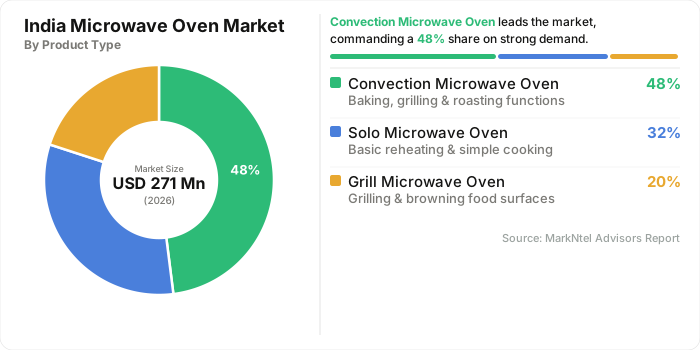
- Convection microwave ovens dominated the product type segment, accounting for approximately 48% of the market.
- The household application segment captured approximately 92% market share in 2026.
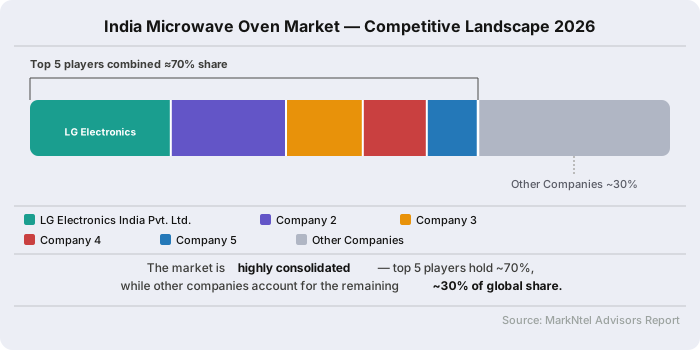
- The industry remains moderately consolidated, with the top five manufacturers collectively holding nearly 70% of the overall market, driven by strong brands, broad distribution networks, and continuous product innovation.
India Microwave Oven Market Size and Outlook
The microwave oven market size in India was valued at USD 259 million in 2025 and is projected to increase from USD 271 million in 2026 to USD 352 million by 2032, registering a CAGR of approximately 4.45% during 2026–2032. Sustained growth is supported by rising household purchasing power, expanding digital retail accessibility, and increasing consumer preference for convenient cooking solutions. These structural shifts are expected to strengthen long-term demand as Indian households continue upgrading modern kitchen environments with smart home appliances.
Government-led housing development is expected to reinforce appliance demand throughout the forecast period. The Ministry of Housing and Urban Affairs reported that 9.381 million houses had been completed under the Pradhan Mantri Awas Yojana (PMAY) by 2025, supported by cumulative investment of approximately USD 98 billion. Every newly completed dwelling creates additional opportunities for modular kitchens, encouraging first-time purchases of microwave ovens as households invest in essential cooking appliances during home furnishing.
Digital commerce is also reshaping purchasing behaviour across urban and emerging markets. During 2024, the Open Network for Digital Commerce (ONDC) recorded more than 14 million monthly transactions in November 2024, operating across over 1,100 cities with more than 700,000 sellers and 190+ network participants. The continued expansion of electronics and home appliance categories is expected to improve accessibility, financing availability, and household appliance adoption, supporting the India microwave oven industry beyond traditional metropolitan retail channels.
Long-term prospects remain favourable as India continues expanding residential infrastructure alongside universal access to electricity. Government updates released in 2026 confirmed that the Saubhagya programme achieved universal household electrification, while PMAY-U 2.0 and PMAY-G continue extending permanent housing with reliable electricity and basic amenities. These initiatives are expected to broaden the addressable consumer base, strengthen first-time appliance ownership, and create sustained replacement demand for microwave ovens across both urban and semi-urban households.
India Microwave Oven Market Key Indicators
- India’s urbanisation continues to reshape kitchen appliance demand. According to the World Bank, the urban population reached approximately 36.87% of the total population in 2024. Higher urban density, smaller residential layouts, and faster-paced lifestyles are increasing preference for compact kitchen appliances, as consumers seek space-efficient solutions that simplify daily cooking without compromising functionality.
- The implementation of GST 2.0 by the Central Board of Indirect Taxes and Customs, effective September 22, 2025, reduced the tax rate on microwave ovens from 28% to 18% following the 56th GST Council meeting. The revision is estimated to lower retail prices of mid-range convection models by 8–9%, making convenience cooking solutions more affordable and encouraging greater adoption among first-time household buyers.
- Workforce participation trends are reshaping household appliance purchasing decisions across India. The Ministry of Statistics and Programme Implementation reported that female labour force participation under usual status increased to 41.7%, compared with 37.0%. With more dual-income households balancing professional commitments, demand is steadily shifting toward digital kitchen appliances that reduce meal preparation time while supporting diverse cooking requirements.
- Reliable electricity infrastructure is improving the operating environment for modern kitchen appliances nationwide. According to the Ministry of Power, India's installed power generation capacity reached 509.743 GW as of November 30, 2025, increasing from 249 GW in March 2014, with 55.57 GW added during the first eleven months of 2025. Enhanced grid stability is encouraging wider adoption of household electronics, particularly across Tier II and Tier III cities.
India Microwave Oven Market Scope
| Category | Segments |
|---|---|
| By Product Type | Solo Microwave Oven, Grill Microwave Oven, Convection Microwave Oven |
| By Installation | Countertop (Free-Standing), Built-in |
| By Capacity | Commercial Capacity, Household Capacity |
| By Distribution Channel | Offline, Online |
| By Application | Household, Commercial |
India Microwave Oven Market Growth Drivers
Rising Per Capita Income Expanding Affordability for Kitchen Appliances
Rising per capita income is a fundamental growth driver for the India microwave oven market, as improving disposable earnings continue expanding the number of households able to purchase discretionary kitchen appliances. As per the Ministry of Statistics and Programme Implementation, per capita net national income increased to approximately USD 2,460 in 2024 from nearly USD 2,260, representing around 8.7% annual growth, while India's real GDP is projected to expand 7.4% in 2025. Growing purchasing power is accelerating demand for premium kitchen appliances.
The increase in household earnings is translating directly into stronger expenditure on durable consumer products. An Economic Advisory Council to the Prime Minister working paper reports that durable goods represented 13.1% of rural monthly per capita expenditure during 2023–24, compared with 11.9%. Over the same period, nominal rural spending on durable goods surged 218%, exceeding the growth recorded for food products and essential consumables, strengthening long-term prospects for the India microwave oven industry.
Manufacturers are increasingly positioned to benefit as rising affordability expands demand beyond metropolitan regions into Tier II and Tier III cities. Consumers with improving incomes are showing greater willingness to purchase convection microwave oven models offering grilling and baking capabilities instead of entry-level alternatives. This broadening customer base encourages companies to strengthen regional distribution networks, diversify product portfolios, and capture sustained replacement as well as first-time appliance demand.
Recent Trends
Rising Reach of Open-Network, Interoperable E-Commerce Channels for Kitchen Appliances
The India microwave oven industry is witnessing a notable shift as open-network, interoperable e-commerce platforms expand appliance accessibility beyond conventional online marketplaces. The Open Network for Digital Commerce (ONDC), an initiative of the Department for Promotion of Industry and Internal Trade under the Ministry of Commerce and Industry, has broadened its Electronics and Home & Kitchen categories across hundreds of cities. This evolution is strengthening e-commerce appliance sales by improving product visibility and consumer access nationwide.
The transformation is supported by measurable ecosystem expansion. Independent technology analysis indicates that the ONDC network has surpassed 370,000 registered sellers and service providers operating across approximately 588 cities. Greater digital accessibility, combined with integrated financing solutions, is enabling first-time buyers to purchase microwave ovens more conveniently while accelerating adoption across emerging urban centres, creating favorable momentum for the India microwave oven market through wider organized appliance retail participation.
The expanding interoperable commerce ecosystem is gradually reducing dependence on exclusive marketplace partnerships by providing regional appliance retailers with greater digital visibility alongside established national brands. Improved online discoverability enables manufacturers to strengthen customer reach, lower acquisition costs, and diversify sales channels across Tier II and Tier III cities. This distribution transformation is expected to intensify competitive dynamics while supporting broader penetration of microwave ovens throughout India's evolving consumer appliance landscape.
India Microwave Oven Market Opportunities and Challenges
Mandatory BIS Certification Costs Leading to Formalisation of the Microwave Oven Category
Mandatory BIS certification presents a near-term challenge for the India microwave oven market by increasing compliance costs for manufacturers. The Ministry of Commerce and Industry notified the Safety of Household, Commercial and Similar Electrical Appliances (Quality Control) Order, 2025 on May 19, 2025, mandating microwave ovens to carry the BIS Standard Mark under IS 302 (Part 1): 2024. Higher testing, factory inspection, and licensing requirements particularly burden smaller manufacturers producing countertop microwave oven models.
Regulatory obligations intensified following the 2026 notification published on April 6, 2026, extending the implementation deadline to October 1, 2026, while allowing small enterprises until January and April 2027 for compliance. Although these measures may temporarily disrupt supply from unorganized manufacturers, they create long-term opportunities for the India microwave oven industry by improving product quality, strengthening consumer confidence, and encouraging adoption of energy-efficient microwave oven solutions from certified brands.
The regulatory transition is expected to accelerate industry formalisation by restricting the sale of uncertified imports and locally assembled products that fail to meet BIS requirements. Established manufacturers with certified production facilities are well positioned to strengthen domestic market presence while enhancing export competitiveness through compliance with IEC 60335-1-aligned safety standards, reinforcing product credibility, supporting international acceptance, and encouraging long-term investment in certified manufacturing capabilities.
Segmentation Insights
Convection Microwave Ovens Lead Owing to Their Multifunctional Cooking Capabilities
Convection microwave ovens account for approximately 48% of the India Microwave Oven industry by product type, making them the leading category within the industry. Their strong position is supported by the ability to combine microwave heating, convection baking, and grilling functions within a single appliance. This multifunctionality aligns with rising consumer demand for premium kitchen appliances that deliver greater versatility without requiring additional kitchen equipment.
Indian households increasingly prefer convection models because they eliminate the need to purchase separate oven-toaster-grillers and traditional stovetop baking alternatives. This integrated functionality enables consumers to prepare a wider variety of meals while optimizing available kitchen space. As residential layouts continue evolving toward compact designs, demand for kitchen modernization solutions that combine convenience with multiple cooking capabilities has strengthened across urban households.
The segment also benefits from its strong value proposition among middle-income consumers seeking long-term appliance efficiency rather than multiple single-purpose products. By reducing countertop clutter while supporting various functions within one appliance, convection microwave ovens continue attracting first-time as well as replacement buyers. Their ability to satisfy diverse cooking preferences is expected to sustain category leadership. Based on product type, the scope has been bifurcated into:
- Solo Microwave Oven
- Grill Microwave Oven
- Convection Microwave Oven
Household Use Dominates Due to Widespread Adoption in Modern Residential Kitchens
Household use represents approximately 92% of the India microwave oven market by application, establishing it as the dominant segment. The category's leadership reflects the growing role of microwave ovens as essential household appliances for reheating, cooking, defrosting, and grilling. Rising demand for food preparation appliances is encouraging families to adopt versatile cooking solutions that simplify daily meal preparation while supporting increasingly convenience-oriented lifestyles.
The segment continues to benefit from changing residential consumption patterns, including expanding nuclear families, urban housing development, and rising ownership of modern kitchen appliances. Consumers increasingly value microwave ovens for their ability to reduce cooking time while offering multiple functions within a compact footprint. These advantages have strengthened their position as indispensable appliances supporting everyday household cooking requirements and efficient kitchen management.
Continued improvements in housing infrastructure, electrification, and consumer purchasing power are expected to reinforce household demand throughout the forecast period. As more families invest in modern residential kitchens, microwave ovens are increasingly viewed as long-term lifestyle purchases rather than optional appliances. Growing preference for home automation appliances is further encouraging manufacturers to introduce technologically advanced models that enhance convenience, usability, and everyday cooking experiences. The key applications analyzed in the study include:
- Household
- Commercial
- Restaurants & QSRs
- Hotels & Hospitality
- Cafés & Bakeries
- Institutional Kitchens
- Retail Food Preparation
India Microwave Oven Market Competitive Analysis
The India microwave oven market is moderately consolidated, with the top five manufacturers LG Electronics India Pvt. Ltd., Samsung India Electronics Private Limited, IFB Industries Limited, Whirlpool of India Limited, and Panasonic India Private Limited collectively accounting for approximately 70% of total market revenue. Their leadership is supported by strong brand equity, nationwide distribution and service networks, localized manufacturing, continuous product innovation, and diversified portfolios spanning solo, grill, and convection microwave ovens. The remaining market comprises players such as Godrej, Haier, BSH, Voltas, and Bajaj Electricals, which compete through competitive pricing, regional expansion, and differentiated product offerings, sustaining healthy competition despite the dominance of established industry leaders.
Prominent Companies in India Microwave Oven Industry
- LG Electronics India Pvt. Ltd.
- Samsung India Electronics Private Limited
- IFB Industries Limited
- Whirlpool of India Limited
- Panasonic India Private Limited
- Godrej & Boyce Manufacturing Company Limited
- Haier Appliances India Private Limited
- BSH Household Appliances Manufacturing Private Limited
- Voltas Limited
- Bajaj Electricals Limited
- Others
India Microwave Oven Industry News and Recent Developments
May 2026: LG Expands 2026 Home Appliance Portfolio with Advanced Convertible Convection Microwave Ovens
LG Electronics India expanded its 2026 home appliance portfolio by introducing new Convertible Convection Microwave Ovens alongside other premium appliances. The microwave range features Air Fry functionality, Charcoal Lighting Heater™, Scan-to-Cook capability, and more than 330 Auto Cook menus, including recipes tailored for Indian consumers. The launch reinforces LG's strategy of delivering localized, feature-rich cooking solutions across premium and affordable-premium segments.
Impact Analysis: The expanded portfolio strengthens competition within India's premium microwave oven segment by addressing rising consumer demand for healthier, multifunctional cooking appliances. Advanced features such as Air Fry, intelligent cooking programs, and connected functionality enhance product differentiation while encouraging consumers to upgrade from conventional microwave models. The launch also reflects manufacturers' increasing emphasis on localized innovation, supporting premiumization trends and accelerating the adoption of technologically advanced cooking appliances across urban and emerging markets.
October 2025: LG Introduces Essential Series Designed Specifically for Indian Households
LG unveiled its Essential Series in October 2025, a new appliance lineup developed under its "Made for India" strategy. The series includes microwave ovens engineered to meet Indian cooking preferences through localized Auto Cook menus, practical capacities, and user-friendly features. Products manufactured in India are also planned for export to 22 countries, reinforcing the company's localization and manufacturing strategy.
Impact Analysis: The Essential Series demonstrates manufacturers' growing focus on localized product development rather than standardized global offerings. By combining India-specific cooking functions with domestic manufacturing, LG is strengthening both consumer relevance and production efficiency. The export plan further enhances India's position as a regional manufacturing hub for home appliances, while encouraging greater investment in localized innovation, supply-chain development, and product customization to address evolving consumer preferences.
March 2025: Manufacturers Broaden Microwave Oven Portfolios with Feature-Rich Models
Leading manufacturers including LG, IFB, Haier, Samsung, Panasonic, and Godrej expanded their microwave oven portfolios by introducing models featuring convection cooking, grilling, Auto Cook programs, child safety functions, inverter technology, and smart controls. The growing availability of differentiated products across multiple price segments reflects increasing competition and continuous innovation.
Impact Analysis: Broader product portfolios are enabling manufacturers to address diverse consumer requirements, ranging from affordable entry-level appliances to premium multifunctional models. Continuous feature upgrades encourage replacement purchases while improving product accessibility across various income groups. The competitive emphasis on innovation, smart functionality, and healthier cooking technologies is expected to accelerate product differentiation, strengthen brand positioning, and support sustained demand as Indian consumers increasingly modernize their kitchens and adopt advanced cooking appliances.
Frequently Asked Questions
- Market Segmentation
- Introduction
- Product Definition
- Research Process
- Assumptions
- Executive Summary
- India Microwave Oven Market Policies, Regulations, and Product Standards
- India Microwave Oven Production Trend 2022-2032
- India Microwave Oven Trend by Type of Product Type
- Solo Microwave Oven
- Grill Microwave Oven
- Convection Microwave Oven
- Company-Wise Production Plants and Statistics
- Installed Production Capacity
- Actual Production
- Planned Production Target
- India Microwave Oven Trend by Type of Product Type
- India Microwave Oven Pricing Analysis 2022-2032
- India Microwave Oven Pricing Trend 2022-2032
- India Microwave Oven Pricing Trend by Product Type 2022-2032
- Solo Microwave Oven
- Grill Microwave Oven
- Convection Microwave Oven
- India Microwave Oven Market Dynamics
- Growth Factors
- Challenges
- India Microwave Oven Market Supply Chain Analysis
- India Microwave Oven Market Import & Export Analysis
- India Microwave Oven Market Hotspot & Opportunities
- India Microwave Oven Market Outlook, 2022-2032F
- Market Size & Outlook
- By Revenues (USD Million)
- By Quantity Sold (Thousand Units)
- Market Share & Outlook
- By Product Type- Market Size & Forecast 2022-2032, USD Million & Thousand Units
- Solo Microwave Oven
- Grill Microwave Oven
- Convection Microwave Oven
- By Installation- Market Size & Forecast 2022-2032, USD Million & Thousand Units
- Countertop (Free-Standing)
- Built-in
- By Capacity- Market Size & Forecast 2022-2032, USD Million & Thousand Units
- Commercial Capacity
- <30L
- 30L - 50L
- >50L
- Household Capacity
- <20L
- 20L - 30L
- >30L
- Commercial Capacity
- By Distribution Channel- Market Size & Forecast 2022-2032, USD Million & Thousand Units
- Offline
- Electronics Specialty Stores
- Brand Exclusive Stores
- Hypermarkets & Supermarkets
- Independent Dealers
- Online
- E-commerce Marketplaces
- Brand DTC Websites
- Offline
- By Application- Market Size & Forecast 2022-2032, USD Million & Thousand Units
- Household
- Commercial
- Restaurants & QSRs
- Hotels & Hospitality
- Cafés & Bakeries
- Institutional Kitchens
- Retail Food Preparation
- By Region- Market Size & Forecast 2022-2032, USD Million & Thousand Units
- North
- South
- East
- West
- By Company
- Competition Characteristics
- Market Share & Analysis
- By Product Type- Market Size & Forecast 2022-2032, USD Million & Thousand Units
- Market Size & Outlook
- India Solo Microwave Oven Market Outlook, 2022-2032
- Market Size & Outlook
- By Revenues (USD Million)
- By Quantity Sold (Thousand Units)
- Market Share & Outlook
- By Installation- Market Size & Forecast 2022-2032, USD Million & Thousand Units
- By Capacity- Market Size & Forecast 2022-2032, USD Million & Thousand Units
- By Distribution Channel- Market Size & Forecast 2022-2032, USD Million & Thousand Units
- By Application- Market Size & Forecast 2022-2032, USD Million & Thousand Units
- By Region- Market Size & Forecast 2022-2032, USD Million & Thousand Units
- Market Size & Outlook
- India Grill Microwave Oven Market Outlook, 2022-2032
- Market Size & Outlook
- By Revenues (USD Million)
- By Quantity Sold (Thousand Units)
- Market Share & Outlook
- By Installation- Market Size & Forecast 2022-2032, USD Million & Thousand Units
- By Capacity- Market Size & Forecast 2022-2032, USD Million & Thousand Units
- By Distribution Channel- Market Size & Forecast 2022-2032, USD Million & Thousand Units
- By Application- Market Size & Forecast 2022-2032, USD Million & Thousand Units
- By Region- Market Size & Forecast 2022-2032, USD Million & Thousand Units
- Market Size & Outlook
- India Convection Microwave Oven Market Outlook, 2022-2032
- Market Size & Outlook
- By Revenues (USD Million)
- By Quantity Sold (Thousand Units)
- Market Share & Outlook
- By Installation- Market Size & Forecast 2022-2032, USD Million & Thousand Units
- By Capacity- Market Size & Forecast 2022-2032, USD Million & Thousand Units
- By Distribution Channel- Market Size & Forecast 2022-2032, USD Million & Thousand Units
- By Application- Market Size & Forecast 2022-2032, USD Million & Thousand Units
- By Region- Market Size & Forecast 2022-2032, USD Million & Thousand Units
- Market Size & Outlook
- India Microwave Oven Market Key Strategic Imperatives for Success & Growth
- Competitive Outlook
- Company Profiles
- LG Electronics India Pvt. Ltd.
- Business Description
- Product Portfolio
- Collaborations & Alliances
- Recent Developments
- Financial Details
- Others
- Samsung India Electronics Private Limited
- Business Description
- Product Portfolio
- Collaborations & Alliances
- Recent Developments
- Financial Details
- Others
- IFB Industries Limited
- Business Description
- Product Portfolio
- Collaborations & Alliances
- Recent Developments
- Financial Details
- Others
- Whirlpool of India Limited
- Business Description
- Product Portfolio
- Collaborations & Alliances
- Recent Developments
- Financial Details
- Others
- Panasonic India Private Limited
- Business Description
- Product Portfolio
- Collaborations & Alliances
- Recent Developments
- Financial Details
- Others
- Godrej & Boyce Manufacturing Company Limited
- Business Description
- Product Portfolio
- Collaborations & Alliances
- Recent Developments
- Financial Details
- Others
- Haier Appliances India Private Limited
- Business Description
- Product Portfolio
- Collaborations & Alliances
- Recent Developments
- Financial Details
- Others
- BSH Household Appliances Manufacturing Private Limited
- Business Description
- Product Portfolio
- Collaborations & Alliances
- Recent Developments
- Financial Details
- Others
- Voltas Limited
- Business Description
- Product Portfolio
- Collaborations & Alliances
- Recent Developments
- Financial Details
- Others
- Bajaj Electricals Limited
- Business Description
- Product Portfolio
- Collaborations & Alliances
- Recent Developments
- Financial Details
- Others
- Others
- LG Electronics India Pvt. Ltd.
- Company Profiles
- Disclaimer
MarkNtel Advisors follows a robust and iterative research methodology designed to ensure maximum accuracy and minimize deviation in market estimates and forecasts. Our approach combines both bottom-up and top-down techniques to effectively segment and quantify various aspects of the market. A consistent feature across all our research reports is data triangulation, which examines the market from three distinct perspectives to validate findings. Key components of our research process include:
1. Scope & Research Design At the outset, MarkNtel Advisors define the research objectives and formulate pertinent questions. This phase involves determining the type of research—qualitative or quantitative—and designing a methodology that outlines data collection methods, target demographics, and analytical tools. They also establish timelines and budgets to ensure the research aligns with client goals.
2. Sample Selection and Data Collection In this stage, the firm identifies the target audience and determines the appropriate sample size to ensure representativeness. They employ various sampling methods, such as random or stratified sampling, based on the research objectives. Data collection is carried out using tools like surveys, interviews, and observations, ensuring the gathered data is reliable and relevant.
3. Data Analysis and Validation Once data is collected, MarkNtel Advisors undertake a rigorous analysis process. This includes cleaning the data to remove inconsistencies, employing statistical software for quantitative analysis, and thematic analysis for qualitative data. Validation steps are taken to ensure the accuracy and reliability of the findings, minimizing biases and errors.

4. Data Forecast and FinalizationThe final phase involves forecasting future market trends based on the analyzed data. MarkNtel Advisors utilize predictive modeling and time series analysis to anticipate market behaviors. The insights are then compiled into comprehensive reports, featuring visual aids like charts and graphs, and include strategic recommendations to inform client decision-making
We offer flexible licensing options to cater to varying organizational needs. Choose the pricing pack that best suits your requirements:
Buy Now Inquire Before Buying
 Request Customization
 Talk to our Consultant