India Smart Kitchen Appliances Market Research Report: Trends & Forecast (2026-2032)
By Product Type (Cooking Appliances, Food Storage, Food Preparation, Cleaning Appliances), By Connectivity Type (Wireless Internet Connectivity, Short-Range Connectivity, Smart Hom ... e Protocols), By Control Type (App-Controlled, Voice-Controlled, Touch / Remote Controlled), By Price Range (Low / Economy, Mid-Range, Premium), By Sales Channel (Retail Online, Retail Offline), By End User (Residential, Commercial), and others Read more
- FMCG
- Mar 2026
- Pages 170
- Report Format: PDF, Excel, PPT
India Smart Kitchen Appliances Market
Projected 25% CAGR from 2026 to 2032
Study Period
2026-2032
Market Size (2026)
USD 0.80 Billion
Market Size (2032)
USD 2.99 Billion
Base Year
2025
Projected CAGR
25%
Leading Segments
By Product Type: Cooking Appliances
India Smart Kitchen Appliances Market Report Key Takeaways:
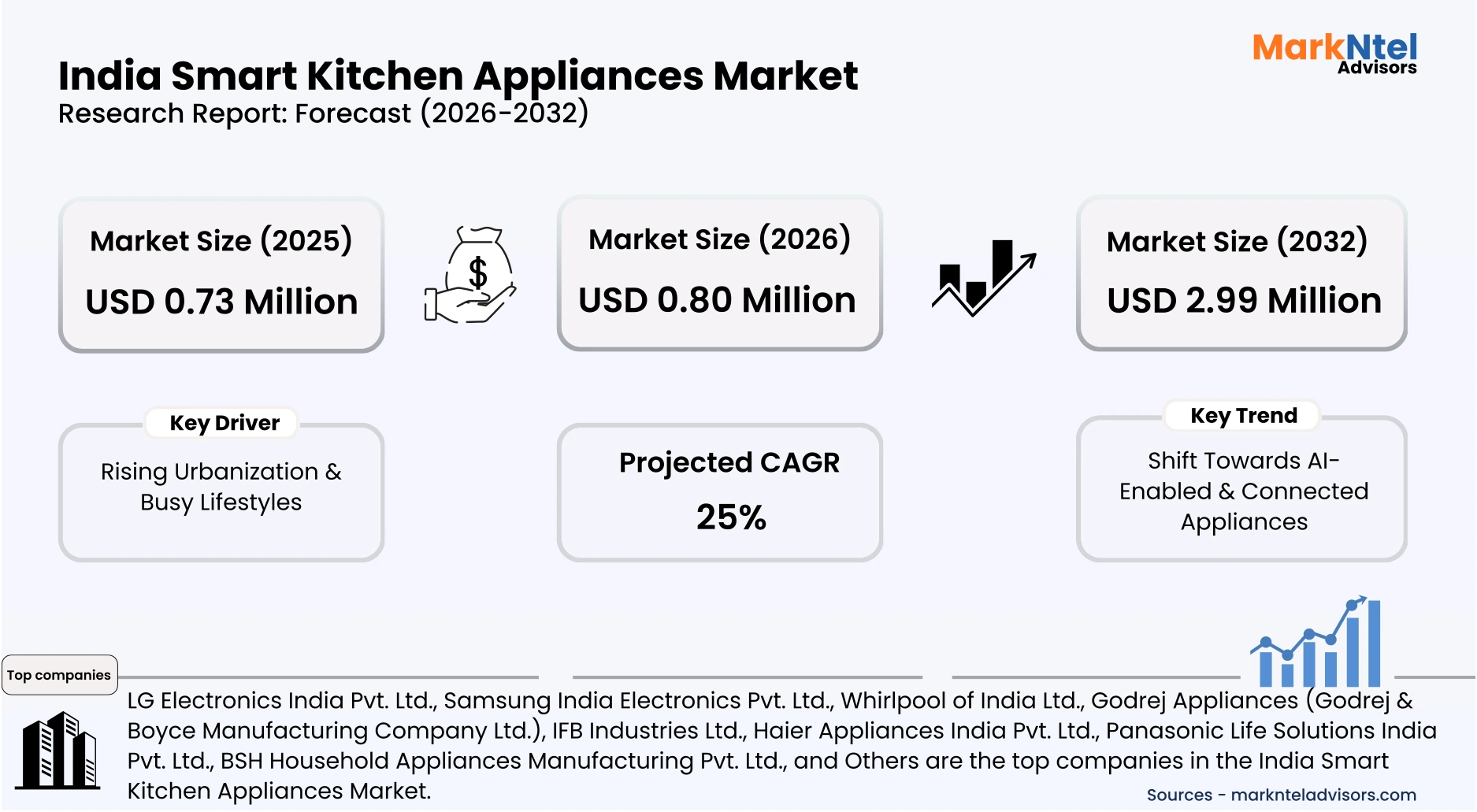
- The India Smart Kitchen Appliances Market size was valued at USD 0.73 billion in 2025 and is projected to grow from USD 0.80 billion in 2026 to USD 2.99 billion by 2032, exhibiting a CAGR of 25% during the forecast period.
- By product type, the cooking appliances represented a significant share of about 48% in the India Smart Kitchen Appliances Market in 2026.
- By connectivity type, the wireless internet connectivity segment seized a significant share of about 60% in the India Smart Kitchen Appliances Market in 2026.
- Leading companies in the market are LG Electronics India Pvt. Ltd., Samsung India Electronics Pvt. Ltd., Whirlpool of India Ltd., Godrej Appliances (Godrej & Boyce Manufacturing Company Ltd.), IFB Industries Ltd., Haier Appliances India Pvt. Ltd., Panasonic Life Solutions India Pvt. Ltd., BSH Household Appliances Manufacturing Pvt. Ltd., Versuni India Home Solutions Ltd., Voltas Beko Home Appliances Pvt. Ltd, and Others.
Market Insights & Analysis: India Smart Kitchen Appliances Market (2026-32):
The India Smart Kitchen Appliances Market size was valued at USD 0.73 billion in 2025 and is projected to grow from USD 0.80 billion in 2026 to USD 2.99 billion by 2032. Along with this, the market is estimated to grow at a CAGR of around 25% during the forecast period, i.e., 2026-32.
The India Smart Kitchen Appliances Market is projected to expand steadily, driven by accelerating urbanization, evolving consumer lifestyles, and increasing adoption of AI-enabled and connected appliances, which are collectively driving demand for convenience, automation, and technologically advanced kitchen solutions.
Highly urbanized regions such as Delhi (NCT), with 97.5% urbanization, and Chandigarh with 97.2% reflect dense, high-income consumer bases characterized by nuclear families and time-constrained lifestyles. These factors are directly contributing to increased demand for automated, efficient, and connected kitchen solutions.
Simultaneously, metropolitan centers including Bengaluru with 13.1 million population, Hyderabad with 9.1 million population, and Ahmedabad with 7.6 million population continue to witness robust expansion, driven by IT sector growth and industrial development . These cities attract a large population of working professionals, fostering a tech-enabled consumption environment where smart appliances are increasingly preferred for convenience and integration with digital ecosystems.
High-population states such as Uttar Pradesh and Bihar, despite relatively lower levels of urbanization, are undergoing rapid structural transformation driven by migration, infrastructure development, and economic diversification. With India’s urban population reaching 36.87% in 2024, these states are expected to play a pivotal role in the next phase of urban expansion, significantly enlarging the addressable consumer base for smart kitchen appliances.
Concurrently, the rapid adoption of AI-enabled and connected appliances is emerging as a key growth catalyst. Leading innovations, such as advanced AI-integrated refrigerators capable of identifying food items, managing inventory, and recommending recipes, are transforming traditional kitchen environments into intelligent ecosystems . Similarly, AI-powered cooking solutions, including automated roti makers that prepare fresh meals in under two minutes, demonstrate the increasing penetration of robotics and automation in household cooking processes, with deployment already exceeding 100,000 homes globally.
From a macroeconomic perspective, urbanization trends remain highly favorable. The Government of India’s Economic Survey 2023–24 projects that over 40% of the population will reside in urban areas by 2030, reflecting sustained migration toward cities for improved employment opportunities and living standards.
Supporting this trend, the World Bank (2025) estimates that more than 50% of India’s urban infrastructure required for 2050 is yet to be developed, while the Union Budget 2025–26 has increased urban development expenditure by 17%, focusing on transport and city infrastructure .
The convergence of urban expansion, rising disposable incomes, and rapid adoption of AI-enabled technologies is creating a favorable demand environment. As infrastructure development and digital integration continue to progress, the market is expected to witness sustained and scalable growth across both established and emerging urban regions.
India Smart Kitchen Appliances Market Recent Developments:
- 2026: Hisense unveiled a new AI-powered induction range at CES 2026, featuring its “ConnectLife AI Cooking Agent” that provides real-time recipe guidance, meal planning, and automatic temperature adjustments via a touchscreen interface. The appliance is designed to simplify cooking with precision and automation, reflecting the growing integration of AI into smart kitchen ecosystems.
- 2025: Wonderchef has launched “Chai Magic,” claimed as the world’s first automatic tea maker, aimed at simplifying daily tea preparation. Unveiled in Kolkata, the appliance automates brewing and ensures consistency. Priced at USD 59, it will be available via retail outlets and the company’s website.
India Smart Kitchen Appliances Market Scope:
| Category | Segments |
|---|---|
| By Product Type | (Cooking Appliances, Food Storage, Food Preparation, Cleaning Appliances), |
| By Connectivity Type | (Wireless Internet Connectivity, Short-Range Connectivity, Smart Home Protocols), |
| By Control Type | (App-Controlled, Voice-Controlled, Touch / Remote Controlled), |
| By Price Range | (Low / Economy, Mid-Range, Premium), |
| By Sales Channel | (Retail Online, Retail Offline), |
| By End User | (Residential, Commercial), |
India Smart Kitchen Appliances Market Driver:
Rising Urbanization & Busy Lifestyles
India’s expanding urban population is a key driver for the Smart Kitchen Appliances Market. The country had approximately 534.9 million urban residents in 2024, accounting for 36.9% of the total population, indicating a large and continuously growing urban consumer base. This demographic shift is significantly influencing purchasing behavior, particularly toward convenience-oriented products.
Urban consumption patterns further reinforce this trend. Government-backed data indicates that urban households allocated 60% of their total expenditure to non-food items in 2023–24, reflecting a clear shift toward lifestyle-enhancing products, including modern kitchen appliances. This transition highlights a growing preference for solutions that save time, reduce manual effort, and improve efficiency in daily routines.
Regionally, states such as Tamil Nadu with approximately 48–54% urban, Kerala with approximately 47.7%, and Maharashtra with approximately 45%+ represent highly urbanized markets. These states host major metropolitan centers like Chennai, Kochi, and Mumbai, which are characterized by dense populations of working professionals and dual-income households. Such environments inherently drive demand for automated and smart cooking solutions that align with fast-paced urban lifestyles.
The rapid expansion of the urban population, coupled with evolving consumption patterns and higher spending on convenience-driven products, is significantly driving demand for smart kitchen appliances. As urban lifestyles become more fast-paced, this trend will continue to accelerate market growth across India.
India Smart Kitchen Appliances Market Trend:
Shift Towards AI-Enabled & Connected Appliances
India is witnessing a significant shift toward AI-enabled and IoT-connected kitchen appliances, driven by rising digital adoption and increasing familiarity with intelligent technologies. A 2024 study indicates that 92% of Indian knowledge workers actively use AI, substantially higher than the global average of 75% . This high level of engagement reflects a growing comfort with AI-driven tools, which is increasingly extending into household applications, including smart kitchen solutions.
At the product level, innovation is accelerating the adoption of connected appliances. For instance, Indian startup Upliance introduced an advanced AI-powered cooking assistant priced at approximately USD 480, designed to automate key cooking processes such as chopping, stirring, and sautéing. The device offers 750+ guided recipes with AI-based customization and supports app connectivity, enabling users to control cooking remotely while achieving up to 40% faster cooking efficiency.
Such innovations highlight a broader market transition from conventional appliances to intelligent, automated, and connected kitchen ecosystems. Consumers are increasingly valuing appliances that offer personalization, time efficiency, and seamless integration with digital lifestyles.
Growing familiarity with AI technologies, combined with continuous product innovation, is accelerating the adoption of smart kitchen appliances. This trend is expected to play a pivotal role in transforming traditional kitchens into intelligent, automated environments, thereby driving sustained market growth.
India Smart Kitchen Appliances Market Opportunity:
Government Push for Smart Cities & Urban Housing
Government-led urban development programs are creating a strong opportunity for smart kitchen appliances in India. Over 8,000 projects worth USD 19.7 billion have been undertaken across 100 cities, with nearly 94% completed by 2025, focusing on modern housing, digital infrastructure, and smart utilities. These initiatives are accelerating the transition toward organized urban living, increasing demand for modular kitchens and integrated home systems. As a result, they are creating a favorable ecosystem for the adoption of connected and automated kitchen appliances.
Simultaneously, the Pradhan Mantri Awas Yojana (PMAY-Urban) has sanctioned over 12 million houses, with 9.38 million already completed as of 2025, significantly expanding affordable urban housing and enabling wider adoption of modern, appliance-ready kitchens across newly developed households.
The launch of PMAY-U 2.0 in 2024 further targets 10 million additional urban homes, with financial assistance of up to USD 3,000 per household, thereby accelerating the adoption of modern, appliance-ready kitchens. Looking ahead, large-scale smart and industrial city projects, including investments of USD 3.4 billion, will further drive urban expansion and increase demand for connected kitchen solutions.
Government-driven urban expansion is rapidly increasing the supply of modern, appliance-ready homes across India. This will significantly accelerate the adoption of smart kitchen appliances, positioning urban housing initiatives as a key long-term growth catalyst for the market.
India Smart Kitchen Appliances Market Challenge:
Insufficient Infrastructure & Connectivity Gaps
Infrastructure limitations continue to restrict the adoption of smart kitchen appliances across India, particularly outside major urban centers. Despite progress in digital expansion, only 46% of the population had regular internet access in 2024, leaving a large portion of households unable to fully utilize connected appliances. This gap is more pronounced in rural and semi-urban regions, where digital penetration remains uneven.
Even in connected areas, service quality remains inconsistent. Around 30% of the population still lacks reliable internet connectivity, with fluctuations in bandwidth and network stability limiting the seamless functioning of IoT-enabled kitchen devices such as app-controlled ovens or AI-powered cookers.
Power infrastructure also presents a challenge. Although electrification has improved significantly, India witnessed a 9% rise in electricity demand in 2024, leading to frequent outages during peak demand periods, particularly during extreme weather conditions . Such disruptions reduce the reliability of smart appliances that depend on an uninterrupted power supply.
Overall, inconsistent internet access and power reliability directly affect appliance performance and user experience. These infrastructure constraints are likely to slow adoption rates, especially in emerging regions, thereby limiting the market’s full growth potential.
India Smart Kitchen Appliances Market (2026-32) Segmentation Analysis:
The India Smart Kitchen Appliances Market study of MarkNtel Advisors evaluates & highlights the major trends and influencing factors in each segment. It includes predictions for the period 2026–32 at the country level. Based on the analysis, the market has been further classified as;
Based on Product Type:
- Cooking Appliances
- Smart Ovens
- Smart Induction Cooktops
- Smart Microwaves
- Smart Air Fryers
- Smart Slow Cookers
- Food Storage
- Smart Refrigerators
- Smart Wine Coolers
- Food Preparation
- Smart Coffee Makers
- Smart Blenders
- Smart Kitchen Scales
- Cleaning Appliances
- Smart Dishwashers
The cooking appliances segment dominates the India Smart Kitchen Appliances Market, accounting for approximately 48% of market size, owing to its critical role in everyday food preparation and higher usage intensity compared to other categories.
Appliances such as smart microwaves, induction cooktops, air fryers, and ovens are integral to daily cooking routines, resulting in consistent and repeat usage, which directly translates into stronger demand and faster replacement cycles.
This dominance is further supported by evolving urban lifestyles. The rise of dual-income households and time-constrained consumers has accelerated the preference for appliances that offer speed, automation, and convenience. Smart cooking devices significantly reduce preparation time while enabling precision cooking, aligning with modern consumer expectations.
Additionally, the segment benefits from relatively lower price points and easier installation compared to large appliances like smart refrigerators or dishwashers. This makes cooking appliances more accessible to middle-income households, thereby expanding their adoption beyond premium segments.
Furthermore, technological advancements, including AI-enabled cooking programs, app-based controls, and multi-functional capabilities, are further enhancing product value and driving consumer interest.
The essential nature, affordability, and technological evolution of cooking appliances position them as the leading segment, ensuring sustained dominance and making them a key contributor to overall market growth in India.
Based on Connectivity Type:
- Wireless Internet Connectivity
- Wi-Fi
- Short-Range Connectivity
- Bluetooth
- NFC
- Smart Home Protocols
- Zigbee
- Thread
- Others
The wireless internet connectivity segment dominates the India Smart Kitchen Appliances market, accounting for about 60% of total market value, due to its ability to support advanced, real-time, and scalable connectivity requirements. Unlike short-range technologies such as Bluetooth and NFC, Wi-Fi enables continuous, high-speed communication, allowing appliances to function seamlessly within connected home ecosystems.
This dominance is primarily driven by the increasing demand for remote access and automation. Wi-Fi connectivity allows users to monitor and control appliances through mobile applications, access cloud-based features, receive software updates, and utilize AI-driven functionalities such as guided cooking and performance optimization. These capabilities are essential for delivering a fully integrated smart kitchen experience.
Moreover, most smart appliances are designed to operate within broader ecosystems, which rely on Wi-Fi for device synchronization and centralized control. This ecosystem compatibility further reinforces Wi-Fi as the preferred connectivity standard among manufacturers and consumers. In addition, improving broadband penetration and affordability of internet services in India are accelerating adoption across urban households.
Given its superior functionality, reliability, and ecosystem integration capabilities, Wi-Fi continues to lead the connectivity segment, playing a pivotal role in advancing smart kitchen appliance adoption across India.
Gain a Competitive Edge with Our India Smart Kitchen Appliances Market Report:
- India Smart Kitchen Appliances Market Report by MarkNtel Advisors provides a detailed & thorough analysis of market size & share, growth rate, competitive landscape, and key players. This comprehensive analysis helps businesses gain a holistic understanding of the market dynamics & make informed decisions.
- This report also highlights current market trends & future projections, allowing businesses to identify emerging opportunities & potential challenges. By understanding market forecasts, companies can align their strategies & stay ahead of the competition.
- India Smart Kitchen Appliances Market Report aids in assessing & mitigating risks associated with entering or operating in the market. By understanding market dynamics, regulatory frameworks, and potential challenges, businesses can develop strategies to minimize risks & optimize their operations.
*Reports Delivery Format - Market research studies from MarkNtel Advisors are offered in PDF, Excel and PowerPoint formats. Within 24 hours of the payment being successfully received, the report will be sent to your email address.
Frequently Asked Questions
- Market Segmentation
- Research Scope
- Research Methodology
- Definitions and Assumptions
- Executive Summary
- India Smart Kitchen Appliances Market Policies, Regulations, and Standards
- India Smart Kitchen Appliances Market Dynamics
- Growth Factors
- Challenges
- Trends
- Opportunities
- India Smart Kitchen Appliances Market Statistics, 2022-2032F
- Market Size & Growth Outlook
- By Revenues in USD Million
- Market Segmentation & Growth Outlook
- By Product Type
- Cooking Appliances- Market Insights and Forecast 2022-2032, USD Million
- Smart Ovens- Market Insights and Forecast 2022-2032, USD Million
- Smart Induction Cooktops- Market Insights and Forecast 2022-2032, USD Million
- Smart Microwaves- Market Insights and Forecast 2022-2032, USD Million
- Smart Air Fryers- Market Insights and Forecast 2022-2032, USD Million
- Smart Slow Cookers- Market Insights and Forecast 2022-2032, USD Million
- Food Storage- Market Insights and Forecast 2022-2032, USD Million
- Smart Refrigerators- Market Insights and Forecast 2022-2032, USD Million
- Smart Wine Coolers- Market Insights and Forecast 2022-2032, USD Million
- Food Preparation- Market Insights and Forecast 2022-2032, USD Million
- Smart Coffee Makers- Market Insights and Forecast 2022-2032, USD Million
- Smart Blenders- Market Insights and Forecast 2022-2032, USD Million
- Smart Kitchen Scales- Market Insights and Forecast 2022-2032, USD Million
- Cleaning Appliances- Market Insights and Forecast 2022-2032, USD Million
- Smart Dishwashers- Market Insights and Forecast 2022-2032, USD Million
- Cooking Appliances- Market Insights and Forecast 2022-2032, USD Million
- By Connectivity Type
- Wireless Internet Connectivity- Market Insights and Forecast 2022-2032, USD Million
- Wi-Fi- Market Insights and Forecast 2022-2032, USD Million
- Short-Range Connectivity- Market Insights and Forecast 2022-2032, USD Million
- Bluetooth- Market Insights and Forecast 2022-2032, USD Million
- NFC- Market Insights and Forecast 2022-2032, USD Million
- Smart Home Protocols- Market Insights and Forecast 2022-2032, USD Million
- Zigbee- Market Insights and Forecast 2022-2032, USD Million
- Thread- Market Insights and Forecast 2022-2032, USD Million
- Others - Market Insights and Forecast 2022-2032, USD Million
- Wireless Internet Connectivity- Market Insights and Forecast 2022-2032, USD Million
- By Control Type
- App-Controlled- Market Insights and Forecast 2022-2032, USD Million
- Voice-Controlled- Market Insights and Forecast 2022-2032, USD Million
- Touch / Remote Controlled- Market Insights and Forecast 2022-2032, USD Million
- By Price Range
- Low / Economy- Market Insights and Forecast 2022-2032, USD Million
- Mid-Range- Market Insights and Forecast 2022-2032, USD Million
- Premium - Market Insights and Forecast 2022-2032, USD Million
- By Sales Channel
- Retail Online- Market Insights and Forecast 2022-2032, USD Million
- Direct Sale- Market Insights and Forecast 2022-2032, USD Million
- E-Commerce- Market Insights and Forecast 2022-2032, USD Million
- Retail Offline- Market Insights and Forecast 2022-2032, USD Million
- Direct Sale- Market Insights and Forecast 2022-2032, USD Million
- Supermarkets / Hypermarkets- Market Insights and Forecast 2022-2032, USD Million
- Specialty Stores- Market Insights and Forecast 2022-2032, USD Million
- Brand Stores- Market Insights and Forecast 2022-2032, USD Million
- Retail Online- Market Insights and Forecast 2022-2032, USD Million
- By End User
- Residential- Market Insights and Forecast 2022-2032, USD Million
- Commercial- Market Insights and Forecast 2022-2032, USD Million
- By Region
- North
- East
- West
- South
- By Competitors
- Competition Characteristics
- Market Share & Analysis
- By Product Type
- Market Size & Growth Outlook
- India Cooking Appliances Market Statistics, 2022-2032
- Market Size & Growth Outlook
- By Revenues in USD Million
- Market Segmentation & Growth Outlook
- By Connectivity Type- Market Insights and Forecast 2022-2032, USD Million
- By Control Type- Market Insights and Forecast 2022-2032, USD Million
- By Price Range- Market Insights and Forecast 2022-2032, USD Million
- By Sales Channel- Market Insights and Forecast 2022-2032, USD Million
- By End User- Market Insights and Forecast 2022-2032, USD Million
- By Region- Market Insights and Forecast 2022-2032, USD Million
- Market Size & Growth Outlook
- India Food Storage Market Statistics, 2022-2032
- Market Size & Growth Outlook
- By Revenues in USD Million
- Market Segmentation & Growth Outlook
- By Connectivity Type- Market Insights and Forecast 2022-2032, USD Million
- By Control Type- Market Insights and Forecast 2022-2032, USD Million
- By Price Range- Market Insights and Forecast 2022-2032, USD Million
- By Sales Channel- Market Insights and Forecast 2022-2032, USD Million
- By End User- Market Insights and Forecast 2022-2032, USD Million
- By Region- Market Insights and Forecast 2022-2032, USD Million
- Market Size & Growth Outlook
- India Food Preparation Market Statistics, 2022-2032
- Market Size & Growth Outlook
- By Revenues in USD Million
- Market Segmentation & Growth Outlook
- By Connectivity Type- Market Insights and Forecast 2022-2032, USD Million
- By Control Type- Market Insights and Forecast 2022-2032, USD Million
- By Price Range- Market Insights and Forecast 2022-2032, USD Million
- By Sales Channel- Market Insights and Forecast 2022-2032, USD Million
- By End User- Market Insights and Forecast 2022-2032, USD Million
- By Region- Market Insights and Forecast 2022-2032, USD Million
- Market Size & Growth Outlook
- India Cleaning Appliances Market Statistics, 2022-2032
- Market Size & Growth Outlook
- By Revenues in USD Million
- Market Segmentation & Growth Outlook
- By Connectivity Type- Market Insights and Forecast 2022-2032, USD Million
- By Control Type- Market Insights and Forecast 2022-2032, USD Million
- By Price Range- Market Insights and Forecast 2022-2032, USD Million
- By Sales Channel- Market Insights and Forecast 2022-2032, USD Million
- By End User- Market Insights and Forecast 2022-2032, USD Million
- By Region- Market Insights and Forecast 2022-2032, USD Million
- Market Size & Growth Outlook
- Competitive Outlook
- Company Profiles
- LG Electronics India Pvt. Ltd.
- Business Description
- Product Portfolio
- Collaborations & Alliances
- Recent Developments
- Financial Details
- Others
- Samsung India Electronics Pvt. Ltd.
- Business Description
- Product Portfolio
- Collaborations & Alliances
- Recent Developments
- Financial Details
- Others
- Whirlpool of India Ltd.
- Business Description
- Product Portfolio
- Collaborations & Alliances
- Recent Developments
- Financial Details
- Others
- Godrej Appliances (Godrej & Boyce Manufacturing Company Ltd.)
- Business Description
- Product Portfolio
- Collaborations & Alliances
- Recent Developments
- Financial Details
- Others
- IFB Industries Ltd.
- Business Description
- Product Portfolio
- Collaborations & Alliances
- Recent Developments
- Financial Details
- Others
- Haier Appliances India Pvt. Ltd.
- Business Description
- Product Portfolio
- Collaborations & Alliances
- Recent Developments
- Financial Details
- Others
- Panasonic Life Solutions India Pvt. Ltd.
- Business Description
- Product Portfolio
- Collaborations & Alliances
- Recent Developments
- Financial Details
- Others
- BSH Household Appliances Manufacturing Pvt. Ltd.
- Business Description
- Product Portfolio
- Collaborations & Alliances
- Recent Developments
- Financial Details
- Others
- Versuni India Home Solutions Ltd.
- Business Description
- Product Portfolio
- Collaborations & Alliances
- Recent Developments
- Financial Details
- Others
- Voltas Beko Home Appliances Pvt. Ltd.
- Business Description
- Product Portfolio
- Collaborations & Alliances
- Recent Developments
- Financial Details
- Others
- LG Electronics India Pvt. Ltd.
- Company Profiles
- Disclaimer
MarkNtel Advisors follows a robust and iterative research methodology designed to ensure maximum accuracy and minimize deviation in market estimates and forecasts. Our approach combines both bottom-up and top-down techniques to effectively segment and quantify various aspects of the market. A consistent feature across all our research reports is data triangulation, which examines the market from three distinct perspectives to validate findings. Key components of our research process include:
1. Scope & Research Design At the outset, MarkNtel Advisors define the research objectives and formulate pertinent questions. This phase involves determining the type of research—qualitative or quantitative—and designing a methodology that outlines data collection methods, target demographics, and analytical tools. They also establish timelines and budgets to ensure the research aligns with client goals.
2. Sample Selection and Data Collection In this stage, the firm identifies the target audience and determines the appropriate sample size to ensure representativeness. They employ various sampling methods, such as random or stratified sampling, based on the research objectives. Data collection is carried out using tools like surveys, interviews, and observations, ensuring the gathered data is reliable and relevant.
3. Data Analysis and Validation Once data is collected, MarkNtel Advisors undertake a rigorous analysis process. This includes cleaning the data to remove inconsistencies, employing statistical software for quantitative analysis, and thematic analysis for qualitative data. Validation steps are taken to ensure the accuracy and reliability of the findings, minimizing biases and errors.

4. Data Forecast and FinalizationThe final phase involves forecasting future market trends based on the analyzed data. MarkNtel Advisors utilize predictive modeling and time series analysis to anticipate market behaviors. The insights are then compiled into comprehensive reports, featuring visual aids like charts and graphs, and include strategic recommendations to inform client decision-making
We offer flexible licensing options to cater to varying organizational needs. Choose the pricing pack that best suits your requirements:
Buy Now Inquire Before Buying
 Request Customization
 Talk to our Consultant