

India Condom Market Research Report: Forecast (2026-2032)
By Product Type (Male/External Condoms, Female/Internal Condoms), By Material Type (Natural Rubber Latex Condoms, Non-Latex Condoms), By Distribution Channel (Offline Commercial Re ... tail, Online Commercial Retail, Social Marketing and Subsidized Sales, Government and Institutional Procurement), By Pack Size (Small Packs (1–3 condoms), Standard Packs (4–12 condoms), Value and Large Packs (13–49 condoms), Bulk Packs (50 condoms and above)), By Feature (Regular, Flavored, Textured, Thin/Ultra-Thin, Extended-Pleasure, Others), and others Read more
- FMCG
- Aug 2026
- Pages 145
- Report Format: PDF, Excel, PPT
India Condom Market
Projected 8.19% CAGR from 2026 to 2032
Study Period
2026-2032
Market Size (2026)
USD 260 Million
Market Size (2032)
USD 417 Million
Base Year
2025
Projected CAGR
8.19%
Leading Segments
By Product Type: Male/External Condoms
India Condom Market Key Takeaways
- The market is estimated at USD 239 million in 2025 and USD 260 million in 2026, reaching USD 417 million by 2032 with an 8.19% CAGR during 2026-32.
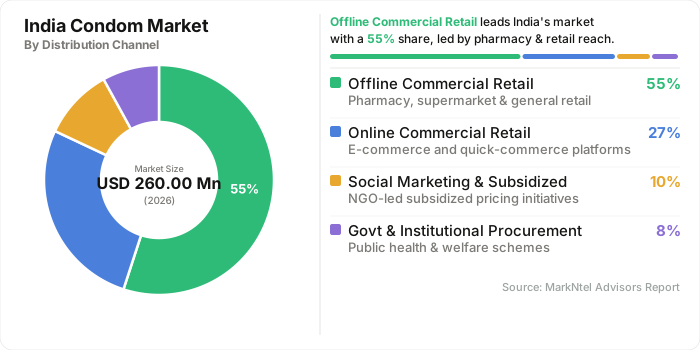
- Offline commercial retail leads by route to market, with an estimated 55% market share in 2026.
- Male/external condoms lead by product type, accounting for an estimated 98% share in 2026.
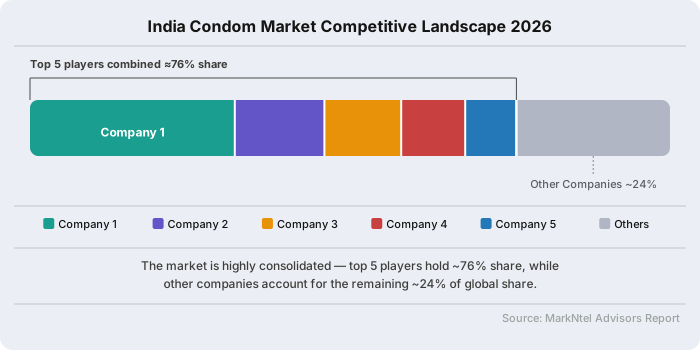
- The market is concentrated, with the top five companies collectively accounting for an estimated 76% share in 2026.
India Condom Market Size and Outlook
The India Condom Market was valued at an estimated USD 239 million in 2025 and is projected to reach USD 260 million in 2026. It is forecast to expand at a CAGR of around 8.19% during 2026–2032, reaching nearly USD 417 million by 2032.
Growth in condom sales in India is supported by commercial demand and headroom for wider adoption. CRISIL’s analysis of IQVIA OTC Audit data placed domestic condom-category sales approximately USD 246 million during the 12 months ended September 2024, compared with approximately USD 179 million in FY2022. Condom use among married Indian women reached 9.5% by 2021—almost twice the level five years earlier—while use among men remained around 10%. These indicators demonstrate improving acceptance but a considerable gap between availability and regular utilization.
Through 2032, the condom industry is expected to benefit from higher consumption and migration toward flavored, textured, ultra-thin and other differentiated formats. E-commerce and quick-commerce platforms should improve discreet access, assortment discovery and larger-pack purchasing. However, social stigma, rural price sensitivity and uneven retail availability will constrain adoption. The outlook therefore favors condom brands in India that combine affordable entry packs and broad pharmacy reach with dependable digital availability, privacy and differentiated premium offerings.
India Condom Market Key Indicators
- National AIDS Control Organisation’s 2025 Sankalak reported that prevention projects covered around 15.8 million people and managed 11.2 million sexually-transmitted/reproductive-tract infection episodes during FY2024–25. This programmatic reach sustains institutional demand and embeds free and social-marketing condom distribution within India’s broader HIV- and STI-prevention infrastructure.
- A May 2026 Government e Marketplace (GeM) tender issued for Central Medical Services Society requested 80.06 million free-supply condoms for the Family Planning Programme, with delivery scheduled within 180 days. The quantity demonstrates the continuing scale of government procurement alongside commercial condom sales in India and social-marketing distribution.
- The Telecom Regulatory Authority of India (TRAI) reported 1.09 billion internet subscribers and 1.07 billion broadband subscribers in India by March 2026. This extensive digital base increases the addressable audience for discreet product discovery, online payment and rapid fulfillment, supporting online commercial retail participation in the condom industry.
- Selected official manufacturer listings observed in August 2026 placed a 12-count latex pack at approximately USD 1.47 MRP and a 10-count premium non-latex pack at approximately USD 6.81. The spread illustrates substantial price and material differentiation among condom brands in India.
- A leading Indian supplier reported that modern trade and e-commerce rose from 11% to 15% of its consumer-healthcare sales in Q1 FY2027, supported by 38% channel growth; its condom portfolio also gained market share. This channel expansion improves product visibility, purchasing privacy and availability beyond conventional pharmacy and general-trade networks.
India Condom Market Manufacturing Capacity Analysis
India has a condom-manufacturing base spanning government-owned and private suppliers. In July 2025, HLL Lifecare reported annual production of 2.217 billion condoms across four manufacturing locations, including a staggering 1.246 billion units at Peroorkada. TTK Healthcare separately reports annual capacity of approximately 1.5 billion condoms across its manufacturing operations. This scale enables condom manufacturing companies to serve commercial brands, government procurement programs and institutional buyers while maintaining high-volume latex production.
Additional capacity is progressing but should remain distinguished from operational supply. Cupid Limited currently reports a combined annual installed capacity of 532 million condoms at its existing facility. In June 2026, the company stated that it planned to operationalize its Palava, Maharashtra, facility during the following quarter. The project is designed to add approximately 845 million condoms annually, taking planned capacity to over 1.37 billion condoms. The expansion should increase tender participation and supply flexibility while adding natural-rubber-latex and nitrile manufacturing capabilities. Through 2032, the condom industry’s manufacturing advantage will depend increasingly on quality certification, automated testing, flexible lines and dependable utilization rather than announced capacity alone.
India Condom Market Export-Import Analysis: Exports Outpace Imports 15.5 Times in 2025
India’s finished-condom trade remains export-oriented, reinforcing the country’s role as a manufacturing base for overseas markets. Export earnings increased from USD 69 million in 2022 to USD 83 million in 2025. Although earnings peaked in 2023 and corrected in 2024, a 18.57% recovery in 2025 renewed export momentum. Shipment volumes expanded faster at over 27% in 2025, indicating stronger overseas offtake but lower average realizations. This trade depth enables Indian condom manufacturing companies to pursue institutional tenders, contract production, private labels, and branded exports alongside condom sales in India.
Imports also increased from a small base, narrowing the export-to-import ratio from around 43 times in 2022 to 15.5 times in 2025. Nevertheless, India generated a USD 77.6 million finished-condom trade surplus in 2025. Imported condoms therefore supplement specific product and brand requirements rather than reshape the condom market in India. Separately, net import dependence in the wider natural-rubber-latex category indicates exposure to overseas input availability, currency movements, and procurement costs across India’s latex-consuming industries, including the condom industry.
India Condom Market Scope
| Category | Segments |
|---|---|
| By Product Type | Male/External Condoms, Female/Internal Condoms |
| By Material Type | Natural Rubber Latex Condoms, Non-Latex Condoms |
| By Distribution Channel | Offline Commercial Retail, Online Commercial Retail, Social Marketing and Subsidized Sales, Government and Institutional Procurement |
| By Pack Size | Small Packs (1–3 condoms), Standard Packs (4–12 condoms), Value and Large Packs (13–49 condoms), Bulk Packs (50 condoms and above |
| By Feature | Regular, Flavored, Textured, Thin/Ultra-Thin, Extended-Pleasure, Others |
India Condom Market Growth Drivers
Broader Reproductive-Health Awareness Expands the Addressable Consumer Base
Condom demand is broadening as India’s reproductive-health discourse increasingly emphasizes informed choice, preventive protection, and shared responsibility between partners. Greater awareness helps consumers recognize condoms as protection against both unintended pregnancy and sexually transmitted infections, while reducing the embarrassment associated with discussing or purchasing them. It can also bring women, couples, and first-time adult buyers more actively into purchase decisions. This broader participation allows condom brands in India to communicate around safety, consent, comfort, and mutual well-being rather than relying predominantly on male-oriented or pleasure-led messaging.
India’s current reproductive-health priorities support this transition. A 2025 UNFPA assessment identified expanded contraceptive choice, improved access for young and marginalized populations, social and behavior-change communication, and greater engagement of men and boys as key priorities. Outreach is also reaching consumers at scale. During 2025, UNFPA’s partnership with government systems delivered life-skills education to 6.4 million adolescents across more than 103,000 schools, twice the previous year’s reach. Its digital campaign portfolio, which included World Contraception Day, reached over 47.7 million people through social media. Continued exposure to reproductive-health information should gradually normalize protected sex, widen the paying consumer base, and support recurring condom sales in India through 2032.
Recent Trends
Participatory Digital Campaigns Move Brand Engagement Beyond Conventional Advertising
Condom brands in India are extending communication beyond conventional commercials and product-led sensual advertising through participatory digital campaigns. Interactive contests, private-message experiences, and issue-based activations invite consumers to engage with a brand rather than passively view an advertisement. This approach is relevant to the condom industry because it creates more acceptable entry points for discussing intimacy, protection, and women’s well-being. It also generates shareable content and earned visibility while helping brands remain culturally relevant without competing only through flavors, textures, or discounts.
Multiple brands adopted this approach during 2025. In March, Durex India introduced ‘The Durex Blocker’ initiative on Women’s Day, inviting women to report online harassment encountered after engaging with the brand so that offenders could be blocked. In October, its ‘The Other G-Spot’ campaign used private social-media messages to guide women toward self-examination on Breast Cancer Day. Manforce followed a different interactive route in September by introducing an AI-generated brand ambassador through an online competition in which the virtual character contested against human participants and won through public voting. These initiatives demonstrate a wider movement toward technology-enabled, participatory storytelling. Through 2032, such campaigns should improve brand recall, normalize sexual-health conversations, and widen engagement among women, couples, and digitally active adults, supporting condom sales in India.
India Condom Market Opportunities and Challenges
Input-Cost Volatility Pressures Affordability but Encourages Pack and Procurement Optimization
Volatility in petroleum-linked chemicals, packaging materials, latex, and exchange rates can raise production costs while limiting manufacturers’ ability to pass increases to consumers. Condoms are low-ticket purchases, but demand outside premium urban categories can be sensitive to visible price changes. Higher input costs may therefore compress margins, reduce promotional flexibility, or widen the affordability gap between commercial products and subsidized alternatives. Smaller condom manufacturing companies face greater exposure because they generally have less purchasing leverage and fewer brands across which to absorb increases.
This risk became visible in May 2026, when a leading condom company indicated that sustained oil-price escalation amid Middle East tensions could necessitate condom price revisions. Petroleum-derived chemicals and packaging are key cost channels, although the company’s available inventories provided a near-term buffer. This creates an opportunity to redesign portfolios rather than apply uniform price increases. Manufacturers can protect entry-level access through smaller packs, improve per-unit economics through value and large packs, reduce packaging intensity, diversify suppliers, and use premium variants to support blended margins.
A structured price and pack ladder can preserve affordability while serving different purchase occasions and spending capacities. Companies managing this balance effectively should be better positioned to sustain condom sales in India and protect profitability as the market expands through 2032.
Segmentation Insights
Offline Commercial Retail Leads Route to Market with an Estimated 55% Market Share in 2026
The dominance of offline commercial retail is sustained through inherent advantages associated with constituent channels. Pharmacies and drugstores provide neighborhood access and established trust for health-related purchases, while general trade and convenience stores support immediate availability across smaller cities and towns. Supermarkets, hypermarkets, and modern trade add organized displays, multipacks, and promotional visibility. Collectively, these outlets retain an advantage through physical reach and established replenishment networks, particularly where rapid-delivery coverage remains limited.
Online Commercial Retail is nevertheless expected to expand fastest through 2032 because discreet ordering and rapid fulfillment directly address embarrassment and urgency. During January–November 2025, sales of condoms and adjacent sexual-wellness products through quick-commerce platforms increased by 35–40%, compared with 22% in general trade. One platform reported nearly 29% growth in condom purchases, with demand spreading from metropolitan centers toward Chandigarh, Jaipur, and Ahmedabad. E-commerce marketplaces and online pharmacies provide wider assortment and planned purchasing, while quick commerce captures immediate occasions. The resulting channel mix should encourage condom companies to differentiate packs, pricing, inventory, and promotions across offline and online routes to market.vBased on route to market, the market is segmented into:
- Offline Commercial Retail
- Online Commercial Retail
- Social Marketing and Subsidized Sales
- Government and Institutional Procurement
Male/External Condoms Dominate Product Type with an Estimated 98% Market Share in 2026
The dominance of Male/external condoms reflects consumer familiarity, lower unit prices, straightforward usage, and widespread availability across pharmacies, general trade, modern retail, and public-health channels. The format also supports differentiation through flavors, textures, thinness, lubrication, and extended-pleasure features, allowing condom brands in India to address value-oriented protection and premium intimacy requirements without requiring a different application method.
A closer look at Cupid’s planned capacity expansion outlined earlier highlights the segment’s dominance. The company indicated a targeted annual capacity of around 1.25 billion male condoms and 125 million female condoms from the current capacity of 480 million and 52 million respectively, maintaining an approximately tenfold difference between the two formats. Female/internal condoms remain constrained by lower awareness, limited retail availability, higher unit prices, and the need for usage familiarity. However, their user-controlled design creates an opportunity as women participate more actively in contraceptive decisions and institutional programs widen method choice. This should support gradual growth, although male/external condoms are expected to retain overwhelming leadership through 2032. Based on product type, the condom industry in India is segmented into:
- Male/External Condoms
- Female/Internal Condoms
Top 5 Companies Hold 76% of India Condom Market
India condom market is concentrated, with top five companies holding 76% market share in 2026. The top five companies in the market are Mankind Pharma Limited, HLL Lifecare Limited, Reckitt Benckiser Group plc, TTK Healthcare Limited, and Godrej Consumer Products Limited.
Key Companies in the India Condom Market
- Mankind Pharma Limited
- HLL Lifecare Limited
- Reckitt Benckiser Group plc
- TTK Healthcare Limited
- Godrej Consumer Products Limited
- Cupid Limited
- Anondita Medicare Limited
- Indus Medicare Limited
- Sirona Hygiene Private Limited
- Okamoto Industries, Inc.
- Others
India Condom Industry News and Recent Developments
-
June 2026 | Anondita Medicare Secures Domestic Government Condom Order
Anondita Medicare received an approximately USD 0.31 million purchase order from the Central Medical Services Society under the Ministry of Health and Family Welfare for Social Marketing Organization condoms under Ustad Nirodh-HLL. Half of the order is due within 60 days and the remainder between days 61 and 120.
Impact analysis: The award reinforces institutional procurement as a commercially relevant route-to-market in the condom market in India and supports near-term capacity utilization for an emerging domestic supplier. Its phased schedule also shows how public-health demand translates into defined production runs, while successful execution could strengthen the company’s credentials for subsequent government business.
-
December 2025 | Okamoto Introduces 0.02 Polyurethane Condom in India
Okamoto introduced its 0.02-mm polyurethane condom in India, positioning it as the country’s first polyurethane condom and the thinnest model available in the domestic market. The company announced availability through physical retail outlets and digital platforms, including Blinkit, Swiggy, Tata 1mg, and Amazon.
Impact analysis: The launch widens premium non-latex choice in the condom industry and provides consumers with a differentiated material-and-sensitivity proposition. Multi-channel availability reduces access barriers for this higher-value niche and establishes another innovation benchmark for condom brands in India competing on thinness, material technology, and perceived comfort rather than primarily on flavors or textures.
Frequently Asked Questions
- Market Segmentation
- Introduction
- Product Definition
- Research Process
- Assumptions
- Executive Summary
- India Condom Market Manufacturing Capacity Analysis
- India Condom Market Export-Import Analysis 2022-25
- India Condom Market Production Capabilities
- India Condom Market Pricing Analysis
- India Condom Market Policies, Regulations, and Product Standards
- India Condom Market Trends & Developments
- India Condom Market Dynamics
- Growth Factors
- Challenges
- India Condom Market Hotspot & Opportunities
- India Condom Market Outlook, 2022-2032
- Market Size & Outlook
- By Revenues (USD Million)
- By Quantity Sold (Thousand Units)
- Market Segmentation & Outlook
- By Product Type- Market Size & Forecast 2022-2032, USD Million & Thousand Units
- Male/External Condoms
- Female/Internal Condoms
- By Material Type- Market Size & Forecast 2022-2032, USD Million & Thousand Units
- Natural Rubber Latex Condoms
- Non-Latex Condoms
- Polyurethane
- Synthetic Polyisoprene
- Nitrile and Other Materials
- By Distribution Channel- Market Size & Forecast 2022-2032, USD Million & Thousand Units
- Offline Commercial Retail
- Pharmacies and Drugstores
- Supermarkets, Hypermarkets and Modern Trade
- General Trade and Convenience Stores
- Others
- Online Commercial Retail
- E-commerce Marketplaces
- Online Pharmacies
- Quick-Commerce Platforms
- Brand- and Retailer-Operated Websites
- Others
- Social Marketing and Subsidized Sales
- Government and Institutional Procurement
- Offline Commercial Retail
- By Unit Price- Market Size & Forecast 2022-2032, USD Million & Thousand Units
- Up to INR 5 (approx. USD 0.05)
- INR 6 to 10 (approx. USD 0.06 to 0.10)
- INR 11 to 15 (approx. USD 0.12 to 0.16)
- INR 16 to 20 (approx. USD 0.17 to 0.21)
- Above INR 20 (above approx. USD 0.21)
- By Pack Size- Market Size & Forecast 2022-2032, USD Million & Thousand Units
- Small Packs (1–3 condoms)
- Standard Packs (4–12 condoms)
- Value and Large Packs (13–49 condoms)
- Bulk Packs (50 condoms and above)
- By Feature- Market Size & Forecast 2022-2032, USD Million & Thousand Units
- Regular
- Flavored
- Textured
- Thin/Ultra-Thin
- Extended-Pleasure
- Others
- By Region- Market Size & Forecast 2022-2032, USD Million & Thousand Units
- North
- South
- West
- East
- By Company
- Competition Characteristics
- Market Share & Analysis
- By Product Type- Market Size & Forecast 2022-2032, USD Million & Thousand Units
- Market Size & Outlook
- India Male/External Condom Market Outlook, 2022-2032
- Market Size & Outlook
- By Revenues (USD Million)
- By Quantity Sold (Thousand Units)
- Market Segmentation & Outlook
- By Material Type- Market Size & Forecast 2022-2032, USD Million & Thousand Units
- By Route to Market- Market Size & Forecast 2022-2032, USD Million & Thousand Units
- By Unit Price- Market Size & Forecast 2022-2032, USD Million & Thousand Units
- By Pack Size- Market Size & Forecast 2022-2032, USD Million & Thousand Units
- By Feature- Market Size & Forecast 2022-2032, USD Million & Thousand Units
- By Region- Market Size & Forecast 2022-2032, USD Million & Thousand Units
- Market Size & Outlook
- India Female/Internal Condom Market Outlook, 2022-2032
- Market Size & Outlook
- By Revenues (USD Million)
- By Quantity Sold (Thousand Units)
- Market Segmentation & Outlook
- By Material Type- Market Size & Forecast 2022-2032, USD Million & Thousand Units
- By Route to Market- Market Size & Forecast 2022-2032, USD Million & Thousand Units
- By Unit Price- Market Size & Forecast 2022-2032, USD Million & Thousand Units
- By Pack Size- Market Size & Forecast 2022-2032, USD Million & Thousand Units
- By Feature- Market Size & Forecast 2022-2032, USD Million & Thousand Units
- By Region- Market Size & Forecast 2022-2032, USD Million & Thousand Units
- Market Size & Outlook
- India Condom Market Key Strategic Imperatives for Success & Growth
- Competitive Outlook
- Company Profiles
- Mankind Pharma Limited
- Business Description
- Product Portfolio
- Collaborations & Alliances
- Recent Developments
- Financial Details
- Others
- HLL Lifecare Limited
- Business Description
- Product Portfolio
- Collaborations & Alliances
- Recent Developments
- Financial Details
- Others
- Reckitt Benckiser Group plc
- Business Description
- Product Portfolio
- Collaborations & Alliances
- Recent Developments
- Financial Details
- Others
- TTK Healthcare Limited
- Business Description
- Product Portfolio
- Collaborations & Alliances
- Recent Developments
- Financial Details
- Others
- Godrej Consumer Products Limited
- Business Description
- Product Portfolio
- Collaborations & Alliances
- Recent Developments
- Financial Details
- Others
- Cupid Limited
- Business Description
- Product Portfolio
- Collaborations & Alliances
- Recent Developments
- Financial Details
- Others
- Anondita Medicare Limited
- Business Description
- Product Portfolio
- Collaborations & Alliances
- Recent Developments
- Financial Details
- Others
- Indus Medicare Limited
- Business Description
- Product Portfolio
- Collaborations & Alliances
- Recent Developments
- Financial Details
- Others
- Sirona Hygiene Private Limited
- Business Description
- Product Portfolio
- Collaborations & Alliances
- Recent Developments
- Financial Details
- Others
- Okamoto Industries, Inc.
- Business Description
- Product Portfolio
- Collaborations & Alliances
- Recent Developments
- Financial Details
- Others
- Others
- Mankind Pharma Limited
- Company Profiles
- Disclaimer
MarkNtel Advisors follows a robust and iterative research methodology designed to ensure maximum accuracy and minimize deviation in market estimates and forecasts. Our approach combines both bottom-up and top-down techniques to effectively segment and quantify various aspects of the market. A consistent feature across all our research reports is data triangulation, which examines the market from three distinct perspectives to validate findings. Key components of our research process include:
1. Scope & Research Design At the outset, MarkNtel Advisors define the research objectives and formulate pertinent questions. This phase involves determining the type of research—qualitative or quantitative—and designing a methodology that outlines data collection methods, target demographics, and analytical tools. They also establish timelines and budgets to ensure the research aligns with client goals.
2. Sample Selection and Data Collection In this stage, the firm identifies the target audience and determines the appropriate sample size to ensure representativeness. They employ various sampling methods, such as random or stratified sampling, based on the research objectives. Data collection is carried out using tools like surveys, interviews, and observations, ensuring the gathered data is reliable and relevant.
3. Data Analysis and Validation Once data is collected, MarkNtel Advisors undertake a rigorous analysis process. This includes cleaning the data to remove inconsistencies, employing statistical software for quantitative analysis, and thematic analysis for qualitative data. Validation steps are taken to ensure the accuracy and reliability of the findings, minimizing biases and errors.

4. Data Forecast and FinalizationThe final phase involves forecasting future market trends based on the analyzed data. MarkNtel Advisors utilize predictive modeling and time series analysis to anticipate market behaviors. The insights are then compiled into comprehensive reports, featuring visual aids like charts and graphs, and include strategic recommendations to inform client decision-making
We offer flexible licensing options to cater to varying organizational needs. Choose the pricing pack that best suits your requirements:
Buy Now Inquire Before Buying
 Request Customization
 Talk to our Consultant







